
German postcard by Photochemie, Berlin, no. K. 2147. Photo: Nordisk Film. Lilly Jacobson as Marya, the Martian leader's daughter, in Himmelskibet / Das Himmelschiff (Holger-Madsen, 1918).

German postcard by Photochemie, Berlin, no. K. 1850. Photo: Nordisk Films. Valdemar Psilander in Lykken / The Road to Happiness (Holger-Madsen, 1918). The German release title was Das zweite Ich.

German postcard by Photochemie, Berlin, no. K. 2029. Photo: Union-Film / Nordisk. Hugo Bruun (also Hugo Brunn) and Lily Jacobson (Lilly Jacobsson) in Testamentets Hemmelighed / The Secret of the Testament (Holger-Madsen, 1918). The German film title was Das trennende Band.

German postcard by Photochemie, Berlin, no. K. 2149. Photo: Nordisk. Publicity still for Himmelskibet / A Trip to Mars / Das Himmelschiff (Holger-Madsen, 1918) with Lily Jacobson as Marya, the Martian leader's daughter, and Gunnar Tolnaes as Avanti Planetaros.
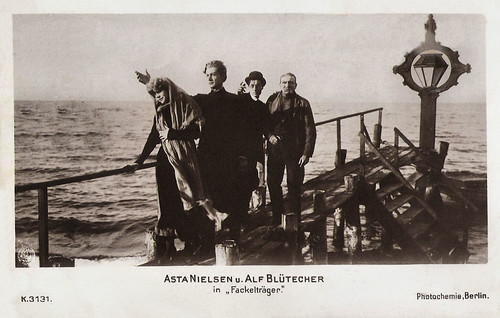
German postcard by Photochemie, Berlin, no. K. 3131. Photo: Nordisk. Asta Nielsen and Alf Blütecher in Mod lyset / Towards the Light / Fackelträger (Holger-Madsen, 1919).
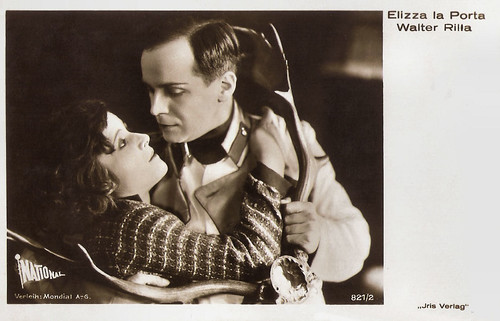
Austrian postcard by Iris Verlag, no. 821/2. Photo: National / Verleih Mondial A.G. Eliza La Porta and Walter Rilla in Die Sporck'schen Jäger / The Sporck Battalion (Holger-Madsen, 1927).
Fine and nuanced depictions of environments
Holger-Madsen was born Holger Madsen in Copenhagen in 1878. Holger Madsen debuted as an actor at Rønne Teater in 1896 and was a provincial actor until 1905. From 1905-1912, he was engaged at Casino and from 1912-1914 at Dagmarteatret. Holger-Madsen played significant roles at the theatre but distinguished himself especially by his talent for masking and was nicknamed 'Maske-Madsen' and 'Troldemads' in the theatre world. He never completely gave up his stage work, but between film assignments, he was engaged as a guest actor at various theatres.
Madsen debuted as a film actor at Nordisk Film in Den sorte hertug / The Black Duke (Viggo Larsen, 1907), now lost. He appeared in several films there until the end of the year. In 1911, he changed his name to Holger-Madsen. Until 1912, he appeared sporadically in quite a few films at various companies, including Ingvar Jørgensen Film.
In 1912, he directed his first film, Kun en Tigger / Only a Beggar (Holger-Madsen, 1912) at Filmfabrikken Skandinavien. He had also written the script and played the lead role of the beggar himself. The following year, he returned to Nordisk Film, and then his career really took off. In the period 1913-1919, Holger-Madsen directed around 80 films and became one of the company's leading director profiles. He often wrote the scripts himself, but only starred in a few films.
Holger-Madsen's films are distinguished primarily by fine and nuanced depictions of environments and beautiful photography and lighting. Evangeliemandens Liv / The Candle and the Moth (Holger-Madsen, 1915) was one of his most successful films, there is an intensity and surprising effect in the beautifully drawn environments and spaces: a harbor pub that exudes atmosphere and lots of depth, the 'evangelist's' ascetic room and not least the visually unforgettable scenes from the prison, where the prisoners with hoods over their heads are led to worship with the prison chaplain and placed side by side in their own small isolated 'window hole'.
The collaboration with the cinematographer Marius Clausen was exemplary and included at least 70 films. The pair were innovative in the use of camera angles and, not least, the lighting, which was a new 'discipline' in the early 1910s.

Danish postcards by Ed. Stenders. Holger-Madsen (standing right), Regnar Bjelke, and Sophus Neumann in the stage operetta 'Prins Incognito' by Preben Nodermann, performed at the Casino theatre in 1909.

German postcard by Photochemie, Berlin, no. K. 1554. Photo: Nordisk. Valdemar Psilander in Manden uden Fremtid / The Man Without A Future (Holger-Madsen, 1916). The German title was Prinz im Exil.
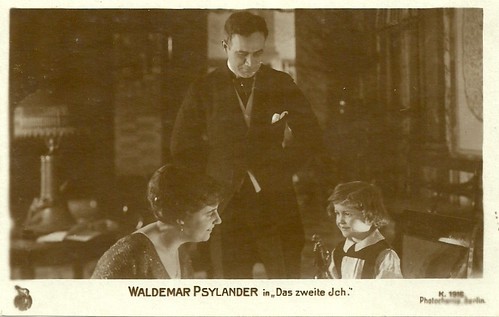
German postcard by Photochemie, Berlin, no. K. 1916. Photo: Nordisk. Valdemar Psiander and Ebba Thomsen in Lykken / The Road to Happiness (Holger-Madsen, 1918). The German release title was Das zweite Ich.

German postcard by Photochemie, Berlin, no. K. 1921. Photo: Nordisk. Valdemar Psilander in Lykken / The Road to Happiness (Holger-Madsen, 1918). The German release title was Das zweite Ich. NB. The card was sent from Czechoslovakia to Vienna, probably after the First World War. Czechoslovakia became a sovereign state in October 1918, one month before the war ended.

German postcard by Photochemie, Berlin, no. K. 1937. Photo: Nordisk. Philip Bech (misspelt as Beck) as Baron Walden in Livets Gøglespil / An Impossible Marriage (Holger-Madsen, 1917), released in Germany as Die Spur der ersten Liebe. Here, .

German postcard by Photochemie, Berlin, no. K. 2017. Photo: Union-Film / Nordisk. Hugo Bruun in Børnenes Synd / Children's Sin (Holger-Madsen, 1917), released in Germany as Gottes Mühlen mahlen langsam. Bruun's last name is misspelt as Brunn.
Responsible for many of the period's blockbusters
Holger-Madsen was responsible for many of the period's blockbusters: the pacifist film Ned med Vaabnene! / Down with the Weapons! (1915), another pacifist film Pax Aeterna (1917) and the first Science-Fiction film, Himmelskibet / A Trip to Mars (1918). He also directed some of the more successful, intense, chamber-play-like dramas such as Elskovsleg / Liebelei (1914) after Arthur Schnitzler's play, Evangeliemandens Liv / The Candle and the Moth (1915) and En Kunstners Gennembrud / The Soul of the Violin (1919).
Also memorable are his films Den mystiske Fremmede / A Deal with the Devil (1914) with Olaf Fønss, Lykken / The Road to Happiness (1918) and Lydia / The Music-Hall Star (1918) with Valdemar Psilander, and Mod lyset / Towards the Light (1919) with Asta Nielsen. A young Carl Th. Dreyer wrote several scripts for Holger-Madsen's films before debuting himself as a film director. Holger-Madsen also directed the first Danish film to be completely banned by the State Film Censorship Board: Opiumsdrømmen / The Opium Smoker (produced in 1914).
His actors were not necessarily enthusiastic about Holger-Madsen, who was portrayed by many as the opposite of the calm and amiable August Blom. Film star Ebba Thomsen described him in an interview as an impulsive and unbalanced gentleman who said everything he thought out loud and ordered around the actors. You couldn't get peace of mind working with him, she said. Zanny Petersen called him 'excited', 'fiery' and 'crazy'.
Around 1920, Holger-Madsen moved to Germany and directed 13 to 14 films for various companies. An example is Die Sporck'schen Jäger (1927) with Walter Rilla. At the end of the 1920s, he returned to Copenhagen, but it became difficult to find a foothold in the Danish film industry after the breakthrough of sound films.
He appeared in several feature films until 1935. The creative film assignments for Holger-Madsen waned. He wrote the script for a film, directed one, and dubbed a handful of the old Fy & Bi (Pat & Patachon) films. His last film was a documentary on eels: Aalens Livsmysterium / The Riddle of the Eel (1937). In 1937, he obtained a cinema licence for a small cinema, Enghave Bio, which he ran until his death. He was married to Rigmor Holger-Madsen, née Neuhaus. She was the daughter of photographer Even Neuhaus and thus the granddaughter of photographer Christian Neuhaus. Holger-Madsen, nicknamed, Holger Bindestreg, died in Copenhagen in 1943. He was 65 years old.

German postcard by Photochemie, Berlin, no. K 1931. Photo: Nordisk. Gunnar Tolnaes in Livets Gøglespil / An Impossible Marriage (Holger Madsen, 1917). The German title was Die Spur der ersten Liebe. The other man is Philip Bech, who plays Baron Walden.

German postcard by Photochemie, Berlin, no. K. 1962. Photo: Nordisk. Gunnar Tolnaes in Livets Gøglespil / An Impossible Marriage (Holger-Madsen, 1917). It was released in Germany as Die Spur der ersten Liebe. Plot: Architect Erik Berndt (Tolnaes) has been hired by Baron Walden (Philip Bech) to restore the old castle, but falls in love with the baron's daughter, the young Lydia (Erna Schøyen). She elopes with him against her father's wishes. One year later, Lydia has a child with Erik, but their relationship cools down, and she returns to her father. The Baron plans to marry off his daughter to Count Herbert Rhena (Robert Schmidt), but he proves to be unworthy. A reconciliation between Erik and Lydia takes place, in which the child also plays a role.

German postcard by Photochemie, Berlin, no. K. 2028. Photo: Union-Film / Nordisk. Lily Jacobson (Lilly Jacobsson) in Testamentets Hemmelighed / The Secret of the Testament (Holger-Madsen, 1918). The German film title was Das trennende Band.

German postcard by Photochemie, Berlin, no. K. 2150. Photo: Nordisk. Publicity still for Himmelskibet / A Trip to Mars / Das Himmelschiff (Holger-Madsen, 1918) with Lily Jacobson as Marya, the Martian leader's daughter, and Gunnar Tolnaes as Avanti Planetaros.
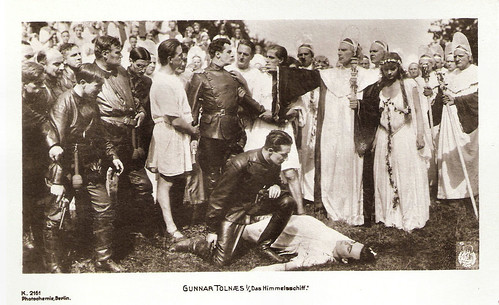
German postcard by Photochemie, Berlin, no. K. 2161. Photo: Nordisk. Publicity still for Himmelskibet / A Trip to Mars / Das Himmelschiff (Holger-Madsen, 1918) with Gunnar Tolnaes as Avanti Planetaros, Philip Bech as the Martian leader, Lily Jacobson as Marya, the Martian leader's daughter, Alf Blütecher (kneeling) as his friend Dr. Krafft and Nils Asther as the fallen Martian.

German collector card by Ross Verlag in the series Vom Werden deutscher Filmkunst - Der Stumme Film, picture no. 113, group 43. Photo: Ufa. Paul Hartmann in Der Evangelimann / The Evangelist (Holger-Madsen, 1924).
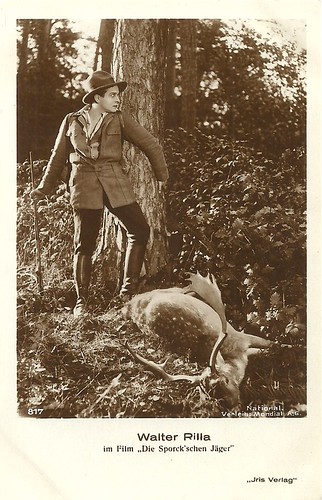
Austrian postcard by Iris Verlag, no. 817. Photo: National / Mondial. Walter Rilla in Die Sporck'schen Jäger/ The Sporck Battalion (Holger-Madsen, 1927).

Austrian postcard by Iris Verlag, no. 818. Photo: National / Distr. Mondial. Anton Pointner in Die Sporck'schen Jäger / The Sporck Battalion (Holger-Madsen, 1927).
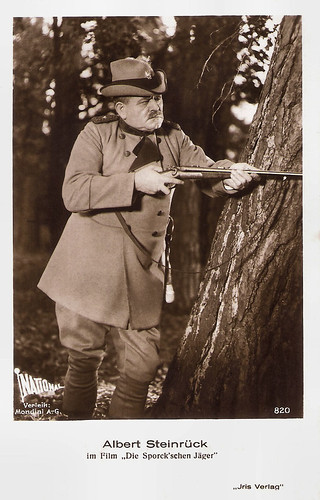
Austrian postcard by Iris Verlag, no. 820. Photo: National / Verleih / Mondial A.G. Albert Steinrück in Die Sporck'schen Jäger / The Sporck Battalion (Holger-Madsen, 1927).

French postcard by Europe, no. 365. Photo: Hegewald Film. Evelyn Holt in Freiwild / Free game (Holger-Madsen, 1928). Collection: Marlene Pilaete.
Sources: Filmdatabasen (Danish), Wikipedia (Danish and English) and IMDb.

No comments:
Post a Comment