
Danish postcard by Alex Vincents Kunstforlag, Eneret, Copenhagen, no. 372. Holger Reenberg in the fairytale play 'Prinsessen og det halve kongerige' (first performed in 1905) by Holger Drachmann.

Danish postcard by Alex. Vincents Kunstforlag, Eneret, no. 1022. Ellen Aggerholm as Käthi in the stage play 'Hans Højhed / His Highness'. Her partner in the play, playing the Highness of the title, was her husband Svend Aggerholm. The postcard was mailed in Flensburg on 10-11-1905.

Danish postcard by Alex Vincents Kunstforlag, Eneret, no. 516. The card was mailed in 1906. Is the painted portrait of Einar Zangenberg, the Danish actor, film director, film producer and a pioneer of Central European film? He was only 24 in 1906, and the man on the card appears to be older. It could, therefore, well be his father, Christian Zangenberg, a prominent actor of the Danish Royal Theatre.

Danish postcard by Alex Vincents Kunstforlag, Copenhagen. Danish film and stage actor Henry Seemann in the operetta 'Valsedrømme / Ein Walzertraum / A Waltz Dream' (1907) by Oscar Strauss.

Danish postcard by Alex Vincents Kunstforlag, no. 695. In 1908, Gerda Krum performed opposite Holger Reenberg at the Casino in Copenhagen in the operetta 'Manden med de tre Koner/ Der Mann mit den drei Frauen' (1908) by Franz Léhar.
Who was Alex Vincent?
Founder Alexander Josva Schmidt Vincent was born out of wedlock in 1861 in Copenhagen. His parents were restaurateur Alexander Prosper Vincent and Josephine Cathrine Schmidt. His father and widowed grandmother Eva Severine Vincent née Rasmussen were the proprietors of the high-end French Restaurant Vincent.
Alexander Prosper Vincent had a reputation for being one of Copenhagen's most skilled restaurateurs. In 1875, he became a hotelier at the newly created Hotel D'Angleterre. It was his great knowledge of the industry, skill and the fine wine cellar that created the hotel's reputation from the beginning, so that to this day it is one of Denmark's finest hotels.
Vincent lived with his mother, but she died when he was just two years old. He was subsequently brought up by his mother's sister, Jutta Frederikke Schmidt. In 1880, he was still living with her when he was employed as a clerk by the Municipality of Copenhagen. In 1885, Alexander Josva Schmidt received a Royal Grant to use the family name Vincent.
In 1889, Alex Vincent married Agnes Juliette Lodbjerg (1864-1943). Her late father had back in 1845 established a business dealing in mirrors, cards and pictures. After the father's death, her mother, Thora Lodberg, had continued the firm as H. A. Lodbergs Enke. Vincent was most likely inspired by this shop to start his own business.
On 23 October 1890, he started a wholesale stationery business (stationery refers to writing materials, including cut paper, envelopes, continuous form paper, and other office supplies), Alex. Vincents Kunstforlag is also sometimes written as Alex Vincent's Kunstforlag A/S. The first prints published by the firm were large prints for framing and hanging on the wall. It was easy to colour them and turn them into postcards. Vincent launched a series of Christmas and New Year cards based on drawings by the illustrator Axel Thiess for the 1893 season. These were very successful.

Danish postcard by Alex. Vincent's Kunstforlag, Eneret, no. 709. Robert Dinesen in the stage play 'Inez fra Coimbra / Inez from Coïmbra' by Karl Larsen, in which Ellen Aggerholm played the title role, opposite Dinesen. Aggerholm debuted in this play at Det Ny Teater in 1908, also opposite Poul Reumert and Asta Nielsen.

Danish postcard by Alex Vincents Kunstforlag, Copenhagen. Photo: Palladium. Fi og By (Pat and Patachon) at the Place de la Concorde in Paris in Raske Riviera Rejsende / At the Mediterranean (Lau Lauritzen, 1924).
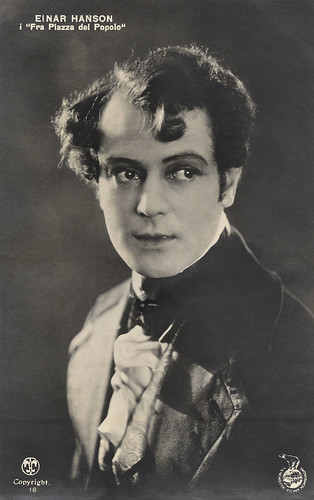
Danish postcard by Alex. Vincents Kunstforlag, Copenhagen, no. 18. Photo: Nordisk. Einar Hanson in Fra Piazza del Popolo / Mists of the Past (A.W. Sandberg, 1925).

Danish postcard by Alex. Vincents Kunstforlag, Copenhagen, no. 99. Mona Martenson in Ingmarsarvet / The Ingmar Inheritance (Gustav Molander, 1925), after Selma Lagerlöf's book 'Jerusalem'.
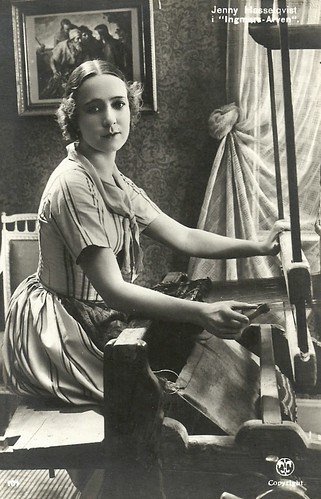
Danish postcard by Alex. Vincents Kunstforlag, Copenhagen, no. 101. Jenny Hasselqvist in Ingmarsarvet / The Ingmar Inheritance (Gustav Molander, 1925), based on Selma Lagerlöf's book 'Jerusalem'.

Danish postcard by Alex. Vincents Kunstforlag, Eneret, no. 254. Photo: Diomira Jacobini and Gösta Ekman in Revolutionshochzeit / Revolutionsbryllup / The Last Night (A.W. Sandberg, 1928). This was a German-Danish dramatisation of Sophus Michaëlis' play 'Revolutionshochzeit' (Revolutionary Wedding), with Karina Bell, Walter Rilla and Fritz Kortner, and produced by Terra-Filmkunst. This card shows left Ekman and Karina Bell, and in the back Fritz Kortner as the Jacobine Monteloup, and right Jacobini, whose character, the aristocratic Alaine, has changed clothes with her maid Leontine (Bell) to get a pass to leave Paris.
Enormous quantities of postcards
In the years around 1900, Alex. Vincents Kunstforlag achieved a dominant position in publishing postcards. The company, like Stender and Alstrup, became nationwide in terms of topographical postage, but also published a wealth of Christmas, New Year's, Easter and Whitsun cards as well as humour cards and theme cards, including the stage and film star postcards. A funny anecdote is about the money cards, which were sold as New Year's cards, when people wanted to congratulate the recipient of the card with prosperity in the new year. On 7 January 1907, the newspaper Thisted Amts Tidende reported (translated by EFSP):
"Convicted of having forged Danish banknotes
The well-known Copenhagen publisher of greeting cards, wholesaler Alex. Vincent was sentenced on Saturday by the Criminal Court to a fine of 100 DKK. Because he had depicted a toilet paper roll, consisting of banknotes, on a series of cards. The format was, however, so small that a serious danger to our banknotes can hardly be said to have been present. The verdict will probably be appealed."
Alex. Vincents Kunstforlag's first topographical postcards with motifs from around the country were produced in the 1890s.In 1904, Svend Fischer, another of the postcard publishers of the time, died, and Alex. Vincent probably bought Svend Fischer's business and rights, or parts of it. The firm was initially based on the second floor at Kronprinsessegade 10. Vincent continued H. A. Lodbergs Enke after his mother-in-law died in 1897. He had bought the property at Kronprinsessegade 12. Both companies continued. H. A. Lodbergs Enke was from then on based on the ground floor of the new building, while Alex. Vincents Kunstforlag was based on the first floor.
Alex Vincent and his wife Agnes lived in the apartment on the second floor at No. 10. The family had grown with the children Ella (1891), Paul (1894-1900), Astrid Maud (1897), Paula (1902) and Alex (1906). In 1916, Vincent fell ill and died half a year later. As the obituary indicated, he was very proud of his French origins. The flower in the company logo is the French Lily, and the logo on the envelopes was the tricolour in the French colours. The company was subsequently continued by Agnes Vincent. In 1919, it started the production of a wide range of four-coloured postcards with Danish artworks.
Alex Vincent Jr. succeeded his mother as managing director of the company in connection with its 50th anniversary in 1940. Agnes died in 1943. The company was converted into an 'aktieselskab' (a stock-based corporation) in 1947. The company was now a wholesale business that sold Christmas cards, napkins, children's books, reproductions of paintings, etc. In 1950, it relocated to Store Kongensgade 81. It closed a few years later. Per Sørensen at the Danish site Piaper: "The company's heyday as a postcard publisher clearly dates back to before 1925, when the quantities of printed postcards were enormous. This fits in well with the common knowledge that the period 1900-1920 was the golden age of postcards. After 1925, there were fewer and fewer postcards."

Danish postcard by Alex Vincents Kunstforlag, Kobenhavn (Copenhagen), no. 85. Photo: William Collier Jr. in The Wanderer (Raoul Walsh, 1925), an adaptation of the Biblical story of the Prodigal Son.

Danish postcard by Alex Vincents Kunstforlag, no. 213. Photo: A/S Filmcentralen / Metro-Goldwyn. Mae Murray in The Merry Widow (Erich von Stroheim, 1925), based on Franz Léhar's eponymous operetta.

Danish postcard by Alex Vincents Kunstforlag, no. 613. Photo: A/S Filmcentralen / Metro-Goldwyn. Mae Murray and John Gilbert in The Merry Widow (Erich von Stroheim, 1925), based on Franz Léhar's eponymous operetta.

Danish postcard by Alex Vincents Kunstforlag, no. 128. Photo: Famous Players-Lasky / Paramount. Gloria Swanson and Charles de Roche (Charles de Rochefort) in Madame Sans-Gêne (Léonce Perret, 1925).

Danish postcard by Alex Vincents Kunstforlag, no. 2. Photo: Sacha Film / Phoebus Film. Nils Asther and Lily Damita in the Austro-German coproduction Die goldene Schmetterling / The Golden Butterfly (Mihaly Kertesz / Michael Curtiz, 1926).
Sources: Per Sørensen (Piaper - Danish), Wikipedia and Indenforvoldene (Danish).

No comments:
Post a Comment