Showing posts with label Greta Garbo. Show all posts

28 July 2026

Die freudlose Gasse (1925)

Die freudlose Gasse / (The) Joyless Street (1925) is a German silent film directed by Georg Wilhelm Pabst. It is the best-known film adaptation of a work by Austrian author Hugo Bettauer and is also one of the first films to be associated with the Neue Sachlichkeit (New Objectivity) art movement. The film starred Asta Nielsen and the young Greta Garbo.

Asta Nielsen in Die freudlose gasse (1925)
German postcard by Ross Verlag, no. 1020/1, 1927-1928. Photo: Oertel, Berlin. Asta Nielsen in Die freudlose gasse / The Joyless Street (G.W. Pabst, 1925)

Greta Garbo in Die freudlose Gasse (1925)
Austrian postcard by Iris Verlag, no. 5098. Photo: Sascha / Sofar Film. Greta Garbo in Die freudlose Gasse / Joyless Street (G.W. Pabst, 1925).

Asta Nielsen in Die freudlose Gasse (1925)
German postcard by Ross Verlag, no. 1007/1, 1927-1928. Photo: Oertel, Berlin. Asta Nielsen in Die freudlose gasse / The Joyless Street (G.W. Pabst, 1925).

A piece of meat in exchange for sexual services


The plot of Die freudlose Gasse unfolds across several parallel levels that are interwoven and ultimately merge. The film is set in 1921. Some people enrich themselves through a share scam. Betting on falling prices, they spread a false rumour causing the price of a coal share to fall temporarily. Others are plunged into poverty as a result. In an alley called Melchiorgasse in a poor quarter of Vienna, the lives of several people coincide. Marie (Asta Nielsen), daughter of an abusive war veteran father (Max Kohlhase), hopes to escape her home with the help of her boyfriend Egon (Henry Stuart), a bank clerk. Grete (Greta Garbo) is the elder daughter of impoverished civil servant Rumfort.

Marie and Grete join the overnight line of waiting customers outside of the butcher's shop run by the abusive Josef Geiringer (Werner Krauss), but Grete passes out and loses her place. Marie and her friend Else (Hertha von Walther) manage to enter Geiringer's shop, where they receive a piece of meat in exchange for Else's sexual services. Else offers Marie to share the meat with her, but Marie declines, knowing that Else, whose husband is unemployed, has a young child to feed.

Marie runs away from home and asks Egon to take her in, but Egon, who is entangled with two women of Vienna's high society, hoping that they will help him climb up the social ladder, declines. She is offered help by Mrs. Greifer (Valeska Gert), owner of a fashion salon with an adjoining nightclub. This is where Vienna’s wealthy residents are drawn. Marie becomes the mistress of Canez (Robert Garrison), a speculator on the stock exchange market. During a date with Canez, she witnesses Egon meeting with Mrs. Lia Leid (Tamara), one of his female acquaintances. When Mrs. Leid is later found strangled, Marie states that she saw Egon commit the murder.

Meanwhile, Rumfort (Jaro Fürth) loses his pension in a share transaction in which Canez was involved, while Grete is dismissed from her job for rejecting her employer's sexual advances. To pay for their expenses, the Rumfort family offers a room to let to American Red Cross officer Lt. Davy (Einar Hanson), who is enamoured with Grete's charms. When Davy's adjutant (Mario Cusmich) accuses Grete's younger sister (Loni Nest) of stealing from their supplies, Grete's father insists that they leave. Grete borrows money from Mrs. Greifer, who in turn tries to talk Grete into working for her. Attached to the nightclub is the ‘Merkl’ love hotel, where, among other things, women pay off loans taken out from Mrs. Greifer or unpaid dress purchases by providing sexual services.

In the end, it turns out that the murder of the wealthy Lia Leid was committed out of jealousy by Marie (Asta Nielsen), who has sunk to the status of a streetwalker known as ‘Mizzi’. Her friend Else, in a fit of desperation, kills the butcher because he refuses to give her any meat. The poor residents of the street turn on the rich after hearing strange noises coming from the nightclub. They start throwing stones. In the process, the building catches fire. Else and her unemployed husband (Otto Reinwald) die in the flames, but manage to pass their child out of the window and save it. Thus, the child becomes the ‘Child of Melchiorgasse’. Only Grete Rumfort (Greta Garbo) has any hope of ever escaping this alley. Her relationship with Red Cross officer Davy offers the prospect of a better life.

Werner Krauss in Die Freudlose Gasse (1925)
German postcard by Ross Verlag G.m.b.H., Berlin. Photo: Sofar-Film-Produktion. Werner Krauss in Die freudlose Gasse / The Joyless Street (Georg Wilhelm Pabst, 1925).

Henry Stuart and Agnes Eszterhazy in Die freudlose Gasse (1925)
German postcard by Ross Verlag G.m.b.H., Berlin. Photo: Sofar-Film-Produktion. Henry Stuart, Agnes Eszterhazy, Ilka Grüning, Karl Etlinger, and Robert Garrison in Die freudlose Gasse / The Joyless Street (Georg Wilhelm Pabst, 1925). Caption: Hotel Carlton.

Einar Hanson and Mario Cusmich in Die Freudlose Gasse
German postcard by Ross Verlag G.m.b.H., Berlin. Photo: Sofar-Film-Produktion. Einar Hanson and Mario Cusmich in Die freudlose Gasse / The Joyless Street (Georg Wilhelm Pabst, 1925). Caption: At Greifer. The postcard contains a stamp of Kino-Palast Zittau.

A highly controversial novel


Die freudlose Gasse / (The) Joyless Street (1925) is a landmark film of the Neue Sachlichkeit (New Objectivity). This art movement emerged in Germany in the early 1920s as a counter to expressionism. The term applies to a number of artistic forms, including film. Georg Wilhelm Pabst is the director most associated with the movement. His films of the 1920s concentrate on subjects such as abortion, prostitution, labour disputes, homosexuality, and addiction. His cool and critical Die freudlose Gasse / (The) Joyless Street established Pabst’s reputation as a leading director of German film realism.

Die freudlose Gasse turns away from expressionist imagery and towards the post-war reality marked by inflation. The sets were designed by Hans Sohnle and Otto Erdmann. The film, made in just five months, was based on Hugo Bettauer’s 1924 novel. Both the author and his work were highly controversial at the time: right-wing politicians and the press denounced Bettauer’s works, and there were even calls for his ‘extermination’. The writer was murdered before filming had even finished.

The film’s enduring impact is due in no small part to the fact that the plot is carried by three brilliant actresses. Frank de Jong at IMDb: "Marie (played by Asta Nielsen) is a daughter of a poor family. Grete (played by Greta Garbo) is daughter of an impoverished family. Marie ends badly, Grete escapes the misery. Symbolically two big stars of Scandinavian cinema pass on the relay baton in this movie. The most striking character of this film is however not played by either Asta Nielsen or Greta Garbo but by Valeska Gert as Frau Greifer. Her character is a sort of female Mephistopheles. She is both tailor and owner of a nightclub. As a tailor she sells expensive coats on credit. As the owner of the nightclub she coerces young girls to perform when they could not pay their debts."

Despite a happy ending - which, unlike the literary source material, was filmed as a concession to the producers and the audience - the film was censored and cut in many countries. The version shown at the premiere in Berlin at 18 May 1925 was still 3,738 metres long. On the night before the premiere, Pabst and his film editor Mark Sorkin had removed ‘a few important scenes’ that the cinema owner had criticised. The first round of censorship on 25 May 1925 resulted in the removal of only a relatively small number of frames - around 3.5 to 4 metres (approximately 7.5 seconds, based on 25 frames per second). Following a request, a further review was carried out the following year, after which only 3,477 metres remained. Consequently, there were many different versions of the film, which differed not only in length but also in the sequence of scenes. In England, the film was banned altogether.

In Germany, several attempts were made to reconstruct the film, with the aim of getting as close as possible to the original version, i.e. that of the premiere. The first attempt was made by Enno Patalas, who in 1989 edited a version at the Munich Film Museum from three surviving copies of the film, closely following Mark Sorkin’s screenplay. Between 1995 and 1998, the second reconstruction took place at the Munich Film Museum under the direction of Jan-Christopher Horak, utilising all known negative film stock as well as all available materials that provided clues as to the correct sequence of scenes and intertitles. The resulting reconstruction of the film is approximately 3,000 metres long and runs for 151 minutes.

Asta Nielsen in Die freudlose Gasse  (1925)
German postcard by Anonyme Fotografie, no. A 43. Photo: Oertel / Collection Eckemeyer, Berlin. Asta Nielsen in Die freudlose Gasse / The Joyless Street (G. W. Pabst, 1925).

Greta Garbo, Mon Ciné (1926)
French magazine cover of Mon Ciné, V, no. 210, 25 February 1926. Greta Garbo in Die freudlose Gasse / Joyless Street (G.W. Pabst, 1925), released in France in 1926 as La rue sans joie.

Asta Nielsen in Die freudlose Gasse (1925)
German postcard by Ross Verlag, no. 1020/1. Photo: Curt Oertel, Berlin. Asta Nielsen in Die freudlose Gasse / Joyless Street (G.W. Pabst, 1925). In 1929, Dutch painter Pyke Koch painted Nielsen's portrait, using one of Oertel's photos. The painting is now at the Centraal Museum, Utrecht. Curt Oertel was one of the cinematographers of the film as well.

Sources: Frank de Jong (IMDb), Wikipedia (German, Dutch and English) and IMDb.

04 September 2022

Greta Garbo: the sound films

Swedish-born Greta Garbo (1905-1990) was one of the greatest and most glamorous film stars ever produced by the Hollywood studio system. She was part of the Golden Age of the silent cinema of the 1920s but Garbo was one of the few Hollywood actors who made a glorious transition to the talkies.

Greta Garbo in Mata Hari (1931)
Dutch postcard by JosPe, no. 299. Photo: Clarence Sinclair Bull / Metro-Goldwyn-Mayer. Publicity still for Mata Hari (George Fitzmaurice, 1931).

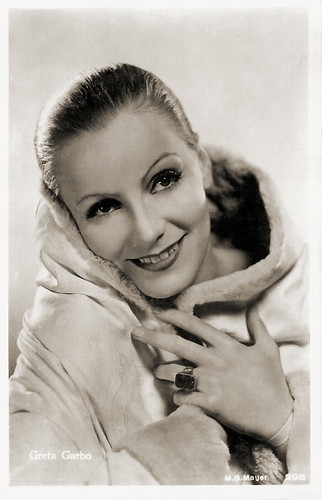
Greta Garbo
Dutch postcard by JosPe, no. 295. Photo: Metro-Goldwyn-Mayer (MGM) / Clarence Sinclair Bull. Publicity still for Mata Hari (George Fitzmaurice, 1931).

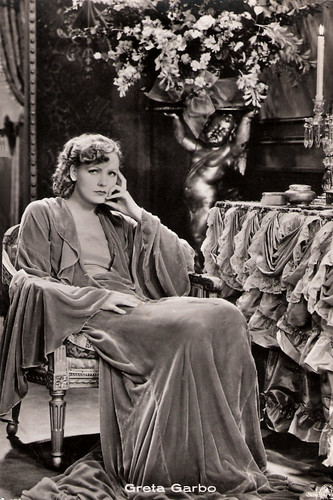
Greta Garbo
Dutch postcard. Sent by mail in 1931. Photo: Metro-Goldwyn-Mayer. Greta Garbo in Romance (Clarence Brown, 1930).

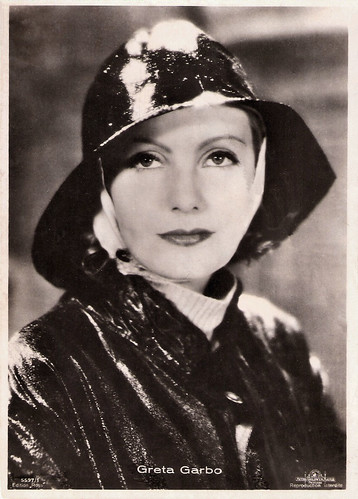
Greta Garbo in Anna Christie (1930)
French postcard by Edition Ross, no. 5597/1, 1930-1931. Photo: Metro-Goldwyn-Mayer. Publicity still for Anna Christie (Clarence Brown, 1930).

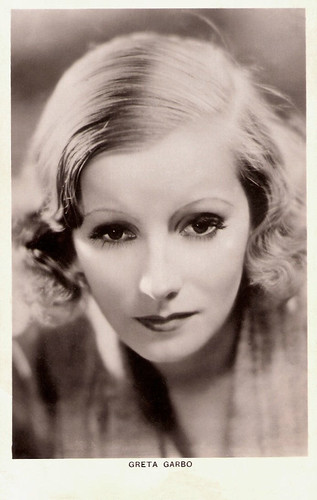
Greta Garbo
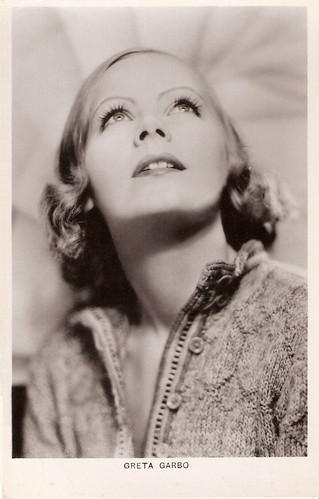
British postcard in the Picturegoer Series, London, no. 283e.

Greta Garbo
British postcard in the Picturegoer Series, London, no. 283b.

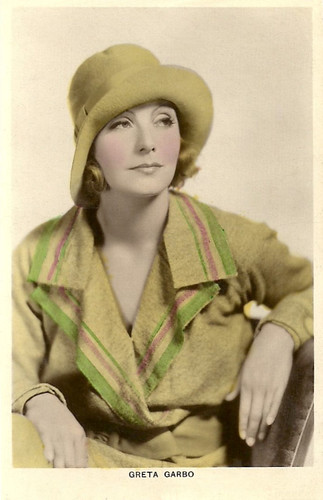
Greta Garbo
British postcard in the Colourgraph Series, London, no. C 81. Photo: publicity still for Anna Christie (Clarence Brown, 1930).

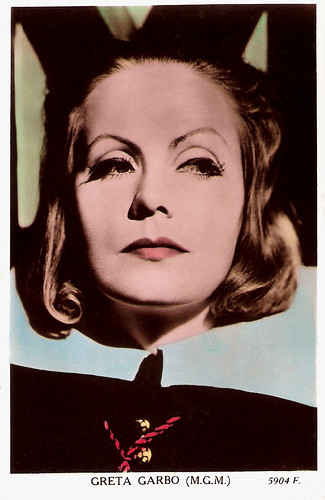
Greta Garbo
British postcard in the Valentine's Postcard series, no. 5904 F. Photo: MGM. Publicity still for Queen Christina (Rouben Mamoulian, 1933).

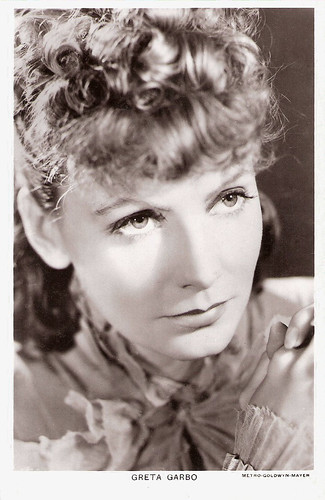
Greta Garbo
British postcard in the Picturegoer Series, London, no. 637b. Photo: Clarence Sinclair Bull / Metro-Goldwyn-Mayer. Publicity still for Anna Karenina (Clarence Brown, 1935).

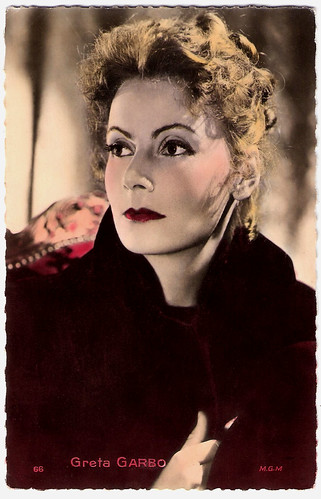
Greta Garbo
French postcard by Ed. Chantal, no. 66. Photo: M.G.M. Publicity still for Conquest (Clarence Brown, 1937).

Garbo Talks!


In Hollywood, Greta Garbo spent most of 1925 posing for nonsensical publicity photos which endeavoured to create a 'mystery woman' image for her. Hal Erickson at AllMovie: "But it was only after shooting commenced on Garbo's first American film, The Torrent (1926), that MGM realized it had a potential gold mine on its hands." The Director of The Torrent was Monta Bell and Greta played a peasant girl turned singer opposite Ricardo Cortez. The film was a hit and despite its cool reception by the trade press, Garbo's performance was critically acclaimed.

Her third film for MGM, Flesh and the Devil (Clarence Brown, 1926), made her an international star. Her co-star was John Gilbert, and their on-screen chemistry soon translated into an off-camera romance by the end of the production, they lived together. The Garbo/Gilbert team went on to make an adaptation of Lev Tolstoy's Anna Karenina titled Love (Edmund Goulding, 1927). The couple planned to marry, but Garbo, in one of her attacks of self-imposed solitude, did not show up for the wedding. Over the years, the actress would have other romantic involvements, but would never marry.

Anna Christie (Clarence Brown, 1930) was filmed at a time of transition in Hollywood from the silent era to sound. Reportedly MGM had concerns about Garbo's voice. The studio was afraid that her thick Swedish accent would not register well in the talkies. The poster for her first sound film read "Garbo Talks!", which would become a catchphrase widely associated with her. Sixteen minutes into Anna Christie, Garbo finally utters her first, now famous line, "Gimme a whiskey, ginger ale on the side, and don't be stingy, baby." Garbo's voice meshed perfectly with her established image, and her performance in Anna Christie was effective. So, when 'Garbo talks' the audience still listened.

Anna Christie, based on a play by Eugene O'Neill, became a transitional film for Garbo. Hal Erickson: "The advent of talkies obliged the actress to drop the 'mysterious temptress' characterization she'd used in silents in favour of more richly textured performances as worldly, somewhat melancholy women to whom the normal pleasures of love and contentment would always be just out of reach."

Greta Garbo had a huge following in Europe, especially in Germany. Therefore MGM also made a German version of Anna Christie. Both versions were filmed back to back. Garbo played the leading role in both versions, but all the other characters in the German version were played by different actors from the English version. Curiously, Garbo herself supposedly favoured her Anna Christie in the German version over the English version. The German version was directed by Jacques Feyder and had its first screening in Germany in 1931.

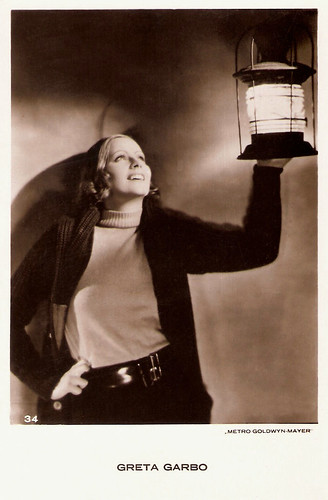
Greta Garbo
Dutch postcard by JosPe, Arnhem, no. 34. Photo: Clarence Sinclair Bull / Metro Goldwyn Mayer. Publicity still for Anna Christie (Clarence Brown, 1930).

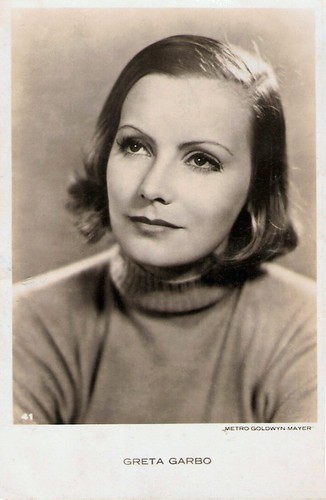
Greta Garbo in Anna Christie (1930)
Dutch Postcard, no. 41. Photo: Clarence Sinclair Bull / Metro Goldwyn Mayer. Publicity still for Anna Christie (Clarence Brown, 1930).

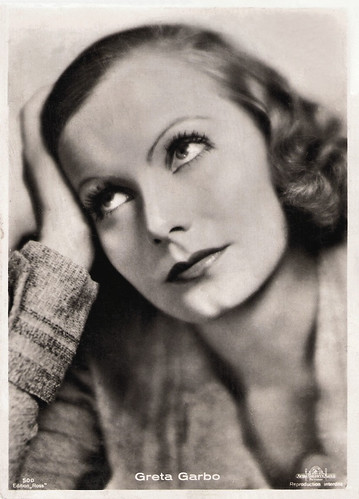
Greta Garbo
French postcard by Edition Ross, no. 500. Photo: Clarence Sinclair Bull. Publicity still for the German version of Anna Christie (Jacques Feyder, 1930).

Greta Garbo
German postcard by Ross Verlag, no. 5513/2, 1930-1931. Photo: MGM. Photo: Clarence Sinclair Bull. Publicity still for the German version of Anna Christie (Jacques Feyder, 1930).

Greta Garbo
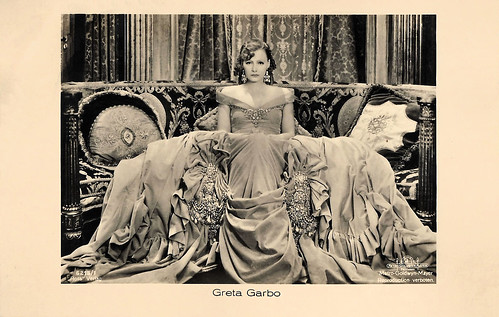
German postcard by Ross Verlag, no. 6215/1, 1931-1932. Photo: George Hurrell / Metro-Goldwyn-Mayer. Greta Garbo in an over-the-top dress by Adrian in Romance (Clarence Brown, 1930). Set by Cedric Gibbons.

Greta Garbo in Romance (1930)
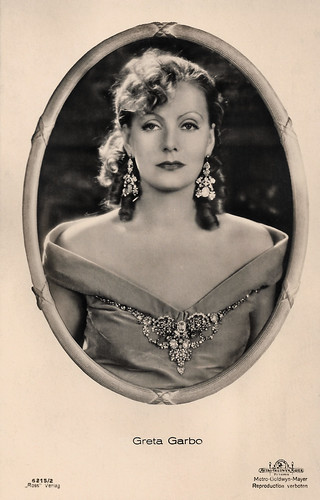
German postcard by Ross Verlag, no. 6215/2, 1931-1932. Photo: George Hurrell / Metro-Goldwyn-Mayer. Greta Garbo in Romance (Clarence Brown, 1930).

Greta Garbo
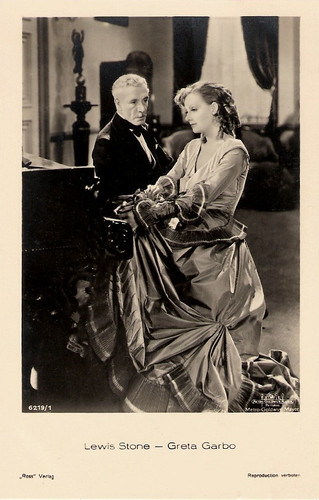
German postcard by Ross Verlag, no. 6219/1, 1931-1932. Photo: Metro-Goldwyn-Mayer (MGM). Greta Garbo and Lewis Stone in Romance (Clarence Brown, 1930).

Greta Garbo and Gavin Gordon
Italian postcard by Cinema-Illustrazione, Milano, series II, no. 1. Photo: Metro-Goldwyn-Mayer. Greta Garbo and Gavin Gordon acted together in the early sound film Romance (Clarence Brown, 1930). It was also issued as a silent film.

Greta Garbo and Robert Montgomery in Inspiration (1931)
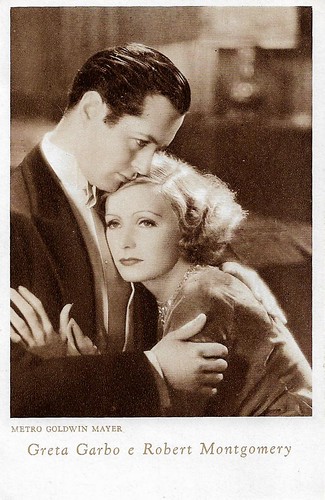
Italian postcard by Cinema-Illustrazione, Milano, series 2, no. 3. Photo: Metro-Goldwyn-Mayer. Greta Garbo and Robert Montgomery in Inspiration (Clarence Brown, 1931).

Greta Garbo in Inspiration (1931)
German postcard by Ross Verlag, no. 5924/2, 1930-1931. Photo:Clarence Sinclair Bull / Metro-Goldwyn-Mayer. Publicity still for Inspiration (Clarence Brown, 1931).

From the Greatest Money-making Machine to Box Office Poison


Greta Garbo next made Romance (Clarence Brown, 1930) in the same year as Anna Christie. Romance is a film with nearly no plot twists, but Garbo is stunning. She originally wanted Gary Cooper as her leading man, but MGM could not borrow Cooper from Paramount, so Garbo had to settle for Lewis Stone and the unknown Gavin Gordon. After Anna Christie, Romance (1930) was somewhat of a letdown, but for her performances in these films, she received the first of three Academy Award nominations for Best Actress. Academy rules at the time allowed for a performer to receive a single nomination for their work in more than one film.

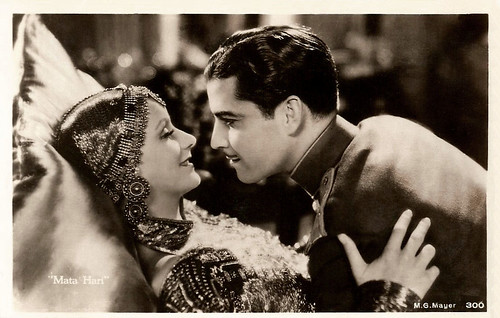
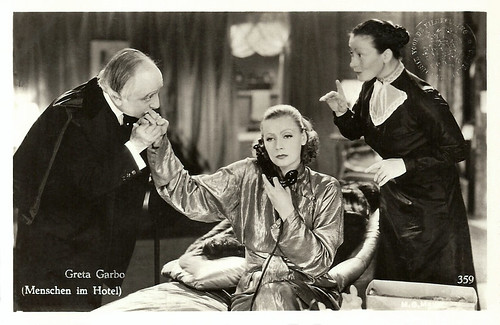
In 1931, Garbo bounced back, landing another lead role opposite Ramon Novarro as the World War I spy in Mata Hari (George Fitzmaurice, 1931). The lavish production turned out to be a major hit. The next year she was cast in yet another hit, Grand Hotel (Edmund Goulding, 1932). She played a Russian ballerina opposite an ensemble cast, including John Barrymore, Joan Crawford, and Wallace Beery. The film won an Academy Award for Best Picture. Both Mata Hari and Grand Hotel had been MGM's highest-earning films of 1931 and 1932, respectively, and Garbo was dubbed "the greatest money-making machine ever put on screen".

From now on, her popularity allowed her to dictate the terms of her contract and Garbo became increasingly selective about her roles. Queen Christina (Rouben Mamoulian, 1933) was a lavish production, becoming one of the studio's biggest productions at the time. Publicised as 'Garbo Returns', the film became the highest-grossing film of the year. However, censors objected to the scenes in which Garbo disguised herself as a man and kissed a female co-star.

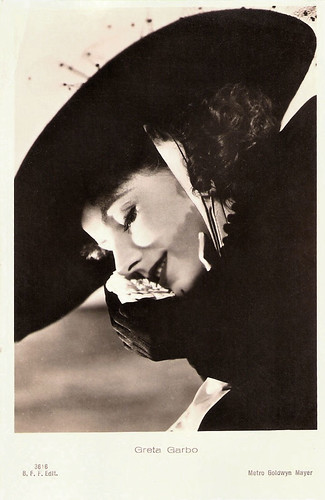
In the Leo Tolstoy adaptation Anna Karenina (Clarence Brown, 1935), she played another of her renowned roles. The film won the Mussolini Cup for the best foreign film at the Venice Film Festival, and Garbo received a New York Film Critics Circle Award for Best Actress for her role as Anna. Many critics and film historians consider her performance as the doomed courtesan Marguerite Gautier in George Cukor's romantic drama Camille (1936) to be her finest. The role gained her a second Academy Award nomination.

However, Greta Garbo's career soon declined after the flop Conquest (Clarence Brown, 1937), and in 1938, she was one of the many stars labelled 'Box Office Poison'.

Greta Garbo and Clark Gable in Susan Lenox (1931)
German postcard by Ross Verlag, no. 140/2. Greta Garbo and Clark Gable in Susan Lenox (Her Fall and Rise) (Robert Z. Leonard, 1931). Susan Lenox (Her Fall and Rise) was released in German-speaking countries as 'Helga's Fall und Aufstieg'. Her character's name is really Helga Ohlin, she only later changes it to Susan Lenox.

Greta Garbo
German postcard by Ross Verlag, no. 6213/1, 1931-1932. Photo: Photo: Clarence Bull / Metro-Goldwyn-Mayer. Publicity still for Susan Lenox, Her Fall and Rise (Robert Z. Leonard, 1931).

Great Garbo and Ramon Novarro in Mata Hari (1931)
Vintage postcard, no. 300. Photo: M.G.Mayer. Publicity still for Mata Hari (George Fitzmaurice, 1931) with Ramon Novarro.

Greta Garbo as Mata Hari (1931)
German postcard by Ross Verlag, no. 6521/2, 1931-1932. Photo: Clarence Sinclair Bull / Metro-Goldwyn-Mayer. Publicity still for Mata Hari (George Fitzmaurice, 1931).

Greta Garbo, Ramon Novarro, and Lionel Barrymore in Mata Hari (1931)
German postcard by Ross Verlag, Berlin, no. 139/3. Photo: Metro-Goldwyn-Mayer. Greta Garbo, Ramon Novarro, and Lionel Barrymore in Mata Hari (George Fitzmaurice, 1931).

Grand Hotel
Postcard with Dutch censorship stamp, no. 359. Photo: publicity still for Grand Hotel (Edmund Goulding, 1932) with Ferdinand Gottschalk and Rafaela Ottiano.

Greta Garbo in Grand Hotel (1932)
German postcard by Ross Verlag, no. 6389/2, 1931-1932. Photo: Metro-Goldwyn-Mayer. Greta Garbo in Grand Hotel (Edmund Goulding, 1932).

Erich von Stroheim and Greta Garbo in As You Desire Me (1932)
German postcard by Ross Verlag, no. 186/3. Photo: Metro-Goldwyn-Mayer. Erich von Stroheim and Greta Garbo in As You Desire me (George Fitzmaurice, 1932).

Greta Garbo in As You Desire Me (1932)
German postcard by Ross Verlag, no. 7802/1, 1932-1933. Photo: Clarence Sinclair Bull / Metro-Goldwyn-Mayer. Publicity still for As You Desire Me (George Fitzmaurice, 1932).

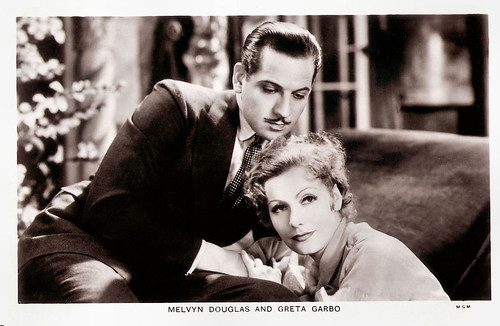
Greta Garbo and Melvyn Douglas in As You Desire Me (1932)
British postcard in the Film Partners series, no. P 82. Photo: MGM. Greta Garbo and Melvyn Douglas in As You Desire Me (George Fitzmaurice, 1932).

Garbo laughs!


In 1939, Greta Garbo made a comeback when she starred in Ninotchka (Ernst Lubitsch, 1939). Her first comedy was one of the first Hollywood films which, under the cover of a satirical, light romance, depicted the Soviet Union under Joseph Stalin as being rigid and grey when compared to its prewar years. Ninotchka was publicised with the catchphrase 'Garbo laughs!', commenting on the departure of Garbo's serious and melancholy image as she transferred to comedy. Bosley Crowther, the famous New York Times film critic wrote that Garbo Garbo "demonstrated that she had the wit and flexibility to be a fine comedienne".

All of Garbo's films were in black and white which enhanced her mystery and romantic allure. Her last film was the domestic comedy Two-Faced Woman (George Cukor, 1941), which was considered a distinct step downward for her. The film drew controversy and was condemned by the Catholic Church and other groups and was a box office failure. She was 35 and had acted in twenty-eight films.

After the war, Greta Garbo hoped to return to films. She was asked to appear in Alfred Hitchcock's The Paradine Case (1947), but she turned the role down. In 1949, after making some screentests for a film project called The Wicked Dutchess which was never realised due to financial problems, Garbo retired definitively. Greta Garbo abandoned Hollywood and moved to New York City. She would jet-set with such personalities as Aristotle Onassis and Cecil Beaton, and spend the rest of her time gardening flowers and vegetables.

In the 1970s, Garbo travelled less and grew more and more eccentric, although she still took daily walks through Central Park with close friends. In the late 1980s failing health decreased her mobility. In her final year, it was her family that cared for her, including taking her to dialysis treatments.

In 1990, Greta Garbo died of natural causes in New York. She was 84. In 1954, she was given a special Oscar 'for her unforgettable performances', and in 1999, the American Film Institute ranked Garbo fifth on their list of the greatest female stars of classic Hollywood cinema, after Katharine Hepburn, Bette Davis, Audrey Hepburn, and Ingrid Bergman. Hal Erickson at AllMovie: "Even after her death in 1990, the legend of Greta Garbo was undiminished. Few of her fans talk of her in human terms; to her devotees, Greta Garbo was not so much film legend as film goddess."

Greta Garbo in Queen Christina (1933)
Dutch postcard, no. 591. Photo: Clarence Sinclair Bull / Metro-Goldwyn-Mayer. Greta Garbo in Queen Christina (Rouben Mamoulian, 1933).

Greta Garbo and John Gilbert in Queen Christina (1933)
German postcard by Ross Verlag, no. 194/3. Photo: MGM. Greta Garbo and John Gilbert in Queen Christina (Rouben Mamoulian, 1933).

Greta Garbo in Queen Christina (1933)
German postcard by Ross Verlag, no. 8341/1, 1933-1934. Photo: Clarence Sinclair Bull / Metro-Goldwyn-Mayer. Greta Garbo in Queen Christina (Rouben Mamoulian, 1933).

Greta Garbo in The Painted Veil
British postcard. Greta Garbo as Kitty Fane in The Painted Veil (Richard Boleslawski, 1934). Metro-Goldwyn-Mayer.

Greta Garbo in Anna Karenina (1935)
German postcard by Ross Verlag, no. 9311/2, 1935-1936. Photo: Clarence Sinclair Bull / Metro-Goldwyn-Mayer. Greta Garbo in Anna Karenina (Clarence Brown 1935).

Greta Garbo and Fredric March in Anna Karenina (1935)
German postcard by Ross Verlag, no. 9313/1, 1935-1936. Photo: Metro-Goldwyn-Mayer. Greta Garbo and Fredric March in Anna Karenina (Clarence Brown 1935).

Greta Garbo
Italian postcard by B.F.F. Edit., no. 3616. Photo: Clarence Sinclair Bull / Metro-Goldwyn-Mayer. Publicity still for Camille (George Cukor, 1936).

Greta Garbo and Robert Taylor, Camille (1936)
German postcard by Ross Verlag, no. A 1330/1, 1937-1938, Photo: Metro-Goldwyn-Mayer. Greta Garbo and Robert Taylor in Camille (George Cukor, 1936).

Greta Garbo in Conquest
German postcard by Ross Verlag, no. A 1424/3, 1937-1938. Photo: Metro-Goldwyn-Mayer. Greta Garbo in Conquest (Clarence Brown, 1937).

Greta Garbo and Scotty Beckett in Conquest (1937)
German postcard by Ross Verlag, no. A 1756/2, 1937-1938. Photo: Metro Goldwyn Mayer. Greta Garbo and Scotty Beckett in Conquest / Marie Walewska (Clarence Brown, 1937).

Greta Garbo in Ninotchka (1939)
Italian postcard by B.F.F. Edit. (Casa Editr. Ballerini & Fratini, Firenze), no. 2178. Photo: Metro-Goldwyn-Mayer. Greta Garbo in Ninotchka (Ernst Lubitsch, 1939).

Sources: Hal Erickson (AllMovie), Denny Jackson (IMDb), Wikipedia, and IMDb.

This post was last updated on 3 May 2024.