Charming and elegant Edwige Feuillère (1907-1998) was during the 1940s the ‘First Lady’ of the French cinema. Edwige was known for the ease in which she could switch from playing sophisticated sexy ladies and cruel, self-centred seductresses. For more than sixty years she stayed a beloved ‘vedette’ of the French stage and screen.

French collectors card by Massilia.

French postcard by Editions P.I., Paris, no. 719. Photo: Studio Harcourt.

French postcard by Editions P.I., Paris, no. 15. Photo: Films Orange. Edwige Feuillère in L'honorable Catherine/The Honourable Catherine (Marcel L'Herbier, 1943).

French postcard by Editions P.I., no. 170. Photo: Studio Carlet Ainé.

French postcard by Edit. Chantal, Rueil, no. 596 A. Photo: Continental Films.
Edwige Feuillère was born Edwige Louise Caroline Cunati in Vesoul, in the Haute-Saône in eastern France in 1907. Her father was Italian and, because he was drafted by the Italian army in World War I, Edwige spent much of her childhood in Italy.
After the war, the family moved to Dijon in France. Edwige attended the lyceum in Dijon where she acted in plays including Jean Racine's plays 'Esther' and 'Athalie'. At the Dijon Conservatoire, she studied diction, interpretation of character and singing, and easily passed the entrance exam for the Paris Conservatoire in 1928.
Two years later, she won the first prize for comedy. She married an older fellow student, Pierre Feuillere, but he proved to be a drug addict who used to play suicidal games with her. She made her theatrical debut under the stage name Cora Lynn, playing small roles in 1930. In 1931 she became a member of the Comédie Française, and made her debut in Pierre Beaumarchais' comedy 'Le Mariage de Figaro'. In 1933, Edwige left both the troupe and her husband, but she kept his surname.
During the 1930s and 1940s, the stunningly beautiful actress became one of the leading ladies on the French stage. A success was her role in Édouard Bourdet's 'La Prisonniere' (The Captive) in 1935 at the Théâtre Heberthot. The play had a long run and was frequently revived. Among her most popular roles was also Marguerite Gautier in 'La Dame aux camélias' (Camille) by Alexandre Dumas fils (1939-1942).
For the next two decades, she appeared in frequent revivals of 'La Dame aux camélias' in France and Britain. Another triumph was 'Sodome et Gomorrhe' (Sodom and Gomorrah) by modern author Jean Giraudoux (1943), for which she helped to discover Gérard Philipe.

French postcard by Erres, no. 12. Photo: Paramount.

French postcard, no. 170. Photo: Star.

French postcard by Editions O.P., Paris, no. 64. Photo: Star.

French postcard by Editions P.I., no. 170. Photo: Studio Carlet Ainé.
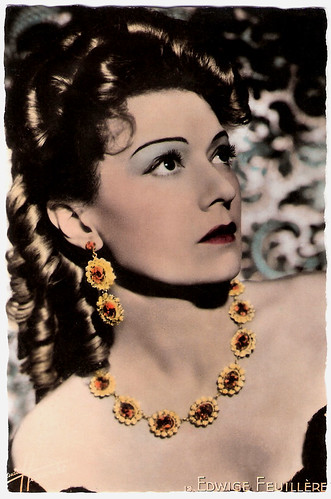
French postcard by Greff / S.E.R.P. Editeur, Paris, no. 596 A. Photo: Continental Films.
Edwige Feuillère's first film appearance was in the short La Fine combine/The Fine combines (André Chotin, 1931) opposite Fernandel, and her feature debut was in Le Cordon bleu/The Champion Cook (Alberto Cavalcanti, Karl Anton, 1931). For both films, she still used the name Cora Lynn. Louis Gasnier cast her in the first film version of the farce Topaze (1933), based on the play by Marcel Pagnol. Her charm and elegance opposite Louis Jouvet were widely appreciated.
In the strait-laced Europe of 1935, she scandalised the public with a brief nude scene in Lucrèce Borgia/Lucrezia Borgia (Abel Gance, 1935). This historical drama in which she played her first leading role, solidified her popularity. That year she also appeared in the epic Golgotha/Behold the Man (Julien Duvivier, 1935) starring Harry Baur and Jean Gabin, and in the Ufa production Barcarolle (Gerhard Lamprecht, Roger Le Bon, 1935), the French-language version of Lamprecht's Barcarole (1935).
Her roles as elegant and often heartless women were displayed in Mister Flow/Compliments of Mr. Flow (Robert Siodmak, 1936), Marthe Richard au service de la France/Marthe Richard (Raymond Bernard, 1937) as a charming spy opposite Erich von Stroheim, La Dame de Malacca/Woman of Malacca (Marc Allégret, 1937), and J'étais une aventurière/I Was an Adventuress (Raymond Bernard, 1938).
She went on to work with famous director Max Ophüls in the melodrama Sans lendemain/Without Tomorrow (1939) in which she gave a wonderful performance as a jaded woman, abandoned by a shady husband with a lot of debts, who is sacrificed, and in De Mayerling à Sarajévo/Mayerling to Sarajevo (1940) about the liaison between Archduke Franz Ferdinand - unwilling heir to the Habsburg throne - and his wife, Countess Sophie Chotek. The film ends with the couple's assassination by a Serb terrorist in 1914, thus starting WW I. Work on this film began in 1939 and was interrupted by the war. It was finished in the spring of 1940, only to be banned by the Germans. The first ‘official’ premiere was on 18 May 1945.
Feuillères next film, Mam'zelle Bonaparte/Miss Bonaparte (Maurice Tourneur, 1941) became a popular success, although IMDb calls the film a ‘dud’. Another success was her role as a coquette caught by a great love for Pierre Richard-Willm in La Duchesse de Langeais/Wicked Duchess (Jacques de Baroncelli, 1941) based on a novel by Honoré de Balzac with dialogues by Jean Giraudoux. Worth watching is also the romantic screwball comedy L'Honorable Catherine/The Honourable Catherine (Marcel L’Herbier, 1943) with Feuillère as a high society blackmailer whose latest blackmail attempt is interrupted, and she has to pose as her victim’s lover.

French postcard by Tobis. Photo: Edwige Feuillère and Pierre Richard-Willm in Stradivarius (Albert Valentin, Géza von Bolváry, 1935).

French postcard by Editions P.I., La Garenne-Colombes, no. 36. Photo: Majestic.

French postcard by Editions P.I., La Garenne-Colombes, no. 36. Photo: Majestic.
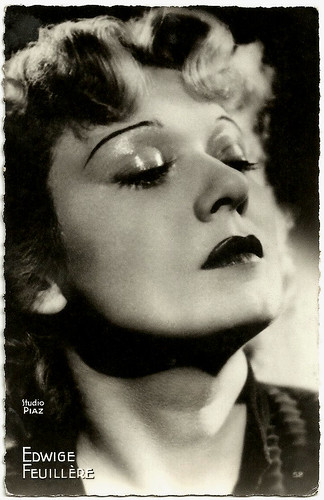
French postcard by Editions P.I., Paris, no. 52. Photo: Studio Paz.

French postcard by Editions P.I., Paris, no. 64. Photo: Studio Paz.
By the mid-1940s Edwige Feuillère had become a distinguished actress, respected for her powerful well-modulated voice, expressive eyes and magnetic presence. She was frequently acclaimed for her interpretation of classical stage roles. She turned down a seven-year Hollywood contract offered by Louis B. Mayer in 1945 and tended to make fewer films after the war. Her stage performances made her even more appreciated in films when she made them. With Gérard Philipe, she appeared in the Fyodor Dostoyevsky film adaptation L’Idiot/The Idiot (Georges Lampin, 1946).
She did 200 performances of Jean Cocteau's 'L'Aigle à deux têtes' (The Eagle with Two Heads) as the widowed queen who falls in love with a political fugitive played by Jean Marais. The role was specially written for Feuillère by Cocteau, and she also starred in the screen version, L'Aigle à deux têtes (Jean Cocteau, 1947).
She played more great screen roles like the title character in Julie de Carneilhan (Jacques Manuel, 1949), and as the older woman introducing an adolescent to love in Le Blé en herbe/The Game of Love (Claude Autant-Lara, 1954), based on Colette's novel. Her role in this film was a scandal, even though Feuillère was brilliant and the writer kept out any suggestion of prurience.
Other great films of this decade were Olivia/The Pit of Loneliness (Jacqueline Audry, 1950) nominated with a BAFTA Film Award, Adorables Créatures/Adorable Creatures (Christian-Jaque, 1952) in which she played an eccentric bourgeoise who discovers the arcane delights of a banal sandwich, and the crime drama En cas de malheur/Love Is My Profession (Claude Autant-Lara, 1958) with Jean Gabin and Brigitte Bardot.
Another major stage role, which she would also perform again and again, was the femme fatale Yse opposite Jean-Louis Barrault in Paul Claudel's 'Partage de midi'. In 1951 she made her first - and reportedly unforgettable - London stage appearance with this long and difficult role for the Renaud-Barrault company. In 1955 she returned to London for a season with La Dame aux Camélias and other plays. In 1968, when she appeared again in London in 'Partage de midi', the British theatre critic Harold Hobson described her as 'the greatest actress he had ever seen'.
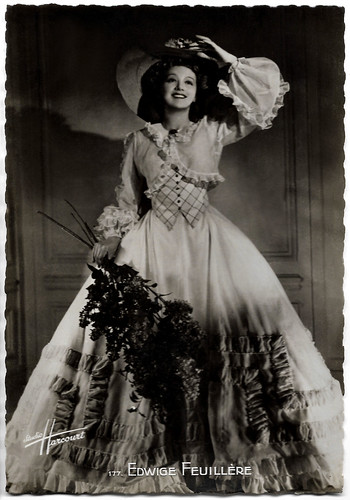
French postcard by S.E.R.P., Paris, no. 177. Photo: Studio Harcourt.

French postcard, no. 274. Photo: Studio Harcourt.
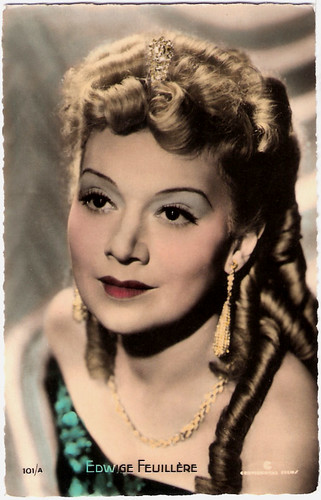
French postcard by Editions Continental, no. 101 A. Photo: Continental Films.
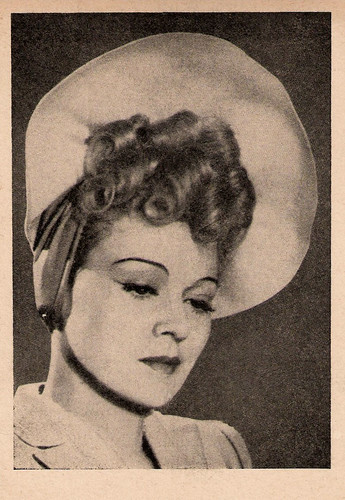
German postcard.
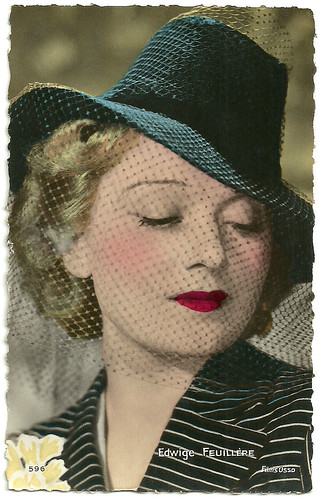
French postcard by Ed. Chantal, Paris, no. 596. Photo: Films Osso.
In the 1960s and 1970s, Edwige Feuillère appeared often on stage, such as in 1965 in 'La folle de Chaillot' (The Madwoman of Chaillot) by Jean Giraudoux. She later reprised this role on television, La folle de Chaillot (Gérard Vergez, 1976). According to IMDb, her nickname was ‘Edwige 1ère’ (Edwige the 1st) for her cool and rather imposing acting style. She was equally at home playing in dramas and comedies.
She also continued to be a popular film and television actress and worked with directors of the next generations like Michel Boisrond in an episode of Amours célèbres/Famous Love Affairs (1961) and Roman Polanski, who wrote the script for the dark cannibal comedy Aimez-vous les Femmes/A Taste for Women (Jean Léon, 1963). She showed little interest in a glamorous lifestyle. Modest and humorous in private, she was also self-deprecating about her talent in her 1977 autobiography, 'Les Feux de la Memoire' (The Fires of Memory).
One of the best of her later films was La chair de l'orchidée/The Flesh of the Orchid (Patrice Chéreau – his film debut, 1975) starring Charlotte Rampling. In this crime drama, based on James Hadley Chase's 'No Orchids for Miss Blandish', Edwige Feuillère appeared disturbingly out of character. Another interesting film was the TV film Le tueur triste/The Sad Killer (Nicolas Gessner, 1984), in which she appeared as the grandmother.
In 1984 she was awarded an honorary César. She continued to act onstage and in the occasional film until her official retirement in 1992. Her last stage performance was 'Edwige Feuillère en Scène', in which she replayed scenes from her most famous roles and told about her long career. TV broadcaster ARTE made a documentary of it, Edwige Feuillère en scène (Serge Moati, 1993). In 1993 she was named 'Commandeur des Arts et Lettres; Grand Officier de la Légion d'Honneur'. That same year she was also awarded the Molière prize for her stage work. The gracefully elegant 'grande dame' played her last role in the TV film La Duchesse de Langeais/The Dutchess of Langeais (Jean-Daniel Verhaeghe, 1995).
Edwige Feuillère died of natural causes in 1998 in Boulogne-Billancourt, Île-de-France. She was 91. After her death, Le Monde wrote: "Edwige Feuillere was our Marlene Dietrich, our Irene Dunne and our Greta Garbo, all in one."
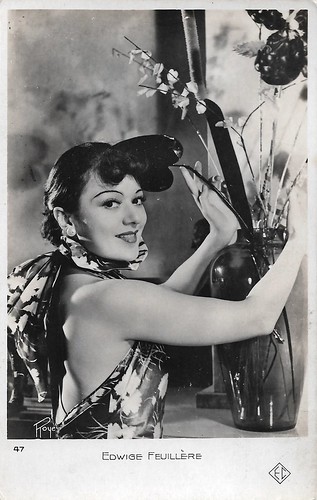
French postcard by Ed. Chantal, Paris, no. 47. Photo: Roye/Royé.

French postcard, no. 596 B. Photo: Védis Film. Edwige Feuillère in La Duchesse de Langeais (Jacques de Baroncelli, 1942).

Italian postcard by Rizzoli. Photo: Tobis.

French postcard by S.E.R.P., Paris, no. 12. Photo: Studio Harcourt.

French postcard by Editions P.I., Paris, no. 36. Photo: Teddy Piaz.

French postcard by Editions O.P., Paris, no. 106. Photo: Studio Harcourt.

French postcard by Ed. Chantal, Paris, no. 596. Photo: Films Osso.

French postcard by Viny, no. 46. Photo: Star.
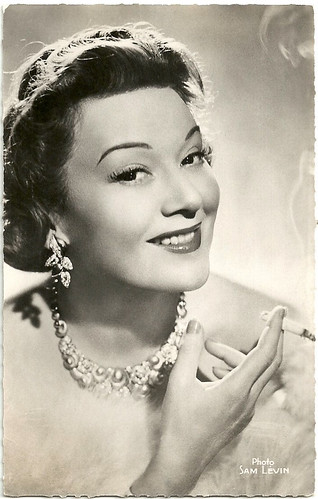
French postcard. Photo: Sam Lévin.

French postcard by Editions P.I., Paris, no. S-1000 18K.
Sources: Karel Tabery (Filmreference.com), Sandra Brennan (AllMovie), Alan Riding (The New York Times), John Calder (The Independent), Wikipedia, and IMDb.
This post was last updated on 13 March 2024.
French collectors card by Massilia.
French postcard by Editions P.I., Paris, no. 719. Photo: Studio Harcourt.
French postcard by Editions P.I., Paris, no. 15. Photo: Films Orange. Edwige Feuillère in L'honorable Catherine/The Honourable Catherine (Marcel L'Herbier, 1943).
French postcard by Editions P.I., no. 170. Photo: Studio Carlet Ainé.
French postcard by Edit. Chantal, Rueil, no. 596 A. Photo: Continental Films.
Camille
Edwige Feuillère was born Edwige Louise Caroline Cunati in Vesoul, in the Haute-Saône in eastern France in 1907. Her father was Italian and, because he was drafted by the Italian army in World War I, Edwige spent much of her childhood in Italy.
After the war, the family moved to Dijon in France. Edwige attended the lyceum in Dijon where she acted in plays including Jean Racine's plays 'Esther' and 'Athalie'. At the Dijon Conservatoire, she studied diction, interpretation of character and singing, and easily passed the entrance exam for the Paris Conservatoire in 1928.
Two years later, she won the first prize for comedy. She married an older fellow student, Pierre Feuillere, but he proved to be a drug addict who used to play suicidal games with her. She made her theatrical debut under the stage name Cora Lynn, playing small roles in 1930. In 1931 she became a member of the Comédie Française, and made her debut in Pierre Beaumarchais' comedy 'Le Mariage de Figaro'. In 1933, Edwige left both the troupe and her husband, but she kept his surname.
During the 1930s and 1940s, the stunningly beautiful actress became one of the leading ladies on the French stage. A success was her role in Édouard Bourdet's 'La Prisonniere' (The Captive) in 1935 at the Théâtre Heberthot. The play had a long run and was frequently revived. Among her most popular roles was also Marguerite Gautier in 'La Dame aux camélias' (Camille) by Alexandre Dumas fils (1939-1942).
For the next two decades, she appeared in frequent revivals of 'La Dame aux camélias' in France and Britain. Another triumph was 'Sodome et Gomorrhe' (Sodom and Gomorrah) by modern author Jean Giraudoux (1943), for which she helped to discover Gérard Philipe.
French postcard by Erres, no. 12. Photo: Paramount.
French postcard, no. 170. Photo: Star.
French postcard by Editions O.P., Paris, no. 64. Photo: Star.
French postcard by Editions P.I., no. 170. Photo: Studio Carlet Ainé.
French postcard by Greff / S.E.R.P. Editeur, Paris, no. 596 A. Photo: Continental Films.
Nude scene
Edwige Feuillère's first film appearance was in the short La Fine combine/The Fine combines (André Chotin, 1931) opposite Fernandel, and her feature debut was in Le Cordon bleu/The Champion Cook (Alberto Cavalcanti, Karl Anton, 1931). For both films, she still used the name Cora Lynn. Louis Gasnier cast her in the first film version of the farce Topaze (1933), based on the play by Marcel Pagnol. Her charm and elegance opposite Louis Jouvet were widely appreciated.
In the strait-laced Europe of 1935, she scandalised the public with a brief nude scene in Lucrèce Borgia/Lucrezia Borgia (Abel Gance, 1935). This historical drama in which she played her first leading role, solidified her popularity. That year she also appeared in the epic Golgotha/Behold the Man (Julien Duvivier, 1935) starring Harry Baur and Jean Gabin, and in the Ufa production Barcarolle (Gerhard Lamprecht, Roger Le Bon, 1935), the French-language version of Lamprecht's Barcarole (1935).
Her roles as elegant and often heartless women were displayed in Mister Flow/Compliments of Mr. Flow (Robert Siodmak, 1936), Marthe Richard au service de la France/Marthe Richard (Raymond Bernard, 1937) as a charming spy opposite Erich von Stroheim, La Dame de Malacca/Woman of Malacca (Marc Allégret, 1937), and J'étais une aventurière/I Was an Adventuress (Raymond Bernard, 1938).
She went on to work with famous director Max Ophüls in the melodrama Sans lendemain/Without Tomorrow (1939) in which she gave a wonderful performance as a jaded woman, abandoned by a shady husband with a lot of debts, who is sacrificed, and in De Mayerling à Sarajévo/Mayerling to Sarajevo (1940) about the liaison between Archduke Franz Ferdinand - unwilling heir to the Habsburg throne - and his wife, Countess Sophie Chotek. The film ends with the couple's assassination by a Serb terrorist in 1914, thus starting WW I. Work on this film began in 1939 and was interrupted by the war. It was finished in the spring of 1940, only to be banned by the Germans. The first ‘official’ premiere was on 18 May 1945.
Feuillères next film, Mam'zelle Bonaparte/Miss Bonaparte (Maurice Tourneur, 1941) became a popular success, although IMDb calls the film a ‘dud’. Another success was her role as a coquette caught by a great love for Pierre Richard-Willm in La Duchesse de Langeais/Wicked Duchess (Jacques de Baroncelli, 1941) based on a novel by Honoré de Balzac with dialogues by Jean Giraudoux. Worth watching is also the romantic screwball comedy L'Honorable Catherine/The Honourable Catherine (Marcel L’Herbier, 1943) with Feuillère as a high society blackmailer whose latest blackmail attempt is interrupted, and she has to pose as her victim’s lover.
French postcard by Tobis. Photo: Edwige Feuillère and Pierre Richard-Willm in Stradivarius (Albert Valentin, Géza von Bolváry, 1935).
French postcard by Editions P.I., La Garenne-Colombes, no. 36. Photo: Majestic.
French postcard by Editions P.I., La Garenne-Colombes, no. 36. Photo: Majestic.
French postcard by Editions P.I., Paris, no. 52. Photo: Studio Paz.
French postcard by Editions P.I., Paris, no. 64. Photo: Studio Paz.
Magnetic presence
By the mid-1940s Edwige Feuillère had become a distinguished actress, respected for her powerful well-modulated voice, expressive eyes and magnetic presence. She was frequently acclaimed for her interpretation of classical stage roles. She turned down a seven-year Hollywood contract offered by Louis B. Mayer in 1945 and tended to make fewer films after the war. Her stage performances made her even more appreciated in films when she made them. With Gérard Philipe, she appeared in the Fyodor Dostoyevsky film adaptation L’Idiot/The Idiot (Georges Lampin, 1946).
She did 200 performances of Jean Cocteau's 'L'Aigle à deux têtes' (The Eagle with Two Heads) as the widowed queen who falls in love with a political fugitive played by Jean Marais. The role was specially written for Feuillère by Cocteau, and she also starred in the screen version, L'Aigle à deux têtes (Jean Cocteau, 1947).
She played more great screen roles like the title character in Julie de Carneilhan (Jacques Manuel, 1949), and as the older woman introducing an adolescent to love in Le Blé en herbe/The Game of Love (Claude Autant-Lara, 1954), based on Colette's novel. Her role in this film was a scandal, even though Feuillère was brilliant and the writer kept out any suggestion of prurience.
Other great films of this decade were Olivia/The Pit of Loneliness (Jacqueline Audry, 1950) nominated with a BAFTA Film Award, Adorables Créatures/Adorable Creatures (Christian-Jaque, 1952) in which she played an eccentric bourgeoise who discovers the arcane delights of a banal sandwich, and the crime drama En cas de malheur/Love Is My Profession (Claude Autant-Lara, 1958) with Jean Gabin and Brigitte Bardot.
Another major stage role, which she would also perform again and again, was the femme fatale Yse opposite Jean-Louis Barrault in Paul Claudel's 'Partage de midi'. In 1951 she made her first - and reportedly unforgettable - London stage appearance with this long and difficult role for the Renaud-Barrault company. In 1955 she returned to London for a season with La Dame aux Camélias and other plays. In 1968, when she appeared again in London in 'Partage de midi', the British theatre critic Harold Hobson described her as 'the greatest actress he had ever seen'.
French postcard by S.E.R.P., Paris, no. 177. Photo: Studio Harcourt.
French postcard, no. 274. Photo: Studio Harcourt.
French postcard by Editions Continental, no. 101 A. Photo: Continental Films.
German postcard.
French postcard by Ed. Chantal, Paris, no. 596. Photo: Films Osso.
A gracefully elegant grande dame
In the 1960s and 1970s, Edwige Feuillère appeared often on stage, such as in 1965 in 'La folle de Chaillot' (The Madwoman of Chaillot) by Jean Giraudoux. She later reprised this role on television, La folle de Chaillot (Gérard Vergez, 1976). According to IMDb, her nickname was ‘Edwige 1ère’ (Edwige the 1st) for her cool and rather imposing acting style. She was equally at home playing in dramas and comedies.
She also continued to be a popular film and television actress and worked with directors of the next generations like Michel Boisrond in an episode of Amours célèbres/Famous Love Affairs (1961) and Roman Polanski, who wrote the script for the dark cannibal comedy Aimez-vous les Femmes/A Taste for Women (Jean Léon, 1963). She showed little interest in a glamorous lifestyle. Modest and humorous in private, she was also self-deprecating about her talent in her 1977 autobiography, 'Les Feux de la Memoire' (The Fires of Memory).
One of the best of her later films was La chair de l'orchidée/The Flesh of the Orchid (Patrice Chéreau – his film debut, 1975) starring Charlotte Rampling. In this crime drama, based on James Hadley Chase's 'No Orchids for Miss Blandish', Edwige Feuillère appeared disturbingly out of character. Another interesting film was the TV film Le tueur triste/The Sad Killer (Nicolas Gessner, 1984), in which she appeared as the grandmother.
In 1984 she was awarded an honorary César. She continued to act onstage and in the occasional film until her official retirement in 1992. Her last stage performance was 'Edwige Feuillère en Scène', in which she replayed scenes from her most famous roles and told about her long career. TV broadcaster ARTE made a documentary of it, Edwige Feuillère en scène (Serge Moati, 1993). In 1993 she was named 'Commandeur des Arts et Lettres; Grand Officier de la Légion d'Honneur'. That same year she was also awarded the Molière prize for her stage work. The gracefully elegant 'grande dame' played her last role in the TV film La Duchesse de Langeais/The Dutchess of Langeais (Jean-Daniel Verhaeghe, 1995).
Edwige Feuillère died of natural causes in 1998 in Boulogne-Billancourt, Île-de-France. She was 91. After her death, Le Monde wrote: "Edwige Feuillere was our Marlene Dietrich, our Irene Dunne and our Greta Garbo, all in one."
French postcard by Ed. Chantal, Paris, no. 47. Photo: Roye/Royé.
French postcard, no. 596 B. Photo: Védis Film. Edwige Feuillère in La Duchesse de Langeais (Jacques de Baroncelli, 1942).
Italian postcard by Rizzoli. Photo: Tobis.
French postcard by S.E.R.P., Paris, no. 12. Photo: Studio Harcourt.
French postcard by Editions P.I., Paris, no. 36. Photo: Teddy Piaz.
French postcard by Editions O.P., Paris, no. 106. Photo: Studio Harcourt.
French postcard by Ed. Chantal, Paris, no. 596. Photo: Films Osso.
French postcard by Viny, no. 46. Photo: Star.
French postcard. Photo: Sam Lévin.
French postcard by Editions P.I., Paris, no. S-1000 18K.
Sources: Karel Tabery (Filmreference.com), Sandra Brennan (AllMovie), Alan Riding (The New York Times), John Calder (The Independent), Wikipedia, and IMDb.
This post was last updated on 13 March 2024.