Showing posts with label Monte Blue. Show all posts

15 April 2020

Monte Blue

Stalwart, durable Monte Blue (1887-1963) was an American romantic leading man of the silent cinema. He entered films as an assistant director and stuntman with D.W. Griffith. Blue's finest role was the alcoholic doctor who finds paradise in the film about which we had a post yesterday, White Shadows in the South Seas (1928).

Monte Blue in One-Round Hogan (1927)
Austrian postcard by Iris Verlag, no. 893. Photo: Warner Bros / Micheluzzi Verleih. Monte Blue in One-Round Hogan (Howard Bretherton, 1927).

Monte Blue
Austrian postcard by Iris Verlag, no. 35a. Photo: Warner Bros.
Monte Blue
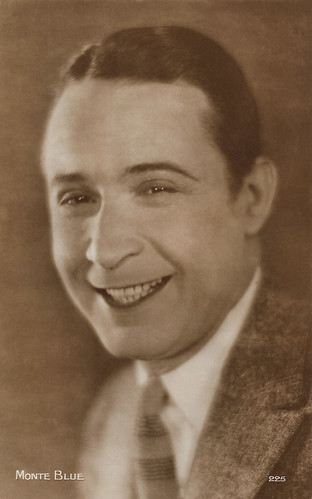
French postcard by Editions Cinémagazine, no. 226.

Raquel Torres and Monte Blue in White Shadows in the South Seas (1928)
German postcard. Ross Verlag, Berlin, no. 110/2. Photo: Metro-Goldwyn-Mayer. Monte Blue and Raquel Torres in White Shadows in the South Seas (W.S. Van Dyke, Robert Flaherty, 1928).

Stuntman for Houdini


Monte Blue was born Gerard Montgomery Blue in 1887 in Indianapolis, Indiana. His father was half-French and part Cherokee and Osage Indian, a Civil War veteran in the Union army who had once served as a scout for famed frontiersman Buffalo Bill Cody.

His father was killed in a railroad accident when Blue was eight years old. His mother could not raise Monte and her other four children by herself, so Monte and one of his brothers were raised in the Soldiers and Sailors Orphans Home in Knightstown, Indiana. He eventually worked his way through Purdue University in West Lafayette, Indiana.

He played football and worked as a fireman, railroad worker, coal miner, cowpuncher, ranch hand, circus rider, and lumberjack. He started his film career as a stuntman for D.W. Griffith and made his debut as an extra in The Birth of a Nation (1915). Next, he played another small part in Intolerance (D. W. Griffith, 1916).

He also was a stuntman or stand-in for Sir Herbert Beerbohm Tree during the making of Macbeth (John Emerson, 1916). He also appeared in the Harry Houdini film The Grim Game (Irvin Willat, 1919) in which he did stunts in an aeroplane because Houdini had a fear of flying.

Gradually moving to support roles for both D.W. Griffith and Cecil B. DeMille, Blue earned his breakthrough role as Danton in Griffith's classic Orphans of the Storm (D.W. Griffith, 1921) with Lillian Gish and Dorothy Gish.

Monte Blue in The Affairs of Anatol (1921)
American postcard by Max B. Sheffer Card Co., Chicago (M.B.S.C.Co.), 1922. Photo: First National. Monte Blue as Abner Elliott in The Affairs of Anatol (Cecil B. DeMille, 1921).

Mae Murray and Monte Blue in The Gilded Lily (1921)
Italian postcard by G. Vettori, Bologna, no. 464. Photo: Ernest Bachrach / Paramount Pictures. Mae Murray and Monte Blue in The Gilded Lily (Robert Z. Leonard, 1921).

Viola Dana and Monte Blue in Revelation (1924)
Italian postcard by G. Vettori, Bologna, no. 488. Photo: Metro Picture. Viola Dana and Monte Blue in Revelation (George D. Baker, 1927). The Italian title is Aspiri e sospiri.....

Monte Blue in White Shadows in the South Seas (1928)
German postcard by Ross Verlag, no. 110/6. Photo: Metro-Goldwyn-Mayer. Monte Blue in White Shadows in the South Seas (W.S. Van Dyke, Robert Flaherty, 1928).

A rugged romantic lead


Monte Blue rose to stardom as a rugged romantic lead opposite Hollywood's top silent stars, among them Gloria Swanson, Clara Bow, and Norma Shearer. He was most often partnered with Marie Prevost, such as in the silent romantic comedy Kiss Me Again (Ernst Lubitsch, 1925).

Blue's finest silent-screen performance was as the alcoholic doctor who finds paradise in White Shadows in the South Seas (W.S. Van Dyke, Robert Flaherty, 1928).

He made a relatively easy transition into talkies as he had a fine, cultivated voice, but, at the same time, lost most of his investments when the stock market crashed in 1929. By the 1930s the ageing star had moved back into small, often unbilled parts, continuously employed, however, by his old friend DeMille and Warner Bros.

In the Film Noir Key Largo (John Huston, 1948), Blue was memorable as 'Sheriff Ben Wade' opposite Lionel Barrymore. On TV, he was a recurring guest star in The Lone Ranger (1949-1953). At the end of his life, he was working as an advance man for the Hamid-Morton Circus in Milwaukee.

Monte Blue died of a coronary attack complicated by influenza in 1963. He was married three times. His wives were Erma Gladys (divorced in 1923), Tove Janson (1924-1956; her death) and Betty Jean Munson Mess (1959-1963; his death). With Janson he had two children: Barbara Ann (d. 2008) and Richard Monte (d. 1962).
Monte Blue
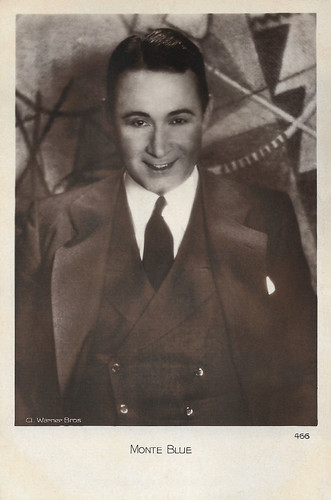
French postcard by Cinémagazine-Edition, Paris, no. 466. Photo: Warner Bros.

Monte Blue
French postcard in the Les Vedettes de Cinéma series by A.N., Paris, no. 23. Photo: Paramount.

Monte Blue
British postcard in the Picturegoer series, London, no. 35a.

Monte Blue
Spanish postcard by EFB (Editorial Fotografica, Barcelona), no. A-33.

Monte Blue and Eleanor Boardman in The Flood (1931)
British postcard in the Film Partners Series, no. PC6, London. Photo: Columbia. Monte Blue and Eleanor Boardman in The Flood (James Tinling, 1931).

Sources: Gary Brumburgh (IMDb), Wikipedia and IMDb.

This post was last updated on 10 June 2023.

14 April 2020

White Shadows in the South Seas (1928)

White Shadows in the South Seas (W.S. Van Dyke, Robert Flaherty, 1928) started a series with exotic films in which Western pioneers travelled to Polynesian islands or other far-away places. In White Shadows in the South Seas, Monte Blue starred as the traveller and Raquel Torres debuted as the beautiful island girl he falls in love with. The film was shot on Tahiti, 4000 miles from Hollywood, a rarity for the time.

Monte Blue and Raquel Torres in White Shadows in the South Seas (1928)
German postcard. Ross Verlag, Berlin, no. 110/1. Photo: Metro-Goldwyn-Mayer. Monte Blue and Raquel Torres in White Shadows in the South Seas (W.S. Van Dyke, Robert Flaherty, 1928).

Raquel Torres and Monte Blue in White Shadows in the South Seas (1928)
German postcard by Ross Verlag, Berlin, no. 110/2. Photo: Metro-Goldwyn-Mayer. Monte Blue and Raquel Torres in White Shadows in the South Seas (W.S. Van Dyke, Robert Flaherty, MGM 1928).

Raquel Torres in White Shadows in the South Seas (1928)
German postcard by Ross Verlag, no. 110/5. Photo: Metro-Goldwyn-Mayer. Raquel Torres in White Shadows in the South Seas (W.S. Van Dyke, 1928).

Monte Blue in White Shadows in the South Seas (1928)
German postcard by Ross Verlag, no. 110/6. Photo: Metro-Goldwyn-Mayer. Monte Blue in White Shadows in the South Seas (W.S. Van Dyke, Robert Flaherty, 1928).

A masterful blend of drama and documentary


In White Shadows in the South Seas (W.S. Van Dyke, Robert Flaherty, 1928), Monte Blue plays Dr. Matthew Lloyd, an alcoholic doctor who is disgusted by the way white men have cheated, robbed and exploited the trusting natives  of the Polynesian Islands. He makes an enemy of Sebastian (Robert Anderson), an evil trader, who manages to get Lloyd on to a plague-ridden boat, which, during a typhoon, is shipwrecked on another uncharted island. The Pacific island is still untouched by the 'white shadows', and Lloyd falls in love with native girl Fayaway (Raquel Torres).

When Lloyd rescues the chief's young son from drowning the island people make him a God. Enchanted by the idyllic lifestyle of the islanders, Lloyd reacts with horror when he sees Sebastian's group sail into view, bringing their usual seductive trinkets of alcohol and cigarettes. Attempting to quell the invasion, Blue is killed by one of Sebastian's men. As her island falls victim to civilisation, Fayaway mourns over her lover's grave.

In 1927, MGM production head Irving Thalberg was in the hospital recuperating and during his stay he read the travel book 'White Shadows in the South Seas' by Frederick O'Brien, who had spent a year in the South Pacific with Marquesas Islanders. Thalberg decided to make O'Brien's book into an epic adventure film and he selected  Robert Flaherty, a famed documentary maker, to direct. Thalberg had been very impressed with his documentary Moana (1926). W.S. Van Dyke, who had mainly worked on Westerns, was named as assistant director.  The film began production in 1927 as a co-venture between Flaherty, Cosmopolitan and MGM.

White Shadows in the South Seas was filmed on location in Tahiti, even though the opening credits claim it was shot on location in the Marquesas Islands with "authentic" islanders. Robert Flaherty had plenty experience with the South Seas: he had lived with his wife and children in Samoa from April 1923 to December 1924 filming Moana. He was at first given complete artistic control, but he began to falter in terms of keeping cast and crew organised.

For Metro-Goldwyn-Mayer, White Shadows was a special project. It was to be MGM's first sound film, with a pre-recorded soundtrack, and the first film in which Leo, the MGM lion roared during the introduction. The soundtrack consisted of a romantic score by William Axt and David Mendoza, with a few sound effects such as wind howling, a storm, trees ruffling and one faint word "Hello".

Flaherty moved too slowly to suit MGM. More and more directorial authority was relegated to Flaherty's assistant, the phenomenally fast W. S. Van Dyke who was known as "One Take Woody", and would go on to an Oscar nomination for The Thin Man (1934). Frustrated, Flaherty resigned although some reports claim that he fell ill and was taken off the project. The film became solely the responsibility of Van Dyke.

The cinematographer was Clyde De Vinna, whose beautiful, vivid photography justly won the Oscar for Best Cinematography. There are some awesome underwater sequences, featuring octopuses, sharks, pearl-diving and an unforgettable, intimate scene in which the 'white god' teaches the island girl to whistle.

Hal Erickson at AllMovie: "Despite the wails from the pro-Flaherty camp about "compromise" and "bastardization", the finished White Shadows in the South Seas is a superlative work. Loosely based on a 1919 book by Frederick O'Brien, the film charts the denigration of the South Sea islands and its denizens thanks to the intervention of white civilization. (...)

Gorgeously photographed, White Shadows in the South Seas is a masterful blend of drama and documentary. Most surviving prints do not include the clumsily constructed talkie sequences, wherein Monte Blue teaches Raquel Torres how to whistle (this scene works far better when conveyed silently)."


Monte Blue and Raquel Torres in White Shadows, Frans
French postcard for the Parisian Ciné Madeleine. Photo: Metro-Goldwyn-Mayer. Monte Blue and Raquel Torres in White Shadows in the South Seas (W.S. Van Dyke, Robert Flaherty, 1928).

White Shadows in the South Seas (1928)
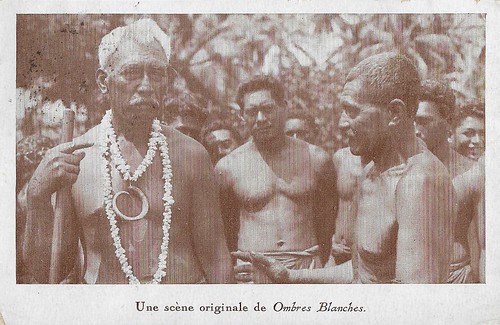
French postcard for the Parisian Ciné Madeleine. Photo: Metro-Goldwyn-Mayer. Nonprofessional actors from Tahiti in White Shadows in the South Seas (W.S. Van Dyke, Robert Flaherty, 1928).

Raquel Torres in White Shadows in the South Seas (1928)
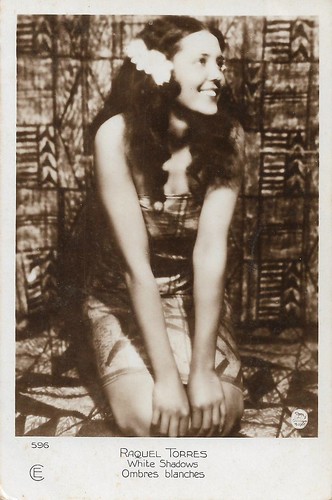
French postcard by Cinémagazine-Editions, no. 596. Photo: Metro-Goldwyn-Mayer. Raquel Torres in White Shadows in the South Seas (W.S. Van Dyke, Robert Flaherty, 1928).

Source: Hal Erickson (AllMovie), Wikipedia and IMDb.