Showing posts with label Szöke Szakáll. Show all posts

15 October 2024

Ich will nicht wissen wer du bist (1932)

Liane Haid, Gustav Fröhlich and Szöke Szakáll were the stars of the delightful romantic comedy Ich will nicht wissen, wer du bist/I Don't Want To Know Who You Are (1932), scripted by Ernst Marischka and Robert Weil and directed by Géza von Bolváry. A year later, Szakall but also Fröhlich's wife and daughter had to go into exile because of the rise of Adolf Hitler and the Nazi Party. The rise of the fascists also ended the careers of the Jewish publishers of the postcards in this post, Heinrich Ross of Ross Verlag and Joseph Peter Welker of JosPe.

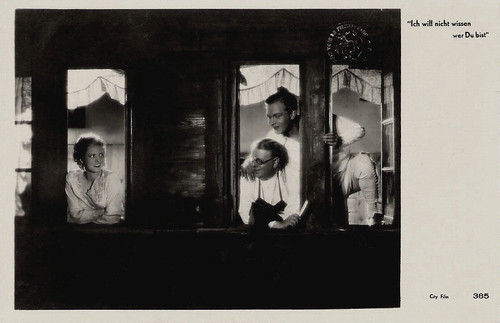
Liane Haid, Szöke Szakall and Gustav Fröhlich in Ich will nicht wissen, wer du bist (1932)
Dutch postcard by JosPe, Arnhem, no. 385. Photo: City Film. Liane Haid, Gustav Fröhlich and Szöke Szakáll in Ich will nicht wissen, wer du bist/I Don't Want To Know Who You Are (Géza von Bolváry, 1932).

Gustav Fröhlich, Liane Haid, and Betty Bird in Ich will nicht wissen wer du bist
German postcard by Ross Verlag, no. 158/1. Photo: Boston-Film. Gustav Fröhlich, Liane Haid and Betty Bird in Ich will nicht wissen, wer du bist/I Don't Want To Know Who You Are (Géza von Bolváry, 1932).
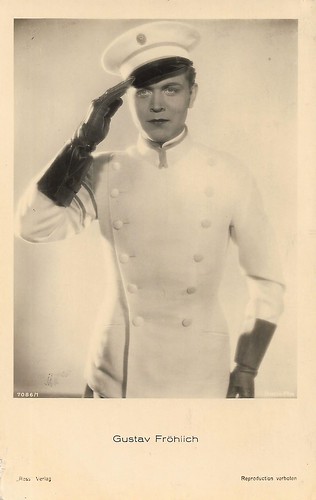
Gustav Fröhlich in Ich will nicht wissen, wer du bist (1932)
German postcard by Ross Verlag. no. 7086/1, 1932-1933. Photo: Boston-Film. Gustav Fröhlich in Ich will nicht wissen, wer du bist/I Don't Want to Know Who You Are (Géza von Bolváry, 1932).

A comedy of mistaken identities


Ich will nicht wissen, wer du bist/I Don't Want To Know Who You Are (Géza von Bolváry, 1932) is a comedy of mistaken identities, written by Ernst Marischka and Robert Weil.

The penniless Count Lerchenau (Gustav Fröhlich) has to work as a chauffeur under the name Robert Lindt. However, he lost his last job, because women love him so much.

His former servant Ottokar (Szöke Szakáll) remains loyal to him and tries to get him to marry a rich woman. However, at the restaurant where he is supposed to meet a suitable lady, he ends up flirting with the attractive Alice (Liane Haid) instead.

Robert gives Count Lerchenau as a reference to get a job on President Fuhring's (Max Güllstorff) staff. But then Führing wants to speak to Lerchenau, and Franz has to play the role of the count...

Alice, it turns out, is Führing's niece. When she learns that Robert is only a chauffeur, she wants nothing more to do with him. But after all sorts of turbulence, they find each other after all.

Gustav Fröhlich in Ich will nicht wissen, wer du bist (1932)
Austrian postcard by Iris Verlag, no. 6498. Photo: Boston Film / Lux Film. Gustav Fröhlich in Ich will nicht wissen, wer du bist/I Don't Want to Know Who You Are (Géza von Bolváry, 1932).

Liane Haid and Gustav Fröhlich in Ich will nicht wissen, wer du bist
Dutch postcard, no. 360. Photo: City Film. Liane Haid and Gustav Fröhlich in Ich will nicht wissen, wer du bist (Géza von Bolváry, 1932). The mark on the right side of the card refers to the Dutch censorship approval.

Because of the regime, because everything was bombed, and because all the good directors had left


The male star of Ich will nicht wissen, wer du bist/I Don't Want To Know Who You Are (Géza von Bolváry, 1932) was Gustav Fröhlich, who had his breakthrough as Freder Fredersen in Metropolis (Fritz Lang, 1927). Fröhlich often played smart gentlemen in lighthearted musicals and romances. Because of his carefree attendance, Fröhlich was seldom allowed to play other characters. He frequently worked with Hungarian film director Géza von Bolváry, who specialised in Viennese Operettas and romantic comedies. Between 1931 and 1933 they made six films together. These include Liebeskommando/Love's Command (Géza von Bolváry, 1931), Ich will nicht wissen, wer du bist/I Do Not Want to Know Who You Are (Géza von Bolváry, 1932), and Was Frauen träumen/What Women Dream (Géza von Bolváry, 1933), which was co-written by Billy Wilder.

In 1931, Fröhlich married Hungarian opera star and actress Gitta Alpár, with whom he had a child, Julika. Alpár was Jewish and the rise to power of Adolf Hitler in 1933 destroyed her successful film career in Germany. Mother and child were forced to leave Germany and fled to the U.S. Fröhlich distanced from his wife because he didn't want to endanger his career. During the Third Reich, he remained one of the most prominent German film stars. Their marriage was dissolved in 1935 as 'illegal' in National Socialist Germany. After the war, Fröhlich tried to apologise for his behaviour but Alpár could not answer his pleas. A circumstance which, according to IMDb, gave Fröhlich a hard time in his last years and beclouded his lust for life.

Liane Haid was the first Austrian movie star in film history. She already appeared in operas and operettas before she made her first film appearance. Very popular were her silent film operettas Im weißen Rößl/The White Horse Inn (Richard Oswald, 1926) and Die Csardasfürstin/The Csardas Princess (Hanns Schwarz, 1927). The transition to sound film, which required a different way of acting, she mastered very well. In the hit film Das Lied ist aus/The Song Is Over (Géza von Bolváry, 1930), she sang the song that became famous: 'Adieu mein kleine Gardeoffizier' composed by Robert Stolz. Haid was at the height of her popularity. In 1933 alone, she appeared in nine feature films. From the mid-1930s, she refused film offers and instead focused on her stage career. In 1942, she escaped from Nazi Germany to Switzerland "because of the regime, because everything was bombed, and because all the good directors had left".

In the early 1930s, Hungarian actor Szöke Szakáll was, next to Hans Moser, the most significant representative of the Wiener Film, the Viennese light romantic comedy genre. Among his German films was Géza von Bolváry's Zwei Herzen im 3/4 Takt/Two Hearts in Waltz Time (1930). The Jewish Szakáll was forced to return to Hungary, because of the rise of Adolf Hitler and the Nazi movement. He was involved in over 40 films in his native land, including Skandal in Budapest/Romance in Budapest (Steve Sekely, Géza von Bolváry, 1933). When Hungary joined the Axis in 1940, he went into exile with his wife and became famous in Hollywood as S.Z Sakall. Many of Szakáll's close relatives later died in Nazi concentration camps, including all three of his sisters and his niece, as well as his wife's brother and sister.

The sets of Ich will nicht wissen, wer du bist/I Don't Want To Know Who You Are were designed by the art director Franz Schroedter. The music was by Robert Stolz. The title song 'Ich will nicht wissen wer du bist', composed by Stolz with lyrics by Ernst Marischka, was sung by Liane Haid. In the cast were also Adele Sandrock as Emerenzia, Betty Bird as Käthe, her niece, Julius E. Herrmann as Councillor of Commerce Blume, and Lotte Lorring as his wife Helga. At VPRO, the reviewer writes: 'An upbeat film operetta with very nice songs by Robert Stolz and fine roles by Liane Haid and Gustav Fröhlich. In 1942, scriptwriter Ernst Marischka directed a remake of the film, Abenteuer im Grandhotel/Adventures in the Grand Hotel (Ernst Marischka, 1942) with Wolf Albach-Retty and Carola Höhn. Hans Moser now played the role of Szöke Szakáll.

Gustav Fröhlich in Ich will nicht wissen, wer du bist (1932)
Dutch Postcard, no. 362. Photo: City Film. Gustav Fröhlich in Ich will nicht wissen, wer du bist/I Don't Want To Know Who You Are (Géza von Bolváry, 1932).

Liane Haid and Gustav Fröhlich in Ich will nicht wissen, wer du bist
Dutch Postcard, no. 382. Photo: City Film. Liane Haid and Gustav Fröhlich in Ich will nicht wissen, wer du bist/I Don't Want To Know Who You Are (Géza von Bolváry, 1932).

Gustav Fröhlich and Liane Haid in Ich will nicht wissen, wer du bist (1932)
Dutch postcard by JosPe, Arnhem, no. 384. Photo: City Film. Liane Haid and Gustav Fröhlich in Ich will nicht wissen, wer du bist/I Don't Want To Know Who You Are (Géza von Bolváry, 1932).

Source: VPRO (Dutch), Filmportal (German), Wikipedia (English) and IMDb.

30 July 2018

Szöke Szakáll

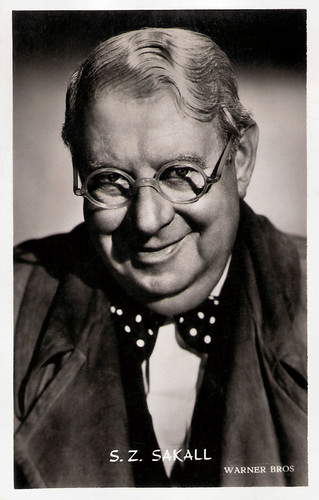
Cute, chubby-jowled Hungarian actor Szöke Szakáll (1883-1955) started his film career in the German and Austrian silent cinema. From 1940 on, he became known in Hollywood as character actor S.Z. Sakall. He was memorable as Carl, the head waiter in Casablanca (Michael Curtiz, 1942) and played many more supporting roles in comedies and musicals, often as a lovable, somewhat befuddled uncle, businessman or neighbourhood eccentric.

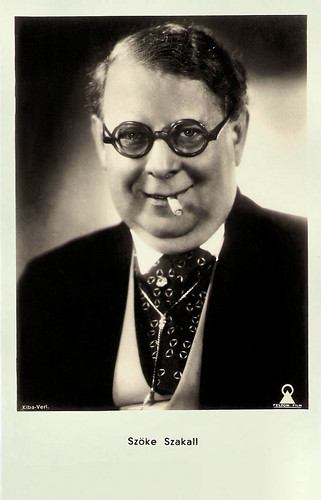
Szöke Szakall in Mädchen zum Heiraten (1932)
Austrian postcard by Iris-Verlag, no. 6539. Photo: Kiba-Verl. / Felsom-Film. Publicity still for Mädchen zum Heiraten/Girls to marry (Wilhelm Thiele, 1932).

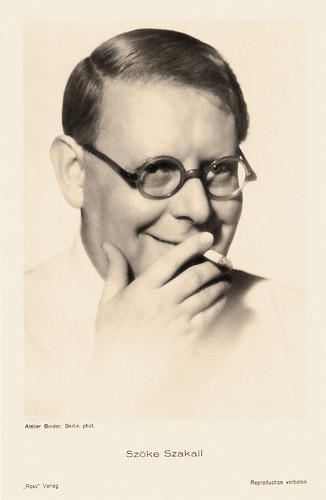
Szöke Szakáll
German postcard by Ross Verlag, no. 7339/1, 1932-1933. Photo: Atelier Binder, Berlin.

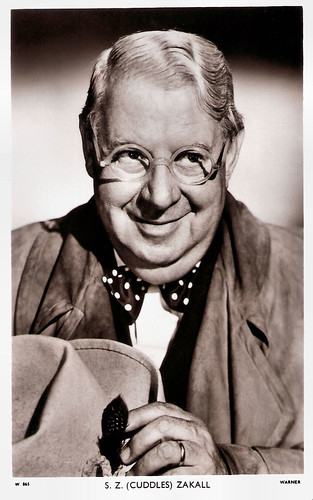
Szöke Szakall
British postcard in the Picturegoer series, London, no. W 865. Photo: Warner Bros.

Blonde Beard


Szöke Szakáll was born Gerő Jenő in Budapest, Austria-Hungary (now Hungary) in 1883 (some sources say 1882 or 1884). His stage name Szöke Szakáll means in Hungarian 'blonde beard'. At 18, he was called so as a young writer and aspiring actor because he wore a beard to look older.

The actor became a star of the Hungarian stage and screen in the 1910s and early 1920s. His films included Az újszülött apa/The newborn dad (Eugen Illés, 1916) and A dollárnéni/The dollar (Lajos Lázár, 1917).

At the beginning of the 1920s, he moved to Vienna, where he appeared in Hermann Leopoldi's Kabarett Leopoldi-Wiesenthal. One of his first film roles there was in Familientag im Hause Prellstein/Family Day in House Prellstein (Hans Steinhoff, 1927) with Erika Glässner.

The next years, he appeared in dozens of films including Großstadtschmetterling/Pavement Butterfly (Richard Eichberg, 1929) starring Anna May Wong, and in Ihre Majestät die Liebe/Her Majesty Love (Joe May, 1931) starring Käthe von Nagy, which was remade in Hollywood as Her Majesty, Love (William Dieterle, 1931) with W.C. Fields in Szákall's role.

In the 1930s, he was, next to Hans Moser, the most significant representative of the Wiener Film, the Viennese light romantic comedy genre. For a brief period during this time, he ran his own production company.

Szákall was forced to return to Hungary, because of the rise of Adolf Hitler and the Nazi movement. He was involved in over 40 films in his native land, including Skandal in Budapest/Romance in Budapest (Steve Sekely, Géza von Bolváry, 1933) and Fräulein Lilli/Miss Lilli (Hans Behrendt, Robert Wohlmuth, 1936), both starring Franziska Gaàl.

When Hungary joined the Axis in 1940, he went in exile with his wife. Many of Szákall's close relatives later died in Nazi concentration camps, including all three of his sisters and his niece, as well as his wife's brother and sister.

Liane Haid, Szöke Szakall and Gustav Fröhlich
Dutch postcard by JosPe, Arnhem, no. 385. Photo: City Film. Liane Haid, Gustav Fröhlich and Szöke Szákall were the stars of the German comedy Ich will nicht wissen, wer du bist/I Do Not Want to Know Who You Are (Géza von Bolváry, 1932).

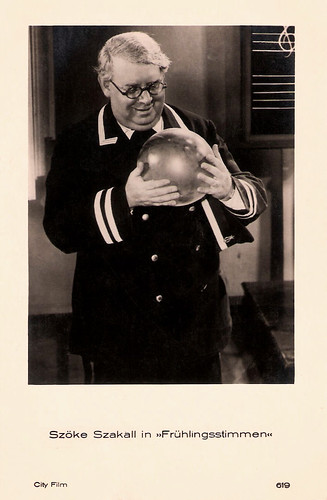
Szöke Szakáll
Dutch postcard by City Film, no. 619. Photo: publicity still for Frühlingsstimmen/Voices of Springtime (Pál Fejös, 1933).

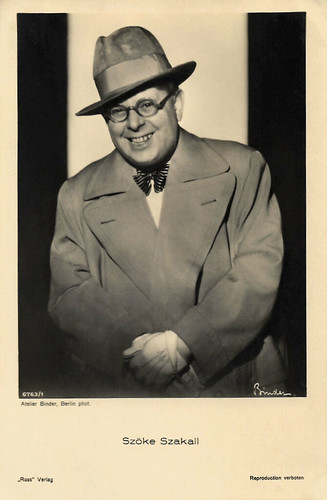
Szöke Szakall
German postcard, no. 6763/1, 1931-1932. Photo: Atelier Binder, Berlin.

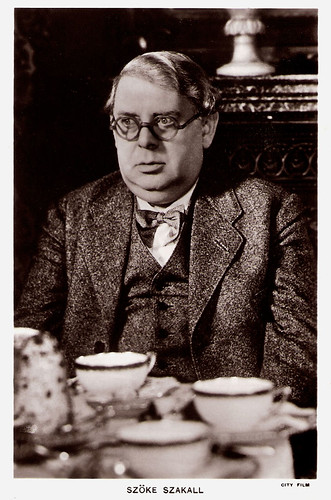
Szöke Szakall
Dutch postcard by City Film.

Cuddles


Producer Joe Pasternak had invited Szöke Szakáll in 1940 to come to the US. His first Hollywood role as S.Z. Sakall was in the comedy It's a Date (William A. Seiter, 1940) opposite Deanna Durbin.

Memorable was his turn as a butler in the comedy The Devil and Miss Jones (Sam Wood, 1941) with Jean Arthur. His first big hit was Ball of Fire (Howard Hawks, 1941) with Gary Cooper and Barbara Stanwyck.

Later, he signed a contract with Warner Brothers. There he was unforgettable as Carl, the head waiter in Casablanca (Michael Curtiz, 1942) and as a somewhat lecherous Broadway producer in the biography/musical Yankee Doodle Dandy (Michael Curtiz, 1942) with James Cagney.

Producer Hal Wallis had signed Sakall for the role of Carl in Casablanca three weeks after filming had begun. When he was first offered the part, Sakall hated it and turned it down. Sakall finally agreed to take the role provided they gave him four weeks of work. The two sides eventually agreed on three weeks.

In the 1940s and 1950s, he played many more supporting roles in comedies and musicals, often as a lovable somewhat befuddled uncle, businessman or neighbourhood eccentric. His nickname became Cuddles. He was famous for using the phrase 'everything hunky dory'.

Among his films of the 1940s are Christmas in Connecticut (Peter Godfrey, 1945) with Barbara Stanwyck, the drama Embraceable You (Felix Jacoves, 1948) and Michael Curtiz's Romance on the High Seas (1948) - Doris Day's film debut.

His films of the 1950s included two more musicals with Doris Day, Tea for Two (David Butler, 1950) and Lullaby of Broadway (David Butler, 1951), and the Errol Flynn Western Montana (Ray Enright, 1950).

His last movie was the musical The Student Prince (Richard Thorpe, 1954). That year, Szöke Szakáll retired from films and he died of a heart attack a year later in Los Angeles, ten days after his 72nd birthday.

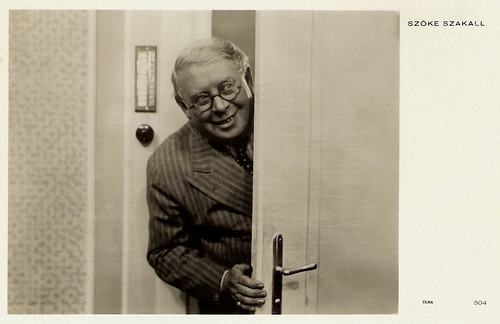
Szöke Szakall
Dutch postcard, no. 504. Photo: Filma.

Szöke Szakall
Belgian postcard, offered by Nieuwe Merksemsche Chocolaterie S.P.R.L., Merksem (Anvers). Photo: Warner Bros.

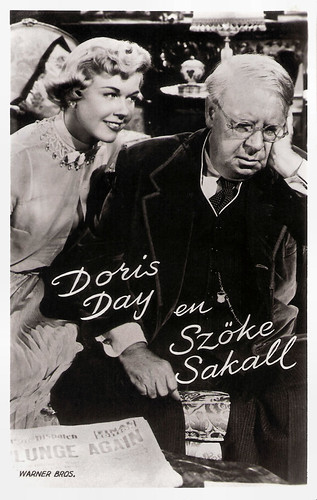
Szöke Szakall and Doris Day in Tea for Two (1950)
Dutch postcard by Takken / 't Sticht, no. AX 343. Photo: Warner Bros. Publicity still for Tea for Two (David Butler, 1950), the first film for which Doris Day received top-billing.

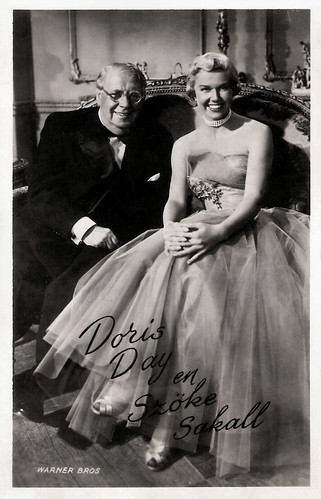
Szöke Szakall and Doris Day in Lullaby of Broadway (1951)
Dutch postcard by Takken / 't Sticht, no. AX 631. Photo: Warner Bros. Publicity still for Lullaby of Broadway ( (David Butler, 1951) with Doris Day.

Sources: Wikipedia and IMDb.