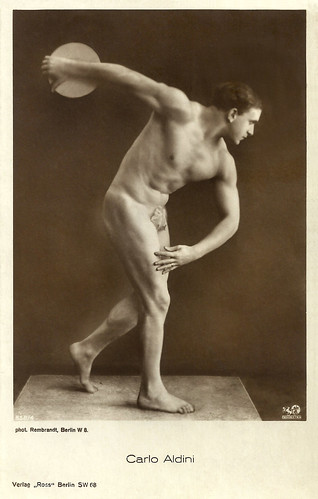
German postcard by Ross Verlag, no. 858/4. Photo: Phoebus Film / Rembrandt. Carlo Aldini imitates Myron's discus thrower.

German or Austrian postcard by FMSI, no. 55. Photo: Studium Film. Carlo Aldini as Achilles in the German two-part epic film Helena (Manfred Noa, 1924).
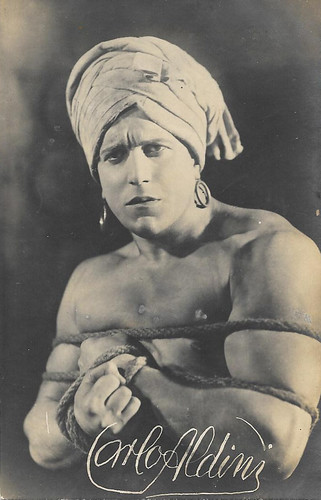
Italian postcard. Photo: publicity still for the film Dreiklang der Nacht/Triad of the night (Karl Gerhardt, 1924). Collection: Didier Hanson.
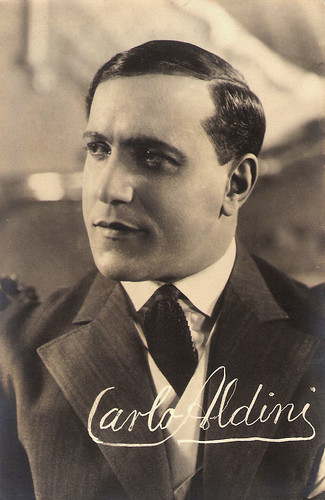
French postcard by Spa Rueil.
Wrestling, Boxing and Jumping
Carlo Aldini was born in 1894 in Pieve di Fosciano near Lucca, Italy, but he was raised in Bologna. There he frequented the famous gymnastic club Virtus from 1910-1911. It wasa the same club in which Luciano Albertini had trained. Soon Carlo won matches in all sections.
At the age of 15, he was a champion in wrestling, boxing and jumping in the province of Emilia. In 1914 and 1915 he won the national wrestling championship, while in 1916 he won the pentathlon.
At the time, the Italian cinema was keen on athletic men and the Cinegraf studio discovered Aldini in 1920. His debut was in their action-adventure La 63 - 7157/The Adventures of Carlo Aldini (Salvo Alberto Salvini, 1920) which featured lots of cars.
Then the Rodolphi film company launched him as Ajax in a series of historical epics, starting with Ajax (Raimondo Scotti, 1921) and followed by films such as Le perle di Cleopatra/The Pearl of Cleopatra (Guido Brignone, 1922). His films, all shot in Turin, were made by renowned directors like Guido Brignone and Romano Borgnetto, and scripted by writers like Arrigo Frusta, Alessandro De Stefani and Giovacchino Forzano. The scripts were simple but effective, focusing on how Ajax would restore order and peace.
He also starred in the comic action film La fuga di Socrate/The Flight of Socrates (Guido Brignone, 1923). In this film, Carlo pursues his fiancee's parrot all over the world. In the end, the parrot returns to his mistress, but Carlo dumps his hysterical fiancee for a nice girl he met during his travels.
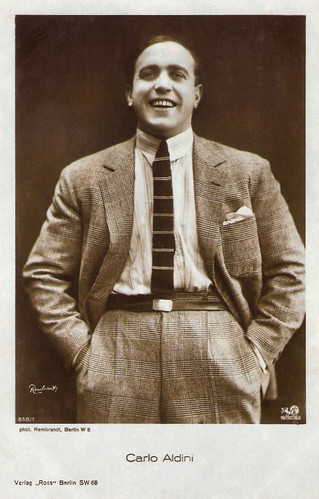
German postcard by Ross Verlag, no. 858/1, 1925-1926. Photo: Rembrandt, Berlin.
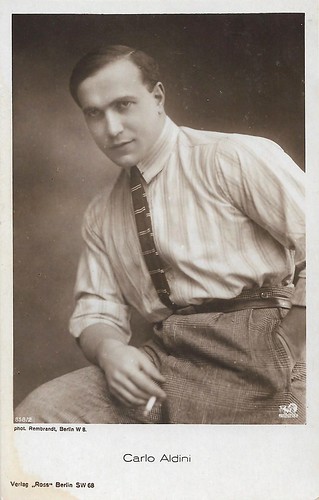
German postcard by Ross Verlag, no. 858/2, 1925-1926. Photo: Rembrandt, Berlin / Phoebus Film.

German postcard by Ross Verlag, no. 858/3, 1925-1926. Photo: Rembrandt, Berlin. Phoebus Film.

German postcard by Ross Verlag, no. 1276/1, 1927-1928. Photo: La Serenissima, Bologna.
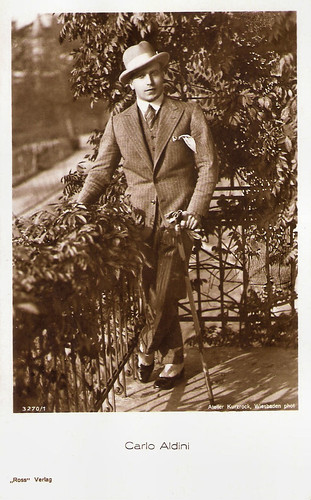
German postcard by Ross Verlag, no. 3270/1, 1928-1929. Photo: Atelier Kurzrock, Wiesbaden.
Sensationsfilme
The Italian film crisis forced Carlo Aldini to move to Berlin where he was well received and starred in a series of 'Sensationsfilmen'. His first German production, Die narrische Wette des Lord Aldini (Luigi Romano Borgnetto, 1923) is absent in IMDb. The film was originally intended for Bartolomeo Pagano, better known as Maciste, who however after four modest films called it a day and went back to Italy. The film opens with a scene of Aldini showing off by flexing his muscles before the camera, but the long plot which also involves a kind of Ruritania story didn't appeal. The film went almost unnoticed by the German film press.
Yet, memorable is his next role as Achilles in the two-part epic Helena (Manfred Noa, 1924) about the Homeric battle of Troy. Italian actress Edy Darclea played Helen of Troy and Vladimir Gajdarov Paris. The film was shot at the Emelka studios in Munich with an all-star cast. The later so prolific film director Karel Lamac played Patroklos, Achilles' devoted friend and lover, who pays for his dedication with his life. In this heroic film Aldini's classic beauty - robust, muscular but also slender and gentleman-like - was expressed best.
Aldini's part was prominently publicised and was well received, even if the film itself suffered from the coinciding release of Fritz Lang's epic Die Nibelungen (1924). Just like before him with Bartolomeo Pagano, Mario Guaita-Ausonia and Luigi Albertini, the epic resulted in starring roles in a series of modern action films, 'Sensationsfilme', full of crime, adventure and breathtaking stunts. Among these films were were Gentleman auf Zeit/Gentleman on time (Karl Gerhardt, 1924), Nick, der König der Chauffeure/Nick, King of the chauffeurs (Carl Wilhelm, 1925) opposite Dutch star Adolphe Engers, and Der Kampf gegen Berlin/The Battle Against Berlin (Max Reichmann, 1926) with Jenny Jugo.
In 1926 Carlo Aldini started his own Aldini Film company. Italian director Nunzio Malasomma directed him in various German films such as Jagd auf Menschen/Hunted People (1926) with Maly Delschaft, and Einer gegen alle/One Against All (1927). Aldini was known for his stunts and heroism, while his supporting actors like Hermann Picha, Adolphe Engers and Siegfried (Sig) Arno provided the humour. As David Chapman writes: "Like Luciano Albertini and Mario Guaita-Ausonia, Aldini looks as photogenic in a tuxedo as he does when the plot requires him to don tight jerseys or to remove his shirt. It was the action that motivated his films, and there was seldom a letup in the stunts, falls, leaps, and lifts performed while saving a damsel in distress or pursuing another benevolent goal."
Aldini also made films in Great Britain and Czechoslovakia. For a short while, Aldini continued to work in German sound film and even directed one film himself: Im Kampf mit der Unterwelt/In the battle with the underworld (1930) with Ruth Weyher. His last films were two middle-length films by Phil Jutzi: Tempo, Carlo, Tempo (1933) and Carlo's schönste Abenteuer/Carlo's Most Beautiful Adventures (1934).
In 1943 he was repatriated to Bologna. His perfect knowledge of German permitted him to act as a mediator between the partisans and the retreating German army in April 1945. This resulted in his house filling up with arms by the Germans to show their surrender. In Bologna, Aldini married Emilia Cella, whom he acquainted in 1945. Carlo Aldini died in 1961 in a hospital in Bologna, his once athletic body ruined by an irreversible disease.
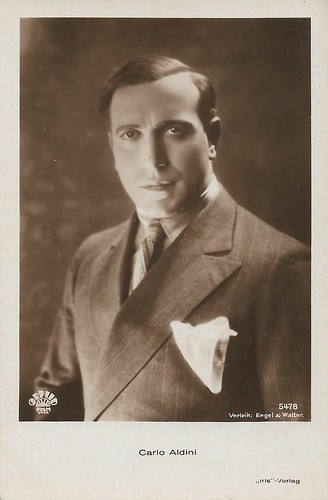
Austrian postcard by Iris Verlag, no. 5478. Photo: Verleih Engel & Walter / Orplid Film.
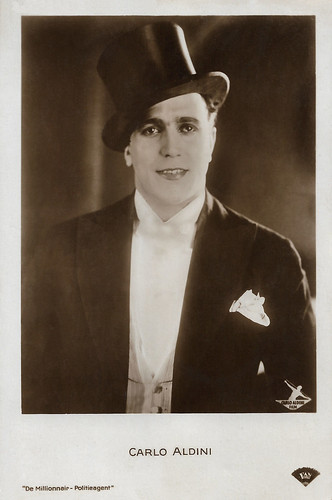
Dutch postcard. Photo: Carlo Aldini Film / FAN Film. Carlo Aldini in Der Mann ohne Kopf (Nunzio Malasomma, 1927). Dutch distributor FAN Film released the film as De Millionnair-Politieagent. The back of the card makes publicity for the film at the Flora Theatre in The Hague, where the film was shown in March 1929. The film started its Dutch release in January 1929 at the Amsterdam-based Passage-Bioscoop. The second version of this card in our collection announces on the back that between 1 and 7 March (1929?) Carl Aldini will be at the Apollo Theater. Probably the film and not the star himself was meant. It is unsure in which city this was, as there were several Apollo cinemas in Amsterdam, The Hague, etc.
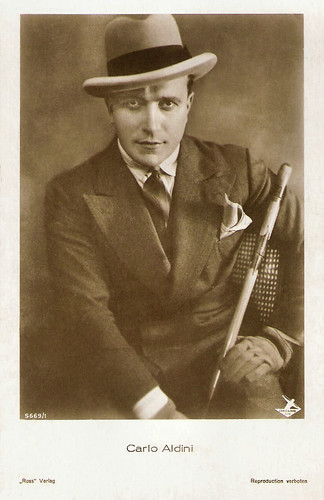
German postcard by Ross Verlag, no. 5669/1, 1930-1931. Photo: Carlo Aldini Film.
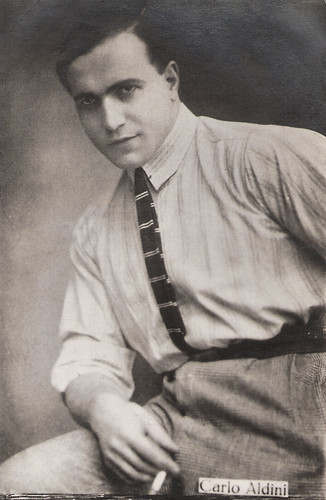
Romanian postcard. The photo retakes the photo by Rembrandt on our Ross card above.
Sources: John D. Fair, David Chapman (Muscles in the Movies: Perfecting the Art of Illusion), Vittorio Martinelli (Italian - Maciste & Co. I giganti buoni del muto italiano), Wikipedia (German), IMDb, and film prints at Bundesarchiv, Cinematek Brussels and Cineteca di Bologna.
This post was last updated on 9 August 2022.
