Showing posts with label Robert Hossein. Show all posts

18 July 2017

Anne Golon (1921-2017)

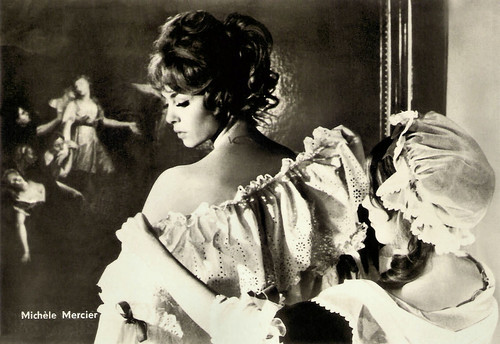
On 14 July 2017, French author Anne Golon (1921-2017) passed away. She and her husband Serge were well known for a wildly popular series of historic novels about an irresistibly beautiful and untamable heroine called Angélique. With more than 150 million copies sold in 45 languages, Angélique is one of the most successful book series of the 20th century. During the 1960s, director Bernard Borderie adapted the novels into a series of five films featuring Michèle Mercier as Angélique.

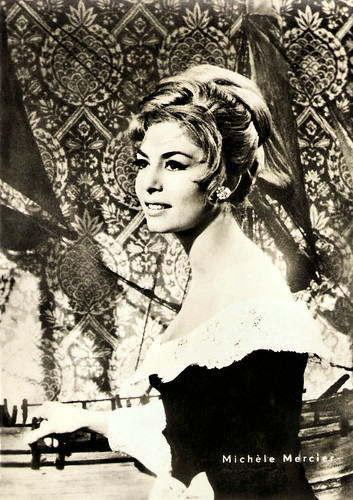
Michèle Mercier in Angélique, marquise des anges (1964)
Vintage card. Photo: publicity still for Angélique, marquise des anges/Angélique (Bernard Borderie, 1964) with Michèle Mercier.

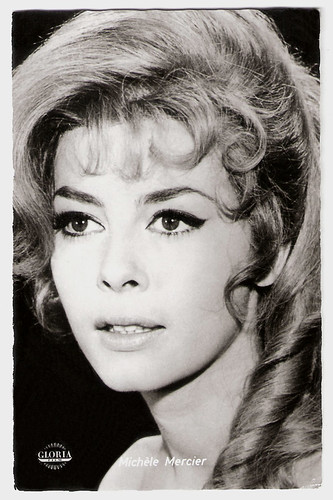
Michèle Mercier
Michèle Mercier. East-German postcard by VEB Progress Film-Vertrieb, Berlin, no. 25/71, 1971. Retail price: 0,20 DM. Photo: Progress.

Michèle Mercier in Angelique et le roy (1965)
West-German postcard by ISV, no. H-137. Photo: publicity still for Angelique et le roy/Angélique and the King (Bernard Borderie, 1965).

An Overnight Success


Anne and Serge Golon published a series of 13 French historical adventure books on Angélique. In fact, Anne Golon is the author and her husband Serge did much of the historical research. International publishers published their books with as the authors name Sergeanne Golon

Anne was born Simone Changeux in Toulon, a port in south-eastern France, in 1921. She was the daughter of Pierre Changeux, a scientist and a captain in the French Navy. She was interested in painting and writing from early childhood and published her first novel, The Country from behind my Eyes, when she was 18 under the pen name Joëlle Danterne.

During World War II Anne travelled via bicycle through France to Spain. She wrote using different pen-names, helped to create France Magazine, and was awarded a literary prize for The Patrol of the Saint Innocents.[4]

She was sent to Africa as a journalist, where she met Vsevolod Sergeïvich Goloubinoff, her future husband, Serge Golon. Their first novel, Angélique, the Marquise of the Angels, was published in 1957. The book was an overnight success. Heroine Angélique de Sancé de Monteloup is a lusciously beautiful 17th Century woman, fifth child of an impoverished country nobleman in the Poitou marshlands in the west of France.

Wikipedia gives a bit ironic summary of the successive books: "she marries at a young age the romantic and talented Count of Toulouse; gets her domestic bliss destroyed when King Louis XIV has her husband executed on trumped up charges; descends into the underworld of Paris; emerges and through a turbulent second marriage gets admittance to the court in Versailles; loses her second husband in war, just as she had started to truly love him, and subsequently refuses to become the King's mistress; finds that her first husband is after all alive and is hiding somewhere in the Mediterranean; sets out on a highly risky search, gets captured by pirates, sold into slavery in Crete, taken into the harem of the King of Morocco, stabs the King when he tries to have sex with her, and stages a daring escape" etc.

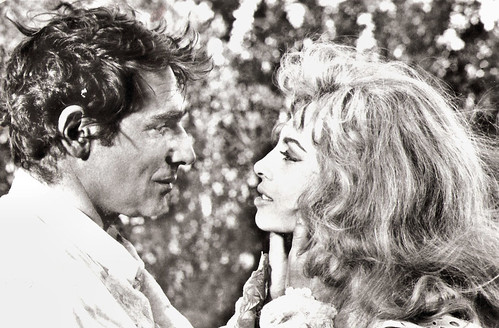
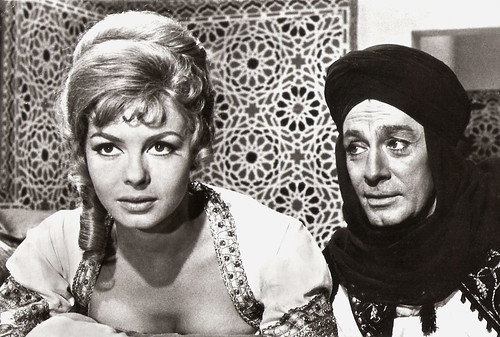
Robert Hossein, Michèle Mercier
Robert Hossein and Michèle Mercier. Romanian mini-card.

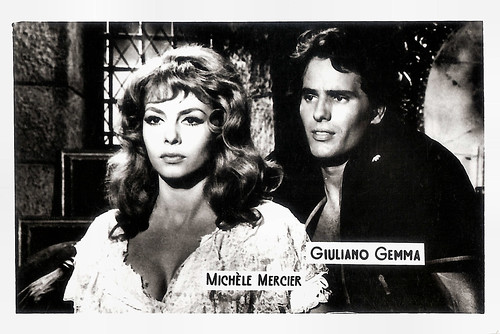
Michèle Mercier and Giuliano Gemma in Angélique, marquise des anges (1964)
Romanian mini-card. Photo: publicity still for Angélique, marquise des anges/Angélique (Bernard Borderie, 1964) with Michèle Mercier and Giuliano Gemma.

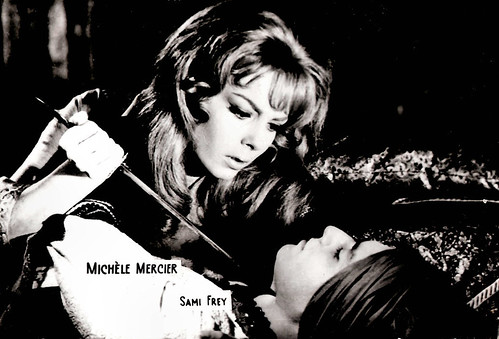
Michèle Mercier and Sami Frey in Angelique et le roy, 1966
Small Romanian collectors card. Photo: publicity still for Angélique et le roy/Angelique and the King (Bernard Borderie, 1966) with Michèle Mercier and Samy Frey.

Unique flair for historical costume dramas


Some of the Angélique novels were adapted into a series of five popular films:

  • Angélique, Marquise des Anges/Angélique (1964).
  • Merveilleuse Angelique/Angelique: The Road to Versailles (1965).
  • Angélique et le roy/Angelique and the King (1966).
  • Indomptable Angelique/Untamable Angelique (1967).
  • Angélique et le sultan/Angelique and the Sultan (1968).

According to James Travers at Films de France, Angélique, Marquise des Anges/Angélique is notably the best of the series: "the adventures of a beautiful 17th century marquise, Angélique, played magnificently by Michèle Mercier. Although rarely seen outside of continental Europe, these films were very successful in France in the 1960s and display that country's unique flair for historical costume dramas."

The films were a joint production of France, Italy and Germany. Director of the whole series of films was Bernard Borderie and the main stars were Michèle Mercier as Angélique Sancé de Monteloup and Robert Hossein as Jeoffrey de Peyrac.

Other characters were played by Jean Rochefort as Desgrez, Giuliano Gemma as Angelique's childhood friend Nicolas Merlot, Jacques Toja as King Louis XIV, Claude Giraud as Angélique's second husband Philippe de Plessis-Bellières, Jean-Louis Trintignant as the poet Claude le Petit, Samy Frey as Bachtiary Bey, Estella Blain as the evil Madame De Montespan, Fred Williams as Ràkóczi, and in the final film Jean-Claude Pascal as Sultan Osman Ferradji.

Michèle Mercier
Michèle Mercier. East-German postcard by VEB Progress Film-Vertrieb, Berlin, no. 35/71, 1971. Retail price: 0,20 DM. Photo: Progress.

Robert Hossein
Romanian postcard by Casa Filmului Acin. Photo: publicity still for Indomptable Angelique/Untamable Angelique (Bernard Borderie, 1967) with Robert Hossein and Michèle Mercier.

Robert Hossein and Michèle Mercier in Indomptable Angelique (1967)
Romanian postcard by Casa Filmului Acin. Photo: publicity still for Indomptable Angelique/Untamable Angélique (Bernard Borderie, 1967) with Robert Hossein and Michèle Mercier.

A Turkish Angélique


The Angélique films were popular all over Europe. They were also very popular in Central Europe where the postcards used for this post were published, by Progress in East-Germany and by Acin in Romania.

During the 1970s, all the kids at my school were exited to see the Angélique films when they were shown on Dutch television. Romance, adventure, and a tiny bit of nudity. We loved it.

To my surprise, two Turkish Angélique films exist as well: Anjelik Osmanli saraylarinda/Angélique in the Ottoman Palaces (Ülkü Erakalin, 1967) and Anjelik ve Deli Ibrahim/Angelique and Deli Ibrahim (Süha Dogan, 1968), both starring Sevda Ferdag as Anjelik 'Angélique de Peyrac'. The first film gets a 7,9 rating at IMDb.

In 2013, a remake of Angélique, marquise des anges went in premiere: Angélique (Ariel Zeitoun, 2013). Nora Arnezeder played Angelique and Gérard Lanvin Joffrey de Peyrac.

At IMDb, the film received a poor rating of only 5,6, but Polish reviewer Malgga liked it 'very, very much': "A beautiful, engaging and immensely romantic rendition of the 'Beauty and the Beast' fairy tale motive".


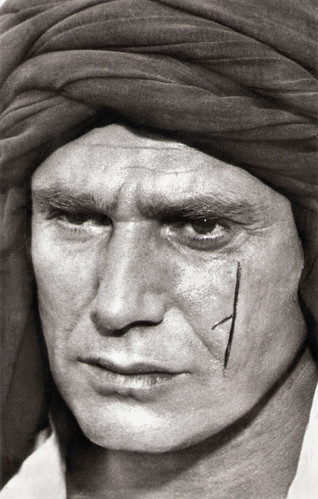
Robert Hossein
Romanian postcard by Casa Filmului Acin, no. 277. Photo: publicity still for Angelique et le sultan/Angelique and the Sultan (Bernard Borderie, 1968) with Robert Hossein.

Michèle Mercier, Jean-Claude Pascal, Angélique et le sultan.
Romanian postcard by Casa Filmului Acin. Photo: publicity still for Angelique et le sultan/Angelique and the sultan (Bernard Borderie, 1968) with Michèle Mercier and Jean-Claude Pascal.

Michèle Mercier in Indomptable Angélique (1967)
French photo by Francos Film - C.I.C.C. (Paris), Gloria Film (Munich), Fono Roma (Rome). Publicity still for Indomptable Angélique/Untamable Angelique (Bernard Borderie, 1967).

Reduced to a state close to poverty 


In 1972, Anne and Serge Golon went to Canada to continue their research. That year, as Anne wrote Angélique and the Ghosts, but Serge died. They had four children: Cyrille (born February 1950), Nadine (born July 1955), Pierre (born April 1957), and Marina (born 1961).

Anne carried on writing and brought up her four children at the same time. Between Serge's death and 1985, Anne wrote four more volumes, beginning with the second half of Ghosts (both portions published in French as a single volume, Angélique à Quebec (Angelique in Quebec)) and proceeding through Victoire d'Angélique (Angélique's Victory).

Anne Golon was reduced to a state close to poverty and filed a lawsuit against the French publisher Hachette for abuse of copyright and for her unpaid royalties. She won her battle over the publishing rights to her Angélique stories.

After a legal battle in France lasting nearly a decade, she reached an agreement which left her the sole owner of the works. In 2009, Golon announced two more books would follow: Royaume de France, (Kingdom of France), and a fifteenth and final volume to complete the series.

On 14 July 2017 Anne Golon died in Versailles, Yvelines, France. She was 95. Estimates of the total number of Angélique books sold worldwide are upwards of 150 million, and they have been published in at least 63 countries, by at least 320 different publishers.

Michèle Mercier in Angélique, marquise des anges (1964)
West-German postcard by Friedrich-W. Sander-Verlag / Kolibri-Verlag, Minden-Westf., no. 2420. Photo: Gloria-Film. Publicity still for Angélique, marquise des anges/Angélique (Bernard Borderie, 1964).

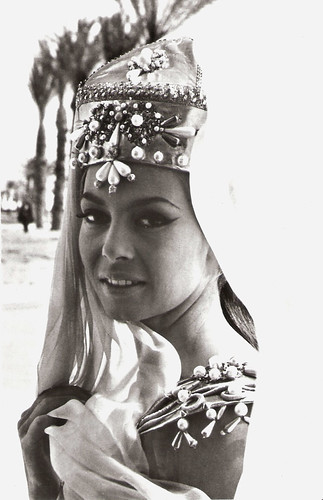
Michèle Mercier
Romanian postcard by Casa Filmului Acin. Photo: publicity still for Angelique et le sultan/Angelique and the sultan (Bernard Borderie, 1968) with Michèle Mercier.

Robert Hossein
Romanian postcard by Casa Filmului Acin. Photo: publicity still for Angelique et le sultan/Angelique and the Sultan (Bernard Borderie, 1968) with Robert Hossein.

Robert Hossein
Robert Hossein. East-German postcard by VEB Progress Film-Vertrieb, Berlin, no. 32/71. Retail price: 0,20 M.

Sources: James Travers (Films de France), Wikipedia and IMDb.

04 May 2014

Robert Hossein

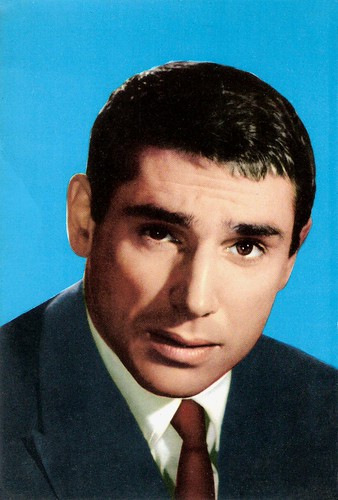
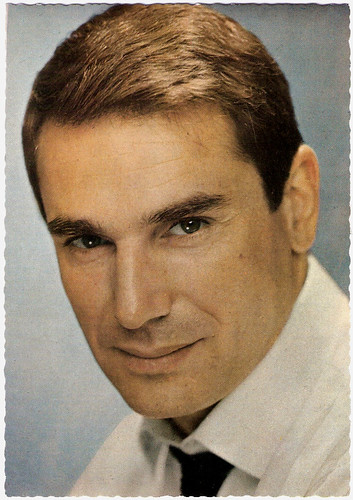
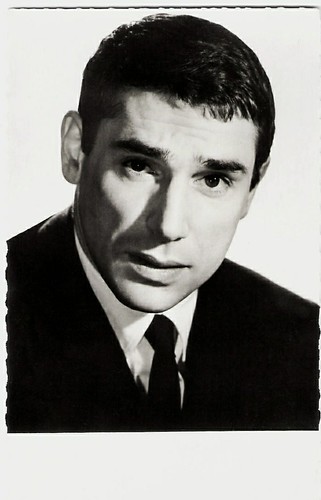
French director, writer and actor Robert Hossein (1927) was generally cast as a tough guy beside such gorgeous actresses as Brigitte Bardot, Sophia Loren and Marina Vlady. He is most famous though as Michèle Mercier's husband in the wildly popular Angélique series of the 1960s.

Robert Hossein
Spanish postcard by Postalco, Barcelona, no. 21/2. Photo: Unifrance Film.

Robert Hossein
French postcard by E.D.U.G., no. 470. Photo: Sam Lévin.

Rififi


Robert Hossein was born as Robert Hosseinoff in Paris in 1927. He was the son of Aminollah (André) Hossein, a French orchestra conductor and composer of Persian-Azeri descent, and Anna Minevskaya, a Jewish comedy actress from Kiev.

Robert was trained at René Simon's acting school. He laboured away as actor/director with the legendary Theatre Grand Guignol in Montmartre, then spent several years on the ‘legitimate’ stage.

He made his first film appearance in a bit part in Les souvenirs ne sont pas à vendre/Sextette (Robert Hennion, 1948) with Martine Carol, and he had his breakthrough with the classic Film-Noir Du rififi chez les hommes/Rififi (Jules Dassin, 1955) as a slightly sadistic drug-addict.

The role of the jaded criminal stuck with him in the coming decades. Hossein also started directing with the thriller Les salauds vont en enfer/The Wicked Go to Hell (Robert Hossein, 1956) in which he co-starred with his wife, Marina Vlady.

The film was based on a play by Frédéric Dard whose novels and plays went on to furnish Hossein with much of his later film material such as the Film-Noir Toi... le venin/Blonde in a White Car (Robert Hossein, 1958), in which he again co-starred with Vlady, and with her sister Odile Versois.

Wikipedia notes: “Right from the start Hossein established his characteristic trademarks: using a seemingly straightforward suspense plot and subverting its conventions (sometimes to the extent of a complete disregard of the traditional demand for a final twist or revelation) in order to concentrate on ritualistic relationships. This is the director's running preoccupation which is always stressed in his films by an extraordinary command of film space and often striking frame compositions where the geometry of human figures and set design is used to accentuate the psychological set-up of the scene. The mechanisms of guilt and the way it destroys relationships is another recurring theme, presumably influenced by Hossein's lifelong interest in the works of Dostoyevski.”

Robert Hossein
French postcard by Editions P.I., offered by Les Carbones Korès Carboplane, no. 906. Photo: Sam Lévin.
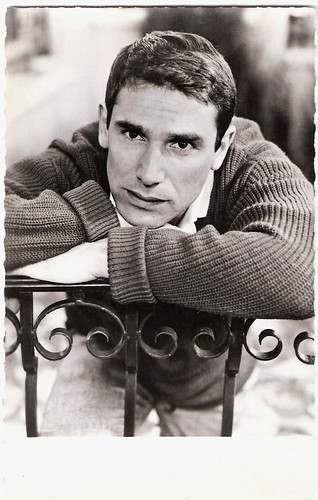
Robert Hossein
French postcard by Editions P.I., Paris, no. 949. Photo: Studio Bernard & Vauclair.
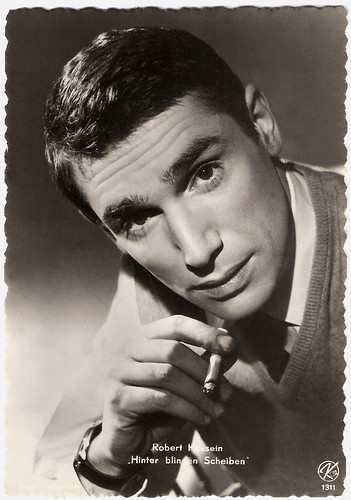
Robert Hossein
Austrian postcard by Kellner-Fotokarten, Wien, no. 1311. Photo: publicity still for Méfiez-vous, fillettes!/Good Girls Beware! (Yves Allégret, 1957).
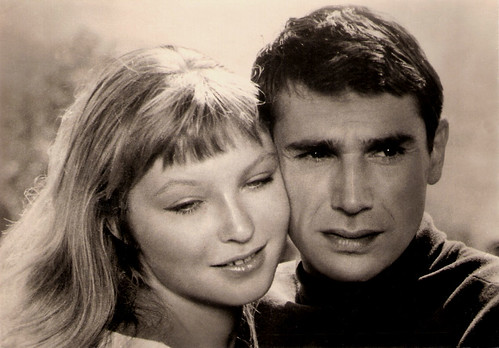
Marina Vlady, Robert Hossein
East-German postcard by VEB Progress Film-Vertrieb, Berlin, no. 1842, 1963. Retail price: 0,20 DM. Publicity still for La liberté surveillée/Provisional Liberty (Henri Aisner, Vladimír Vlcek, 1958) with Marina Vlady.

Unashamedly Melodramatic Frameworks


As a director Robert Hossein had some modest international successes with films like Le vampire de Düsseldorf/The Vampire of Dusseldorf (Robert Hossein, 1965), but he was much singled out for scorching criticism by the critics and followers of the Nouvelle Vague for the unashamedly melodramatic frameworks of his films.

The fact that he was essentially an auteur director with a consistent set of themes and an extraordinary mastery of original and unusual approaches to staging his stories, was never appreciated. He was not averse to trying his hand at widely different genres and was never defeated, making the strikingly different spaghetti western Une corde, un Colt/The Rope and the Colt (Robert Hossein, 1969) and the low-budgeted but daringly subversive period drama J'ai tué Raspoutine/Rasputin (Robert Hossein, 1967) starring Gert Fröbe.

However, because of the lack of wider success and continuing adverse criticism, Hossein virtually ended his film directing career in 1970, and concentrated on the theatre where his achievements were never questioned.

However, in 1982, he directed the film adaption of Victor Hugo’s classic literary masterpiece, Les Misérables (Robert Hossein, 1982) with Lino Ventura as Jean Valjean.

James Travers writes in his review at Films de France: “The film’s exceptional production values are enhanced by Hossein’s own stylised approach, which gives the film a sense of authenticity and surprising modernity.”
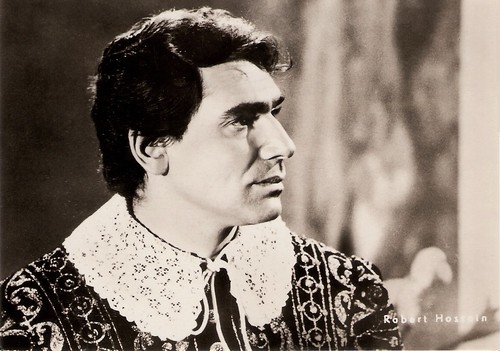
Robert Hossein
East-German postcard by VEB Progress Film-Vertrieb, Berlin, no. 32/71. Retail price: 0,20 M.
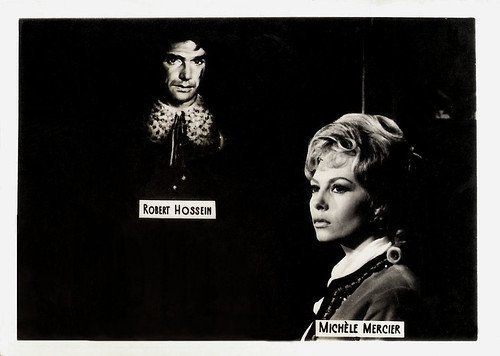
Robert Hossein, Michèle Mercier
Romanian mini-card. With Michèlé Mercier in one of the Angelique films.

Robert Hossein
Romanian postcard by Casa Filmului Acin, no. 277. Photo: publicity still for Angelique et le sultan/Angelique and the Sultan (Bernard Borderie, 1968).
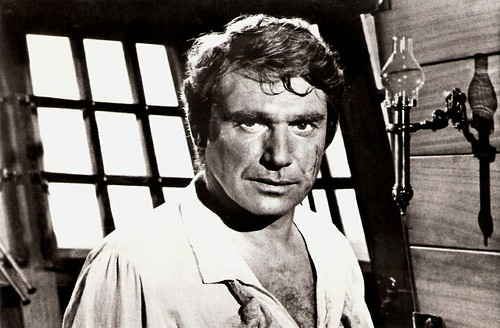
Robert Hossein
Romanian postcard by Casa Filmului Acin. Publicity still for Indomptable Angelique/Untamable Angelique (Bernard Borderie, 1967).

Angélique


Robert Hossein’s most famous role was as Michèle Mercier's husband Jeoffrey de Peyrac in the historical romance/adventure Angélique, marquise des anges/Angélique (Bernard Borderie, 1964) and its four sequels.

Other films in which he appeared were Crime et châtiment/Crime and Punishment (Georges Lampin, 1956) starring Jean Gabin, Madame Sans-Gêne (Christian-Jaque, 1961) opposite Sophia Loren, and the Marquis de Sade adaptation Le vice et la vertu/Vice and Virtue (Roger Vadim, 1963) with Catherine Deneuve.

In the 1970s and 1980s he played opposite Jean Paul Belmondo in police thrillers like Le Casse/The Burglars (Henri Verneuil, 1971) and Le professionnel/The Professional (Georges Lautner, 1981).

He also appeared opposite Brigitte Bardot in one of her last films, Don Juan ou Si Don Juan était une femme.../Don Juan (Or If Don Juan Were a Woman) (Roger Vadim, 1973), and he was excellent as a Catholic priest who falls in love with Claude Jade and becomes a communist in Prêtres interdits/Forbidden Priests (Denys de La Patellière, 1973).

One of his most famous starring roles was as a pianist in the musical epic Les Uns et les Autres/Bolero (Claude Lelouch, 1981). In the theatre he directed popular historical vehicles involving large sets and numerous actors. Among his latest creations were Danton and Celui qui a dit non (Those Who Said No), a play on Charles de Gaulle and the French resistance.

At the age of 72, Hossein again played romantic love-scenes in a film, now with Audrey Tautou in Vénus beauté (institut)/Venus Beauty Institute (Tonie Marshall, 1999). He still regularly appears on TV and in films.

Robert Hossein was married three times: first to Marina Vlady (he has two sons with her, Pierre and Igor), later to Caroline Eliacheff (with whom he has a son, Nicholas). He is currently married to actress Candice Patou, with whom he has one son, Julien.


Trailer Angélique Marquise des Anges (1964). Source: Oldiestrailers (YouTube).


German Trailer for Une corde, un Colt (1969). Source: r6dw6c (YouTube).


Theatrical Trailer Le Professional (1981). Source: Classic Full Movie & Theatrical Trailer Collection (YouTube).


Scene from Les Misérables (1982)> Source: Gérard Roche (YouTube)

Sources: James Travers (Films de France), Hal Erickson (AllMovie), Darius Kadivar (The Iranian), Wikipedia, and IMDb.