Italian actor Ermanno Roveri (1903-1968) became famous in 1913/1914 as Frugolino, one of the comic child stars of Cines. Later he starred for the Turninese company Gloria in silent melodramas such as Il piccolo patriota padovano / The Little Patriot from Padua (1915) and Naufragio / Shipwreck (1916).

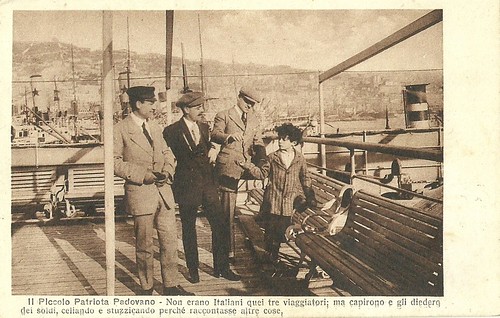
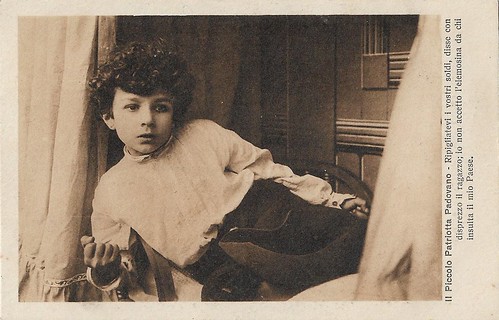
Italian postcard, no. 3371. Photo: Film Artistica Gloria, Torino. Ermanno Roveri in Il piccolo patriota padovano / The Little Patriot from Padua (Leopoldo Carlucci, 1915). Caption: Take back your money, the boy disdainfully said, for I won't take any alms from those who insult my Country.

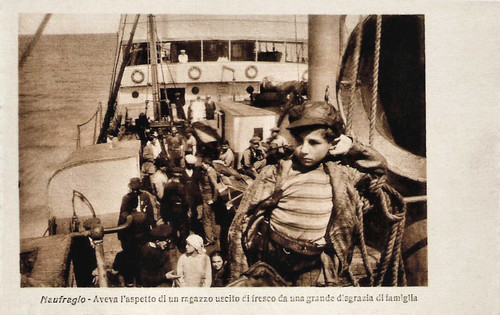
Italian postcard by Film Artistica Floria, Torino (Turin), no. 3404. Printed by Uff. Rev. St. Terni, 16-5-17. Ermanno Roveri in Naufragio / Shipwreck (Umberto Paradisi, 1916). Caption: He had the look of a boy who had just come out of a big family misfortune.
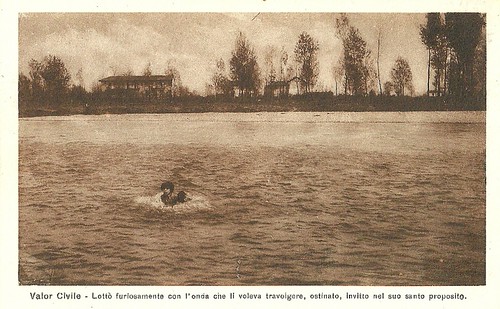
Italian postcard by Alterocca, Terni. Photo: Film Artistica Gloria, Torino (Turin). Ermanno Roveri in Valor civile / Civic Value (Umberto Paradisi, 1916), based on the short stories in 'Cuore' by Edmondo De Amicis. Caption: he furiously fought with the wave that wanted to tear him down. He remained obstinate, invincible in his holy plight.
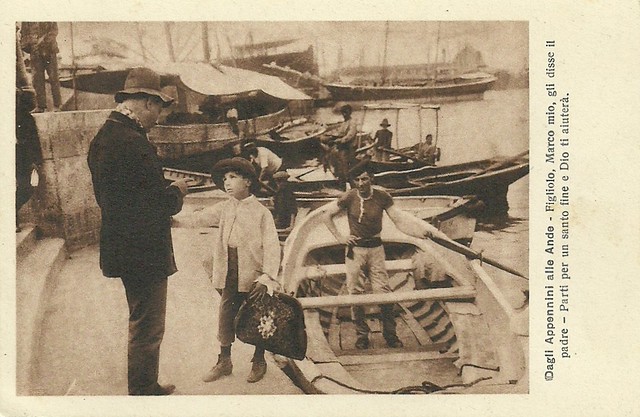
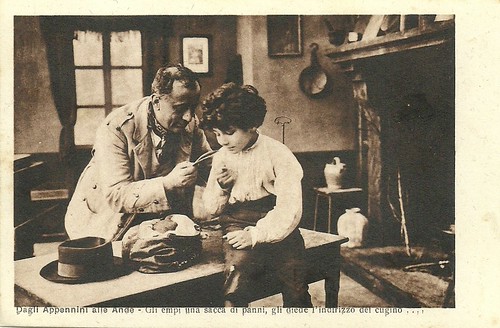
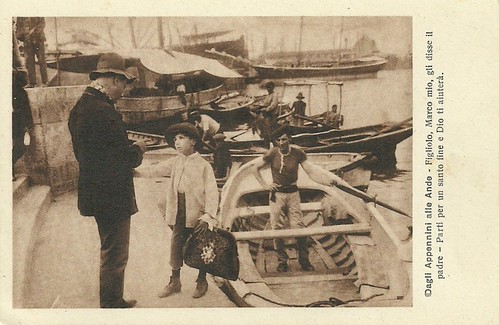
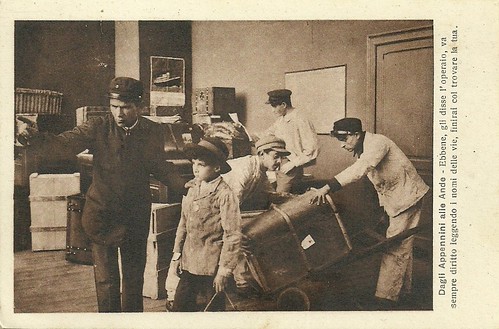
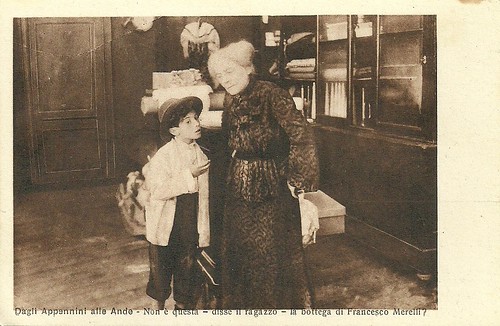
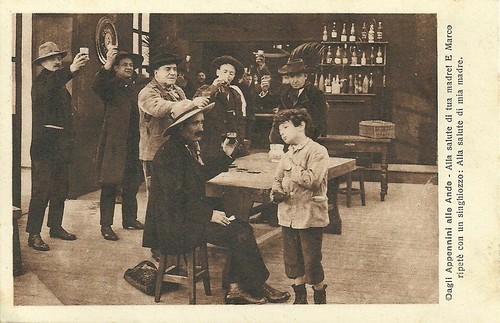
Italian postcard. Ermanno Roveri in Dagli Appennini alle Ande / From the Apennines to the Andes (Umberto Paradisi, 1916), an adaptation of one of the stories of Edmondo De Amicis' novel 'Cuore' (Heart). Translation caption: 'Dear son, Marco mine', his father said to him, 'you now leave on a holy mission, and God will help you'. The background may be the harbour of Genoa.
Ermanno Roveri was born in 1903 in Milan, Italy. As a child, he became famous as Frugolino, one of the comic child actors of the Cines company in Rome.
Among his early films were Il Trabocchetto punitore / Fatal Trap Door (1912) with Emilio Ghione and Amleto Novelli, and Il Portafoglio rosso / The Lost Pocket-Book (Guglielmo Zorzi, 1914) with Lea Giunchi. Ermanno appeared opposite diva Leda Gys in Il Piccolo cerinaio / The Small Cerinaio (Augusto Genina, 1914).
After 1914, he became one of the stars of Gloria, the film company in Turin that also produced the first films of diva Lyda Borelli. Gloria produced a series of films based on the stories in the children's book 'Cuore' (Heart, 1886) by Italian author Edmondo De Amicis (1846-1908). 'Cuore' is his best-known work to this day, having been inspired by his own children, Furio and Ugo, who had been schoolboys at the time. It is set during the Italian unification and includes several patriotic themes. The book's strong evocation of Italian nationalism and patriotism also made it very welcome in Fascist Italy. Cuore was adapted for the screen several times.
In 1915-1916, the Italian company Gloria Film made a series of seven silent films, based on the stories. These films included Il piccolo scrivano fiorentino / The Little Scribe from Florence (Leopoldo Carlucci, 1915) and Il piccolo patriota padovano / The Little Patriot from Padua (Leopoldo Carlucci, 1915). In Il piccolo scrivano fiorentino / The Little Scribe from Florence (Leopoldo Carlucci, 1915), Giulio (Roveri), a 12-year-old boy from Florence, lacks sleep as he secretly helps his father (Antonio Monti) copy volumes at night. His parents reproach him, as he loses weight and lacks attention in school. One night, however, the father discovers the secret.
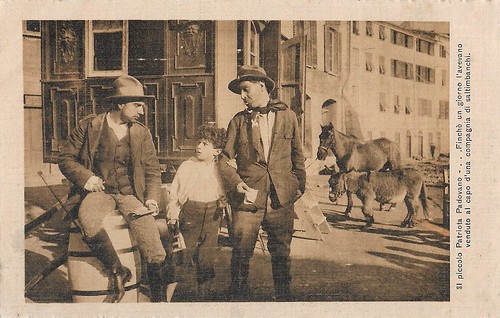
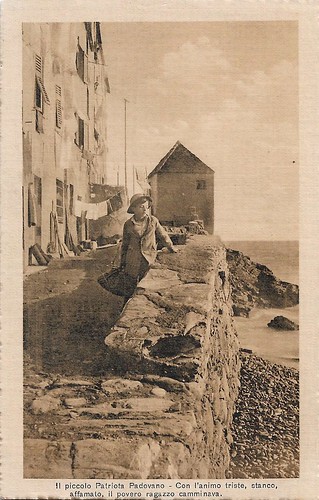
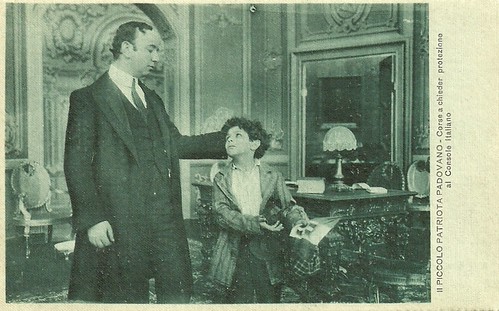
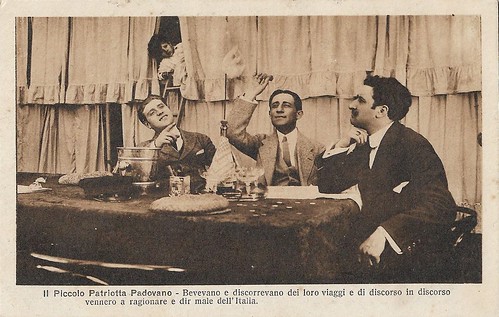
In Il piccolo patriota padovano / The Little Patriot from Padua, Ermanno Roveri played a young boy from Padua, dressed in rags, who is discovered on a boat to Genoa. His poor parents have sold him to acrobats, who maltreat him. During a stop in Barcelona, he flees to the Italian consul, who helps him return. Aboard the ship to Italy, he is nurtured, dressed, and foreign visitors give him money. When he overhears them talking badly about Italy and the Italians, he throws the money back at them. He does not accept alimony from those who insult his country!
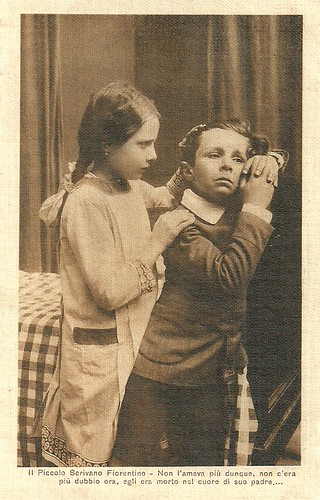
Italian postcard, no. 3386. Photo: Film Artistica Gloria, Torino. Ermanno Roveri in Il piccolo scrivano fiorentino / The Little Scribe from Florence (Leopoldo Carlucci, 1915). Caption: He didn't love him anymore. There was no doubt now. He was dead in the heart of his father...

Italian postcard, no. 3386. Photo: Film Artistica Gloria, Torino. Ermanno Roveri in Il piccolo scrivano fiorentino / The Little Scribe from Florence (Leopoldo Carlucci, 1915). Caption: One night, for the first time in his life, he fell asleep over his notebook. Wake up! Wake up! His father shouted to him, Get to work!

Italian postcard, no. 3386. Photo: Film Artistica Gloria, Torino. Ermanno Roveri in Il piccolo scrivano fiorentino / The Little Scribe from Florence (Leopoldo Carlucci, 1915). Caption: 'Oh, Daddy! Daddy, forgive me, forgive me!' he cried, recognising his father.
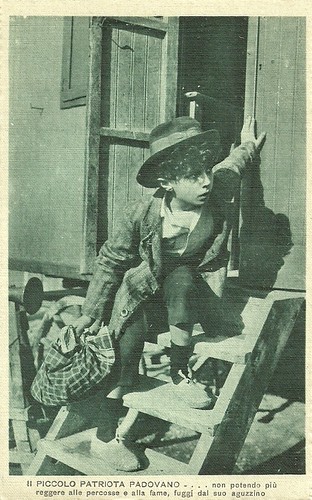
Italian postcard, no. 3371. Photo: Film Artistica Gloria, Torino. Ermanno Roveri in Il piccolo patriota padovano / The Little Patriot from Padua (Leopoldo Carlucci, 1915). Caption: ...No longer able to stand the beatings and the hunger, he escapes his tormentor.
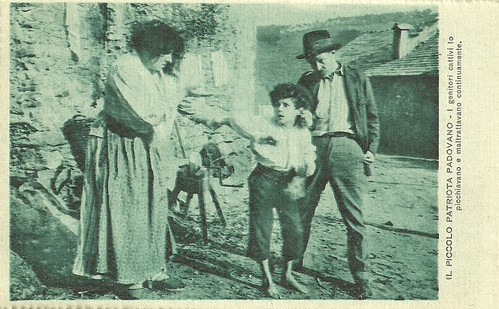
Italian postcard, no. 3371. Photo: Film Artistica Gloria, Torino. Ermanno Roveri in Il piccolo patriota padovano / The Little Patriot from Padua (Leopoldo Carlucci, 1915). Caption: His bad parents continuously beat and abused him.

Italian postcard, no. 3371. Photo: Film Artistica Gloria, Torino. Ermanno Roveri in Il piccolo patriota padovano / The Little Patriot from Padua (Leopoldo Carlucci, 1915). Caption: He ran to ask for protection from the Italian consul.
For Gloria, Ermanno Roveri appeared in such films as Dagli Appennini alle Ande / From the Apennines to the Andes (Umberto Paradisi, 1916) and La Felicità / Happiness (Guglielmo Zorzi, 1917). He also played in the Gloria production Naufragio / Shipwreck (Umberto Paradisi, 1916) as a Sicilian orphan, Mario, who is repatriated from Liverpool to Sicily. On the boat, he meets Giulietta (played by Ermanno’s sister, Lavinia Roveri), who has to return to her parents in Naples. During a tempest, the boat sinks and Mario offers his seat in the lifeboat to Giulietta. Mario drowns on the sinking ship.
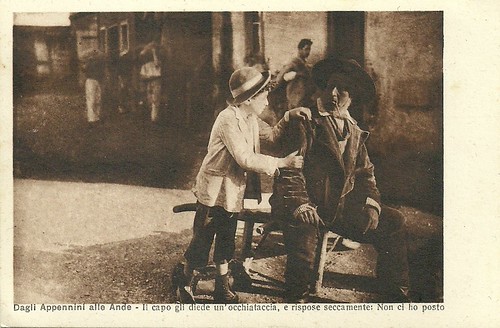
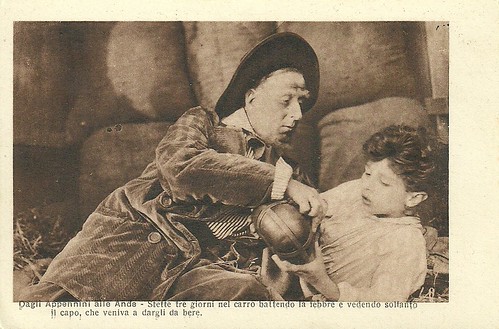
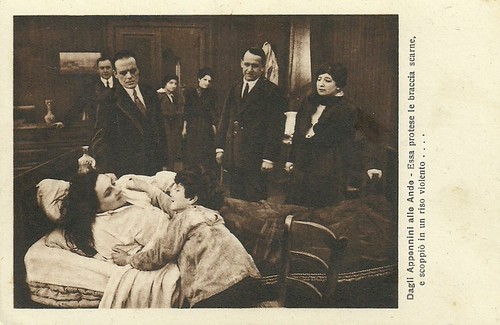
In Dagli Appennini alle Ande / From the Apennines to the Andes (Umberto Paradisi, 1916), young Marco (Roveri) from Genoa sails to Buenos Aires to visit his seriously ill mother, who emigrated for work. While his mother refuses any cure, Marco wanders around endlessly in search of his mother. Marco follows the traces of the family for whom his mother worked, all over Argentina until the foot of the Andes Mountains. He first joins a caravan, but when they abandon him, he continues on his own until he finds his mother, who then agrees to be operated on and cured.
During the early 1920s, Ermanno Roveri appeared as a young adult in silent productions by Lombardo Films such as Il re della forza / The King of Strength (Ubaldo Maria Del Colle, 1920) opposite the famous wrestler Giovanni Raicevich, I figli di nessuno / Nobody's Children (Ubaldo Maria Del Colle, 1921) starring Leda Gys, and Il disco d'oro / The Gold Record (Francesco Bertolini, 1921).
In the 1930s and 1940s, Ermanno Roveri played in a dozen Italian films, including Tempo massimo / Full Speed (Mario Mattoli, 1934) and L'Uomo che sorride / The Man Who Smiles (Mario Mattoli, 1936), both starring Vittorio De Sica.
His last film appearance was in I Due sergenti / The Two Sergeants (Carlo Alberto Chiesa, 1951) with Antonella Lualdi. Till his death, Ermanno Roveri worked in theatre and incidentally in cinema or television. In 1968, he died in Milan, Italy. He was 65.

Italian postcard by Stabilimenti Alterocca, Terni. Photo: Gloria. Ermanno Roveri in Dagli Appennini alle Ande / From the Apennines to the Andes (Umberto Paradisi, 1916). Caption: The head [the head conductor of the convoy of wagons] surveyed him with a keen glance, and replied drily, “I have no place”.

Italian postcard by Stabilimenti Alterocca, Terni. Photo: Gloria. Ermanno Roveri in Dagli Appennini alle Ande / From the Apennines to the Andes (Umberto Paradisi, 1916). Caption: For three days he remained in the wagon, fighting a fever, and seeing no one except the head, who came to give him to drink.

Italian postcard by Uff. Rev. St. Terni, 16-5-17, no. 3404. Photo: Film Artistica Gloria, Torino (Turin). Ermanno Roveri in Naufragio / Shipwreck (Umberto Paradisi, 1916). Caption: They saw all around them persons frozen like statues, with eyes wide open and with blank stares, with the faces of corpses and madmen.

Italian postcard by Uff. Rev. St. Terni, 16-5-17, no. 3404. Photo: Film Artistica Gloria, Torino (Turin). Ermanno Roveri in Naufragio / Shipwreck (Umberto Paradisi, 1916). Caption: In the interior of the vessel, confusion started as well as fright, and an uproar of weeping and prayers.
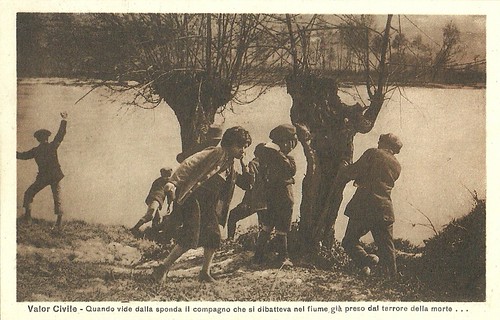
Italian postcard by Alterocca, Terni. Photo: Film Artistica Gloria, Torino (Turin). Ermanno Roveri in Valor civile / Civic Value (Umberto Paradisi, 1916), based on one of the short stories in 'Cuore' by Edmondo de Amicis. Caption: When he saw from the riverbank that his friend was fighting in the river, already taken by the terror of death...
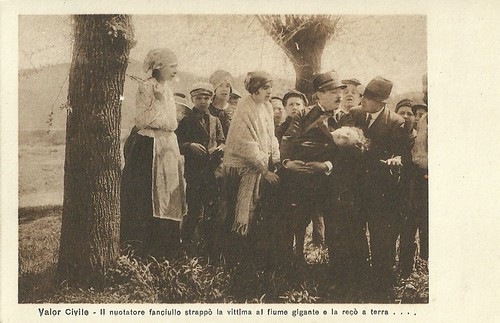
Italian postcard by Alterocca, Terni. Photo: Film Artistica Gloria, Torino (Turin). Ermanno Roveri in Valor civile / Civic Value (Umberto Paradisi, 1916). Caption: The young swimmer saved the victim from the giant river and brought him to the river's edge. In the town hall, there is a solemn ceremony for the medal for civic value. The winner is a Piedmont boy (Ermanno Roveri) who has risked his life to save that of a fellow (Antonio Monti) who was drowning in the river Po.

Italian postcard by Alterocca, Terni. Photo: Film Artistica Gloria, Torino (Turin). Ermanno Roveri in Valor civile / Civic Value (Umberto Paradisi, 1916), based on the short stories in 'Cuore' by Edmondo de Amicis. Caption: ... and a boy of eight or nine years old, pushed forward by a woman, threw himself on the decorated one.
Sources: Vittorio Martinelli (Il Cinema Italiano 1916) and IMDb.
Italian postcard, no. 3371. Photo: Film Artistica Gloria, Torino. Ermanno Roveri in Il piccolo patriota padovano / The Little Patriot from Padua (Leopoldo Carlucci, 1915). Caption: Take back your money, the boy disdainfully said, for I won't take any alms from those who insult my Country.
Italian postcard by Film Artistica Floria, Torino (Turin), no. 3404. Printed by Uff. Rev. St. Terni, 16-5-17. Ermanno Roveri in Naufragio / Shipwreck (Umberto Paradisi, 1916). Caption: He had the look of a boy who had just come out of a big family misfortune.
Italian postcard by Alterocca, Terni. Photo: Film Artistica Gloria, Torino (Turin). Ermanno Roveri in Valor civile / Civic Value (Umberto Paradisi, 1916), based on the short stories in 'Cuore' by Edmondo De Amicis. Caption: he furiously fought with the wave that wanted to tear him down. He remained obstinate, invincible in his holy plight.
Italian postcard. Ermanno Roveri in Dagli Appennini alle Ande / From the Apennines to the Andes (Umberto Paradisi, 1916), an adaptation of one of the stories of Edmondo De Amicis' novel 'Cuore' (Heart). Translation caption: 'Dear son, Marco mine', his father said to him, 'you now leave on a holy mission, and God will help you'. The background may be the harbour of Genoa.
Child star Frugolino
Ermanno Roveri was born in 1903 in Milan, Italy. As a child, he became famous as Frugolino, one of the comic child actors of the Cines company in Rome.
Among his early films were Il Trabocchetto punitore / Fatal Trap Door (1912) with Emilio Ghione and Amleto Novelli, and Il Portafoglio rosso / The Lost Pocket-Book (Guglielmo Zorzi, 1914) with Lea Giunchi. Ermanno appeared opposite diva Leda Gys in Il Piccolo cerinaio / The Small Cerinaio (Augusto Genina, 1914).
After 1914, he became one of the stars of Gloria, the film company in Turin that also produced the first films of diva Lyda Borelli. Gloria produced a series of films based on the stories in the children's book 'Cuore' (Heart, 1886) by Italian author Edmondo De Amicis (1846-1908). 'Cuore' is his best-known work to this day, having been inspired by his own children, Furio and Ugo, who had been schoolboys at the time. It is set during the Italian unification and includes several patriotic themes. The book's strong evocation of Italian nationalism and patriotism also made it very welcome in Fascist Italy. Cuore was adapted for the screen several times.
In 1915-1916, the Italian company Gloria Film made a series of seven silent films, based on the stories. These films included Il piccolo scrivano fiorentino / The Little Scribe from Florence (Leopoldo Carlucci, 1915) and Il piccolo patriota padovano / The Little Patriot from Padua (Leopoldo Carlucci, 1915). In Il piccolo scrivano fiorentino / The Little Scribe from Florence (Leopoldo Carlucci, 1915), Giulio (Roveri), a 12-year-old boy from Florence, lacks sleep as he secretly helps his father (Antonio Monti) copy volumes at night. His parents reproach him, as he loses weight and lacks attention in school. One night, however, the father discovers the secret.
In Il piccolo patriota padovano / The Little Patriot from Padua, Ermanno Roveri played a young boy from Padua, dressed in rags, who is discovered on a boat to Genoa. His poor parents have sold him to acrobats, who maltreat him. During a stop in Barcelona, he flees to the Italian consul, who helps him return. Aboard the ship to Italy, he is nurtured, dressed, and foreign visitors give him money. When he overhears them talking badly about Italy and the Italians, he throws the money back at them. He does not accept alimony from those who insult his country!
Italian postcard, no. 3386. Photo: Film Artistica Gloria, Torino. Ermanno Roveri in Il piccolo scrivano fiorentino / The Little Scribe from Florence (Leopoldo Carlucci, 1915). Caption: He didn't love him anymore. There was no doubt now. He was dead in the heart of his father...
Italian postcard, no. 3386. Photo: Film Artistica Gloria, Torino. Ermanno Roveri in Il piccolo scrivano fiorentino / The Little Scribe from Florence (Leopoldo Carlucci, 1915). Caption: One night, for the first time in his life, he fell asleep over his notebook. Wake up! Wake up! His father shouted to him, Get to work!
Italian postcard, no. 3386. Photo: Film Artistica Gloria, Torino. Ermanno Roveri in Il piccolo scrivano fiorentino / The Little Scribe from Florence (Leopoldo Carlucci, 1915). Caption: 'Oh, Daddy! Daddy, forgive me, forgive me!' he cried, recognising his father.
Italian postcard, no. 3371. Photo: Film Artistica Gloria, Torino. Ermanno Roveri in Il piccolo patriota padovano / The Little Patriot from Padua (Leopoldo Carlucci, 1915). Caption: ...No longer able to stand the beatings and the hunger, he escapes his tormentor.
Italian postcard, no. 3371. Photo: Film Artistica Gloria, Torino. Ermanno Roveri in Il piccolo patriota padovano / The Little Patriot from Padua (Leopoldo Carlucci, 1915). Caption: His bad parents continuously beat and abused him.
Italian postcard, no. 3371. Photo: Film Artistica Gloria, Torino. Ermanno Roveri in Il piccolo patriota padovano / The Little Patriot from Padua (Leopoldo Carlucci, 1915). Caption: He ran to ask for protection from the Italian consul.
A Sicilian orphan
For Gloria, Ermanno Roveri appeared in such films as Dagli Appennini alle Ande / From the Apennines to the Andes (Umberto Paradisi, 1916) and La Felicità / Happiness (Guglielmo Zorzi, 1917). He also played in the Gloria production Naufragio / Shipwreck (Umberto Paradisi, 1916) as a Sicilian orphan, Mario, who is repatriated from Liverpool to Sicily. On the boat, he meets Giulietta (played by Ermanno’s sister, Lavinia Roveri), who has to return to her parents in Naples. During a tempest, the boat sinks and Mario offers his seat in the lifeboat to Giulietta. Mario drowns on the sinking ship.
In Dagli Appennini alle Ande / From the Apennines to the Andes (Umberto Paradisi, 1916), young Marco (Roveri) from Genoa sails to Buenos Aires to visit his seriously ill mother, who emigrated for work. While his mother refuses any cure, Marco wanders around endlessly in search of his mother. Marco follows the traces of the family for whom his mother worked, all over Argentina until the foot of the Andes Mountains. He first joins a caravan, but when they abandon him, he continues on his own until he finds his mother, who then agrees to be operated on and cured.
During the early 1920s, Ermanno Roveri appeared as a young adult in silent productions by Lombardo Films such as Il re della forza / The King of Strength (Ubaldo Maria Del Colle, 1920) opposite the famous wrestler Giovanni Raicevich, I figli di nessuno / Nobody's Children (Ubaldo Maria Del Colle, 1921) starring Leda Gys, and Il disco d'oro / The Gold Record (Francesco Bertolini, 1921).
In the 1930s and 1940s, Ermanno Roveri played in a dozen Italian films, including Tempo massimo / Full Speed (Mario Mattoli, 1934) and L'Uomo che sorride / The Man Who Smiles (Mario Mattoli, 1936), both starring Vittorio De Sica.
His last film appearance was in I Due sergenti / The Two Sergeants (Carlo Alberto Chiesa, 1951) with Antonella Lualdi. Till his death, Ermanno Roveri worked in theatre and incidentally in cinema or television. In 1968, he died in Milan, Italy. He was 65.
Italian postcard by Stabilimenti Alterocca, Terni. Photo: Gloria. Ermanno Roveri in Dagli Appennini alle Ande / From the Apennines to the Andes (Umberto Paradisi, 1916). Caption: The head [the head conductor of the convoy of wagons] surveyed him with a keen glance, and replied drily, “I have no place”.
Italian postcard by Stabilimenti Alterocca, Terni. Photo: Gloria. Ermanno Roveri in Dagli Appennini alle Ande / From the Apennines to the Andes (Umberto Paradisi, 1916). Caption: For three days he remained in the wagon, fighting a fever, and seeing no one except the head, who came to give him to drink.
Italian postcard by Uff. Rev. St. Terni, 16-5-17, no. 3404. Photo: Film Artistica Gloria, Torino (Turin). Ermanno Roveri in Naufragio / Shipwreck (Umberto Paradisi, 1916). Caption: They saw all around them persons frozen like statues, with eyes wide open and with blank stares, with the faces of corpses and madmen.
Italian postcard by Uff. Rev. St. Terni, 16-5-17, no. 3404. Photo: Film Artistica Gloria, Torino (Turin). Ermanno Roveri in Naufragio / Shipwreck (Umberto Paradisi, 1916). Caption: In the interior of the vessel, confusion started as well as fright, and an uproar of weeping and prayers.
Italian postcard by Alterocca, Terni. Photo: Film Artistica Gloria, Torino (Turin). Ermanno Roveri in Valor civile / Civic Value (Umberto Paradisi, 1916), based on one of the short stories in 'Cuore' by Edmondo de Amicis. Caption: When he saw from the riverbank that his friend was fighting in the river, already taken by the terror of death...
Italian postcard by Alterocca, Terni. Photo: Film Artistica Gloria, Torino (Turin). Ermanno Roveri in Valor civile / Civic Value (Umberto Paradisi, 1916). Caption: The young swimmer saved the victim from the giant river and brought him to the river's edge. In the town hall, there is a solemn ceremony for the medal for civic value. The winner is a Piedmont boy (Ermanno Roveri) who has risked his life to save that of a fellow (Antonio Monti) who was drowning in the river Po.
Italian postcard by Alterocca, Terni. Photo: Film Artistica Gloria, Torino (Turin). Ermanno Roveri in Valor civile / Civic Value (Umberto Paradisi, 1916), based on the short stories in 'Cuore' by Edmondo de Amicis. Caption: ... and a boy of eight or nine years old, pushed forward by a woman, threw himself on the decorated one.
Sources: Vittorio Martinelli (Il Cinema Italiano 1916) and IMDb.