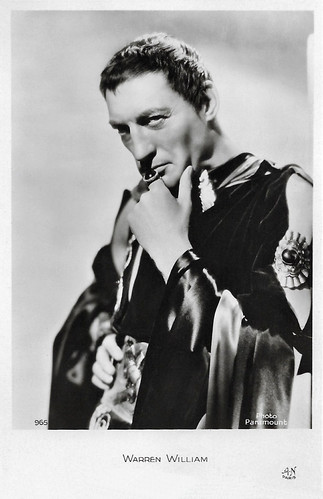
French postcard by A.N., Paris, no. 985. Photo: Paramount. Warren William as Julius Caesar in Cleopatra (Cecil B. DeMille, 1934).

British Real Photograph postcard, no. 90. Photo: Warner Bros & Vitaphone Pictures.

British postcard in the Film Weekly Series, London.
Hard-nosed, sometimes amoral businessmen, lawyers and outright charlatans
Warren William Krech was born in 1894 (some sources say 1895) in Aitken, Minnesota. The son of a publisher, he initially wanted to become a journalist. He abandoned this plan and attended the American Academy of Dramatic Arts to become an actor. As his senior year at AADA was coming to an end, the United States had entered the First World War, and William served as a soldier. He was assigned from base to base, in charge of training new men at various locations.
In 1918 was assigned to Fort Dix, New Jersey, near New York City. During this period, he met his future wife, Helen Barbara Nelson, who was 17 years his elder. After the war ended, William appeared in his first Broadway play in 1920. He soon made a name for himself in New York. Between 1920 and 1931, he appeared in more than 20 plays on Broadway, including the H.G. Wells play 'The Wonderful Visit' (1924).
In New York, he also acted in two silent films, The Town That Forgot God (Harry F. Millarde, 1922) and the serial Plunder (George B. Seitz, 1923) starring Pearl White in her last serial. In 1931, William moved from New York City to Hollywood. He made the transition to sound film with Honour of the Family (Lloyd Bacon, 1931), an adaptation of Honoré de Balzac's novel 'Cousin Pons' with Bebe Daniels.
In the midst of the Great Depression, he began as a contract player at Warner Bros. and quickly became a major Hollywood star. His breakthrough role was a district attorney who quits for the other side of the law, defending mobsters before a last-reel conversion in The Mouthpiece (James Flood, Elliott Nugent, 1932).
During the ‘Pre-Code era’ (1930-1934), American feature films often tackled controversial themes such as sexuality, violence and addiction. In these films, Warren William typically portrayed hard-nosed, sometimes amoral businessmen, lawyers and outright charlatans. Looking back at his career in 2011, The Village Voice christened him 'The King of Pre-Code', as it was during this era that he played his most significant film roles.

Dutch flyer, part 2. Photo: Warner Bros / First National Pictures. Loretta Young, Warren William and Alice White in Employees' Entrance (Roy Del Ruth, 1933).

Dutch flyer, part 3. Photo: Warner Bros / First National Pictures. Loretta Young and Warren William in Employees' Entrance (Roy Del Ruth, 1933).

Dutch postcard promoting a visit to the American epic Cleopatra (Cecil B. DeMille, 1934), starring Claudette Colbert (Cleopatra), Henry Wilcoxon (Marc Anthony) and Warren William (Julius Caesar). However, the guy on the right on this card is not Wilcoxon but Cleopatra's rival Pothinos (Leonard Mudie).
An investigating detective or a shady suspect
A striking example of Warren William's typical roles is the sadistic managing director in Employees’ Entrance (Roy Del Ruth, 1933), who steers his company through the economic crisis using heavy-handed methods. However, despite their detachment, his characters could also become likeable figures, such as the friendly gangster ‘Dave the Duke’ in Capra’s comedy Lady for a Day (Frank Capra, 1933), or the cynical but ultimately good-natured millionaire in the musical classic The Gold Diggers of 1933 (Mervyn LeRoy, 1933).
He played Julius Caesar in Cecil B. DeMille’s historical film Cleopatra (1934) alongside Claudette Colbert, with whom he also starred in the original version of the melodrama Imitation of Life (John M. Stahl, 1934). Between 1934 and 1936, he portrayed defence lawyer Perry Mason in four films. William also appeared in several whodunit films, either as an investigating detective or as a shady suspect.
When the Hays Code was introduced in Hollywood in 1934, there was an increasing demand for family-friendly entertainment. Warren William’s star began to fade rapidly. In the second half of the 1930s, he was cast in leading roles almost exclusively in B-grade crime films. He played a Raffles-like reformed jewel thief, The Lone Wolf, in nine films, beginning with The Lone Wolf Spy Hunt (Peter Godfrey, 1939), and appeared as Detective Philo Vance in two of the series films, The Dragon Murder Case (H. Bruce Humberstone, 1934) and the comedic The Gracie Allen Murder Case (Alfred E. Green, 1939).
He also starred as Sam Spade (renamed Ted Shane) opposite Bette Davis in Satan Met a Lady (William Dieterle, 1936), the second screen version of 'The Maltese Falcon'. Among his more notable roles from this later period were a jealous district attorney in the James Whale film, Wives Under Suspicion (James Whale, 1938), the swashbuckling musketeer Charles d’Artagnan in Whale's The Man in the Iron Mask (James Whale, 1939), and the role of a scientist in the classic Werewolf film The Wolf Man (George Waggner, 1941), starring Claude Rains. B-movie director Edgar G. Ulmer cast him as a cunning, highly dangerous murderer in the stylish Film Noir Strange Illusion (1945).
In 1947, William made the last of his 65 films. He played Laroche-Mathieu in The Private Affairs of Bel Ami (Albert Lewin, 1947), starring George Sanders. Due to his deteriorating health, he was unable to work for most of 1947. In 1948, Warren William died of cancer in Encino, California, at just 53. In 1923, the actor had married Helen Barbara Nelson, and remained married to her until his death. His wife Helen was to die only a few months later. William’s ashes were scattered into Long Island Sound. Unlike his unscrupulous screen characters, William was frequently described as friendly and shy. A star on the Hollywood Walk of Fame at 1559 Vine Street is dedicated in his honour.

British postcard by Film Weekly. Photo: Paramount. Warren William as Julius Caesar and Claudette Colbert as Cleopatra in Cleopatra (Cecil B. DeMille, 1934).

British postcard in the Film-Kurier Series, London, no. 24. Photo: First National Pictures.
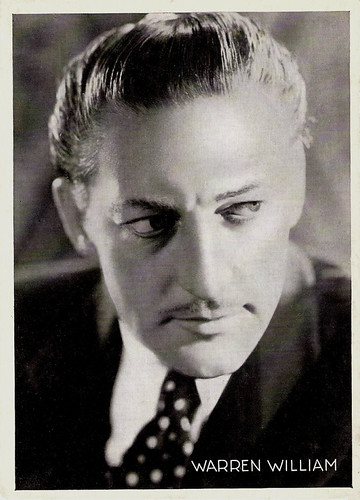
Vintage postcard.

British postcard by Film Weekly.
Sources: Jon C. Hepwood (IMDb), Wikipedia (German and English) and IMDb.

No comments:
Post a Comment