Italian postcard. Roberto Villa in Il fornaretto di Venezia/The Baker Boy of Venice (Duilio Coletti, 1939).

Italian postcard, no. 98. Photo: Vaselli. Roberto Villa as Nemorino in L'Elisir d'amore/The Elixir of Love (Amleto Palermi, 1941), freely based on the opera by Gaetano Donizetti.

Italian postcard, no. 85. Photo: Bertazzini. Roberto Villa as Vincenzo Bellini in La Sonnambula/The Sleepwalker (Piero Ballerini, 1941).
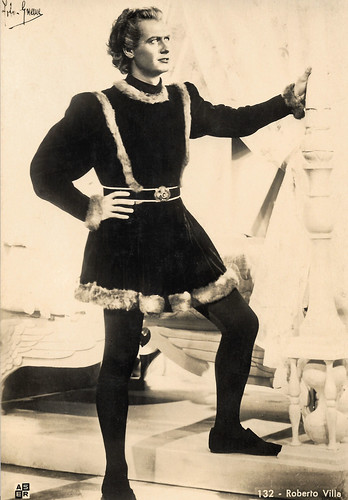
Italian postcard by ASER. no. 132. Photo: Greue (?). Roberto Villa in Cenerentola e il signor Bonaventura/Princess Cinderella (Sergio Tofano, 1942).

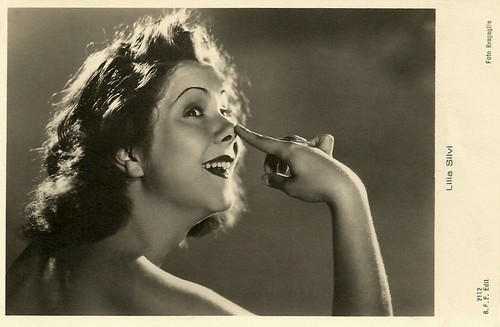
Italian postcard by B.F.F. Edit. (Casa Editr. Ballerini & Fratini, Firenze), no. 4295. Photo: Bragaglia.
Propaganda films
Roberto Villa was born Giulio Sabetta in Casablanca, French Protectorate of Morocco (now Morocco) in 1915. He studied medicine and followed the courses of the Centro Sperimentale (Centre of Cinematography) by Mario Camerini.
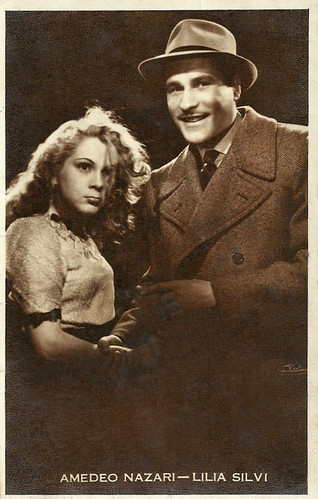
Camerini gave him the role of the illegitimate son of Camillo Pilotto in the Propaganda film Il Grande Appello/The Last Roll-Call (Mario Camerini, 1936) about the war with the Abyssinians. In 1938 followed another Propaganda film, Luciano Serra pilota/Luciano Serra, pilot (Goffredo Alessandrini, 1938), featuring Amedeo Nazzari.
Villa became a star with the successful Il fornaretto di Venezia/The Baker Boy of Venice (Duilio Coletti, 1939) with Clara Calamai. The handsome and friendly actor can be compared with such Hollywood stars as Robert Young and Robert Montgomery.
A popular film was Marco Visconti (Mario Bonnard, 1940), an elaborate costume drama based on a historical novel by Thomas Grossi. Hal Erickson at AllMovie: “Carlo Ninchi stars as Marco Visconti, head of the Milanese militia during the Middle Ages. When not fighting for the liberty of his countrymen, Visconti is engaged in a rivalry over the love of beautiful aristocrat Rice del Balzo (Mariella Lotti).
Since he'd once been in love with the girl's mother, Visconti feels that he has a proprietary right to the heroine, but his younger, handsome cousin Ottorino (Roberto Villa) has other ideas. Surprisingly laid back for a historical epic, the film bursts into life during the action sequences, which include a lively jousting tournament.”

Italian postcard by ASER (Aldo Scarmiglia Ed. Roma), no. 204. Photo: Vaselli / Lux Film.

Italian postcard by B.F.F. Edit. (Casa Editrice Ballerini & Fratini), no. 20890. Photo: Venturini.

Italian postcard by B.F.F. Edit (Casa Editrice Ballerini & Fratini), no. 43600. Photo: Bragaglia.

Italian postcard by Armando Tezoli, Roma, no. 210. Photo: Villoresi.

Italian postcard.
White telephones
Roberto Vila played one of his best roles in Vittorio De Sica’s sentimental Maddalena, Zero in Condotta/Maddalena, Zero for Conduct (1940) starring De Sica himself and Carla Del Poggio.
Maddalena is a typical Telefoni bianchi (White telephones film), that is to say, upper-class melodramas and comedies that were popular in Italy before and during WWII when Mussolini wanted cinema to distract and uphold the consensus.
The Telefoni bianchi gently mocked upper-class convention while celebrating the triumph of the commonplace. They were named after the luxurious white telephones which the film characters used rather than the standard black phones.
Villa reunited with veteran filmmaker Mario Bonnard for La gerla di papà Martin/Disillusion (Mario Bonnard, 1940) as the archetypal prodigal son who is ostensibly attending law school but is actually squandering his father's (Ruggero Ruggeri) money on gambling and women. When his father discovers this, he does his best to earn back the money he has frittered away.
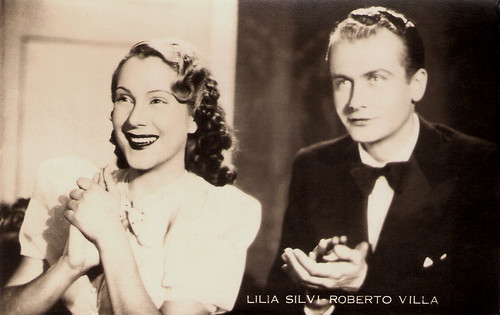
In several Telefoni bianchi he played the attractive partner of such stars as Alida Valli. In the drama Violette nei capelli/Violets in her hair (Carlo Ludovico Bragaglia, 1942) he was the love interest of Lilia Silvi. This successful pairing was repeated in the comedy La vispa Teresa/Lively Teresa (Mario Mattoli, 1943).

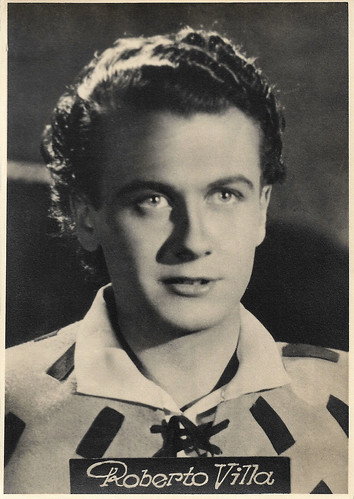
Italian postcard by B.F.F. Edit. (Ballerini & Fratini, Firenze), no. 4200. Photo by E.N.I.C. Roberto Villa as Ottorino Visconti in Marco Visconti (Mario Bonnard, 1941).

Italian postcard, no. 85. Photo: Bertazzini. Roberto Villa as Vincenzo Bellini in La Sonnambula/The Sleepwalker (Piero Ballerini, 1941).

Italian postcard by ASER, Roma, no. 118. Roberto Villa in Cenerentola e il signor Bonaventura/Princess Cinderella (Sergio Tofano, 1941).

Italian postcard. Roberto Villa as Nemorino in L'Elisir d'amore/The Elixir of Love (Amleto Palermi, 1941).

Italian postcard, no. 62/2. Photo: Lilia Silvi and Roberto Villa in Violette nei capelli/Violets in the hair (Carlo Ludovico Bragaglia, 1942).

Italian postcard by Ed. ASER, no. 219. Photo: Vaselli / Lux Film. Roberto Villa and Anna Vivaldi in Giorno di nozze/Wedding Day (Raffaello Matarazzo, 1942).
Shells
After the Second World War, Roberto Villa devoted himself to the stage. During the 1950s, he formed the successful stage company Tamberlani-Barbara-Villa. He appeared only incidentally in films.
Villa played supporting parts in the French-Italian production Danse de Mort/Dance of Death (Marcel Cravenne, 1948) starring Erich von Stroheim and María Denis, and the British film My Daughter Joy/Operation X (Gregory Ratoff, 1950) with Edward G. Robinson and Peggy Cummins.
Villa also worked as a voice actor. He did the Italian comment for the defilé ‘Beautiful Girls’ in the post-synchronised version of Singin' in the Rain (Gene Kelly, Stanley Donen, 1952). He was also the Italian voice of Paul Meurisse in L'armée des ombres (Jean-Pierre Melville, 1969), of Toshiro Mifune in The Battle of Midway (Jack Smight, 1976), and of John Gielgud in Chariots of Fire (Hugh Hudson, 1981).
In the 1960s he also participated in TV series like Avventure in IV B/Adventure in IV B (Lelio Golletti, 1964) and Le avventure di Laura Storm/The Adventures of Laura Storm (Camillo Mastrocinque, 1966). In the early 1980s, he retired and lived in the town of Sutri, near Rome.
In 1995, Sergio Micheli published the biography 'Roberto Villa, an Actor and a Star.' Villa himself wrote an autobiography 'I was born in Casablanca....' (2000), in cooperation with Sergio Micheli. Roberto Villa died in Fontevivola, Italy in 2002. He was married to actress and director Adriana Parrella from 1952 till his death. Villa was a great lover and collector of shells. Following his death his widow donated his collection to the Museo Malacologico (Museum of Malacology) in Piceno.

German postcard by Ross / Das Programm von Heute, Berlin. Photo: Degeto / Tobis / Aquila.

German postcard by Das Programma von Heute, Berlin. Photo: Difu.

Italian postcard, possibly by Terzoli, no. 83.
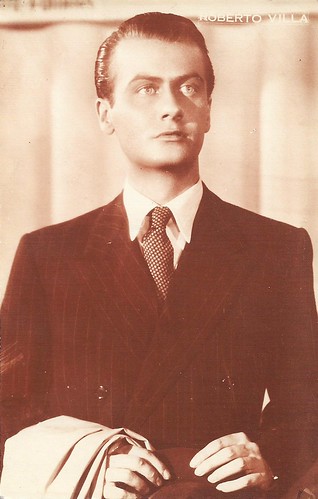
Vintage postcard by Leonar, no. 1112.

Italian postcard by Mimosa.
Sources: Hal Erickson (AllMovie), Antonio Genna (Il mondo dei doppiatori - Italian), Wikipedia (Italian) and IMDb.