Showing posts with label Bernhard Goetzke. Show all posts

27 July 2018

Bernhard Goetzke

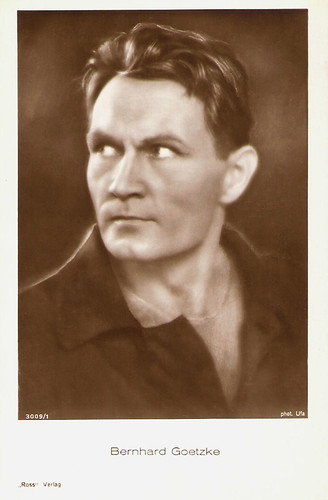
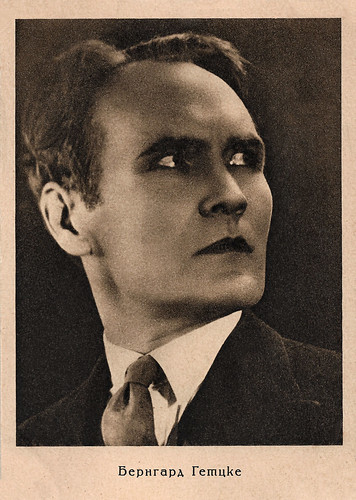
With his sharply featured face, high forehead and low-lying eyes, German film actor Bernhard Goetzke (1884–1964) was one of the impressive stars of the silent films of Fritz Lang. He appeared in 130 films between 1917 and 1961.
Bernhard Goetzke
German postcard by Ross Verlag, no. 3009/1, 1928-1929. Photo: Ufa.

Die Nibelungen (1924)
German postcard by Ross Verlag, no. 675/4. Photo: Decla-Ufa-Film. Caption: Kriemhild (Margarethe Schön) gives Volkert (Bernhard Goetzke) Siegfried's cloak. Still for Die Nibelungen, II: Kriemhilds Rache (Fritz Lang, 1924).
Bernhard Goetzke
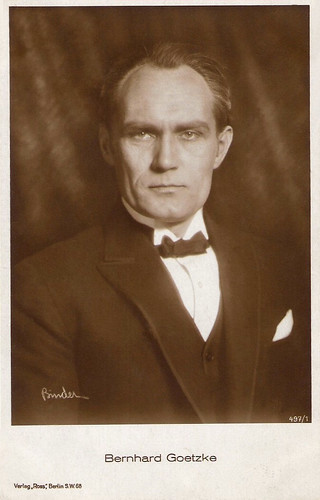
German postcard by Ross Verlag, no. 497/1, 1919-1924. Photo: Alex Binder.

Ernst Lubitsch


Bernhard Goetzke was born in Danzig, Germany (now Gdańsk, Poland) in 1884.

After a private training as an actor, he performed in theatres in Düsseldorf, Hagen, and Dresden. During the First World War, he went to Berlin. There he played on many stages and worked under the famous director Max Reinhardt.

Goetzke started his film career in the 1910s. In 1917 he appeared with Conrad Veidt in the eerie dream-like Furcht/Fear (Robert Wiene, 1917).

This was soon followed by leading roles in the mystery Die Japanerin/The Japanese Woman (Ewald André Dupont, 1919) opposite Ria Jende, Anita Jo (Dimitri Buchowetzki, 1919) featuring Hanni Weisse, and Zwischen Tod und Leben/Between Life and Death (Arthur Wellin, 1919) with Alexander Moissi.

Goetzke had a supporting part in the international box office hit Madame DuBarry (Ernst Lubitsch, 1919) starring Pola Negri.

A second highlight was Die Brüder Karamasoff/The Brothers Karamazov (Carl Froelich, 1921), the first film version of Fyodor Dostoevsky’s famous novel. He played Iwan Karamazov, and Emil Jannings and Fritz Kortner as his (young and older) brother, the murderer Dimitri.

Another huge success was the two-part adventure epic Das indische Grabmal/The Indian Tomb (Joe May, 1921), in which Goetzke appeared as a sinister Yogi opposite Olaf Fönss and Mia May. His sharply featured face, high forehead and low-lying eyes as well as his long, slim form made him one of the most impressive appearances of the silent cinema.

Bernhard Goetzke in Die Nibelungen
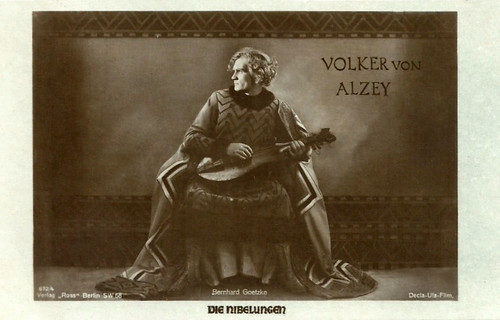
German postcard by Ross Verlag, no. 672/4. Photo: Decla-Ufa-Film. Bernhard Goetzke as Volker von Alzey, the bard in Die Nibelungen (Fritz Lang, 1924). Costumes and sets of the film were inspired by Carl Otto Czeschka's book illustrations (1909) of Die Nibelungen.

Bernhard Goetzke in Gli ultimi giorni di Pompei (1926)
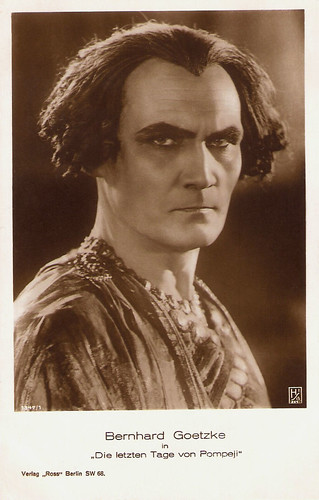
German postcard by. Ross Verlag, no. 1347/1. Photo: Hisa Film-Vertrieb. Bernhard Goetzke as the evil Egyptian priest Arbaces in the silent epic Gli ultimi giorni di Pompei/ The Last Days of Pompeii (Carmine Gallone, Amleto Palermi, 1926).

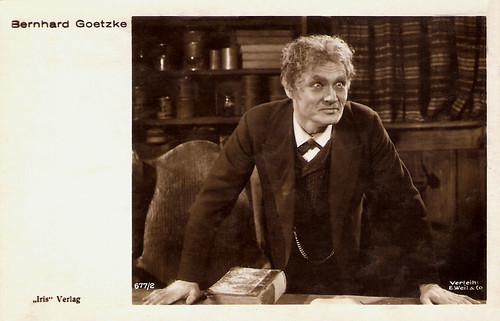
Bernhard Goetzke
Austrian postcard by Iris Verlag, no. 677/2. Photo: Verleih E. Weil & Co.

Alfred Hitchcock


Bernhard Goetzke’s most notable film performance was his title role of Death in Fritz Lang’s Der müde Tod/Destiny (Fritz Lang, 1921). He worked again for Lang in Dr. Mabuse, der Spieler/Dr. Mabuse: The Gambler (Fritz Lang, 1922) the first in Lang's series of thrillers around the criminal mastermind Dr. Mabuse (Rudolph Klein Rogge).

Goetzke also played Volker von Alzey, the Bard, in Lang‘s epic fantasy Die Nibelungen (Fritz Lang, 1924).

Then he played the leading role of engineer Kramer in Gerhard Lamprecht‘s social drama Die Verrufenen/Slums of Berlin (Gerhard Lamprecht, 1925) with Aud Egede Nissen, and he also starred in the sequel Die Unehelichen/Children of No Importance (Gerhard Lamprecht, 1926).

In that same year Alfred Hitchcock directed him in the leading role of his romantic thriller The Mountain Eagle (1926), which was shot in München (Munich). He played a Kentucky shopkeeper in love with a teacher (Nita Naldi). When she refuses him, he accuses her from molesting his mentally ill son. Hitchcock also wrote the drama Die Prinzessin und der Geiger/The Blackguard (Graham Cutts, 1925) with Goetzke and in the title role Walter Rilla.

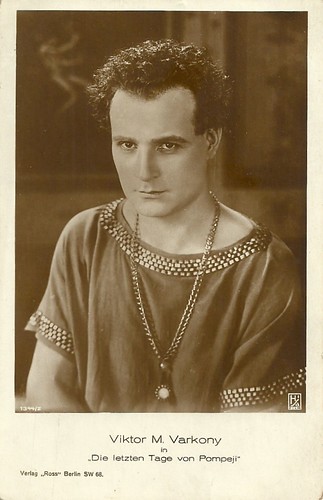
In Italy, Goetzke played in the historical epic Gli ultimi giorni di Pompeii/The Last Days of Pompeii (Carmine Gallone, Amleto Palermi, 1926) with Victor Varconi.

In France, he co-starred in the crime film Vivre/To Live (Robert Boudrioz, 1928) with Elmire Vautier. In France, he also played father Faria in a silent adaptation of Alexandre Dumas Père’s Monte Cristo (Henri Fescourt, 1929) starring Jean Angelo.

He had his last leading role in Salamandra/Salamander (Grigori Roshal, 1929), one of the first German-Soviet co-productions. It was a Socialist Realist distortion of Dr. Paul Kammerer's experiments in the inheritance of acquired character(istic)s: the conjecture that certain changes which the environment produces in an individual may spontaneously appear in the next generation.
Bernhard Goetzke
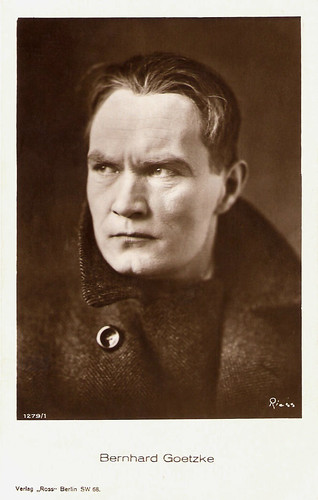
German postcard by Ross Verlag, no. 1279/1, 1927-1928. Photo: Riess.
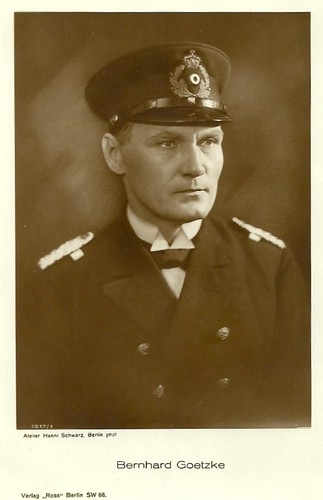
Bernhard Goetzke
German postcard by Ross Verlag, no. 1517/1, 1927-1928. Photo: Atelier Hanns Schwarz.
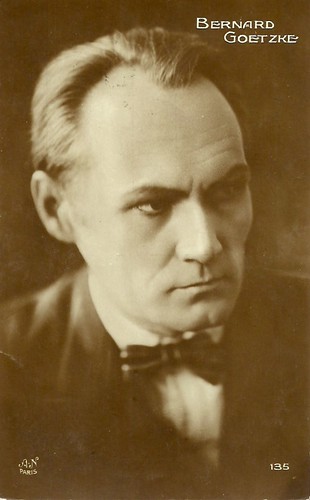
Bernhard Goetzke
French postcard by A. N. (A. Noyer), Paris, no. 135.

Alraune


When the sound film arrived, Bernhard Goetzke joined the fate of many of his colleagues and his film career went into decline. During the sound era, he only appeared in supporting roles.

In the interesting SciFi film Alraune/Daughter of Evil (Richard Oswald, 1930), he played one of the men who fall for the vamp Alraune, played by Brigitte Helm. In this sound version, Helm gives a different interpretation of the same part she had in the silent version two years earlier. She not only portrays Alraune, the artificially created girl who brings down men by the dozen but also her mother, a prostitute who agrees to take part in an experiment of artificial insemination.

Goetzke reunited with his former director Lamprecht and co-star Aud Egede Nissen for Zwischen Nacht und Morgen/Between Night and Dawn (Gerhard Lamprecht, 1931), but his role was only a minor one.

In Finland he played his last lead role as an old hunter in the drama Erämaan turvissa (Kalle Kaarna, Friedrich von Maydell, 1931). From then he played supporting or bit parts in dozens of run-of-the mill films.

Among the more interesting films are the Jules Verne adaptation Der Kurier des Zaren/The Czar's Courier (Richard Eichberg, 1936) starring Adolph Wohlbrück (aka Anton Walbrook) as Lt. Michael Strogoff, and the pro-Irish propaganda film Der Fuchs von Glenarvon/The Fox of Glenarvon (Max W. Kimmich, 1941) with Olga Tschechova.

He also played a small part in the notorious propaganda film Jus Süss/Jew Süss (Veit Harlan, 1941). His roles at the time were so small that his performances sometimes were not even credited.

After the war Goetzke only appeared in two films of the East-German DEFA studio, as a poor farmer in the classic children’s fantasy Das kalte Herz/The heart of Stone (Paul Verhoeven, 1950) with Lutz Moik, and as a priest in the biography Semmelweis - Retter der Mütter/Dr. Semmelweis (Georg C. Klaren, 1950).

He focused on his stage career, and till his death he was an ensemble member of the Staatlichen Schauspielbühnen Westberlins (the State Theatres of West Berlin). His final screen appearance was a bit role in the TV film Elisabeth von England/Elizabeth of England (Hanns Korngiebel, 1961) featuring Elisabeth Flickenschildt.

Bernhard Goetzke died in 1964 in West-Berlin. He was 80.
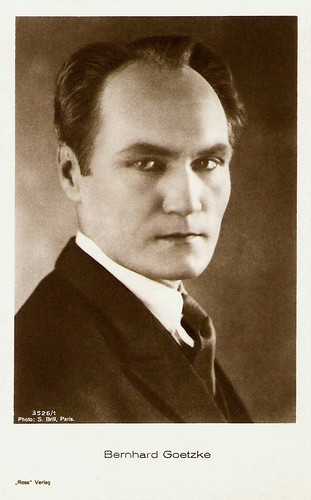
Bernhard Goetzke
German postcard by Ross Verlag, no. 3526/1, 1928-1929. Photo: S. Brill, Paris.
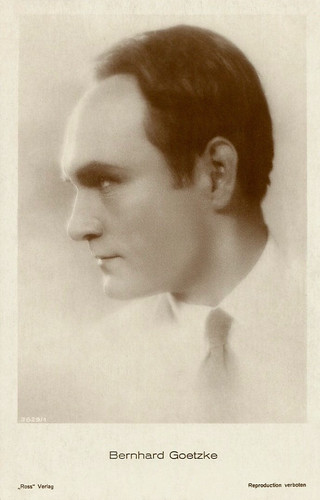
Bernhard Goetzke
German postcard by Ross Verlag, no. 3629/1, 1928-1929.
Sources: Volker Wachter (DEFA Filmsterne), Wikipedia (English and German), and IMDb.

28 October 2015

Gli ultimi giorni di Pompei (1926)

The Italian-German silent film Gli ultimi giorni di Pompei/The Last Days of Pompeii (Amleto Palermi, Carmine Gallone, 1926) was one of the many adaptations of the novel The Last Days of Pompeii (1834) by Edward George Bulwer-Lytton. The stars were the Hungarian actors Victor Varconi and Maria Corda, the Italian actress Rina De Liguoro and the German Bernhard Goetzke. Original release prints of the film were entirely colourised by the Pathechrome stencil colour process.

Gli ultimi giorni di Pompei
Italian postcard by C. Chierichetti, Milano. Photo: Grandi Films, Roma. Publicity still for Gli ultimi giorni di Pompei/The Last Days of Pompeii (Amleto Palermi, Carmine Gallone, 1926).

Glaucus (Victor Varconi) training at the gymnasium.

Gli ultimi giorni di Pompei
Italian postcard by C. Chierichetti, Milano. Photo: Grandi Films, Roma. Publicity still for Gli ultimi giorni di Pompei/The Last Days of Pompeii (Amleto Palermi, Carmine Gallone, 1926).

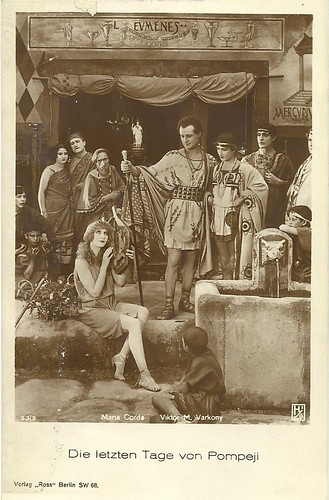
Pompeian street life with the rich Greek Glaucus (Victor Varconi) and his wealthy friends meeting the blind flower girl Nydia (Maria Corda), who also sings and plays the lyre. The bearded man left in the back is Burbo (Carlo Duse), the brutal tavern owner, who owns Nydia as a slave.

Gli ultimi giorni di Pompei
Italian postcard by C. Chierichetti, Milano. Photo: Grandi Films, Roma. Publicity still for Gli ultimi giorni di Pompei/The Last Days of Pompeii (Amleto Palermi, Carmine Gallone, 1926).

A Pompeiian street with Burbo's tavern. Sets were by Vittorio Cafiero, costumes by Duilio Cambellotti.

Gli ultimi giorni di Pompei
Italian postcard by C. Chierichetti, Milano. Photo: Grandi Films, Roma. Publicity still for Gli ultimi giorni di Pompei/The Last Days of Pompeii (Amleto Palermi, Carmine Gallone, 1926).

Glaucus (Victor Varconi) has saved Nydia (Maria Corda) from Burbo and taken into his house. Nydia loves Glaucus, but he can only think of Ione.

Gli ultimi giorni di Pompei
Italian postcard by C. Chierichetti, Milano. Photo: Grandi Films, Roma. Publicity still for Gli ultimi giorni di Pompei/The Last Days of Pompeii (Amleto Palermi, Carmine Gallone, 1926).

Nydia, in love with Glaucus, thinks she has given Glaucus a love potion, but instead it makes him delirious. It is Arbaces who has concocted this.

The Novel and the painting


The novel The Last Days of Pompeii was written by the baron Edward Bulwer-Lytton in 1834. The novel was inspired by the painting The Last Day of Pompeii by the Russian painter Karl Briullov, which Bulwer-Lytton had seen in Milan.

The novel culminates in the cataclysmic destruction of the city of Pompeii by the eruption of Mount Vesuvius in AD 79. The novel became a bestseller, helped on its release by the eruption of Vesuvius just before publication.

The Last Days of Pompeii uses its characters to contrast the decadent culture of 1st-century Rome with both older cultures and coming trends. The protagonist, Glaucus, a handsome Athenian nobleman and Ione's betrothed, represents the Greeks who have been subordinated by Rome.

His nemesis is Arbaces, a scheming Egyptian sorcerer and a high priest of Isis, and the former guardian of Ione and her brother Apaecides. Arbaces represents the still older culture of Egypt. He murders Apaecides and frames Glaucus for the crime. Repeatedly he attempts to seduce Ione.

Olinthus is the chief representative of the nascent Christian religion, which is presented favourably but not uncritically. The Christian converts Apaecides to Christianity and is sentenced to death for his religion.

Maria Corda and Victor Varconi in The Last Days of Pompeii (1926)
German postcard by Ross Verlag, no. 53/3. Photo: Hisa Film-Vertrieb. Publicity still for Gli ultimi giorni di Pompei/The Last Days of Pompeii (Carmine Gallone, Amleto Palermi, 1926). Collection: Didier Hanson.

Victor Varconi as Glaucus in Gli ultimi giorni di Pompei (1926)
German postcard by Ross Verlag, no. 1344/2, 1927-1928. Photo: Hisa Film-Vertrieb. Publicity still for Gli ultimi giorni di Pompei/The Last Days of Pompeii (Carmine Gallone, Amleto Palermi, 1926). Victor Varconi as Glaucus.

Bernhard Goetzke in Gli ultimi giorni di Pompei
German postcard by Ross Verlag, no. 1347/1, 1927-1928. Photo: Hisa Film-Vertrieb. Publicity still for Gli ultimi giorni di Pompei/The Last Days of Pompeii (Carmine Gallone, Amleto Palermi, 1926). Bernhard Goetzke as the evil Egyptian priest Arbaces.

Gli ultimi giorni di Pompei
Italian postcard by C. Chierichetti, Milano. Photo: Grandi Films, Roma. Publicity still for Gli ultimi giorni di Pompei/The Last Days of Pompeii (Amleto Palermi, Carmine Gallone, 1926).

The funeral of Apecides (Vittorio Evangelisti). Apecides, brother of Glaucus' lover Ione and former pupil of the Egyptian high priest of Isis, Arbaces, has converted to Christianity and threatens to unmask Arbaces's frauds. Arbaces stabs him and puts the blame on Glaucus, drugged unknowingly by Nydia. The priest in the middle is Calenus (Emilio Ghione), who has seen Arbaces murdering Apecides. Arbaces himself (Bernhard Goetzke) can be seen extreme left.

Gli ultimi giorni di Pompei
Italian postcard by C. Chierichetti, Milano. Photo: Grandi Films, Roma. Publicity still for Gli ultimi giorni di Pompei/The Last Days of Pompeii (Amleto Palermi, Carmine Gallone, 1926).

At the Via delle Tombe in Pompeii the funeral service for the murdered Apecides is held. In the centre is the priest Calenus (Emilio Ghione).

The Star Cast


Handsome Victor Varconi (1891–1976) was as Glaucus the male star of Gli ultimi giorni di Pompei/The Last Days of Pompeii. The Hungarian Varconi, originally Viktor Varkony, was a highly successful matinee idol of the Hungarian-Austrian and German silent cinema in the 1910s and early 1920s. Later he was the first Hungarian actor to become a Hollywood star until the sound film completely altered the course of his career.

Hungarian Maria Corda (1898-1975) played the slave girl Nydia, who is in love with Glaucus. Corda was an immensely popular star of the silent cinema of Austria and Germany. The pretty, blonde actress was a queen of the popular epic spectacles of the 1920s, which were often directed by her husband, Alexander Korda.

Not pictured on one of the postcards is Rina De Liguoro (1892-1966) as Ione. She was the last diva of the Italian silent cinema of the 1920s. De Liguoro had her breakthrough in 1924 as the sensual, untamed Roman empress Messalina, and the beautiful countess continued her glittering career in such epics as Quo Vadis (1924), Casanova (1927) and Cecil B. De Mille's notorious box office flop Madam Satan (1930).

Emilio Ghione (1879-1930), who played Calenus, was an Italian silent film actor, director and screenwriter. He is best known for writing, directing and starring in the Za La Mort series of adventure films, in which he played a likeable French apache and 'honest outlaw.'

The evil Egyptian priest Arbaces was played by German film actor Bernhard Goetzke (1884–1964). He was one of the impressive stars of German silent cinema, in particular in the films by Fritz Lang. Goetzke appeared in 130 films between 1917 and 1961.

Gli ultimi giorni di Pompei
Italian postcard by C. Chierichetti, Milano. Photo: Grandi Films, Roma. Publicity still for Gli ultimi giorni di Pompei/The Last Days of Pompeii (Amleto Palermi, Carmine Gallone, 1926).

Calenus (Emilio Ghione) tries to blackmail Arbaces (Bernhard Goetzke). Arbaces leads him to his treasury.

Gli ultimi giorni di Pompei
Italian postcard by C. Chierichetti, Milano. Photo: Grandi Films, Roma. Publicity still for Gli ultimi giorni di Pompei/The Last Days of Pompeii (Amleto Palermi, Carmine Gallone, 1926).

Calenus (Emilio Ghione) has been fooled by Arbaces and is locked up in the treasury, which is also a dungeon.

Gli ultimi giorni di Pompei
Italian postcard by C. Chierichetti, Milano. Photo: Grandi Films, Roma. Publicity still for Gli ultimi giorni di Pompei/The Last Days of Pompeii (Amleto Palermi, Carmine Gallone, 1926).

At the basilica (courts of justice). Glaucus (Victor Varconi) is sentenced to die.

Gli ultimi giorni di Pompei
Italian postcard by C. Chierichetti, Milano. Photo: Grandi Films, Roma. Publicity still for Gli ultimi giorni di Pompei/The Last Days of Pompeii (Amleto Palermi, Carmine Gallone, 1926).

Glaucus (Victor Varconi) and the Christian Olintus (Ferruccio Biancini), the man on the right, in the prison of the Christians, waiting for their ordeal in the arena.

The adaptations


The first theatrical adaptation of The Last Days of Pompeii was Errico Petrella's opera Jone, with a libretto by Giovanni Peruzzini. It premiered at La Scala in 1858. It was very successful and remained in the Italian repertoire well into the 20th century. In 1877 followed an ambitious theatrical adaptation, which was mounted at the Queen's Theatre, Long Acre in London. It featured a staged eruption of the Vesuvius, an earthquake and a sybaritic Roman feast – the earth did not quake, the volcano did not work, acrobats fell onto the cast below, and the production was an expensive flop.

The first film version was the British short film The Last Days of Pompeii (1900), directed by Walter R. Booth. Eight years later followed Gli ultimi giorni di Pompei/The Last Days of Pompeii (Arturo Ambrosio, Luigi Maggi, 1908). In 1913 followed to more Italian silent film versions, Gli ultimi giorni di Pompei/The Last Days of Pompeii (Mario Caserini, 1913), and Jone ovvero gli ultimi giorni di Pompei/Jone or the Last Days of Pompeii (Giovanni Enrico Vidali, Ubaldo Maria Del Colle, 1913).

The first sound version was the Hollywood production The Last Days of Pompeii (Ernest B. Schoedsack, Merian C. Cooper, 1935), with Preston Foster and Basil Rathbone. It carried a disclaimer that, although the movie used the novel's description of Pompei, it did not use its plot or characters. The film was a moderate success on its initial release, but made an overall loss of $237,000.

After the war followed the French-Italian version Gli ultimi giorni di Pompei/Les Derniers Jours de Pompéi/The Last Days of Pompeii (Marcel L'Herbier, Paolo Moffa, 1950), starring Micheline Presle and Georges Marchal. The amphitheatre scenes were filmed at the Arena di Verona. The next adaptation was another Italian version, Gli ultimi giorni di Pompei/The Last Days of Pompeii (Sergio Leone, 1959), starring Steve Reeves. Mario Bonnard, the original director, fell ill on the first day of shooting, so assistant director Leone and the scriptwriters finished the film. Later followed two TV versions and a German stage musical, Pompeji (2008).

But how was the 1926 version? David Melville reviews at IMDb: "The last of the great silent Italian epics, The Last Days of Pompeii is as lavish as anything produced by Hollywood at that time - only much, much raunchier. During an orgy in the house of the evil priest Arbaces, naked slave girls are served up (literally!) on platters decked with flowers. A nubile mummy rises out of her sarcophagus to do a striptease and bare-breasted sphinx statues come to life as her chorus line. In the gladiators' tavern, wildly effeminate men (kohl-dark eyelids and lipstick as thick as clotted blood) drool and bat their eyes over so much naked, muscular flesh. All in all, the most satisfyingly decadent Ancient Rome saga until Fellini Satyricon in 1968!"

Gli ultimi giorni di Pompei
Italian postcard by C. Chierichetti, Milano. Photo: Grandi Films, Roma. Publicity still for Gli ultimi giorni di Pompei/The Last Days of Pompeii (Amleto Palermi, Carmine Gallone, 1926).

Glaucus (Victor Varconi) in prison. The man on the right is the Christian Olintus (Ferruccio Biancini), who had converted Apecides. Olintus will see the eruption and destruction of Pompeii as a punishment of God.

Gli ultimi giorni di Pompei
Italian postcard by C. Chierichetti, Milano. Photo: Grandi Films, Roma. Publicity still for Gli ultimi giorni di Pompei/The Last Days of Pompeii (Amleto Palermi, Carmine Gallone, 1926).

Glaucus is sentenced to die in the arena, eaten by lions, when just in time Glaucus's friend Sallustius, Nydia, Ione and Calenus expose Arbaces as the real murderer and he threatens to be lynched by the mob. Suddenly the Vesuvius erupts and the terrorised people flee.

Gli ultimi giorni di Pompei
Italian postcard by C. Chierichetti, Milano. Photo: Grandi Films, Roma. Publicity still for Gli ultimi giorni di Pompei/The Last Days of Pompeii (Amleto Palermi, Carmine Gallone, 1926).

The destruction of the house of Glaucus.

Sources: David Melville (IMDb), Wikipedia and IMDb.

04 October 2014

Die Nibelungen (1924)

Today starts the 33rd edition of the Giornate del Cinema Muto, which will take place in Pordenone, Italy, from 4 till 11 October. The Teatro Verdi will be the venue for 60 screenings of silent films. The main programme section is devoted to The Barrymores, Lionel, Ethel and John - the Royal Family of Broadway who brought prestige to 1920s Hollywood. The closing show of the festival is a live performance of City Lights (Charles Chaplin, 1931), with Chaplin's own score restored. There are exciting rediscoveries of films long considered lost, among them Lady Hamilton (Richard Oswald, 1921) with Conrad Veidt as Nelson, the sensational white-slave drama Das Frauenhaus von Rio/Girls for Sale! (Bud Pollard, Hans Steinhoff, 1927), and Die Macht der Finsternis/Power of Darkness (Conrad Wiene, 1924), a legendary adaptation of Tolstoy's drama. Another highlight is a marathon screening of both films of Fritz Lang's Die Nibelungen diptych, screened successively on the same afternoon and evening, and accompanied by Günter Buchwald (piano) and Frank Bockius (percussion). I can't attend the screening, but today's extra long film special honours this film and the Giornate del Cinema Muto.

Die Nibelungen, Siegfried
German postcard by Ross Verlag, Berlin, no. 675/1. Photo: Decla-Ufa-Film. Publicity still for Die Nibelungen: Siegfried (Fritz Lang, 1924) with Paul Richter.

Margarete Schön, Die Nibelungen
German postcard by Ross Verlag, no. 672/6. Photo: Decla-Ufa-Film. Publicity still for Die Nibelungen (Fritz Lang, 1924) with Margarethe Schön.

Paul Richter in Die Nibelungen: Siegfried
Italian postcard by Q. Vettori, Bologna.

How Siegfried Slayed the Dragon


Die Nibelungen (Fritz Lang, 1924) is one of the masterpieces of the Weimar cinema. Die Nibelungen is a duology of silent fantasy films: Die Nibelungen: Siegfried and Die Nibelungen: Kriemhilds Rache/Kriemhild's Revenge.

It was produced by the Ufa and Decla studios, and it starred Austrian actor Paul Richter as the (nearly) invulnerable hero Siegfried. Ross Verlag published in 1924 a beautiful series of sepia tinted postcards with stills of this classic film.

The screenplays were written by Fritz Lang and his wife at the time, Thea von Harbou. They were based upon the epic Nordic poem Nibelungenlied, written around AD 1200 and told through seven cantos.

It is the tale of the legendary German hero Siegfried (Paul Richter), son of King Siegmund. He masters the art of forging a sword at the shop of Mime (George John). On his journey home, he hears tales from the locals about Princess Kriemhild (Margarete Schön), the beautiful sister of King Gunter of Burgundy (Theodor Loos).

Siegfried decides to go to Worms, the capital of Burgundy, to win Kriemhild. On his journey to Worms, he is attacked by a dragon. Siegfried slays the dragon and bathes in his blood.

This bath makes him invulnerable - except for one spot on his shoulder blade which is missed after being covered by a falling lime leaf.

Paul Richter in Die Nibelungen,
German postcard by Ross Verlag, no. 678/1. Photo: Decla / Ufa-Film. Publicity still for part I. of Die Nibelungen (Fritz Lang, 1924) with Paul Richter as Siegfried. Caption: Siegfrieds Kampf mit den Drachen (Siegfried's fight with the dragon).

Die Nibelungen - Siegfried fighting the dragon
German postcard by Ross Verlag, no. 678/2. Photo: Decla-Ufa-Film. Publicity still for Die Nibelungen: Siegfried (Fritz Lang, 1924). Caption: Siegfried's Fight with the Dragon.

Die Nibelungen, Siegfrieds kampf mit den Drachen
German postcard by Ross Verlag, Berlin, no. 678/3. Photo: Decla-Ufa-Film. Caption: Siegfried's Fight with the Dragon.

Die Nibelungen: Siegfried bathes in the dragon's blood
German postcard by Ross Verlag, no. 678/4. Photo: Decla-Ufa-Film. Publicity still for Die Nibelungen: Siegfried (Fritz Lang, 1924). Caption: Siegfried bathes in the dragon's blood. After slaying the dragon, Siegfried (Paul Richter) bathes in the dragon's blood, which will make him invulnerable. Incidentally, a leaf falls on his back, creating Siegfried's one weak spot (his Achilles heel). When the vain and arrogant Paul Richter refused to strip for this scene, Lang called in the not so pretty Rudolf Klein-Rogge (Etzel - Attila - in the film), who immediately undressed and played the scene, to the dismay of Richter, as people now would identify Klein-Rogge's behind as his.

How Volker, the Bard, sang of Siegfried in front of Kriemhild, and How Siegfried Came in Worms

Siegfried trespasses on the land of the Nibelungen and is attacked by Alberich, King of the Dwarves (again George John).

He fights and defeats Alberich who was wearing his wonder cloak of invisibility and transformation. Alberich asks Siegfried to spare his life and in return he gives the Treasure of the Nibelungen and the Balmung sword.

While Siegfried is mesmerised by the treasure, Alberich tries to defeat him, but dies in the attempt. Dying, Alberich curses all inheritors of the treasure and he and his dwarves turn to stone.

Siegfried makes twelve kings as his vassals, and arrives in Worms as a hero.

Die Nibelungen I: Siegfried und Alberich in der Nebelwiese
German postcard by Ross Verlag, Berlin, no. 675/2. Photo: Decla-Ufa-Film. Publicity still for Die Nibelungen: Siegfried (Fritz Lang, 1924). Caption: Siegfried and Alberich in the fog meadow.

Die Nibelungen, Siegfried und Alberich in der Höhle
German postcard by Ross Verlag, Berlin, no. 675/3. Photo: Decla-Ufa-Film. Publicity still for Die Nibelungen: Siegfried (1924, Fritz Lang) with Paul Richter as Siegfried and Georg John as Alberich. Caption: Siegfried and Alberich in the cave.

Die Nibelungen, Siegfried
German postcard by Ross Verlag, Berlin, no. 672/1, 1924. Photo: Decla-Ufa-Film. Publicity still for Die Nibelungen: Siegfried (Fritz Lang, 1924).

How Siegfried Won Brunhild for Gunther


News reaches the court that Brunhild, a queen of outstanding strength and beauty may be won only by a man capable of matching her athletic prowess.

Gunther decides to woo Brunhild (Hanna Ralph) with the aid of Siegfried, to whom he promises the hand of Kriemhild if successful.

The men travel to Iceland, to the kingdom of Brunhild, where Siegfried feigns vassalage to Gunther so that he can avoid Brunhild's challenge.

He uses instead the cloak's power of invisibility to help Gunther beat the powerful Queen in a three-fold amazonian battle of strength: throwing stones, throwing a spear and jumping.

Die Nibelungen
German postcard by Ross Verlag, Berlin, no. 673/3. Photo: Decla-Ufa-Film. Publicity still for Die Nibelungen: Siegfried (Fritz Lang, 1924).

Die Nibelungen I: Brunhild
German postcard by Ross Verlag, Berlin, no. 672/8. Photo: Decla-Ufa-Film. Publicity still for Die Nibelungen: Siegfried (Fritz Lang, 1924) with Hanna Ralph as Brunhild.

How Brunhild Enters Worms and How the King Celebrate Their Wedding


The men return to Burgundy where Gunther marries Brunhild and Siegfried weds Kriemhild.

Brunhild is not, however, completely defeated. She suspects deceit and says to Gunther that she is his captive but not his bride.

Hagen von Tronje (Hans Adalbert Schlettow) convinces Siegfried to help.

Siegfried transforms himself with the cloak into Gunther and battles Brunhild and removes her arm-ring during battle after which she submits to his will.

Siegfried leaves the real Gunther to consummate the marriage. Siegfried accidentally brings Brunhild's armlet with him.

On the postcard below Siegfried presents Kriemhild the circlet.

Die Nibelungen I: Siegfried begrüsst Kriemhild
German postcard by Ross Verlag, Berlin, no. 675/6. Photo: Decla-Ufa-Film. Publicity still for Die Nibelungen: Siegfried (Fritz Lang, 1924). Caption: Siegfried greets Kriemhild.

Paul Richter and Margarete Schön in Die Nibelungen
German postcard by Ross Verlag, no. 673/1. Photo: Decla / Ufa-Film. Publicity still for Siegfried (Paul Richter) and Kriemhild (Margarete Schön) in part I. of Die Nibelungen (Fritz Lang, 1924).

Die Nibelungen I: Siegfried überreicht Kriemhild den Reif
German postcard by Ross Verlag, Berlin, no. 675/7. Photo: Decla-Ufa-Film. Publicity still for Die Nibelungen: Siegfried (Fritz Lang, 1924). Siegfried (Paul Richter) presents Kriemhild (Margarete Schön) the circlet.

Die Nibelungen I
German postcard by Ross Verlag, Berlin, no. 673/4. Photo: Decla-Ufa-Film. Publicity still for Die Nibelungen: Siegfried (Fritz Lang, 1924).

How After Half a Year, Siegfried's Gift to His Bride, The Nibelungen Treasure, Arrives in Worms and How the Two Queens Quarrel With Each Other


When Kriemhild finds Brunhild's armlet, Siegfried tells her how her brother won the queen.

When the Nibelungen treasure that Siegfried acquired from Alberich arrives at the court of Burgundy as Kriemhild's morning gift, the jealous Brunhild becomes more suspicious about Siegfried's feigned vassalage to Gunther.

Brunhild dons the Queen Mother's jewelery and proceeds to the cathedral to enter as the first person, as is her right as Queen of Burgundy.

Kriemhild and Brunhild quarrel. Brunhild ridicules Kriemhild for marrying a vassal, and Kriemhild reveals Siegfried’s and Gunther’s deception.

Die Nibelungen, Gunther
German postcard by Ross Verlag, Berlin, no. 672/7. Photo: Decla-Ufa-Film. Publicity still for Die Nibelungen: Siegfried (Fritz Lang, 1924) with Theodor Loos as Gunther.

Die Nibelungen 1: Siegfried
German postcard by Ross Verlag, Berlin, no. 673/2. Photo: Decla-Ufa-Film. Publicity still for Die Nibelungen: Siegfried (Fritz Lang, 1924). Siegfried (Paul Richter) in the woods.

Die Nibelungen, part I
German postcard by Ross Verlag, Berlin, no. 675/5. Photo: Decla-Ufa-Film. Publicity still for Die Nibelungen, part I, Siegfried (Fritz Lang, 1924). Kriemhild (Margarete Schön) and the women in the 'kemenate', the heated private room of the castle, also called 'cabinet'.

How Gunther Betrayed Siegfried


Brunhild demands Siegfried to be killed.

She lies to Gunther and tells him that Siegfried stole her maidenhood when he battled her on her wedding night.

King Gunther and his uncle and loyal warrior, Hagen von Tronje (Hans Adalbert Schlettow), conspire to murder Siegfried during a hunt in the Odenwald Forest.

Hagen deceives Kriemhild into telling him the vulnerable part of Siegfried's body where the leaf has fallen.

She sews a cross on the spot in Siegfried's tunic.

After the hunt, Hagen challenges Siegfried to a race to a nearby spring.

When Siegfried is on his knees drinking, Hagen pierces him from behind with a spear.

Die Nibelungen, Siegfried an der Quelle
German postcard by Ross Verlag, Berlin, no. 675/8. Photo: Decla-Ufa-Film. Publicity still for Die Nibelungen: Siegfried (Fritz Lang, 1924). Caption: Siegfried at the well.

Siegfried's Death
German postcard by Uvachrome, serie 405, no. 5487. Photo: publicity still for Die Nibelungen: Siegfried (Fritz Lang, 1924).

Die Nibelungen
German postcard by Ross Verlag, no. 673/6. Photo: Decla-Ufa-Film. Publicity still for Die Nibelungen (Fritz Lang, 1924) with Margarete Schön as Kriemhild near the corpse of Siegrfied (Paul Richter). She points at the murderer Hagen Tronje (Hans Adalbert Schlettow). Her brother, King Gunther (Theodor Loos), is standing next to her.

How Kriemhild Swears Revenge to Hagen Tronje


On the postcard below Kriemhild (Margarete Schön) and Brunhild (Hanna Ralph) mourn by the body of Siegfried (Paul Richter).

In an evil twist of bitter revenge, Brunhild confesses that she lied about Siegfried stealing her maidenhood in order to avenge Gunther's deceit of her. Gunther killed his only loyal friend.

Kriemhild demands her family avenge her husband's death at the hands of Siegfried, but her family is complicit in the murder, and so they protect Hagen.

Kriemhild swears revenge against Hagen while a guilt-ridden Brunhild commits suicide at the foot of Siegfried's corpse laid in state in the cathedral. Kriemhild swears revenge to Hagen.

Die Nibelungen I: Kriemhild und Brunhild an der Leiche Siegfrieds
German postcard by Ross Verlag, Berlin, no. 675/9. Photo: Decla-Ufa-Film. Publicity still for Die Nibelungen: Siegfried (Fritz Lang, 1924).

Bernhard Goetzke in Die Nibelungen
German postcard. Decla-Ufa-Film. Ross Verlag, no. 672/4. Bernhard Goetzke as Volker von Alzey, the bard in Die Nibelungen (1924).

Hans-Carl Müller and Erwin Biswanger in Die Nibelungen
German postcard by Ross Verlag, no. 672/2. Photo: Decla / Ufa-Film. Publicity still for part I. of Die Nibelungen (Fritz Lang, 1924) with Hans-Carl Müller as Gerenot von Burgund and Erwin Biswanger as Giselher von Burgund.

Die Nibelungen: Gertrud Arnold as Queen Ute
German postcard by Ross Verlag, no. 672/3. Photo: Decla / Ufa-Film. Publicity still for Die Nibelungen (Fritz Lang, 1924) with Gertrud Arnold as Queen Ute.

Hans Adalbert Schlettow in Die Nibelungen
German postcard by Ross Verlag, Berlin, no. 672/5. Photo: Decla-Ufa-Film. Hans Adalbert Schlettow as Hagen (von) Tronje in Fritz Lang's saga Die Nibelungen (1924).

Kriemhild's Revenge


In the second film, Kriemhild's Rache/Kriemhild's Revenge, is shown how Kriemhild gets her revenge.

After Siegfried's dead, Kriemhild marries Etzel, the King of the Huns.

She gives birth to a child, and invites her brothers for a party.

She tries to persuade Etzel and the other Huns, that they kill Hagen, the murderer of Siegfried, but he is protected by her brothers.

A fierce battle begins to force her brothers to give Hagen to her.

Probably no literary work has given more to Germanic arts than the Nibelungenlied. Many variations and adaptations appeared through the centuries.

The most significant modern adaptation is Richard Wagner’s famous opera cycle Der Ring des Nibelungen (1853–1874).

The 1924 film Die Nibelungen is still astounding to look at. Fritz Lang gives the film a real sense of wonder by way of fantasy elements such as dwarfs, dragons and magic powers.

It's amazing that such a masterpiece of the cinema could have been made in the early 1920s.

The standout is the dragon-slaying scene with its wonderful special effects.

Margarete Schön as Kriemhild in Die Nibelungen
German postcard by Ross Verlag, no. 676/1. Photo: Decla-Ufa-Film. Publicity still for Die Nibelungen (Fritz Lang, 1924) with Margarete Schön as Kriemhild.

Fritz Alberti in Die Nibelungen
German postcard by Ross Verlag, Berlin, no. 676/2. Photo: Decla-Ufa-Film. Fritz Alberti as Dietrich von Bern in Fritz Lang's medieval saga Die Nibelungen (1924).

Georg August Koch in Die Nibelungen
German postcard by Ross Verlag, no. 676/3. Photo: Decla / Ufa-Film. Publicity still for Die Nibelungen (Fritz Lang, 1924) with Georg August Koch as Hildebrand.

Rudolf Rittner in Die Nibelungen
German postcard by Ross Verlag, no. 676/4. Photo:Decla-Ufa-Film. Rudolf Rittner as Rüdiger von Bechlaren in Fritz Lang's historical drama Die Nibelungen, part II (1924). The geometric patterns in the costumes and sets were inspired by book illustrations for a 1908-1909 edition of Die Nibelungen, edited at Gerlachs Jugendbücherei. These illustrations were by the Viennese artist Carl Otto Czeschka.

Die Nibelungen: king Etzel (Rudolf Klein-Rogge)
German postcard by Ross Verlag, no. 676/9. Photo: Decla-Ufa-Film. Rudolf Klein-Rogge as lord Etzel, king of the Huns, in Die Nibelungen (Fritz Lang, 1924), part II.

Die Nibelungen, part II.
German postcard by Ross Verlag, no. 677/1. Photo: Decla-Ufa-Film. Publicity still for Die Nibelungen 2: Kriemhilds Rache/Die Nibelungen: Kriemhild's Revenge (Fritz Lang, 1924). The Betrothal of Giselher (Erwin Biswanger) and Dietlind (Annie Röttgen), led by her father Rüdiger von Bechlaren (Rudolf Rittner). To the right the Burgunds assist, including king Gunther (Theodor Loos), Hagen von Tronje (Hans Adalbert Schlettow) and Volker von Alzey (Bernhard Goetzke).

Die Nibelungen, part II
German postcard by Ross Verlag, Berlin, no. 677/2. Photo: Decla-Ufa-Film. Kriemhild (Margarete Schön) at the spring where Siegfried died. Publicity still for Die Nibelungen, part II, Kriemhilds Rache/Kriemhild's Revenge (Fritz Lang, 1924).

Die Nibelungen: Margarethe Schön as Kriemhild
German postcard by Ross Verlag, no. 677/3. Photo: Decla-Ufa-Film. Publicity still for Die Nibelungen 2: Kriemhilds Rache/Die Nibelungen: Kriemhild's Revenge (Fritz Lang, 1924). At the beginning of Kriemhild's Rache Margrave Rüdiger von Bechlaren (Rudolf Ritttner) swears loyalty to the vengeful Kriemhild (Margarete Schön).

Die Nibelungen: Hagen drowns the treasure
German postcard by Ross Verlag, no. 677/5. Photo: Decla-Ufa-Film. Publicity still for Die Nibelungen 2: Kriemhilds Rache/Die Nibelungen: Kriemhild's Revenge (Fritz Lang, 1924). Hagen von Tronje (Hans Adalbert Schlettow) dumps the Nibelungen treasure, that has been the cause of so much fight, jealousy and even murder.

Die Nibelungen, part II.
German postcard by Ross Verlag, Berlin, no. 677/7. Photo: Decla-Ufa-Film. Publicity still for Die Nibelungen 2: Kriemhilds Rache/Die Nibelungen: Kriemhild's Revenge (Fritz Lang, 1924). Hagen von Tronje (Hans Adalbert Schlettow) protects king Gunther (Theodoor Loos) in the burning palace of Etzel.

Die Nibelungen 2: Kriemhilds Rache
German postcard by Ross Verlag, Berlin, no. 671/8. Photo: Decla-Ufa-Film. Publicity still for Die Nibelungen 2: Kriemhilds Rache/Die Nibelungen: Kriemhild's Revenge (Fritz Lang, 1924). Kriemhild (Margarete Schön) has got the deathblow. In the back, King Hetzel (Rudolf Klein-Rogge) looks on in astonishment.


See how Siegfried slays the dragon in Die Nibelungen (Fritz Lang, 1924). Source: Gtelloz (YouTube).

Sources: Claudio Carvalho (IMDb), Thomas Staedeli (Cyranos), Encyclopedia Britannica, IMDb and Wikipedia.