German actress and singer Katja Riemann (1963) was a major star of the German cinema of the 1990s. She appeared in such internationally successful films as Der bewegte Mann (1994) and Comedian Harmonists (1997). Riemann also often worked with the directors Katja von Garnier and Margaretha von Trotta.

German postcard by Franz Josef Rüdel, Filmpostkartenverlag, Hamburg. Photo: Mathias Bothor.
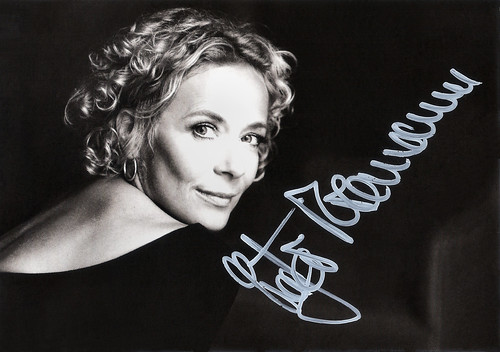
German postcard by Katja Riemann.de. Photo: Mirjam Knickriem.
Katja Hannchen Leni Riemann was born in 1963 in Weyhe-Kirchweyhe, Germany. She is the daughter of two teachers, and she has a sister, Susanne, and a brother, Jochen. Riemann grew up in Weyhe, near Bremen. After high school, she studied at the School of Theatre and Music in Hanover from 1984 to 1986 and the Otto Falckenberg Drama School in Munich from 1986 to 1987. She attended the Westphalian Landestheater in Castrop-Rauxel and came to the ensemble of the Münchner Kammerspiele before the end of her training.
She made her screen debut in the TV mini-series Sommer in Lesmona / Summer in Lesmona (Peter Beauvais, 1985-1986). For her role, she won two awards. After this success, several TV roles followed, including the title role in the series Regina auf den Stufen (Bernd Fischerauer, 1992) with Mark Kuhn and Serge Avedikian. She had her breakthrough in the cinema with Abgeschminkt! / Making Up! (Katja von Garnier, 1993) opposite Max Tidof. The film is a satire about women of the 1990s in search of the men of their dreams.
The following year, she appeared as the girlfriend of Til Schweiger in the hilarious romantic comedy Der bewegte Mann / Maybe, Maybe Not (Sönke Wortmann, 1994), with Joachim Król. The comedy was based on the gay comics by Ralf König. At the time of its release, this was the biggest-grossing homegrown film at the German box office. Other comedies followed, like Nur über meine Leiche / Over My Dead Body (Rainer Matsutani, 1995).
Riemann reunited with director Katja von Garnier for the road movie Bandits (Katja von Garnier, 1997) with Jutta Hoffmann. The story is about members of a female rock band who escape from prison. Riemann even learned to play the drums for her role. Both the film and soundtrack album were commercially successful in Germany, and Riemann won the Deutscher Filmpreis (German Film Award) for her role.
With director Rainer Kaufmann, she made the films Stadtgespräch / Talk of the Town (Rainer Kaufmann, 1995) with Martina Gedeck and Kai Wiesinger, and the comedy Die Apothekerin / The Pharmacist (Rainer Kaufmann, 1997) with Jürgen Vogel and August Zirner. An international success was Comedian Harmonists (Joseph Vilsmaier, 1997) about the legendary close-harmony sextet, played by a.o. Ben Becker, Kai Wiesinger and Max Tidof.
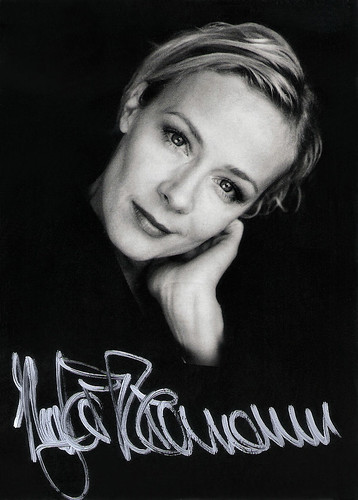
German postcard by Franz Josef Rüdel, Filmpostkartenverlag, Hamburg. Photo: Stefan May.
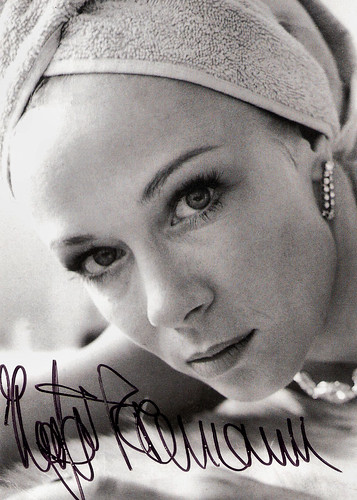
German postcard by Franz Josef Rüdel, Filmpostkartenverlag, Hamburg. Photo: Stefan May, München.
Besides her acting career, Katja Riemann started singing and released her first album 'Nachtblende' in 2000. In 2003, the English-language jazz album 'Favourites' followed with the Katja Riemann octet. In the cinema, she appeared in the pan-European production Novel (Fabio Carpi, 2001) starring Hector Alterio. She starred with Maria Schrader in the film Rosenstraße (Margarethe von Trotta, 2003) about the Rosenstraße protest where women waited for seven days and nights outside of a Nazi jail for their Jewish husbands. The protests took place in Berlin during the winter of 1943. In Italy, the film won a David at the David di Donatello Awards.
With Von Trotta, she also worked on the psychodrama Ich bin die Andere / I Am the Other Woman (Margarethe von Trotta, 2006), with Armin Mueller-Stahl and Karin Dor. She played with Moritz Bleibtreu in the drama Agnes und seine Brüder / Agnes & His Brothers (Oskar Roehler, 2004). With Von Garnier, she made an international production, Blood and Chocolate (Katja von Garnier, 2007) with Hugh Dancy and Olivier Martinez, but it was a flop. More interesting was the Swiss-German rural drama Der Verdingbub / The Foster Boy (Markus Imboden, 2011). Filmportal.de: “She gives a stunning performance as a cold-hearted farmer, who holds an orphan boy like a slave on her yard.”
A huge box-office success was the comedy Fack ju Göhte / Suck Me Shakespeer (Bora Dagtekin, 2013) starring Elyas M'Barek. Riemann played a strict school principal and received a Best Supporting Actress Nomination at the 2014 German Film Award. In the drama Die abhandene Welt/The Misplaced World (Margaretha von Trotta, 2015), she co-starred with Barbara Sukowa and Mathias Habich. She also had a small part in the Hitler-in the-21st-century comedy Er ist wieder da / Look Who's Back (David Wnendt, 2015). Later films included Fack ju Göhte 3 / Suck Me Shakespeer 3 (Bora Dagtekin, 2017), the comedy Forget About Nick (Margaretha von Trotta, 2017) and Subs (Oskar Roehler, 2018). In 2018, Katja Riemann had a leading role in the much-discussed Thor-Kunkel film HERRliche Zeiten (Oskar Roehler, 2018), a satire about a wealthy landscape architect who hires two 'house slaves' together with her husband. In the same year, the drama Goliath96 premiered at the Hofer Filmtage, in which Riemann played a single mother whose adult son has been locking himself in his room for over two years. The film was theatrically released in April 2019.
Riemann played leading roles in the family film Sprite Sisters - Vier zauberhafte Schwestern (Sven Unterwaldt Jr., 2019) and in the drama Valeska (Jakob Moritz Erwa, 2019) about the first transgender model, Valeska Réon. She played Gudrun in the drama Enfant Terrible (Oskar Roehler, 2020) about the German film director Rainer Werner Fassbinder. In the film comedy Catweazle (Sven Unterwaldt, 2021), she played the role of art historian Dr. Katharina Metzler alongside Otto Waalkes. The film was based on the classic British children's series Catweazle (1970-1971). She also appeared in the biographical drama Stella. Ein Leben / Stella. A Life (Kilian Riedhof, 2023), based on the true story of Stella Goldschlag (Paula Beer), who delivered hundreds of fellow Jews to the Gestapo from September 1943 until the end of the war. Her most recent film is Lieblingsmenschen: Die außergewöhnliche Freundschaft von Agnes und Amir / Favourite People: The extraordinary friendship of Agnes and Amir (Hewlena Hufnagel, 2026) with Katharina Thalbach.
Katja Riemann is the mother of actress Paula Riemann (also Paula Romy), whose father is Peter Sattmann. Riemann met Sattmann on the set of Von Gewalt keine Rede (1991), and they had a relationship from 1990 to 1998. Since 2007, she has been the longtime companion of sculptor Raphael Alexander Beil. won the Bavarian Film Award three times. Twice as Best Actress in 1993 and 1995, and once for the Best Film Score in 1997. She wrote two successful children's books, Der Name der Sonne (The name of the sun) and Der Chor der Engel (The choir of the angels), together with her sister Susanne (2002). In 2025, she and Thilo Mischke investigated her family's Nazi past in the documentary German Guilt and discovered that her grandmother Hannchen E. was murdered in 1945 at the age of 47 in the Wehnen sanatorium and nursing home.
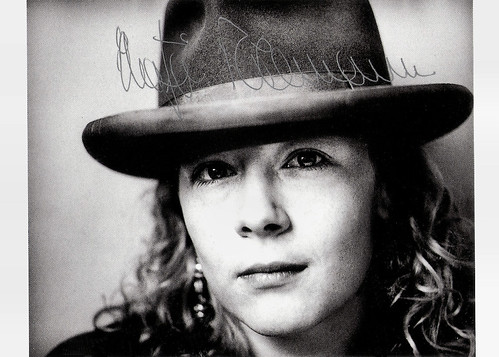
German postcard by Franz Josef Rüdel, Filmpostkartenverlag, Hamburg. Photo: Jim Rakete / Photo Selection.
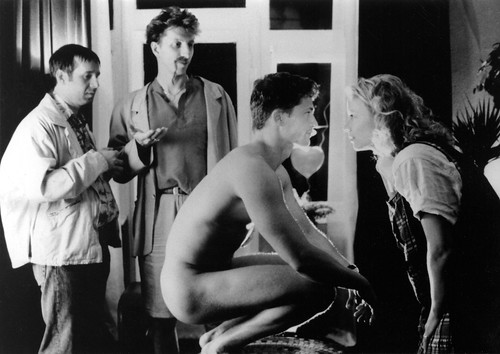
German press photo. Joachim Król, Til Schweiger and Katja Riemann in Der bewegte Mann / Maybe, Maybe Not (Sönke Wortmann, 1994).

German press photo. Til Schweiger and Katja Riemann in Der bewegte Mann / Maybe, Maybe Not (Sönke Wortmann, 1994).
Sources: Filmportal.de, Wikipedia (English and German), and IMDb.
This post was last updated on 24 July 2026.
German postcard by Franz Josef Rüdel, Filmpostkartenverlag, Hamburg. Photo: Mathias Bothor.
German postcard by Katja Riemann.de. Photo: Mirjam Knickriem.
The biggest grossing homegrown film
Katja Hannchen Leni Riemann was born in 1963 in Weyhe-Kirchweyhe, Germany. She is the daughter of two teachers, and she has a sister, Susanne, and a brother, Jochen. Riemann grew up in Weyhe, near Bremen. After high school, she studied at the School of Theatre and Music in Hanover from 1984 to 1986 and the Otto Falckenberg Drama School in Munich from 1986 to 1987. She attended the Westphalian Landestheater in Castrop-Rauxel and came to the ensemble of the Münchner Kammerspiele before the end of her training.
She made her screen debut in the TV mini-series Sommer in Lesmona / Summer in Lesmona (Peter Beauvais, 1985-1986). For her role, she won two awards. After this success, several TV roles followed, including the title role in the series Regina auf den Stufen (Bernd Fischerauer, 1992) with Mark Kuhn and Serge Avedikian. She had her breakthrough in the cinema with Abgeschminkt! / Making Up! (Katja von Garnier, 1993) opposite Max Tidof. The film is a satire about women of the 1990s in search of the men of their dreams.
The following year, she appeared as the girlfriend of Til Schweiger in the hilarious romantic comedy Der bewegte Mann / Maybe, Maybe Not (Sönke Wortmann, 1994), with Joachim Król. The comedy was based on the gay comics by Ralf König. At the time of its release, this was the biggest-grossing homegrown film at the German box office. Other comedies followed, like Nur über meine Leiche / Over My Dead Body (Rainer Matsutani, 1995).
Riemann reunited with director Katja von Garnier for the road movie Bandits (Katja von Garnier, 1997) with Jutta Hoffmann. The story is about members of a female rock band who escape from prison. Riemann even learned to play the drums for her role. Both the film and soundtrack album were commercially successful in Germany, and Riemann won the Deutscher Filmpreis (German Film Award) for her role.
With director Rainer Kaufmann, she made the films Stadtgespräch / Talk of the Town (Rainer Kaufmann, 1995) with Martina Gedeck and Kai Wiesinger, and the comedy Die Apothekerin / The Pharmacist (Rainer Kaufmann, 1997) with Jürgen Vogel and August Zirner. An international success was Comedian Harmonists (Joseph Vilsmaier, 1997) about the legendary close-harmony sextet, played by a.o. Ben Becker, Kai Wiesinger and Max Tidof.
German postcard by Franz Josef Rüdel, Filmpostkartenverlag, Hamburg. Photo: Stefan May.
German postcard by Franz Josef Rüdel, Filmpostkartenverlag, Hamburg. Photo: Stefan May, München.
I am the other woman
Besides her acting career, Katja Riemann started singing and released her first album 'Nachtblende' in 2000. In 2003, the English-language jazz album 'Favourites' followed with the Katja Riemann octet. In the cinema, she appeared in the pan-European production Novel (Fabio Carpi, 2001) starring Hector Alterio. She starred with Maria Schrader in the film Rosenstraße (Margarethe von Trotta, 2003) about the Rosenstraße protest where women waited for seven days and nights outside of a Nazi jail for their Jewish husbands. The protests took place in Berlin during the winter of 1943. In Italy, the film won a David at the David di Donatello Awards.
With Von Trotta, she also worked on the psychodrama Ich bin die Andere / I Am the Other Woman (Margarethe von Trotta, 2006), with Armin Mueller-Stahl and Karin Dor. She played with Moritz Bleibtreu in the drama Agnes und seine Brüder / Agnes & His Brothers (Oskar Roehler, 2004). With Von Garnier, she made an international production, Blood and Chocolate (Katja von Garnier, 2007) with Hugh Dancy and Olivier Martinez, but it was a flop. More interesting was the Swiss-German rural drama Der Verdingbub / The Foster Boy (Markus Imboden, 2011). Filmportal.de: “She gives a stunning performance as a cold-hearted farmer, who holds an orphan boy like a slave on her yard.”
A huge box-office success was the comedy Fack ju Göhte / Suck Me Shakespeer (Bora Dagtekin, 2013) starring Elyas M'Barek. Riemann played a strict school principal and received a Best Supporting Actress Nomination at the 2014 German Film Award. In the drama Die abhandene Welt/The Misplaced World (Margaretha von Trotta, 2015), she co-starred with Barbara Sukowa and Mathias Habich. She also had a small part in the Hitler-in the-21st-century comedy Er ist wieder da / Look Who's Back (David Wnendt, 2015). Later films included Fack ju Göhte 3 / Suck Me Shakespeer 3 (Bora Dagtekin, 2017), the comedy Forget About Nick (Margaretha von Trotta, 2017) and Subs (Oskar Roehler, 2018). In 2018, Katja Riemann had a leading role in the much-discussed Thor-Kunkel film HERRliche Zeiten (Oskar Roehler, 2018), a satire about a wealthy landscape architect who hires two 'house slaves' together with her husband. In the same year, the drama Goliath96 premiered at the Hofer Filmtage, in which Riemann played a single mother whose adult son has been locking himself in his room for over two years. The film was theatrically released in April 2019.
Riemann played leading roles in the family film Sprite Sisters - Vier zauberhafte Schwestern (Sven Unterwaldt Jr., 2019) and in the drama Valeska (Jakob Moritz Erwa, 2019) about the first transgender model, Valeska Réon. She played Gudrun in the drama Enfant Terrible (Oskar Roehler, 2020) about the German film director Rainer Werner Fassbinder. In the film comedy Catweazle (Sven Unterwaldt, 2021), she played the role of art historian Dr. Katharina Metzler alongside Otto Waalkes. The film was based on the classic British children's series Catweazle (1970-1971). She also appeared in the biographical drama Stella. Ein Leben / Stella. A Life (Kilian Riedhof, 2023), based on the true story of Stella Goldschlag (Paula Beer), who delivered hundreds of fellow Jews to the Gestapo from September 1943 until the end of the war. Her most recent film is Lieblingsmenschen: Die außergewöhnliche Freundschaft von Agnes und Amir / Favourite People: The extraordinary friendship of Agnes and Amir (Hewlena Hufnagel, 2026) with Katharina Thalbach.
Katja Riemann is the mother of actress Paula Riemann (also Paula Romy), whose father is Peter Sattmann. Riemann met Sattmann on the set of Von Gewalt keine Rede (1991), and they had a relationship from 1990 to 1998. Since 2007, she has been the longtime companion of sculptor Raphael Alexander Beil. won the Bavarian Film Award three times. Twice as Best Actress in 1993 and 1995, and once for the Best Film Score in 1997. She wrote two successful children's books, Der Name der Sonne (The name of the sun) and Der Chor der Engel (The choir of the angels), together with her sister Susanne (2002). In 2025, she and Thilo Mischke investigated her family's Nazi past in the documentary German Guilt and discovered that her grandmother Hannchen E. was murdered in 1945 at the age of 47 in the Wehnen sanatorium and nursing home.
German postcard by Franz Josef Rüdel, Filmpostkartenverlag, Hamburg. Photo: Jim Rakete / Photo Selection.
German press photo. Joachim Król, Til Schweiger and Katja Riemann in Der bewegte Mann / Maybe, Maybe Not (Sönke Wortmann, 1994).
German press photo. Til Schweiger and Katja Riemann in Der bewegte Mann / Maybe, Maybe Not (Sönke Wortmann, 1994).
Sources: Filmportal.de, Wikipedia (English and German), and IMDb.
This post was last updated on 24 July 2026.
