French leading man Maurice Ronet (1927-1983) was also a director and screenwriter. In the 1950s and 1960s, the smooth and slick actor was a favourite of such influential directors as Louis Malle and Claude Chabrol.
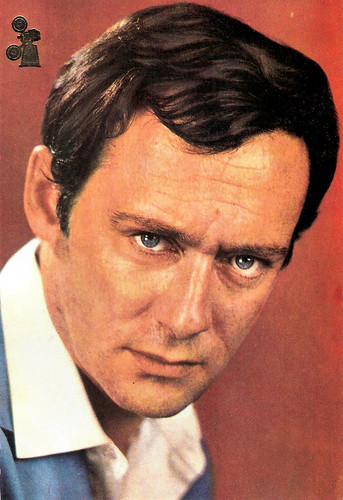
Spanish postcard by Postalcolor, Hospitalet, no. 87, 1964. Photo: Sam Lévin.
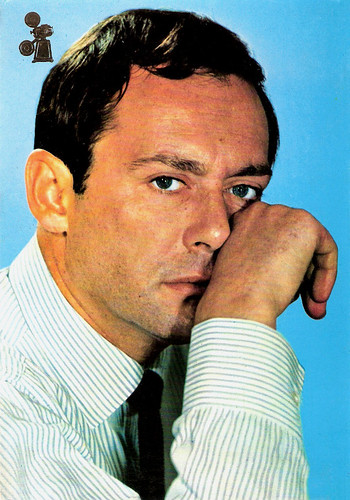
Spanish postcard by Toro de Bronce, no. 182, 1964. Photo: Sam Lévin.
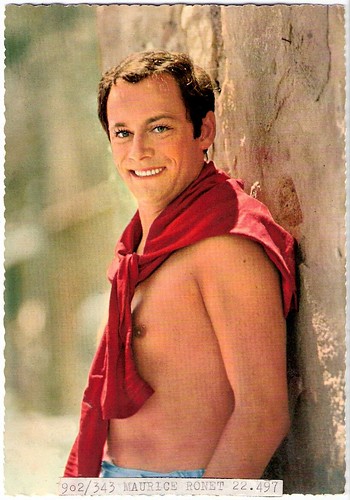
German postcard by Krüger, no. 902/343.
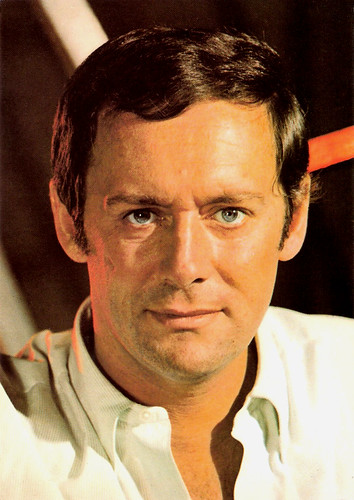
French postcard by E.D.U.G., Paris, no. 519. Photo: Sam Lévin.
Maurice Ronet was born Maurice Julien Marie Robinet in Nice on the Côte d'Azur, in 1927. He was the only child of the actors Émile Robinet and Gilberte Dubreuil. He studied at the Paris Conservatoire where Jean-Louis Barrault was one of his mentors. Ronet made his film debut in Rendez-vous de juillet / Rendezvous in July (Jacques Becker, 1949) at the age of 22. Shortly thereafter, he married actress Maria Pacôme and departed to southern France to try his hand at ceramics, painting, writing and music.
Throughout the early 1950s, he made his living by selling his paintings and acting in supporting roles in the films of directors like Yves Ciampi (Un grand patron / A Great Man, 1951), Yves Allégret (Les Sept péchés capitaux / The Seven Deadly Sins, 1952; La jeune folle / Desperate Decision, 1952), and Bernard Borderie (the Eddie Constantine thriller La môme vert de gris / Poison Ivy, 1953).
He had ambitions to become a director himself, but he discovered a freedom and creative satisfaction in acting that provided a synthesis of all that interested him in painting and literature. Ronet first garnered acclaim at the Cannes Film Festival for his work on Horizons sans fin / Endless Horizons (Jean Dréville, 1953). Over the next few years, he appeared notably as the romantic lead in La Sorcière / The Sorceress (André Michel, 1956) and in Jules Dassin's follow-up to Rififi, Celui qui doit mourir / He Who Must Die (Jules Dassin, 1957).
It was at the presentation of La Sorcière at Cannes in 1956 that Ronet met a creative and intellectual counterpart in Louis Malle. Ronet made his international box-office breakthrough as Julien Tavernier in Malle's first feature film, Ascenseur pour l'échafaud / Elevator to the Gallow (Louis Malle, 1957) opposite Jeanne Moreau.
Le Feu follet / The Fire Within (1963) would be Malle's and Ronet's finest work of that period. Ronet plays an alcoholic writer, Alain Leroy, who is on the verge of suicide. His character was based on writer Jacques Rigaut, who killed himself in 1929. At French Films, James Travers wrote: "Feu follet sees Ronet give his most captivating and well-judged performance – his portrayal is fascinating but not wholly sympathetic. Part of the genius of this film is that Malle doesn’t require us to like his protagonist. Indeed, the film would lose much of its meaning and impact if Ronet played Leroy as an attractive or even pathetic character." The film won the Special Jury Prize at the Venice Film Festival and was nominated for an Academy Award for Best Foreign Language Film.
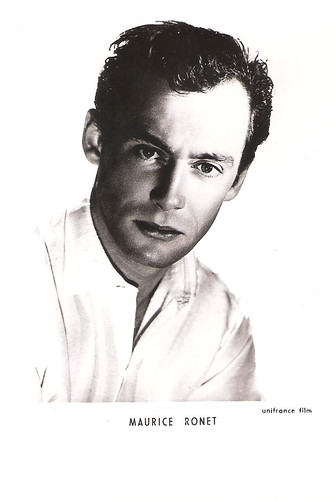
Vintage postcard. Photo: Unifrance Film.

East German card by VEB Progress Film-Vertrieb, Berlin, no. 1297, 1960. Retail price: 0,20 DM. Photo: publicity still for Casta Diva (Carmine Gallone, 1954).
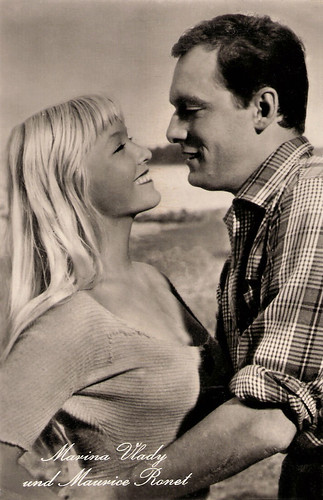
East German card by VEB Progress Film-Vertrieb, Berlin. Retail price: 0,20 DM. Photo: Les Films Metzger & Woog u. Productions Iena, no. 1.375, 1957. Publicity still for La Sorcière / The Blonde Witch (André Michel, 1956) with Marina Vlady.

Spanish postcard, no. 12. Marina Vlady and Maurice Ronet in La sorcière / Häxan (André Michel, 1956). Collection: Marlene Pilaete.
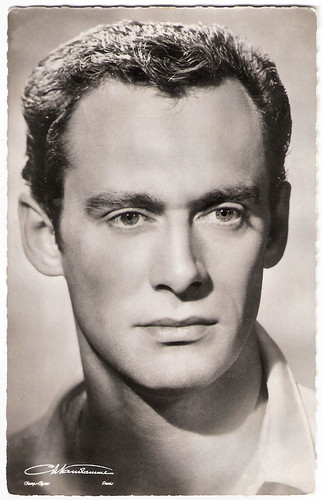
French postcard by Éditions du Globe (EDUG), no. 292. Photo: Ch. Van Damme, Paris.

West German film programme by Illustrierte Film-Bühne (merged with Illustrierte Film-Kurier), no. 4417, page 1 (cover). Photos: Pallas Film. Maurice Ronet and Jean Wall in Ascenseur pour l'échafaud / Elevator to the Gallows (Louis Malle, 1958). The German title was Fahrstuhl zum Schafott.
Maurice Ronet went on to appear in close to one hundred French and Spanish, Italian, British and American co-productions of the 1950s, 1960s, 1970s and 1980s. He played both leading and comedic character roles, such as in Plein Soleil / Purple Noon (René Clément, 1960), La Dénonciation / The Immoral Moment (Jacques Doniol-Valcroze, 1962), and Le Scandale / The Champagne Murders (Claude Chabrol, 1966) for which he won the Best Actor award at the 1967 San Sebastián International Film Festival.
Other films were La Femme infidèle / The Unfaithful Wife (Claude Chabrol, 1968), La Piscine / The Swimming Pool (Jacques Deray, 1969), Raphaël ou le débauché / Raphael, or The Debauched One (Michel Deville, 1971), and Beau-père / Stepfather (Bertrand Blier, 1981).
He made his directorial debut in 1964 with Le Voleur de Tibidabo / The Thief of Tibidabo, a light-hearted crime story shot in Barcelona, and followed it up with two documentaries: Vers l'île des Dragons / To the Island of the Dragons (1974), an allegorical journey to Indonesia to film the Komodo dragon, and a report on the building of a dam in Cabora Bassa, Mozambique, for French television.
Toward the end of his life, Ronet directed more programs for TV: an acclaimed adaptation of Herman Melville's Bartleby in 1976, which was released theatrically in 1978, and adaptations of Edgar Allan Poe and Cornell Woolrich stories. He also authored two books: 'L'île des Dragons' (1973), a chronicle of the making of Vers l'île des Dragons, and 'Le Métier de Comédien' (1977), an honest and thorough discussion of the acting profession.
Maurice Ronet died of cancer, a month before what would have been his 56th birthday. His marriage to Maria Pacôme ended in a separation in 1952, and they divorced in 1956. From 1977 until he died in 1983, he lived with his partner Josephine Chaplin, a daughter of Charles and Oona Chaplin, in the village of Bonnieux in Provence. They had a son, Julien (1980).
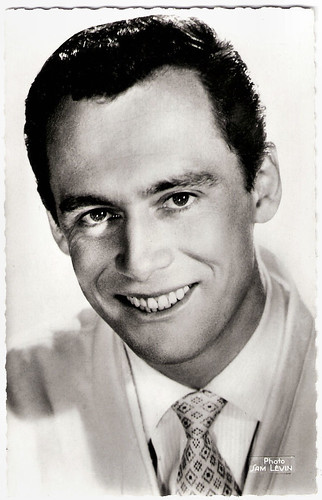
French postcard by Éditions du Globe, no. 637. Photo: Sam Lévin.

Spanish postcard by F.A.G. Photo: Cosmofilm. Sara Montiel and Maurice Ronet in Carmen de la Ronda / The Devil Made a Woman (Tulio Demicheli, 1959).

Spanish postcard by Edición Archivo Bermejos, no. 7028. Photo: Suevia Films. Sara Montiel and Maurice Ronet in Mi último tango / My Last Tango (Luis César Amadori, 1960).
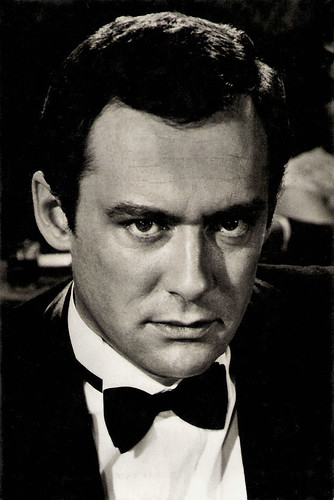
Spanish postcard by Edición Archivo Bermejo, no. 7031. Photo: Suevia Films. Publicity still for Mi último tango / My Last Tango (Luis César Amadori, 1960).
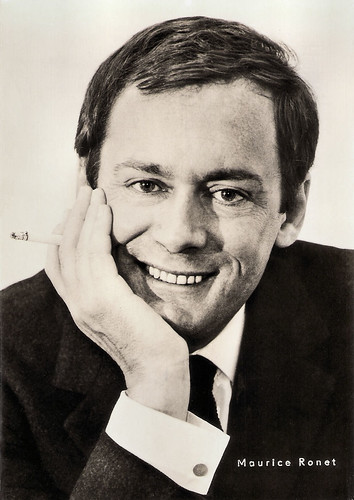
East German card by VEB Progress Film-Vertrieb, Berlin, no. 24/71. Photo: Unifrance Film.
Scene from Plein Soleil (1960) with Alain Delon, Maurice Ronet and Marie Laforêt. Source: Tubinho79 (YouTube).
Scene from Le Feu Follet (1963) with Maurice Ronet and Jeanne Moreau. Source: Wunbad777 (YouTube).
Sources: James Travers (French Films - now defunct), Hal Erickson (AllMovie - Page now defunct), Wikipedia, and IMDb.
This post was last updated on 16 September 2026.
Spanish postcard by Postalcolor, Hospitalet, no. 87, 1964. Photo: Sam Lévin.
Spanish postcard by Toro de Bronce, no. 182, 1964. Photo: Sam Lévin.
German postcard by Krüger, no. 902/343.
French postcard by E.D.U.G., Paris, no. 519. Photo: Sam Lévin.
Freedom and satisfaction
Maurice Ronet was born Maurice Julien Marie Robinet in Nice on the Côte d'Azur, in 1927. He was the only child of the actors Émile Robinet and Gilberte Dubreuil. He studied at the Paris Conservatoire where Jean-Louis Barrault was one of his mentors. Ronet made his film debut in Rendez-vous de juillet / Rendezvous in July (Jacques Becker, 1949) at the age of 22. Shortly thereafter, he married actress Maria Pacôme and departed to southern France to try his hand at ceramics, painting, writing and music.
Throughout the early 1950s, he made his living by selling his paintings and acting in supporting roles in the films of directors like Yves Ciampi (Un grand patron / A Great Man, 1951), Yves Allégret (Les Sept péchés capitaux / The Seven Deadly Sins, 1952; La jeune folle / Desperate Decision, 1952), and Bernard Borderie (the Eddie Constantine thriller La môme vert de gris / Poison Ivy, 1953).
He had ambitions to become a director himself, but he discovered a freedom and creative satisfaction in acting that provided a synthesis of all that interested him in painting and literature. Ronet first garnered acclaim at the Cannes Film Festival for his work on Horizons sans fin / Endless Horizons (Jean Dréville, 1953). Over the next few years, he appeared notably as the romantic lead in La Sorcière / The Sorceress (André Michel, 1956) and in Jules Dassin's follow-up to Rififi, Celui qui doit mourir / He Who Must Die (Jules Dassin, 1957).
It was at the presentation of La Sorcière at Cannes in 1956 that Ronet met a creative and intellectual counterpart in Louis Malle. Ronet made his international box-office breakthrough as Julien Tavernier in Malle's first feature film, Ascenseur pour l'échafaud / Elevator to the Gallow (Louis Malle, 1957) opposite Jeanne Moreau.
Le Feu follet / The Fire Within (1963) would be Malle's and Ronet's finest work of that period. Ronet plays an alcoholic writer, Alain Leroy, who is on the verge of suicide. His character was based on writer Jacques Rigaut, who killed himself in 1929. At French Films, James Travers wrote: "Feu follet sees Ronet give his most captivating and well-judged performance – his portrayal is fascinating but not wholly sympathetic. Part of the genius of this film is that Malle doesn’t require us to like his protagonist. Indeed, the film would lose much of its meaning and impact if Ronet played Leroy as an attractive or even pathetic character." The film won the Special Jury Prize at the Venice Film Festival and was nominated for an Academy Award for Best Foreign Language Film.
Vintage postcard. Photo: Unifrance Film.
East German card by VEB Progress Film-Vertrieb, Berlin, no. 1297, 1960. Retail price: 0,20 DM. Photo: publicity still for Casta Diva (Carmine Gallone, 1954).
East German card by VEB Progress Film-Vertrieb, Berlin. Retail price: 0,20 DM. Photo: Les Films Metzger & Woog u. Productions Iena, no. 1.375, 1957. Publicity still for La Sorcière / The Blonde Witch (André Michel, 1956) with Marina Vlady.
Spanish postcard, no. 12. Marina Vlady and Maurice Ronet in La sorcière / Häxan (André Michel, 1956). Collection: Marlene Pilaete.
French postcard by Éditions du Globe (EDUG), no. 292. Photo: Ch. Van Damme, Paris.
West German film programme by Illustrierte Film-Bühne (merged with Illustrierte Film-Kurier), no. 4417, page 1 (cover). Photos: Pallas Film. Maurice Ronet and Jean Wall in Ascenseur pour l'échafaud / Elevator to the Gallows (Louis Malle, 1958). The German title was Fahrstuhl zum Schafott.
An allegorical journey to Indonesia to film the Komodo dragon
Maurice Ronet went on to appear in close to one hundred French and Spanish, Italian, British and American co-productions of the 1950s, 1960s, 1970s and 1980s. He played both leading and comedic character roles, such as in Plein Soleil / Purple Noon (René Clément, 1960), La Dénonciation / The Immoral Moment (Jacques Doniol-Valcroze, 1962), and Le Scandale / The Champagne Murders (Claude Chabrol, 1966) for which he won the Best Actor award at the 1967 San Sebastián International Film Festival.
Other films were La Femme infidèle / The Unfaithful Wife (Claude Chabrol, 1968), La Piscine / The Swimming Pool (Jacques Deray, 1969), Raphaël ou le débauché / Raphael, or The Debauched One (Michel Deville, 1971), and Beau-père / Stepfather (Bertrand Blier, 1981).
He made his directorial debut in 1964 with Le Voleur de Tibidabo / The Thief of Tibidabo, a light-hearted crime story shot in Barcelona, and followed it up with two documentaries: Vers l'île des Dragons / To the Island of the Dragons (1974), an allegorical journey to Indonesia to film the Komodo dragon, and a report on the building of a dam in Cabora Bassa, Mozambique, for French television.
Toward the end of his life, Ronet directed more programs for TV: an acclaimed adaptation of Herman Melville's Bartleby in 1976, which was released theatrically in 1978, and adaptations of Edgar Allan Poe and Cornell Woolrich stories. He also authored two books: 'L'île des Dragons' (1973), a chronicle of the making of Vers l'île des Dragons, and 'Le Métier de Comédien' (1977), an honest and thorough discussion of the acting profession.
Maurice Ronet died of cancer, a month before what would have been his 56th birthday. His marriage to Maria Pacôme ended in a separation in 1952, and they divorced in 1956. From 1977 until he died in 1983, he lived with his partner Josephine Chaplin, a daughter of Charles and Oona Chaplin, in the village of Bonnieux in Provence. They had a son, Julien (1980).
French postcard by Éditions du Globe, no. 637. Photo: Sam Lévin.
Spanish postcard by F.A.G. Photo: Cosmofilm. Sara Montiel and Maurice Ronet in Carmen de la Ronda / The Devil Made a Woman (Tulio Demicheli, 1959).
Spanish postcard by Edición Archivo Bermejos, no. 7028. Photo: Suevia Films. Sara Montiel and Maurice Ronet in Mi último tango / My Last Tango (Luis César Amadori, 1960).
Spanish postcard by Edición Archivo Bermejo, no. 7031. Photo: Suevia Films. Publicity still for Mi último tango / My Last Tango (Luis César Amadori, 1960).
East German card by VEB Progress Film-Vertrieb, Berlin, no. 24/71. Photo: Unifrance Film.
Scene from Plein Soleil (1960) with Alain Delon, Maurice Ronet and Marie Laforêt. Source: Tubinho79 (YouTube).
Scene from Le Feu Follet (1963) with Maurice Ronet and Jeanne Moreau. Source: Wunbad777 (YouTube).
Sources: James Travers (French Films - now defunct), Hal Erickson (AllMovie - Page now defunct), Wikipedia, and IMDb.
This post was last updated on 16 September 2026.
