Showing posts with label Vilma Bánky. Show all posts

11 October 2024

The Winning of Barbara Worth (1926)

The final evening of the Giornate del Cinema Muto 2024 is for Henry King's wonderful Western The Winning of Barbara Worth (1926), starring Vilma Bánky, Ronald Colman and Gary Cooper in his first major role. The film owes part of its fame to Ned Mann's revolutionary visual effects in the climactic flood sequence. Mainly with miniature models, the scene depicts the 1905 formation of the Salton Sea. The spectacular effects will be the subject of the Jonathan Dennis Memorial Lecture by Craig Barron, Oscar winner in 2009 for the special effects of The Curious Case of Benjamin Button (David Fincher, 2008). The Winning of Barbara Worth will be accompanied by the Pordenone Chamber Orchestra conducted by Ben Palmer in the performance of the score that the festival commissioned from Neil Brand.

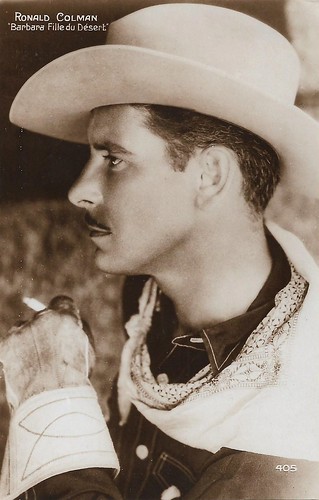
Ronald Colman in The Winning of Barbara Worth (1926)
French postcard by Editions Cinémagazine, no. 405. Ronald Colman in The Winning of Barbara Worth (Henry King, 1926).

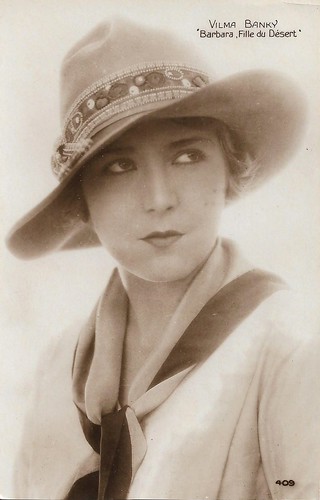
Vilma Banky in The Winning of Barbara Worth
French postcard by Editions Cinémagazine, no. 409. Vilma Bánky in The Winning of Barbara Worth (Henry King, 1926).

Vilma Banky
French postcard by Editions Cinémagazine, no. 428. Photo: Vilma Banky in The Winning of Barbara Worth (Henry King, 1926).

Ronald Colman in The Winning of Barbara Worth (1926)
French postcard by Europe, no. 212. Ronald Colman in The Winning of Barbara Worth (Henry King, 1926).

A catastrophic flood


Frances Marion based her film script on the novel 'The Winning of Barbara Worth' by Harold Bell Wright, which in turn is a dramatisation of the real events that gave rise to the Salton Sea in California between 1905 and 1907. As a child, Barbara (Vilma Bánky) is orphaned when her settler parents perish trying to cross a California desert. She is rescued and adopted by Jefferson Worth (Charles Willis Lane). Worth's dream is to one day cultivate the desert with his own irrigation concept and thus take away its horrors.

Fifteen years later, Willard Holmes (Ronald Colman) arrives in the area. He is the West Coast chief engineer of his unscrupulous stepfather James Greenfield (E. J. Ratcliffe)'s company. Holmes plans to divert the Colorado River so that the desert will one day be greener. Worth joins forces with him. During his task, Willard meets the beautiful Barbara and the two fall in love.

However, Willarde has a rival: another, younger man is also vying for the favour of the beautiful Barbara. The lanky, grounded cowboy Abe Lee (Gary Cooper), the foreman of her father's ranch and company, shows interest in her. In the course of the story, Abe realises that Barbara's love for him will never be anything more than brotherly feelings.
.
James Greenfield, Willard Holmes's greedy employer, meanwhile, refuses to spend the money to reinforce his gigantic water project. The river is dammed, but the developer swindles the ranchers and refuses to reinforce the weakening dam, as he no longer needs it. An angry mob turns on Worth. After the project workers refuse to continue their work, an enormous flood puts everything under water and costs many lives. This catastrophic flood is the visual and dramatic highlight of the film. Willard, in unison with Abe Lee, heroically tries to save what can be saved. Barbara is impressed by his energy. He promises to return to marry her after he has conquered the Colorado River and turned the desert into a bountiful paradise.

The Winning of Barbara Worth (Henry King, 1926) was filmed in California's Imperial Valley and in the Black Rock Desert of Nevada. The reviewer of Variety in 1925: "Taking a story of this sort and injecting, besides the author’s purport, entertainment, is no child’s task. King has performed a miraculous task. The telling of the story, of course, was the big thing. Putting over the fine points of the yarn by showing a desert sandstorm and then showing the progress of reclamation work and the destruction done by faulty construction was a mountainous job, well executed."

Ronald Colman
German postcard by Ross Verlag, no. 1794/2, 1927-1928. Photo: United Artists. Ronald Colman in The Winning of Barbara Worth (Henry King, 1926).

Ronald Colman in The Winning of Barbara Worth (1926)
German postcard by Ross Verlag, no. 1794/3. Ronald Colman in The Winning of Barbara Worth (Henry King, 1926). On the card, the French title of the film is handwritten, Barbara, fille du Désert.

Ronald Colman and Vilma Banky in The Winning of Barbara Worth (1926)
German postcard by Ross Verlag, no. 1795/1, 1927-1928. Photo: United Artists. Ronald Colman and Vilma Bánky in The Winning of Barbara Worth (Henry King, 1926).

Ronald Colman and Vilma Banky in The Winning of Barbara Worth (1926)
German postcard by Ross Verlag, no. 1795/3, 1927-1928. Photo: United Artists. Ronald Colman and Vilma Bánky in The Winning of Barbara Worth (Henry King, 1926).

Ronald Colman and Vilma Banky in The Winning of Barbara Worth (1926)
German postcard by Ross Verlag, no. 1795/4, 1927-1928. Photo: United Artists. Ronald Colman and Vilma Bánky in The Winning of Barbara Worth (Henry King, 1926).

Sources: the Giornate del Cinema Muto 2024 (Italian), Variety, Wikipedia (English, German and French) and IMDb

27 March 2019

The Son of the Sheik (1926)

The Son of the Sheik (George Fitzmaurice, 1926) is one of the most popular films from the silent era. It is a delightful adventure full of romance, action and drama. It was the last film of Italian-born Hollywood star Rudolph Valentino, the great Latin lover of the 1920s. What made this film and its star so good?
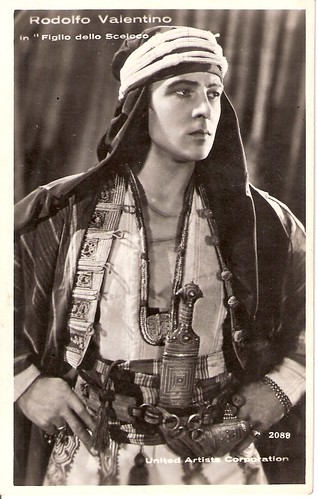
Rudolph Valentino in The Son of the Sheik (1926)
Italian postcard by Vettori, Bologna, no. 2089. Photo: United Artists. Publicity still for The Son of the Sheik (George Fitzmaurice, 1926).
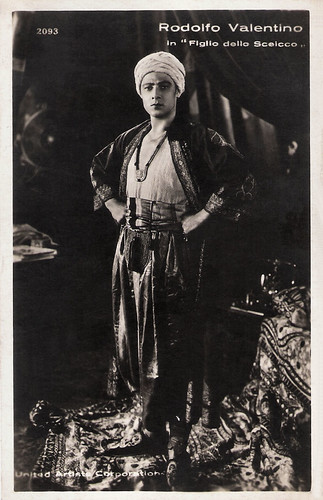
Rudolph Valentino in The Son of the Sheik (1926)
Italian postcard by Vettori, Bologna, no. 2093. Photo: United Artists. Publicity still for The Son of the Sheik (George Fitzmaurice, 1926).
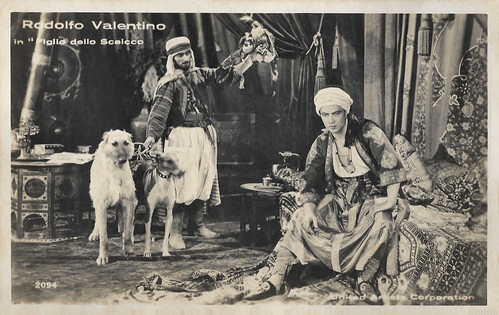
Rudolph Valentino in The Son of the Sheik (1926)
Italian postcard by Vettori, Bologna, no. 2094. Photo: United Artists. Publicity still for The Son of the Sheik (George Fitzmaurice, 1926).
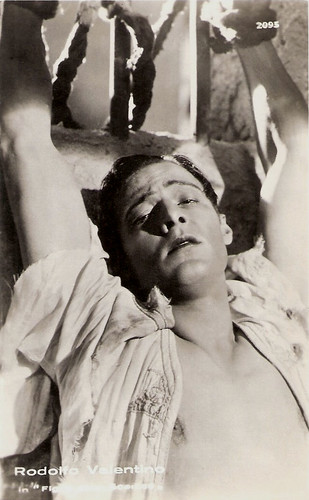
Rudolph Valentino in The Son of the Sheik (1926)
Italian postcard by Vettori, Bologna, no. 2095. Photo: United Artists. Publicity still for The Son of the Sheik (George Fitzmaurice, 1926).
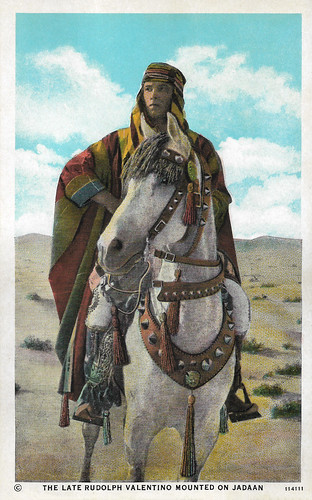
Rudolph Valentino in The Son of the Sheik (1926)
American postcard by Curt Teich & Company, inc., Chicago, no. 114111. Photo: United Artists. Publicity still for The Son of the Sheik (George Fitzmaurice, 1926). Captions: The late Rudolph Valentino mounted on Jadaan. This picture was taken at the time of filming the famous photoplay The Son of the Sheik in which the late Rudolph Valentino, with Jadaan as his mount, achieved notable success. Jadaan was the last horse ridden by Valentino. Jadaan, a beautiful Arabian stallion, was used in the picture courtesy of W. K. Kellogg owner of the W. K. Kellogg Arabian Horse Ranch, Pomona, Calif. Mr. Kellogg is a well-known Cereal Manufacturer in Battle Creek, Michigan.

A secret love, torture and revenge


The Son of the Sheik (George Fitzmaurice, 1926), is situated 'Not East of Suez, but South of Algiers', as we read in the opening title. In fact, the city of Touggourt in the south of Algiers is the location. In the marketplace, Ahmed (Rudolph Valentino), the handsome son of Sheik Ahmed Ben Hassan meets a dancing girl, Yasmine (Vilma Bánky). The two fall in love, and every night he travels from his desert camp to see her again and again.

Yasmine is the daughter of renegade Frenchman Andre (George Fawcett), who is the leader of a group of entertainers and criminals. By dancing publicly, Yasmine fronts her father's gang of cutthroats. Among the gang members is the villainous moor Gahbah (Montague Love), "whose crimes outnumber the desert sands" and to whom Yasmin is promised.

In the ruins near Touggourt, Yasmine and Ahmed meet secretly. During a rendezvous under the moonlight, Ahmed is suddenly caught and robbed by Gahbah and his gang. The gang holds Ahmed captive in a building where he hangs by his tied-up wrists placed on the window bars. He is tortured with a whip for not revealing the name of his father or any other information. Gahbah poisons Ahmed, telling him that Yasmin is bait to lure victims for them.

The young prince is freed by his trusted servant Ramadan (Karl Dane), who takes him to a friend's home to recover. Ahmed now believes that Yasmin has betrayed him. He seeks revenge and takes her by force to his desert camp. Ahmed subjects her to his methods of torture, with one scene looking at Yasmin with vengeance in his eyes, and (off camera) raping her. When his father takes his son home to fulfil a marriage agreement, Ahmed Ben Hassan orders him to release the girl.

Bitterly chastised by his father, Ahmed learns the truth about the innocent Yasmin from Ramadan, who has just escaped from Gahbah and his gang. The young prince tries to win back Yasmin. She has returned to the dance hall and does not want to have anything to do with him anymore. In the dance hall, a fight breaks out with the gang of criminals and Ahmed tries to rescue Yasmin from Gahbah. Finally, he chases them into the desert and saves the girl. And of course, all is forgiven in the end.
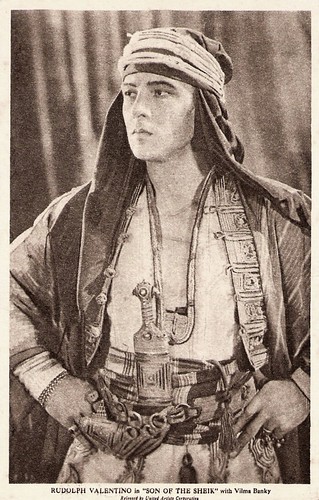
Rudolph Valentino in The Son of the Sheik (1926)
British postcard for Butywave Shampoo. Photo: United Artists. Publicity still for The Son of the Sheik (George Fitzmaurice, 1926).
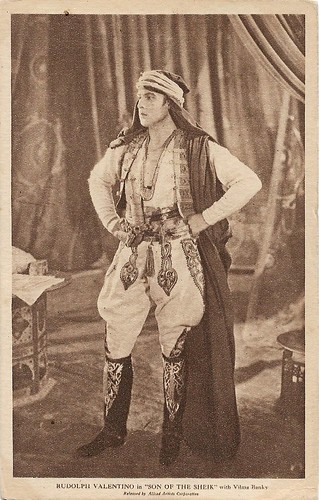
Rudolph Valentino in The Son of the Sheik (1926)
French postcard in a series by Shampoing Butywave. Photo: Allied Artists. Publicity still of Rudolph Valentino in The Son of the Sheik (George Fitzmaurice, 1926).
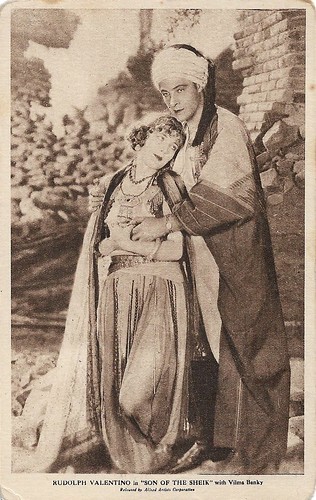
Rudolph Valentino and Vilma Banky in The Son of the Sheik (1926)
French postcard in a series by Shampoing Butywave. Photo: Allied Artists Corporation. Publicity still of Rudolph Valentino and Vilma Bánky in The Son of the Sheik (George Fitzmaurice, 1926).
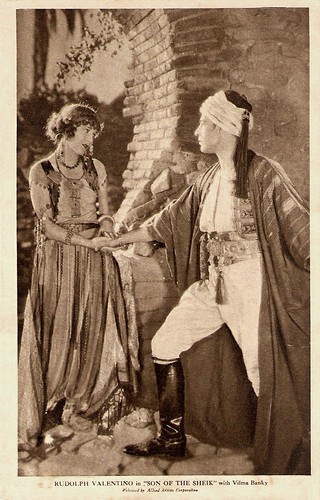
Vilma Banky, Rudolph Valentino, The Son of the Sheik
French postcard in a series by Shampoing Butywave. Photo: Allied Artists. Publicity still for The Son of the Sheik (George Fitzmaurice, 1926).
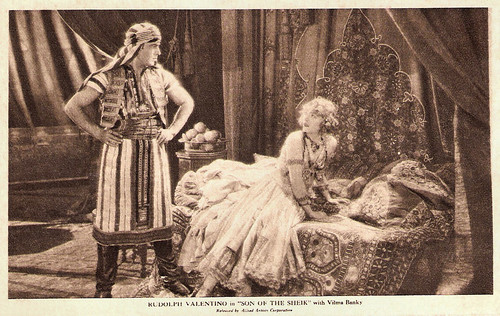
Vilma Banky, Rudolph Valentino, The Son of the Sheik
French postcard in a series by Shampoing Butywave. Photo: Allied Artists. Publicity still of Rudolph Valentino and Vilma Bánky in The Son of the Sheik (1926).
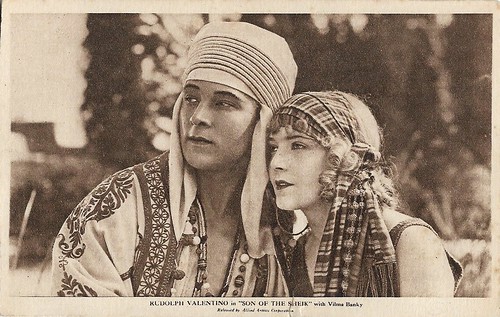
Rudolph Valentino and Vilma Banky in The Son of the Sheik (1926)
French postcard in a series by Shampoing Butywave. Photo: Allied Artists. Publicity still of Rudolph Valentino and Vilma Bánky in The Son of the Sheik (George Fitzmaurice, United Artists 1926).
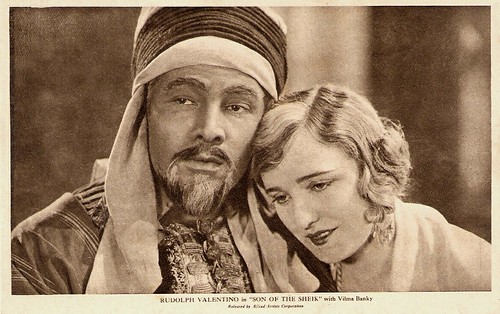
Agnes Ayres, Rudolph Valentino, Son of the Sheik
French postcard in a series by Shampoing Butywave. Photo: Allied Artists. Publicity still for The Son of the Sheik (1926). Despite the card telling this is Banky, the lady in question is Agnes Ayres. Ayres and Valentino play the parents of the leading character, also played by Valentino. Actually, the parents are the former protagonists of the earlier film The Sheik, now grown older.

A success beyond anyone's wildest dreams


The Son of the Sheik (George Fitzmaurice, 1926) was Rudolph Valentino's last film. It was a sequel to his earlier success, The Sheik (George Melford, 1921), in which he had played the impassioned lover who is initially impetuous, self-centred and brutal, but who gradually matures into an admirable man. The box office hit The Sheik solidified Valentino's image as 'the Great Lover'. In many ways, however, The Son of the Sheik is a much more interesting story than its predecessor. The film has a lighter tone that allows some humour as well as a lot more action. Sequels were rare in the silent era. Earlier, Douglas Fairbanks had followed his popular adventure film The Mark of Zorro (Fred Niblo, 1920) with the sequel Don Q, Son of Zorro (Donald Crisp, 1925). In The Son of the Sheik, the male lead is also the son of the original sheik. In the sequel, Valentino plays a stronger and more nuanced version of his signature role. He portrays both the son and his now middle-aged father, who is wiser but still commanding and able to wield a sword.

Agnes Ayres, Valentino's leading lady in The Sheik (1921), got special billing in the opening credits, and re-enacted her original role as Diana, this time as wife and mother. She makes the transition to worried mother effortlessly. The Son of the Sheik reunited Valentino with Vilma Bánky, with whom he had co-starred in The Eagle (Clarence Brown, 1925). He had personally picked her as his leading lady, and there is fine chemistry between them. The beautiful Banky dances magnificently well and has a great interpretation of her role. The famous erotic scene where Valentino ravishes her is one of the highlights of the film. Another striking (and homoerotic) sequence is the one in which Valentino, tied up, his tailored white shirt torn to shreds, is subject to a prolonged whipping by the gang of thieves. The most sadistic of them address him as "My young lion." Also memorable are Montagu Love in his role as the villain, the sandy sets with production designs by William Cameron Menzies and the impressive cinematography by George Barnes. Barnes executed the shots of the two characters played by Valentino in the same frame - even touching each other - flawlessly.

The Son of the Sheik is for all Rudolph Valentino's film. His burning stare and fetching smile made many filmgoers swoon, and the pure raw sensuality that Valentino portrays in this film is still exciting. He is excellent from start to finish and shows real talent in portraying both the son and the father. Valentino is very charming as the son and manages to be funny in his own right but the more impressive performance comes from the older father. Valentino is unrecognisable as the old sheik. Rudolph Valentino turned The Son of the Sheik into a rollicking and sexy adventure film, with adequate doses of humour. The swashbuckling scenes are exciting and well-choreographed. Frances Marion and Fred de Gresac had adapted Edith Maude Hull's novel Son of the Sheik for the screen. George Marion Jr. made the sometimes delicious tongue-in-cheek title cards. "The night was young at the Cafe Maure. Not a knife had been thrown, so far", one of his title cards reads.

The Son of the Sheik premiered at the Million Dollar Theater in Los Angeles on 9 July 1926. There it played for four weeks. Valentino then embarked on a nationwide tour to promote the film as it rolled out around the first-run theatres in the country's cities. On 15 August, he collapsed in his New York City hotel room and was rushed to the hospital. Doctors discovered he had a perforated ulcer which required emergency surgery. After the surgery, Valentino developed peritonitis and died on 23 August 1926. The Son of the Sheik was one of the first films to be released after its star's death. On 5 September 1926, nearly two weeks after Valentino had died, the film was put into general release nationwide. The Son of the Sheik grossed $1,000,000 within the first year of its release. Eventually, it more than doubled that. Who knows how far Valentino's film career would have gone had it not been for this untimely death at 31.

Hal Erickson concludes at AllMovie: "The finished film manages to convey a tongue-in-cheek, larger-than-life approach to its melodramatic material without ever actually making fun of that material or condescending to Valentino's legions of fans. Rudolph Valentino had made Son of the Sheik in hopes of boosting his slightly flagging career; while it succeeded beyond anyone's wildest dreams, Valentino, alas, had died just before the film was released."

Rudolph Valentino in The Son of the Sheik (1926)
French postcard in the Les Vedettes de Cinéma series by A.N., Paris, no. 243. Photo: United Artists. Publicity still of Rudolph Valentino in The Son of the Sheik (George Fitzmaurice, 1926).
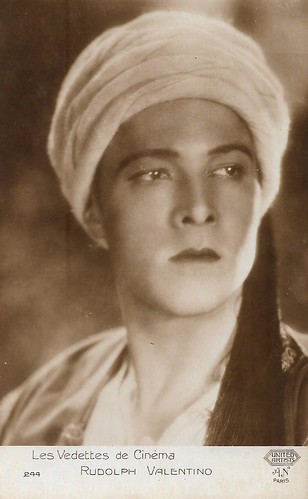
Rudolph Valentino
French postcard in the Les Vedettes de Cinéma series by A.N., Paris, no. 244. Photo: United Artists. Publicity still of Rudolph Valentino in The Son of the Sheik (George Fitzmaurice, 1926).
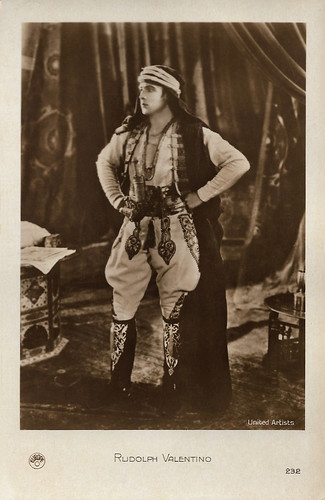
Rudolph Valentino in The Son of the Sheik (1926)
French postcard by Europe, no. 232. Photo: United Artists. Publicity still for The Son of the Sheik (George Fitzmaurice, 1926).
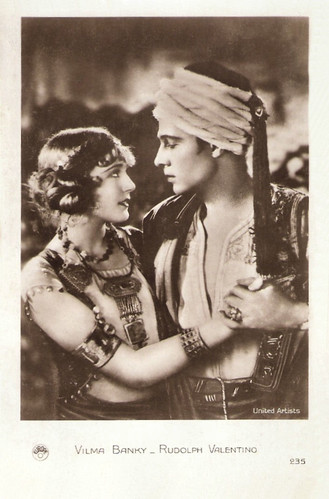
Vilma Banky, Rudolph Valentino
French postcard by Europe, no. 235. Photo: United Artists. Publicity still for The Son of the Sheik (George Fitzmaurice, 1926).
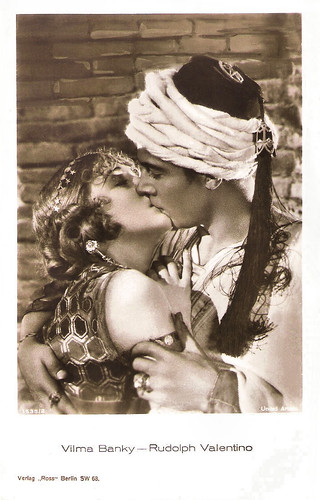
Vilma Banky and Rudolph Valentino in The Son of the Sheik (1926)
German postcard by Ross Verlag, no. 1535/2, 1927-1928. Distributed in Italy by Casa Editrice Ballerini & Fratini, Firenze. Photo: United Artists. Publicity still for The Son of the Sheik (George Fitzmaurice, 1926).
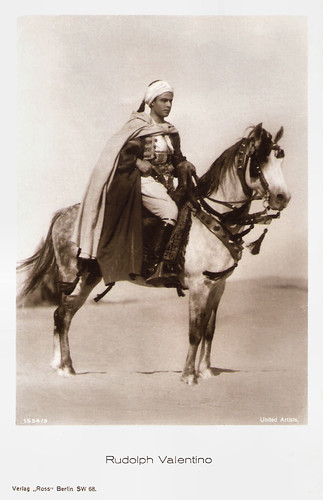
Rudolph Valentino in The Son of the Sheik (1926)
German postcard by Ross Verlag, no. 1534/3, 1927-1928. Photo: United Artists. Publicity still for The Son of the Sheik (George Fitzmaurice, 1926).
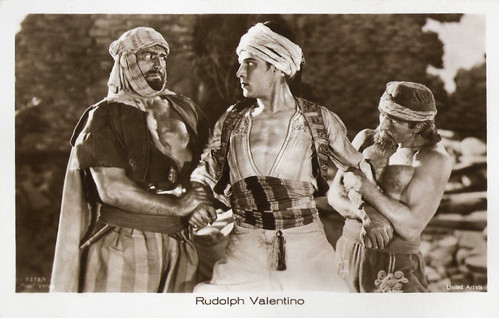
Rudolph Valentino in The Son of the Sheik (1926)
German postcard by Ross Verlag, no. 3373/1, 1928-1929. Photo: United Artists. Publicity still for The Son of the Sheik (George Fitzmaurice, 1926).
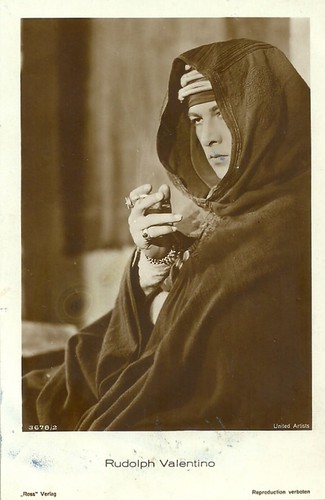
Rudolph Valentino in The Son of the Sheik (1926)
German postcard by Ross Verlag, no. 3678/2, 1928-1929. Photo: United Artists. Publicity still of Rudolph Valentino in The Son of the Sheik (George Fitzmaurice, 1926).
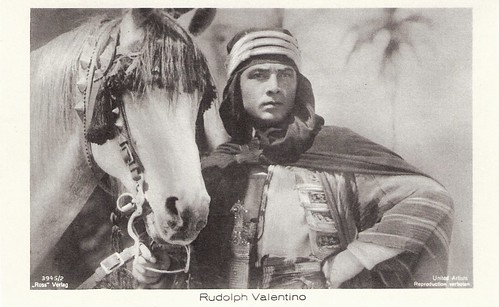
Rudolph Valentino in The Son of the Sheik (1926)
Dutch-German postcard by Ross Verlag, no. 3945/2, 1928-1929. Photo: United Artists. Publicity still for The Son of the Sheik (George Fitzmaurice, 1926). This vintage postcard contains Dutch text on the backside.

Sources: Hal Erickson (AllMovie), Wikipedia and IMDb.

This post was last updated on 30 April 2023.
04 September 2013

Vilma Bánky

Hungarian-born silent film star Vilma Bánky (1901-1991) filmed in Budapest, France, Austria, and Germany, before Sam Goldwyn took her to Hollywood. There she starred opposite silent stars like Rudolph Valentino and Ronald Colman. She became Goldwyn's biggest money maker till sound finished her career.

Vilma Banky
British postcard in the 'Famous Cinema Star' series by J. Beagles & Co, LTD., London, no. 235 G. Photo: Allied Artists Pictures. Publicity still for The Eagle (1925).

Blonde And Violet-Eyed


Vilma Bánky was born Vilma Konsics Bánky to János Konsics Bánky and Katalin Ulbert in Nagydorog, Austria-Hungary, in 1901. (Although reference books give dates ranging from 1898 to 1903).

Her father was a bureau chief under Franz Joseph's Austro-Hungarian Empire. Shortly after her birth, her father was transferred to Budapest, and the family relocated. She had two siblings - an older brother, Gyula (who would later go on to work in Berlin as a writer and cinematographer), and a younger sister, Gisella.

After graduation from secondary school, Bánky took courses to work as a stenographer, but then she was offered a role in a film. Her debut was in the now lost German film Im Letzten Augenblick/The Last Moment (Carl Boese, 1919).

The violet-eyed, blonde beauty was soon asked for Hungarian, Austrian, and French films. To her European productions belong Galathea (Béla Balogh, 1921), A Halott szerelma/The Eye of the Death (Carl Boese, 1922), Das Bildnis/The Picture (Jacques Feyder, 1923), Das verbotene Land/The Forbidden Country (Friedrich Feher, 1924), and Soll man heiraten?/Do You Have to Marry? (Manfred Noa, 1925).

Vilma Banky
French postcard by Editions Cinémagazine, no. 428. Photo: Vilma Banky in The Winning of Barbara Worth (Henry King, 1926), also with Ronald Colman and a young Gary Cooper, who debuted in this film.

Vilma Banky & Ronald Colman
French postcard by Editions Cinémagazine, no. 433, with Ronald Colman.

Ronald Colman, Vilma Banky
German postcard by Ross Verlag, no. 3375/3, 1928-1929. Photo: United Artists. Publicity still for Two Lovers (Fred Niblo, 1928), with Ronald Colman.

Vilma Banky, Ronald Colman
German postcard by Ross Verlag, no. 3375/1, 1928-1929. Photo: United Artists. Publicity still for Two Lovers (Fred Niblo, 1928), with Ronald Colman.

Vilma Banky & Ronald Colman
German postcard by Ross Verlag, no. 2082/3, 1927-1928. Photo: United Artists, with Ronald Colman.

The Hungarian Rhapsody


On a trip to Budapest in 1925, Hollywood film producer Samuel Goldwyn discovered and signed Vilma Bánky to a contract. Both her mother and father were vehemently against Bánky's acting career as was her fiancé.

Nonetheless she left for the United States in March 1925, arriving to a great deal of fanfare. She was hailed as ‘The Hungarian Rhapsody’.

Bánky was an immediate hit with American audiences with her first American film, The Dark Angel (George Fitzmaurice, 1925). The New York Times review praised her acting and called her "so exquisite that one is not in the least surprised that she is never forgotten" by her co-star.

This would be the first of five fantastic love stories in which she co-starred with Ronald Colman, including the very popular The Winning of Barbara Worth (Henry King, 1926).

Opposite Rudolph Valentino, she appeared as the daughter of a Russian aristocrat in The Eagle (Clarence Brown, 1925), and as an Arab dancer in his last film The Son of the Sheik (George Fitzmaurice, 1926).

Vilma Banky, Rudolph Valentino, Son of the Sheik
French postcard in a series by Shampoing Butywave. Photo: Allied Artists. Publicity still for The Son of the Sheik (1926), with Rudolph Valentino. The woman portrayed is not Vilma Banky, but Agnes Ayres.

Vilma Banky, Rudolph Valentino, Son of the Sheik
French postcard in a series by Shampoing Butywave. Photo: Allied Artists. Publicity still for The Son of the Sheik (1926), with Rudolph Valentino.

Vilma Banky, Rudolph Valentino
French postcard by Europa, no. 235. Photo: United Artists. Publicity still for The Son of the Sheik (1926), with Rudolph Valentino.

Vilma Banky, Rudolph Valentino, Son of the Sheik
French postcard in a series by Shampoing Butywave. Photo: Allied Artists. Publicity still for The Son of the Sheik (1926), with Rudolph Valentino.

Vilma Banky, Rudolph Valentino, Son of the Sheik
French postcard in a series by Shampoing Butywave. Photo: Allied Artists. Publicity still for The Son of the Sheik (1926), with Rudolph Valentino.

Extravagant Wedding


In 1927 Vilma Bánky married another star, Rod La Rocque, during an extravagant wedding, paid by Sam Goldwyn. Cecil B. DeMille was best man and the ushers included Ronald Colman and Harold Lloyd.

In 1928, Bánky participated in the first public demonstration of the way films could be transmitted over telephone wires. Film of her arrival by train in Chicago was shown at a newsreel theatre in New York nine hours later; the process was hailed as a technological breakthrough.

It is commonly believed that her thick Hungarian accent cut her career short with the advent of sound, however she also began losing interest in films and wanted to settle down with her new husband. Her first talking movie was This Is Heaven (Alfred Santell, 1929). It proved to be an awful experience for the almost inaudible Hungarian actress. A Lady To Love (Victor Sjöström, 1930) with Edward G. Robinson would be Bánky's final American film and her second attempt at a talkie.

 According to IMDb reviewer drednm "it's a very good film indeed. (...) I was struck throughout this film at what a nice voice she had and how much her accent resembled that of Greta Garbo in Anna Christie that same year.". She also made an alternate-language version in German, Die Sehnsucht jeder Frau/Every Woman's Desire (Victor Sjöström, 1930).

Bánky went with Rod La Rocque to Germany to make a final film, Der Rebell/The Rebel (Edwin H. Knopf, Luis Trenker, 1932), starring Luis Trenker. Vilma remained with Rod till his death in 1969. Her post Hollywood years were spent selling real estate with her husband and playing golf, her favourite sport.

In 1981, Bánky established an educational fund called the Banky - La Rocque Foundation, which is still in operation. Vilma Bánky died in 1991, from cardiopulmonary failure, aged 90. Today, of her twenty-four films, seven exist in their entirety and three only in fragments.

Vilma Banky
Austrian postcard by Iris Verlag, no. 975. Photo: Halasz, Budapest.

Vilma Banky
Austrian postcard by Iris Verlag, no. 577/1. Photo: Fanamet Film.

Vilma Banky
Austrian postcard by Iris Verlag, no. 695/3. Photo: Halasz, Budapest / Fanamet-Film.

Vilma Banky
Austrian postcard by Iris Verlag, no. 577-2. Sent by mail in Serbia in 1930.

Vilma Banky
British postcard by Real Photograph in the Picturegoer series, no. 272.

Vilma Banky
German postcard by Ross Verlag, no. 1689/1, 1927-1928. Photo: United Artists.

Vilma Banky
German postcard by Ross Verlag, no. 1540/3, 1927-1928. Photo: United Artists.

Vilma Banky
French postcard by Cinémagazine-Edition, Paris, no. 407.


Vilma Banky and Rudolph Valentino in a scene from The Eagle (1925). Source: (YouTube).

Sources: Ed Stephan (IMDb), Thomas Staedeli (Cyranos), New York Times, Wikipedia, and IMDb.