Pretty Austrian actress Jenny Jugo (1904-2001) had a prolific career in German cinema, from the late silent era well into the war years. She did particularly well as a comedienne and starred between 1931 and 1942 in eleven smart and charming comedies directed by Erich Engel.
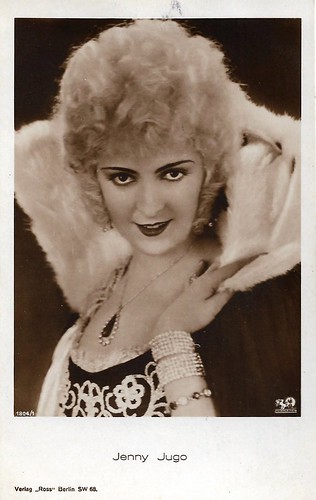
German postcard by Ross Verlag, no. 1804/1. Photo: Phoebus-Film. Jenny Jugo in the period drama Prinz Louis Ferdinand (Hans Behrendt, 1927).
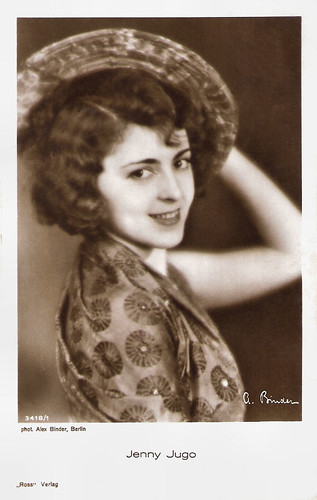
German postcard by Ross Verlag, no. 3418/1, 1928-1929. Photo: Alex Binder, Berlin.

German postcard by Ross Verlag, no. 3584/1, 1928-1929. Photo: Ufa.
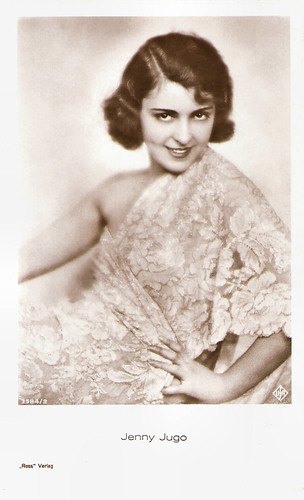
German postcard by Ross Verlag, no. 3584/2, 1928-1929. Photo: Ufa.

German postcard by Ross Verlag, no. 3606/2, 1928-1929. Photo: Atelier Balázs, Berlin / Ufa.
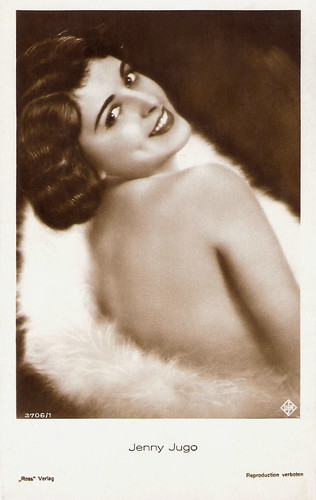
German postcard by Ross Verlag, no. 3706/1, 1928-1929. Photo: Ufa.

German postcard by Ross Verlag, no. 3962/2, 1928-1929. Photo: Ufa.

German postcard by Ross Verlag, no. 4144/1, 1929-1930. Photo: Ufa. Jenny Jugo in Die Schmugglerbraut von Mallorca/The smuggler's bride from Mallorca (Hans Behrendt, 1929).
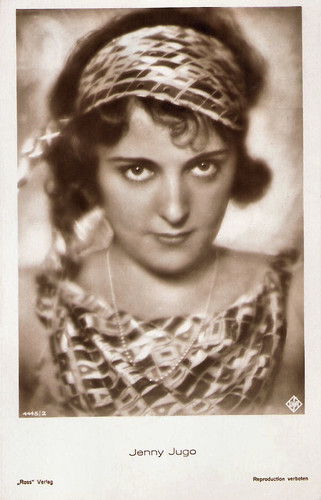
German postcard by Ross Verlag, no. 4445/2, 1929-1930. Photo: Ufa.
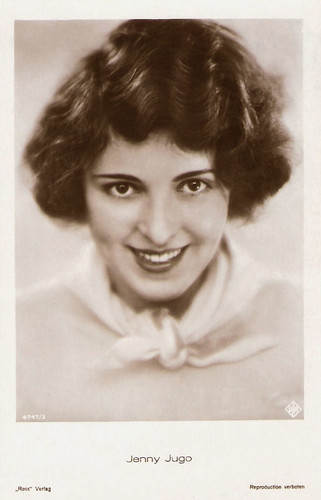
German postcard by Ross Verlag, no. 4747/3, 1929-1930. Photo: Ufa.
Jenny Jugo was born as Eugenie Jenny Walter in Mürzzuschlag, Austria-Hungary (now Austria), in 1904, as the daughter of a factory owner. She grew up in Vienna and Graz, where she visited a monastic school.
At the age of 16, Jenny got married to the Italian actor Emo Jugo who took her to Berlin. Already one year later followed their separation. The famous producer Erich Pommer discovered Jenny for the cinema, and in 1924, she got a three-year contract from the Ufa.
She started to play in films like Die Puppe vom Lunapark/The Lunapark Doll (Jaap Speyer, 1925) with Adolphe Engers, Der Turm des Schweigens/The Tower of Silence (Johannes Guter, 1925), Die gefundene Braut/The Found Bride (Rochus Gliese, 1925) both starring Xenia Desni, Blitzzug der Liebe/Love Express Train (Johannes Guter, 1925) with Ossi Oswalda, and Liebe macht blind/Love Makes Us Blind (Lothar Mendes, 1925) with Georg Alexander.
Her dramatic roles were not very successful and Ufa lent her to the Phoebus-Film A.G. There she made some of her most successful films like Schiff in Not/Ship Stranded (Fred Sauer, 1925) with Gustav Fröhlich, Casanova/The Loves of Casanova (Alexandre Volkoff, 1927) starring Ivan Mozzhukhin, and the Alexander Pushkin adaptation Pique Dame (Aleksandr Razumnyi, 1927).
As the vivacious and much younger wife of bureaucrat Werner Krauss she proved in the farce Die Hose/The Trousers (Hans Behrendt, 1927) her talent for comedy and self-irony.
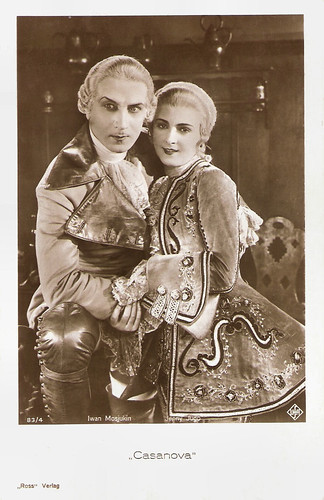
German postcard by Ross Verlag, no. 83/4. Photo: Ufa. Publicity still for Casanova (Alexandre Volkoff, 1927) with Ivan Mozzhukhin.

German postcard by Ross Verlag, no. 3418/2, 1928-1929. Photo: Alex Binder, Berlin.
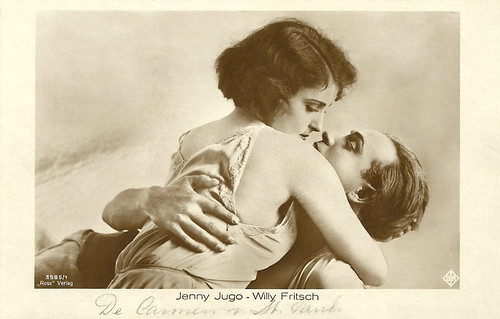
German postcard by Ross Verlag, no. 3585/1, 1928-1929. Photo: Ufa. Publicity still for Die Carmen von St. Pauli/The Carmen of St. Pauli (1928) with Willy Fritsch.
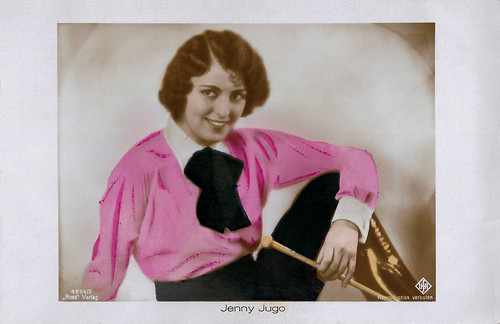
German postcard by Ross Verlag, no. 4536/2, 1929-1930. Photo: Ufa. Collection: Geoffrey Donaldson Institute.
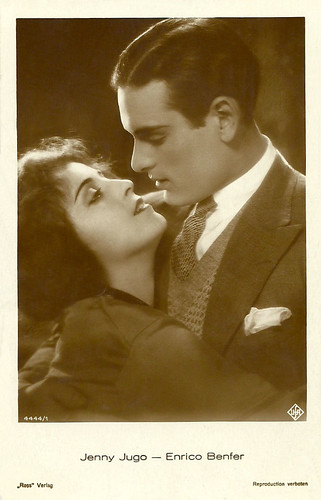
German postcard by Ross Verlag, no. 4444/1, 1929-1930. Photo: Ufa. With Enrico Benfer.
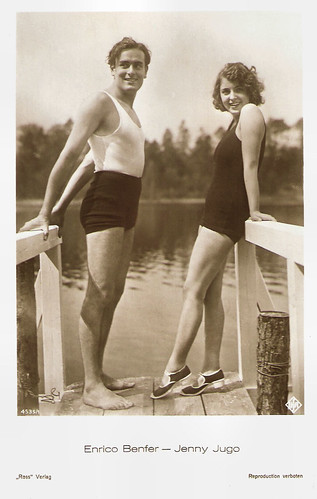
German postcard by Ross Verlag, no. 4535/1, 1929-1930. Photo: Ufa. With Enrico Benfer.
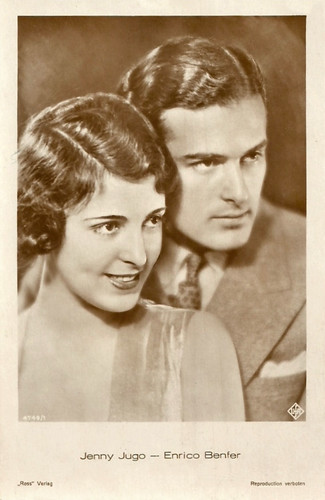
German postcard by Ross Verlag, no. 4749/1, 1929-1930. Photo: Ufa. With Enrico Benfer.
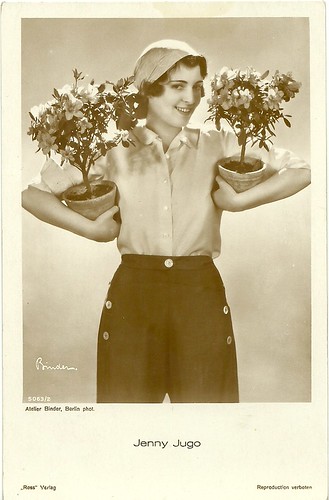
German postcard by Ross Verlag, no. 5063/2, 1930-1931. Photo: Alex Binder / Atelier Binder, Berlin. Collection: Didier Hanson.

German postcard by Ross Verlag, no. 5433/2, 1930-1931. Photo: Atelier Binder, Berlin.
When the era of the silent film was over and sound film demanded a new acting talent and especially a very clear pronunciation, Jenny Jugo took acting lessons for the first time in her life. In the next years she acted in less important films like Kopfüber ins Glück/Headfirst in Happiness (Hans Steinhoff, 1929) with Fritz Schulz, and Die nackte Wahrheit/The Naked Truth (Karl Anton, 1931).
Starting with Wer nimmt die Liebe ernst?/Who Takes Love Seriously? (Erich Engel, 1931) starring Max Hansen, she began cooperation with director Erich Engel who knew how to use her comedy talent. Till 1942 they shot eleven films together.
These included Fünf von der Jazzband/Five of the Jazzband (Erich Engel, 1932), the G.B. Shaw adaptation Pygmalion (Erich Engel, 1935) with Gustaf Gründgens, as the young Queen Victoria in Mädchenjahre einer Königin/Girlhood of a Queen (Erich Engel, 1936), Gefährliches Spiel/Dangerous Game (Erich Engel, 1937) opposite Harry Liedtke, Nanette (Erich Engel, 1939) with Hans Söhnker, and Viel Lärm um Nixi/Much Ado About Nixi (Erich Engel, 1942) with Albert Matterstock.
In these films, she established an acting style that was described by Bertolt Brecht as "just naturalness". She belonged with Zarah Leander and Paula Wessely to the best-paid actresses of the Ufa.
However, she would play in only three more productions: Die Gattin/The Wife (Georg Jacoby, 1943), Träum' nicht, Anette/Don't Dream, Anette (Eberhard Klagemann, 1949) and Königskinder/Royal Children (Helmut Käutner, 1949) with Peter van Eyck.
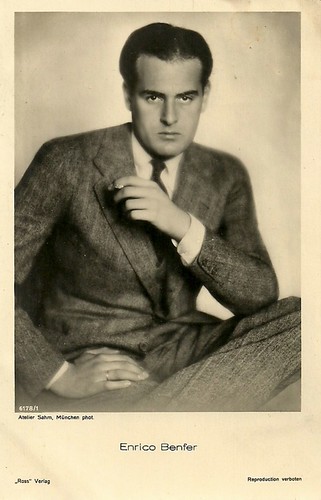
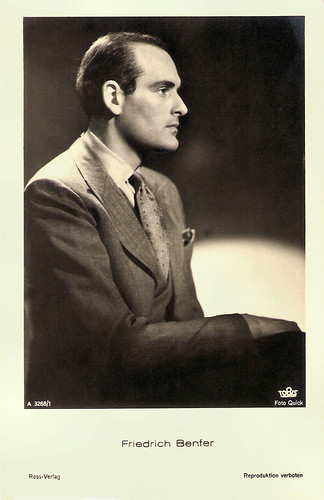
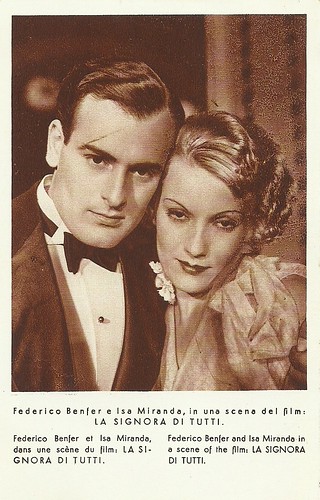
In 1950 Jugo married actor Enrico Benfer a.k.a. Friedrich Benfer, with whom she had worked in many of her films. They retired from the film business to a farm in Schönrain near Bad Heilbrunn, Bavaria. In 1971 she was awarded the Filmband in Gold for her long and outstanding contributions to the German cinema. In the 1970s a medical treatment went wrong, and since then Jugo was tied up to a wheelchair.
Jenny Jugo died in 2001 in Schwaighofen near Königsdorf, Germany. She was 96. In the summer of 2006, the film museum of Potsdam acquired a quite special collection: about forty costumes which Jugo had worn in her Ufa films and numerous documents, which the star herself had saved at her High-Bavarian farm.

German collectors card by Ross Verlag in the Unsere Bunten Filmbilder series for Cigarettenfabrik Josetti, Berlin, no. 151. Photo: Fox. Jenny Jugo in Herz ist Trumpf/Hearts are trumps (Carl Boese, 1934).

Austrian postcard by Iris-Verlag, no. 5401. Photo: Excelsior-Film / Phoebus Film.

Belgian postcard. Photo Ufa. S.A. Cacao et Chocolat Kivou, Vilvoorde / N.V. Cacao en Chocolade Kivou, Vilvoorde.
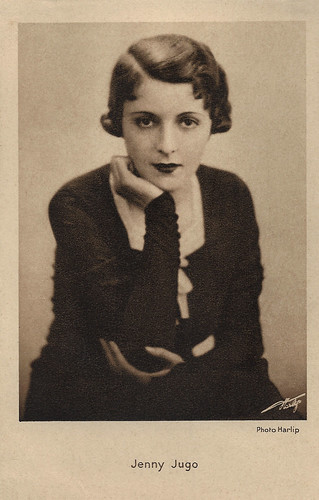
German postcard in "Das Programm von Heute" für Film und Theater G.m.b.H., Stuttgart. Photo: Harlip.
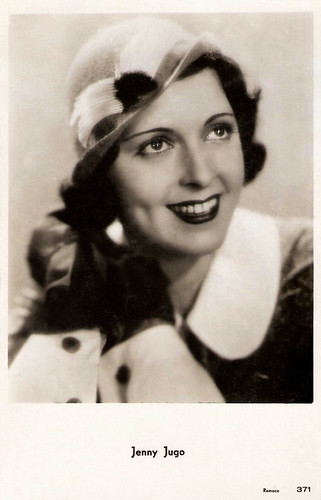
Dutch postcard by JosPe, no. 371. Photo: Remaco. Jenny Jugo in Ich bleib bei Dir/I stay with you (Johannes Meyer, 1931).
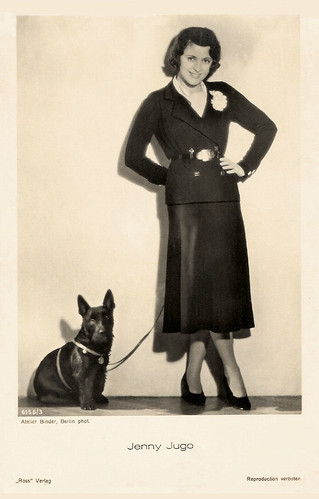
German postcard by Ross Verlag, no. 6156/3, 1931-1932. Photo: Atelier Binder, Berlin.
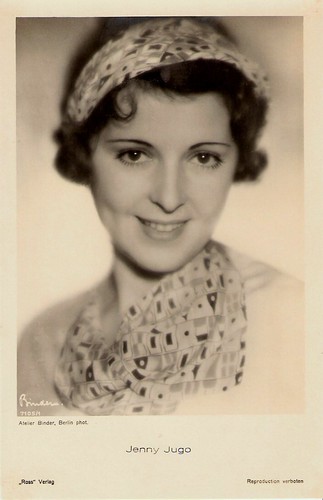
German postcard by Ross Verlag, no. 7105/1, 1932-1933. Photo: Alex Binder / Atelier Binder, Berlin.
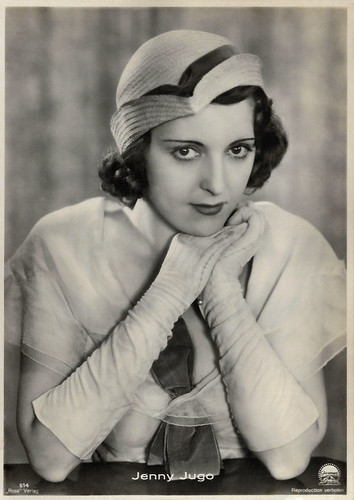
German postcard in the Luxus-Klasse series by Ross Verlag, no. 614. Photo: Paramount. Jenny Jugo in Die nackte Wahrheit/The Naked Truth (Karl Anton, 1932). It was shot at the Joinville Studios in Paris, where many of Paramount Pictures' multiple-language versions were made. It is the German version of Nothing but the Truth (Victor Schertzinger, 1929) and was also known by the alternative title of Heut' küsst Paris.
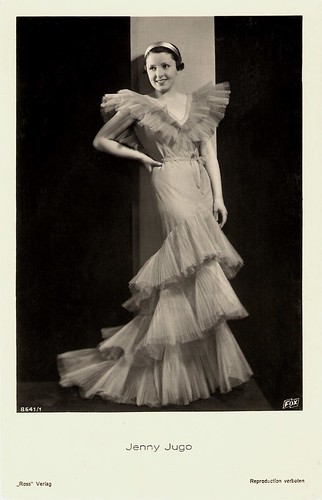
German postcard by Ross Verlag, no. 8641/1, 1933-1934. Photo: Fox. Publicity still for ...heute abend bei mir/Tonight with me (Carl Boese, 1934).

German collectors card by Ross Verlag. Photo: Roth. Jenny Jugo in Pygmalion (Erich Engel, 1935).
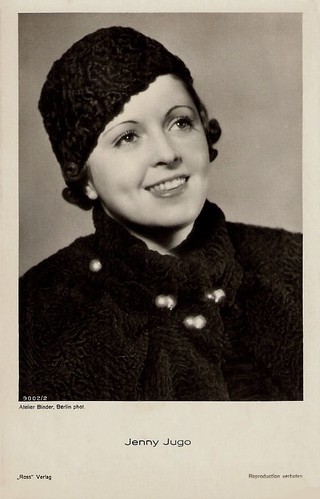
German postcard by Ross Verlag, no. 9007/2, 1934-1935. Photo: Atelier Binder, Berlin.
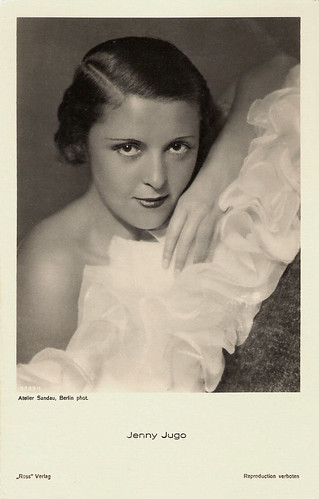
German postcard by Ross Verlag, no. 9289/1, 1935-1936. Photo: Atelier Sandau, Berlin.
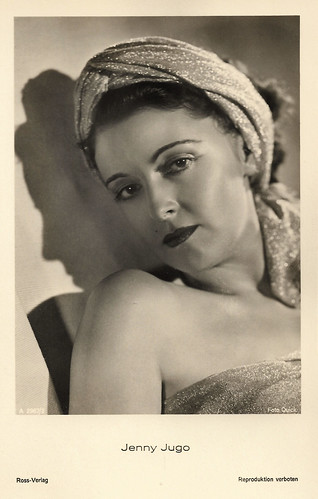
German postcard by Ross Verlag, no. A 2967/2, 1939-1940. Photo: Quick.
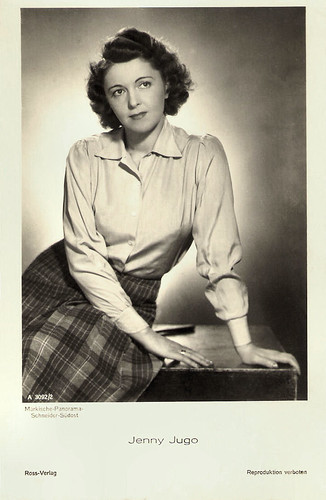
German postcard by Ross Verlag, no. A 3092/2, 1941-1944. Photo: Markische-Panorama-Schneider-Südost.
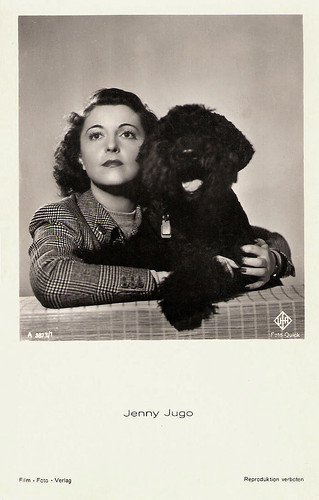
German postcard by Film-Foto-Verlag, no. A 3873/1, 1941-1944. Photo: Quick / Ufa.
Sources: Stephanie D'heil (Steffi-line - German), Thomas Staedeli (Cyranos), Filmportal.de, IMDb, and Wikipedia (German).
This post was last updated on 27 April 2021.
German postcard by Ross Verlag, no. 1804/1. Photo: Phoebus-Film. Jenny Jugo in the period drama Prinz Louis Ferdinand (Hans Behrendt, 1927).
German postcard by Ross Verlag, no. 3418/1, 1928-1929. Photo: Alex Binder, Berlin.
German postcard by Ross Verlag, no. 3584/1, 1928-1929. Photo: Ufa.
German postcard by Ross Verlag, no. 3584/2, 1928-1929. Photo: Ufa.
German postcard by Ross Verlag, no. 3606/2, 1928-1929. Photo: Atelier Balázs, Berlin / Ufa.
German postcard by Ross Verlag, no. 3706/1, 1928-1929. Photo: Ufa.
German postcard by Ross Verlag, no. 3962/2, 1928-1929. Photo: Ufa.
German postcard by Ross Verlag, no. 4144/1, 1929-1930. Photo: Ufa. Jenny Jugo in Die Schmugglerbraut von Mallorca/The smuggler's bride from Mallorca (Hans Behrendt, 1929).
German postcard by Ross Verlag, no. 4445/2, 1929-1930. Photo: Ufa.
German postcard by Ross Verlag, no. 4747/3, 1929-1930. Photo: Ufa.
Talent For Comedy
Jenny Jugo was born as Eugenie Jenny Walter in Mürzzuschlag, Austria-Hungary (now Austria), in 1904, as the daughter of a factory owner. She grew up in Vienna and Graz, where she visited a monastic school.
At the age of 16, Jenny got married to the Italian actor Emo Jugo who took her to Berlin. Already one year later followed their separation. The famous producer Erich Pommer discovered Jenny for the cinema, and in 1924, she got a three-year contract from the Ufa.
She started to play in films like Die Puppe vom Lunapark/The Lunapark Doll (Jaap Speyer, 1925) with Adolphe Engers, Der Turm des Schweigens/The Tower of Silence (Johannes Guter, 1925), Die gefundene Braut/The Found Bride (Rochus Gliese, 1925) both starring Xenia Desni, Blitzzug der Liebe/Love Express Train (Johannes Guter, 1925) with Ossi Oswalda, and Liebe macht blind/Love Makes Us Blind (Lothar Mendes, 1925) with Georg Alexander.
Her dramatic roles were not very successful and Ufa lent her to the Phoebus-Film A.G. There she made some of her most successful films like Schiff in Not/Ship Stranded (Fred Sauer, 1925) with Gustav Fröhlich, Casanova/The Loves of Casanova (Alexandre Volkoff, 1927) starring Ivan Mozzhukhin, and the Alexander Pushkin adaptation Pique Dame (Aleksandr Razumnyi, 1927).
As the vivacious and much younger wife of bureaucrat Werner Krauss she proved in the farce Die Hose/The Trousers (Hans Behrendt, 1927) her talent for comedy and self-irony.
German postcard by Ross Verlag, no. 83/4. Photo: Ufa. Publicity still for Casanova (Alexandre Volkoff, 1927) with Ivan Mozzhukhin.
German postcard by Ross Verlag, no. 3418/2, 1928-1929. Photo: Alex Binder, Berlin.
German postcard by Ross Verlag, no. 3585/1, 1928-1929. Photo: Ufa. Publicity still for Die Carmen von St. Pauli/The Carmen of St. Pauli (1928) with Willy Fritsch.
German postcard by Ross Verlag, no. 4536/2, 1929-1930. Photo: Ufa. Collection: Geoffrey Donaldson Institute.
German postcard by Ross Verlag, no. 4444/1, 1929-1930. Photo: Ufa. With Enrico Benfer.
German postcard by Ross Verlag, no. 4535/1, 1929-1930. Photo: Ufa. With Enrico Benfer.
German postcard by Ross Verlag, no. 4749/1, 1929-1930. Photo: Ufa. With Enrico Benfer.
German postcard by Ross Verlag, no. 5063/2, 1930-1931. Photo: Alex Binder / Atelier Binder, Berlin. Collection: Didier Hanson.
German postcard by Ross Verlag, no. 5433/2, 1930-1931. Photo: Atelier Binder, Berlin.
Just Naturalness
When the era of the silent film was over and sound film demanded a new acting talent and especially a very clear pronunciation, Jenny Jugo took acting lessons for the first time in her life. In the next years she acted in less important films like Kopfüber ins Glück/Headfirst in Happiness (Hans Steinhoff, 1929) with Fritz Schulz, and Die nackte Wahrheit/The Naked Truth (Karl Anton, 1931).
Starting with Wer nimmt die Liebe ernst?/Who Takes Love Seriously? (Erich Engel, 1931) starring Max Hansen, she began cooperation with director Erich Engel who knew how to use her comedy talent. Till 1942 they shot eleven films together.
These included Fünf von der Jazzband/Five of the Jazzband (Erich Engel, 1932), the G.B. Shaw adaptation Pygmalion (Erich Engel, 1935) with Gustaf Gründgens, as the young Queen Victoria in Mädchenjahre einer Königin/Girlhood of a Queen (Erich Engel, 1936), Gefährliches Spiel/Dangerous Game (Erich Engel, 1937) opposite Harry Liedtke, Nanette (Erich Engel, 1939) with Hans Söhnker, and Viel Lärm um Nixi/Much Ado About Nixi (Erich Engel, 1942) with Albert Matterstock.
In these films, she established an acting style that was described by Bertolt Brecht as "just naturalness". She belonged with Zarah Leander and Paula Wessely to the best-paid actresses of the Ufa.
However, she would play in only three more productions: Die Gattin/The Wife (Georg Jacoby, 1943), Träum' nicht, Anette/Don't Dream, Anette (Eberhard Klagemann, 1949) and Königskinder/Royal Children (Helmut Käutner, 1949) with Peter van Eyck.
In 1950 Jugo married actor Enrico Benfer a.k.a. Friedrich Benfer, with whom she had worked in many of her films. They retired from the film business to a farm in Schönrain near Bad Heilbrunn, Bavaria. In 1971 she was awarded the Filmband in Gold for her long and outstanding contributions to the German cinema. In the 1970s a medical treatment went wrong, and since then Jugo was tied up to a wheelchair.
Jenny Jugo died in 2001 in Schwaighofen near Königsdorf, Germany. She was 96. In the summer of 2006, the film museum of Potsdam acquired a quite special collection: about forty costumes which Jugo had worn in her Ufa films and numerous documents, which the star herself had saved at her High-Bavarian farm.
German collectors card by Ross Verlag in the Unsere Bunten Filmbilder series for Cigarettenfabrik Josetti, Berlin, no. 151. Photo: Fox. Jenny Jugo in Herz ist Trumpf/Hearts are trumps (Carl Boese, 1934).
Austrian postcard by Iris-Verlag, no. 5401. Photo: Excelsior-Film / Phoebus Film.
Belgian postcard. Photo Ufa. S.A. Cacao et Chocolat Kivou, Vilvoorde / N.V. Cacao en Chocolade Kivou, Vilvoorde.
German postcard in "Das Programm von Heute" für Film und Theater G.m.b.H., Stuttgart. Photo: Harlip.
Dutch postcard by JosPe, no. 371. Photo: Remaco. Jenny Jugo in Ich bleib bei Dir/I stay with you (Johannes Meyer, 1931).
German postcard by Ross Verlag, no. 6156/3, 1931-1932. Photo: Atelier Binder, Berlin.
German postcard by Ross Verlag, no. 7105/1, 1932-1933. Photo: Alex Binder / Atelier Binder, Berlin.
German postcard in the Luxus-Klasse series by Ross Verlag, no. 614. Photo: Paramount. Jenny Jugo in Die nackte Wahrheit/The Naked Truth (Karl Anton, 1932). It was shot at the Joinville Studios in Paris, where many of Paramount Pictures' multiple-language versions were made. It is the German version of Nothing but the Truth (Victor Schertzinger, 1929) and was also known by the alternative title of Heut' küsst Paris.
German postcard by Ross Verlag, no. 8641/1, 1933-1934. Photo: Fox. Publicity still for ...heute abend bei mir/Tonight with me (Carl Boese, 1934).
German collectors card by Ross Verlag. Photo: Roth. Jenny Jugo in Pygmalion (Erich Engel, 1935).
German postcard by Ross Verlag, no. 9007/2, 1934-1935. Photo: Atelier Binder, Berlin.
German postcard by Ross Verlag, no. 9289/1, 1935-1936. Photo: Atelier Sandau, Berlin.
German postcard by Ross Verlag, no. A 2967/2, 1939-1940. Photo: Quick.
German postcard by Ross Verlag, no. A 3092/2, 1941-1944. Photo: Markische-Panorama-Schneider-Südost.
German postcard by Film-Foto-Verlag, no. A 3873/1, 1941-1944. Photo: Quick / Ufa.
Sources: Stephanie D'heil (Steffi-line - German), Thomas Staedeli (Cyranos), Filmportal.de, IMDb, and Wikipedia (German).
This post was last updated on 27 April 2021.