Showing posts with label Erich von Stroheim. Show all posts

27 June 2022

Directed by Erich von Stroheim

Highlights at Il Cinema Ritrovato in Bologna are always the cine-concerts. This year, the Bologna Opera House Orchestra, conducted by Timothy Brock, will be back to Piazza Maggiore to accompany two masterpieces turning 100. Tonight, the magnificent Foolish Wives by Erich von Stroheim (1885-1957) will be the first cine-concert. We will be there. So today's post is on Erich von Stroheim's short but interesting career as a director.

Erich von Stroheim
Spanish card by La Novela Semanal Cinematográfica, no. 78. Erich von Stroheim.

Mae Murray and John Gilbert in The Merry Widow (1925)
Italian postcard by Casa Editrice Ballerini & Fratini, Firenze, no. 657. Photo: Metro-Goldwyn-Film, Roma. Mae Murray and John Gilbert in The Merry Widow (Erich von Stroheim, 1925).
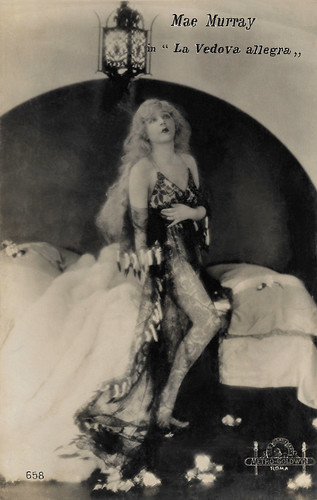
Mae Murray in The Merry Widow (1925)
Italian postcard by Casa Editrice Ballerini & Fratini, Firenze, no. 658. Photo: Metro-Goldwyn, Roma. Mae Murray in The Merry Widow (Erich von Stroheim, 1925).

Mae Murray in The Merry Widow (1925)
Italian postcard by Casa Editrice Ballerini & Fratini, Firenze, no. 660. Photo: Metro-Goldwyn, Roma. Mae Murray in The Merry Widow (Erich von Stroheim, 1925).

Blind Husbands (1919), The Devil's Passkey (1920) and Foolish Wives (1922)


Erich von Stroheim's directorial debut was Blind Husbands, made in 1919 for Carl Laemmle's Universal. He filmed a script he had written himself about a disastrous love triangle among tourists in the Dolomites. For this film, he also designed the set, did the editing and played a leading role. The film was a great box office success and brought him further directing assignments for Universal Studios.

A digital version of the historical print of Blind Husbands was preserved at the Austrian Film Museum and was released on DVD in 2006 with a musical score by Günter A. Buchwald. 'Il Cinema Ritrovato screened this restoration in 2007'. 'Il Cinema Ritrovato 2022' screened a new digital restoration from 2021. This restoration differs from this DVD release as the image has now been restored, English intertitles were added and the original tinting and toning were digitally reconstructed.

Stroheim's second film, The Devil's Passkey from 1920, is considered lost today, and only a few stills exist. This film was also very successful, so Stroheim was able to indulge in wild and costly extravagances in his next production, Foolish Women (1921).

Blind Husbands (1919), The Devil's Pass Key (1920) and Foolish Wives (1922) formed a triptych of so-called "sex dramas", films about love triangles and adultery. All three films were about an American wife who went to Europe and, thanks to the attention of a European gentleman, became aware of her own sexuality. The role of the gentleman in Blind Husbands (1919) and Foolish Wives (1922) was played by Von Stroheim himself.

Von Stroheim became known as a demanding director, obsessed with details and not afraid to spend money. He often took on multiple roles, including not only director and screenwriter but also actor, film editor and set and costume designer. His reputation was established with Foolish Wives. He paints a vitriolic portrait of a society corrupted by money. As a perfectionist, he demanded that wardrobes and chests of drawers, which were not opened once, be filled with clothes.

Foolish Wives cost almost a million dollars which in 1922 was a considerable sum for a film. Von Stroheim had a life-size replica of Monte Carlo built and frequently filmed on location. The film ended up being Universal's biggest hit to date but managed to make little profit due to the high costs.

Blind Husbands
Italian programme card for Il Cinema Ritrovata 2007. Photo: Erich von Stroheim in Blind Husbands (Erich von Stroheim, 1919).

Miss DuPont in Foolish Wives (1922)
German postcard by Ross Verlag. Photo: Universal / Super Jewel. Miss DuPont in Foolish Wives (Erich von Stroheim, 1922).
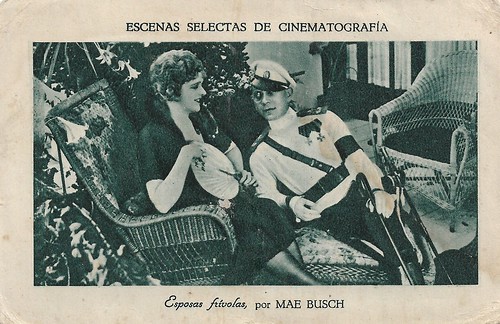
Erich von Stroheim and Miss Dupont in Foolish Wives (1922)
Spanish minicard in the Escenas selectas de cinematografía series, series A, no. 2, for Chocolate Guillèn. Erich von Stroheim in Foolish Wives (Erich von Stroheim, 1922). The lady depicted is not Mae Busch but Miss Dupont.

Erich von Stroheim in Foolish Wives (1922)
Big programme card by Cineteca Bologna for Il Cinema Ritrovato, XXXVI edizione, 27 June 2022, Front side. Erich von Stroheim in Foolish Wives (Erich von Stroheim, 1922).
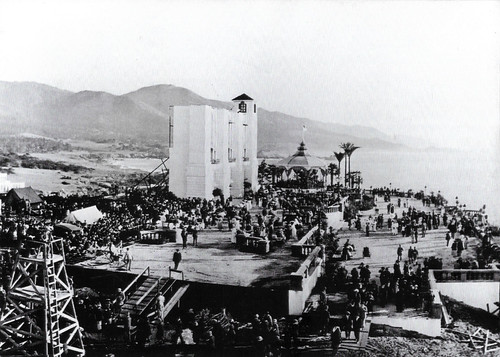
Set Foolish Wives (1922)
Big programme card by Cineteca Bologna for Il Cinema Ritrovato, XXXVI edizione, 27 June 2022, Flip side. Set Foolish Wives (Erich von Stroheim, 1922).

Merry-Go-Round (1923) and Greed (1924)


Erich von Stroheim's films were also known for the slow pace at which the story was told. Because of this, Universal, under production head Irving Thalberg, often left the editing to other people. Foolish Wives was a third shorter than Von Stroheim actually intended. Halfway through the production of his fourth film, Merry-Go-Round (1923), he was fired by Thalberg.

He had once again not adhered to the studio's specifications. Von Stroheim ordered the necessary military uniforms in Vienna because in his opinion this was the only way to portray the necessary authenticity. He had extras who appeared as soldiers drill for days until he was satisfied with the shots. He had the Prater in Vienna recreated in great detail on the studio lot. Von Stroheim was replaced by Rupert Julian and he left for Goldwyn.

His best-known film is maybe his fifth, Greed (1924), an adaptation of the novel 'McTeague' by Frank Norris. This film is now considered Von Stroheim's masterpiece. The version of the film edited by Von Stroheim followed the novel very closely. This led to a 42-reel version, lasting more than eight hours. Von Stroheim, however, had to contend with Irving Thalberg again, who became his boss when Goldwyn merged with Metro (where Thalberg was working at the time).

Thalberg demanded that Von Stroheim shorten the film. The new version included 24 reels, still too long for theatrical release. Rex Ingram shortened the film to an 18-reel version. Eventually, a ten-reel version lasting just over two hours was released in cinemas, much to Von Stroheim's dismay.

This version received mixed reviews from critics and was not a success in cinemas. The few who had seen the original, complete version said it was one of the greatest masterpieces in film history. However, this version has been lost and probably destroyed.
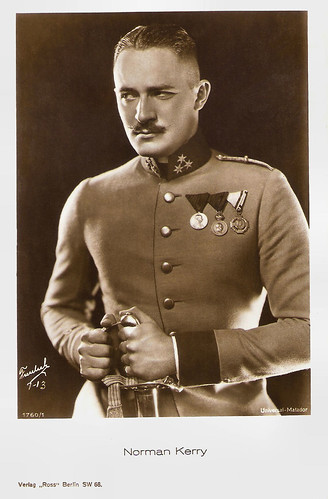
Norman Kerry in  Merry-Go-Round (1923)
German postcard by Ross Verlag, Berlin, no. 1760/1, 1927-1928. Photo: Freulich / Universal-Matador. Norman Kerry in Merry-Go-Round (Rupert Julian, Erich von Stroheim, 1923).

Norman Kerry in Merry-Go-Round (1923)
French postcard by Cinémagazine-Edition, no. 401. Photo: Roman Freulich. Norman Kerry in Merry-Go-Round (Rupert Julian, Erich von Stroheim, 1923). Norman Kerry's surname is misspelt on the card as Keery.

Norman Kerry in Merry-Go-Round (1923)
American postcard. Photo: Universal. Norman Kerry in Merry-Go-Round (Erich von Stroheim, 1923).

The Merry Widow (1925) and The Wedding March (1928)


For MGM, Erich von Stroheim made The Merry Widow, starring Mae Murray and John Gilbert as the romantic couple Sally O'Hara and Prince Danilo. It was an adaptation of Franz Lehár's operetta. He hijacked the operetta to make a film about orgies in a royal court with cripples, sex addicts and degenerate monarchs. The film was a huge success.

Von Stroheim made his next film for Paramount, The Wedding March (1925). Von Stroheim had also seen these films as part of a triptych, with Merry-Go-Round as the first part, about decadence in the Habsburg Empire.

Due to the great success of The Merry Widow, Stroheim was given a free hand again and was initially able to shape the production of The Wedding March at Paramount entirely according to his own ideas. Again, however, he exceeded the planned shooting time and budget to such an extent that filming was abandoned.

The Wedding March was also far too long to be released in cinemas and was released in two parts, with the second part being shown as a stand-alone film, The Honeymoon. Today, only the first part exists. The second part, The Honeymoon, is considered lost. The sole surviving print of The Honeymoon was destroyed in a fire at the Cinémathèque Française in 1957, five days after Stroheim’s death.

Rebecca Peters at the San Francisco Silent Film Festival website: "In 1997, Kevin Brownlow and Patrick Stanbury of Photoplay Productions undertook a restoration of The Wedding March, inspired by Fay Wray’s vivid account of the production. Working with the Library of Congress, they have produced a print that matches the re-edited version created by Erich von Stroheim at the Cinémathèque Française in 1954."
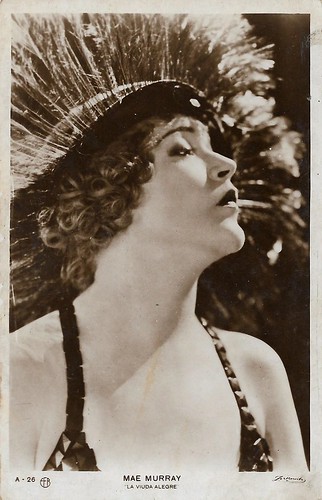
Mae Murray in The Merry Widow (1925)
Spanish postcard by EFB (Editorial Fotografica, Barcelona), no. A-26. Photo: Zerkowitz. Mae Murray in The Merry Widow (Erich von Stroheim, 1925).

John Gilbert in The Merry Widow (1925)
German postcard by Ross Verlag, no. 1319/1, 1927-1928. Photo: Loew Metro Goldwyn. John Gilbert in The Merry Widow (Erich von Stroheim, 1925).

Mae Murray and John Gilbert in The Merry Widow
French postcard in the Les Vedettes de Cinéma Series, by A.N., Paris, no. 369. Mae Murray [the trema is a mistake] and John Gilbert in The Merry Widow (Erich von Stroheim, 1925). The film was a huge success.
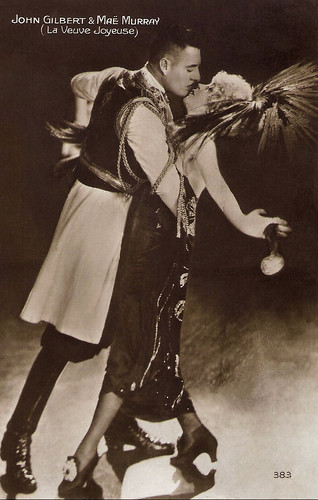
John Gilbert and Mae Murray in The Merry Widow (1925)
French postcard by Cinémagazine-Edition, Paris, no. 383. Photo: Metro-Goldwyn-Film. John Gilbert and Mae Murray in The Merry Widow (Erich von Stroheim, 1925).
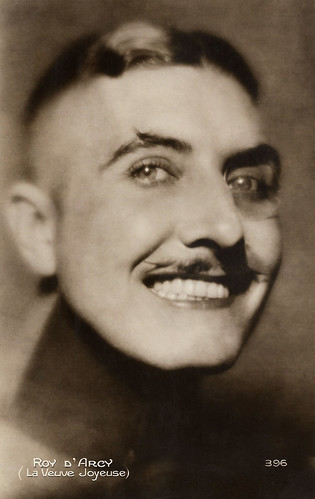
Roy d'Arcy in The Merry Widow (1925)
French postcard by Cinémagazine-Edition, Paris, no. 396. Photo: Roy d'Arcy in The Merry Widow (Erich von Stroheim, 1925).

Queen Kelly (1928) and Walking down Broadway (1932)


Erich von Stroheim's last film was Queen Kelly in 1928. Stroheim used up countless hours of footage for the prologue alone. Due to friction with leading actress and producer Gloria Swanson, Joseph Kennedy, Swanson's co-producer and partner, forced the director to leave. Kennedy declared: "Stroheim must never be allowed to direct a film again".

Swanson had a few more scenes shot without Von Stroheim to bring the plot to a close. However, this version was only shown a few times in Europe and then disappeared into the archives. A restored version of the existing material according to Von Stroheim's original plans was only made available to the public in 1985.

His reputation as a director was ruined as a result, and Von Stroheim was forced to return to the camera as a performer for other directors. In 1929 he played the title role in his first sound film, The Great Gabbo by James Cruze. Just like at the beginning of his career, he was now often seen again as a villain in supporting roles. During this period, Von Stroheim was also frequently forced to work as a technical advisor and assistant dramaturge.

All of Von Stroheim's films were silent movies. Fox allowed him to direct the sound film Walking Down Broadway in 1932, but the film was entirely re-edited on the orders of producer Sol Wurtzel and enhanced with new scenes shot by Alfred Werker, Raoul Walsh and Edwin Burke. The final version was released in 1933 under the title Hello, Sister.
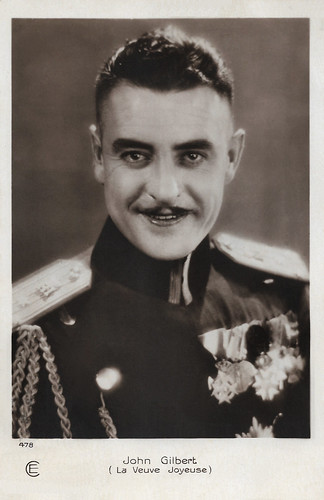
John Gilbert in The Merry Widow (1925)
French postcard by Cinémagazine-Edition, Paris, no. 478. Photo: Metro-Goldwyn-Film. John Gilbert in The Merry Widow (Erich von Stroheim, 1925).

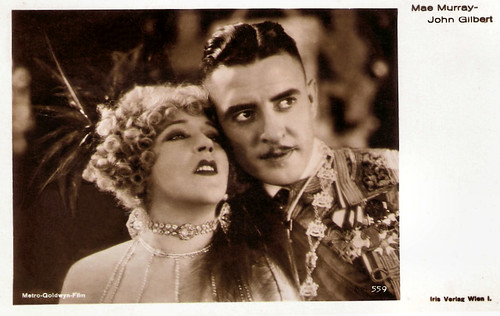
John Gilbert and Mae Murray in The Merry Widow (1925)
Austrian postcard by Iris Verlag, no. 559. Photo: Metro-Goldwyn-Film. John Gilbert and Mae Murray in The Merry Widow (Erich von Stroheim, 1925).

Fay Wray and Erich von Stroheim in The Wedding March (1928)
Italian card for the Il Cinema Ritrovato festival. Photo: Fay Wray and Erich von Stroheim in The Wedding March (Erich von Stroheim, 1928).
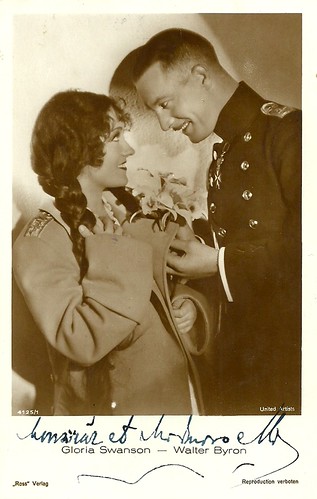
Walter Byron and Gloria Swanson in Queen Kelly (1929)
German postcard by Ross Verlag, no. 4125/1, 1929-1930. Photo: United Artists. Walter Byron and Gloria Swanson in Queen Kelly (Erich von Stroheim, 1929).
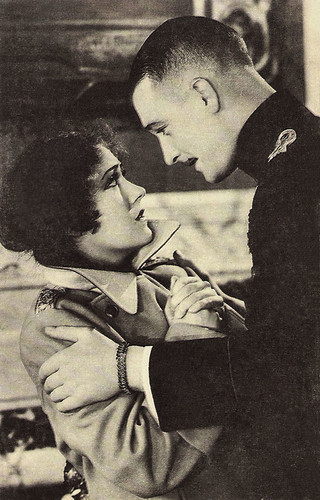
Gloria Swanson in Queen Kelly
Spanish postcard by Casa Molina, Madrid. Gloria Swanson and Walter Byron in Queen Kelly (Erich von Stroheim, 1929).

Sources: Rebecca Peters (San Francisco Silent Film Festival), Film Museum Austria, Wikipedia (Dutch, French and German) and IMDb.

This post was last updated on 3 July 2022.

02 July 2014

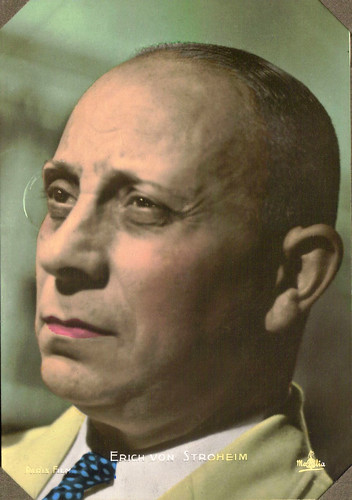
Erich von Stroheim

Il Cinema Ritrovato film festival (28 June - 5 July) in Bologna celebrates the 50th anniversary of Österreichisches Filmmuseum with a screening of the silent classic The Merry Widow (Erich von Stroheim, 1925) with Mae Murray and John Gilbert. As the sadistic, monocled Prussian officer in both American and French films, Austrian-born Erich von Stroheim (1885–1957) became ‘The Man You Love to Hate’. But maybe he is best known as one of the greatest and influential directors of the silent era, known for his extravaganza and the uncompromising accuracy of detail in his monumental films.

Erich von Stroheim
French card by Massilia. Photo: Paris Film. Collection: Amit Benyovits.

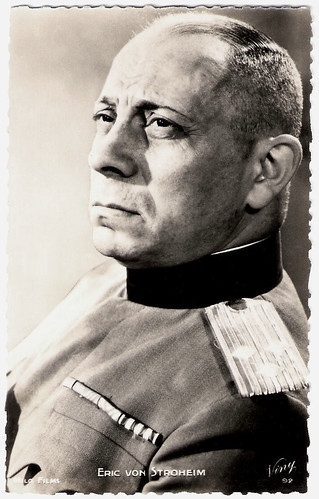
Erich von Stroheim
French postcard by Viny, no. 92. Photo: Milo Films. Collection: Didier Hanson.

Mae Murray, John Gilbert
Austrian postcard by Iris Verlag, no. 559. Photo: Metro-Goldwyn-Film. Publicity still for The Merry Widow (Erich von Stroheim, 1925) with Mae Murray and John Gilbert.

Deep Depressions And Terrible Temper Tantrums


Erich von Stroheim's most recent biographers, such as Richard Koszarski, say that he was born in Austria-Hungary (now Austria) in 1885 as Erich Oswald Stroheim.

He was the son of Benno Stroheim, a middle-class hat-maker, and Johanna Bondy, both of whom were practicing Jews. Stroheim emigrated to America at the end of 1909. On arrival at Ellis Island he claimed to be Count Erich Oswald Hans Carl Maria von Stroheim und Nordenwall, the son of Austrian nobility like the characters he later played in his films. However, both Billy Wilder and Stroheim's agent Paul Kohner claimed that he spoke with a decidedly lower-class Austrian accent.

In 1912 while working at a tavern he met his first wife, Margaret Knox, and moved in with her. Knox acted as a sort of mentor to Von Stroheim, teaching him language and literature and encouraging him to write. Under Knox's tutelage, he wrote a novella entitled In the Morning, with themes that anticipated his films: corrupt aristocracy and innocence debased. The couple married in 1913, but money woes drove Von Stroheim to deep depressions and terrible temper tantrums, and in 1914 Knox filed for divorce.

By then Von Stroheim was working in Hollywood. He began his cinema career in bit-parts and as a consultant on German culture and fashion. His first film was The Country Boy (Frederick A. Thomson, 1915) in which he was an uncredited diner in a restaurant.

His first credited role came in Old Heidelberg (John Emerson, 1915) starring Wallace Reed and Dorothy Gish. He began working with D. W. Griffith, taking uncredited roles in Intolerance (1916). Additionally, Von Stroheim acted as one of the many assistant directors on Intolerance, a film remembered in part for its huge cast of extras.

Later, he played the sneering German with the short Prussian military hairstyle in such films as Sylvia of the Secret Service (George Fitzmaurice, 1917) and The Hun Within (Chester Whitey, 1918) with Dorothy Gish.

In the war drama The Heart of Humanity (Allen Holubar, 1918), he tore the buttons from a nurse's uniform with his teeth, and when disturbed by a crying baby, threw it out of a window. Following the end of World War I, Von Stroheim turned to writing.

Mae Murray in The Merry Widow (1925)
Italian postcard by G.B. Falci, Milano. Photo: Metro-Goldwyn-Film. Mae Murray in The Merry Widow (Erich von Stroheim, 1925).

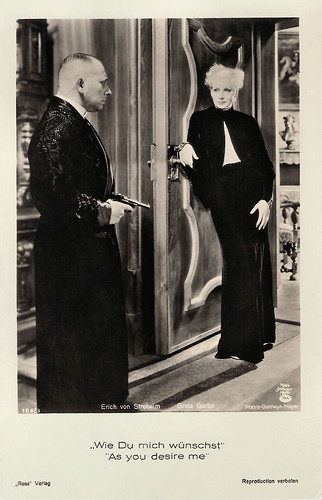
Erich von Stroheim and Greta Garbo in As You Desire Me
German postcard by Ross Verlag, no. 186/3. Photo: Metro-Goldwyn-Mayer. Publicity still for As You Desire me (George Fitzmaurice, 1932) with Erich von Stroheim and Greta Garbo.

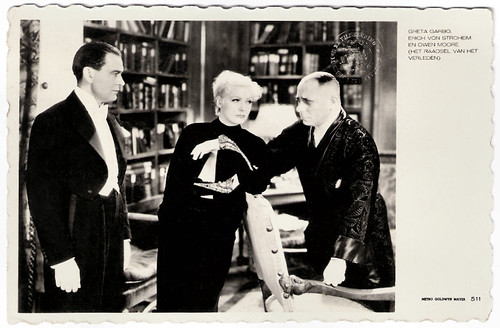
Greta Garbo, Owen Moore and Erich von Stroheim in As You Desire Me (1932)
Dutch postcard, no. 511. Photo: Metro-Goldwyn-Mayer. Publicity still for As You Desire me (George Fitzmaurice, 1932) with Owen Moore, Greta Garbo and Erich von Stroheim.

A Dictatorial And Demanding Director


In 1919, Erich von Strohem directed his own script for Blind Husbands (1919), and also starred in the film. As a director, Von Stroheim was known to be dictatorial and demanding, often antagonizing his actors. He is considered one of the greatest directors of the silent era, with his both cynical and romantic views of human nature.

His next directorial efforts were the lost film The Devil's Pass Key (1919) and Foolish Wives (1922), in which he also starred. Studio publicity for Foolish Wives claimed that it was the first film to cost one million dollars. ‘Von’ translated sexual subjects in a witty and ostentatious manner, and his first films for Universal are among the most acclaimed sophisticated films of the silent era.

In 1923, Von Stroheim began work on Merry-Go-Round. He cast the American actor Norman Kerry in a part written for himself, 'Count Franz Maximilian Von Hohenegg', and newcomer Mary Philbin in the lead actress role. However studio executive Irving Thalberg fired Von Stroheim during filming and replaced him with director Rupert Julian.

He left Universal for Goldwyn Films to make Greed (1924). This monumental film is now one of Von Stroheim's best remembered works as a director. It is a detailed filming of Frank Norris’ novel McTeague, about the power of money to corrupt. The original print ran for an astonishing 10 hours. Knowing this version was far too long, Von Stroheim cut out almost half the footage, reducing it to a six-hour version to be shown over two nights. It was still deemed too long, so Von Stroheim and director Rex Ingram edited it into a four-hour version that could be shown in two parts.

In the midst of filming, Goldwyn was bought by Marcus Loew and merged into Metro-Goldwyn-Mayer. After rejecting Von Stroheim's attempts to cut it to less than three hours, MGM removed Greed from his control and gave it to head scriptwriter June Mathis, with orders to cut it down to a manageable length. Mathis gave the print to a routine cutter, who reduced it to 2.5 hours. In what is considered one of the greatest losses in cinema history, a janitor destroyed the cut footage. The shortened release version was a box-office failure, and was angrily disowned by Von Stroheim.

Von Stroheim followed with his most commercially successful film The Merry Widow (1925) starring Mae Murray and John Gilbert, the more personal The Wedding March (1928) and the low-lost The Honeymoon (1928). Von Stroheim's unwillingness or inability to modify his artistic principles for the commercial cinema, his extreme attention to detail, his insistence on near-total artistic freedom and the resulting costs of his films led to fights with the studios.

As time went on he received fewer directing opportunities. In 1929, Von Stroheim was dismissed as the director of the film Queen Kelly after disagreements with star Gloria Swanson and producer and financier Joseph P. Kennedy over the mounting costs of the film and Von Stroheim's introduction of indecent subject matter into the film's scenario. It was followed by Walking Down Broadway, another project from which Von Stroheim was dismissed.

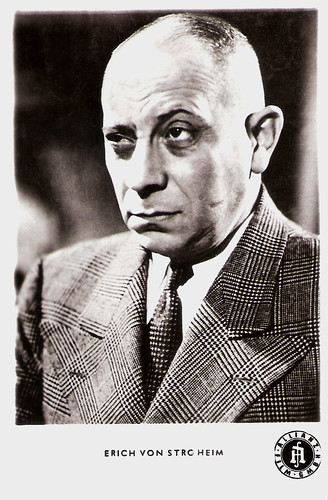
Erich von Stroheim
German postcard by Netter's Star Verlag, Berlin. Photo: Allianz Film GmbH.

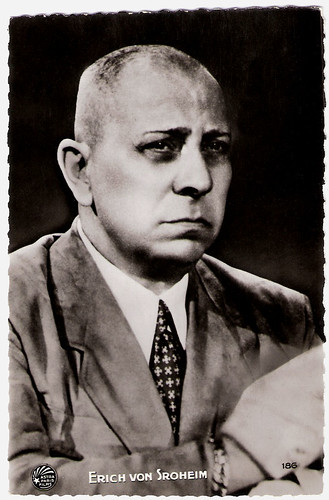
Erich von Stroheim
French postcard by Edition P.I., Paris, no. 186. Photo: Astra Paris Films.

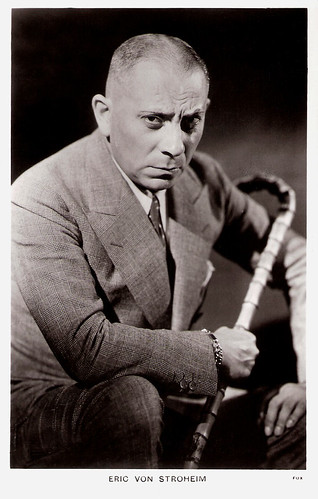
Erich von Stroheim
British postcard by Real Photograph, London, in the Picturegoer series, no. 20a. Photo: Fox.

Friendship, Comradeship And Human Relations


After the introduction of sound film, Erich von Stroheim returned to working principally as an actor, in both American and French films.

One of his most famous roles is the prison-camp commandant Von Rauffenstein in Jean Renoir's La Grande Illusion/Grand Illusion (1937) with Jean Gabin. It is a classic anti-war film about friendship, comradeship, and human relations.

Working in France on the eve of World War II, Von Stroheim was prepared to direct the film La dame blanche from his own story and screenplay. Jean Renoir wrote the dialogue, Jacques Becker was to be assistant director and Von Stroheim himself, Louis Jouvet and Jean-Louis Barrault were to be the featured actors. The production was prevented by the outbreak of the war on 1 September 1939, and Von Stroheim returned to the United States.

There he appeared in Five Graves to Cairo (Billy Wilder, 1943). Today, he is perhaps best known as an actor for his role as Max von Mayerling in Wilder's Sunset Boulevard (Billy Wilder, 1950), co-starring Gloria Swanson. For this role, Von Stroheim was nominated for the Academy Award for Best Supporting Actor. His character states in the film that he used to be one of the three great directors of the silent era, along with D.W. Griffith and Cecil B. DeMille, and he and Swanson watch excerpts from Queen Kelly in the film. Their characters in Sunset Boulevard thus had an autobiographical basis and reflected the humiliations Von Stroheim suffered through his career.

Erich von Stroheim was married three times. His second wife was Mae Jones. Their son Erich Jr. became an assistant director. With his third wife, actress Valerie Germonprez, he had another son, Joseph Erich von Stroheim, who eventually became a sound editor. From 1939 until his death, he lived with actress Denise Vernac. She had worked for him as his secretary since 1938, and co-starred with him in several films.

Von Stroheim spent the last part of his life in France where his silent film work was much admired by artists in the French film industry. In France he acted in films, wrote several novels that were published in French, and worked on various unrealized film projects. Erich von Stroheim was awarded the Légion d'honneur shortly before his death in 1957 in Maurepas near Paris, France at the age of 71.


Erich von Stroheim is smoking in Foolish Wives (1922) to the tune of Leo Riesman's Smoke Gets In Your Eyes. Source: gregoryagogo (YouTube).


Trailer La Grande Illusion/Grand Illusion (1937). Source: Danios12345 (YouTube).

Hollywood, Walk of Fame, Erich Von Stroheim
Walk of Fame, Hollywood.