EFSP follows Cinema Ritrovato! A silent film I am really looking forward to is René Clair’s debut, Paris qui dort / While Paris Sleeps (1923-1925). In this curious film, French actor and stage director Henri Rollan (1888-1967) plays the guardsman of the Eiffel Tower and one of the few people who hasn't fallen asleep. In addition to a rich stage career, Rollan also acted in many French silent and sound films. Other memorable films with Rollan are the silent and the sound versions of Les Trois Mousquetaires / The Three Musketeers by Henri Diamant-Berger.

French postcard by Editions Cinémagazine no. 23. Photo: Pathé Consortium Cinéma. Henri Rollan as Athos in Les Trois Mousquetaires / The Three Musketeers (Henri Diamant-Berger, 1921).

French card by Massilia. The flipside has the handwritten text: "Je suis heureux de pouvoir vous saluer de cette façon un peu inattendue.... aussi inconnue à qui sont dédiés mes efforts, mais qui en pensez... quoi??? Bien sympathiquement... quoi qu'il en soit. Henri Rollan" (I am delighted to be able to greet you in this somewhat unexpected way... so unfamiliar to those to whom my efforts are dedicated, but who think of me... what??? Very kindly... in any case. Henri Rollan). An undecipherable signature is added, perhaps that of Rollan.
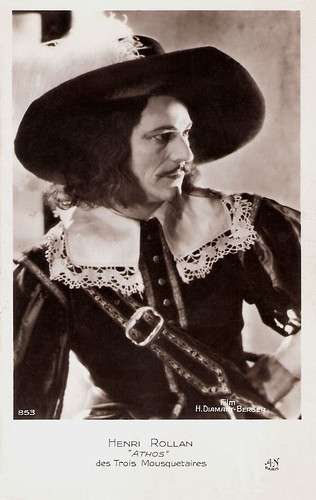
French postcard by A.N., Paris no. 853. Photo: Film H. Diamant-Berger. Henri Rollan as Athos in Les Trois Mousquetaires / The Three Musketeers (Henri Diamant-Berger, 1921).
Henri Rollan was born as Henri Martine in Paris in 1888. In 1906 he started his acting career with the great André Antoine at the Théâtre de l’Odeon, where he remained until 1909, playing in classics such as William Shakespeare’s 'Julius Caesar'.
In 1910, Rollan made his film debut, perhaps attracted by previous film contributions by renowned stage actors such as Charles Le Bargy. His first film was probably the Film d’Art production L’Héritière (Henri Pouctal, André Calmettes, 1910) starring Paul Mounet of the Comédie française. In the same year, Rollan played in the Pathé film L’Amour et le temps / Love and Time (Michel Carré, 1910), a mythological tale starring young Raymonde Dupré as Cupid and thespian Henry Krauss as grumpy old Father Time.
Several more Pathé films followed, such as L’Absent (Albert Capellani, 1913), in which Henri Étievant played the lead as a Dutch farmer whose son and mother-in-law (Jeanne Grumbach) refuse his second wife (Germaine Dermoz) and her daughter. Six years later, the whole family reconciles when first the mother-in-law recognises the virtues of the second wife and then the farmer blesses the love between his son (Rollan) and his stepdaughter (Dupré).
In Jeanne la Maudite (1913), Rollan is the ruthless murderer of his uncle, while an innocent lumberjack is imprisoned for the murder. Jeanne, the innocent’s daughter, becomes the punch-bag of the village.
In 1914, Rollan played Maurice Lindey in the long-running Pathé serial Le Chevalier de Maison-Rouge (Albert Capellani, 1914), adapted from Alexandre Dumas, and with Paul Escoffier as the Chevalier and Marie-Louise Derval as Geneviève Dixmer. Rollan played the lead as a young Republican who unknowingly implicates himself in a plot to rescue Queen Marie-Antoinette during the Reign of Terror. The serial had 6 parts, each split up into 10 episodes. In 1918, Rollan played in another film serial, this time in 8 episodes: Le baron mystère (Maurice Chaillot, 1918) starring Pierre Alcover.

French postcard by M. Le Deley, Paris. Photo: still for Les Trois Mousquetaires (Henri Diamant Berger, 1921).
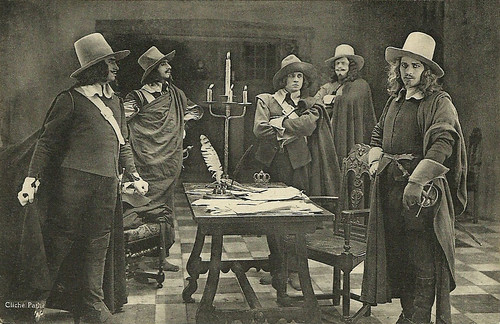
French postcard. Photo: Pathé. Publicity still for Vingt ans après / The Return of the Musketeers (Henri Diamant-Berger, 1922). Collection: Didier Hanson. The four musketeers were played by Jean Yonnel (D'Artagnan), Henri Rollan (Athos), Pierre de Guingand (Aramis) and Charles Martinelli (Porthos).
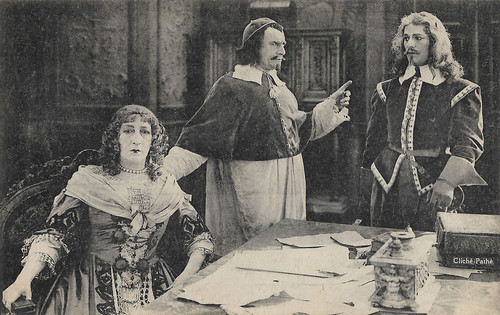
French postcard. Photo: Pathé. Publicity still for Vingt ans après / The Return of the Musketeers (Henri Diamant-Berger, 1922). Marguerite Moreno as Queen-Mother Anne of Austria, Jean Périer as Cardinal Mazarin, and Henri Rollan as Athos.
In 1921 Henri Rollan starred in the SCAGL production Les Trois masques / The Three Masks (Henry Krauss, 1921), a story about family feuds and deadly revenge.
In the same year, Rollan performed Athos in Les Trois Mousquetaires / The Three Musketeers (Henri Diamant-Berger, 1921), a prestigious Pathé production with lavish sets and many extras. The super-production rivalled Douglas Fairbanks' contemporary Three Musketeers of 1921. Together with Charles Martinelli (Porthos), Pierre de Guingand (Aramis) and Aimé Simon-Girard (D’Artagnan), Rollin became a national star.
The success of the film urged Pathé to make the sequel Vingt ans après / The Return of the Musketeers (Henri Diamant-Berger, 1922), in which Martinelli, Guingand and Rollan remained but Jean Yonnel replaced Simon-Girard. Other films with Rollan in those years were Mimi Trottin (Henri Andréani, 1922), Le Sang d’Allah (Luitz Morat, 1922) and L’Emprise (Henri Diamant-Berger, 1923).
Rollan's last silent film is probably his most famous one, Paris qui dort (René Clair, 1923-1925), in which he starred as Albert, the guardsman of the Eiffel Tower. Together with a group who just flew into Paris, he is the only one to have survived a scientist’s experiment to freeze the whole of Paris. His former buddy from Les Trois Mousquetaires, Charles Martinelli, played the scientist, while Albert Préjean was the pilot. The startling images of the actors on top of the Eiffel Tower and their reckless behaviour still impress today.
Incredibly, this was the directing debut of René Clair, even if the film was publicly released after Clair’s next film Entr’acte (1924). Paris qui dort was produced by Henri Diamant-Berger’s company Films Diamant. After that, Rollin took a break from film acting. He kept playing on stage, and performed at various Parisian theatres – first mainly at the Théàtre de Paris and later at the Théàtre de Port Saint-Martin.

French postcard. Photo: publicity still for Vingt ans après / The Return of the Musketeers (Henri Diamant-Berger, 1922). Photo: Pathé. This could be Athos (Henri Rollan) and his son Raoul (played by actress Pierrette Madd).

French postcard by EC, no. 37. Photo: Star.
When sound cinema set in in France, Henri Diamant-Berger called back his ‘musketeer’ to act in three films. In Sola (1931), Henri Rollan starred opposite Chanson singer Damia. In Clair de lune (1932), he co-starred with Blanche Montel and Claude Dauphin. The third film was the sound version of Les Trois Mousquetaires (1932), this time set up as a two-episode film instead of a long serial. Ten years after the silent version, Rollan again played Athos, now with Thomy Bourdelle as Porthos, Jean-Louis Allibert as Aramis, and Aimé Simon-Girard returned as D’Artagnan, and Blanche Montel as Constance.
During the 1930's, Rollan remained very active in French films, playing in some twenty films, performing opposite actors such as Madeleine Renaud, Gaby Morlay, and Michel Simon, Victor Francen, Madeleine Ozeray, and Huguette Duflos. While most of his directors are forgotten names now, some might ring a bell, such as Marcel L’Herbier and the Italian directors Augusto Genina and Mario Bonnard.
During the war, Rollan acted in just a few films, and it took until the late 1940s to have his film acting career revived. During the first half of the 1950s, though, Rollan had memorable parts as the incompetent Maréchal d'Estrée in Fanfan la Tulipe (Christian-Jaque, 1951) and a French politician in Les Aventures d'Arsène Lupin (Jacques Becker, 1956). Rollan’s last film part was in 121 Rue Blanche à Paris (Quinto Albicocco, 1961), which starred stage and film actress Berthe Bovy, who, just like Rollan, had started out in film in the days of Film d’art.
While Rollan had acted on stage in the 1930s as well, it was in particular from the mid-1940s on that he intensified this. Between the late 1940s and early 1950s, he must have been constantly working either on stage or on a film set, despite his age. Moreover, from 1945 on, he also directed various stage plays and would do so until his death. From 1948 on, Rollan almost exclusively played at the Comédie française, and would do so until 1965. Henri Rollan died in Paris in 1967. He was 79.
As Guy Bellinger writes at IMDb: “He was always a great professional, and his performances (most often as a tough, stiff, humourless character endowed with authority) are excellent whatever the film he is in. Of course, where he really shone was on stage, as an actor first, later as a renowned director. He was also a much-loved and respected drama teacher who guided, among others, the first steps of Jean Claudio, Jacques Fabbri, Raymond Devos, Anna Gaylor, Annie Girardot, Marie Dubois and Jacques Lorcey. None of these persons ever forgot Henri Rollan, a passionate man who had the gift to transmit his genuine passion to other young passionates.”

French postcard. Photo: Harcourt, Paris. In 1944, Henri Rollan directed the play 'La Danse de mort' by August Strindberg, for Le Théâtre de l'Œuvre of Jacques Hébertot.

French postcard by Editions et Publications Cinématographiques, no. 63.

French postcard by Editions P.I., Paris, no. 147. Photo: Star.
Sources: Guy Bellinger (IMDb), CineArtistes.com (French - now defunct), Fondation Jérôme Seydoux, CineRessources, Wikipedia (French), and IMDb.
This post was last updated on 2 September 2026.
French postcard by Editions Cinémagazine no. 23. Photo: Pathé Consortium Cinéma. Henri Rollan as Athos in Les Trois Mousquetaires / The Three Musketeers (Henri Diamant-Berger, 1921).
French card by Massilia. The flipside has the handwritten text: "Je suis heureux de pouvoir vous saluer de cette façon un peu inattendue.... aussi inconnue à qui sont dédiés mes efforts, mais qui en pensez... quoi??? Bien sympathiquement... quoi qu'il en soit. Henri Rollan" (I am delighted to be able to greet you in this somewhat unexpected way... so unfamiliar to those to whom my efforts are dedicated, but who think of me... what??? Very kindly... in any case. Henri Rollan). An undecipherable signature is added, perhaps that of Rollan.
French postcard by A.N., Paris no. 853. Photo: Film H. Diamant-Berger. Henri Rollan as Athos in Les Trois Mousquetaires / The Three Musketeers (Henri Diamant-Berger, 1921).
Ruthless murderer
Henri Rollan was born as Henri Martine in Paris in 1888. In 1906 he started his acting career with the great André Antoine at the Théâtre de l’Odeon, where he remained until 1909, playing in classics such as William Shakespeare’s 'Julius Caesar'.
In 1910, Rollan made his film debut, perhaps attracted by previous film contributions by renowned stage actors such as Charles Le Bargy. His first film was probably the Film d’Art production L’Héritière (Henri Pouctal, André Calmettes, 1910) starring Paul Mounet of the Comédie française. In the same year, Rollan played in the Pathé film L’Amour et le temps / Love and Time (Michel Carré, 1910), a mythological tale starring young Raymonde Dupré as Cupid and thespian Henry Krauss as grumpy old Father Time.
Several more Pathé films followed, such as L’Absent (Albert Capellani, 1913), in which Henri Étievant played the lead as a Dutch farmer whose son and mother-in-law (Jeanne Grumbach) refuse his second wife (Germaine Dermoz) and her daughter. Six years later, the whole family reconciles when first the mother-in-law recognises the virtues of the second wife and then the farmer blesses the love between his son (Rollan) and his stepdaughter (Dupré).
In Jeanne la Maudite (1913), Rollan is the ruthless murderer of his uncle, while an innocent lumberjack is imprisoned for the murder. Jeanne, the innocent’s daughter, becomes the punch-bag of the village.
In 1914, Rollan played Maurice Lindey in the long-running Pathé serial Le Chevalier de Maison-Rouge (Albert Capellani, 1914), adapted from Alexandre Dumas, and with Paul Escoffier as the Chevalier and Marie-Louise Derval as Geneviève Dixmer. Rollan played the lead as a young Republican who unknowingly implicates himself in a plot to rescue Queen Marie-Antoinette during the Reign of Terror. The serial had 6 parts, each split up into 10 episodes. In 1918, Rollan played in another film serial, this time in 8 episodes: Le baron mystère (Maurice Chaillot, 1918) starring Pierre Alcover.
French postcard by M. Le Deley, Paris. Photo: still for Les Trois Mousquetaires (Henri Diamant Berger, 1921).
French postcard. Photo: Pathé. Publicity still for Vingt ans après / The Return of the Musketeers (Henri Diamant-Berger, 1922). Collection: Didier Hanson. The four musketeers were played by Jean Yonnel (D'Artagnan), Henri Rollan (Athos), Pierre de Guingand (Aramis) and Charles Martinelli (Porthos).
French postcard. Photo: Pathé. Publicity still for Vingt ans après / The Return of the Musketeers (Henri Diamant-Berger, 1922). Marguerite Moreno as Queen-Mother Anne of Austria, Jean Périer as Cardinal Mazarin, and Henri Rollan as Athos.
The three musketeers
In 1921 Henri Rollan starred in the SCAGL production Les Trois masques / The Three Masks (Henry Krauss, 1921), a story about family feuds and deadly revenge.
In the same year, Rollan performed Athos in Les Trois Mousquetaires / The Three Musketeers (Henri Diamant-Berger, 1921), a prestigious Pathé production with lavish sets and many extras. The super-production rivalled Douglas Fairbanks' contemporary Three Musketeers of 1921. Together with Charles Martinelli (Porthos), Pierre de Guingand (Aramis) and Aimé Simon-Girard (D’Artagnan), Rollin became a national star.
The success of the film urged Pathé to make the sequel Vingt ans après / The Return of the Musketeers (Henri Diamant-Berger, 1922), in which Martinelli, Guingand and Rollan remained but Jean Yonnel replaced Simon-Girard. Other films with Rollan in those years were Mimi Trottin (Henri Andréani, 1922), Le Sang d’Allah (Luitz Morat, 1922) and L’Emprise (Henri Diamant-Berger, 1923).
Rollan's last silent film is probably his most famous one, Paris qui dort (René Clair, 1923-1925), in which he starred as Albert, the guardsman of the Eiffel Tower. Together with a group who just flew into Paris, he is the only one to have survived a scientist’s experiment to freeze the whole of Paris. His former buddy from Les Trois Mousquetaires, Charles Martinelli, played the scientist, while Albert Préjean was the pilot. The startling images of the actors on top of the Eiffel Tower and their reckless behaviour still impress today.
Incredibly, this was the directing debut of René Clair, even if the film was publicly released after Clair’s next film Entr’acte (1924). Paris qui dort was produced by Henri Diamant-Berger’s company Films Diamant. After that, Rollin took a break from film acting. He kept playing on stage, and performed at various Parisian theatres – first mainly at the Théàtre de Paris and later at the Théàtre de Port Saint-Martin.
French postcard. Photo: publicity still for Vingt ans après / The Return of the Musketeers (Henri Diamant-Berger, 1922). Photo: Pathé. This could be Athos (Henri Rollan) and his son Raoul (played by actress Pierrette Madd).
French postcard by EC, no. 37. Photo: Star.
A tough, stiff, humourless character
When sound cinema set in in France, Henri Diamant-Berger called back his ‘musketeer’ to act in three films. In Sola (1931), Henri Rollan starred opposite Chanson singer Damia. In Clair de lune (1932), he co-starred with Blanche Montel and Claude Dauphin. The third film was the sound version of Les Trois Mousquetaires (1932), this time set up as a two-episode film instead of a long serial. Ten years after the silent version, Rollan again played Athos, now with Thomy Bourdelle as Porthos, Jean-Louis Allibert as Aramis, and Aimé Simon-Girard returned as D’Artagnan, and Blanche Montel as Constance.
During the 1930's, Rollan remained very active in French films, playing in some twenty films, performing opposite actors such as Madeleine Renaud, Gaby Morlay, and Michel Simon, Victor Francen, Madeleine Ozeray, and Huguette Duflos. While most of his directors are forgotten names now, some might ring a bell, such as Marcel L’Herbier and the Italian directors Augusto Genina and Mario Bonnard.
During the war, Rollan acted in just a few films, and it took until the late 1940s to have his film acting career revived. During the first half of the 1950s, though, Rollan had memorable parts as the incompetent Maréchal d'Estrée in Fanfan la Tulipe (Christian-Jaque, 1951) and a French politician in Les Aventures d'Arsène Lupin (Jacques Becker, 1956). Rollan’s last film part was in 121 Rue Blanche à Paris (Quinto Albicocco, 1961), which starred stage and film actress Berthe Bovy, who, just like Rollan, had started out in film in the days of Film d’art.
While Rollan had acted on stage in the 1930s as well, it was in particular from the mid-1940s on that he intensified this. Between the late 1940s and early 1950s, he must have been constantly working either on stage or on a film set, despite his age. Moreover, from 1945 on, he also directed various stage plays and would do so until his death. From 1948 on, Rollan almost exclusively played at the Comédie française, and would do so until 1965. Henri Rollan died in Paris in 1967. He was 79.
As Guy Bellinger writes at IMDb: “He was always a great professional, and his performances (most often as a tough, stiff, humourless character endowed with authority) are excellent whatever the film he is in. Of course, where he really shone was on stage, as an actor first, later as a renowned director. He was also a much-loved and respected drama teacher who guided, among others, the first steps of Jean Claudio, Jacques Fabbri, Raymond Devos, Anna Gaylor, Annie Girardot, Marie Dubois and Jacques Lorcey. None of these persons ever forgot Henri Rollan, a passionate man who had the gift to transmit his genuine passion to other young passionates.”
French postcard. Photo: Harcourt, Paris. In 1944, Henri Rollan directed the play 'La Danse de mort' by August Strindberg, for Le Théâtre de l'Œuvre of Jacques Hébertot.
French postcard by Editions et Publications Cinématographiques, no. 63.
French postcard by Editions P.I., Paris, no. 147. Photo: Star.
Sources: Guy Bellinger (IMDb), CineArtistes.com (French - now defunct), Fondation Jérôme Seydoux, CineRessources, Wikipedia (French), and IMDb.
This post was last updated on 2 September 2026.
