Showing posts with label Emilio Ghione. Show all posts

04 January 2025

La via del peccato (1925)

Despite the title and an all-star cast, the Italian silent drama La via del peccato/The Way of Sin (Amleto Palermi, 1925) is quite an incoherent and tame film. The postcards promise wild scenes in the underworld with femme fatales and Apache dance, but none of it can be seen in the film. Whatever happened between filming and the premiere?

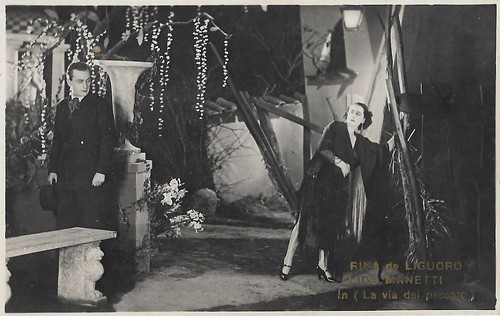
Rina De Liguoro in La via del peccato (1925)
Italian postcard by Edizione G.B. Falci, Milano, no. 340. Photo: La Fotominio / A.P. Film. Rina de Liguoro in La via del peccato/The Way of Sin (Amleto Palermi, 1925).

Rina De Liguoro and Lido Manetti in La via del peccato (1925)
Italian postcard by G.B. Falci Editore, Milano, no. 355. Photo: La Fotominio / A.P. Film. Rina De Liguoro and Lido Manetti in La via del peccato/The Way of Sin (Amleto Palermi, 1925).

Rina de Liguoro and Lido Manetti in La via del peccato (1925)
Italian postcard by G.B. Falci Editore, Milano, no. 361. Photo: La Fotominio / A.P. Film. Rina de Liguoro and Lido Manetti in La via del peccato/The Way of Sin (Amleto Palermi, 1925).

Rina De Liguoro and Lido Manetti in La via del peccato (1925)
Italian postcard by G.B. Falci Editore, Milano, no. 362. Photo: La Fotominio / A.P. Film. Rina de Liguoro and Lido Manetti in La via del peccato/The Way of Sin (Amleto Palermi, 1925).

Emilio Ghione and Kally Sambucini in La via del peccato (1925)
Italian postcard by G.B. Falci Editore, Milano, no. 364. Photo: La Fotominio / A.P. Film. Emilio Ghione and Kally Sambucini in La via del peccato/The Way of Sin (Amleto Palermi, 1925). Sambucini's first name is misspelt on the card.

A terrible nightmare


For La via del peccato/The Way of Sin (1925), A.P. film had contracted an all-star cast. There are even two divas in the film, Soava Gallone and Rina De Liguoro. But also stars like Ruggero Ruggeri, Gustavo Serena, Mario Bonnard, Cecyl Tryan, Luigi Serventi, Lido Manetti (later known in the US as Arnold Kent), Mary-Cléo Tarlarini and Lamberto Picasso, appear in the film.

Ruggero Ruggeri stars as Marco Selva, who presumedly died in prison. After six years, he suddenly returns home and finds his fiancee Giovanna (Soava Gallone) married to his best friend (Gustavo Serena). He concocts a ruse to separate her from her husband and children and he nearly manages to do so. She is almost in doubt whether to give in, following her ex-lover to America.

While Marco is booking a cabin, Giovanna falls asleep and has a terrible nightmare. Her house is destroyed, and her husband and she have died. Their children first well cared for, grow up and become reckless, caught by adventures and morbid passions. They gradually descend into vice, even crime, leading to the woman (probably Diomira Jacobini) being assassinated by her companions and the man (probably Lido Manetti) being killed by the guillotine. Awakened, Giovanna decides to flee from her old flame and returns home, while. Marco leaves for faraway places to construct a life of his own.

On our postcards, there are no pictures of Ruggero Ruggeri or Diomira Jacobini. The film's publicity stills rather focused on Rina De Liguoro as a femme fatale. They also show Emilio Ghione and Kally Sambucini, who were famous for their underworld characters Za-la-Mort and Za-la-vie. Most postcards seem to deal with Giovanna's dream.

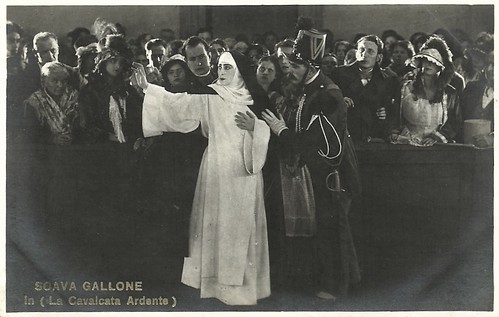
Reportedly, the filmmakers had spiced up the nightmare with lurid scenes of the underworld and even nudity. The result was immediately annulled by the Italian censor. All sinful scenes were cut. It made the film that finally was presented in the cinemas quite incoherent and tame and it was not a success. Perhaps someday a restoration of the film including the censored scenes, may raise a new appreciation for this film. Anyway, Soava Gallone and Emilio Ghione were much more successful in their subsequent film, La cavalcata ardente/The Fiery Cavalcade (Carmine Gallone, 1925), a historical melodrama about the conquest of Naples by Garibaldi.

Soava Gallone and Gustavo Serena in La via del peccato (1925)
Italian postcard by Ed. G.B. Falci, Milano, no. 365. Photo: La Fotominio / A.P. Film. Soava Gallone and Gustavo Serena in La via del peccato/The Way of Sin (Amleto Palermi, 1925).

Rina De Liguoro and Emilio Ghione in La via del peccato (1925)
Italian postcard by Ed. G.B. Falci, Milano, no. 369. Photo: La Fotominio / A.P. Film. Rina de Liguoro and Emilio Ghione performing a 'danse apache' in La via del peccato/The Way of Sin (Amleto Palermi, 1925).

Rina De Liguoro and Emilio Ghione in La via del peccato (1925)
Italian postcard by Ed. G.B. Falci, Milano, no. 370. Photo: La Fotominio / A.P. Film. Rina de Liguoro and Emilio Ghione performing a 'danse apache' in La via del peccato/The Way of Sin (Amleto Palermi, 1925).

Soava Gallone and Gustavo Serena in La via del peccato
Italian postcard by Ed. G.B. Falci, Milano, no. 387. Photo: La Fotominio / A.P. Film. Soava Gallone and Gustavo Serena in La via del peccato/The Way of Sin (Amleto Palermi, 1925).

Emilio Ghione, Kally Sambucini, Rina De Liguoro and Lido Manetti in La via del peccato (1925)
Italian postcard by Ed. G.B. Falci, Milano, no. 398. Photo: La Fotominio / A.P. Film. Emilio Ghione, Kally Sambucini, Rina De Liguoro and Lido Manetti in La via del peccato/The Way of Sin (Amleto Palermi, 1925).

Sources: Vittorio Martinelli (Il cinema muto italiano, 1923-1931) and IMDb.

23 May 2019

Emilio Ghione

Emilio Ghione (1879-1930) was an Italian silent film actor, director, and screenwriter. He is best known for writing, directing, and starring in a series of adventure films about Za La Mort, a likable French apache and 'honest outlaw.'
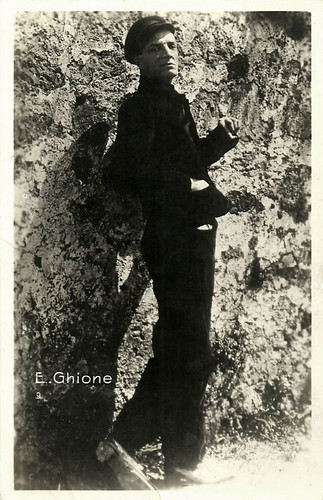
 Emilio Ghione
Italian postcard.

Emilio Ghione and Kally Sambucini in Za-la-Mort (1915)
Italian postcard by G. Vettori, Bologna, no. 5. Emilio Ghione as Za la mort and Kally Sambucini as Za la vie in Za-la-Mort (Emilio Ghione, 1915).

Emilio Ghione
Italian postcard by Ed. G. Vettori, Bologna, no. 2012. Photo: Ghione-Film. Emilio Ghione in La maga e il grifo (Emilio Ghione, 1922).

Emilio Ghione in Senza pietà
Italian postcard by Vettori, Bologna, no. 2011. Photo: Tiber Film / U.C.I. Emilio Ghione in Senza pietà/Without pity (Emilio Ghione, 1921).
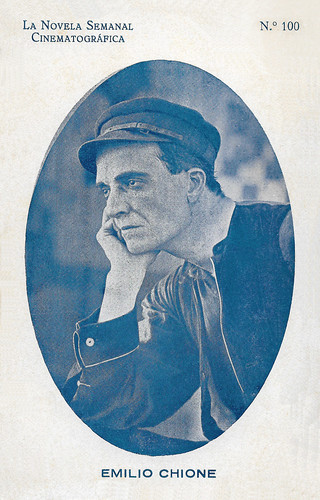
Emilio Ghione
Spanish card by La Novela Semanal Cinematográfica, no. 100.

Bad guy


Emilio Ghione was born Emilio Luigi Carlo Giuseppe Maria Ghione in Turin, Italy in 1879. He was the son of painter Celestino Ghione, and he initially worked as a painter of miniatures himself. Ghione secured work in Turin's growing film industry in 1908, initially as a set-hand and stuntman, then playing secondary roles in all kinds of films mainly by Itala Film, including comedies with Cretinetti (André Deed). Frustrated by the slow progress of his career, Ghione moved to Rome in 1911. There he quickly obtained starring roles in films made by Cines and Celio-Film, such as Il poverello di Assisi (Enrico Guazzoni, 1911) in which he had the lead of St. Francis.

Ghione then starred in a series of films alongside Francesca Bertini and Alberto Collo, including Panne d’auto (1912), Terra promessa (1913), L’amazzone mascherata (1913) – all available at the Eye Institute (the Dutch Filmmuseum) - and Histoire d'un Pierrot (1914), all directed by Baldassarre Negroni. Ghione mostly played the bad guy in these films.

In 1913 Ghione directed his first film as actor-director, Il Circolo Nero, of which a print was rediscovered at the Eye Institute as well. Ghione became known for his success in directing the demanding divas of the period, including Lina Cavalieri, Francesca Bertini, and Hesperia. However, Ghione was not entirely able to resist their demands. Francesca Bertini allegedly ordered the destruction of all the prints of the Roberto Bracco adaptation Don Pietro Caruso (Emilio Ghione, 1914) because she didn’t like the outfits she wore in the film.

In 1914, Ghione created the first film featuring his character Za La Mort, Nelly La Gigolette (Emilio Ghione, 1914), which was a great success. As a consequence, Ghione moved to Tiber film, where he created a sequel around his character, Za La Mort (1915) as well. It also introduced his long-time companion on-screen, Za La Vie, played by Kally Sambucini, who also became Ghione’s private companion till his death. In 1911 Ghione married Clotilde Coletti and they had one son, Pierfrancesco Ghione, also known as Emilio Ghione Jr., but the couple separated after 1913. Ghione created thirteen Za La Mort feature films and three serial films between 1914 and 1924, many of which were very successful commercially, such as Anime buie (Emilio Ghione, 1916), Triangolo giallo (Emilio Ghione, 1917), I topi grigi (Emilio Ghione, 1918) and Dollari e fraks (Emilio Ghione, 1918).

The character of Za La Mort, a Parisian Apache, was unstable throughout the series. In some films, Za La Mort is a cruel-hearted, murderous, seductive criminal, while in others he is a romantic, faithful, underworld avenger, similar to Louis Feuillade's Judex. The Za La Mort series was mostly set in an imaginary Paris, with some episodes set in America and exotic tropical locations. Despite inconsistencies in plot and character and mostly negative critical reviews, Za La Mort's exotic, exciting adventures captured the public imagination and Ghione became one of the most recognisable stars of the Italian silent cinema. During the production of the Za La Mort series, Ghione continued to star in and direct a variety of films, including melodramas, adventure films, and propagandistic biopics: Cicueracchio (Emilio Ghione, 1916) and Oberdan (Emilio Ghione, 1916), both for Tiber Film.
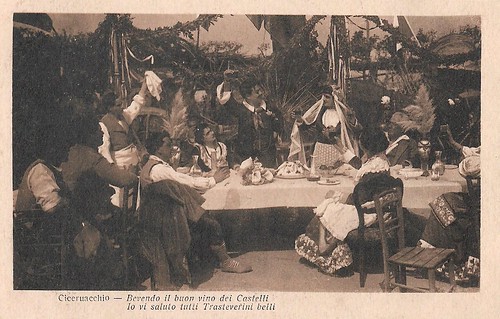
Gastone Monaldi in Cicueracchio (1915)
Italian postcard. Photo: Tiber Film. Gastone Monaldi as Cicueracchio in Ciceruacchio (Emilio Ghione, 1915). Caption: Drinking the wine of the Castelli [romani], I greet you all, beautiful people of Trastevere!
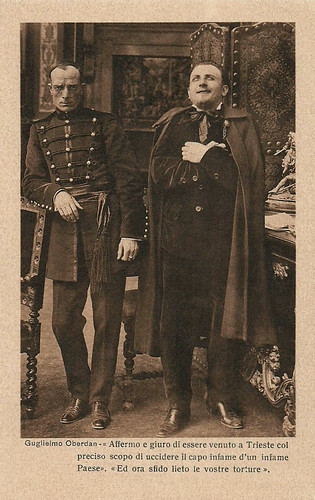
Alberto Collo and Emilio Ghione in Oberdan (1915)
Italian postcard. Emilio Ghione (left) and Alberto Collo in Oberdan (Emilio Ghione, 1916). Caption: Guglielmo Oberdan: "I admit and I swear to have come to Trieste with the exact scope of killing the infamous head of an infamous state. And now I happily challenge your tortures."
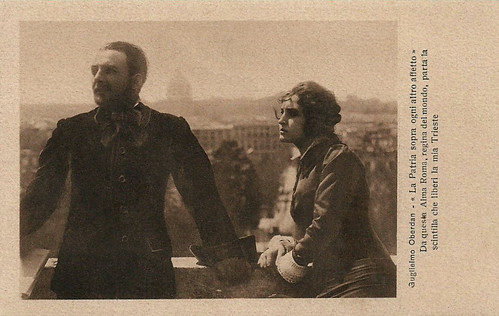
Alberto Collo and Vittorina Moneta in Oberdan (1915)
Italian postcard. Alberto Collo and Vittorina Moneta in Oberdan (Emilio Ghione, 1916). Caption: Gugliemo Oberdan: "The Fatherland above all other affections. From this wet nurse Rome, queen of the world, the spark will part that will free my Trieste."
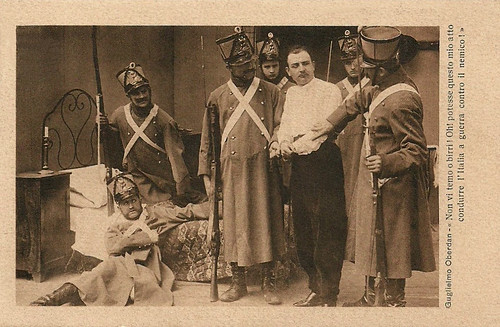
Alberto Collo in Oberdan (1915)
Italian postcard. Alberto Collo in Oberdan (Emilio Ghione, 1916). Caption: Guglielmo Oberdan: "I don't fear you, you cops. If only my act could cause Italy to start a war with the enemy."
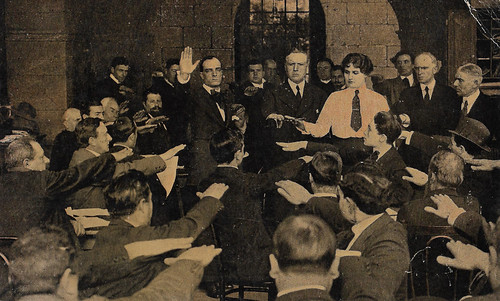
Emilio Ghione and Hesperia in Il potere sovrano (1916)
Spanish collectors card by Chocolate Pi, Barcelona, no. 2 of 6. Photo: Tiber Film. Hesperia and Emilio Ghione in Il potere sovrano (Baldassarre Negroni, Percy Nash, 1916). The Spanish title on the cards is Poder Soberano. Spanish distributor of the film: J. Verdaguer.

Decadent lifestyle


In the period 1919-1924, Emilio Ghione directed and starred in films for all kinds of Italian film companies including Tiber Film, Itala, and Lombardo (now known as Titanus). He even had his own company Ghione Film for a short time in 1922. Ghione Film coproduced films together with Pasquali Film and made the last film in 1924: Senza padre, which was only released in 1927. Ghione led a famously decadent life, following the trends set by poet Gabriele D'Annunzio. Ghione spent a lot of money on restaurants, generous tips, clothes, and antiques. Ghione was a fan of luxury automobiles made by Lancia and used them in his films. Ghione's decadent lifestyle and expensive habits left him nearly penniless when the Italian film industry collapsed in 1922.

In 1924, he left for Germany to direct his last Za La Mort film: Za La Mort-Der Traum der Za La Vie with daring femme fatale Fern Andra opposite Ghione and Sambuccini, but the film was a commercial failure, owing partially to the fact that it was extensively cut by the censors. Returned to Italy, Ghione played in two major productions with Soava Gallone, La via del peccato (Amleto Palermi, 1925) and La cavalcata ardente/The Fiery Cavalcade (Carmine Gallone, 1925). While he played an Apache and Sambuccini a Gigolette in the former film, Ghione had a major part as the bad guy in the latter. As the Borbonic Prince of Santafé, he pushes Grazia de Montechiaro (Soava Gallone) to marry him, but her lover, the patriot Giovanni (Gabriel de Gravone) manages to prevent this, with the help of the bandit Pasquale Noto (Raimondo Van Riel).

One of Ghione’s last parts was in the epic Gli ultimi giorni di Pompei/The Last Days of Pompei (Amleto Palermi, Carmine Gallone, 1926), which despite its ambitions to revive the glory of the Italian epics of the 1910s failed to revive the dying Italian film industry. Ghione remarked himself that it was rather The Last Days of Italian Cinema, instead of The Last Days of Pompei. He turned to the theatre instead. In 1926, Ghione launched a theatrical revue with Kally Sambucini and Alberto Collo and toured Italy performing sketches based on the Za La Mort films. Ghione was also active as a writer, exploiting his famous character. In 1922, Ghione's first Za La Mort novel, 'Le Maschere Bianche', was published in instalments in the popular Al Cinema magazine. Ghione published his second novel, 'Za La Mort', in 1928. The novel was largely based on the Za La Mort films, especially on the German one, the plot of which had been made almost unintelligible by censorship cuts.

Between March and December 1928 Ghione's autobiography 'Memorie e Confessioni' also appeared in the monthly cinema magazine Cinemalia. In 1927 Emilio Ghione was hospitalised because of tuberculosis. A public appeal was opened, and the money was used to help his recovery and to send him to Paris in search of work. During his stay in Paris in 1929, his health deteriorated and he had to go to hospital again. Actress Lina Cavalieri paid to send him back to Turin by train. Emilio Ghione died on 7 January 1930 in Rome, in the presence of Kally Sambucini and his son, Pierfrancesco Ghione. In 1930, another Za La Mort novel was published called 'L'Ombra di Za La Mort'. The novel's central character is Ghione/Za La Mort, a mix of Ghione's decadent star persona and his favourite character, and tells of his adventures across the world and his encounters with beautiful women.

In 1979, a retrospective of Ghione's films was held at the Venice Film Festival. In 2007 Vittorio Martinelli’s study 'Za La Mort. Ritratto di Emilio Ghione' appeared, edited by the Cineteca di Bologna. In 2008, a retrospective of his films was held at the Cinema Ritrovato festival in Bologna, a temporary exhibition of photographs and film stills documenting Ghione's career was opened at the Cineteca of Bologna, and Denis Lotti’s monography on Emilio Ghione appeared: 'Emilio Ghione. L’ultimo apache. Vita e film di un divo italiano' (2008).

Emilio Ghione and Kally Sambucini in La via del peccato (1925)
Italian postcard by G.B. Falci Editore, Milano (La Fotominio), no. 364. Photo: A.P. Film. Emilio Ghione and Kally Sambucini in La via del peccato (Amleto Palermi, 1925). Sambucini's first name is misspelt on the card.
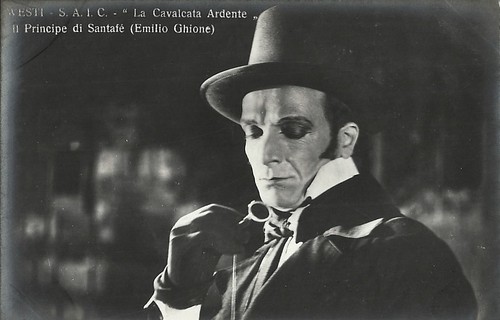
Emilio Ghione in La cavalcata ardente
Italian postcard by Ed. A. Traldi, Milano. Photo: Westi SAIC. Emilio Ghione as the Prince of Santafé in La cavalcata ardente/The Fiery Cavalcade (Carmine Gallone, 1925).
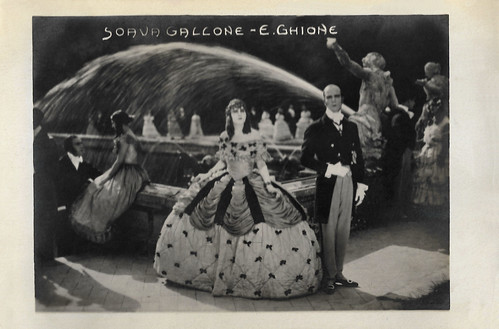
Soava Gallone and Emilio Ghione in La cavalcata ardente (1925)
Italian postcard by Eureka. Sent by mail in 1927. Soava Gallone and Emilio Ghione in La cavalcata ardente/The Fiery Cavalcade (Carmine Gallone, 1925).
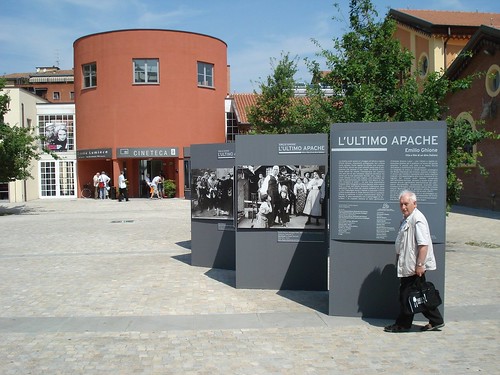
Lumière Cinema, Bologna
At the Cinema Ritrovato Festival in Bologna, June-July 2008, the exhibition 'L'Ultimo Apache' was dedicated to Ghione. Here you see the Cineteca, Bologna, with the two Lumière cinemas.

Sources: Vittorio Martinelli (Za La Mort. Ritratto di Emilio Ghione), Denis Lotti (Emilio Ghione. L’ultimo apache. Vita e film di un divo italiano), Wikipedia (English and Italian) and IMDb.

This post was last updated on 16 May 2024.

16 November 2017

Guglielmo Oberdan, il martire di Trieste (1915)

In 1882, Guglielmo Oberdan was executed after a failed attempt to assassinate Austrian Emperor Francis Joseph. He became a martyr of the Italian unification movement. Thirty years later, silent film star Alberto Collo played him in Guglielmo Oberdan, il martire di Trieste/Guglielmo Oberdan, the martyr of Trieste (Emilio Ghione, 1915), produced by Tiber Films during World War I. Viva L'Italia!

Alberto Collo and Vittorina Moneta in Guglielmo Oberdan, il martire di Trieste (1915)
Italian postcard for Guglielmo Oberdan, il martire di Trieste (Emilio Ghione, 1915) with Alberto Collo as Gugliemo Oberdan and Vittorina Moneta as his fiancee Maria. Caption: "The Fatherland above all other affections. From this wet nurse Rome, queen of the world, the spark will part that will free my Trieste."

Alberto Collo in Guglielmo Oberdan (1915)
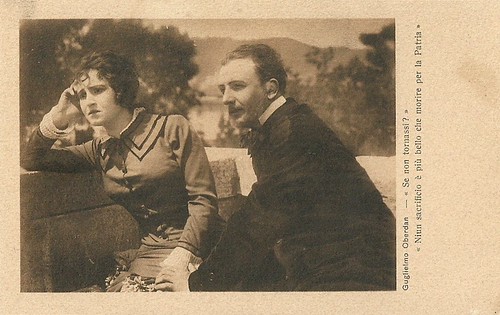
Italian postcard for Guglielmo Oberdan, il martire di Trieste (Emilio Ghione, 1915) with Alberto Collo and Vittorina Moneta. Caption: And if you don't return? There is no nicer sacrifice than dying for the fatherland.

Alberto Collo and Ida Carloni Talli in Guglielmo Oberdan, il martire di Trieste
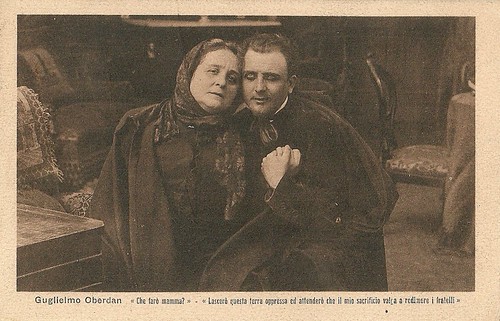
Italian postcard for Guglielmo Oberdan, il martire di Trieste (Emilio Ghione, 1915), with Alberto Collo as Oberdan and famous stage actress Ida Carloni Talli as his mother. Caption: "What shall I do, mamma? I will leave this oppressed land and will take care my sacrifice will be worthwhile to redeem my brothers and sisters."

Alberto Collo and Ida Carloni Talli in Guglielmo Oberdan, il martire di Trieste
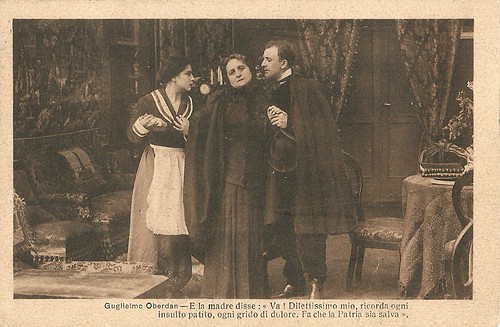
Italian postcard for Guglielmo Oberdan, il martire di Trieste (Emilio Ghione, 1915), with Alberto Collo as Oberdan and Ida Carloni Talli as his mother. Caption: "And his mother said: 'Go! My most beloved one, remember every suffered insult, every cry of grief. Make sure that the Fatherland will be saved'."

Propaganda


During the First World War, more postcards were mailed than ever before - or ever after. Different European countries decided to use the postcard to advertise films and to create film stars. Governments used the cinema as part of their propaganda machines. Italian producers chose the martyrs of the Italian liberation, like Guglielmo Oberdan, for their patriotic films to justify Italy's participation in the Great War.

Wilhelm Oberdan was born in the city of Trieste, then part of the Austrian Empire. His mother was a Slovene woman from Šempas in the County of Gorizia and Gradisca, while his father, Valentino Falcier, was a Venetian soldier in the Austrian army. He did not recognize his son, so Wilhelm took his mother's surname. He was educated in an Italian cultural milieu and Italianised his name to Guglielmo Oberdan.

In 1877 he enrolled at the Vienna's College of Technology (now Vienna University of Technology) where he studied engineering. As he supported the idea of independence for all of the empire's national groups he resented the occupation of Bosnia-Herzegovina by Austria-Hungary and therefore deserted from the Austro-Hungarian Army because he did not want to take part in military activities there.

Instead, he fled to Rome to continue his studies there. In the Italian capital he adopted irredentist ideas, aiming at the annexation to Italy of the Italian-speaking lands still under Austro-Hungarian rule. In 1882 he met with irredentist leader and co-founder Matteo Renato Imbriani. It was then that he came to the conviction that only radical acts of martyrdom could bring the liberation of Trieste from Austrian rule. And at the same time, Emperor Franz Joseph was planning a visit to Trieste as part of the celebration of the 500th anniversary of Habsburg dominion over the city...

Oberdan and Istrian pharmacist Donato Ragosa plotted an assassination attempt on the Emperor. However, their attempt failed. Oberdan was arrested and sentenced to hang by an Austrian court. His mother, author Victor Hugo and poet Giosue Carducci appealed for clemency - but in vain. Just before the execution, Oberdan cried "Viva l'Italia!" (Long live Italy!), which helped establish his later reputation as a martyr of the Italian National cause. Statues of him were erected throughout unified Italy. The Emperor Franz Joseph, who reigned another thirty-five years, never visited Trieste again. The assassination of Archduke Franz Ferdinand in 1914, harked back to Oberdan's earlier attempt.

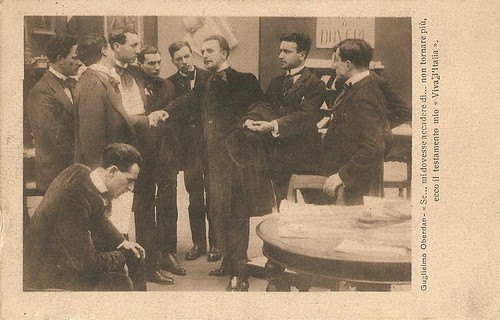
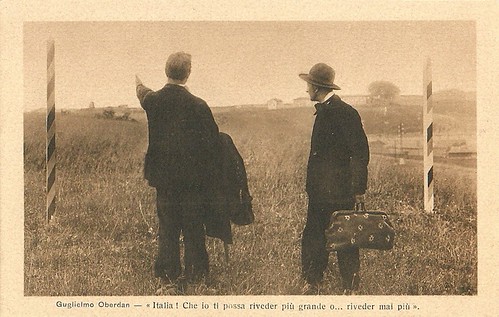
Tiber Films produced Guglielmo Oberdan, il martire di Trieste in 1915. Director of this film adaptation of Oberdan's life was Emilio Ghione, who also played the role of the governor of Trieste. Ghione met the irredentist Gabriele D'Annunzio at an invitational showing of the film in Rome and Ghione's inter-titles were praised by D'Annunzio. Guglielmo Oberdan, il martire di Trieste was just one of a number of irredentist films produced in Italy during World War One.  In our coming film special next week, EFSP will feature another example of these patriotic films.

Alberto Collo in Guglielmo Oberdan, il martire di Trieste
Italian postcard for Guglielmo Oberdan, il martire di Trieste (Emilio Ghione 1915), with Alberto Collo as Oberdan. Caption: "If it would happen... that I would not return ... here is my testament: Viva L'Italia!"

Alberto Collo in Guglielmo Oberdan (1915)
Italian postcard for Guglielmo Oberdan, il martire di Trieste (Emilio Ghione, 1915) with Alberto Collo as Guglielmo Obedan. Caption: Italy! May I see you again having grown bigger... or never see you again.

Alberto Collo in Guglielmo Oberdan, il martire di Trieste (1915)
Italian postcard for Guglielmo Oberdan, il martire di Trieste (Emilio Ghione, 1915) with Alberto Collo as Guglielmo Obedan. Caption: "I don't fear you, you cops. If only my act could cause Italy to start war with the enemy."

Alberto Collo and Emilio Ghione in Guglielmo Oberdan, il martire di Trieste (1915)
Italian postcard for Guglielmo Oberdan, il martire di Trieste (Emilio Ghione 1915), with Alberto Collo (right) as Guglielmo Oberdan (right) and Emilio Ghione (left) as the governor of Trieste. Caption: "I admit and I swear to have come to Trieste with the exact scope of killing the infamous head of an infamous state. And now I happily challenge your tortures."

Vittorina Moneta in Guglielmo Oberdan, il martire di Trieste
Italian postcard for Guglielmo Oberdan, il martire di Trieste (Emilio Ghione 1915), with Vittorina Moneta as Oberdan's fiancee Maria. Caption: "Let your sweet, delightful soul exult for the imminent liberation."

Sources: Wikipedia and IMDb

09 May 2015

La cavalcata ardente (1925)

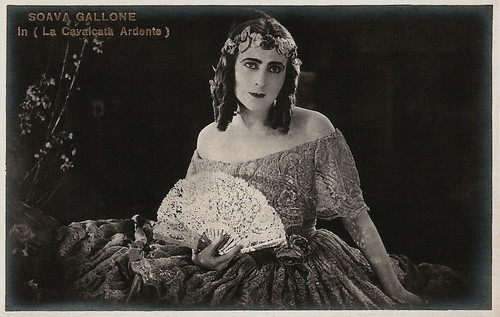
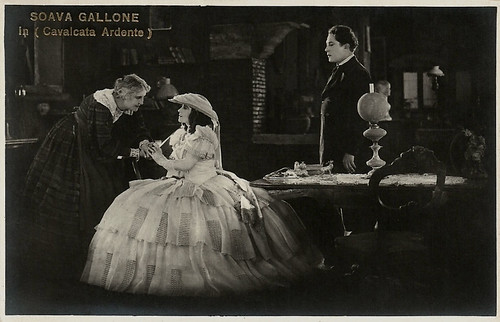
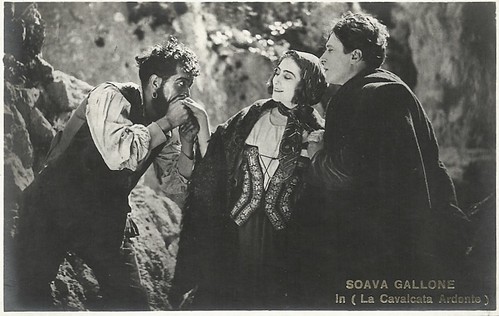
The silent Italian film La cavalcata ardente/The Fiery Cavalcade (1925) was a highly successful historical melodrama about the conquest of Naples by Garibaldi. The film was a good example of the cooperation of the husband-and-wife team of writer-director Carmine Gallone and Polish-born film diva Soava Gallone between 1916 and 1927.

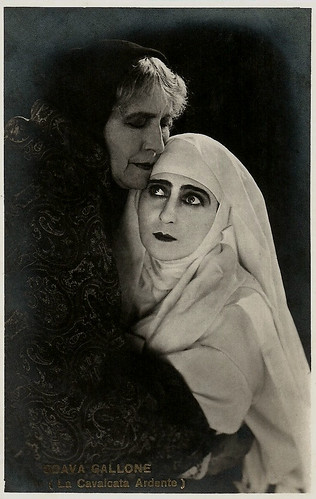
Soava Gallone in La cavalcata ardente
Italian postcard by Ed. G.B. Falci, Milano. Photo: Soava Gallone in La cavalcata ardente (1925).

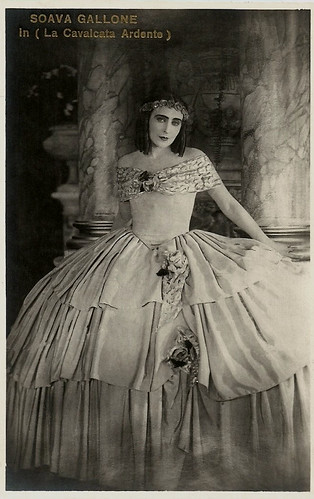
Soava Gallone in La cavalcata ardente
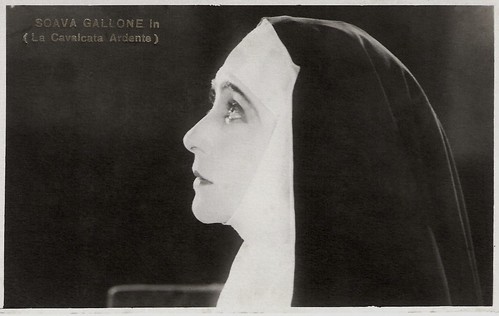
Italian postcard by G.B. Falci Editori, Milano. Photo: Soava Gallone in La cavalcata ardente (1925).

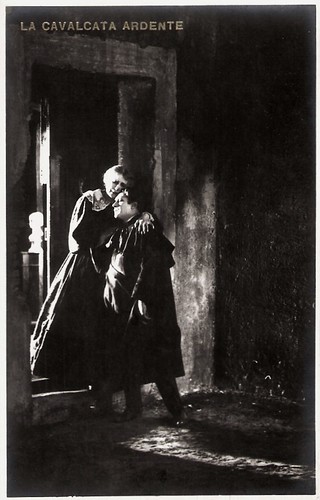
Soava Gallone, Jeanne Brindeau and Gabriel de Gravone in La cavalcata ardente
Italian postcard by Ed. G.B. Falci, Milano. Photo: Jeanne Brindeau, Soava Gallone and Gabriel de Gravone in La cavalcata ardente (1925).

Soava Gallone and Gabriel de Gravone in La cavalcata ardente (1925)
Italian postcard by Ed. G.B. Falci, Milano. Soava Gallone and Gabriel de Gravone in La cavalcata ardente/The Fiery Cavalcade (Carmine Gallone, 1925).

Soava Gallone and Jeanne Brindeau in La cavalcata ardente (1925)
Italian postcard by Ed. G.B. Falci, Milano. Photo: Jeanne Brindeau, and Soava Gallone in La cavalcata ardente (1925).

Raimondo Van Riel in La cavalcata ardente (1925)
Italian postcard by Ed. G.B. Falci, Milano. Raimondo Van Riel as the bandit Pasquale Noto in La cavalcata ardente/The Fiery Cavalcade (Carmine Gallone, 1925).

A refined, delicate soul


Carmine Gallone had the intelligence to pick films that fully sustained the image of Soava Gallone as a refined, delicate soul, and he limited her performances to no more than two per year.

In La cavalcata ardente/The Fiery Cavalcade (Carmine Gallone, 1925), his wife Soava Gallone plays a beautiful aristocratic girl, who has to hide in a convent.

The photography was by Alfredo Donelli and Emilio Guattari. The costumes were designed by French fashion designer Paul Poiret and the sets by Filippo Folchi.

Director Gallone wrote the script himself. The film had its premiere in the Supercinema (now Teatro Nazionale) in Rome in April 1925. In the audience were many of the old veterans of Giuseppe Garibaldi's volunteer army dressed in their shirts.

The reviewer of the magazine L'epoca praised the combination of the love story and the historical background.

Raimondo Van Riel in La cavalcata ardente
Italian postcard by Ed. G.B. Falci, Milano. Photo: Westi / S.A.I.C. Publicity still of Raimondo Van Riel as Il Brigante (The Bandit) in La cavalcata ardente (1925).

La cavalcata ardente
Italian postcard by Ed. G.B. Falci, Milano. Photo: Raimondo Van Riel and Gabriel de Gravone in La cavalcata ardente (1925).

Soava Gallone and Raimondo Van Riel in La cavalcata ardente
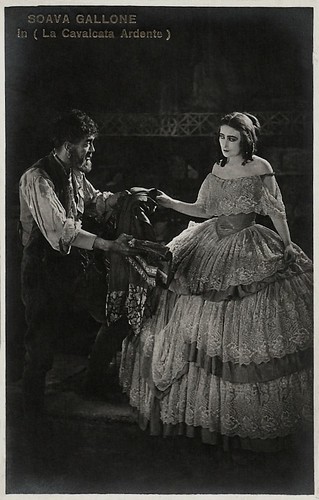
Italian postcard by Ed. G.B. Falci, Milano. Photo: Raimondo Van Riel and Soava Gallone in La cavalcata ardente (1925).

Raimondo Van Riel, Soava Gallone & Gabriel de Gravone in La cavalcata ardente
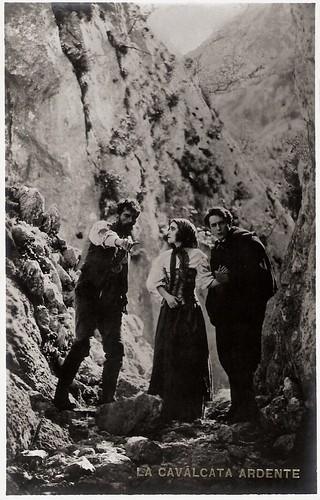
Italian postcard by Ed. G.B. Falci, Milano. Photo: Raimondo Van Riel, Soava Gallone and Gabriel de Gravone in La cavalcata ardente (1925).

Soava Gallone and Jeanne Brindeau in La cavalcata ardente
Italian postcard by Ed. G.B. Falci, Milano. Photo: Jeanne Brindeau and Soava Gallone in La cavalcata ardente (1925).

Gabriel de Gravone in La cavalcata ardente
Italian postcard by Ed. A. Traldi, Milano. Photo: Westi / SAIC. Gabriel de Gravone and Jeanne Brindeau in La cavalcata ardente/The Fiery Cavalcade (Carmine Gallone, 1925). Caption: The farewell to his mother.

Gabriel de Gravone & Jeanne Brindeau in La cavalcata ardente
Italian postcard by Ed. G.B. Falci, Milano. Photo: Jeanne Brindeau and Gabriel de Gravone in La cavalcata ardente (1925).

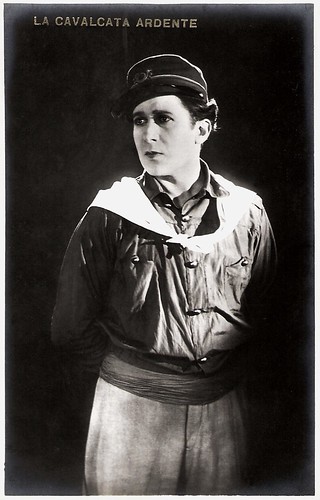
Gabriel de Gravone in La cavalcata ardente
Italian postcard by Ed. G.B. Falci, Milano. Photo: Gabriel de Gravone in La cavalcata ardente (1925).

Soava Gallone
Italian postcard by Ed. G.B. Falci, Milano. Photo: Soava Gallone in La cavalcata ardente (1925).

Secretly in love


La cavalcata ardente/The Fiery Cavalcade (Carmine Gallone, 1925) is a melodrama set against the background of the conquest of Naples by Giuseppe Garibaldi's volunteers in 1860.

In the ancient Montechiaro family, linked to the Bourbons, Pietro (Amerigo Di Giorgio), the eldest son, is the leader of the royal forces while his sister Grazia (Soava Gallone) is forced into a marriage with the old prince of Santafè (Emilio Ghione). She is secretly in love with Giovanni Artuni (Gabriel de Gravone), a patriot and revolutionary.

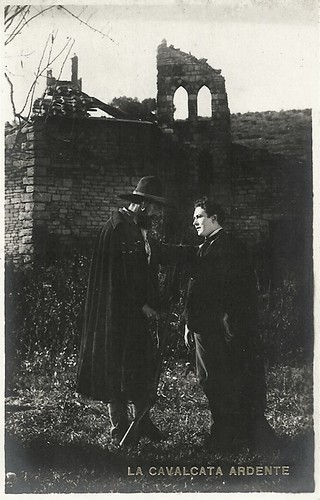
Artuni escapes an ambush and hides with the brigand Pasquale Noto (Raimondo Van Riel). Masked together with his companions, he participates in the 'cavalcata ardente', a horse race with torches in the park of the Montechiaro family's villa, where the party for Grazia's official engagement takes place.

A ruthless manhunt ensues. Grazia hides in a convent, while Giovanni tries to join Garibaldi's army (Ciro Galvani). But, recognised by a traitor, he is arrested by the Bourbon police, immediately tried and sentenced to death.

Grazia intercedes for his life, yielding to old Santafé's blackmail. While the wedding between Grazia and the old Prince is being celebrated, Giovanni and his old mother (Jeanne Brindeau) are escorted to the border.

But Garibaldi is now at the gates, the Bourbon army rebels and, in an attempt to stem the advance, Santafé falls in battle. With the entrance of the Red Shirts army into Naples, Grazia and Giovanni are reunited and realise their dream of love.

Soava Gallone in La cavalcata ardente
Italian postcard by Ed. A. Traldi, Milano. Photo: Westi / SAIC. Soava Gallone in the historical film La cavalcata ardente (Carmine Gallone, 1925).

Soava Gallone and Emilio Ghione in La cavalcata ardente (1925)
Italian postcard by Eureka. Sent by mail in 1927. Soava Gallone and Emilio Ghione in La cavalcata ardente/The fiery cavalcade (Carmine Gallone, 1925).

Emilio Ghione in La cavalcata ardente
Italian postcard by Ed. G.B. Falci, Milano. Photo: Westi / S.A.I.C. Emilio Ghione as the Prince of Santafé in La cavalcata ardente (1925).

Soava Gallone and Emilio Ghione in La cavalcata ardente
Italian postcard by Ed. A Traldi, Milano, no 312. Photo: Soava Gallone and Emilio Ghione in La cavalcata ardente (1925).

Soava Gallone and Emilio Ghione in La cavalcata ardente
Italian postcard by Ed. G.B. Falci, Milano. Photo: Westi / S.A.I.C. Publicity still of Soava Gallone and Emilio Ghione in La cavalcata ardente (1925).

Soava Gallone and Emilio Ghione in La cavalcata ardente
Italian postcard by Ed. G.B. Falci, Milano. Photo: Westi / S.A.I.C. Publicity still of Soava Gallone and Emilio Ghione in La cavalcata ardente (1925). Caption: The death of Santafé.

Soava Gallone and Gabriel de Gravone in La cavalcata ardente
Italian postcard by Ed. G.B. Falci, Milano, no 318. Photo: Soava Gallone and Gabriel de Gravone in La cavalcata ardente (1925).

Soava Gallone in La cavalcata ardente
Italian postcard by Ed. G.B. Falci, Milano. Photo: Soava Gallone in La cavalcata ardente (1925).

La cavalcata ardente
Italian postcard by Ed. G.B. Falci, Milano. Photo: Raimondo Van Riel,Soava Gallone and Gl de Gravone in La cavalcata ardente (1925).

La cavalcata ardente
Italian postcard by Ed. G.B. Falci, Milano. Photo: Raimondo Van Riel, and Gabriel de Gravone in La cavalcata ardente/The Fiery Cavalcade (1925).

Sources: Sempre in penombra (Italian), Vittorio Martinelli (Le dive del silenzio), Vittorio Martinelli (Il cinema muto italiano), Wikipedia (Italian) and IMDb.

This post was last updated on 1 December 2023.