Mary Johnson (1896-1975) was an angelic Swedish actress, who peaked in the Swedish cinema of the 1910s and early 1920s and also in German silent films of the later 1920s. Her most well-known parts were in Herr Arnes pengar/Sir Arne's Treasure (1919) and Geschlecht in Fesseln/Sex in Chains (1928). After her marriage to Rudolf Klein-Rogge, she retired.
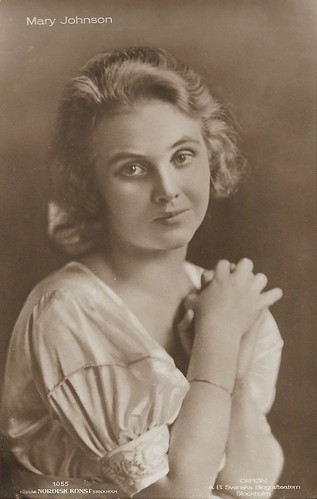
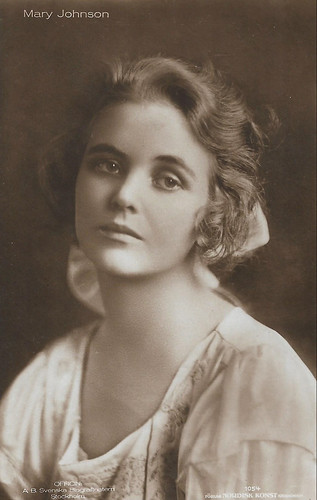
Swedish postcard by Förlag Nordisk Konst, Stockholm, no. 1055. Photo: A.B. Svenska Biografteatern, Stockholm.

Swedish postcard by Nordisk Konst, Stockholm, no. 1078/9. Photo: Svenska Biografteatern. Mary Johnson in Herr Arnes pengar/Sir Arne's Treasure (Mauritz Stiller, 1919). Caption: The next day the dream did not leave Elsalill's mind.

Swedish postcard by Axel Eliassons Konstförlag, Stockholm, no. 310. Photo: Gösta Hard, Stockholm, 1927. On this postcard, Johnson is indicated with the name of her second husband.

Swedish postcard by Axel Eliassons Konstförlag, no. 189. Photo: Skandiafilm. Scene from the tragicomedy Familjens traditioner/Family Traditions (Rune Carlsten, 1920), starring Gösta Ekman and Mary Johnson.

German postcard by Ross Verlag, no. 1653/1, 1927-1928. Photo: M. v. Bucovich (Atelier K. Schenker).
Mary Johnson was born Astrid Maria Carlsson, in 1896 in Eskilstuna, Sweden. She was born into a working-class family.
She made her first apprenticeship as an actress in Karin Swanström's company, where she made her debut in the spring of 1913 in a dramatisation of the classic novel 'Rosen pa Tistelön' (The Rose of Tistelön). However, a contemporary newspaper claims that she already joined this company in 1911. On tour, she met Karl Gerhard, then called Karl Emil Georg Johnson, who became her first husband.
Already in 1913, Gerhard and she made their film debut with small film roles in Mauritz Stiller's unfinished film Mannekängen/The Model but they were then away from the film set till 1916. In 1914, the two became involved with Hjalmar Selander at the Nya Teatern in Gothenburg, where Mary Johnson became the theatre's prima donna. She was later often associated with one of her major roles there, namely the title role in 'Dunungen' (1915), which drew the critics’ attention to her. Later, 'Dunungen' would be adapted for film with Renée Björling in the lead.
During this time, Johnson was engaged by the Gothenburg-based company Hasselblads Fotografiska AB, and she acted in a string of 12 films all but one directed by Georg af Klercker: e.g. Ministerpresidenten/The Prime Minister (1916), Nattens barn/Child of the Night (1916) in which she had the lead, the censorship-forbidden Mysteriet natten till den 25:e/The Mystery of the Night of the 25th (1917), Mellan liv och död/Between Life and Death (1917), and Fyrvaktarens dotter/The Four Guardian's Daughter (1918), and Förstadsprästen/The Suburban Vicar (1917). Fyrvaktarens dotter/The Daughter of the Lighthouse Keeper (1918) was Hasselblad’s last film before it merged with the new company Skandia.
In addition, until 1917 Johnson toured with Skådebanan, a theatre company founded in 1910, and set on popular education. She appeared in the season of 1917-1918 at its new fixed stage at Folkets Hus Theatre in Stockholm. Karl Gerhard then broke with Skådebanan and started with his own tour activity in 1918 and 1919, where Mary Johnson and Richard Lund became his stars. In 1920 Johnson played at Folkteatern in Gothenburg.
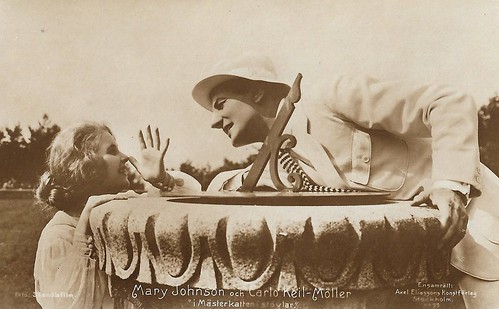
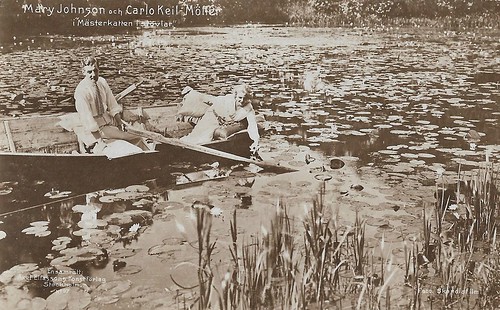
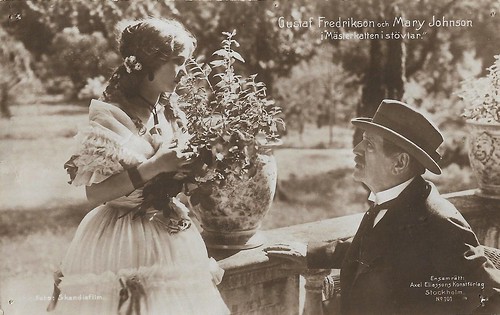
Swedish postcard by Axel Eliassons Konstförlag, Stockholm, no. 99. Photo: Skandiafilm. Mary Johnson and Carl Keil-Möller in the romantic film Mästerkatten i stövlar/Puss in Boots (John W. Brunius, 1918).
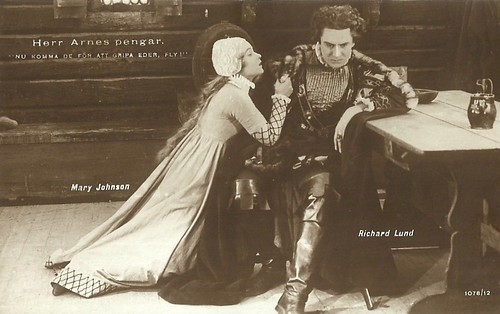
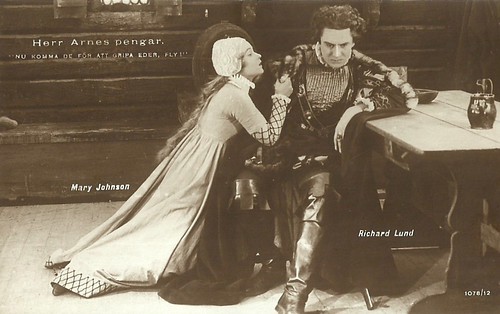
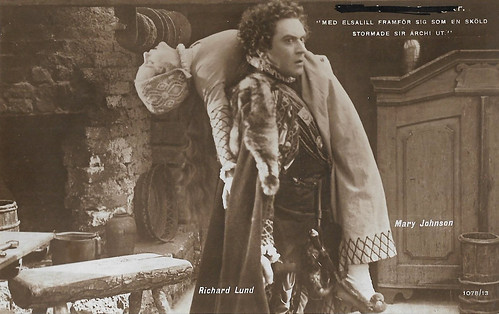
Swedish postcard by Nordisk Konst, Stockholm, no. 1078/12. Richard Lund and Mary Johnson in the Swedish silent film Herr Arnes pengar/Sir Arne's Treasure (Mauritz Stiller, 1919). Caption: They have come now to arrest you, escape!

Swedish postcard by Axel Eliassons Konstförlag, Stockholm, no. 192. Photo: Skandia Film. Scene from the tragicomedy Familjens traditioner/Family Traditions (Rune Carlsten, 1920), starring Gösta Ekman and Mary Johnson, here also with Sven Bergvall and Carl Browallius, mentioned here as Brovallius.
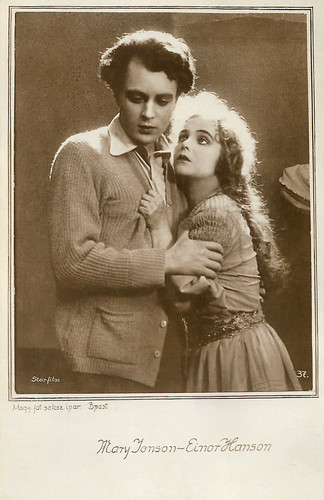
Hungarian postcard by Magy. fot. soksz ipar, Budapest, no. 37. Photo: Star-film. Publicity still for Gunnar Hedes saga/Snowbound (Mauritz Stiller, 1923) with Einar Hanson.
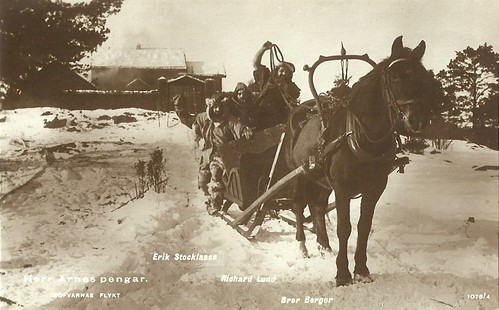
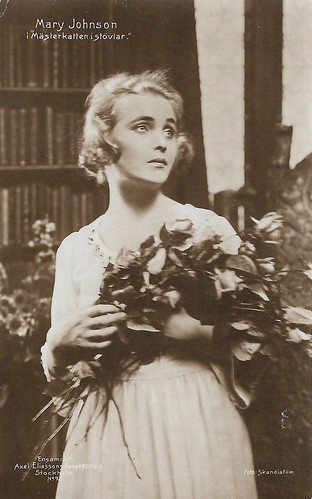
After Hasselblad's merger with Skandia in 1918, Mary Johnson came over to this company and had a big breakthrough with the film Mästerkatten/Puss in Boots (John W. Brunius, 1918) and when that company in its turn in 1919 formed Svensk Filmindustri, Mary got her perhaps most famous Swedish film role as Elsalill in the rural drama Herr Arnes pengar/Sir Arne’s Treasure (1919).
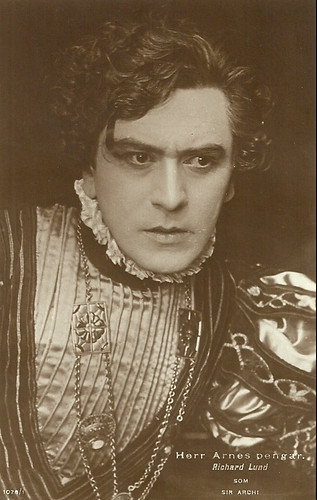
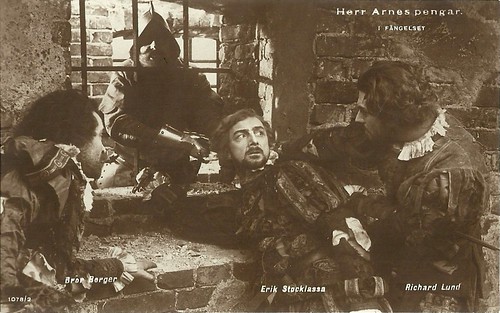
Mary plays the young girl, whose whole family is murdered by three treasure-hunting Scottish officers. She is torn between justice and her love for the leader of the gang, Sir Archi (Richard Lund). The international success of Herr Arnes pengar resulted in films such as En lyckoriddare/A Happy Knight (John W. Brunius, 1921), with a dashing Gösta Ekman opposite an ethereal Johnson.
At about the same time, Johnson divorced Gerhard Johnson and married the Norwegian actor Einar Rød and started to work in Norway as an actress, where a.o. she did a tour in 1922 and acted at the Chat Noir in Oslo from 1922-1923. In 1923 she shortly worked for Svenska Biografteatern, acting in Gunnar Hedes saga/Snowbound (Mauritz Stiller, 1923), adapted from Selma Lagerlöf’s novel, and starring Einar Hanson as the title character, and in Johan Ulfstjerna (John W. Brunius, 1923), starring Einar Hanson and Ivan Hedqvist.
In 1924 she moved to Germany, where she worked in films in the late 1920s. Her first film in Germany was Hanns Schwarz's Die Stimme des Herzens/The Voice of the Heart (1924), in which also her second husband, the Norwegian actor Einar Röd, appeared. When the film’s production company, Trianon, collapsed, she moved over to Rex Film, which gave her a big role as Werner Krauss’ character’s daughter in Das Haus der Lüge/The House of Lies (Lupu Pick 1926), based on Henrik Ibsen’s play The Wild Duck.
This also meant her to abandon the ingenue type, developing into a more versatile actress, able to play both in tragedy and comedy. In Das Haus der Lüge, she became an excellent interpreter of the shy and weak as the protagonist who eventually becomes a victim. Filming in Germany also meant that Johnson became one of the Swedish films' first international stars. In Germany, she eventually met her third man, actor Rudolf Klein-Rogge. They married in 1932.
Swedish postcard by Förlag Nordisk Konst, Stockholm, no. 1054. Photo: A.B. Svenska Biografteatern.

German postcard by Ross Verlag, no. 1659/1, 1927-1928. Photo: Phoebus Film.

German postcard by Ross Verlag, no. 3145/1, 1928-1929. Photo: Atelier Balàzs, Berlin.
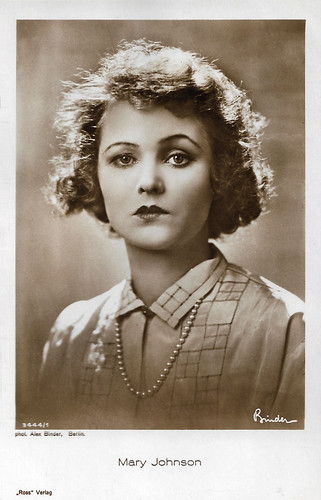
German postcard by Ross Verlag, no. 3444/1, 1928-1929. Photo: Alex Binder, Berlin.
In Germany, Mary Johnson played supporting parts in films with Paul Richter, Paul Wegener, and Marcella Albani. She also starred in leading roles in Staatsanwalt Jordan/State Attorney Jordan (Joe May, 1926) with Hans Mierendorff, in Manege/Life's Circus (Max Reichmann, 1927/1928), with Ernst von Düren, and in two films by the Munich director Franz Osten: Was Kinder den Eltern verschweigen/What Children Conceal From Their Parents (1927), a film banned in several European countries, and Die raffinierteste Frau Berlins/The most refined woman of Berlin (1927), with Luigi Serventi and André Mattoni.
Johnson’s most well-known film in the late 1920s was William Dieterle's Geschlecht in Fesseln/Sex in Chains (1928), in which she played the female lead opposite Dieterle. While her husband is in jail, sentenced for manslaughter, and is being seduced by an inmate, she has an affair with a former inmate of her man, who gets her a job. When the husband is finally released, the man and woman feel guilty and commit suicide.
After a relatively diligent film career during the 1920s, Johnson disappeared from the film sets after one bit part in 1931, while Rudolf Klein-Rogge continued to act all through the 1930s. The Second World War hit the two spouses very hard and they lost virtually all their assets except a summer place outside Graz in Austria, where they settled after the end of the war. Klein-Rogge died there in 1955.
Mary Johnson spent her last few years in utmost oblivion and she died in Stockholm. She seems to have been very shy of publicity and there is very little written about her. Johnson has been regarded as one of the Swedish film's most beautiful actresses and was similar in many places to a crisp and beautiful porcelain doll. When she broke through in 'Dunungen', one critic meant that by being small and thin, blond and blue-eyed, she fulfilled the demands of being a real kid. Her first man, Karl Gerhard, described her as angelic and shy and said she instantly awakened his instincts of protection.
Zarah Leander described Johnson in her memoirs as ethereal and angelic. There was also something androgynous about her appearance and it was claimed that she received as much admiration from female as from male spectators. Mary Johnson died on 7 (or perhaps 15) May 1975 in Hägersten, Stockholm, or according to others in Brännkyrka, Sweden. She was 78.
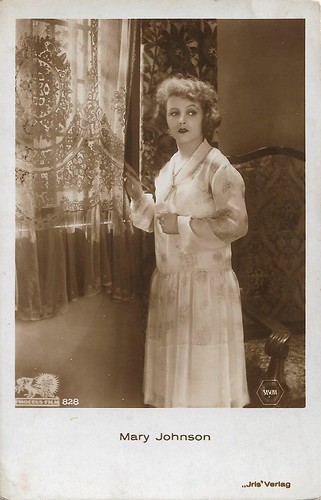
Austrian postcard by Iris Verlag, no. 828. Photo: Sascha Film / Phoebus Film.
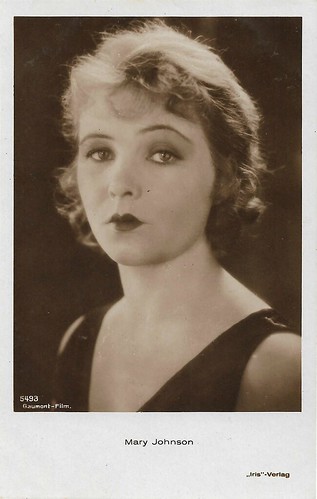
Austrian postcard by Iris-Verlag, no. 5493. Photo: Gaumont-Film.

German postcard by Ross Verlag, no. 4916/1, 1929-1930. Photo: Atelier Balàzs, Berlin.
Sources: This biography is largely based on the one written by P.O. Qvist (2004) on the Swedish Film Database, Svenskfilmdatabas. Additional information came from IMDb and Swedish Wikipedia.
This post was last updatred on 24 November 2024.
Swedish postcard by Förlag Nordisk Konst, Stockholm, no. 1055. Photo: A.B. Svenska Biografteatern, Stockholm.
Swedish postcard by Nordisk Konst, Stockholm, no. 1078/9. Photo: Svenska Biografteatern. Mary Johnson in Herr Arnes pengar/Sir Arne's Treasure (Mauritz Stiller, 1919). Caption: The next day the dream did not leave Elsalill's mind.
Swedish postcard by Axel Eliassons Konstförlag, Stockholm, no. 310. Photo: Gösta Hard, Stockholm, 1927. On this postcard, Johnson is indicated with the name of her second husband.
Swedish postcard by Axel Eliassons Konstförlag, no. 189. Photo: Skandiafilm. Scene from the tragicomedy Familjens traditioner/Family Traditions (Rune Carlsten, 1920), starring Gösta Ekman and Mary Johnson.
German postcard by Ross Verlag, no. 1653/1, 1927-1928. Photo: M. v. Bucovich (Atelier K. Schenker).
The theatre's prima donna
Mary Johnson was born Astrid Maria Carlsson, in 1896 in Eskilstuna, Sweden. She was born into a working-class family.
She made her first apprenticeship as an actress in Karin Swanström's company, where she made her debut in the spring of 1913 in a dramatisation of the classic novel 'Rosen pa Tistelön' (The Rose of Tistelön). However, a contemporary newspaper claims that she already joined this company in 1911. On tour, she met Karl Gerhard, then called Karl Emil Georg Johnson, who became her first husband.
Already in 1913, Gerhard and she made their film debut with small film roles in Mauritz Stiller's unfinished film Mannekängen/The Model but they were then away from the film set till 1916. In 1914, the two became involved with Hjalmar Selander at the Nya Teatern in Gothenburg, where Mary Johnson became the theatre's prima donna. She was later often associated with one of her major roles there, namely the title role in 'Dunungen' (1915), which drew the critics’ attention to her. Later, 'Dunungen' would be adapted for film with Renée Björling in the lead.
During this time, Johnson was engaged by the Gothenburg-based company Hasselblads Fotografiska AB, and she acted in a string of 12 films all but one directed by Georg af Klercker: e.g. Ministerpresidenten/The Prime Minister (1916), Nattens barn/Child of the Night (1916) in which she had the lead, the censorship-forbidden Mysteriet natten till den 25:e/The Mystery of the Night of the 25th (1917), Mellan liv och död/Between Life and Death (1917), and Fyrvaktarens dotter/The Four Guardian's Daughter (1918), and Förstadsprästen/The Suburban Vicar (1917). Fyrvaktarens dotter/The Daughter of the Lighthouse Keeper (1918) was Hasselblad’s last film before it merged with the new company Skandia.
In addition, until 1917 Johnson toured with Skådebanan, a theatre company founded in 1910, and set on popular education. She appeared in the season of 1917-1918 at its new fixed stage at Folkets Hus Theatre in Stockholm. Karl Gerhard then broke with Skådebanan and started with his own tour activity in 1918 and 1919, where Mary Johnson and Richard Lund became his stars. In 1920 Johnson played at Folkteatern in Gothenburg.
Swedish postcard by Axel Eliassons Konstförlag, Stockholm, no. 99. Photo: Skandiafilm. Mary Johnson and Carl Keil-Möller in the romantic film Mästerkatten i stövlar/Puss in Boots (John W. Brunius, 1918).
Swedish postcard by Nordisk Konst, Stockholm, no. 1078/12. Richard Lund and Mary Johnson in the Swedish silent film Herr Arnes pengar/Sir Arne's Treasure (Mauritz Stiller, 1919). Caption: They have come now to arrest you, escape!
Swedish postcard by Axel Eliassons Konstförlag, Stockholm, no. 192. Photo: Skandia Film. Scene from the tragicomedy Familjens traditioner/Family Traditions (Rune Carlsten, 1920), starring Gösta Ekman and Mary Johnson, here also with Sven Bergvall and Carl Browallius, mentioned here as Brovallius.
Hungarian postcard by Magy. fot. soksz ipar, Budapest, no. 37. Photo: Star-film. Publicity still for Gunnar Hedes saga/Snowbound (Mauritz Stiller, 1923) with Einar Hanson.
A more versatile actress
After Hasselblad's merger with Skandia in 1918, Mary Johnson came over to this company and had a big breakthrough with the film Mästerkatten/Puss in Boots (John W. Brunius, 1918) and when that company in its turn in 1919 formed Svensk Filmindustri, Mary got her perhaps most famous Swedish film role as Elsalill in the rural drama Herr Arnes pengar/Sir Arne’s Treasure (1919).
Mary plays the young girl, whose whole family is murdered by three treasure-hunting Scottish officers. She is torn between justice and her love for the leader of the gang, Sir Archi (Richard Lund). The international success of Herr Arnes pengar resulted in films such as En lyckoriddare/A Happy Knight (John W. Brunius, 1921), with a dashing Gösta Ekman opposite an ethereal Johnson.
At about the same time, Johnson divorced Gerhard Johnson and married the Norwegian actor Einar Rød and started to work in Norway as an actress, where a.o. she did a tour in 1922 and acted at the Chat Noir in Oslo from 1922-1923. In 1923 she shortly worked for Svenska Biografteatern, acting in Gunnar Hedes saga/Snowbound (Mauritz Stiller, 1923), adapted from Selma Lagerlöf’s novel, and starring Einar Hanson as the title character, and in Johan Ulfstjerna (John W. Brunius, 1923), starring Einar Hanson and Ivan Hedqvist.
In 1924 she moved to Germany, where she worked in films in the late 1920s. Her first film in Germany was Hanns Schwarz's Die Stimme des Herzens/The Voice of the Heart (1924), in which also her second husband, the Norwegian actor Einar Röd, appeared. When the film’s production company, Trianon, collapsed, she moved over to Rex Film, which gave her a big role as Werner Krauss’ character’s daughter in Das Haus der Lüge/The House of Lies (Lupu Pick 1926), based on Henrik Ibsen’s play The Wild Duck.
This also meant her to abandon the ingenue type, developing into a more versatile actress, able to play both in tragedy and comedy. In Das Haus der Lüge, she became an excellent interpreter of the shy and weak as the protagonist who eventually becomes a victim. Filming in Germany also meant that Johnson became one of the Swedish films' first international stars. In Germany, she eventually met her third man, actor Rudolf Klein-Rogge. They married in 1932.
Swedish postcard by Förlag Nordisk Konst, Stockholm, no. 1054. Photo: A.B. Svenska Biografteatern.
German postcard by Ross Verlag, no. 1659/1, 1927-1928. Photo: Phoebus Film.
German postcard by Ross Verlag, no. 3145/1, 1928-1929. Photo: Atelier Balàzs, Berlin.
German postcard by Ross Verlag, no. 3444/1, 1928-1929. Photo: Alex Binder, Berlin.
Sex in chains
In Germany, Mary Johnson played supporting parts in films with Paul Richter, Paul Wegener, and Marcella Albani. She also starred in leading roles in Staatsanwalt Jordan/State Attorney Jordan (Joe May, 1926) with Hans Mierendorff, in Manege/Life's Circus (Max Reichmann, 1927/1928), with Ernst von Düren, and in two films by the Munich director Franz Osten: Was Kinder den Eltern verschweigen/What Children Conceal From Their Parents (1927), a film banned in several European countries, and Die raffinierteste Frau Berlins/The most refined woman of Berlin (1927), with Luigi Serventi and André Mattoni.
Johnson’s most well-known film in the late 1920s was William Dieterle's Geschlecht in Fesseln/Sex in Chains (1928), in which she played the female lead opposite Dieterle. While her husband is in jail, sentenced for manslaughter, and is being seduced by an inmate, she has an affair with a former inmate of her man, who gets her a job. When the husband is finally released, the man and woman feel guilty and commit suicide.
After a relatively diligent film career during the 1920s, Johnson disappeared from the film sets after one bit part in 1931, while Rudolf Klein-Rogge continued to act all through the 1930s. The Second World War hit the two spouses very hard and they lost virtually all their assets except a summer place outside Graz in Austria, where they settled after the end of the war. Klein-Rogge died there in 1955.
Mary Johnson spent her last few years in utmost oblivion and she died in Stockholm. She seems to have been very shy of publicity and there is very little written about her. Johnson has been regarded as one of the Swedish film's most beautiful actresses and was similar in many places to a crisp and beautiful porcelain doll. When she broke through in 'Dunungen', one critic meant that by being small and thin, blond and blue-eyed, she fulfilled the demands of being a real kid. Her first man, Karl Gerhard, described her as angelic and shy and said she instantly awakened his instincts of protection.
Zarah Leander described Johnson in her memoirs as ethereal and angelic. There was also something androgynous about her appearance and it was claimed that she received as much admiration from female as from male spectators. Mary Johnson died on 7 (or perhaps 15) May 1975 in Hägersten, Stockholm, or according to others in Brännkyrka, Sweden. She was 78.
Austrian postcard by Iris Verlag, no. 828. Photo: Sascha Film / Phoebus Film.
Austrian postcard by Iris-Verlag, no. 5493. Photo: Gaumont-Film.
German postcard by Ross Verlag, no. 4916/1, 1929-1930. Photo: Atelier Balàzs, Berlin.
Sources: This biography is largely based on the one written by P.O. Qvist (2004) on the Swedish Film Database, Svenskfilmdatabas. Additional information came from IMDb and Swedish Wikipedia.
This post was last updatred on 24 November 2024.