Lilly Jacobsson (1893-1979), aka Lilly Jacobson, was a Swedish actress who starred in Swedish and Danish silent films by Eric Malmberg, Mauritz Stiller and Holger-Madsen. She was the star of the popular Danish film Maharadjahens Yndlingshustru / The Maharaja’s Favourite Wife (1917).

Swedish postcard by Förlag Nordisk Konst, Stockholm. Photo: Nordisk Films Kompagni, Copenhagen. Collection: Geoffrey Donaldson Institute.
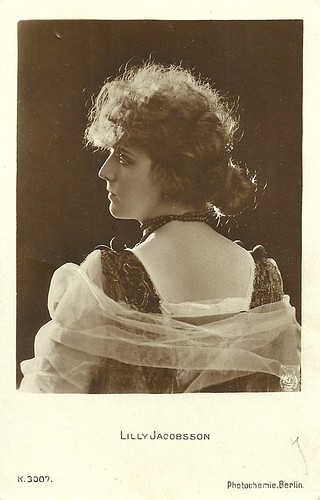
German postcard by Photochemie, Berlin, no. K. 3007. Photo: Nordisk Film.

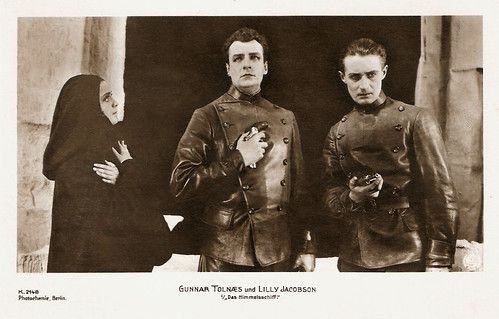
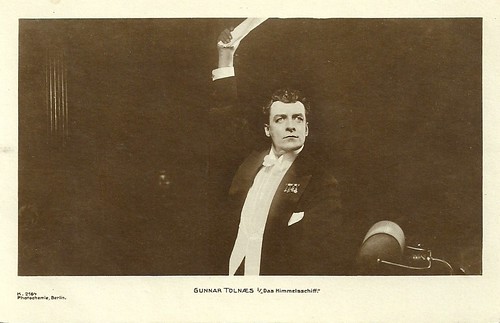
German postcard by Photochemie, Berlin, no. K. 2147. Photo: Nordisk Film. Lilly Jacobsson as Marya, the Martian leader's daughter, in Himmelskibet / Das Himmelschiff (Holger-Madsen, 1918).
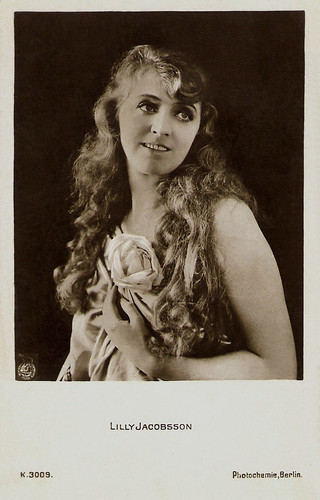
German postcard by Photochemie, Berlin, no. K. 3009. Photo: Nordisk Film.
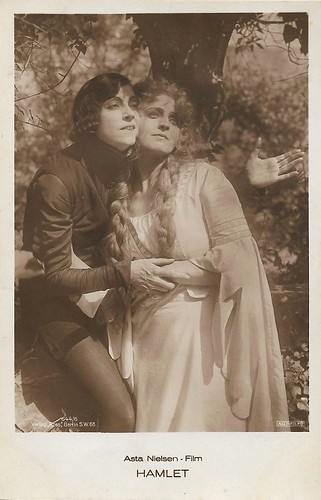
German postcard by Ross Verlag, Berlin, no. 644/6. Photo: Art-Film / Asta Nielsen-Film. Asta Nielsen as Hamlet and Lilly Jacobsson as Ophelia in Hamlet (Svend Gade, Heinz Schall, 1921).
Lilly Jacobsson (also written as Jacobson) was born in Göteborg, Sweden, in 1893. She made her film debut at AB Svenska Biografteatern in 1911 and collaborated with various Swedish filmmakers until 1914. First, she played in films by Eric Malmberg, with him often in the male lead. Her first film was Opiumhålan / The Opium Den (Eric Malmberg, 1911). It was shot in various Swedish cities such as her native town Göteborg, but also in Paris, Monte Carlo and aboard the SS Lusitania, going to New York.
Her next film, Bränningar eller Stulen lycka / Burnings or Stolen Luck (Eric Malmberg, 1912) repeated the pick of locations, again including a transatlantic trip with the Lusitania. The third film of Jacobsson and Malberg, Det gröna halsbandet / The Green Necklace (Eric Malmberg, 1912) was completely filmed in Göteborg.
Jacobsson then played the female lead in a film by Georg af Klercker: Musikens makt / The Power of Music (1912), again partly shot in Göteborg. Next came the farce Kolingens galoscher / Kolingen’s Boots (Eric Malmberg, 1912), in which Jacobsson played a millionaire's daughter.
It was then time for another transatlantic trip, resulting in Samhällets dom / The Judgment of Society (1912), aboard the Lusitania to New York. The trip also resulted in a short documentary Med Lusitania till Amerika / Med 2.300 Passagerare ofver Atlanten. Samhällets dom was released in February 1912, two months before the sinking of the SS Titanic.
The documentary was released one week after the naval disaster. Malmberg and Jacobsson then exploited their ocean trip for Tva svenska emigranters äfventyr i Amerika / The Adventures of Two Swedish Emigrants in America (1912), which also included shots made in New York and at Niagara Falls.

Swedish postcard by Förlag Nordisk Konst, Stockholm, no. 1006. Photo: Nordisk Films Kompagni, Copenhagen. Lilly Jacobsson in Maharadjahens Yndlingshustru / The Maharaja’s Favourite Wife (Robert Dinesen, Svend Gade, 1917). Collection: Geoffrey Donaldson Institute.

Swedish postcard by Förlag Nordisk Konst, Stockholm, no. 1007. Photo: Nordisk Films Kompagni, Copenhagen. Lilly Jacobsson in Maharadjahens Yndlingshustru / The Maharaja’s Favourite Wife (Robert Dinesen, Svend Gade, 1917). Collection: Geoffrey Donaldson Institute.

Swedish postcard by Förlag Nordisk Konst, Stockholm, no. 1008. Photo: Nordisk Films Kompagni, Copenhagen. Lilly Jacobsson in Maharadjahens Yndlingshustru / The Maharaja’s Favourite Wife (Robert Dinesen/ Svend Gade, 1917). Collection: Geoffrey Donaldson Institute.

German postcard by Photochemie, Berlin, no. K 2028. Photo: Union-Film / Nordisk Film. Lilly Jacobson (Lilly Jacobsson) in Testamentets Hemmelighed / The Secret of the Testament (Holger-Madsen, 1918). The German film title was Das trennende Band.

German postcard by Photochemie, Berlin, no. K 2029. Photo: Union-Film / Nordisk Film. Hugo Bruun (also Hugo Brunn) and Lilly Jacobson (Lilly Jacobsson) in Testamentets Hemmelighed / The Secret of the Testament (Holger-Madsen, 1918).
Back in Sweden, Lilly Jacobsson played the female lead as the daughter opposite Anna Norrie as the mother, in Mauritz Stiller’s debut as a film director: Mor och dotter/Mother and Daughter (1912). Next came Stiller’s När larmklockan ljuder/When the Alarm Bell Rings (Mauritz Stiller, 1913). The film was partly shot in and around the Swedish town of Sollefteå. Officers and soldiers of the local regiment, Kungl Västernorrlands, collaborated as extras, while the Airedale terrier Tell from the war dogs school also had a part in the film.
Stiller and Jacobsson worked together for a third time at Gränsfolken/Brother Against Brother (Mauritz Stiller, 1913), based on Emile Zola’s 'Le débacle' (The Debacle). The film had a huge international release. For a long time, Gränsfolken / Brother Against Brother was considered lost until a print was found in Poland in 2009.
Stiller and Jacobsson then did När svärmor regerar / When the Mother-in-Law Reigns (Mauritz Stiller, 1914). It was based on a Finnish play which Stiller had directed on stage. In their next film, För sin kärleks skull / Because of her love (Mauritz Stiller, 1914), Jacobsson had a secondary role – the female lead was for Lilly Bech (or Beck) - while the male lead was for Victor Sjöström.
Jacobsson then acted in another Af Klercker film: För fäderneslandet / For the Fatherland (Georg af Klercker, 1914), shot in Svenska Bio’s film studio in Stockholm, and in a studio in Copenhagen, while exteriors were filmed in Sollefteå.
Jacobsson returned to Stiller for Stormfågeln / Stormy Petrel (Mauritz Stiller, 1914), with Bech again in the female lead. It was shot both in Stockholm and in and around the train station of Åre. Lilly Jacobsson’s penultimate Swedish film was Strejken / Strike (Mauritz Stiller, 1915), again with Victor Sjöström in the lead, while the last one was directed by Sjöström himself: En av de många / One of the Many (Victor Sjöström, 1915), which starred Gunnar Tolnaes and Lili Bech.

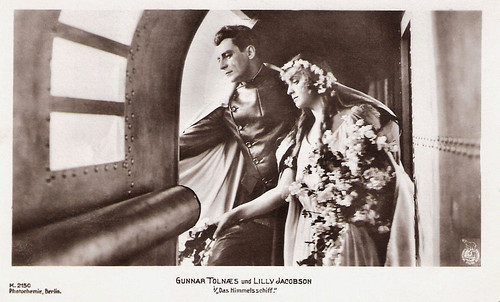
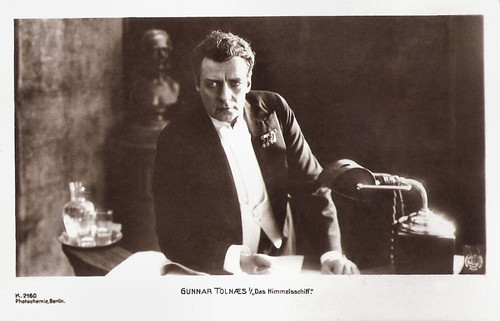
German postcard by Photochemie, Berlin, no. K. 2150. Photo: Nordisk Film. Lilly Jacobsson as Marya, the Martian leader's daughter, and Gunnar Tolnaes as Avanti Planetaros in Himmelskibet/400 Million Miles from Earth (Holger-Madsen, 1918). The German title was Das Himmelschiff.

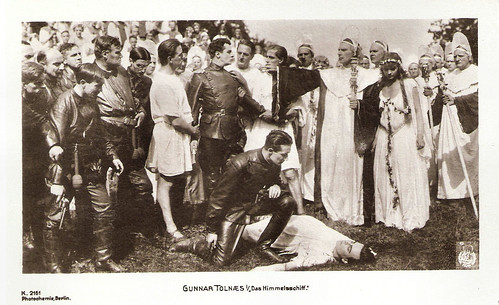
German postcard by Photochemie, Berlin, no. K. 2151. Photo: Nordisk Film. Lilly Jacobsson as Marya, the Martian leader's daughter, and Gunnar Tolnaes as Avanti Planetaros in Himmelskibet/400 Million Miles from Earth (Holger-Madsen, 1918).

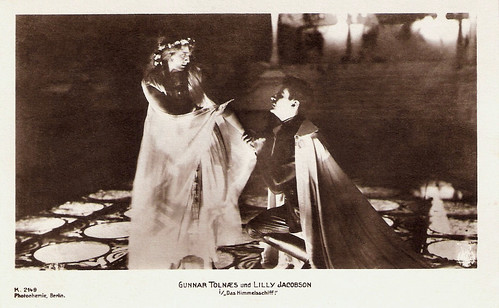
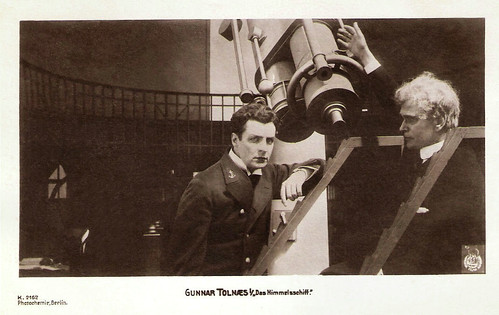
German postcard by Photochemie, Berlin, no. K. 2152. Photo: Nordisk Film. Lilly Jacobsson and Gunnar Tolnaes in Himmelskibet / 400 Million Miles from Earth (Holger Madsen, 1918).
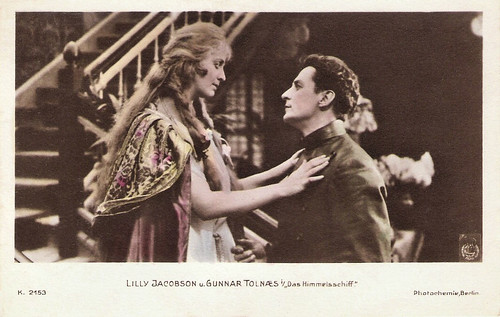
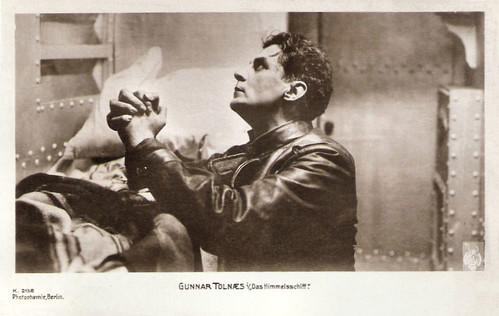
German postcard by Photochemie, Berlin, no. K. 2153. Photo: Nordisk Film. Still from Himmelskibet / 400 Million Miles from Earth (Holger Madsen, 1918).
In 1916, the Danish company Nordisk was looking for a new star. Lilly Jacobsson was chosen from hundreds of competitors and became the leading actress in Maharadjahens Yndlingshustru / The Maharaja’s Favourite Wife (Robert Dinesen, Svend Gade, 1917), in which she performed as Elly, who enters the harem of an Indian maharaja, played by Gunnar Tolnaes.
The film was such a success that Nordisk Film made a sequel: Maharadjahens Yndlingshustru II/The Maharaja's Favourite Wife II (August Blom, 1919).
In between, Jacobsson played in various Danish films, mostly directed by Holger-Madsen. These films included the Science fiction film Himmelskibet/400 Million Miles From Earth (Holger-Madsen, 1918) starring Gunnar Tolnaes, Folkets ven/Friend of the People (Holger-Madsen, 1918), and Mod Lyset/Towards the Light (Holger-Madsen, 1918) starring Asta Nielsen. Nielsen plays a cold, partying woman who neglects religion, but later on, repents and becomes the wife of a preacher man (Alf Blütecher) who takes care of the poor.
In 1919, Lilly Jacobsson married director Corbett Edwards in Odense (Denmark), which ended her film career. Only her former colleague, Asta Nielsen, could persuade her to play Ophelia in Asta’s famous German production of Hamlet (Svend Gade, Heinz Schall, 1921), in which Nielsen played the title role herself.
Lilly Jacobsson died in 1979 in Odense, Denmark, at the age of 86. She is interred at the Assistenskirkegården in Odense.

German postcard by Photochemie, Berlin, no. K. 1475. Photo: Nordisk Film. Lilly Jacobsson in Maharadjahens Yndlingshustru / The Maharaja’s Favourite Wife (Robert Dinesen, Svend Gade, 1917)

German postcard by Photochemie, Berlin, no. K. 1976. Photo: Nordisk Film. Gunnar Tolnaes and Lilly Jacobsson in Maharadjahens Yndlingshustru / The Maharaja’s Favourite Wife (Robert Dinesen, Svend Gade, 1917).
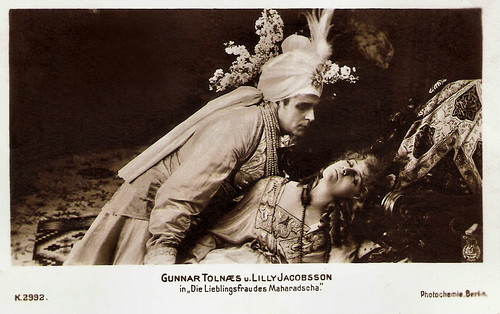
German postcard by Photochemie, Berlin, no. K. 2992. Photo: Nordisk Film. Gunnar Tolnaes and Lilly Jacobsson in Maharadjahens Yndlingshustru II / The Maharaja's Favourite Wife II (August Blom, 1919).
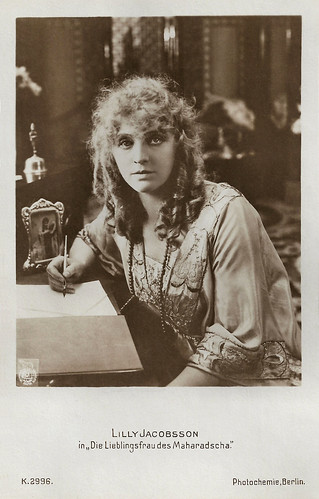
German postcard by Photochemie, Berlin, no. K. 2996. Photo: Nordisk Film. Lilly Jacobsson in Maharadjahens Yndlingshustru II / The Maharaja's Favourite Wife II (August Blom, 1919).
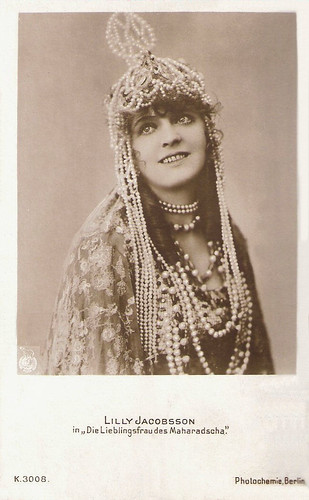
German postcard by Photochemie, Berlin, no. K. 3008. Photo: Nordisk Film. Lilly Jacobsson in Maharadjahens Yndlingshustru II / The Maharaja's Favourite Wife II (August Blom, 1919).
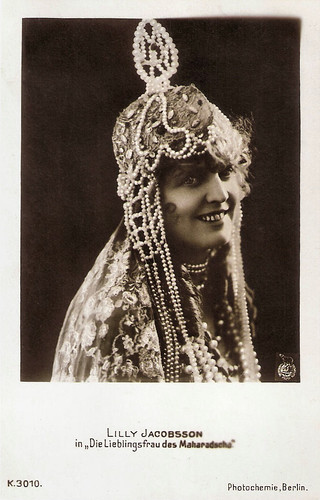
German postcard by Photochemie, Berlin, no. K. 3010. Photo: Nordisk Film. Lilly Jacobsson in Maharadjahens Yndlingshustru II / The Maharaja's Favourite Wife II (August Blom, 1919).
Sources: Wikipedia (Danish and Swedish), and IMDb.
Swedish postcard by Förlag Nordisk Konst, Stockholm. Photo: Nordisk Films Kompagni, Copenhagen. Collection: Geoffrey Donaldson Institute.
German postcard by Photochemie, Berlin, no. K. 3007. Photo: Nordisk Film.
German postcard by Photochemie, Berlin, no. K. 2147. Photo: Nordisk Film. Lilly Jacobsson as Marya, the Martian leader's daughter, in Himmelskibet / Das Himmelschiff (Holger-Madsen, 1918).
German postcard by Photochemie, Berlin, no. K. 3009. Photo: Nordisk Film.
German postcard by Ross Verlag, Berlin, no. 644/6. Photo: Art-Film / Asta Nielsen-Film. Asta Nielsen as Hamlet and Lilly Jacobsson as Ophelia in Hamlet (Svend Gade, Heinz Schall, 1921).
The Lusitania and the Titanic
Lilly Jacobsson (also written as Jacobson) was born in Göteborg, Sweden, in 1893. She made her film debut at AB Svenska Biografteatern in 1911 and collaborated with various Swedish filmmakers until 1914. First, she played in films by Eric Malmberg, with him often in the male lead. Her first film was Opiumhålan / The Opium Den (Eric Malmberg, 1911). It was shot in various Swedish cities such as her native town Göteborg, but also in Paris, Monte Carlo and aboard the SS Lusitania, going to New York.
Her next film, Bränningar eller Stulen lycka / Burnings or Stolen Luck (Eric Malmberg, 1912) repeated the pick of locations, again including a transatlantic trip with the Lusitania. The third film of Jacobsson and Malberg, Det gröna halsbandet / The Green Necklace (Eric Malmberg, 1912) was completely filmed in Göteborg.
Jacobsson then played the female lead in a film by Georg af Klercker: Musikens makt / The Power of Music (1912), again partly shot in Göteborg. Next came the farce Kolingens galoscher / Kolingen’s Boots (Eric Malmberg, 1912), in which Jacobsson played a millionaire's daughter.
It was then time for another transatlantic trip, resulting in Samhällets dom / The Judgment of Society (1912), aboard the Lusitania to New York. The trip also resulted in a short documentary Med Lusitania till Amerika / Med 2.300 Passagerare ofver Atlanten. Samhällets dom was released in February 1912, two months before the sinking of the SS Titanic.
The documentary was released one week after the naval disaster. Malmberg and Jacobsson then exploited their ocean trip for Tva svenska emigranters äfventyr i Amerika / The Adventures of Two Swedish Emigrants in America (1912), which also included shots made in New York and at Niagara Falls.
Swedish postcard by Förlag Nordisk Konst, Stockholm, no. 1006. Photo: Nordisk Films Kompagni, Copenhagen. Lilly Jacobsson in Maharadjahens Yndlingshustru / The Maharaja’s Favourite Wife (Robert Dinesen, Svend Gade, 1917). Collection: Geoffrey Donaldson Institute.
Swedish postcard by Förlag Nordisk Konst, Stockholm, no. 1007. Photo: Nordisk Films Kompagni, Copenhagen. Lilly Jacobsson in Maharadjahens Yndlingshustru / The Maharaja’s Favourite Wife (Robert Dinesen, Svend Gade, 1917). Collection: Geoffrey Donaldson Institute.
Swedish postcard by Förlag Nordisk Konst, Stockholm, no. 1008. Photo: Nordisk Films Kompagni, Copenhagen. Lilly Jacobsson in Maharadjahens Yndlingshustru / The Maharaja’s Favourite Wife (Robert Dinesen/ Svend Gade, 1917). Collection: Geoffrey Donaldson Institute.
German postcard by Photochemie, Berlin, no. K 2028. Photo: Union-Film / Nordisk Film. Lilly Jacobson (Lilly Jacobsson) in Testamentets Hemmelighed / The Secret of the Testament (Holger-Madsen, 1918). The German film title was Das trennende Band.
German postcard by Photochemie, Berlin, no. K 2029. Photo: Union-Film / Nordisk Film. Hugo Bruun (also Hugo Brunn) and Lilly Jacobson (Lilly Jacobsson) in Testamentets Hemmelighed / The Secret of the Testament (Holger-Madsen, 1918).
Tell from the war dogs school
Back in Sweden, Lilly Jacobsson played the female lead as the daughter opposite Anna Norrie as the mother, in Mauritz Stiller’s debut as a film director: Mor och dotter/Mother and Daughter (1912). Next came Stiller’s När larmklockan ljuder/When the Alarm Bell Rings (Mauritz Stiller, 1913). The film was partly shot in and around the Swedish town of Sollefteå. Officers and soldiers of the local regiment, Kungl Västernorrlands, collaborated as extras, while the Airedale terrier Tell from the war dogs school also had a part in the film.
Stiller and Jacobsson worked together for a third time at Gränsfolken/Brother Against Brother (Mauritz Stiller, 1913), based on Emile Zola’s 'Le débacle' (The Debacle). The film had a huge international release. For a long time, Gränsfolken / Brother Against Brother was considered lost until a print was found in Poland in 2009.
Stiller and Jacobsson then did När svärmor regerar / When the Mother-in-Law Reigns (Mauritz Stiller, 1914). It was based on a Finnish play which Stiller had directed on stage. In their next film, För sin kärleks skull / Because of her love (Mauritz Stiller, 1914), Jacobsson had a secondary role – the female lead was for Lilly Bech (or Beck) - while the male lead was for Victor Sjöström.
Jacobsson then acted in another Af Klercker film: För fäderneslandet / For the Fatherland (Georg af Klercker, 1914), shot in Svenska Bio’s film studio in Stockholm, and in a studio in Copenhagen, while exteriors were filmed in Sollefteå.
Jacobsson returned to Stiller for Stormfågeln / Stormy Petrel (Mauritz Stiller, 1914), with Bech again in the female lead. It was shot both in Stockholm and in and around the train station of Åre. Lilly Jacobsson’s penultimate Swedish film was Strejken / Strike (Mauritz Stiller, 1915), again with Victor Sjöström in the lead, while the last one was directed by Sjöström himself: En av de många / One of the Many (Victor Sjöström, 1915), which starred Gunnar Tolnaes and Lili Bech.
German postcard by Photochemie, Berlin, no. K. 2150. Photo: Nordisk Film. Lilly Jacobsson as Marya, the Martian leader's daughter, and Gunnar Tolnaes as Avanti Planetaros in Himmelskibet/400 Million Miles from Earth (Holger-Madsen, 1918). The German title was Das Himmelschiff.
German postcard by Photochemie, Berlin, no. K. 2151. Photo: Nordisk Film. Lilly Jacobsson as Marya, the Martian leader's daughter, and Gunnar Tolnaes as Avanti Planetaros in Himmelskibet/400 Million Miles from Earth (Holger-Madsen, 1918).
German postcard by Photochemie, Berlin, no. K. 2152. Photo: Nordisk Film. Lilly Jacobsson and Gunnar Tolnaes in Himmelskibet / 400 Million Miles from Earth (Holger Madsen, 1918).
German postcard by Photochemie, Berlin, no. K. 2153. Photo: Nordisk Film. Still from Himmelskibet / 400 Million Miles from Earth (Holger Madsen, 1918).
The Maharaja’s Favourite Wife
In 1916, the Danish company Nordisk was looking for a new star. Lilly Jacobsson was chosen from hundreds of competitors and became the leading actress in Maharadjahens Yndlingshustru / The Maharaja’s Favourite Wife (Robert Dinesen, Svend Gade, 1917), in which she performed as Elly, who enters the harem of an Indian maharaja, played by Gunnar Tolnaes.
The film was such a success that Nordisk Film made a sequel: Maharadjahens Yndlingshustru II/The Maharaja's Favourite Wife II (August Blom, 1919).
In between, Jacobsson played in various Danish films, mostly directed by Holger-Madsen. These films included the Science fiction film Himmelskibet/400 Million Miles From Earth (Holger-Madsen, 1918) starring Gunnar Tolnaes, Folkets ven/Friend of the People (Holger-Madsen, 1918), and Mod Lyset/Towards the Light (Holger-Madsen, 1918) starring Asta Nielsen. Nielsen plays a cold, partying woman who neglects religion, but later on, repents and becomes the wife of a preacher man (Alf Blütecher) who takes care of the poor.
In 1919, Lilly Jacobsson married director Corbett Edwards in Odense (Denmark), which ended her film career. Only her former colleague, Asta Nielsen, could persuade her to play Ophelia in Asta’s famous German production of Hamlet (Svend Gade, Heinz Schall, 1921), in which Nielsen played the title role herself.
Lilly Jacobsson died in 1979 in Odense, Denmark, at the age of 86. She is interred at the Assistenskirkegården in Odense.
German postcard by Photochemie, Berlin, no. K. 1475. Photo: Nordisk Film. Lilly Jacobsson in Maharadjahens Yndlingshustru / The Maharaja’s Favourite Wife (Robert Dinesen, Svend Gade, 1917)
German postcard by Photochemie, Berlin, no. K. 1976. Photo: Nordisk Film. Gunnar Tolnaes and Lilly Jacobsson in Maharadjahens Yndlingshustru / The Maharaja’s Favourite Wife (Robert Dinesen, Svend Gade, 1917).
German postcard by Photochemie, Berlin, no. K. 2992. Photo: Nordisk Film. Gunnar Tolnaes and Lilly Jacobsson in Maharadjahens Yndlingshustru II / The Maharaja's Favourite Wife II (August Blom, 1919).
German postcard by Photochemie, Berlin, no. K. 2996. Photo: Nordisk Film. Lilly Jacobsson in Maharadjahens Yndlingshustru II / The Maharaja's Favourite Wife II (August Blom, 1919).
German postcard by Photochemie, Berlin, no. K. 3008. Photo: Nordisk Film. Lilly Jacobsson in Maharadjahens Yndlingshustru II / The Maharaja's Favourite Wife II (August Blom, 1919).
German postcard by Photochemie, Berlin, no. K. 3010. Photo: Nordisk Film. Lilly Jacobsson in Maharadjahens Yndlingshustru II / The Maharaja's Favourite Wife II (August Blom, 1919).
Sources: Wikipedia (Danish and Swedish), and IMDb.