Showing posts with label Richard Burton. Show all posts

13 December 2018

Cleopatra (1963)

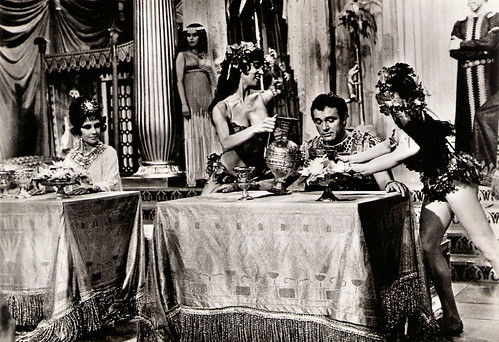
The American historical drama Cleopatra (Joseph L. Mankiewicz, 1963) chronicles the struggles of Cleopatra, the young Queen of Egypt, to resist the imperial ambitions of Rome. It achieved notoriety for its massive cost overruns and production troubles, which included changes in director and cast, a change of filming locale, sets that had to be constructed twice, lack of a firm shooting script, and personal scandal around co-stars Elizabeth Taylor and Richard BurtonCleopatra almost bankrupted 20th Century Fox, but was also the highest-grossing film of 1963, and it won four Academy Awards, and was nominated for five more, including Best Picture.
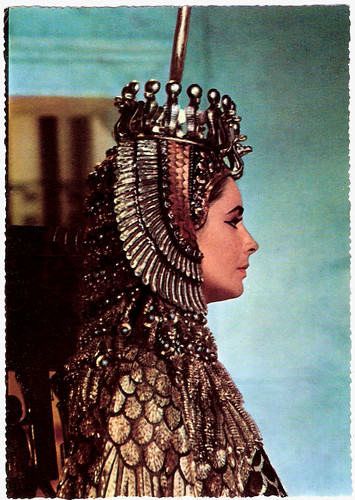
Elizabeth Taylor (1932-2011)
Elizabeth Taylor. Belgian postcard by SB (Uitgeverij Best), Antwerpen (Antwerp). Photo: still for Cleopatra (Joseph L. Mankiewicz, 1963).
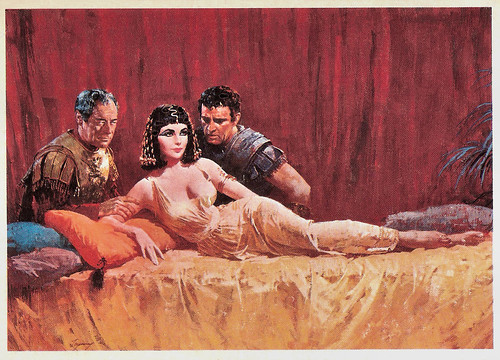
Rex Harrison, Elizabeth Taylor, Richard Burton in Cleopatra (1963)
Rex HarrisonElizabeth Taylor and Richard Burton. Vintage postcard. Image: poster art work for Cleopatra (Joseph l. Mankiewicz, 1963).
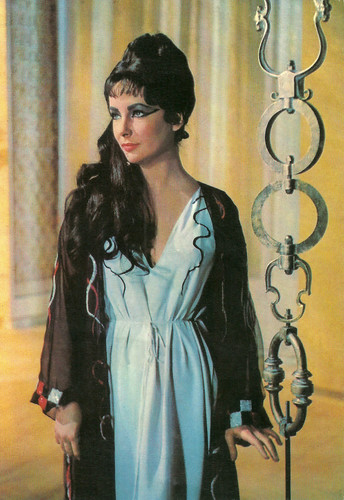
Elizabeth Taylor in Cleopatra (1963)
German postcard by ISV, no. A.104. Photo: 20th Century Fox. Elizabeth Taylor in the epic Cleopatra (Joseph Manckiewcz, 1963).

The triumph and tragedy of a legendary queen


Cleopatra (Joseph Mankiewcz, 1963) was based on a screenplay adapted by Mankiewicz, Ranald MacDougall and Sidney Buchman from a book by Carlo Maria Franzero. It tells the story of the legendary Queen Cleopatra VII of Egypt (Elizabeth Taylor), who experiences both triumph and tragedy as she attempts to resist the imperial ambitions of Rome.

In 48 B.C., Julius Caesar (Rex Harrison) has beaten Pompey the Great in a brutal civil war for control of the Roman Republic and pursues Pompey from Pharsalia to Egypt. Caesar learns that Pompey has fled to neutral Egypt, hoping to enlist the support of the young teenage Pharaoh Ptolemy XIII (Richard O'Sullivan).

Ptolemy, now supreme ruler of Egypt after deposing his older sister, Cleopatra, attempts to gain favour with Caesar by presenting the conqueror with the head of Pompey, borne by his governors, Pothinos (Grégoire Aslan) and Achillas (John Doucette). Caesar is not pleased. For him, it is a sorry end for a worthy foe.

To win Caesar's support from her brother, the young Cleopatra hides herself in a rug, which her servant Apollodorus (Cesare Danova), disguised as a rug peddler, presents to Caesar as a gift from Cleopatra. When a suspicious Caesar unrolls the rug, he finds Cleopatra herself concealed within. The Roman is immediately infatuated; banishing Ptolemy, he declares Cleopatra Egypt's sole ruler and takes her as his mistress.

The ambitious Cleopatra uses her charms to manipulate Caesar and to establish her authority. A year later, she bears him the son he never had, Caesarion, and strives that their son will take his rightful place in Rome. Cleopatra can almost taste Egypt's long-awaited union with Rome, and the formation of a mighty empire. Caesar, however, must return to Italy for his triumph.

Two years pass before the two see each other again. After he is made dictator for life, Caesar sends for Cleopatra. She arrives in Rome in a lavish procession and wins the adulation of the Roman people. On the Ides of March in 44 B.C., the Senate is preparing to vote on whether to award Caesar additional powers for the Republic. Despite warnings from his wife Calpurnia (Gwen Watford) and Cleopatra, he is confident of victory. However, he is stabbed to death by various senators. Octavian (Roddy McDowall), Caesar's nephew, is named as his heir, not Caesarion. Cleopatra returns home to Egypt leaving Rome in turmoil.

Two years later in 42 B.C., Caesar's assassins, among them Cassius (John Hoyt) and Brutus (Kenneth Haigh), are killed at the Battle of Philippi. The powerful Roman general Marc Antony (Richard Burton) establishes a Second Triumvirate government with Octavian and Lepidus. Antony will take control of the eastern provinces including Asia Minor and Syria. In 38 B.C., when Mark Antony, Caesar's protege, beholds the beautiful Cleopatra aboard her elaborate barge at Tarsus, he is smitten and becomes both her lover and military ally.

Octavian uses their affair in his smear campaign against Antony. When Antony returns to Rome to address the situation brewing there, Octavian traps him into a marriage of state to Octavian's sister, Octavia (Jean Marsh). The marriage satisfies no one. Cleopatra is infuriated. Antony, tiring of his Roman wife, soon returns to Egypt and divorces Octavia. IN Egypt, he marries Cleopatra in a public ceremony. It leads the two lovers to a personal and political demise.

Shocked and insulted, the Senators who had previously stood by Antony abandon their hero and vote for war. Octavian murders the Egyptian ambassador, Cleopatra's tutor Sosigenes (Hume Cronyn), on the Senate steps. Sensing Antony's weakness, Octavian attacks and defeats his forces at Actium in 31 B.C. Alarmed, Cleopatra withdraws her fleet and seeks refuge in her tomb. Realising Anthony and her son are death, she arranges to be bitten by a poisonous asp.

In the final shot, Octavian and Agrippa enter Cleopatra's temple afterwords to see her dead, dressed in a gold funeral robe with her two handmaidens, also bitten by the same venomous snake that Cleopatra allowed herself to get bitten, dying by her side. Octavian also finds a last letter from Cleopatra requesting to be buried with Marc Antony.
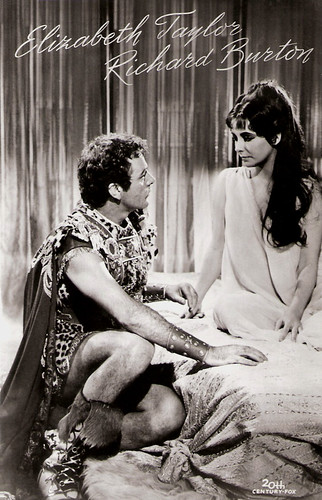
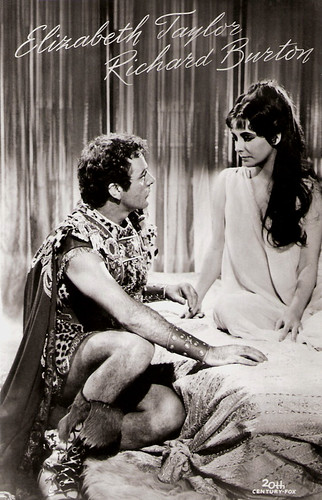
Richard Burton and Elizabeth Taylor in Cleopatra (1963)
Richard Burton and Elizabeth Taylor. German postcard by Filmbilder-Vertrieb Ernst Freihoff, Essen, no. AX 5536. Photo: publicity still for Cleopatra (Joseph L. Mankiewicz, 1963).
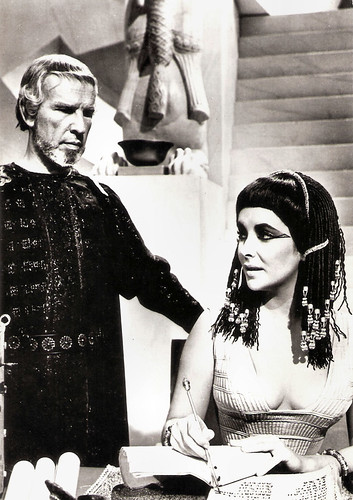
Elizabeth Taylor and Hume Cronyn in Cleopatra (1963)
Elizabeth Taylor and Hume Cronyn. Czech postcard by UPF, Praha / Press Photo. Photo: publicity still for Cleopatra (Joseph L. Mankiewicz, 1963).
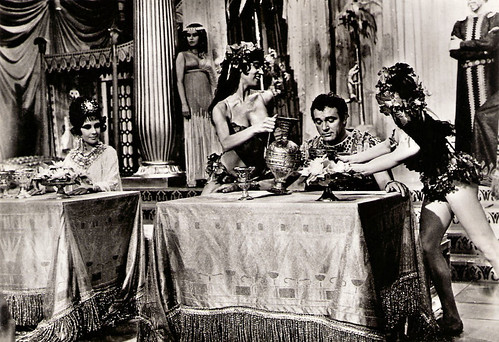
Richard Burton and Elizabeth Taylor in Cleopatra (1963)
Richard Burton and Elizabeth Taylor. Czech postcard by UPTF Pressfoto, Praha (Prague), no. S 206/7. Photo: publicity still for Cleopatra (Joseph L. Mankiewicz, 1963).

The most expensive film ever made


As the story of Cleopatra had proved a hit for silent-screen legend Theda Bara with Cleopatra (J. Gordon Edwards, 1917), and for Claudette Colbert with Cleopatra (Cecil B. De Mille, 1934), 20th Century Fox executives hired veteran Hollywood producer Walter Wanger in 1958 to shepherd a new remake into production. Although the studio originally sought a relatively cheap production of $2 million, Wanger envisioned a much more opulent epic, and in mid-1959 successfully negotiated a higher budget of $5 million.

Rouben Mamoulian was assigned to direct and Elizabeth Taylor was awarded a record-setting contract of $1 million. Filming began in England but in January 1961 Taylor became so ill that production was shut down. Sixteen weeks of production and costs of $7 million had produced just ten minutes of film. Fox was reimbursed by the insurance company and Mamoulian was fired.

Joseph L. Mankiewicz was brought on to the production after Mamoulian's departure and the set moved to Cinecittà, outside of Rome. Peter Finch and Stephen Boyd left the production owing to other commitments and were replaced by Rex Harrison and Richard Burton.

During filming, Taylor met Richard Burton and the two began an adulterous affair. The scandal made headlines worldwide, since both were married to others, and brought bad publicity to the already troubled production. Mankiewicz was later fired during the editing phase, only to be rehired to reshoot the opening battle scenes in Spain.

The cut of the film which Mankiewicz screened for the studio was six hours long. This was cut to four hours for its initial premiere, but the studio demanded (over the objections of Mankiewicz) that the film be cut once more, this time to just barely over three hours to allow theatres to increase the number of showings per day. Mankiewicz unsuccessfully attempted to convince the studio to split the film in two in order to preserve the original cut. These were to be released separately as Caesar and Cleopatra followed by Antony and Cleopatra.

Cleopatra ended up costing $31 million, making it the most expensive film ever made at the time, and almost bankrupted 20th Century Fox. It was also the highest-grossing film of 1963, earning box-office of $57.7 million in the United States (equivalent to $461 million now), yet lost money due to its production and marketing costs of $44 million (equivalent to $352 million now), making it the only film ever to be the highest-grossing film of the year to run at a loss. Cleopatra later won four Academy Awards, and was nominated for five more, including Best Picture which it lost to the British adventure-comedy Tom Jones (Tony Richardson, 1963).

On 21 May 2013, the restored film was shown at a special screening at the 2013 Cannes Film Festival, to commemorate its 50th anniversary. It was later released as a 50th-anniversary version available on DVD and Blu-ray. Unfortunately Fox had long ago destroyed all of the trims and outs from negatives to save costs, preventing the release of traditional outtakes.

Derek Armstrong at All Movie: "Cleopatra is an interesting study in contradictions, as both a dud that won five Oscars and a lavish production that wastes most of its time on scenes of talking heads. Unfortunately, it's also not a 246-minute movie that breezes by; any modern viewer brave enough to sit through its four hours will feel the passage of every minute, with little ultimate reward for the time spent. The leads all acquit themselves admirably, especially Rex Harrison as Caesar, but viewers better acquainted with these characters through Shakespeare's lyrical language will lament the all-too-ordinary and sometimes anachronistic dialogue that comprises Joseph L. Mankiewicz's film. Elizabeth Taylor shines like the star she was, jumping in and out of dozens of ornate costumes, many of which hug her figure tightly, in a way that was provocative at the time. But she's a little too petulant and melodramatic to ultimately be taken seriously."

D.B DuMonteil at IMDb calls the film a 'visual poem, a feast for the eye and for the mind': "it was one of the most underrated Hollywood epics. First of all,it's only partially an epic: most of the scenes are intimate,generally two characters who are constantly tearing each other apart. Joseph L. Mankiewicz, one of the most intelligent director of his time, rewrote the dialogue during the shooting, night after night, and the results are stunning, considering the difficulties he encountered with his budget and his stars. Cleopatra's dream is perfectly recreated, much better than in De Mille's version."
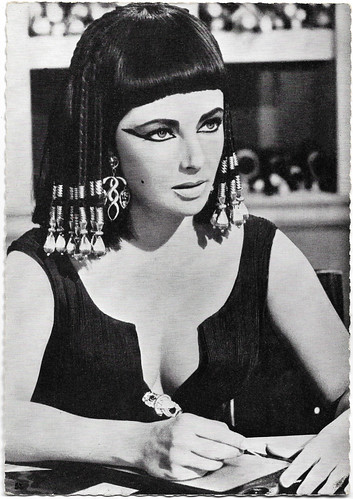
Elizabeth Taylor in Cleopatra (1963)
Elizabeth Taylor. German postcard by Filmbilder-Vertrieb Ernst Freihoff, Essen, no. 824. Photo: Cleopatra / Centfox. Publicity still for Cleopatra (Joseph L. Mankiewicz, 1963).
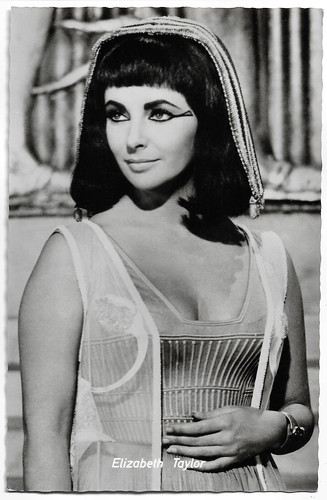
Elizabeth Taylor in Cleopatra (1963)
German postcard by Kolibri-Verlag, Minden/Westf., no. 1657. Photo: Centfox. Publicity still for Cleopatra (Joseph L. Mankiewicz, 1963).
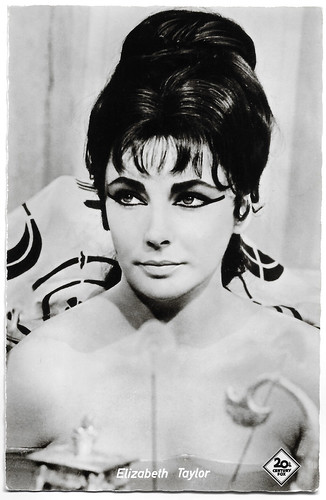
Elizabeth Taylor in Cleopatra (1963)
German postcard by Kolibri-Verlag, Minden/Westf., no. 1866. Photo: Centfox. Publicity still for Cleopatra (Joseph L. Mankiewicz, 1963).
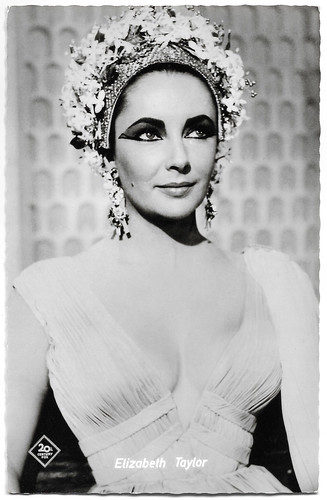
Elizabeth Taylor in Cleopatra (1963)
German postcard by Kolibri-Verlag, Minden/Westf., no. 2163. Photo: Centfox. Publicity still for Cleopatra (Joseph L. Mankiewicz, 1963).
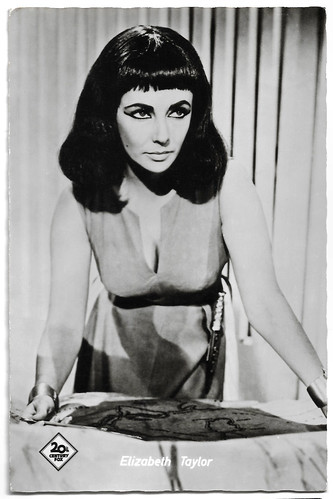
Elizabeth Taylor in Cleopatra (1963)
German postcard by Kolibri-Verlag, Minden/Westf., no. 2312. Photo: Centfox. Publicity still for Cleopatra (Joseph L. Mankiewicz, 1963).
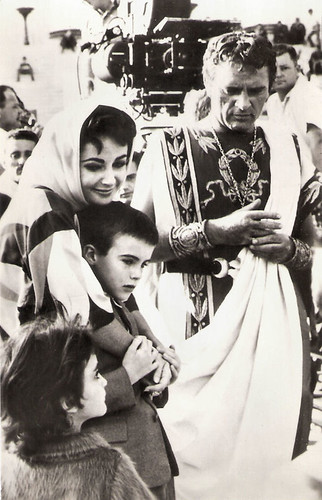
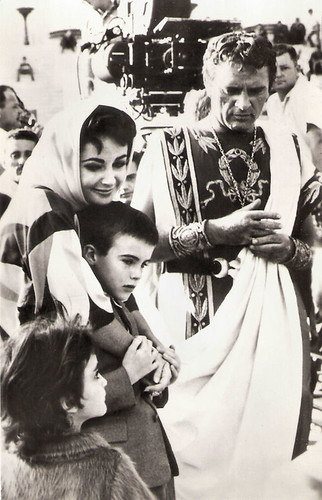
Richard Burton and Elizabeth Taylor at the set of Cleopatra (1962)
Richard Burton and Elizabeth Taylor. Czech collectors card by Pressfoto, Praha (Prague), no. S 229/2 769. Photo: a 1962 set photo of Cleopatra (Joseph L. Mankiewicz, 1963).
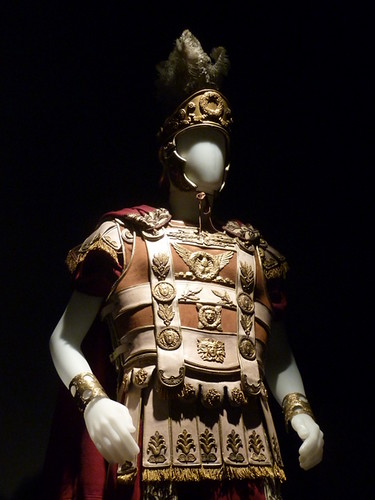
Cinecittà, Rome
Costume of Richard Burton in Cleopatra (Joseph Mankiewicz, 1963), Cinecittà, Roma. Photo: Ivo Blom.
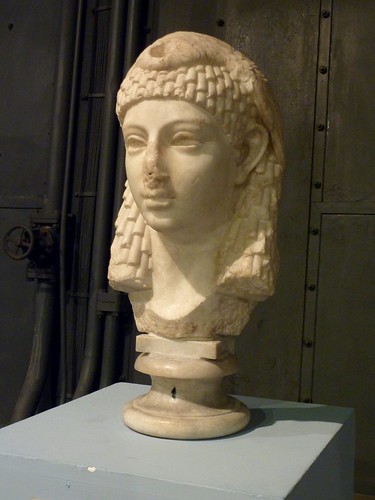
Centrale Montemartini, Cleopatra
Portrait of Cleopatra. Hellenistic age. Found at the Via Labicana, Rome (1886). Centrale Montemartini Rome, Machine Hall. Photo: Ivo Blom.

Sources: Derek Armstrong (AllMovie), D.B DuMonteil (IMDb), Wikipedia and IMDb.

20 March 2017

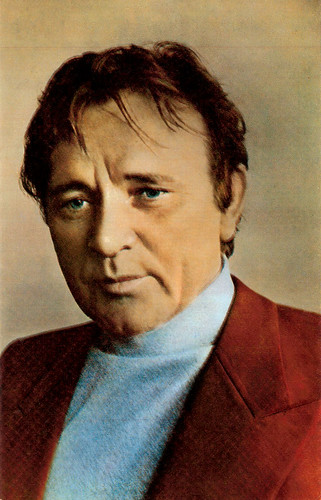
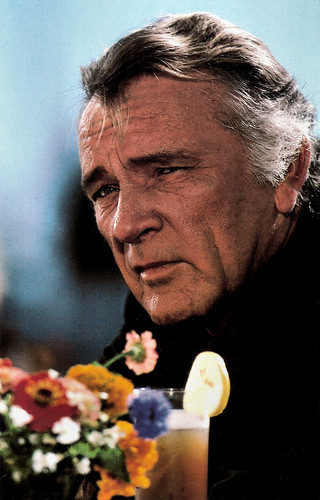
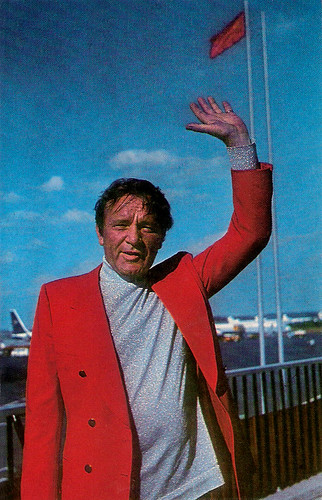
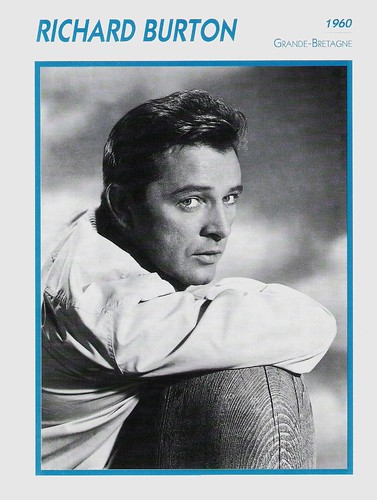
Richard Burton

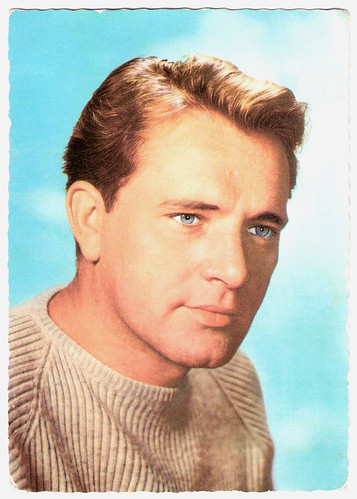
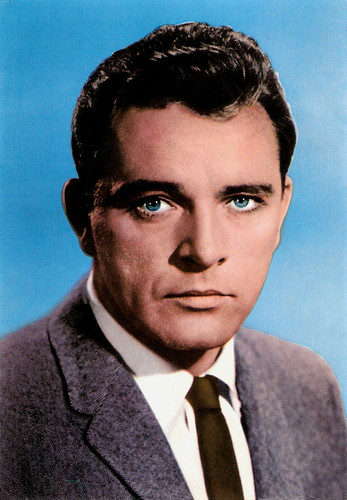
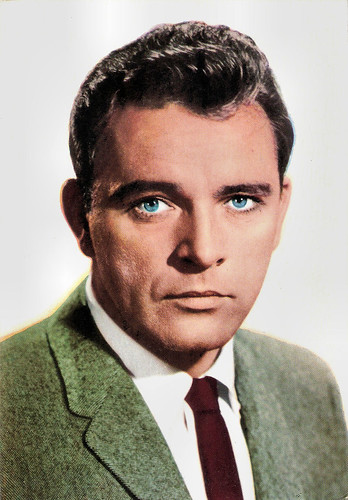
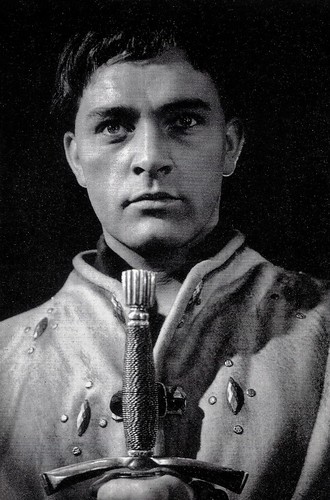
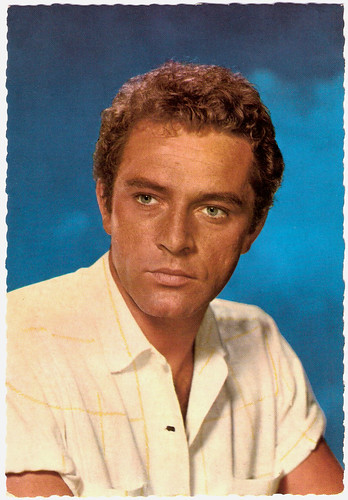
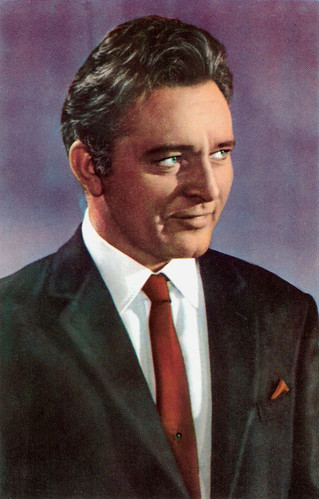
Richard Burton (1927–1984) was one of the great British actors of the post World War II period. Although never trained as an actor, he became famous on stage in most of the plays by William Shakespeare. Blessed with a thrillingly theatrical voice, Burton also became, at one time, the highest-paid film actor in the world. He was nominated seven times for an Academy Award, six of which were for Best Actor in a Leading Role (without ever winning), and he was a recipient of BAFTA, Golden Globe and Tony Awards for Best Actor. His adulterous romance with Elizabeth Taylor became an international scandal and their two tempestuous marriages were covered in detail by the Paparazzi.

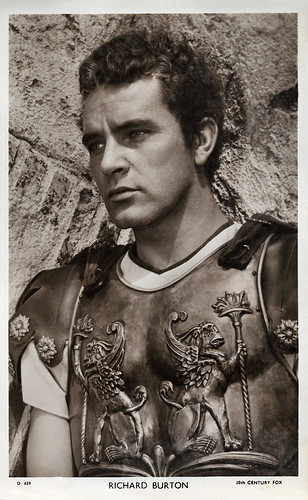
Richard Burton
French postcard by ISV / Huit, no. B 9. Photo: 20th Century Fox. Publicity still for Sea Wife (Bob McNaught, 1957).

Richard Burton
Spanish postcard by Postalcolor, Barcelona, no. 35, 1963.

Richard Burton
Spanish postcard by Postal Oscarcolor, no. 118.

An impoverished Welsh living


Richard Burton was born Richard Walter Jenkins in the village of Pontrhydyfen, Wales in 1925. He was the twelfth of thirteen children. His father, Richard Walter Jenkins, was a short, robust coal miner, a ‘twelve-pints-a-day man’.

Burton was less than two years old in 1927 when his mother, Edith Maude (née Thomas), died at the age of 43 after giving birth to her 13th child. His sister Cecilia ‘Cis’ and her husband Elfed took him into their Presbyterian mining family in nearby Port Talbot (an English-speaking steel town). He grew up speaking Cymraeg (Welsh) as well as English. His 19 year older brother Ifor became his de facto father figure, and in later years, his assistant and boon companion.

Burton showed a talent for English and Welsh literature at grammar school, and demonstrated an excellent memory, though his consuming interest was sports – rugby. He earned pocket money by running messages, hauling horse manure, and delivering newspapers. He started to smoke at the age of eight and to drink regularly at twelve. He believed that the way out of an impoverished Welsh living was to read, and he was always reading books.

Inspired by his schoolmaster, Philip H. Burton, he excelled in school productions, his first being The Apple Cart. The young man had spoken no English until the age of ten. Burton taught him to speak English without a Welsh accent, to read the classics, and to hold a knife and fork. Richard left school at sixteen for full-time work. He worked for the local wartime co-operative committee, handing out supplies in exchange for coupons, but then considered other professions for his future, including boxing, religion and singing.

When Jenkins joined the Port Talbot Squadron of the Air Training Corps as a cadet, he re-encountered Philip Burton, his former teacher, who was the commander. Burton rigorously schooled him in both literature and acting, even sending him to Welsh mountaintops to work on voice projection. After receiving his school certificate, Richard was accepted to Exeter College at Oxford for a special term of study. In order to gain admittance as an undergraduate, Philip Burton was required to adopt the young man; after discovering that it was legally impossible to do so, he made Richard his ward, and changed his surname to Burton.

Before leaving for Exeter, Burton made his professional acting debut in the play The Druid's Rest in 1944. The show was successful enough to move to London, where he received his first positive review in the New Statesman magazine. Those words would solidify Burton's resolve to become an actor.

While at Exeter, he appeared in his first significant Shakespearean role - Angelo in Measure for Measure - before an audience that included such important theatrical figures as John Gielgud and Terence Rattigan. Subsequently he served in the RAF (1944–1947) as a navigator.  In 1947, after his discharge, Burton went to London to seek his fortune. He immediately signed up with a theatrical agency to make himself available for casting calls. His first film was The Last Days of Dolwyn (Russell Lloyd, Emlyn Williams, 1949), set in a Welsh village about to be drowned to provide a reservoir.

Richard Burton as Prince Hal (1951)
British postcard in the Shakespeare Memorial Theatre series, no. 18. Photo: Angus McBean. Richard Burton as Prince Hal in the stage production of   Henry IV, Part I and Henry IV, Part 2, Stratford-upon-Avon, 1951.

He met his future wife, the young actress Sybil Williams, on the set, and they married in 1949. They had two daughters, and divorced in 1963 after Burton's widely reported affair with Elizabeth Taylor. In the years of his marriage to Sybil, Burton appeared in the West End in a highly successful production of The Lady's Not for Burning, alongside Sir John Gielgud and Claire Bloom, in both the London and New York productions.

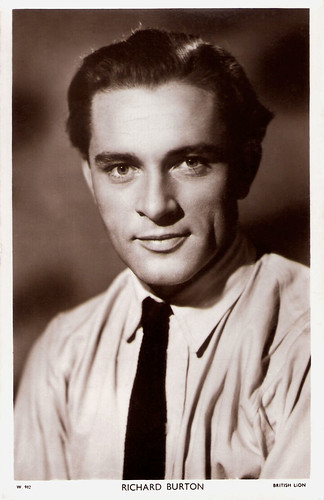
Richard Burton
British postcard in the Picturegoer series, London, no. W 912. Photo: British Lion.

Richard Burton and Claire Bloom in Hamlet (1954)
Danish postcard by Kaj Brammers Boghandel, Helsingor, no. 748. Photo: publicity still for the stage production of Hamlet at the Hamletspillene in Kronborg, 1954. Richard Burton as Hamlet and Claire Bloom as Ophelia.

Richard Burton
German postcard by WS-Druck, Wanne-Eickel, no 226. Offered by Macaroni Honig, Gent (Belgium). Photo: Centfox.

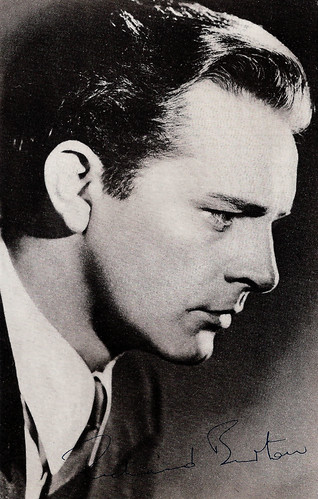
Richard Burton
British postcard in the Film Star Autograph Portrait series by Celebrity Publishers, London, no. 79.

A Watchful Brooding Intensity


Richard Burton had small parts in various low-key British films: Now Barabbas (Gordon Parry, 1950) starring Richard Greene, Waterfront (Michael Anderson, 1950) with Robert Newton, The Woman with No Name (Ladislao Vajda, 1951) featuring Phyllis Calvert, and a bigger part as a smuggler in the B-film Green Grow the Rushes (Derek N. Twist, 1951). He displayed a watchful brooding intensity in these films.

In the 1951 season at Stratford, he gave a critically acclaimed performance and achieved stardom as Prince Hal in Shakespeare's Henry IV, Part 1 opposite Anthony Quayle's Falstaff. Burton was already demonstrating the same independence and competitiveness as an actor that he displayed off-stage in drinking, sport, or story-telling. He was admitted to the post-War British acting circle which included Anthony Quayle, John Gielgud, Michael Redgrave, Hugh Griffith and Paul Scofield.

The following year, Burton signed a five-year contract with Alexander Korda at £100 a week, launching his Hollywood career. On the recommendation of Daphne du Maurier, he was given the leading role in the mystery-romance My Cousin Rachel (Henry Koster, 1952) opposite Olivia de Havilland. Burton arrived on the Hollywood scene at a time when the studios were struggling. Television's rise was drawing away viewers and the studios looked to new stars and new film technology to staunch the bleeding. 20th Century Fox negotiated with Korda to borrow him for this film and a further two at $50,000 a film. My Cousin Rachel was a critical success. It established Burton as a Hollywood leading man and won him his first Academy Award nomination and the Golden Globe Award for New Star of the Year – Actor.

In the wartime action-drama The Desert Rats (Robert Wise, 1953), Burton plays a young English captain in the North African campaign during World War II who takes charge of a hopelessly out-numbered Australian unit against the indomitable Field Marshal Erwin Rommel (James Mason). Then he created a sensation by starring in the biblical epic The Robe (Henry Koster, 1953), the first film to premiere in the wide-screen process CinemaScope. The film was a colossal hit, it gave Burton his second Oscar nomination, and minted him as a genuine movie star.

Burton was offered a seven-year, $1 million contract by Darryl F. Zanuck at Fox, but he turned it down, though later the contract was revived and he agreed to it. Between 1953 and 1956, he was juggling theatre with film, playing Hamlet and Coriolanus at the Old Vic theatre and alternating the roles of Iago and Othello with the Old Vic's other rising matinee idol John Neville. For his Henry V he won the Evening Standard drama award.

Known for his resonant voice he also gave frequent readings of classic works on BBC Radio. In 1954, Burton took his most famous radio role, as the narrator in the original production of Dylan Thomas' Under Milk Wood, a role he would reprise in the film version twenty years later.

Burton appeared on Broadway, receiving a Tony Award nomination for Time Remembered (1958) and winning the award for playing King Arthur in the musical Camelot (1960). The latter show went on to run for over 800 performances, and netted a total of four Tony Awards. He then put his stage career on the back burner to concentrate on film.

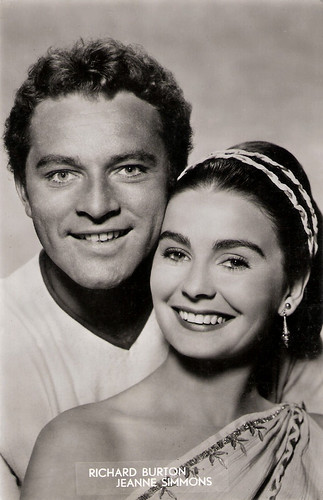
Richard Burton, Jean Simmons
French postcard. Photo: publicity still for The Robe (1953) with Jean Simmons.

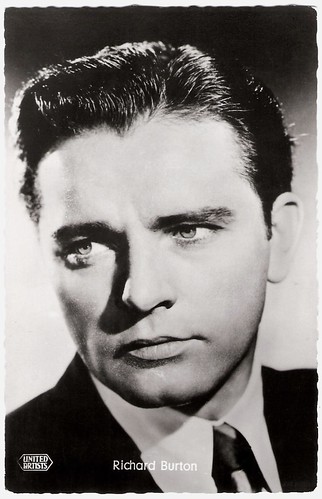
Richard Burton
German postcard by Kolibri-Verlag G.m.b.H., Minden/Westf., no. 2395. Photo: United Artists. Publicity still for Alexander the Great (1956).

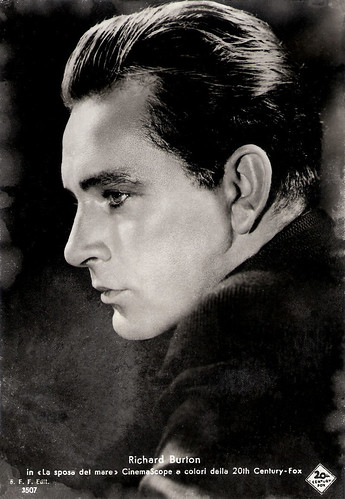
Richard Burton
Italian postcard by B.F.F. Edit. (Ballerini & Fratini, Firenze), no. 2507. Photo: 20th Century Fox. Publicity still for Sea Wife (Bob McNaught, 1957).

Richard Burton
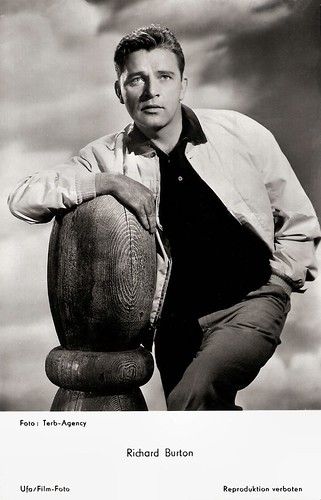
West-German postcard by Ufa, Berlin-Tempelhof, no. FK 4738. Photo: Terb-Agency.

Richard Burton
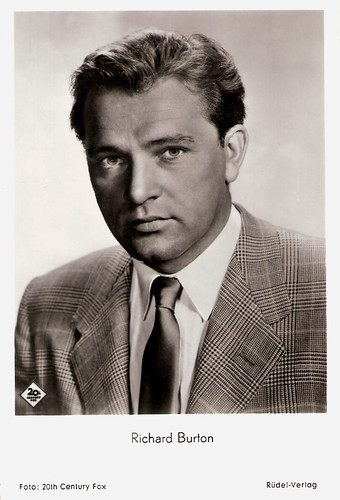
West-German postcard by Rüdel Verlag, Hamburg-Bergedorf, no 1453. Photo: 20th Century Fox.

Liz and Dick


In terms of critical success, Richard Burton's Hollywood roles throughout the 1950s did not live up to the early promise of his debut. Burton returned to Hollywood to star in The Prince of Players (Philp Dunne, 1955), another historical CinemaScope film, this time concerning Edwin Booth, famous American actor and brother of Abraham Lincoln's assassin John Wilkes Booth.

Next came Alexander The Great (Robert Rossen, 1956), with the handsome and self-assured Burton in the title role, on a loan out to United Artists, and again with Claire Bloom co-starring. Contrary to Burton's expectations, the ‘intelligent epic’ was a wooden, slow-paced flop.

In The Rains of Ranchipur (Jean Negulesco, 1955) Burton plays a noble Hindu doctor who attempts the spiritual recovery of an adulteress (Lana Turner). In Sea Wife (Bob McNaught, 1957), shot in Jamaica, a young Joan Collins plays a nun shipwrecked on an island with three men.

 For the British cinema the late 1950s was an exciting and inventive time, often referred to as the British New Wave, and Burton was right in the thick of things. In 1958, he was offered the part of Jimmy Porter, ‘an angry young man’ role, in the film version of John Osborne's play Look Back in Anger (Tony Richardson, 1959).

Hal Erickson writes at AllMovie: “His own film greatness would not manifest itself until he played the dirt-under-the-nails role of Jimmy Porter in Look Back in Anger (1959). In this, he spoke the vernacular of regular human beings - rather than that of high-priced, affected Hollywood screenwriters - and delivered a jolting performance as a working-class man trapped by the system and his own personal demons.” Although it didn't do well commercially, Burton was proud of the effort.

After playing King Arthur in Camelot on Broadway for six months, Burton was one of the ‘42 international stars’ that appeared in the massive World War II epic The Longest Day (Ken Annakin, Andrew Marton, Bernhard Wicki, 1962).

And then he replaced Stephen Boyd as Mark Antony in the troubled production Cleopatra (Joseph L. Mankiewicz, 1963). Twentieth Century Fox's future appeared to hinge on what became the most expensive movie ever made up until then. During the filming, Burton met and fell in love with Elizabeth Taylor, who was married to Eddie Fisher. Such was the scandal surrounding the Burton-Taylor romance that the U.S. State Department was requested to revoke Burton's visa on grounds that he was ‘detrimental to the morals of the youth of our nation.’

The tidal wave of press about the very public affair only helped to bring the curious public to theatres, which made it the highest grossing film of the year - though still a financial disaster, since its $26 million in ticket sales could never cover its price tag (an estimated $40 million). Cleopatra proved to be the start of Burton's most successful period in Hollywood; he would remain among the top 10 box-office earners for the next four years.

He and Taylor would not be free to marry until 1964 when their respective divorces were complete. Their marriage was the start of a series of on-screen collaborations. In the first, The V.I.P.s (Anthony Asquith, 1964), Burton played a husband who tries to prevent his wife (Taylor) from leaving to join her lover (Louis Jourdan) in the VIP lounge of London Airport. It proved to be a box-office hit.

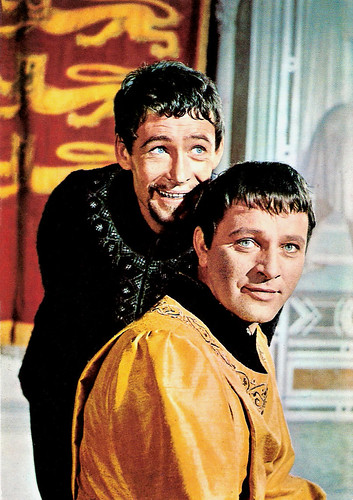
Liz and Dick, as they were known, lived on a grand scale. He bought her jewels, including a 69-carat Cartier diamond. They bought a yacht for $500,000. Then he portrayed the archbishop martyred by Henry II in the title role of Becket (Peter Glenville, 1964), turning in an effective, restrained performance, contrasting with Peter O'Toole's manic portrayal of Henry.

Burton triumphed as defrocked Episcopal priest Dr. T. Lawrence Shannon in Tennessee Williams' The Night of the Iguana (John Huston, 1964), a film which became another critical and box office success. Part of Burton's success in this film was due to how well he varied his acting with the three female characters, each of whom he tries to seduce differently: Ava Gardner (the randy hotel owner), Sue Lyon (the nubile American tourist), and Deborah Kerr (the poor, repressed artist).

He received a third Tony Award nomination when he reprised his Hamlet under John Gielgud's direction in 1964 in a production that holds the record for the longest run of the play in Broadway history (136 performances).

Richard Burton and Elizabeth Taylor in Cleopatra (1963)
German postcard by Filmbilder-Vertrieb Ernst Freihoff, Essen, no. AX 5536. Photo: publicity still for Cleopatra (Joseph L. Mankiewicz, 1963) with Elizabeth Taylor.

Richard Burton and Elizabeth Taylor at the set of Cleopatra (1962)
Czech collectors card by Pressfoto, Praha (Prague), no. S 229/2 769. Set photo of Cleopatra (Joseph L. Mankiewicz, 1963) with Elizabeth Taylor and her children.

Richard Burton and Elizabeth Taylor in Cleopatra (1963)
Czech postcard by UPTF Pressfoto, Praha (Prague), no. S 206/7. Photo: publicity still for Cleopatra (Joseph L. Mankiewicz, 1963) with Elizabeth Taylor.

Richard Burton and Elizabeth Taylor
Czech collectors card by Pressfoto, Praha (Prague), no. S 229/6 769, with Elizabeth Taylor.

Lush and rollicking


Richard Burton returned to the cinema as British spy Alec Leamas in The Spy Who Came in from the Cold (Martin Ritt, 1965). Burton and Taylor continued making films together though the next one, The Sandpiper (Vincente Minnelli, 1965), was poorly received.

Following that, he and Elizabeth Taylor were a great success in the film adaptation of the Edward Albee play Who's Afraid of Virginia Woolf? (Mike Nichols, 1966), in which a bitter erudite couple spend the evening trading vicious barbs in front of their horrified and fascinated guests, played by George Segal and Sandy Dennis. Burton was not the first choice for the role of Taylor's husband. Jack Lemmon was offered the role first, but when he backed off, Jack Warner, with Taylor's insistence, agreed on Burton and paid him his price. Although all four actors received Oscar nominations for their roles in the film (the film received a total of thirteen), only Taylor and Dennis went on to win.

Their lush and rollicking adaptation of Shakespeare's The Taming of the Shrew (Franco Zeffirelli, 1967), was a notable success. Later collaborations, however, The Comedians (Peter Glenville, 1967), Boom! (Joseph Losey, 1968), and the Burton-directed Doctor Faustus (Richard Burton, Nevill Coghill, 1967) (which had its genesis from a theatre production he staged and starred in at the Oxford University Dramatic Society) were critical and commercial failures.

He did enjoy a final commercial blockbuster with Clint Eastwood in Where Eagles Dare (Brian G. Hutton, 1968) but his last film of the decade, Anne of the Thousand Days (Charles Jarrott, 1969), was a commercial and critical disappointment. In spite of those failures, it performed remarkably well at that year's Academy awards (receiving ten nominations, including one for Burton's performance as Henry VIII), which many thought to be largely the result of an expensive advertising campaign by Universal Studios.

He was awarded the CBE (Commander of the Order of the British Empire) in the 1970 Queen's Birthday Honours List for his services to drama. He collected this award on his 45th birthday with his older sister Cis, who raised him as a child, and his wife Elizabeth Taylor. Due to Burton and Taylor's extravagant spending and his support of his family and others (42 people at one point), Burton agreed to work in mediocre films such as Bluebeard (Edward Dmytryk, Luciano Sacripanti, 1972) opposite Virna Lisi, Hammersmith Is Out (Peter Ustinov, 1972), and The Klansman (Terence Young, 1974) that hurt his career.

He recognised his financial need to do so, and that in the New Hollywood era of cinema he or Taylor would not soon again be paid as well as at the height of their stardom. The 1972 death of his brother Ifor cast him into a deep depression that brought his marriage to Taylor - once the gold standard for Hollywood unions - to an end in 1974.

Richard Burton
French postcard by E.D.U.G., no. 254.

Peter O´Toole, Richard Burton
Spanish postcard by Postal Oscarcolor, no. 279. Photo: Publicity shot for Becket (Peter Glenville, 1964) with Peter O'Toole.

Richard Burton
Israelian postcard by Editions de Luxe, no. 10.

Richard Burton
Russian postcard by Izdanije Byuro Propogandy Sovietskogo Kinoiskusstva, 1975. (This postcard was printed in an edition of 200.000 cards.)

Critically Reviled Films


After twelve years, Richard Burton returned to the stage in 1976 in Equus. He replaced Anthony Perkins as psychiatrist Martin Dysart dealing with a young, sexually troubled patient. He won a special Tony Award for his appearance, although he had to make Exorcist II: The Heretic (John Boorman, 1977) before Hollywood producers would allow him to repeat his role in the film version, Equus (Sidney Lumet, 1977). For this role he won the Golden Globe Award as well as an Academy Award nomination. Public sentiment towards his perennial frustration at not winning an Oscar made many pundits consider him the favourite to finally win the award, but on Oscar Night he lost to Richard Dreyfuss in The Goodbye Girl.

In 1976 Burton received a Grammy in the category of Best Recording for Children for his narration of The Little Prince by Antoine de Saint-Exupéry. He also found success in 1978, when he narrated Jeff Wayne's Musical Version of The War of the Worlds. His distinctive performance became a necessary part of the concept album – so much so that a hologram of Burton is used to narrate the live stage show (touring in 2006, 2007, 2009 and 2010) of the musical.

Burton had an international box office hit with The Wild Geese (Andrew V. McLaglen, 1978), an adventure tale co-starring Roger Moore, Richard Harris and Stewart Granger as mercenaries in Africa. He returned to appearing in critically reviled films like The Medusa Touch (Jack Gold, 1978) opposite Lino Ventura, Circle of Two (Jules Dassin, 1980), and opposite Laurence Olivier as Wagner (Tony Palmer, 1983), a role he said he was born to play, after his success in Equus.

He died shortly after the filming of Michael Radford's adaptation of George Orwell's Nineteen Eighty-Four (1984) was completed. Burton played O'Brien, a sinister member of a totalitarian government who tortured John Hurt's low-ranking office worker for the crime of free thought. He was in terrible health during filming from years of alcoholism and heavy smoking, and had to wear a neck brace during rehearsals. His performance as O'Brien in the film was one of his most critically acclaimed performances, and as well as one of his most underplayed.

Richard Burton was nominated six times for an Academy Award for Best Actor and once for an Academy Award for Best Supporting Actor – but he never won. Richard Burton was married five times and he had four children. From 1949 until their divorce in 1963, he was married to producer Sybil Williams, by whom he had two daughters, actress Katherine ´Kate´ Burton (1957) and Jessica Burton (1961), who was diagnosed as profoundly autistic and would eventually be institutionalised. He was married twice, consecutively, to Elizabeth Taylor, from 1964 to 1974 and from 1975 to 1976. In 1964, the couple adopted a daughter from Germany, Maria Burton (1961). Burton also adopted Taylor's daughter by the late producer Mike Todd, Elizabeth Frances ´Liza´ Todd Burton (1957). In August 1976, a month after his second divorce from Taylor, Burton married model Susan Hunt, the former wife of Formula 1 Champion James Hunt; the marriage ended in divorce in 1982. From 1983 until his death in 1984, Burton was married to make-up artist Sally Hay.

Richard Burton died at age 58 from a brain haemorrhage in 1984 at his home in Céligny, Switzerland, and is buried there. Posthumously the television miniseries Ellis Island (Jerry London, 1984) was shown. It co-starred Richard with his daughter Kate Burton. Brian McFarlane concludes in the Encyclopedia of British Cinema: “In a wayward career, almost as famous for his drinking and his marriages, Burton would intermittently remind audiences of what he could do.”

Richard Burton
American postcard by Coral-Lee, Rancho Cordova, no. CL/Personality # 71. Photo: Douglas Kirkland, 1981.

Richard Burton
German postcard by WS-Druck, Wanne-Eickel, no 226.


Trailer for Look Back In Anger (1959). Source: ChocolateFrogPrince (YouTube).


Trailer for Cleopatra (1963). Source: DameElizabethTaylor (YouTube).

Sources: Brian McFarlane (Encyclopedia of British Cinema), Hal Erickson (AllMovie), Kit and Morgan Benson (Find A Grave), TCM,  Wikipedia and IMDb.
19 August 2012

Jean Simmons

Demure, dark-haired English beauty Jean Simmons (1929 - 2010) was in the late 1940’s a box office attraction in films like Great Expectations (1946) and Hamlet (1948). In 1950 she moved to the US with her husband, Stewart Granger, and soon became a major Hollywood star who would be twice nominated for an Oscar.

Jean Simmons (1919-2010)
German postcard by Krüger / Ufa, no. 902/144. Photo: Terb Agency / Ufa.

Jean Simmons
German postcard by F.J. Rüdel Filmpostkartenverlag, Hamburg-Bergedorf, no. 115. Photo: J. Arthur Rank Organisation.

Jean Simmons
German postcard by ISV, no. A 26. Photo: 20th Century Fox.

Revered and Beloved
Jean Merilyn Simmons was born in London, England in 1929. Her father, a schoolteacher, helped Jean to start in a dancing school. Two weeks later the school was visited by producer Val Guest, who was looking for a ‘fresh face’ to play Margaret Lockwood's precocious sister in Give Us the Moon (1944, Val Guest). He had found her. Jean went on to make a name for herself in such major British productions as the G.B. Shaw adaptation Caesar and Cleopatra (1945, Gabriel Pascal), as the pretty, seductive and mischievous Estella in Great Expectations (1946, David Lean), as a sultry native beauty with a nosering in Black Narcissus (1947, Michael Powell, Emeric Pressburger), the original version of The Blue Lagoon (1949, Frank Launder), and the thriller So Long at the Fair (1950, Antony Darnborough, Terence Fisher) costarring Dirk Bogarde. For her role as Ophelia in Olivier’s adaptation of William Shakespeare's Hamlet (1948, Laurence Olivier), she earned a Best Supporting Actress Oscar nomination. Jean Simmons was revered and beloved by both the British critics and filmgoers. By the end of 1950, she was the #4 box office attraction, American or British, in British cinema. Only 20 and seemingly on top of the world, Jean soon had her own flat in London and the luxuries that stardom brings.

Jean Simmons
Dutch postcard by Uitg. Takken, Utrecht. Photo: J. Arthur Rank Organ.

Jean Simmons
French postcard by Editions P.I., Paris, no. 244. Photo: Victory Rank.

Legal Battle
In 1950, Jean Simmons married actor Stewart Granger, 16 years her senior. They had met when she played his adopted daughter in the romantic comedy Adam and Evelyne (1949, Harold French). Together they made the transition to Hollywood. Granger was under contract to Metro-Goldwyn-Mayer and would play Allan Quartermain, the Prisoner of Zenda and Scaramouche. The 21-years old Simmons found out that RKO head Howard Hughes had purchased the remaining six months of her Rank Studio contract. When Hughes claimed that an oral agreement with Rank precluded her from being loaned out to any other studio, she sued RKO. The legal battle raged for over a year. When the suit was finally settled, RKO had a three-year contract for Jean's services but was obligated to pay her $250,000 in addition to her legal fees. Furthermore, she won the right to work on loan to other studios at a substantial salary. David Thomson writes in his 2010-obituary in the Guardian: "The strange tycoon was obsessed with her personally, and he laid siege to her romantically and professionally so that she did not work for over a year. Only one thing emerged from the stand-off, Angel Face, in which she is a spoiled child and lethal temptress who seduces nearly everyone she meets (most notably Robert Mitchum). The brilliant picture was directed by Otto Preminger and photographed by the great veteran Harry Stradling. Thus it contains – and she sustains – some of the most luminous close-ups ever given to a femme fatale. How far she understood the picture is unclear. One can only say that it is a rare tribute to unrequited love."

Jean Simmons (1929-2010), Stewart Granger
Vintage postcard. Photo: MGM.

Jean Simmons
Dutch postcard by Uitg. Takken, Utrecht. Photo: Metro-Goldwyn-Mayer.

Film Noir
Among Jean Simmons' best-known Hollywood films are the biblical epic The Robe (1953, Henry Koster) with Richard Burton, The Egyptian (1954, Michael Curtiz) with Victor Mature, and The Big Country (1958, William Wyler) with Gregory Peck. She also starred in the Frank Sinatra / Marlon Brando musical Guys and Dolls (1955, Joseph L. Mankiewicz). She used her own singing voice and earned her first Golden Globe Award. Simmons divorced Granger in 1960 and almost immediately after married writer-director Richard Brooks, who cast her as Sister Sharon opposite Burt Lancaster in Elmer Gantry (1960), a memorable adaptation of the Sinclair Lewis novel. That same year she costarred with Kirk Douglas in Stanley Kubrick's Spartacus (1960) and played a would-be homewrecker opposite Cary Grant in The Grass Is Greener (1960, Stanley Donen).

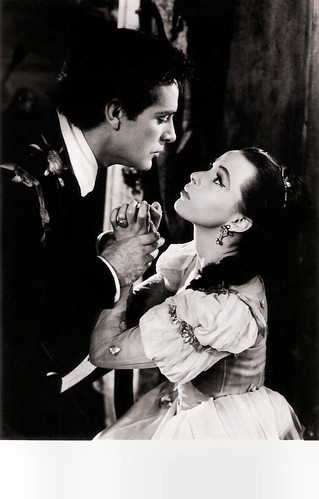
Richard Burton, Jean Simmons
French postcard. There may have been a fling with Burton, suggests David Thomson in his obituary in The Guardian.

Jean Simmons
Vintage postcard. Photo: Metro-Goldwyn-Mayer.

Jean Simmons
Collector's card. Photo: Centfox.

Depressed
Off the screen for a few years, Jean Simmons captivated moviegoers with a brilliant performance as the mother in All the Way Home (1963, Alex Segal), a literate, tasteful adaptation of James Agee's A Death in the Family. After that, however, she found quality projects somewhat harder to come by, and took work in Life at the Top (1965, Ted Kotcheff), Divorce American Style (1967, Bud Yorkin), and The Happy Ending (1969, Richard Brooks) for which she was again Oscar-nominated, this time as Best Actress. By the 1970's, she turned her focus to stage and television acting. In the theatre she appeared most notably as Desiree in the London premiere of Stephen Sondheim's A Little Night Music (1974) and she headlined the American national tour as well. She and Richard Brooks divorced in 1977. In the 1980’s she mainly appeared in TV mini-series, such as The Thorn Birds (1983, Daryl Duke) for which she won an Emmy Award, and North and South (1985, Richard T. Heffron). Becoming depressed at the lack of quality parts being offered her, Jean became addicted to alcohol. In 1986, she sought professional treatment. Jean made a comeback in the cinemas in How to Make an American Quilt (1995, Jocelyn Moorehouse), co-starring with Winona Ryder and Anne Bancroft. More recently she gave her voice to the elderly Sophie in the English version of the beautiful animation film Hauru no ugoku shiro/Howl’s Moving Castle (2004 Hayao Miyazaki). Her last film was Shadows in the Sun (2009, David Rocksavage) with James Wilby in which she was deeply touching as a dying poet. In 2003 she was made an OBE (Officer of the Order of the British Empire) for services to acting. Jean Simmons lived as a naturalized U.S. citizen in California, where she had been for the last fifty years. Jean Simmons passed away in 2010, at the age of 80. She had two children: a daughter with Stewart Granger, Tracy Granger, and a daughter with Richard Brooks, Kate Brooks.

Sources: David Thomson (The Guardian), kdhaisch (IMDb), Wikipedia, and IMDb.

23 April 2012

Irene Papas

Irene Papas (1926) is a Greek actress of international fame. In a career spanning more than fifty years, she starred in over seventy films, including such classics as The Guns of Navarone and Zorba the Greek. Papas also portrayed ancient Greek heroines as Helen in The Trojan Women, Clytemnestra in Iphigenia, Electra and Antigone.

Irene Papas
Mexican collector's card, no. 80. Photo: MGM. Publicity still for Tribute to a Bad Man (1956, Robert Wise).

Gutsy Resistance Fighter
Irene Papas (Greek Ειρήνη Παππά) was born as Eiríni Lelékou in Chilimodion, outside Corinth in Greece in 1926. At 12, she enrolled in a dramatic school. She spent her first professional years as a singer-dancer in stage reviews and as a radio vocalist In 1943 she married director Alkis Papas. Four years later the marriage ended in a divorce, but she kept his name. Papas rose to stardom acting in Greek films as the drama Hamenoi angeloi/Fallen Angels (1948, Nikos Tsiforos) and Nekri politeia/Dead City (1952, Frixos Iliadis). In Italy she played in the crime comedy Le Infedeli/Unfaithfuls (1953, Mario Monicelli, Steno) with Gina Lollobrigida, the American-Italian film noir The Man from Cairo (1954, Ray Enright) starring George Raft, and the epic adventures Teodora, imperatrice di Bisanzio/Theodora, Slave Empress (1954, Riccardo Freda) featuring Gianna Maria Canale, and Attila, Flagello di Dio/Attila (1954, Pietro Francisci, William Witney) with Anthony Quinn and Sophia Loren. Next stop was Hollywood, where Papas appeared for MGM in the big-budget western Tribute to a Bad Man (1956, Robert Wise) as the love interest of James Cagney. In Athens she was trained in the classics of Greece's Golden Age. She played all the major tragic stage roles, including Medea and Electra. In addition, she was active in the contemporary productions put on by the Greek Popular Theatre in the late 1950’s. She also featured in the film Bouboulina (1959, Kostas Andritsos) about the Greek heroine of 1821 (when Greek fought the Turks). Papas became best known to international filmgoers for her portrayals of gutsy resistance fighter Maria Pappadimos in the major box-office hit Guns of Navarone (1961, J. Lee Thompson); the widow in Alexis Zorbas/Zorba the Greek (1964, Michael Cacoyannis); and the wife of Yves Montand in the political thriller Z (1968, Costa-Gravas), which won the Oscar for Best Foreign Film of 1969. In between she starred in film adaptations of the classic Greek tragedies Antigoni/Antigone (1961, George Tzavellas, Dinos Katsouridis) and Ilektra/Electra (1962, Michael Cacoyannis), and she made her Broadway debut in That Summer, That Fall (1967).

Yves Montand
Yves Montand. French card by Editions Vianelly, Paris, nr. 7, 1968.

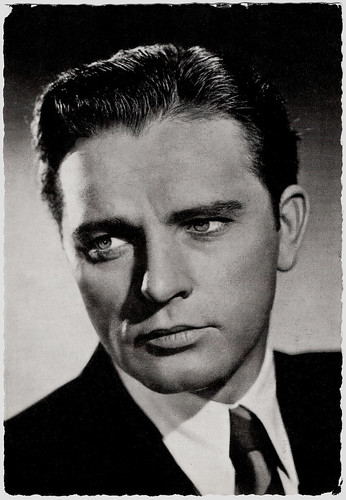
Richard Burton
Richard Burton. Russian postcard by Izdanije Byuro Propogandy Sovietskogo Kinoiskusstva, 1975. (This postcard was printed in an edition of 200.000 cards.)

Europe's woman
Irene Papas is an occasional singer. In 1969, she recorded 11 songs of Mikis Theodorakis, for the album Irene Papas Songs of Theodorakis. Papas and Theodorakis had worked together in 1964 on Alexis Zorbas/Zorba the Greek. In 1971 she contributed to a song of the concept album 666 of the Greek rock band Aphrodite's Child, with singer Demis Roussos and Vangelis Papathanassiou, who later became an Oscar-winning composer. With Vangelis, she also recorded Odes (1976), containing eight Greek folk songs, and Rapsodies (1986), an electronic rendition of seven Byzantine liturgical hymns. The songs and hymns were re-arranged by Vangelis. Both records have gained the status of classical music in Greece and are very popular around the Greek Orthodox Easter. In the cinema, she appeared as Catherine of Aragon in Anne of the Thousand Days (1969, Charles Jarrott), opposite Richard Burton and Geneviève Bujold. She also delivered award-winning performances in the ambitious Euripides adaptations directed by Michael Cacoyannis, playing Helen in The Trojan Women (1972) opposite Katharine Hepburn and Vanessa Redgrave, and Clytemnestra in Iphigenia (1977). In 1976, she starred opposite Anthony Quinn in Mohammad, Messenger of God/The Message (1976, Moustapha Akkad) about the origin of Islam, and the message of Mohammad. With Quinn, she reunited in Lion of the Desert (1982, Moustapha Akkad). Other interesting films were the Italian biopic, Cristo si e fermato a Eboli/Christ Stopped at Eboli (1979, Francesco Rosi) about prominent anti-fascist author Carlo Levi (Gian-Maria Volonté), and the Gabriel Garcia Marquez adaptations Erendira (1983, Ruy Guerra), and Cronaca di una Morte Annunciata/Chronicle of a Death Foretold (1987, Francesco Rosi) starring Rupert Everett and Ornella Muti. Her last film appearances were as Christian Bale’s mother in Captain Corelli's Mandolin (2001, John Madden), and as a tourist on a cruise ship in Um Filme Falado/A Talking Picture (2003, Manoel de Oliveira) with Catherine Deneuve. In 2002, she was named 'Europe's woman', a title given to women who offer a lot to European civilization. In her speech, she sang a Greek folklore song. According to IMDb she has no intention of returning to Greece to play in the theatre, because she has suffered from continuous negative criticisms. Irene Papas lives in Greece, Spain and Italy. She is the aunt of director-producer Manousos Manousakis and actor Aias Manthopoulos.


Trailer for The Guns of Navarone (1961). Source: IFILMuser (YouTube).


Trailer for Anne of the Thousand Days (1969). Source: OldHollywoodTrailers (YouTube).


Theatrical trailer for The Trojan Women (1972). Source: Robatsea2009 (YouTube).

Sources: AllMovie, Wikipedia and IMDb.