Today, Marilyn Monroe (1926-1962) would have turned 100. By 1953, she was one of the most marketable Hollywood stars, with leading roles in three films: the Film Noir Niagara, which focused on her sex appeal, and the comedies Gentlemen Prefer Blondes and How to Marry a Millionaire, which established her star image as a 'dumb blonde'. Although she played a significant role in shaping her public image throughout her career, she was disappointed by being typecast and underpaid by the studio. She was briefly suspended in early 1954 for refusing a film project, but returned to star in one of the biggest box office successes of her career, The Seven Year Itch (1955).
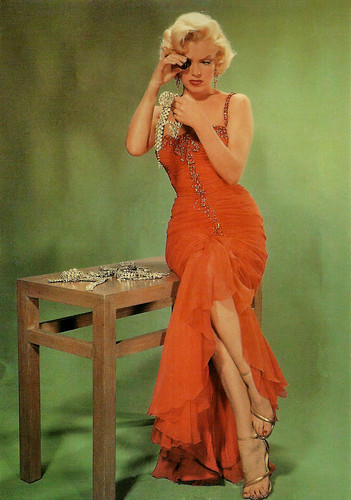
French postcard, no. Réf. Marilyn 97. Marilyn Monroe in Gentlemen Prefer Blondes (Howard Hawks, 1953).

American postcard by the American Postcard Co., NYC, no. 677.
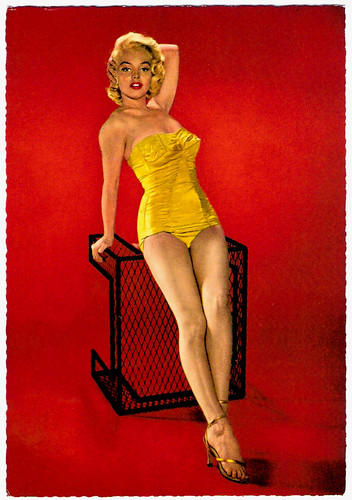
German postcard by ISV, Sort. VI/6.
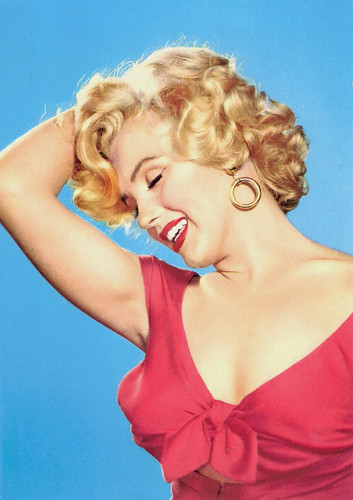
Italian postcard by Rotalcolor, Milano, no. 36. Photo: publicity still for Niagara (Henry Hathaway, 1953).
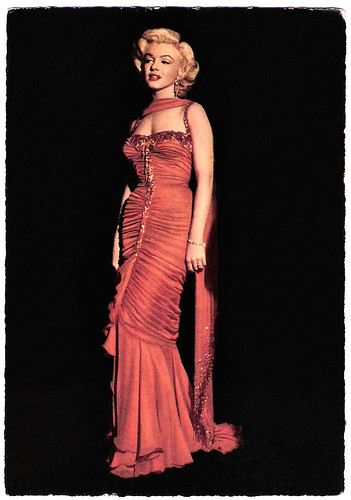
West German postcard by Krüger, no. 902/13. Photo: publicity still for Gentlemen Prefer Blondes (Howard Hawks, 1953).
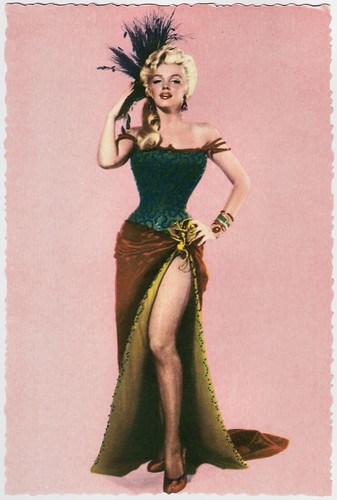
Spanish postcard by Archivo Bermejo, no. 7. Photo: 20th Century Fox. Publicity still for River of No Return (Otto Preminger, 1954).

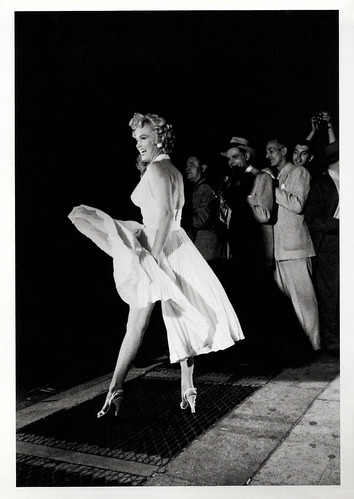
Swiss postcard by CVB Productions, Grandson / News Productions, no. CCP 46, 1996. Photo: Sam Shaw. Tom Ewell and Marilyn Monroe in The Seven Year Itch (Billy Wilder, 1955).

Postcard from the 'Marilyn Monroe Book of 30 Postcards' by Magna Books. Photo: The Hulton-Deutsch Collection. Marilyn Monroe in Let's Make Love (George Cukor, 1960).
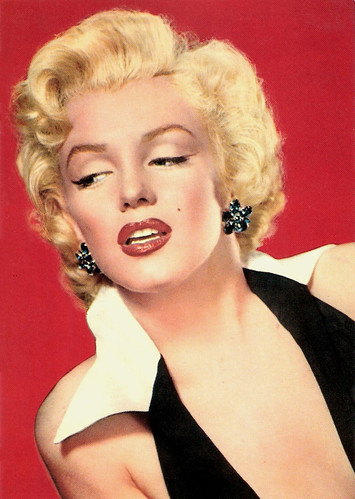
French postcard by Edition P.I., Paris, no. 1044.
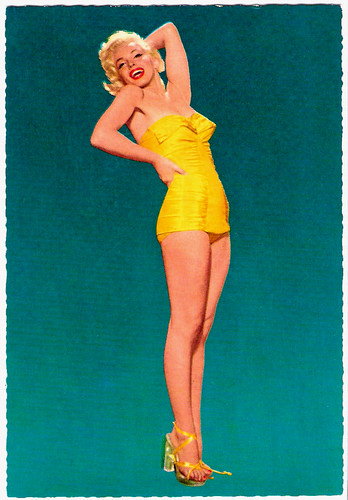
German postcard by ISV, Sort. VI/6.
Marilyn Monroe was born Norma Jeane Mortenson in 1926 in Lemmon, South Dakota. She was the third child of Gladys Pearl Baker née Monroe, who suffered from mental illness and later worked as a film-cutter at RKO. Marilyn was abandoned by her mother, and she spent most of her childhood in foster homes and an orphanage. Just after her 16th birthday, she married 21-year-old aircraft plant worker James 'Jim' Dougherty. In 1943, Dougherty enlisted in the Merchant Marine. He was initially stationed on Catalina Island, where she lived with him until he was shipped out to the Pacific in April 1944; he would remain there for most of the next two years.
While working in a factory as part of the war effort in 1944, Marilyn met photographer David Conover and began a successful modelling career. She began to occasionally use the name Jean Norman when working, and had her curly brunette hair straightened and dyed blond to make her more employable. As her figure was deemed more suitable for pin-up than fashion modelling, she was employed mostly for advertisements and men's magazines. By early 1946, she had appeared on 33 magazine covers for publications such as Pageant, U.S. Camera, Laff, and Peek. She divorced Dougherty in 1946. The work led to a screen test by 20th Century Fox executive and former film star Ben Lyon. Head executive Darryl F. Zanuck was unenthusiastic about it, but he was persuaded to give her a standard six-month contract to avoid her being signed by rival studio RKO Pictures.
Monroe began her contract in August 1946, and together with Lyon selected the screen name of Marilyn Monroe. Among her first film parts were nine lines of dialogue as a waitress in the drama Dangerous Years (Arthur Pierson, 1947) and a one-line appearance in the comedy Scudda Hoo! Scudda Hay! (F. Hugh Herbert, 1948). After a series of other minor film roles, she moved to Columbia. While at Fox, her roles had been those of a 'girl next door', at Columbia, she was modelled after Rita Hayworth. Monroe's hairline was raised by electrolysis, and her hair was bleached even lighter to platinum blond. She also began working with the studio's head drama coach, Natasha Lytess, who would remain her mentor until 1955. Her only film at the studio was the low-budget musical Ladies of the Chorus (Phil Karlson, 1948), in which she had her first starring role as a chorus girl who is courted by a wealthy man.
After leaving Columbia in September 1948, Monroe became a protégée of Johnny Hyde, vice president of the William Morris Agency. Hyde began representing her, and their relationship soon became sexual, although she refused his proposals of marriage. To advance Monroe's career, he paid for a silicone prosthesis to be implanted in her jaw and arranged a bit part in the Marx Brothers film Love Happy (David Miller, 1949). That year, she also made minor appearances in two critically acclaimed films: John Huston's crime film The Asphalt Jungle (1950) and Joseph Mankiewicz's drama All About Eve (1950). Following Monroe's success in these roles, Hyde negotiated a seven-year contract with 20th Century-Fox in December 1950.
Over the next two years, she became a popular actress with roles in several comedies, including As Young as You Feel (Harmon Jones, 1951) and Monkey Business (Howard Hawks, 1952) with Cary Grant, and in the dramas Clash by Night (Fritz Lang, 1952) and Don't Bother to Knock (Roy Ward Baker, 1952) with Richard Widmark. Her popularity with audiences was growing: she received several thousand letters of fan mail a week. The second year of the Fox contract saw Monroe become a top-billed actress, with gossip columnist Florabel Muir naming her the year's 'it girl' and Hedda Hopper describing her as the 'cheesecake queen' turned 'box office smash'. She began a highly publicised romance with retired New York Yankee baseball legend Joe DiMaggio, one of the most famous sports personalities of the era. A month later, Monroe faced a scandal when it was revealed that she had posed for nude photos before becoming a star, but rather than damaging her career, the story increased interest in her films.
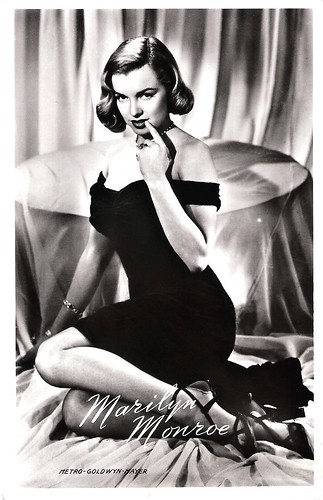
Dutch postcard by Uitg. Takken, Utrecht, no. 1708. Photo: Eric Carpenter / Metro-Goldwyn-Mayer. Publicity still for The Asphalt Jungle (John Huston, 1950).

French postcard by Travelling Editions, Paris, no. CP 59. Photo: 20th Century-Fox. Marilyn Monroe and Louis Calhern in The Asphalt Jungle (John Huston, 1950).

American postcard by The American Postcard Company Inc., no. F50, 1982. Photo: 20th Century-Fox. Marilyn Monroe in Love Nest (Joseph M. Newman, 1951). Caption: Marilyn as ex-WAC Roberta Stevens.

British postcard from 'Marilyn Monroe, 20 Classic Picture Postcards' by Bloomsbury Books, 1993. Photo: Frank Powolny / 20th Century Fox, 1952.
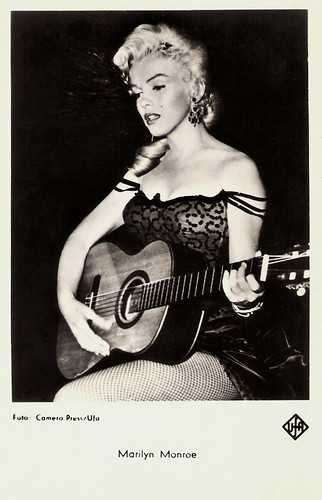
French postcard by Editions P.I., Paris, no. FK 3969. Photo: Camera Press / Ufa. Publicity still for River of No Return (Otto Preminger, 1954).
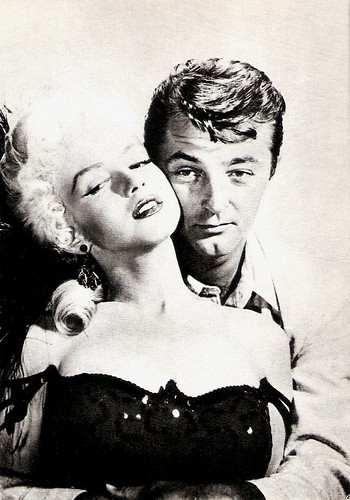
Vintage postcard. Photo: publicity still for River of No Return (Otto Preminger, 1954), with Robert Mitchum.
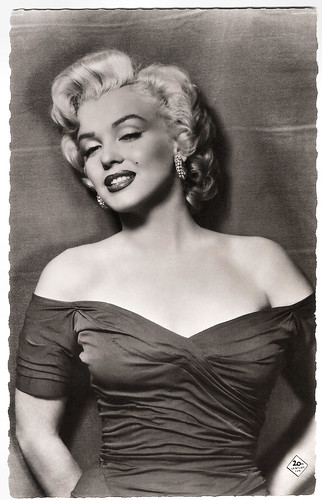
French postcard by Editions P.I., offered by Les Carbones Korès Carboplane, mo. 882. Photo: 20th Century Fox.
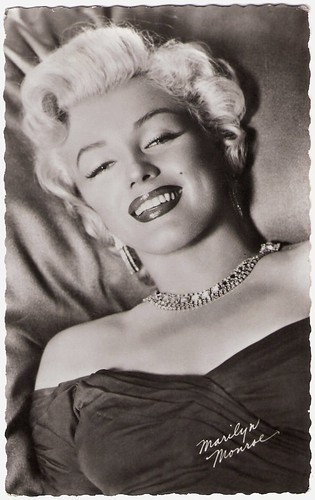
Dutch postcard by Int. Filmpers (IFP), Amsterdam, no. 1154.

British postcard by Santoro Graphics, London, no. BW 846. Photo: 20th Century-Fox. Marilyn Monroe in Niagara (Henry Hathaway, 1953).

American postcard by Classico San Francisco Inc., no. 232-005.
Before posing for her famous calendar shots taken by photographer Tom Kelley, Marilyn Monroe had turned down many offers to pose nude. It seems she accepted only when her need was dire and immediate. In early 1949, her contracts with 20th Century Fox and Columbia had not been renewed, she was out of work, and had a certain level of lifestyle to maintain. The $50 she was paid was exactly what she needed to get back her car, which had been impounded. The photographs that became the infamous 'Golden Dreams' calendar were taken on 27 May 1949. Kelley's wife, Natalie, helped to prepare the red velvet backdrop and the cameras. The shoot lasted two hours while Kelley shot a sequence of photographs from a ten-foot ladder.
Only two of the twenty-four shots Kelley took actually made it to print. 'A New Wrinkle' (pictured here) graced one Braugarth Company calendar, but the picture that captured a nation's imagination was 'Golden Dreams'. The story that Hollywood's hottest new property, Marilyn Monroe, was in fact the girl in the nude calendar was broken by wire journalist Aline Mosby in March 1952. The studio's initial reaction was to deny everything. No Hollywood star had ever been proven to have done such a thing; the early fifties were a time of strait-laced public morals. Biographers agree that Marilyn was instrumental in persuading the studio that their natural inclination to deny the whole thing was the wrong way to handle it. An exclusive interview was arranged, and the following confession ran in US newspapers on 13 March 1952.
MARILYN MONROE ADMITS SHE'S NUDE BLONDE OF CALENDAR
A photograph of a beautiful nude blonde on a 1952 calendar is hanging in garages and barbershops all over the nation today. Marilyn Monroe admitted today that the beauty is she. She posed, stretched out on rumpled red velvet for the artistic photo 3 years ago because "I was broke and needed the money". "Oh, the calendar's hanging in garages all over town," said Marilyn. "Why deny it? You can get one any place. Besides, I'm not ashamed of it. I've done nothing wrong." The beautiful blonde now gets a fat paycheck every week from an excited Twentieth Century-Fox studio. She's rated the most sensational sweater girl since Lana Turner....she lives in an expensive hotel room...She dines at Romanoff's.
But in 1949, she was just another scared young blonde, struggling to find fame in the magic city, and all alone. As a child, she lived in a Hollywood orphanage. She was pushed around among twelve sets of foster parents before she turned an insecure sixteen."I was a week behind on my rent," she explained. "I had to have the money. A photographer, Tom Kelley, had asked me before to pose, but I'd never do it. This time I called him and said I would. Tom didn't think anyone would recognise me. My hair was long then. But when the picture came out, everybody knew me. I'd never have done it if I'd known things would happen in Hollywood so fast for me."
In the aftermath of the calendar confession, Marilyn was harangued by journalists. In typical fashion, when asked if it was true she had nothing on when she posed, she replied, "Oh no, I had the radio on." In December 1953, a man named Hugh Hefner bought the rights to reproduce the 'Golden Dreams' photograph as the first centrefold in the first-ever issue of Playboy magazine.
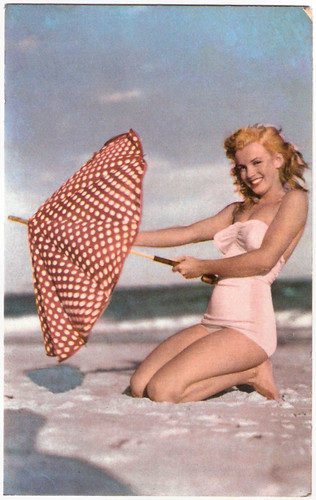
French postcard by JG, Paris, no. 603/5. Photo: Andre de Dienes, 1949.
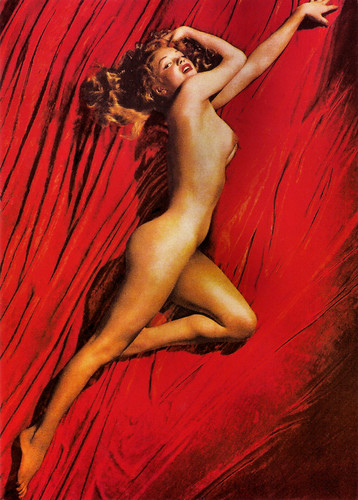
Modern postcard. Photo: Tom Kelley, 1949.
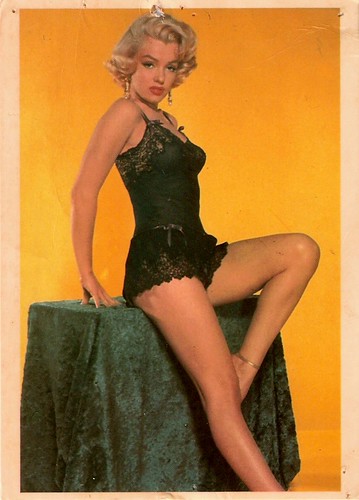
British postcard by Camden Graphics, nr. PC 443. Photo: Frank Powolny, 1951.
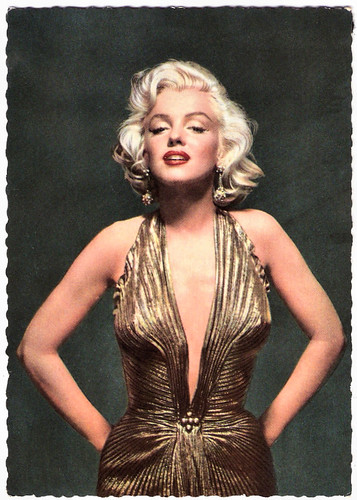
German postcard by Universum-Film Aktiengesellschaft (Ufa), Berlin-Tempelhof, no. CK-73. Photo: Gene Korman / 20th Century Fox, 1953.
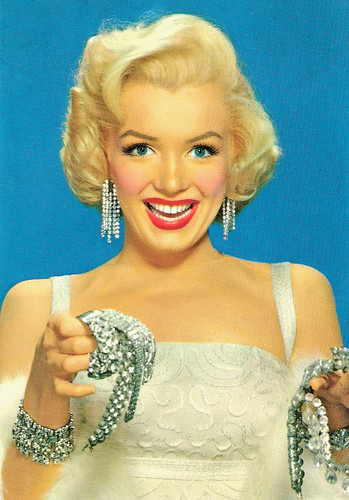
British postcard by Santoro Graphics, London, no. C213. Photo: publicity still for Gentlemen Prefer Blondes (Howard Hawks, 1953).

British postcard by A Bigger Splash, Manchester, no. X 155. Photo: 20th Century Fox. Caption: costume test of Marilyn Monroe as Rose in Niagara (Henry Hathaway, 1953).

French postcard by Editions Hazan, Paris, 1995. Marilyn Monroe in River of No Return (Otto Preminger, 1954).
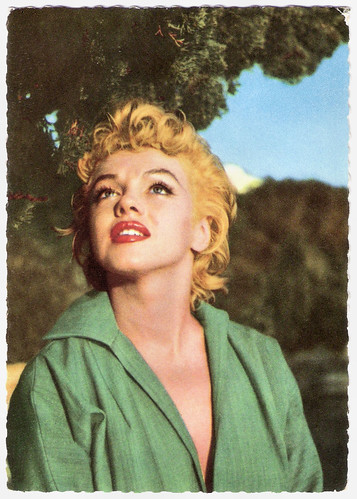
West German postcard by Ufa, Berlin-Tempelhof, no. CK-10. Photo: Baron Studios, London. Sterling Henry Nahum, known professionally as Baron, was a society and court photographer in the United Kingdom. However, one notable sitter was Marilyn Monroe, whom in 1954 he went to California to photograph in an outdoor shoot in Palm Springs.
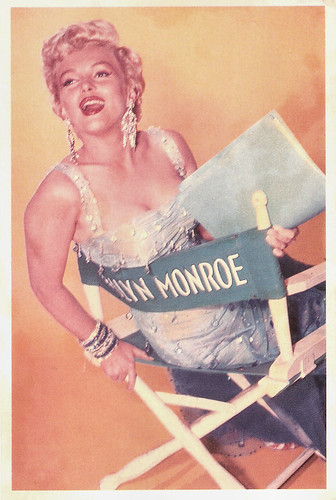
American postcard by The American Postcard Company, no. 282, 1981. Photo: Bruno Bernard (Bernard of Hollywood).
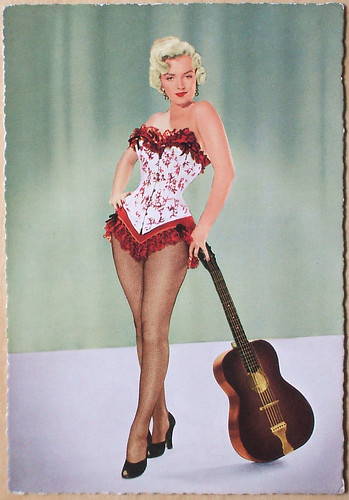
Vintage postcard, no. PU 13. Photo: publicity still for The River of No Return (Otto Preminger, 1953). Collection: Meiter.
By 1953, Marilyn Monroe was one of the most marketable Hollywood stars with leading roles in three hits: the Film Noir Niagara, and the comedies Gentlemen Prefer Blondes and How to Marry a Millionaire. In Niagara (Henry Hathaway, 1953), she played a femme fatale scheming to murder her husband, played by Joseph Cotten. While Niagara made Monroe a sex symbol, the satirical musical comedy Gentlemen Prefer Blondes (Howard Hawks, 1953) established her screen persona as a 'dumb blonde'. Based on Anita Loos' bestselling novel and its Broadway version, the film focuses on two 'gold-digging' showgirls, Lorelei Lee and Dorothy Shaw, played by Monroe and Jane Russell. It became one of the biggest box office successes of the year by grossing $5.3 million, more than double its production costs. Her next film, How to Marry a Millionaire (Jean Negulesco, 1953), co-starred Betty Grable and Lauren Bacall. It featured Monroe in the role of a naïve model who teams up with her friends to find rich husbands, repeating the successful formula of Gentlemen Prefer Blondes. Despite mixed reviews, the film was Monroe's biggest box office success so far, earning $8 million in world rentals.
Although she played a significant role in the creation and management of her public image throughout her career, she was disappointed at being typecast and underpaid by the studio. She was suspended in early 1954 for refusing a film project. The suspension was front-page news, and Monroe immediately began a publicity campaign to counter any negative press and to strengthen her position in the conflict. On 14 January, she and Joe DiMaggio were married at the San Francisco City Hall. They then travelled to Japan, combining a honeymoon with his business trip. From there, she travelled alone to Korea, where she performed songs from her films as part of a USO show for over 60,000 U.S. Marines over four days. She settled with Fox and returned to star in one of the biggest box office successes of her career, The Seven Year Itch (Billy Wilder, 1955). Then followed the release of Otto Preminger's Western River of No Return (1955), in which Monroe appeared opposite Robert Mitchum. When the studio was still reluctant to change her contract, Monroe and photographer Milton Greene founded a film production company in late 1954, Marilyn Monroe Productions (MMP). She dedicated 1955 to building her company and began studying method acting at the Actors Studio. She grew close to the studio's director, Lee Strasberg and to his wife Paula, receiving private lessons at their home due to her shyness, and she soon became like a family member.
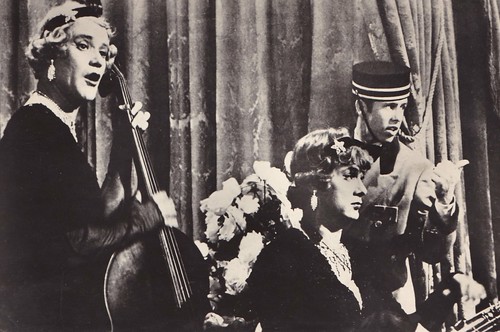
In late 1955, Fox awarded her a new contract, which gave her more control and a larger salary. Monroe did a critically acclaimed performance in Bus Stop (Joshua Logan, 1956). She played Chérie, a saloon singer whose dreams of stardom are complicated by a naïve cowboy who falls in love with her. She received a Golden Globe nomination for Best Actress for her performance. Then she acted opposite Laurence Olivier in the first independent production of MMP, The Prince and the Showgirl (Laurence Olivier, 1957), made in Great Britain. It was released in June 1957 to mixed reviews and proved unpopular with American audiences. The film was better received in Europe, where it won Crystal Star awards and was nominated for a BAFTA. Then she acted opposite Jack Lemmon and Tony Curtis in the classic comedy Some Like It Hot (Billy Wilder, 1959). The film was an absolute smash hit, with Curtis and Lemmon pretending to be females in an all-girl band, so they could get work. This was to be Marilyn's only film for the year. She won a Golden Globe for Best Actress for her role. Monroe took a hiatus until late 1959, when she returned to Hollywood to star in the musical comedy Let's Make Love (George Cukor, 1960), about an actress and a millionaire (Yves Montand) who fall in love when performing in a satirical play. Her affair with Montand was widely reported by the press and used in the film's publicity campaign. Her last completed film was the drama The Misfits (John Huston, 1961), which Arthur Miller had written to provide her with a dramatic role. She played a recently divorced woman who becomes friends with three ageing cowboys, played by Clark Gable, Eli Wallach and Montgomery Clift.
Monroe returned to the public eye in spring 1962: she received a 'World Film Favourite' Golden Globe award and began to shoot a new film for 20th Century-Fox, Something's Got to Give, a remake of My Favorite Wife (Garson Kanin, 1940). Days before filming began, Monroe caught sinusitis; despite medical advice to postpone the production, Fox began it as planned in late April. Monroe was too ill to work for the majority of the next six weeks, but despite confirmations by multiple doctors, the studio tried to put pressure on her by alleging publicly that she was faking it. On 19 May 1962, she took a break to sing 'Happy Birthday' on stage at President John F. Kennedy's birthday celebration at Madison Square Garden in New York. She drew attention with her costume: a beige, skintight dress covered in rhinestones, which made her appear nude. Monroe next filmed a scene for Something's Got to Give in which she swam naked in a swimming pool. To generate advanced publicity, the press was invited to take photographs of the scene, which were later published in Life. It was the first time that a major star had posed nude while at the height of their career. When she was again on sick leave for several days, Fox decided that it could not afford to have another film running behind schedule when it was already struggling to cover the rising costs of Cleopatra (Joseph L. Mankiewicz, 1963). The studio blamed Monroe for the film's demise and began spreading negative publicity about her, even alleging that she was mentally disturbed.
Fox soon regretted its decision, and reopened negotiations with Monroe later in June; a settlement about a new contract, including re-commencing Something's Got to Give and a starring role in the black comedy What a Way to Go! (J. Lee Thompson, 1964), was reached later that summer. To repair her public image, Monroe engaged in several publicity ventures, including interviews for Life and Cosmopolitan and her first photo shoot for Vogue. For Vogue, she and photographer Bert Stern collaborated for two series of photographs, one a standard fashion editorial and another of her posing nude, which were both later published posthumously with the title The Last Sitting. In the last weeks of her life, she was also planning on starring in a biopic of Jean Harlow. Only 36, Marilyn Monroe died on 5 August 1962 from an overdose of barbiturates. She was discovered dead at her home at 12305 Fifth Helena Drive in Brentwood. She had a phone in one of her hands, her body was completely nude and face down, on her bed. During her life and also after her death, her troubled private life received much attention. She struggled with addiction, depression, and anxiety. She had two highly publicised marriages, to baseball player Joe DiMaggio and playwright Arthur Miller, which both ended in divorce. Although the death was ruled a probable suicide, several conspiracy theories have been proposed in the decades following her death. There are over 600 books written about her.

Vintage postcard by Metro Music, no, MM144. Image: American Lobby card by 20th Century Fox. Marilyn Monroe in Niagara (Henry Hathaway, 1953).
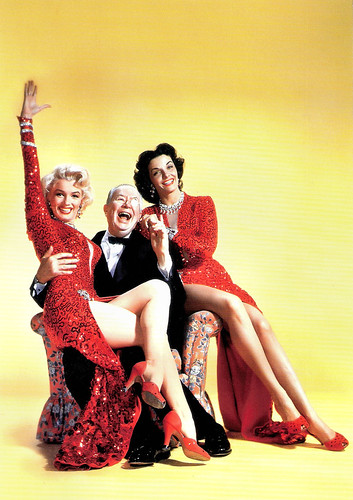
Italian programme card for Il Cinema Ritrovata 2011. Photo: publicity still for Gentlemen prefer blondes (Howard Hawks, 1953), starring Marilyn Monroe, Charles Coburn, and Jane Russell.

American postcard by The American Postcard Company in the 20th Century Fox Postcard Series, no. F 43. Marilyn Monroe in There's No Business Like Show Business (Walter Lang, 1954). Caption: Marilyn Monroe as Vicky goes from hat-check girl to showgirl.
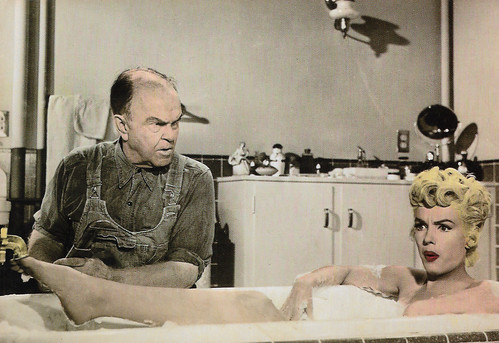
American postcard by Classico San Francisco, no. 105/001. Photo: Twentieth Century Fox / Charles K. Feldman Group Productions. Victor Moore and Marilyn Monroe in The Seven Year Itch (Billy Wilder, 1955).

American postcard in the 20th Century Fox Series by The American Postcard Company Inc., 1994, no. F45. Photo: 20th Century Fox. Marilyn Monroe in The Seven Year Itch (Billy Wilder, 1955).Caption: 1955, Marilyn Monroe is 'The Girl'.

American postcard by Classico San Francisco, no. 105-017. Photo: 20th Century Fox. Marilyn Monroe in Bus Stop (Joshua Logan, 1956).
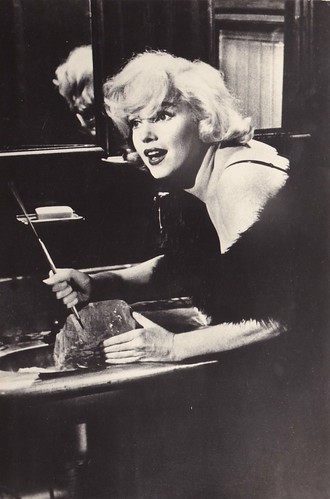
Czech postcard by Pressfoto, Praha (Prague). Photo: publicity still for Some Like It Hot (Billy Wilder, 1959). Collection: Carla Bosch.

French postcard by Editions Hazan, Paris, 1995. Marilyn Monroe in Let's Make Love (George Cukor, 1960). The French title was Le Milliardaire.

French postcard by Editions La Malibran, Paris, no. MC 11. Marilyn Monroe in The Misfits (John Huston, 1961).

Swiss postcard by News Productions, Baulmes, no. 56192. Photo: Douglas Kirkland, 1989 / Govinda Gallery, Washington D.C., Dauman Pictures N.Y.C. Caption: Marilyn Monroe, Dream # 2, November 1961.

Vintage postcard by Superior, no. PC 11. Photo: Lawrence Schiller. Marilyn Monroe in Something’s Got to Give (George Cukor, 1962). Something’s Got to Give was intended as a remake of My Favorite Wife (Garson Kanin, 1940). The film remained unfinished because of Marilyn Monroe's firing, rehiring, and sudden death in August 1962.

Yugoslav postcard by Cik Razglednica. Marilyn Monroe in Something's Got To Give (George Cukor, 1962). For one sequence, Marilyn Monroe was to wear a flesh-coloured bathing suit and appear to be swimming in the nude. When the scene was being filmed, Marilyn doffed the costume and wore only a flesh-colored bikini bottom. During a still photo session after filming the scene, she removed even that. The resulting publicity photos, many with Marilyn's obviously naked back to the camera, garnered the film worldwide media coverage. The documentary Marilyn Monroe: The Final Days (Patty Ivins Specht, 2001) includes a 37-minute segment made from the surviving unused footage of what was to have been this film.
Collecting Marilyn, 5 March 2017.
Wanna be Marilyn, 1 April 20217.
Gentlemen Prefer Blondes (1953), 14 November 2022.
The Seven Year Itch (1955), 21 November 2022.
Bus Stop (1956), 28 November 2022.
Sources: De Nieuwe Kerk (Page now defunct), Marilyn Geek, IMDb and Wikipedia.
French postcard, no. Réf. Marilyn 97. Marilyn Monroe in Gentlemen Prefer Blondes (Howard Hawks, 1953).
American postcard by the American Postcard Co., NYC, no. 677.
German postcard by ISV, Sort. VI/6.
Italian postcard by Rotalcolor, Milano, no. 36. Photo: publicity still for Niagara (Henry Hathaway, 1953).
West German postcard by Krüger, no. 902/13. Photo: publicity still for Gentlemen Prefer Blondes (Howard Hawks, 1953).
Spanish postcard by Archivo Bermejo, no. 7. Photo: 20th Century Fox. Publicity still for River of No Return (Otto Preminger, 1954).
Swiss postcard by CVB Productions, Grandson / News Productions, no. CCP 46, 1996. Photo: Sam Shaw. Tom Ewell and Marilyn Monroe in The Seven Year Itch (Billy Wilder, 1955).
Postcard from the 'Marilyn Monroe Book of 30 Postcards' by Magna Books. Photo: The Hulton-Deutsch Collection. Marilyn Monroe in Let's Make Love (George Cukor, 1960).
French postcard by Edition P.I., Paris, no. 1044.
German postcard by ISV, Sort. VI/6.
Cheesecake queen turned box office smash
Marilyn Monroe was born Norma Jeane Mortenson in 1926 in Lemmon, South Dakota. She was the third child of Gladys Pearl Baker née Monroe, who suffered from mental illness and later worked as a film-cutter at RKO. Marilyn was abandoned by her mother, and she spent most of her childhood in foster homes and an orphanage. Just after her 16th birthday, she married 21-year-old aircraft plant worker James 'Jim' Dougherty. In 1943, Dougherty enlisted in the Merchant Marine. He was initially stationed on Catalina Island, where she lived with him until he was shipped out to the Pacific in April 1944; he would remain there for most of the next two years.
While working in a factory as part of the war effort in 1944, Marilyn met photographer David Conover and began a successful modelling career. She began to occasionally use the name Jean Norman when working, and had her curly brunette hair straightened and dyed blond to make her more employable. As her figure was deemed more suitable for pin-up than fashion modelling, she was employed mostly for advertisements and men's magazines. By early 1946, she had appeared on 33 magazine covers for publications such as Pageant, U.S. Camera, Laff, and Peek. She divorced Dougherty in 1946. The work led to a screen test by 20th Century Fox executive and former film star Ben Lyon. Head executive Darryl F. Zanuck was unenthusiastic about it, but he was persuaded to give her a standard six-month contract to avoid her being signed by rival studio RKO Pictures.
Monroe began her contract in August 1946, and together with Lyon selected the screen name of Marilyn Monroe. Among her first film parts were nine lines of dialogue as a waitress in the drama Dangerous Years (Arthur Pierson, 1947) and a one-line appearance in the comedy Scudda Hoo! Scudda Hay! (F. Hugh Herbert, 1948). After a series of other minor film roles, she moved to Columbia. While at Fox, her roles had been those of a 'girl next door', at Columbia, she was modelled after Rita Hayworth. Monroe's hairline was raised by electrolysis, and her hair was bleached even lighter to platinum blond. She also began working with the studio's head drama coach, Natasha Lytess, who would remain her mentor until 1955. Her only film at the studio was the low-budget musical Ladies of the Chorus (Phil Karlson, 1948), in which she had her first starring role as a chorus girl who is courted by a wealthy man.
After leaving Columbia in September 1948, Monroe became a protégée of Johnny Hyde, vice president of the William Morris Agency. Hyde began representing her, and their relationship soon became sexual, although she refused his proposals of marriage. To advance Monroe's career, he paid for a silicone prosthesis to be implanted in her jaw and arranged a bit part in the Marx Brothers film Love Happy (David Miller, 1949). That year, she also made minor appearances in two critically acclaimed films: John Huston's crime film The Asphalt Jungle (1950) and Joseph Mankiewicz's drama All About Eve (1950). Following Monroe's success in these roles, Hyde negotiated a seven-year contract with 20th Century-Fox in December 1950.
Over the next two years, she became a popular actress with roles in several comedies, including As Young as You Feel (Harmon Jones, 1951) and Monkey Business (Howard Hawks, 1952) with Cary Grant, and in the dramas Clash by Night (Fritz Lang, 1952) and Don't Bother to Knock (Roy Ward Baker, 1952) with Richard Widmark. Her popularity with audiences was growing: she received several thousand letters of fan mail a week. The second year of the Fox contract saw Monroe become a top-billed actress, with gossip columnist Florabel Muir naming her the year's 'it girl' and Hedda Hopper describing her as the 'cheesecake queen' turned 'box office smash'. She began a highly publicised romance with retired New York Yankee baseball legend Joe DiMaggio, one of the most famous sports personalities of the era. A month later, Monroe faced a scandal when it was revealed that she had posed for nude photos before becoming a star, but rather than damaging her career, the story increased interest in her films.
Dutch postcard by Uitg. Takken, Utrecht, no. 1708. Photo: Eric Carpenter / Metro-Goldwyn-Mayer. Publicity still for The Asphalt Jungle (John Huston, 1950).
French postcard by Travelling Editions, Paris, no. CP 59. Photo: 20th Century-Fox. Marilyn Monroe and Louis Calhern in The Asphalt Jungle (John Huston, 1950).
American postcard by The American Postcard Company Inc., no. F50, 1982. Photo: 20th Century-Fox. Marilyn Monroe in Love Nest (Joseph M. Newman, 1951). Caption: Marilyn as ex-WAC Roberta Stevens.
British postcard from 'Marilyn Monroe, 20 Classic Picture Postcards' by Bloomsbury Books, 1993. Photo: Frank Powolny / 20th Century Fox, 1952.
French postcard by Editions P.I., Paris, no. FK 3969. Photo: Camera Press / Ufa. Publicity still for River of No Return (Otto Preminger, 1954).
Vintage postcard. Photo: publicity still for River of No Return (Otto Preminger, 1954), with Robert Mitchum.
French postcard by Editions P.I., offered by Les Carbones Korès Carboplane, mo. 882. Photo: 20th Century Fox.
Dutch postcard by Int. Filmpers (IFP), Amsterdam, no. 1154.
British postcard by Santoro Graphics, London, no. BW 846. Photo: 20th Century-Fox. Marilyn Monroe in Niagara (Henry Hathaway, 1953).
American postcard by Classico San Francisco Inc., no. 232-005.
The nude calendar
Before posing for her famous calendar shots taken by photographer Tom Kelley, Marilyn Monroe had turned down many offers to pose nude. It seems she accepted only when her need was dire and immediate. In early 1949, her contracts with 20th Century Fox and Columbia had not been renewed, she was out of work, and had a certain level of lifestyle to maintain. The $50 she was paid was exactly what she needed to get back her car, which had been impounded. The photographs that became the infamous 'Golden Dreams' calendar were taken on 27 May 1949. Kelley's wife, Natalie, helped to prepare the red velvet backdrop and the cameras. The shoot lasted two hours while Kelley shot a sequence of photographs from a ten-foot ladder.
Only two of the twenty-four shots Kelley took actually made it to print. 'A New Wrinkle' (pictured here) graced one Braugarth Company calendar, but the picture that captured a nation's imagination was 'Golden Dreams'. The story that Hollywood's hottest new property, Marilyn Monroe, was in fact the girl in the nude calendar was broken by wire journalist Aline Mosby in March 1952. The studio's initial reaction was to deny everything. No Hollywood star had ever been proven to have done such a thing; the early fifties were a time of strait-laced public morals. Biographers agree that Marilyn was instrumental in persuading the studio that their natural inclination to deny the whole thing was the wrong way to handle it. An exclusive interview was arranged, and the following confession ran in US newspapers on 13 March 1952.
MARILYN MONROE ADMITS SHE'S NUDE BLONDE OF CALENDAR
A photograph of a beautiful nude blonde on a 1952 calendar is hanging in garages and barbershops all over the nation today. Marilyn Monroe admitted today that the beauty is she. She posed, stretched out on rumpled red velvet for the artistic photo 3 years ago because "I was broke and needed the money". "Oh, the calendar's hanging in garages all over town," said Marilyn. "Why deny it? You can get one any place. Besides, I'm not ashamed of it. I've done nothing wrong." The beautiful blonde now gets a fat paycheck every week from an excited Twentieth Century-Fox studio. She's rated the most sensational sweater girl since Lana Turner....she lives in an expensive hotel room...She dines at Romanoff's.
But in 1949, she was just another scared young blonde, struggling to find fame in the magic city, and all alone. As a child, she lived in a Hollywood orphanage. She was pushed around among twelve sets of foster parents before she turned an insecure sixteen."I was a week behind on my rent," she explained. "I had to have the money. A photographer, Tom Kelley, had asked me before to pose, but I'd never do it. This time I called him and said I would. Tom didn't think anyone would recognise me. My hair was long then. But when the picture came out, everybody knew me. I'd never have done it if I'd known things would happen in Hollywood so fast for me."
In the aftermath of the calendar confession, Marilyn was harangued by journalists. In typical fashion, when asked if it was true she had nothing on when she posed, she replied, "Oh no, I had the radio on." In December 1953, a man named Hugh Hefner bought the rights to reproduce the 'Golden Dreams' photograph as the first centrefold in the first-ever issue of Playboy magazine.
French postcard by JG, Paris, no. 603/5. Photo: Andre de Dienes, 1949.
Modern postcard. Photo: Tom Kelley, 1949.
British postcard by Camden Graphics, nr. PC 443. Photo: Frank Powolny, 1951.
German postcard by Universum-Film Aktiengesellschaft (Ufa), Berlin-Tempelhof, no. CK-73. Photo: Gene Korman / 20th Century Fox, 1953.
British postcard by Santoro Graphics, London, no. C213. Photo: publicity still for Gentlemen Prefer Blondes (Howard Hawks, 1953).
British postcard by A Bigger Splash, Manchester, no. X 155. Photo: 20th Century Fox. Caption: costume test of Marilyn Monroe as Rose in Niagara (Henry Hathaway, 1953).
French postcard by Editions Hazan, Paris, 1995. Marilyn Monroe in River of No Return (Otto Preminger, 1954).
West German postcard by Ufa, Berlin-Tempelhof, no. CK-10. Photo: Baron Studios, London. Sterling Henry Nahum, known professionally as Baron, was a society and court photographer in the United Kingdom. However, one notable sitter was Marilyn Monroe, whom in 1954 he went to California to photograph in an outdoor shoot in Palm Springs.
American postcard by The American Postcard Company, no. 282, 1981. Photo: Bruno Bernard (Bernard of Hollywood).
Vintage postcard, no. PU 13. Photo: publicity still for The River of No Return (Otto Preminger, 1953). Collection: Meiter.
More control and a larger salary
By 1953, Marilyn Monroe was one of the most marketable Hollywood stars with leading roles in three hits: the Film Noir Niagara, and the comedies Gentlemen Prefer Blondes and How to Marry a Millionaire. In Niagara (Henry Hathaway, 1953), she played a femme fatale scheming to murder her husband, played by Joseph Cotten. While Niagara made Monroe a sex symbol, the satirical musical comedy Gentlemen Prefer Blondes (Howard Hawks, 1953) established her screen persona as a 'dumb blonde'. Based on Anita Loos' bestselling novel and its Broadway version, the film focuses on two 'gold-digging' showgirls, Lorelei Lee and Dorothy Shaw, played by Monroe and Jane Russell. It became one of the biggest box office successes of the year by grossing $5.3 million, more than double its production costs. Her next film, How to Marry a Millionaire (Jean Negulesco, 1953), co-starred Betty Grable and Lauren Bacall. It featured Monroe in the role of a naïve model who teams up with her friends to find rich husbands, repeating the successful formula of Gentlemen Prefer Blondes. Despite mixed reviews, the film was Monroe's biggest box office success so far, earning $8 million in world rentals.
Although she played a significant role in the creation and management of her public image throughout her career, she was disappointed at being typecast and underpaid by the studio. She was suspended in early 1954 for refusing a film project. The suspension was front-page news, and Monroe immediately began a publicity campaign to counter any negative press and to strengthen her position in the conflict. On 14 January, she and Joe DiMaggio were married at the San Francisco City Hall. They then travelled to Japan, combining a honeymoon with his business trip. From there, she travelled alone to Korea, where she performed songs from her films as part of a USO show for over 60,000 U.S. Marines over four days. She settled with Fox and returned to star in one of the biggest box office successes of her career, The Seven Year Itch (Billy Wilder, 1955). Then followed the release of Otto Preminger's Western River of No Return (1955), in which Monroe appeared opposite Robert Mitchum. When the studio was still reluctant to change her contract, Monroe and photographer Milton Greene founded a film production company in late 1954, Marilyn Monroe Productions (MMP). She dedicated 1955 to building her company and began studying method acting at the Actors Studio. She grew close to the studio's director, Lee Strasberg and to his wife Paula, receiving private lessons at their home due to her shyness, and she soon became like a family member.
In late 1955, Fox awarded her a new contract, which gave her more control and a larger salary. Monroe did a critically acclaimed performance in Bus Stop (Joshua Logan, 1956). She played Chérie, a saloon singer whose dreams of stardom are complicated by a naïve cowboy who falls in love with her. She received a Golden Globe nomination for Best Actress for her performance. Then she acted opposite Laurence Olivier in the first independent production of MMP, The Prince and the Showgirl (Laurence Olivier, 1957), made in Great Britain. It was released in June 1957 to mixed reviews and proved unpopular with American audiences. The film was better received in Europe, where it won Crystal Star awards and was nominated for a BAFTA. Then she acted opposite Jack Lemmon and Tony Curtis in the classic comedy Some Like It Hot (Billy Wilder, 1959). The film was an absolute smash hit, with Curtis and Lemmon pretending to be females in an all-girl band, so they could get work. This was to be Marilyn's only film for the year. She won a Golden Globe for Best Actress for her role. Monroe took a hiatus until late 1959, when she returned to Hollywood to star in the musical comedy Let's Make Love (George Cukor, 1960), about an actress and a millionaire (Yves Montand) who fall in love when performing in a satirical play. Her affair with Montand was widely reported by the press and used in the film's publicity campaign. Her last completed film was the drama The Misfits (John Huston, 1961), which Arthur Miller had written to provide her with a dramatic role. She played a recently divorced woman who becomes friends with three ageing cowboys, played by Clark Gable, Eli Wallach and Montgomery Clift.
Monroe returned to the public eye in spring 1962: she received a 'World Film Favourite' Golden Globe award and began to shoot a new film for 20th Century-Fox, Something's Got to Give, a remake of My Favorite Wife (Garson Kanin, 1940). Days before filming began, Monroe caught sinusitis; despite medical advice to postpone the production, Fox began it as planned in late April. Monroe was too ill to work for the majority of the next six weeks, but despite confirmations by multiple doctors, the studio tried to put pressure on her by alleging publicly that she was faking it. On 19 May 1962, she took a break to sing 'Happy Birthday' on stage at President John F. Kennedy's birthday celebration at Madison Square Garden in New York. She drew attention with her costume: a beige, skintight dress covered in rhinestones, which made her appear nude. Monroe next filmed a scene for Something's Got to Give in which she swam naked in a swimming pool. To generate advanced publicity, the press was invited to take photographs of the scene, which were later published in Life. It was the first time that a major star had posed nude while at the height of their career. When she was again on sick leave for several days, Fox decided that it could not afford to have another film running behind schedule when it was already struggling to cover the rising costs of Cleopatra (Joseph L. Mankiewicz, 1963). The studio blamed Monroe for the film's demise and began spreading negative publicity about her, even alleging that she was mentally disturbed.
Fox soon regretted its decision, and reopened negotiations with Monroe later in June; a settlement about a new contract, including re-commencing Something's Got to Give and a starring role in the black comedy What a Way to Go! (J. Lee Thompson, 1964), was reached later that summer. To repair her public image, Monroe engaged in several publicity ventures, including interviews for Life and Cosmopolitan and her first photo shoot for Vogue. For Vogue, she and photographer Bert Stern collaborated for two series of photographs, one a standard fashion editorial and another of her posing nude, which were both later published posthumously with the title The Last Sitting. In the last weeks of her life, she was also planning on starring in a biopic of Jean Harlow. Only 36, Marilyn Monroe died on 5 August 1962 from an overdose of barbiturates. She was discovered dead at her home at 12305 Fifth Helena Drive in Brentwood. She had a phone in one of her hands, her body was completely nude and face down, on her bed. During her life and also after her death, her troubled private life received much attention. She struggled with addiction, depression, and anxiety. She had two highly publicised marriages, to baseball player Joe DiMaggio and playwright Arthur Miller, which both ended in divorce. Although the death was ruled a probable suicide, several conspiracy theories have been proposed in the decades following her death. There are over 600 books written about her.
Vintage postcard by Metro Music, no, MM144. Image: American Lobby card by 20th Century Fox. Marilyn Monroe in Niagara (Henry Hathaway, 1953).
Italian programme card for Il Cinema Ritrovata 2011. Photo: publicity still for Gentlemen prefer blondes (Howard Hawks, 1953), starring Marilyn Monroe, Charles Coburn, and Jane Russell.
American postcard by The American Postcard Company in the 20th Century Fox Postcard Series, no. F 43. Marilyn Monroe in There's No Business Like Show Business (Walter Lang, 1954). Caption: Marilyn Monroe as Vicky goes from hat-check girl to showgirl.
American postcard by Classico San Francisco, no. 105/001. Photo: Twentieth Century Fox / Charles K. Feldman Group Productions. Victor Moore and Marilyn Monroe in The Seven Year Itch (Billy Wilder, 1955).
American postcard in the 20th Century Fox Series by The American Postcard Company Inc., 1994, no. F45. Photo: 20th Century Fox. Marilyn Monroe in The Seven Year Itch (Billy Wilder, 1955).Caption: 1955, Marilyn Monroe is 'The Girl'.
American postcard by Classico San Francisco, no. 105-017. Photo: 20th Century Fox. Marilyn Monroe in Bus Stop (Joshua Logan, 1956).
Czech postcard by Pressfoto, Praha (Prague). Photo: publicity still for Some Like It Hot (Billy Wilder, 1959). Collection: Carla Bosch.
French postcard by Editions Hazan, Paris, 1995. Marilyn Monroe in Let's Make Love (George Cukor, 1960). The French title was Le Milliardaire.
French postcard by Editions La Malibran, Paris, no. MC 11. Marilyn Monroe in The Misfits (John Huston, 1961).
Swiss postcard by News Productions, Baulmes, no. 56192. Photo: Douglas Kirkland, 1989 / Govinda Gallery, Washington D.C., Dauman Pictures N.Y.C. Caption: Marilyn Monroe, Dream # 2, November 1961.
Vintage postcard by Superior, no. PC 11. Photo: Lawrence Schiller. Marilyn Monroe in Something’s Got to Give (George Cukor, 1962). Something’s Got to Give was intended as a remake of My Favorite Wife (Garson Kanin, 1940). The film remained unfinished because of Marilyn Monroe's firing, rehiring, and sudden death in August 1962.
Yugoslav postcard by Cik Razglednica. Marilyn Monroe in Something's Got To Give (George Cukor, 1962). For one sequence, Marilyn Monroe was to wear a flesh-coloured bathing suit and appear to be swimming in the nude. When the scene was being filmed, Marilyn doffed the costume and wore only a flesh-colored bikini bottom. During a still photo session after filming the scene, she removed even that. The resulting publicity photos, many with Marilyn's obviously naked back to the camera, garnered the film worldwide media coverage. The documentary Marilyn Monroe: The Final Days (Patty Ivins Specht, 2001) includes a 37-minute segment made from the surviving unused footage of what was to have been this film.
More Marilyn Monroe posts
Collecting Marilyn, 5 March 2017.
Wanna be Marilyn, 1 April 20217.
Gentlemen Prefer Blondes (1953), 14 November 2022.
The Seven Year Itch (1955), 21 November 2022.
Bus Stop (1956), 28 November 2022.
Sources: De Nieuwe Kerk (Page now defunct), Marilyn Geek, IMDb and Wikipedia.