Herbert Marshall (1890-1966) overcame the loss of a leg in World War I to enjoy a long career in the theatre and the cinema. He was the star of Alfred Hitchcock's early sound film Murder! (1930). In Hollywood, he first became popular as a romantic lead opposite stars like Marlene Dietrich and Greta Garbo, and later as a fine character actor.
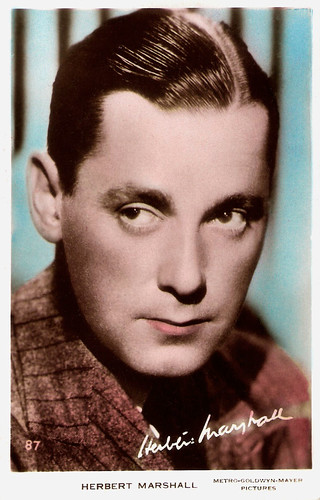
British postcard in the Real Photograph series, no. 87. Photo: Metro-Goldwyn-Mayer Pictures (M.G.M.).
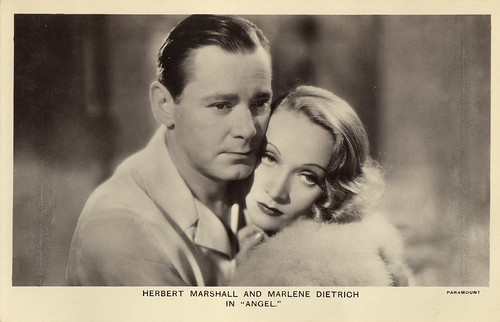
Dutch postcard by M. Bonnist & Zonen, Amsterdam, no. B 480. Photo: Paramount. Herbert Marshall and Marlene Dietrich in Angel (Ernst Lubitsch, 1937). Collection: Marlene Pilaete.
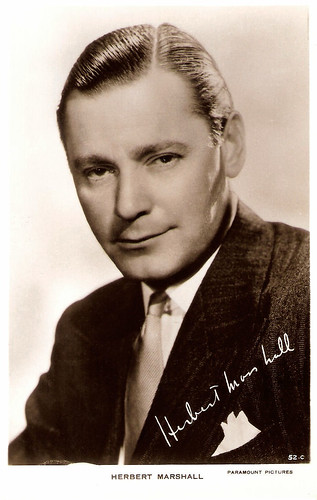
British postcard in the Real Photograph series, no. 52 C. Photo: Paramount Pictures.
Herbert Brough Falcon Marshall was born in London, England, in 1890. His parents were actors Percy F. Marshall and Ethel May Turner, but initially, Herbert had no stage career intentions himself. After graduating from St. Mary's College in Harrow, Marshall became an accounting clerk. His job failed to interest him, and with an equal lack of enthusiasm, Marshall joined a stock company in Brighton.
So he made his stage debut in 1911, and ascended to stardom two years later in the evergreen stage farce, 'Brewster's Millions'. During World War I, he served in the London Scottish Regiment with fellow actors Basil Rathbone, Ronald Colman, and Claude Rains. He was severely wounded and his right leg was amputated.
While this might normally have signalled the end of a theatrical career, Marshall was outfitted with a prosthesis and determined to make something of himself as an actor. His wooden leg was kept a secret from the public for most of his career. He used a very deliberate, square-shouldered and guided walk, largely unnoticeable, to cover up his disability. In tandem with his first wife, actress Edna Best, Marshall worked on stage in a series of domestic comedies and dramas.
He had spent nearly 20 years in distinguished stage work in London before he entered motion pictures with the British silent film Mumsie (Herbert Wilcox, 1927) starring American character actress Pauline Frederick. He was almost 40 when he appeared in his first Hollywood picture, the early sound film The Letter (Jean de Limur, 1929) featuring Broadway star Jeanne Eagels. According to William McPeak at IMDb, the courtroom drama is “a worthwhile comparison (but for the primitive sound recording) with the more famous second version (The Letter (1940)) with Bette Davis. Marshall is the murder victim in 1929 and the betrayed husband in 1940.”
In Great Britain Herbert Marshall appeared in Murder! (Alfred Hitchcock, 1930). He starred as a juror in a murder trial, who after a young actress (Norah Baring) voting to convict, has second thoughts and begins to investigate on his own before the execution. In Britain, he also starred in films for the Gainsborough Studio like Michael and Mary (Victor Saville, 1931) with Edna Best.
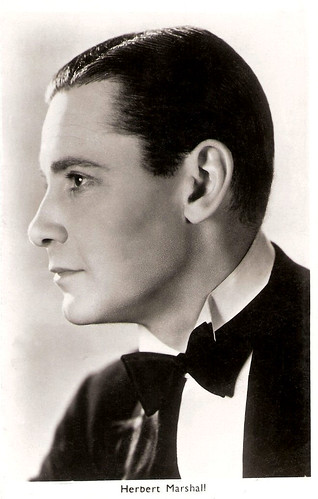
British postcard.
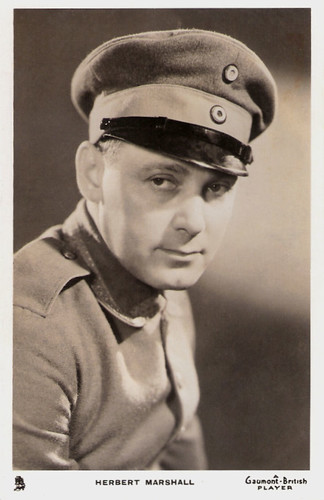
British postcard by Raphael Tuck & Sons in the Real Photograph Series, no. 176. Photo: Gaumont-British. Herbert Marshall in I was a Spy (Victor Saville, 1933).

British hand-coloured Real Photograph postcard in the Colourgraph Series, London, no. C 233. Photo: M.G.M.
In the 1930s, Herbert Marshall had his breakthrough with producer-director Ernst Lubitsch's marvellous Hollywood comedy Trouble in Paradise (1932). He and Miriam Hopkins played Gaston and Lily, a pair of Parisian thieves, both disguised as nobility. They decide to rob the lovely perfume company executive Mariette Colet (Kay Francis). Love rears its head, forcing Gaston to choose between marriage to Mariette and a fast getaway with Lily.
Hal Erickson at AllMovie: “Filled with marvellous throwaway gags and sophisticated innuendo, Trouble in Paradise was described by one critic as ‘as close to perfection as anything I have ever seen in the movies.’”
That same year, Marshall did one of his most warmly human romantic roles in the wonderfully erotic Blonde Venus (Josef von Sternberg, 1932) with the mesmerising Marlene Dietrich. Initially he played romantic leads opposite such stars as Dietrich (also in Angel (Ernst Lubitsch, 1937)), Claudette Colbert (in Secrets of a Secretary (George Abbott, 1931) and Zaza (George Cukor, 1939)), Greta Garbo (in The Painted Veil (Richard Boleslawski, 1934)) and Bette Davis (in The Letter (William Wyler, 1940) and The Little Foxes (William Wyler, 1941)).
Later, he specialised in substantial character roles in films like The Razor's Edge (Edmund Goulding, 1946). His rather blasé demeanour could take on various nuances - without overt emotion - to fit any role he played, whether sophisticated comedy or drama - and the accent fit just as well. He filled the range from romantic lead, with several sympathetic strangers thrown in, to a dignified military officer, to a doctor, to various degrees of villainy - his unemotional delivery meshing with the cold, impassive criminal character.
Marshall was deviously subtle as the pre-World War II peace leader actually working against peace for a veiled foreign power (Germany) in the adventure-thriller Foreign Correspondent (1940), one of Alfred Hitchcock's earliest Hollywood films. He did a small but standout performance as Scott Chavez, who at the beginning of Duel in the Sun (King Vidor, 1946) - with typical Marshall nonchalance - calmly shoots his cantina entertainer Indian wife for her cheating ways. His mellow baritone British accent rolled out with a minimum of mouth movement and nonchalant ease that stood out as unique.

British postcard in the Film Partners series, London, no. P 72. Photo: Gainsborough. Edna Best and Herbert Marshall.
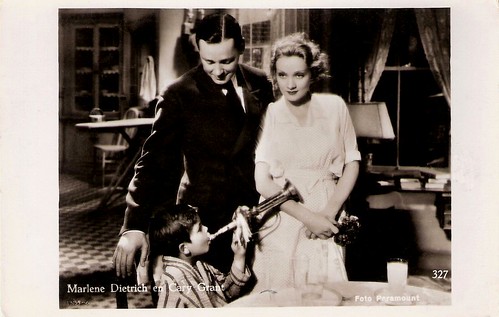
Dutch postcard by JosPe, no. 327. Photo: Paramount. Marlene Dietrich, Herbert Marshall and Dickie Moore in Blonde Venus (1932).
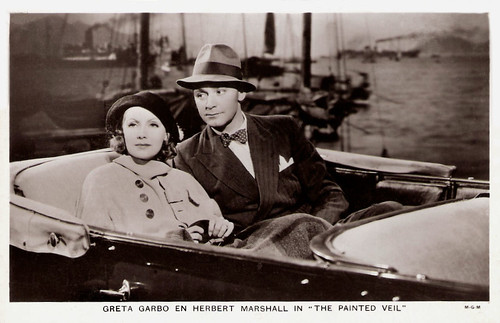
Dutch postcard by M. Bonnist & Zonen, Amsterdam, no. B 422. Photo: M.G.M. Publicity still for The Painted Veil (1934) starring Greta Garbo.
By the 1950s, Herbert Marshall was doing fewer films, but he still did a variety. He played the father of Jean Simmons in Otto Preminger's Angel Face (1953).
His voice was perfect to lend credence to some early Sci-Fi classics like Riders to the Stars (Richard Carlson, 1954), Gog (Herbert L. Strock, 1954) and The Fly (Kurt Neumann, 1958).
But he was also busy honing his considerable talent on radio and television. On the radio he portrayed British intelligence agent Ken Thurston on CBS (1944-1948) and NBC Radio's (1950-1952) 'The Man Called X'. He also fit comfortably into episodic TV including a rare five episode run as a priest on 77 Sunset Strip (1958).
One of his last film roles was in The List of Adrian Messenger (John Huston, 1963) starring George C. Scott. Herbert Marshall graced nearly 100 film and TV roles with an aplomb that remains a rich legacy.
He was married five times. Among his wives were two actresses, Edna Best, with whom he appeared in The Calendar, Michael and Mary and The Faithful Heart, and Boots Mallory, to whom he was married from 1947 until she died in 1958. He had three children, including actress Sarah Marshall, with Edna Best. Herbert Marshall died of a heart attack in Beverly Hills, Los Angeles, in 1966, aged 75.
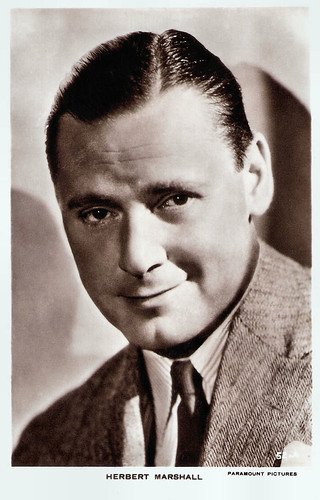
British postcard in the Real Photograph series, no. 52 A. Photo: Paramount Pictures.
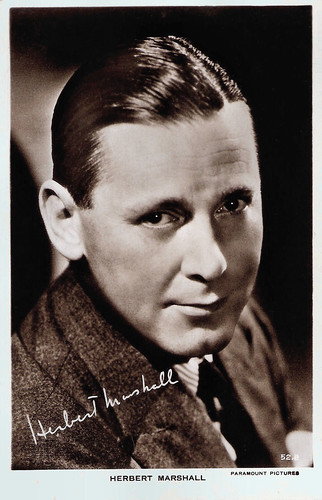
British postcard in the Real Photograph series, no. 52 B. Photo: Paramount Pictures.
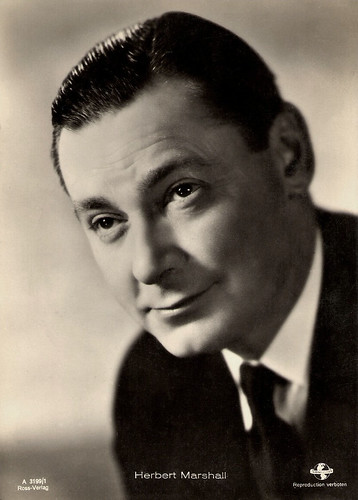
German postcard by Ross Verlag, no. A 3199/1, 1941-1944. Photo: Universal.
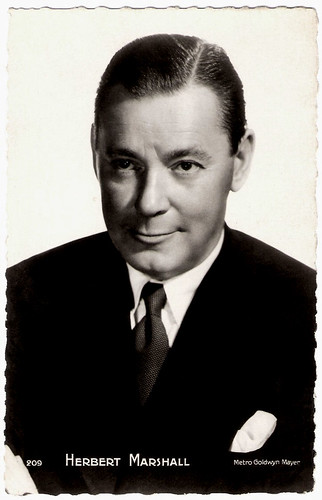
French postcard by Editions P.I., Paris, no. 209, 1946. Photo: M.G.M.
Sources: William McPeak (IMDb), Wikipedia and IMDb.
This post was last updated on 28 May 2025.
British postcard in the Real Photograph series, no. 87. Photo: Metro-Goldwyn-Mayer Pictures (M.G.M.).
Dutch postcard by M. Bonnist & Zonen, Amsterdam, no. B 480. Photo: Paramount. Herbert Marshall and Marlene Dietrich in Angel (Ernst Lubitsch, 1937). Collection: Marlene Pilaete.
British postcard in the Real Photograph series, no. 52 C. Photo: Paramount Pictures.
Amputated leg
Herbert Brough Falcon Marshall was born in London, England, in 1890. His parents were actors Percy F. Marshall and Ethel May Turner, but initially, Herbert had no stage career intentions himself. After graduating from St. Mary's College in Harrow, Marshall became an accounting clerk. His job failed to interest him, and with an equal lack of enthusiasm, Marshall joined a stock company in Brighton.
So he made his stage debut in 1911, and ascended to stardom two years later in the evergreen stage farce, 'Brewster's Millions'. During World War I, he served in the London Scottish Regiment with fellow actors Basil Rathbone, Ronald Colman, and Claude Rains. He was severely wounded and his right leg was amputated.
While this might normally have signalled the end of a theatrical career, Marshall was outfitted with a prosthesis and determined to make something of himself as an actor. His wooden leg was kept a secret from the public for most of his career. He used a very deliberate, square-shouldered and guided walk, largely unnoticeable, to cover up his disability. In tandem with his first wife, actress Edna Best, Marshall worked on stage in a series of domestic comedies and dramas.
He had spent nearly 20 years in distinguished stage work in London before he entered motion pictures with the British silent film Mumsie (Herbert Wilcox, 1927) starring American character actress Pauline Frederick. He was almost 40 when he appeared in his first Hollywood picture, the early sound film The Letter (Jean de Limur, 1929) featuring Broadway star Jeanne Eagels. According to William McPeak at IMDb, the courtroom drama is “a worthwhile comparison (but for the primitive sound recording) with the more famous second version (The Letter (1940)) with Bette Davis. Marshall is the murder victim in 1929 and the betrayed husband in 1940.”
In Great Britain Herbert Marshall appeared in Murder! (Alfred Hitchcock, 1930). He starred as a juror in a murder trial, who after a young actress (Norah Baring) voting to convict, has second thoughts and begins to investigate on his own before the execution. In Britain, he also starred in films for the Gainsborough Studio like Michael and Mary (Victor Saville, 1931) with Edna Best.
British postcard.
British postcard by Raphael Tuck & Sons in the Real Photograph Series, no. 176. Photo: Gaumont-British. Herbert Marshall in I was a Spy (Victor Saville, 1933).
British hand-coloured Real Photograph postcard in the Colourgraph Series, London, no. C 233. Photo: M.G.M.
Heavily in demand
In the 1930s, Herbert Marshall had his breakthrough with producer-director Ernst Lubitsch's marvellous Hollywood comedy Trouble in Paradise (1932). He and Miriam Hopkins played Gaston and Lily, a pair of Parisian thieves, both disguised as nobility. They decide to rob the lovely perfume company executive Mariette Colet (Kay Francis). Love rears its head, forcing Gaston to choose between marriage to Mariette and a fast getaway with Lily.
Hal Erickson at AllMovie: “Filled with marvellous throwaway gags and sophisticated innuendo, Trouble in Paradise was described by one critic as ‘as close to perfection as anything I have ever seen in the movies.’”
That same year, Marshall did one of his most warmly human romantic roles in the wonderfully erotic Blonde Venus (Josef von Sternberg, 1932) with the mesmerising Marlene Dietrich. Initially he played romantic leads opposite such stars as Dietrich (also in Angel (Ernst Lubitsch, 1937)), Claudette Colbert (in Secrets of a Secretary (George Abbott, 1931) and Zaza (George Cukor, 1939)), Greta Garbo (in The Painted Veil (Richard Boleslawski, 1934)) and Bette Davis (in The Letter (William Wyler, 1940) and The Little Foxes (William Wyler, 1941)).
Later, he specialised in substantial character roles in films like The Razor's Edge (Edmund Goulding, 1946). His rather blasé demeanour could take on various nuances - without overt emotion - to fit any role he played, whether sophisticated comedy or drama - and the accent fit just as well. He filled the range from romantic lead, with several sympathetic strangers thrown in, to a dignified military officer, to a doctor, to various degrees of villainy - his unemotional delivery meshing with the cold, impassive criminal character.
Marshall was deviously subtle as the pre-World War II peace leader actually working against peace for a veiled foreign power (Germany) in the adventure-thriller Foreign Correspondent (1940), one of Alfred Hitchcock's earliest Hollywood films. He did a small but standout performance as Scott Chavez, who at the beginning of Duel in the Sun (King Vidor, 1946) - with typical Marshall nonchalance - calmly shoots his cantina entertainer Indian wife for her cheating ways. His mellow baritone British accent rolled out with a minimum of mouth movement and nonchalant ease that stood out as unique.
British postcard in the Film Partners series, London, no. P 72. Photo: Gainsborough. Edna Best and Herbert Marshall.
Dutch postcard by JosPe, no. 327. Photo: Paramount. Marlene Dietrich, Herbert Marshall and Dickie Moore in Blonde Venus (1932).
Dutch postcard by M. Bonnist & Zonen, Amsterdam, no. B 422. Photo: M.G.M. Publicity still for The Painted Veil (1934) starring Greta Garbo.
Sci-fi classics
By the 1950s, Herbert Marshall was doing fewer films, but he still did a variety. He played the father of Jean Simmons in Otto Preminger's Angel Face (1953).
His voice was perfect to lend credence to some early Sci-Fi classics like Riders to the Stars (Richard Carlson, 1954), Gog (Herbert L. Strock, 1954) and The Fly (Kurt Neumann, 1958).
But he was also busy honing his considerable talent on radio and television. On the radio he portrayed British intelligence agent Ken Thurston on CBS (1944-1948) and NBC Radio's (1950-1952) 'The Man Called X'. He also fit comfortably into episodic TV including a rare five episode run as a priest on 77 Sunset Strip (1958).
One of his last film roles was in The List of Adrian Messenger (John Huston, 1963) starring George C. Scott. Herbert Marshall graced nearly 100 film and TV roles with an aplomb that remains a rich legacy.
He was married five times. Among his wives were two actresses, Edna Best, with whom he appeared in The Calendar, Michael and Mary and The Faithful Heart, and Boots Mallory, to whom he was married from 1947 until she died in 1958. He had three children, including actress Sarah Marshall, with Edna Best. Herbert Marshall died of a heart attack in Beverly Hills, Los Angeles, in 1966, aged 75.
British postcard in the Real Photograph series, no. 52 A. Photo: Paramount Pictures.
British postcard in the Real Photograph series, no. 52 B. Photo: Paramount Pictures.
German postcard by Ross Verlag, no. A 3199/1, 1941-1944. Photo: Universal.
French postcard by Editions P.I., Paris, no. 209, 1946. Photo: M.G.M.
Sources: William McPeak (IMDb), Wikipedia and IMDb.
This post was last updated on 28 May 2025.