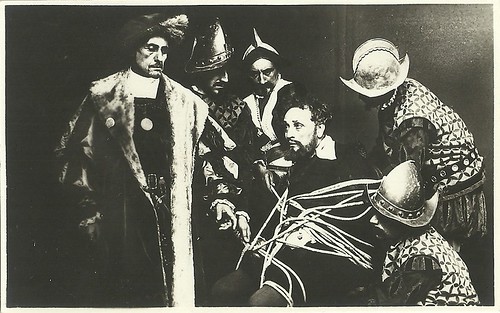
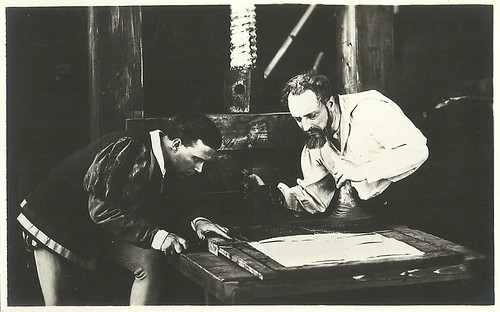
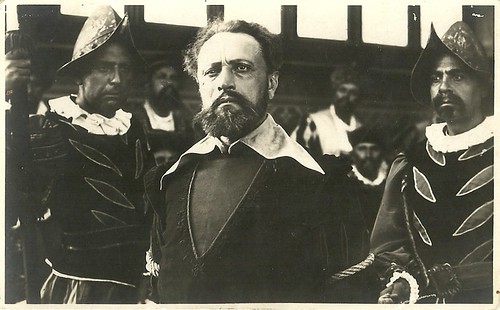
Elena Sangro (1896-1969) was a major actress of Italian cinema in the 1920s. Despite the current film crisis, she starred in one film after another. She was also one of the first female directors and had a famous affair with the old poet Gabriele D'Annunzio.
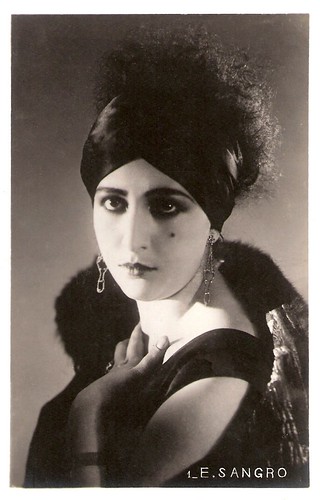
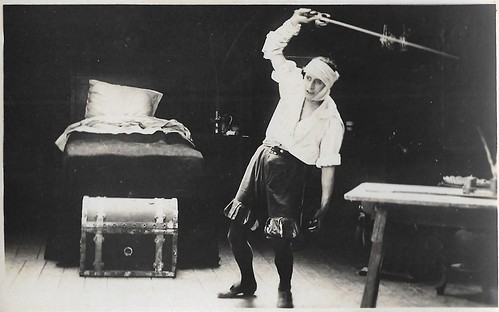
Italian postcard.
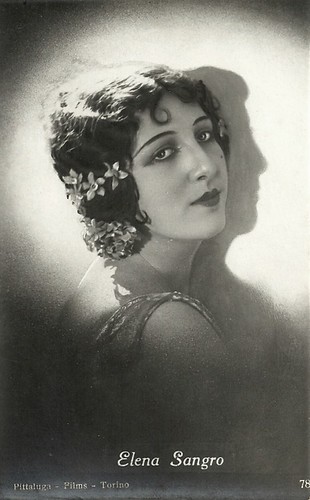
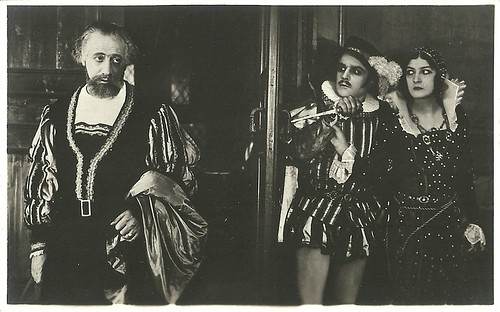
Italian postcard by Ed. A. Traldi, Milano, no. 78. Photo: Pittaluga-Films, Torino.

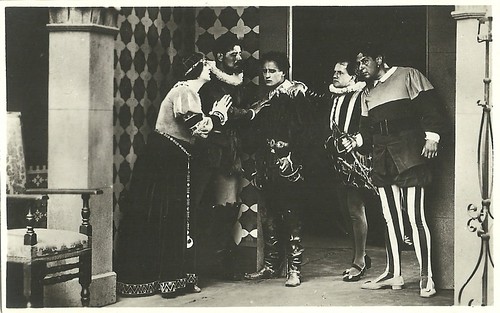
Italian postcard by Ed. A. Traldi, Roma, Milano, no. 320. Photo: Pinto, Roma.
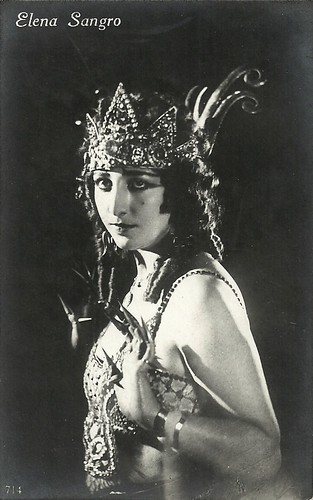
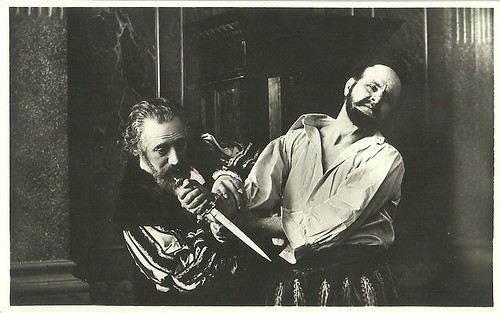
Italian postcard by Ed. A. Traldi, Milano, no. 714. Elena Sangro as Proserpina, wife of Pluto, King of the underworld, in the Italian silent film Maciste all'inferno (Guido Brignone, 1925).

Italian postcar by Ed. A. Traldi, Milano, no. 785. Photo: Pittaluga-Films, Torino.
Elena Sangro was born Maria Antonietta Bartoli-Avveduti in Aragona Castle in Vasto, Italy, in 1897. She was the daughter of Avveduto Bartoli-Avveduti, administrator of the affairs and estates of the Duke of Belgioioso, and his wife Ortensia d’Avalos, and of Ida Albini, a lady of noble birth
After attending acting lessons at the Accademia di Santa Cecilia, she debuted on stage in 'La cena delle beffe' (The Jester's Supper) by Sem Benelli and in 'Patria' (Homeland) by Victorien Sardou.
Baron Kanzler spotted her in 1917 and introduced her to director Enrico Guazzoni, who gave the young actress the lead in his film Fabiola (1918). After the success of this film, roles followed in the epic La Gerusalemme liberata / Jerusalem Liberated (Enrico Guazzoni, 1918) based on the poem by Torquato Tasso, and the comedy Primerose (Mario Caserini, 1919).
In a series of films, her cousin Giorgi Fini was her partner: Il più forte amore / The Strongest Love (N.N., 1919), Il fauno di marmo / The Marble Faun (Mario Bonnard, 1921) and L'eredità di Caino / The Legacy of Cain (Giuseppe Maria Viti, 1921). In L'onesto mondo / The Honest World (Torello Rolli, 1921), she played a singer who sacrifices herself for an unworthy man.
She played a proud, patriotic princess opposite Rina De Liguoro in Saracinesca / Portcullis (Augusto Camerini, Gaston Ravel, 1922), set in papal Rome. That same year she also played in the pro-Montenegro drama Non c'è resurrezione senza morte / There Is No Resurrection Without Death (Edoardo Bencivenga, 1922), based on the memoirs of Vladimir Popovic and personally produced by Sangro. A pro-Montenegro group, headed by the famous poet Gabriele D'Annunzio, promoted the film. This century, the film was found, restored, and presented at the Giornate del Cinema Muto, the silent film festival in Pordenone.

Spanish postcard for Amatller Marca Luna chocolate, Series 8, no. 1. Photo: Palatino Film. Elena Sangro as Fabiola in the silent film Fabiola (Enrico Guazzoni, 1918). When her servant accidentally hurts her with a hairpin, the rich and cruel aristocrat Fabiola hurts her slave with a sharp weapon Roman ladies used to have for these matters. This is from the opening scene.

Rina de Liguoro, co-star of Elena Sangro in several films. German postcard by Ross Verlag. no. 3902/1, 1928-1929. Photo: Pinto Roma.

Italian postcard. Photo: Unione Cinematografica Italiana / Medusa Film. Elena Sangro in the Italian period piece Saracinesca (Gaston Ravel, 1921), based on the novel by Frances Marion Crawford. Caption: After the killing of her husband, Corona d'Astradente has become a rich heiress.

Italian postcard. Photo: Unione Cinematografica Italiana / Medusa Film. Carlo Gualandri and Elena Sangro in the Italian period piece Saracinesca (Gaston Ravel, 1921), based on the novel by Frances Marion Crawford. Caption: [At the opera] Corona and Giovanni are now husband and wife.
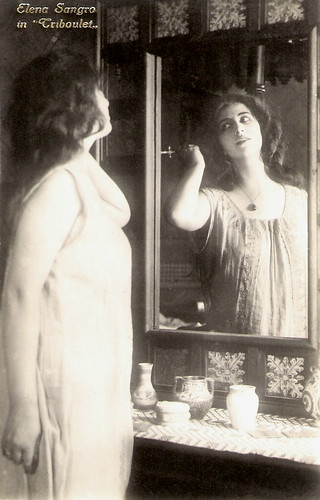
Italian postcard. Photo: Elena Sangro in Triboulet (Febo Mari, 1923).
Elena Sangro starred in the historical serial Triboulet (Febo Mari, 1923), as Poppea in Quo vadis? (Georg Jacoby, Gabriellino D'Annunzio - the son of, 1924) starring Emil Jannings and in the fantastic Peplum comedy Maciste all'inferno / Maciste in Hell (Guido Brignone, 1926).
Maciste all'inferno was one of three Maciste films in which she appeared opposite strongman Bartolomeo Pagano. When the film was first released, it was censored because it presented Hell like a sort of brothel in which hordes of semi-naked women lived.
In 1927-1928, Sangro had a famous affair with the then 64-year-old poet Gabriele D'Annunzio. He dedicated to her the erotic poem 'Alla Piacente' (To the pleasant one).
In the cinema, she was the seductress in Addio giovinezza / Farewell to Youthful Romances (Augusto Genina, 1927) with Walter Slezak and Carmen Boni. She played in Germany in Villa Falconieri (Richard Oswald, 1928) with Maria Jacobini and Hans Stüwe.
Elena Sangro finished her silent film career as the spicy Madonna Orietta in the heavily censored Boccaccesca (Alfredo de Antoni, 1928).

Italian postcard by. Ed. A. Traldi, Milano, no. 9. Photo: Fert / Pittaluga-Films. Elena Sangro as Cinzia and René [Raoul] Mayllard as Prince Otis [Ortis] in Maciste imperatore (Guido Brignone, 1924). In the kingdom of Sindagna, the prince regent Stanos tries by all means to dispose of the legitimate heir to the throne, Prince Ortis. When Maciste and Saetta happen to be in the chaotic empire, they set things straight for the poor, weak prince. Maciste is proclaimed emperor of Sindagna after getting rid of the regent and his puppet ruler. He restores peace and arranges that the prince can be united with his beloved. The plot line comes near to Mussolini's takeover of Italy, 'helping' the weak King Victor Emmanuel III and 'restoring order'.
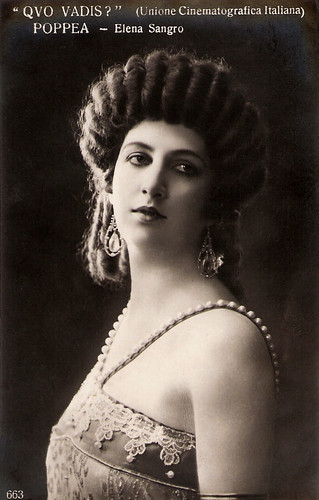
Italian postcard by Ed. A. Traldi, Milano, no. 663. Photo: UCI (Unione Cinematografica Italiana). Elena Sangro as the Empress Poppea in the epic film Quo vadis? (Gabriellino D'Annunzio, Georg Jacoby, 1924).

Italian postcard by Editions di lusso L'Argentografica, Torino (Turin), no. 3053. Photo: Unione Cinematografica Italiana. Elena Sangro in Quo vadis? (Gabriellino D'Annunzio, Georg Jacoby, 1924). Sent by mail in Italy in 1926.
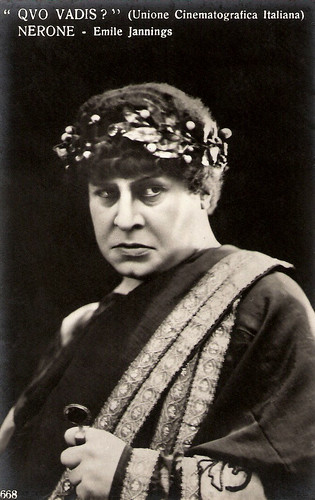
Emil Jannings in Quo vadis? (1924). Italian postcard by editor A. Traldi, Milano.

Italian poster postcard by Giulio Bolaffi Editore, Torino. Design: Lugati. Elena Sangro in Maciste all'inferno / Maciste in Hell (Guido Brignone, 1925).
In the sound era, Elena Sangro had a small role in the film Il re Burlone / The King's Jester (Enrico Guazzoni, 1935). She returned to the stage as a singer under the pseudonym of Lilia Flores.
In 1945, she founded the production company Stella d’Oro Film and made various art documentaries under the name Anton Bià. Her documentary Villa d’Este (1947) marked the debut of the actress Gina Lollobrigida. She served as assistant director on a stage production of 'Aida' (1952) and the film La sonnambula / The Sleepwalker (1954), based on Vincenzo Bellini's opera. Both were directed by Cesare Barlacchi.
Sangro also appeared in bit roles in films such as L'abito nero da sposa / The Black Dress of the Bride (Luigi Zampa, 1945) starring Fosco Giachetti, and the biography Enrico Caruso: leggenda di una voce / The Young Caruso (Giacomo Gentilomo, 1951) with Gina Lollobrigida.
This restless woman's last job was president of Associazione dei Pionieri del Cinema (the Association of Cinema Pioneers), an initiative begun in the early 1960s to safeguard this important part of film history.
Her final film appearance was a cameo in Federico Fellini's masterpiece 8½ (1963). Elena Sangro died in 1969 in Roma (Rome, Italy). She was 71.

Italian postcard by Ed. Romeo Biagi, Bologna, no. 723. Photo: Villoresi, Roma.

Italian postcard by Ed. A. Traldi, Milano, no. 437. Photo: Pinto, Roma.
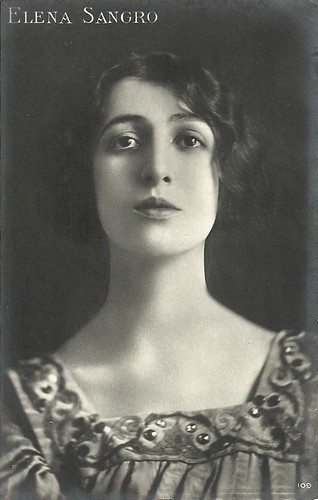
Italian postcard by Fotocelere, Torino, no. 109.
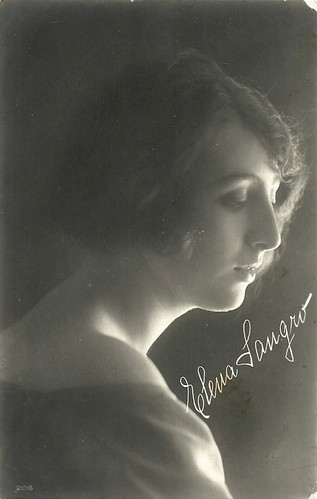
Italian postcard by Fotocelere, Torino, no. 206.
Sources: Vittorio Martinelli (Le dive del silenzio - Italian), Lino Spadaccini (Noi Vastesi - Italian), Anna Battista (Irenebrination - now defunct), Wikipedia (Italian) and IMDb.
This post was last updated on 3 November 2026.
Italian postcard.
Italian postcard by Ed. A. Traldi, Milano, no. 78. Photo: Pittaluga-Films, Torino.
Italian postcard by Ed. A. Traldi, Roma, Milano, no. 320. Photo: Pinto, Roma.
Italian postcard by Ed. A. Traldi, Milano, no. 714. Elena Sangro as Proserpina, wife of Pluto, King of the underworld, in the Italian silent film Maciste all'inferno (Guido Brignone, 1925).
Italian postcar by Ed. A. Traldi, Milano, no. 785. Photo: Pittaluga-Films, Torino.
Baron Kanzler
Elena Sangro was born Maria Antonietta Bartoli-Avveduti in Aragona Castle in Vasto, Italy, in 1897. She was the daughter of Avveduto Bartoli-Avveduti, administrator of the affairs and estates of the Duke of Belgioioso, and his wife Ortensia d’Avalos, and of Ida Albini, a lady of noble birth
After attending acting lessons at the Accademia di Santa Cecilia, she debuted on stage in 'La cena delle beffe' (The Jester's Supper) by Sem Benelli and in 'Patria' (Homeland) by Victorien Sardou.
Baron Kanzler spotted her in 1917 and introduced her to director Enrico Guazzoni, who gave the young actress the lead in his film Fabiola (1918). After the success of this film, roles followed in the epic La Gerusalemme liberata / Jerusalem Liberated (Enrico Guazzoni, 1918) based on the poem by Torquato Tasso, and the comedy Primerose (Mario Caserini, 1919).
In a series of films, her cousin Giorgi Fini was her partner: Il più forte amore / The Strongest Love (N.N., 1919), Il fauno di marmo / The Marble Faun (Mario Bonnard, 1921) and L'eredità di Caino / The Legacy of Cain (Giuseppe Maria Viti, 1921). In L'onesto mondo / The Honest World (Torello Rolli, 1921), she played a singer who sacrifices herself for an unworthy man.
She played a proud, patriotic princess opposite Rina De Liguoro in Saracinesca / Portcullis (Augusto Camerini, Gaston Ravel, 1922), set in papal Rome. That same year she also played in the pro-Montenegro drama Non c'è resurrezione senza morte / There Is No Resurrection Without Death (Edoardo Bencivenga, 1922), based on the memoirs of Vladimir Popovic and personally produced by Sangro. A pro-Montenegro group, headed by the famous poet Gabriele D'Annunzio, promoted the film. This century, the film was found, restored, and presented at the Giornate del Cinema Muto, the silent film festival in Pordenone.
Spanish postcard for Amatller Marca Luna chocolate, Series 8, no. 1. Photo: Palatino Film. Elena Sangro as Fabiola in the silent film Fabiola (Enrico Guazzoni, 1918). When her servant accidentally hurts her with a hairpin, the rich and cruel aristocrat Fabiola hurts her slave with a sharp weapon Roman ladies used to have for these matters. This is from the opening scene.
Rina de Liguoro, co-star of Elena Sangro in several films. German postcard by Ross Verlag. no. 3902/1, 1928-1929. Photo: Pinto Roma.
Italian postcard. Photo: Unione Cinematografica Italiana / Medusa Film. Elena Sangro in the Italian period piece Saracinesca (Gaston Ravel, 1921), based on the novel by Frances Marion Crawford. Caption: After the killing of her husband, Corona d'Astradente has become a rich heiress.
Italian postcard. Photo: Unione Cinematografica Italiana / Medusa Film. Carlo Gualandri and Elena Sangro in the Italian period piece Saracinesca (Gaston Ravel, 1921), based on the novel by Frances Marion Crawford. Caption: [At the opera] Corona and Giovanni are now husband and wife.
Italian postcard. Photo: Elena Sangro in Triboulet (Febo Mari, 1923).
Hell, like a sort of brothel
Elena Sangro starred in the historical serial Triboulet (Febo Mari, 1923), as Poppea in Quo vadis? (Georg Jacoby, Gabriellino D'Annunzio - the son of, 1924) starring Emil Jannings and in the fantastic Peplum comedy Maciste all'inferno / Maciste in Hell (Guido Brignone, 1926).
Maciste all'inferno was one of three Maciste films in which she appeared opposite strongman Bartolomeo Pagano. When the film was first released, it was censored because it presented Hell like a sort of brothel in which hordes of semi-naked women lived.
In 1927-1928, Sangro had a famous affair with the then 64-year-old poet Gabriele D'Annunzio. He dedicated to her the erotic poem 'Alla Piacente' (To the pleasant one).
In the cinema, she was the seductress in Addio giovinezza / Farewell to Youthful Romances (Augusto Genina, 1927) with Walter Slezak and Carmen Boni. She played in Germany in Villa Falconieri (Richard Oswald, 1928) with Maria Jacobini and Hans Stüwe.
Elena Sangro finished her silent film career as the spicy Madonna Orietta in the heavily censored Boccaccesca (Alfredo de Antoni, 1928).
Italian postcard by. Ed. A. Traldi, Milano, no. 9. Photo: Fert / Pittaluga-Films. Elena Sangro as Cinzia and René [Raoul] Mayllard as Prince Otis [Ortis] in Maciste imperatore (Guido Brignone, 1924). In the kingdom of Sindagna, the prince regent Stanos tries by all means to dispose of the legitimate heir to the throne, Prince Ortis. When Maciste and Saetta happen to be in the chaotic empire, they set things straight for the poor, weak prince. Maciste is proclaimed emperor of Sindagna after getting rid of the regent and his puppet ruler. He restores peace and arranges that the prince can be united with his beloved. The plot line comes near to Mussolini's takeover of Italy, 'helping' the weak King Victor Emmanuel III and 'restoring order'.
Italian postcard by Ed. A. Traldi, Milano, no. 663. Photo: UCI (Unione Cinematografica Italiana). Elena Sangro as the Empress Poppea in the epic film Quo vadis? (Gabriellino D'Annunzio, Georg Jacoby, 1924).
Italian postcard by Editions di lusso L'Argentografica, Torino (Turin), no. 3053. Photo: Unione Cinematografica Italiana. Elena Sangro in Quo vadis? (Gabriellino D'Annunzio, Georg Jacoby, 1924). Sent by mail in Italy in 1926.
Emil Jannings in Quo vadis? (1924). Italian postcard by editor A. Traldi, Milano.
Italian poster postcard by Giulio Bolaffi Editore, Torino. Design: Lugati. Elena Sangro in Maciste all'inferno / Maciste in Hell (Guido Brignone, 1925).
Restless woman
In the sound era, Elena Sangro had a small role in the film Il re Burlone / The King's Jester (Enrico Guazzoni, 1935). She returned to the stage as a singer under the pseudonym of Lilia Flores.
In 1945, she founded the production company Stella d’Oro Film and made various art documentaries under the name Anton Bià. Her documentary Villa d’Este (1947) marked the debut of the actress Gina Lollobrigida. She served as assistant director on a stage production of 'Aida' (1952) and the film La sonnambula / The Sleepwalker (1954), based on Vincenzo Bellini's opera. Both were directed by Cesare Barlacchi.
Sangro also appeared in bit roles in films such as L'abito nero da sposa / The Black Dress of the Bride (Luigi Zampa, 1945) starring Fosco Giachetti, and the biography Enrico Caruso: leggenda di una voce / The Young Caruso (Giacomo Gentilomo, 1951) with Gina Lollobrigida.
This restless woman's last job was president of Associazione dei Pionieri del Cinema (the Association of Cinema Pioneers), an initiative begun in the early 1960s to safeguard this important part of film history.
Her final film appearance was a cameo in Federico Fellini's masterpiece 8½ (1963). Elena Sangro died in 1969 in Roma (Rome, Italy). She was 71.
Italian postcard by Ed. Romeo Biagi, Bologna, no. 723. Photo: Villoresi, Roma.
Italian postcard by Ed. A. Traldi, Milano, no. 437. Photo: Pinto, Roma.
Italian postcard by Fotocelere, Torino, no. 109.
Italian postcard by Fotocelere, Torino, no. 206.
Sources: Vittorio Martinelli (Le dive del silenzio - Italian), Lino Spadaccini (Noi Vastesi - Italian), Anna Battista (Irenebrination - now defunct), Wikipedia (Italian) and IMDb.
This post was last updated on 3 November 2026.