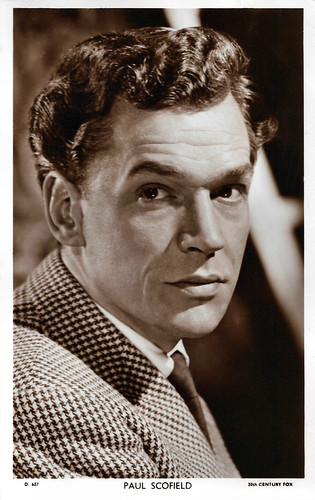
British postcard in the Picturegoer Series, London, no. D. 657. Photo: 20th Century Fox.
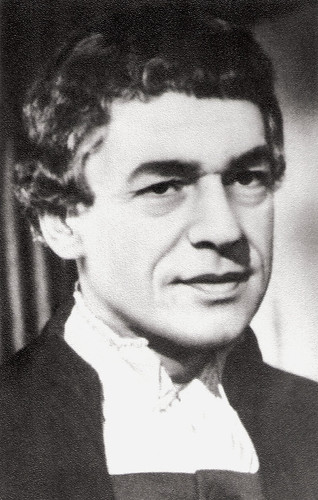
Soviet postcard by Leningrad Department of the Bureau of Soviet Cinema Propaganda in the Actors Laureates series, no. 108, 1975. Paul Scofield in A Man For All Seasons (Fred Zinnemann, 1966). Scofield won the Best Actor award for his role at the Moscow International Film Festival in 1967.
The Hamlet of his generation
David Paul Scofield was born in Birmingham in 1922. He was the son of Mary and Edward Harry Scofield, the local headmaster in Hurstpierpoint, Mid Sussex. Scofield attended the Varndean School, a boys' school in Brighton. The love of acting came early. As a schoolboy, he played Juliet in a school production of Shakespeare's 'Romeo and Juliet'.
At 17, he left school and began training as an actor at the Croydon Repertory Theatre School (1939) and then at the Mask Theatre School (1940) in London. He took on all the experience he could handle by joining touring companies and also entertained British troops during World War II. His debut performance was in American playwright Eugene O'Neill's 'Desire Under the Elms' at the Westminster Theatre. He joined the Birmingham Repertory Theatre.
In 1946, he moved to Stratford-upon-Avon and had the title role in 'Henry V', Lucio in 'Measure for Measure', and then Hamlet, alongside a then-unknown Claire Bloom as Ophelia. Scofield's performance was so highly praised that it caused him to be dubbed "The Hamlet of his generation." William McPeak at IMDb: "With a rich, sonorous voice compared to a Rolls Royce being started up, in one instance, and a great sound rumbling forth from an antique crypt in yet another, he was quickly compared to Laurence Olivier."
Scofield won many awards for his stage performances, including a Tony Award for his portrayal of Sir Thomas More in 'A Man for All Seasons' by a schoolmaster-turned-playwright, Robert Bolt. More was the great English humanist and chancellor, who defied King Henry VIII in his wish to put aside his first wife for Anne Boleyn. Scofield debuted the role in London in 1960. His only appearance on Broadway was the next year in that play, which ran into 1962. For this role, Scofield also won an Oscar for Best Actor in the film version of A Man for All Seasons (Fred Zinnemann, 1966).
Despite his great success in this film, the stage remained his primary focus. Scofield appeared as Charles Dyer in Dyer's play 'Staircase', staged by the Royal Shakespeare Company in 1966; Laurie in John Osborne's 'A Hotel in Amsterdam' (1968); and Antonio Salieri in the original stage production of Peter Shaffer's 'Amadeus' (1979). In 19977, he also played a leading role in the Peter Hall production of Ben Jonson’s play 'Volpone' for the Royal National Theatre. In 1997, he was nominated for the Laurence Olivier Theatre Award for Best Actor for his performance in 'John Gabriel Borkman' (1996) by Henrik Ibsen.

Vintage postcard. Paul Scofield in 'Hamlet'. Michael Benthall directed Scofield in the 1948 production of 'Hamlet' by the Royal Shakespeare Company. He took the radical step of casting two Hamlets (Paul Scofield and Robert Helpmann) for his production. Audiences could compare the actors' performances on different nights, seeing how an actor's individual personality and presence can change the atmosphere of a production.

Canadian postcard by Canadian Post Card Co. Ltd., Toronto 3. Paul Scofield as Coriolanus in 'Coriolanus' at the Shakespearean Festival 1961, Stratford, Canada.
Winning the Triple Crown of Acting: the Tony, the Emmy and the Oscar
From his film debut in That Lady (Terence Young, 1955), Paul Scofield was always extremely picky about accepting a particular film role. Scofield won the BAFTA Award for Most Promising Newcomer for his role, but during the following years, he only played in the box-office hit Carve Her Name with Pride (Lewis Gilbert, 1958), opposite Virginia McKenna. His third film role was a standout performance in The Train (John Frankenheimer, 1964), with Burt Lancaster.
A Man for All Seasons (Fred Zinnemann, 1966) collected 33 international awards, including six Oscars. William McPeak: "Scofield was unforgettable as the incisive man of state, able to juggle the volatile politics of the time but always keep his honour and so brimming with faith as to endure the inevitably mounting tide against him." In 1969, he became the sixth performer to win the Triple Crown of Acting, when he won the Emmy for Best Actor for Emlyn (Anthony Page, 1969), an episode of Male of the Species with Laurence Olivier.
He joined Burt Lancaster and Alain Delon for the Spy thriller Scorpio (Michael Winner, 1973). He played a memorable role as a Russian comrade of Lancaster from World War II, caught in Cold War spycraft brutality. He co-starred with Katharine Hepburn in the drama A Delicate Balance (Tony Richardson, 1973) based on the 1966 Pulitzer Prize–winning play by Edward Albee. Through the 1980s, Scofield did a mix of TV and film on both sides of the Atlantic. He was drawn back to Shakespeare in Henry V (Kenneth Branagh, 1989) as the French king, and Hamlet (Franco Zeffirelli, 1990), as The Ghost. Both were supporting roles, and the real buzz around Hamlet was for Mel Gibson as the Prince of Denmark.
In 1994, Paul Scofield appeared in the film Quiz Show (Robert Redford, 1994) concerning a real-life quiz show scandal in the United States. Scofield played the role of Mark Van Doren, the father of Charles Van Doren (Ralph Fiennes), the man at the centre of the scandal. He was nominated for an Oscar for Best Supporting Actor. In the same year, he starred in the television film Martin Chuzzlewit, an adaptation of Charles Dickens’s novel. He played both Martin Chuzzlewit senior and his brother Anthony. For this series, he received a BAFTA Award nomination for Best Supporting Actor. Two years later, he won a BAFTA Award for his role as Judge Danforth in The Crucible (Nicholas Hytner, 1996), starring Daniel Day-Lewis and Winona Ryder. Writer Arthur Miller adapted his 1953 play of the same name, which was based on the Salem witch trials, into a screenplay for the film.
Scofield declined a CBE three times, but in 2001 he accepted an appointment as a Companion of Honour. "If you want a title, Mister is really good enough, isn't it? If you've always been that, why would you want to give it up? I have a title; it's the same one I've always had", Paul Scofield explained in a rare 1992 interview. Scofield was also well known as a voice actor. He provided the narration for the radio version of 'The Chronicles of Narnia'. In 2008, Paul Scofield died at the age of 86 in a hospital near his home in the South of England, following a battle with leukaemia. He was married from 1943 till his death to actress Joy Parker. They had two children: Martin (1944), a lecturer in 19th-century English literature at the University of Kent, and Sarah (1951).
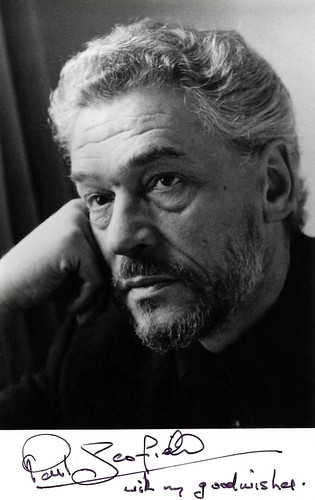
British autograph card.

French poster postcard by Editions Avant Garde, no. P1261. Image: Warner Bros. Poster with Mel Gibson, Glenn Close, Helena Bonham Carter, Alan Bates, Ian Holm and Paul Scofield in Hamlet (Franco Zeffirelli, 1990).
Sources: William McPeak (IMDb), Wikipedia (Dutch, German and English) and IMDb.
