Charismatic German theatre and film actress Brigitte Horney (1911-1988) worked both in German and English films. Her earthy charm, prominent cheekbones and deep, sultry voice made her stand out from her colleagues. She is best remembered as Empress Catherine the Great in the lavish UFA spectacle Baron Munchhausen (1943). After the war, she moved to the US and became an American citizen.
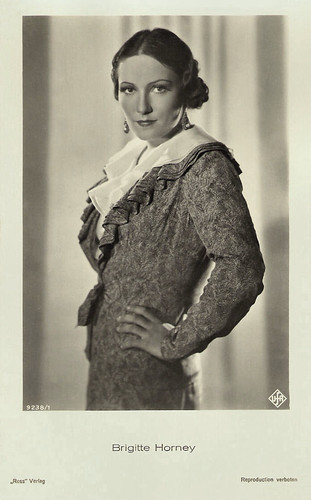
German postcard by Ross-Verlag, no. 9238/1, 1935-1936. Photo: Ufa.
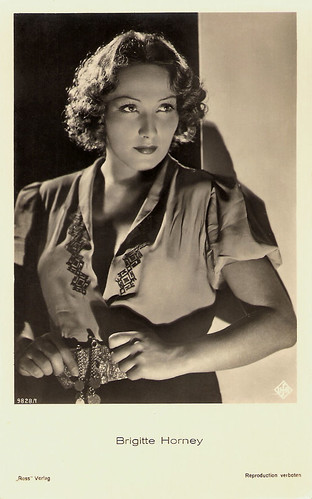
German postcard by Ross-Verlag, no. 9828/1, 1935-1936. Photo: Ufa.

German postcard by Ross-Verlag, no. A 2745, 1941-1944.
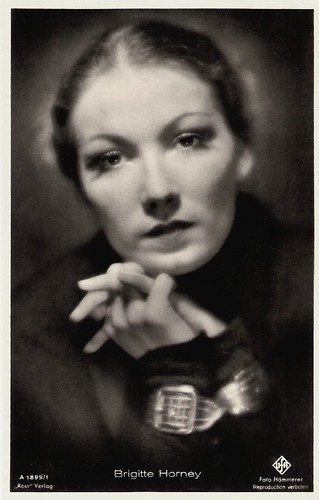
German postcard by Ross Verlag, no. A 1899/1, 1941-1944. Photo: Ufa / Hämmerer.
Brigitte Horney was born in 1911, in Berlin-Dahlem, Germany. She was the daughter of Karen Horney-Danielsen, a noted German psychoanalyst, and Oscar Horney, an industrialist from Berlin. She had a bilingual education. Brigitte attended lessons for expressive dance by the legendary Mary Wigman and also acting classes by actress Ilka Grüning at the Ilka-Grüning-Schule in Berlin.
She began her stage career in Würzburg, and was, for more than a decade, engaged by Berlin's Volksbühne. Already in 1930, she won the Max-Reinhardt-Preis as an up-and-coming actress. Young director Robert Siodmak discovered her for the cinema and cast her as a sales clerk in his film Abschied/Farewell (Robert Siodmak, 1930), the first sound film of the Ufa and according to reviewer Stanislas Lefort at IMDb a ‘forgotten masterpiece’.
The young actress refused the contract that Ufa offered her because she wanted to continue her stage career. But in the next years Horney would also appear in films like Fra Diavolo (Mario Bonnard, 1931), Rasputin, Dämon der Frauen/Rasputin (Adolf Trotz, 1932) featuring Conrad Veidt, and Ein Mann will nach Deutschland/A Man Wants to Get to Germany (Paul Wegener, 1934) with Karl Ludwig Diehl.
Although her mother had escaped to New York, Horney opportunistically remained in the Third Reich. When she accepted the starring role as a waterfront girl in the highly popular film Liebe, Tod und Teufel/Love, Death and the Devil (Heinz Hilpert, Reinhart Steinbicker, 1934) with Käthe von Nagy. A new star was born when she sang in her inimitable husky voice So oder so ist das Leben (So or so is life), written by Theo Mackeben. It became her Leitmotiv song. Critics and audiences alike compared her favourably to Marlene Dietrich.
This success was followed by such films as Savoy-Hotel 217 (Gustav Ucicky, 1936) opposite Hans Albers, the English films The House of the Spaniard (Reginald Denham, 1936) and Secret Lives (Edmond T. Gréville, 1937) as well as Der Katzensteg/The Cat’s Alley (Fritz Peter Buch, 1937), Anna Favetti (Erich Waschneck, 1938) with Mathias Wieman, and Befreite Hände/Freed Hands (Hans Schweikart, 1939) with Olga Tschechova. In these films, she often played strong women, not unlike herself.
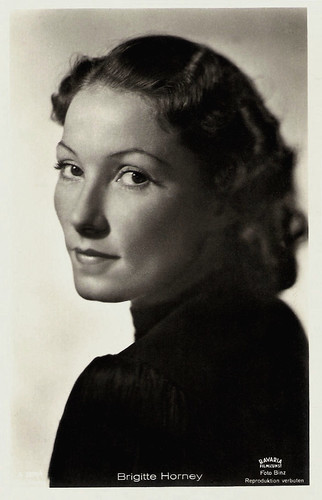
German postcard by Ross-Verlag, no. 3378/1, 1941-1944. Photo: Bavaria / Binz.
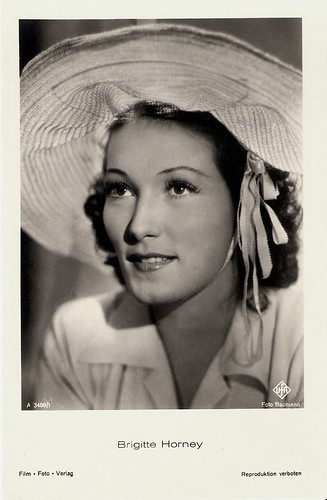
German postcard by Film-Foto-Verlag, no. A 3480/1, 1941-1944. Photo: Ufa / Baumann. Publicity still for Illusion (Viktor Tourjansky, 1941).
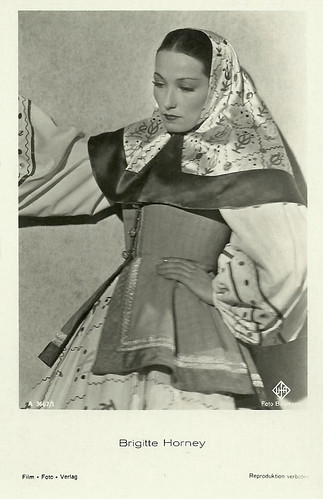
German postcard by Film-Foto-Verlag, no. 3667/1, 1941-1944. Photo: Baumann / Ufa. Publicity still for Münchhausen/The Adventures of Baron Munchausen (Josef von Báky, 1943).
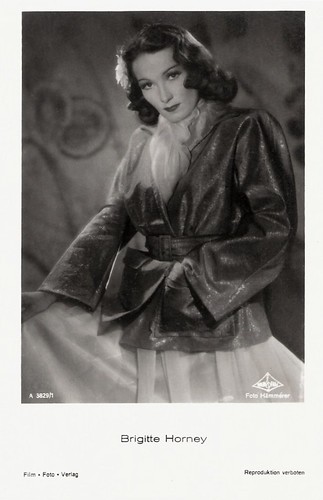
German postcard by Film-Foto-Verlag, no. A 3829/1, 1941-1944. Photo: Hämmerer / Wien Film.
When Brigitte Horney appeared at Joachim Gottschalk's side in Du und ich/You and I (Wolfgang Liebeneiner, 1938) the result was a splendid success and they continued to work successfully as a pair in Aufruhr in Damaskus/Tumult in Damascus (Gustav Ucicky, 1939), Eine Frau wie Du/A Woman Like You (Viktor Tourjansky, 1939) and eventually Das Mädchen von Fanö/The Girl From the Isle of Fanö (Hans Schweikart, 1940).
The cooperation was destroyed when Joachim Gottschalk was ordered by the Nazis to leave his Jewish wife. The family Gottschalk committed suicide in 1941 - one day before their deportation. Horney and Gottschalk had been good friends and Horney attended with only four other people his funeral in 1941, regardless of the political and career implications of doing so.
Till the end of the war, she took only part in a few more films and she is maybe best remembered for her role as Empress Catherine the Great in the Ufa production Münchhausen/Baron Munchhausen (Josef von Baky, 1943), with Hans Albers in the title role.
Josef Goebbels, Reichsminister of propaganda and also chief of the Ufa Studios, ordered this film to be made for the 25th anniversary of Ufa. Ironically the banned author Erich Kästner worked on this film and included some digs at the Nazi regime, such as a villain with a moustache talking about invading Poland. During the war, he was hidden in Horney's house in Neubabelsberg where he could write under a pseudonym.
Horney soldiered on in her own way - filming the prophetically titled Am Ende der Welt/The End of the World (Gustav Ucicky, 1944) while bombs were literally dropping around her. She finally fled to Switzerland in early 1945, with her husband, the Russian cinematographer Konstantin Irmen-Tschet. There she fell ill with tuberculosis and the newspapers even announced her death in 1946, but she answered the condolences herself.
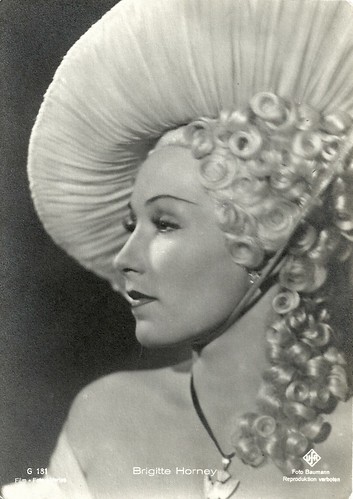
German postcard by Film-Foto-Verlag, no. G 181. Photo: Baumann.
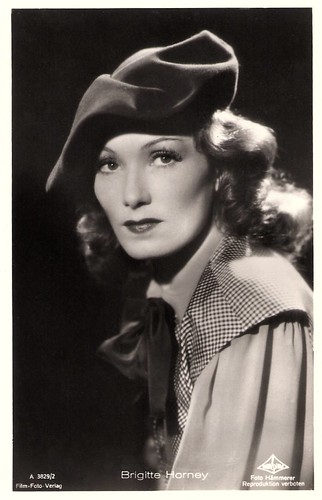
German postcard by Film-Foto-Verlag, no. A 3829/2, 1941-1944. Photo: Hämmerer / Wien Film.
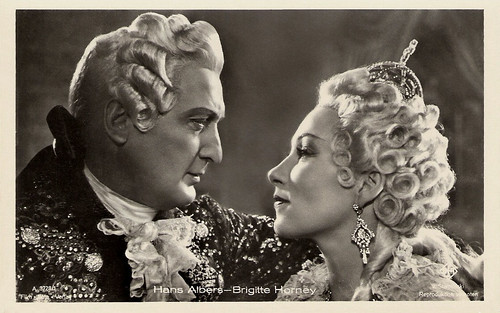
German postcard by Film-Foto-Verlag, no. A 3728/1, 1941-1944. Photo: V. Swolinski/Ufa. Publicity still for Munchhausen/The Adventures of Baron Munchausen (Josef von Baky, 1943) with Hans Albers.
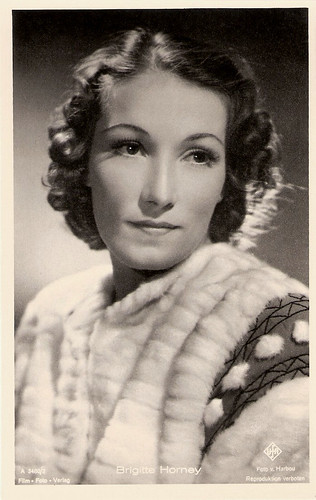
German postcard by Film-Foto-Verlag, no. A 3480/2, 1941-1944. Photo: Ufa / V. Harbou.
After the war, Brigitte Horney first acted in Zurich and Basel, including a Swiss production of Jean-Paul Sartre's 'Les Mains Sales' (Dirty Hands, 1949). She also appeared in films in Austria. The post-war cinema offered her - with a few exceptions - no demanding roles. In 1952 she moved to the US to open the Karen Horney clinic in New York City, in honour of her mother’s achievements. There she married art historian Hanns Swarzenski and received the American nationality in 1953. She visited Germany frequently and had a house in Bavaria.
She continued to work in films like Solange Du da bist/As Long as You're Near Me (Harald Braun, 1953) with O.W. Fischer, Der letzte Sommer/The Last Summer (Harald Braun, 1954) starring Hardy Krüger, Der gläserne Turm/The Glass Tower (Harald Braun, 1957) with Lilli Palmer, and the Edgar Wallace Krimi The Trygon Factor (Cyril Frankel, 1966) with Stewart Granger.
During her later years, she became a popular TV star as Aunt Polly in the Canadian-German children’s series Huckleberry Finn and His Friends (1980). On TV she also appeared in the popular series Jakob und Adele (Hans Jürgen Tögel, 1983-1986) with Carl-Heinz Schroth and the soap Das Erbe der Guldenburgs/The Guldenburg Heritage (1986–1988).
She incidentally appeared in interesting films as the war drama Charlotte (Frans Weisz, 1981) with Birgit Doll as the Jewish painter Charlotte Salomon, and Bella Donna (Peter Keglevic, 1983) with Harry Baer and Krystyna Janda. She also played a supporting role in Fassbinder's Die Sehnsucht der Veronika Voss/Veronika Voss (Rainer Werner Fassbinder, 1982), based on the life of one of her contemporaries, the haunting Sybille Schmitz.
Brigitte Horney died of cancer in 1988, in Hamburg, Germany. She was honoured with several German awards, the Bambi in 1965, the Filmband in Gold in 1972, the Goldene Kamera in 1981 and the Telestar in 1987.
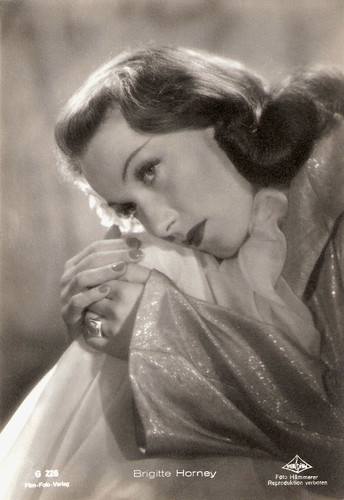
German postcard by Film-Foto-Verlag, no. G 228. Photo: Hämmerer.

Big German card by Film-Foto-Verlag, no. W 83, 1941-1944. Photo: Wien-Film / Hämmerer.
Brigitte Horney sings So oder so ist das Leben in Liebe, Tod und Teufel/Love, Death and the Devil (1934). Source: Alparfan (YouTube).
Eddi Arent, Brigitte Horney, Robert Morley and Cathleen Nesbitt in The Trygon Factor (1966). Source: whatchawatchabar (YouTube).
Sources: Thomas Staedeli (Cyranos), Hans J. Wollstein (AllMovie - page now defunct), Stanislas Lefort (IMDb), Wikipedia, and IMDb.
This post was last updated on 20 October 2024.
German postcard by Ross-Verlag, no. 9238/1, 1935-1936. Photo: Ufa.
German postcard by Ross-Verlag, no. 9828/1, 1935-1936. Photo: Ufa.
German postcard by Ross-Verlag, no. A 2745, 1941-1944.
German postcard by Ross Verlag, no. A 1899/1, 1941-1944. Photo: Ufa / Hämmerer.
Forgotten masterpiece
Brigitte Horney was born in 1911, in Berlin-Dahlem, Germany. She was the daughter of Karen Horney-Danielsen, a noted German psychoanalyst, and Oscar Horney, an industrialist from Berlin. She had a bilingual education. Brigitte attended lessons for expressive dance by the legendary Mary Wigman and also acting classes by actress Ilka Grüning at the Ilka-Grüning-Schule in Berlin.
She began her stage career in Würzburg, and was, for more than a decade, engaged by Berlin's Volksbühne. Already in 1930, she won the Max-Reinhardt-Preis as an up-and-coming actress. Young director Robert Siodmak discovered her for the cinema and cast her as a sales clerk in his film Abschied/Farewell (Robert Siodmak, 1930), the first sound film of the Ufa and according to reviewer Stanislas Lefort at IMDb a ‘forgotten masterpiece’.
The young actress refused the contract that Ufa offered her because she wanted to continue her stage career. But in the next years Horney would also appear in films like Fra Diavolo (Mario Bonnard, 1931), Rasputin, Dämon der Frauen/Rasputin (Adolf Trotz, 1932) featuring Conrad Veidt, and Ein Mann will nach Deutschland/A Man Wants to Get to Germany (Paul Wegener, 1934) with Karl Ludwig Diehl.
Although her mother had escaped to New York, Horney opportunistically remained in the Third Reich. When she accepted the starring role as a waterfront girl in the highly popular film Liebe, Tod und Teufel/Love, Death and the Devil (Heinz Hilpert, Reinhart Steinbicker, 1934) with Käthe von Nagy. A new star was born when she sang in her inimitable husky voice So oder so ist das Leben (So or so is life), written by Theo Mackeben. It became her Leitmotiv song. Critics and audiences alike compared her favourably to Marlene Dietrich.
This success was followed by such films as Savoy-Hotel 217 (Gustav Ucicky, 1936) opposite Hans Albers, the English films The House of the Spaniard (Reginald Denham, 1936) and Secret Lives (Edmond T. Gréville, 1937) as well as Der Katzensteg/The Cat’s Alley (Fritz Peter Buch, 1937), Anna Favetti (Erich Waschneck, 1938) with Mathias Wieman, and Befreite Hände/Freed Hands (Hans Schweikart, 1939) with Olga Tschechova. In these films, she often played strong women, not unlike herself.
German postcard by Ross-Verlag, no. 3378/1, 1941-1944. Photo: Bavaria / Binz.
German postcard by Film-Foto-Verlag, no. A 3480/1, 1941-1944. Photo: Ufa / Baumann. Publicity still for Illusion (Viktor Tourjansky, 1941).
German postcard by Film-Foto-Verlag, no. 3667/1, 1941-1944. Photo: Baumann / Ufa. Publicity still for Münchhausen/The Adventures of Baron Munchausen (Josef von Báky, 1943).
German postcard by Film-Foto-Verlag, no. A 3829/1, 1941-1944. Photo: Hämmerer / Wien Film.
Tuberculosis
When Brigitte Horney appeared at Joachim Gottschalk's side in Du und ich/You and I (Wolfgang Liebeneiner, 1938) the result was a splendid success and they continued to work successfully as a pair in Aufruhr in Damaskus/Tumult in Damascus (Gustav Ucicky, 1939), Eine Frau wie Du/A Woman Like You (Viktor Tourjansky, 1939) and eventually Das Mädchen von Fanö/The Girl From the Isle of Fanö (Hans Schweikart, 1940).
The cooperation was destroyed when Joachim Gottschalk was ordered by the Nazis to leave his Jewish wife. The family Gottschalk committed suicide in 1941 - one day before their deportation. Horney and Gottschalk had been good friends and Horney attended with only four other people his funeral in 1941, regardless of the political and career implications of doing so.
Till the end of the war, she took only part in a few more films and she is maybe best remembered for her role as Empress Catherine the Great in the Ufa production Münchhausen/Baron Munchhausen (Josef von Baky, 1943), with Hans Albers in the title role.
Josef Goebbels, Reichsminister of propaganda and also chief of the Ufa Studios, ordered this film to be made for the 25th anniversary of Ufa. Ironically the banned author Erich Kästner worked on this film and included some digs at the Nazi regime, such as a villain with a moustache talking about invading Poland. During the war, he was hidden in Horney's house in Neubabelsberg where he could write under a pseudonym.
Horney soldiered on in her own way - filming the prophetically titled Am Ende der Welt/The End of the World (Gustav Ucicky, 1944) while bombs were literally dropping around her. She finally fled to Switzerland in early 1945, with her husband, the Russian cinematographer Konstantin Irmen-Tschet. There she fell ill with tuberculosis and the newspapers even announced her death in 1946, but she answered the condolences herself.
German postcard by Film-Foto-Verlag, no. G 181. Photo: Baumann.
German postcard by Film-Foto-Verlag, no. A 3829/2, 1941-1944. Photo: Hämmerer / Wien Film.
German postcard by Film-Foto-Verlag, no. A 3728/1, 1941-1944. Photo: V. Swolinski/Ufa. Publicity still for Munchhausen/The Adventures of Baron Munchausen (Josef von Baky, 1943) with Hans Albers.
German postcard by Film-Foto-Verlag, no. A 3480/2, 1941-1944. Photo: Ufa / V. Harbou.
Aunt Polly
After the war, Brigitte Horney first acted in Zurich and Basel, including a Swiss production of Jean-Paul Sartre's 'Les Mains Sales' (Dirty Hands, 1949). She also appeared in films in Austria. The post-war cinema offered her - with a few exceptions - no demanding roles. In 1952 she moved to the US to open the Karen Horney clinic in New York City, in honour of her mother’s achievements. There she married art historian Hanns Swarzenski and received the American nationality in 1953. She visited Germany frequently and had a house in Bavaria.
She continued to work in films like Solange Du da bist/As Long as You're Near Me (Harald Braun, 1953) with O.W. Fischer, Der letzte Sommer/The Last Summer (Harald Braun, 1954) starring Hardy Krüger, Der gläserne Turm/The Glass Tower (Harald Braun, 1957) with Lilli Palmer, and the Edgar Wallace Krimi The Trygon Factor (Cyril Frankel, 1966) with Stewart Granger.
During her later years, she became a popular TV star as Aunt Polly in the Canadian-German children’s series Huckleberry Finn and His Friends (1980). On TV she also appeared in the popular series Jakob und Adele (Hans Jürgen Tögel, 1983-1986) with Carl-Heinz Schroth and the soap Das Erbe der Guldenburgs/The Guldenburg Heritage (1986–1988).
She incidentally appeared in interesting films as the war drama Charlotte (Frans Weisz, 1981) with Birgit Doll as the Jewish painter Charlotte Salomon, and Bella Donna (Peter Keglevic, 1983) with Harry Baer and Krystyna Janda. She also played a supporting role in Fassbinder's Die Sehnsucht der Veronika Voss/Veronika Voss (Rainer Werner Fassbinder, 1982), based on the life of one of her contemporaries, the haunting Sybille Schmitz.
Brigitte Horney died of cancer in 1988, in Hamburg, Germany. She was honoured with several German awards, the Bambi in 1965, the Filmband in Gold in 1972, the Goldene Kamera in 1981 and the Telestar in 1987.
German postcard by Film-Foto-Verlag, no. G 228. Photo: Hämmerer.
Big German card by Film-Foto-Verlag, no. W 83, 1941-1944. Photo: Wien-Film / Hämmerer.
Brigitte Horney sings So oder so ist das Leben in Liebe, Tod und Teufel/Love, Death and the Devil (1934). Source: Alparfan (YouTube).
Eddi Arent, Brigitte Horney, Robert Morley and Cathleen Nesbitt in The Trygon Factor (1966). Source: whatchawatchabar (YouTube).
Sources: Thomas Staedeli (Cyranos), Hans J. Wollstein (AllMovie - page now defunct), Stanislas Lefort (IMDb), Wikipedia, and IMDb.
This post was last updated on 20 October 2024.
