Showing posts with label Hedda Vernon. Show all posts

05 June 2019

Wo ein Wille, ist ein Weg (1918)

German actress, writer and producer Hedda Vernon (1866-?) appeared in more than 60 films of the early silent period. She made the drama Wo ein Wille, ist ein Weg/Where there is a will, there is a way (Hubert Moest, Richard Wilde, 1918) for the Eiko Film studio in Berlin. Rotophot made a series of six sepia cards for the film in the Film Sterne series.

Hedda Vernon in Wo ein Wille, ist ein Weg (1918)
German postcard in the Film Sterne series by Rotophot, no. 560/1. Photo: Eiko Film. Hedda Vernon in Wo ein Wille, ist ein Weg (Hubert Moest, Richard Wilde, 1918).

Hedda Vernon in Wo ein Wille, ist ein Weg (1918)
German postcard in the Film Sterne Series by Rotophot, no. 560/2. Photo: Eiko Film. Hedda Vernon in Wo ein Wille, ist ein Weg (Hubert Moest, Richard Wilde, 1918) with right back Ernst Hofmann.

Hedda Vernon in Wo ein Wille, ist ein Weg
German postcard in the Film Sterne series by Rotophot, no. 560/3. Photo: Eiko Film. Hedda Vernon in Wo ein Wille, ist ein Weg (Hubert Moest, Richard Wilde, 1918).

The girl from a shady inn


In Wo ein Wille, ist ein Weg/Where there is a will, there is a way (Hubert Moest, Richard Wilde, 1918), Hedda Vernon plays Gerda, a girl from a shady inn.

Gerda is surrounded by evil people, but she experiences goodness, betters her life and manages to marry well.

The film was scripted by Richard Wilde, and based on a story by Richard Skowronnek. Wilde codirected the film with Hubert Moest, Vernon's then-husband, who directed her in dozens of films in the later 1910s.

In addition to Vernon, the other main actors were Ernst Hofmann (Heinz), Olga Engl, Marie von Bülow, Kurt Walden, and Ernst Gross. Wo ein Wille, ist ein Weg premiered in November 1918 at the Berlin Tauentzien Palast.

Wo ein Wille, ist ein Weg was censored in Germany as not permitted to juveniles. As the postcards show the film's plot contained theft by children and adults alike, this may have been the cause.
Hedda Vernon in Wo ein Wille, ist ein Weg
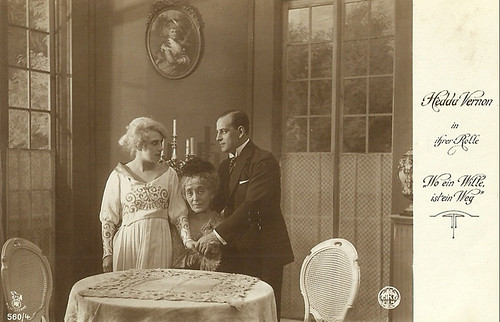
German postcard in the Film Sterne series by Rotophot, no. 560/4. Photo: Eiko Film. Hedda Vernon in Wo ein Wille, ist ein Weg (Hubert Moest, Richard Wilde, 1918). The seated woman is Olga Engl, the man could be Kurt Walden or Ernst Gross.

Hedda Vernon in Wo ein Wille, ist ein Weg
German postcard in the Film Sterne series by Rotophot, no. 560/5. Photo: Eiko Film. Hedda Vernon in Wo ein Wille, ist ein Weg (Hubert Moest, Richard Wilde, 1918).

Hedda Vernon in Wo ein Wille, ist ein Weg
German postcard by Rotophot in the Film-Sterne series, no. 560/6. Photo: Eiko Film. Hedda Vernon in Wo ein Wille, ist ein Weg (Hubert Moest, Richard Wilde, 1918). The woman on the right is Olga Engl.

Sources: The German Early Cinema Database, Filmportal.de and IMDb.

06 March 2019

Mouschy (1918)

German actress, writer and producer Hedda Vernon starred in more than 60 films of the early silent period. During the 1910s she was such a popular film star that she got her own Hedda-Vernon serial. One of her hits was Mouschy aka Mouchy (Hubert Moest, 1918), an Eiko Film production in which her co-star was Paul Hartmann.

Hedda Vernon in Mouschy (1918)
German postcard by Rotophot in the Film-Sterne series, no. 518/1. Photo: Eiko Film. Hedda Vernon and probably Theodor Becker in Mouschy aka Mouchy (Hubert Moest, 1918).

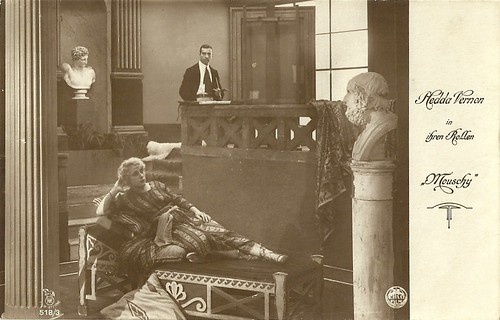
Hedda Vernon in Mouschy aka Mouchy
German postcard by Rotophot in the Film-Sterne series, no. 518/3. Photo: Eiko Film. Hedda Vernon and probably Theodor Becker in Mouschy (Hubert Moest, 1918).

Under the direction of her husband


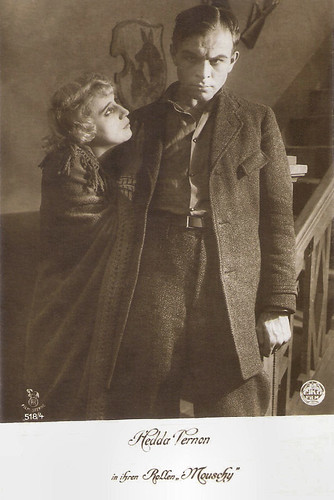
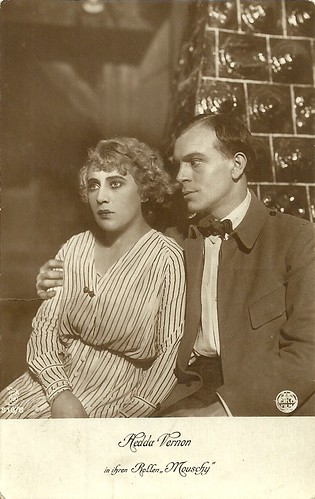
In Mouschy (Hubert Moest, 1918), Hedda Vernon plays an orphan girl who is in love with a count (Theodor Becker). But he needs to marry rich. So Mouchy becomes the wife of the forester (Paul Hartmann). The script was written by Ruth Goetz and director Hubert Moest.

In 1913, Vernon had married Hubert Moest, who was also working as an actor. She was signed by the Eiko film and worked until the end of the First World War, mainly under the direction of her husband.

He founded in 1919 his own production company Moest production. For the Moest films Die roten Schuhe/The Red Shoes (1917) and Das Todesgeheimnis/The Death Secrets (1918) ,Vernon also wrote the screenplay. In 1920, her marriage to Moest ended in a divorce.

In Mouschy (Hubert Moest, 1918), but also earlier in Zofia (Hubert Moest, 1915), Hedda Vernon played a fifteen year old girl although she was double that age at the time. On the postcards it looks a bit silly. However, such ‘child parts’ were normal for actresses in the 1910s and 1920s.

In the cast of Mouschy were also Friedrich Kühne and Eva Speyer. Producer was Franz Vogel and the cinematography was done by Hans Karl Gottschalk. Not much more is known about the film.

Mouschy (Hubert Moest, 1918) premiered at the Berlin Tauentzienpalast in August 1918, only a few months before the end of the First World War.

Hedda Vernon and Paul Hartmann in Mouschy
German postcard by Rotophot in the Film-Sterne series, no. 518/4. Photo: Eiko Film. Hedda Vernon and Paul Hartmann in Mouschy aka Mouchy (Hubert Moest, 1918).

Hedda Vernon and Paul Hartmann in Mouschy
German postcard by Rotophot in the Film-Sterne series, no. 518/6. Photo: Eiko Film. Hedda Vernon and Paul Hartmann in Mouschy (Hubert Moest, 1918).

Sources: Wikipedia (German) and IMDb.

23 June 2018

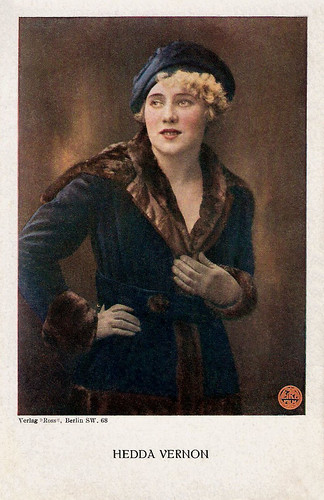
Hedda Vernon

Today starts the 32nd edition of Il Cinema Ritrovato, and we're in Bologna, Italy to enjoy the festival. One of the classics programmes is One Hundred years Ago: 1918. One the main European stars of that year was German actress, writer and producer Hedda Vernon (1886-1925). During the 1910s, she appeared in more than 60 films and she was such a popular star that she got her own Hedda-Vernon-serial.

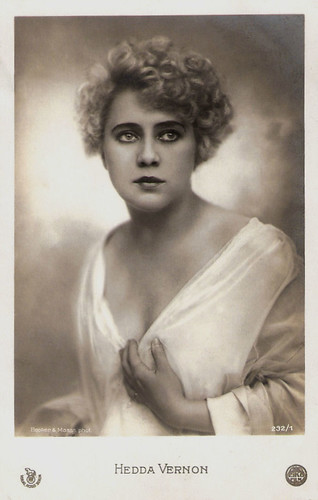
Hedda Vernon
German postcard by Rotophot in the Film Sterne series, no. 232/1. Photo: Becker & Maass / Eiko-Film.

Hedda Vernon (retouched)
German postcard by Ross Verlag, Berlin, no. 2001/12, 1919-1924. Photo: Becker & Maass / Eiko Film.

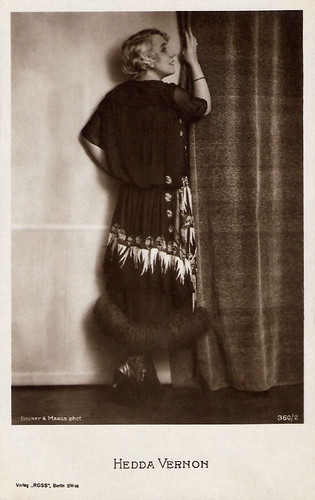
Hedda Vernon
German postcard by Ross Verlag, no. 360/2, 1919-1924. Photo: Becker & Maass Phot.

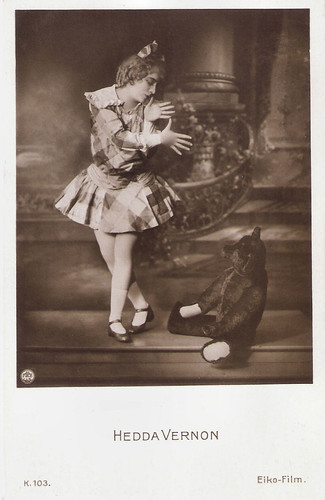
Hedda Vernon
German postcard by Photochemie, Berlin, no. K. 103. Photo: Eiko-Film.

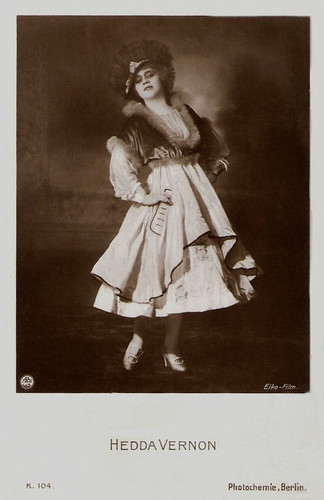
Hedda Vernon
German postcard by Photochemie, Berlin, no. K. 104. Photo: Eiko-Film.

Child Parts


Hedda Vernon (sometimes credited as Hedda Vernon-Moest) was born in 1886.

In 1912 she made her first film appearances in silent shorts for the Deutsche Bioscop GmbH in Berlin. That year she appeared in Die Papierspur/The Paper Trail (Emil Albes, 1912), Die Rote Jule/Red Jule (Emil Albes, 1912) and Der Kampf um das Erbe/The Conflict about the Heritage (Max Obal, 1912).

The following years, she played in Vitascope productions directed by Harry Piel, like Menschen und Masken 1 & 2/People and Masks 1 and 2 (Harry Piel, 1913), Die Millionenmine/The Millions Mine (Harry Piel, 1914) and Die braune Bestie/The Brown Beast (Harry Piel, 1914).

But she worked most often with her husband, actor-director Hubert Moest. They made a series of Eiko-productions, including Zofenstreichen/Abigail Paintings (Hubert Moest, 1915), Maria Niemand und Ihre Zwölf Väter/Maria Nobody and Her Twelve Fathers (Hubert Moest, 1915) with Theodor Loos, and Das Bild der Ahnfrau/The Picture of the Ancestress (Hubert Moest, 1916) with Rudolf Forster and Harry Liedtke.

These were followed by Noemi die blonde Judin/Noemi the Blonde Jew (Hubert Moest, 1917), Der Peitschenhieb/The Whiplash (Hubert Moest, 1918), and Taumel/Rapture (Hubert Moest, 1919) with Alfred Abel and Paul Hartmann.

In Zofia (Hubert Moest, 1915), Hedda Vernon impersonated a fifteen year old girl although she was almost 29 at the time. Such ‘child parts’ were normal for actresses in the 1910s and 1920s.

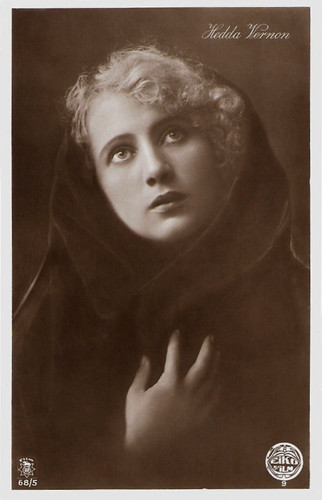
Hedda Vernon
German postcard by Rotophot in the Film Sterne series, no. 68/5. Photo: Eiko-Film.

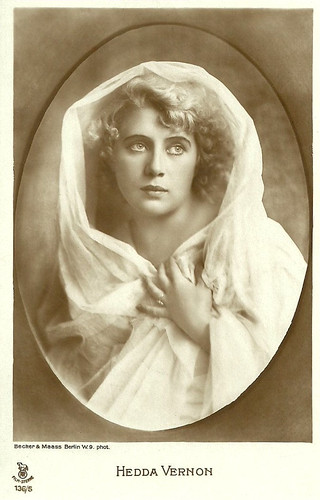
Hedda Vernon
German postcard by Rotophot in the Film Sterne Series, no. 136/5. Photo: Becker & Maass, Berlin.

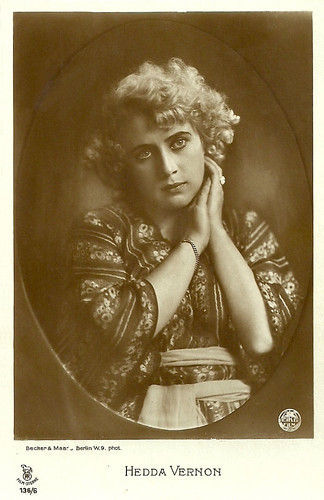
Hedda Vernon
German postcard by Rotophot in the Film-Sterne Series, no. 138/6. Photo Becker & Maass, Berlin / Eiko Film.

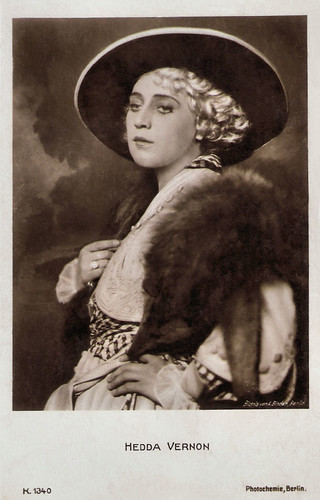
Hedda Vernon
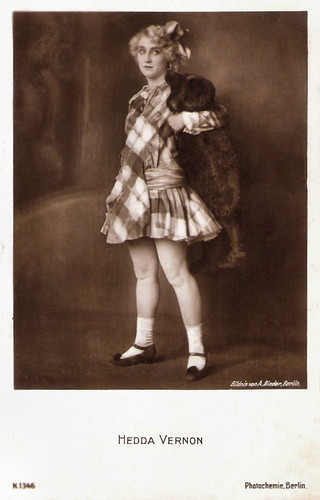
German postcard by Photochemie, Berlin, no. K. 1340. Photo: Alex Binder.

Hedda Vernon
German postcard by Photochemie, no. K. 1346. Photo: Alex Binder.

Harry Piel Series


Hedda Vernon became so popular that she got her own serial which was financed by her production company Vernon-Produktion. She produced herself in Selbstgerichtet oder Die gelbe Fratze/Self Defence or The Yellow Grimace (Hubert Moest, 1914) and Hedda Vernon’s Bühnensketch/Hedda Vernon's Stage Sketch (Hubert Moest, 1916).

She also worked with director Richard Oswald on Der Eiserne Kreuz/The Iron Cross (1914) with Hanni Weisse, Der Tod des andern/Other's Death (1919) with Alwin Neuss, and Manolescus Memoiren/The Memories of Manolescu (1920) starring Conrad Veidt.

During the 1920s, the interest in Hedda Vernon flagged. New stars became more in demand. To her few films in the 1920s belong Der Verächter des Todes/The Death Defier (Harry Piel, 1920), the Harry Piel series Der Reiter ohne Kopf/The Horseman Without a Head (Harry Piel, 1921) and Die Sonne von St. Moritz/The Sun of St. Moritz (Friedrich Weissenberg, Hubert Moest, 1923).

Her last film was Zwischen zwei Frauen/Between Two Women (Hubert Moest, 1925) opposite Reinhold Schünzel.

Hedda Vernon died that same year, at an unknown location, and of unknown causes. She was married with producer-director Hubert Moest from 1913 till 1920.

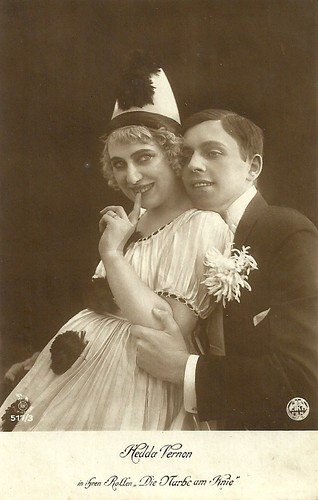
Hedda Vernon in Die Narbe am Knie
German postcard by Rotophot in the Film-Sterne series, no. 517/3. Photo: Eiko-Film. Hedda Vernon in Die Narbe am Knie (Hubert Moest, 1917).

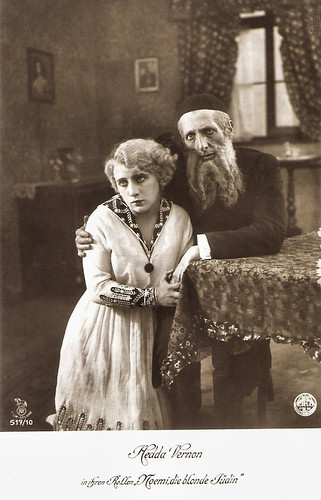
Hedda Vernon in Noemi, die blonde Jüdin.
German postcard by Rotophot in the Film-Sterne series, no. 517/10. Photo: Eiko Film. Publicity still of Hedda Vernon in Noemi, die blonde Jüdin (Hubert Moest, 1917).

Hedda Vernon in Mouschy
German postcard by Rotophot in the Film-Sterne series, no. 518/1. Photo: Eiko Film. Hedda Vernon in Mouschy (Hubert Moest, 1918).

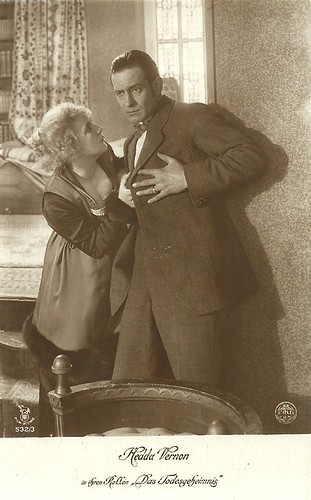
Hedda Vernon in Das Todesgeheimnis (1918)
German postcard by Rotophot in the Film-Sterne series, no. 532/3. Photo: Eiko Film. Hedda Vernon and Erich Kaiser-Titz in Das Todesgeheimnis (Hubert Moest, 1918). Vernon co-scripted this film, with Ruth Goetz - who wrote several scripts for the Hedda Vernon films of the late 1910s.

Hedda Vernon in Der Übel größtes aber ist die Schuld
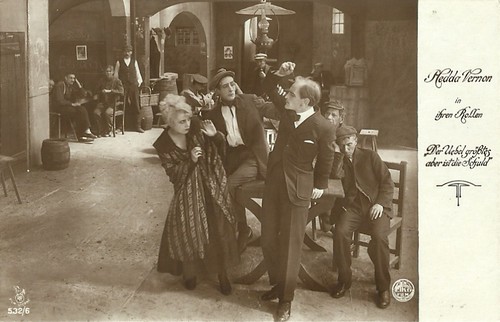
German postcard by Rotophot in the Film-Sterne series, no. 532/6. Photo: Eiko Film. Hedda Vernon in Der Übel größtes aber ist die Schuld (Hubert Moest, 1918).

Hedda Vernon in Fesseln
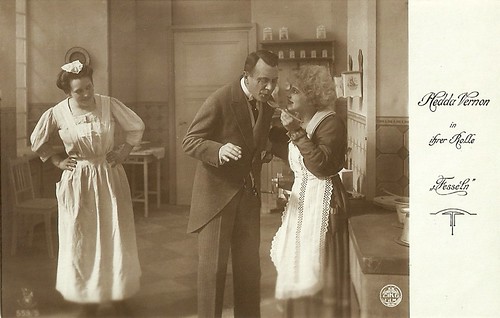
German postcard by Rotophot in the Film-Sterne series, no. 559/5. Photo: Eiko Film. Hedda Vernon in Fesseln/Chains (Hubert Moest, 1918).

Hedda Vernon in Wo ein Wille, ist ein Weg (1918)
German postcard by Rotophot in the Film Sterne Series, no. 560/2. Photo: Eiko Film. Publicity still for Wo ein Wille, ist ein Weg (Hubert Moest, 1918) with in the back right Ernst Hofmann.

Hedda Vernon in Puppchen (1918)
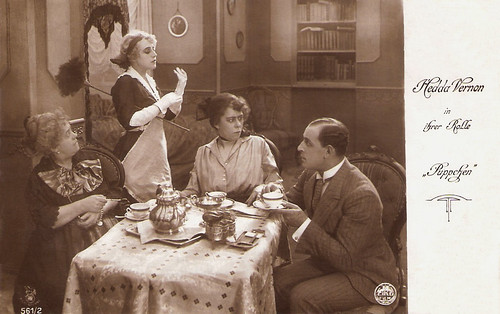
German postcard by Rotophot in the Film-Sterne series, no. 561/2. Photo: Eiko Film. Hedda Vernon in Puppchen/Dolly (Hubert Moest, 1918).

Sources: Thomas Staedeli (Cyranos), Filmportal.de, Wikipedia (German) and IMDb.
18 January 2018

Der Übel größtes aber ist die Schuld (1918)

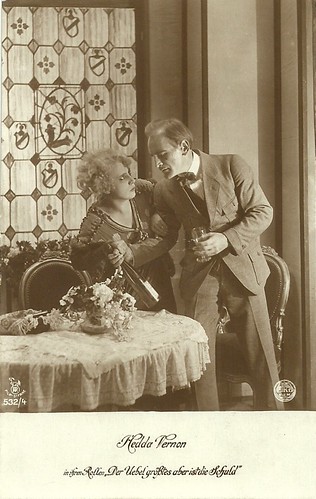
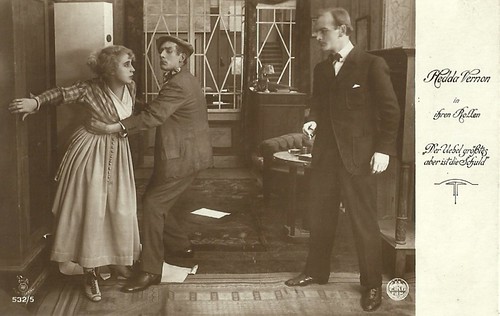
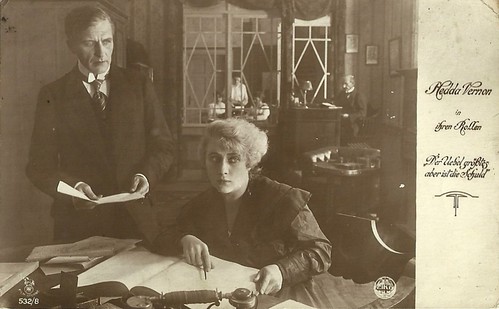
The title of the silent German drama Der Übel größtes aber ist die Schuld (Hubert Moest, 1918) refers to a line by Cicero, retaken by Friedrich Schiller in the closing lines of his play Die Braut von Messina. Worse than a (self-chosen) death, both claim, is guilt.

Hedda Vernon in Der Übel größtes aber ist die Schuld
German postcard in the Film Sterne series by Rotophot, no. 532/4. Photo: Eiko Film. Hedda Vernon and Josef Peterhans in Der Übel größtes aber ist die Schuld (Hubert Moest, 1918).

Hedda Vernon in Der Übel größtes aber ist die Schuld
German postcard in the Film Sterne series by Rotophot, no. 532/5. Photo: Eiko Film. Hedda Vernon and Josef Peterhans in Der Übel größtes aber ist die Schuld (Hubert Moest, 1918).

One of the most prolific writers for the German silent film


German actress, writer and producer Hedda Vernon (1866-?) appeared in more than 60 films of the early silent period. During the 1910s she was such a popular film star that she got her own Hedda-Vernon serial. One of these productions was Der Übel größtes aber ist die Schuld (Hubert Moest, 1918).

Der Übel größtes aber ist die Schuld was scripted by German scriptwriter Ruth Goetz, "one of the most prolific writers for film in Germany in the period 1916–1927, with about sixty-five titles including original scripts and adaptations credited to her name", as Mila Ganeva writes on the website Women Film Pioneers project.

Ganeva: "Ruth Goetz was the only woman featured in this special 1918 issue of the Berlin-based trade magazine Kinematograph edited by E.A. Dupont and devoted to the invisible work of scenarists. A year earlier, one of her scripts had been included as a model for aspiring writers in one of the first manuals compiled by Wilhelm Adler. The film based on this script, Noemi, die blonde Jüdin/Noemi, the Blond Jewess (1917), was directed by Hubert Moest and served primarily as a star vehicle for actress Hedda Vernon."

Director Hubert Moest was Hedda Vernon's husband from 1913 to 1920. After having acted together from 1913 on, he directed her in many films at the Eiko studio in the years 1914-1919.

In 1917-1918 many postcards for Vernon's films were released: Die Verworfenen, Die Narbe am Knie, Noemi, die blonde Jüdin (all 1917), and Puppchen, Fesseln, Der Übel größtes aber ist die Schuld, Mouchy, Das Todesgeheimnis and Wo ein Wille, ist ein Weg (all 1918). All these films were directed by Moest.

Hedda Vernon in Der Übel größtes aber ist die Schuld
German postcard in the Film Sterne series by Rotophot, no. 532/6. Photo: Eiko Film. Hedda Vernon and Josef Peterhans in Der Übel größtes aber ist die Schuld (Hubert Moest, 1918).

Hedda Vernon in Der Übel größtes aber ist die Schuld
German postcard in the Film Sterne series by Rotophot, no. 532/7. Photo: Eiko Film. Hedda Vernon and Josef Peterhans in Der Übel größtes aber ist die Schuld (Hubert Moest, 1918).

Hedda Vernon in Der Übel größtes aber ist die Schuld
German postcard in the Film Sterne series by Rotophot, no. 532/8. Photo: Eiko Film. Hedda Vernon in Der Übel größtes aber ist die Schuld (Hubert Moest, 1918).

Source: Women Film Pioneers Project; Stephanie D'heil (Steffi-line.de - German), Wikipedia and IMDb.

10 December 2017

Fesseln (1918)

German actress, writer and producer Hedda Vernon was the star of the Eiko Film production Fesseln/Chains (Hubert Moest, 1918). During the 1910s, she was such a popular film star in Germany that she got her own Hedda-Vernon serial.

Hedda Vernon in Fesseln
German postcard in the Film Sterne series by Rotophot, no. 559/1. Photo: Eiko-Film. Hedda Vernon and Hermann Vallentin in Fesseln (Hubert Moest, 1918).

Hedda Vernon in Fesseln
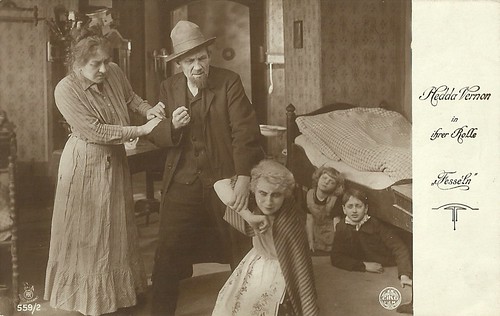
German postcard in the Film Sterne series by Rotophot, no. 559/2. Photo: Eiko-Film. Hedda Vernon in Fesseln (Hubert Moest, 1918).

Hedda Vernon in Fesseln
German postcard in the Film Sterne series by Rotophot, no. 559/3. Photo: Eiko-Film. Hedda Vernon and Hermann Vallentin in Fesseln (Hubert Moest, 1918).

A forgotten film


Little is known about this film. Fesseln/Chains (Hubert Moest, 1918) was offered to the German National Board of Censors in August 1918.

Fesseln is one of the seven silent films from 1918 in which German film star Hedda Vernon (1886–1925) played the lead role. Between 1912 and 1925 she starred in more than 80 films. How and where she died is unknown.

Next to Hedda Vernon were in the cast: Emil Albes, Ewald Brückner, Lucie Friedrich, Hermann Vallentin and Erich Wilde.

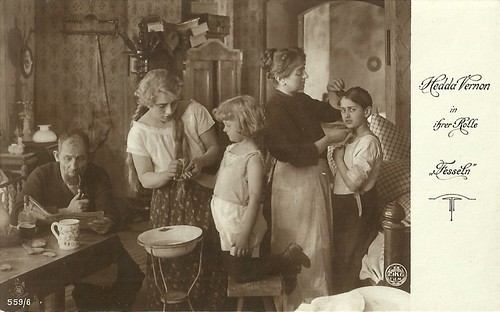
The film was scripted by Richard Wilde. We don't what the plot was about, but the postcards seem to suggest a storyline. Vernon plays a poor girl who finds a job as a nanny but is maltreated.

Director was Hubert Moest, who was Hedda Vernon's husband from 1913 till 1920. Moest was also her regular film director at Eiko in the years 1914-1918 and afterwards at other companies, including his own company Moest-Film from 1919 on.

Rotophot produced this series of sepia postcards with scenes from the film in their Film Sterne (Film Stars) series.

Hedda Vernon in Fesseln
German postcard in the Film Sterne series by Rotophot, no. 559/4. Photo: Eiko-Film. Hedda Vernon in Fesseln (Hubert Moest, 1918).

Hedda Vernon in Fesseln
German postcard in the Film Sterne series by Rotophot, no. 559/5. Photo: Eiko-Film. Hedda Vernon in Fesseln (Hubert Moest, 1918).

Hedda Vernon in Fesseln
German postcard in the Film Sterne series by Rotophot, no. 559/6. Photo: Eiko-Film. Hedda Vernon in Fesseln (Hubert Moest, 1918).

Sources: Wikipedia (German) and IMDb.