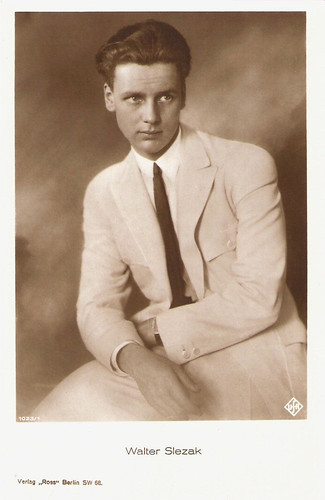
German postcard by Ross Verlag, Berlin, no. 1023/1, 1927-1928. Photo: Ufa.
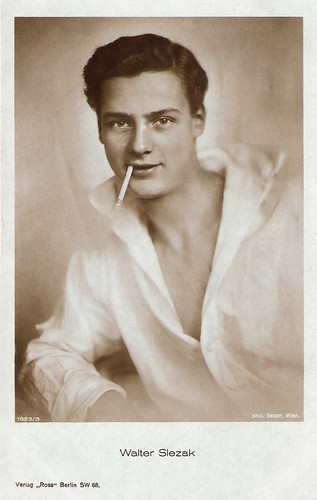
German postcard by Ross Verlag, Berlin, no. 1023/3, 1927-1928. Photo: Setzer, Wien (Vienna).
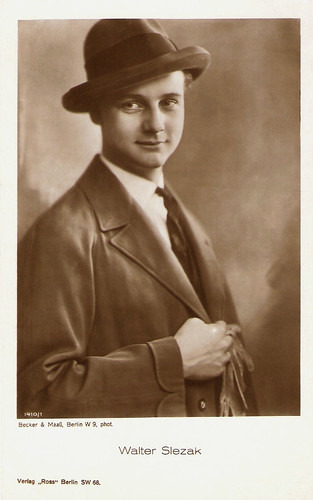
German postcard by Ross Verlag, Berlin, no. 1410/1, 1927-1928. Photo: Becker & Maass, Berlin.
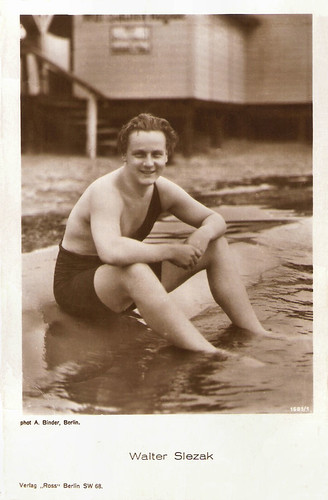
German postcard by Ross Verlag, Berlin, no. 1581/1, 1927-1928. Photo: Alex Binder.
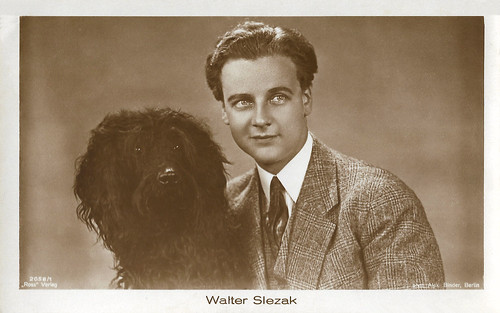
German postcard by Ross Verlag, Berlin, no. 2058/1, 1927-1928. Photo: Alex Binder, Berlin.
Thin Leading Man
Walter Slezak was born in Vienna, Austria into an artistic family in 1902. he was the brother of actress Margarete Slezak. His father was the opera tenor and later film comedian Leo Slezak. During a production of 'Lohengrin', when the mechanical swan that was to carry the hero across the lake malfunctioned and ‘floated’ off too soon, Leo allegedly said: "What time is the next swan?" In 1962, this quote became the title of Walter Slezak's autobiography.
The young Slezak was a medical student before settling into the comfortable position of a bank clerk. Slezak was coerced by his friend, actor/director Mihály Kertész (who later changed his name into Michael Curtiz), to accept an acting role in Curtiz' spectacular Sodom und Gomorrha/Sodom and Gomorrah (Mihály Kertész, 1922) starring Lucy Doraine. With this film, Slezak's career in the world of finance came to an end.
Subsequently, the then rather lean Slezak was signed by the Ufa and became a matinee idol in German films of the 1920s. Two years later he starred in the German drama Mikael/Michael (1924) by the brilliant Danish director Carl Theodor Dreyer. It was released in the US under the more lurid titles Chained and The Story of the Third Sex, an unsubtle allusion to the plotline's homosexual subtext.
Fellow director Benjamin Christensen stars as The Master, a world-renowned painter. Celebrated for his portrait of a 'beautiful' young male art student named Mikael, the Master graciously accepts the plaudits of his acolytes. Inwardly, however, he is tormented by his strong, passionate feelings for Mikael. Ironically, both men have a falling out over the affections of a woman (Nora Gregor) - and when The Master dies, Mikael is accused of his murder.
In the next years, Slezak appeared as a romantic leading man in films like Grüß mir das blonde Kind am Rhein/Greet for me the blond child on the Rhine (Carl Boese, 1926), Junges Blut/Young Blood (Manfred Noa, 1926) with Lya de Putti and the Italian production Addio giovinezza!/Goodbye youth! (Augusto Genina, 1927) with Elena Sangro.
Always somewhat too fond of the culinary arts, Slezak put on so much weight that, by the end of the decade, he was no longer considered bankable as a romantic star. Slezak decided around 1930 to become a character actor. He played a supporting part in the musical comedy Spione im Savoy-Hotel/The Gala Performance (Friedrich Zelnik, 1932) starring Alfred Abel, and after that, he went to the USA.
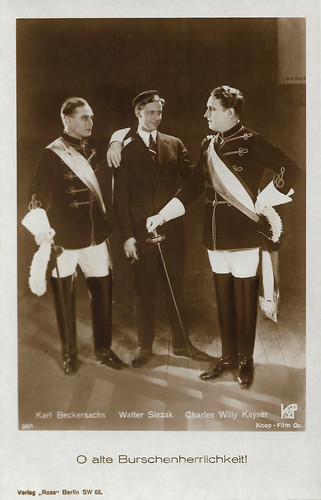
German postcard by Ross Verlag, no. 35/1. Photo: Koop-Film Co. Karl Beckersachs, Walter Slezak and Charles Willy Kayser in O alte Burschenherrlichkeit/Oh Those Glorious Old Student Days (Helene Lackner, Eugen Rex, 1925).

German postcard by Ross Verlag, Berlin, no. 35/4. Photo: Koop-Film Co. Maria Zelenka and Walter Slezak in O alte Burschenherrlichkeit!/Oh Those Glorious Old Student Days (Helene Lackner, Eugen Rex, 1925).

German postcard by Ross Verlag, Berlin, no. 1027/1, 1927-1928. Photo: Ufa. With André Mattoni in Die gefundene Braut/The Found Bride (Rochus Gliese, 1925).

German postcard by Ross Verlag, no. 79/5. Photo: Henny Porten-Froehlich Produktion GmbH. Henny Porten and Walter Slezak in the German silent film Die grosse Pause (Carl Froehlich, 1927).
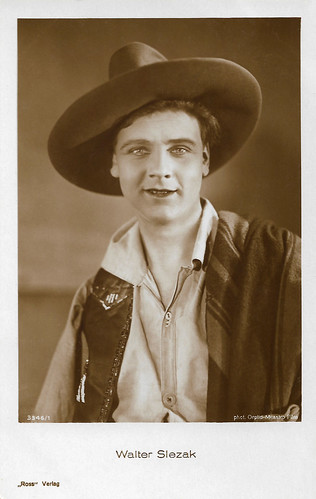
German postcard by Ross Verlag, Berlin, no. 3346/1, 1928-1929. Photo: Orplid / Messtro Film. Walter Slezak in Ledige Mütter/Unwed Mothers (Fred Sauer, 1928).

German postcard by Ross Verlag, Berlin, no. 3346/2, 1928-1929. Sent by mail in former Yugosl;avia in 1929. Photo: Orplid-Messtro-Film. Walter Slezak in Ledige Mütter/Unwed mothers (Fred Sauer, 1928).
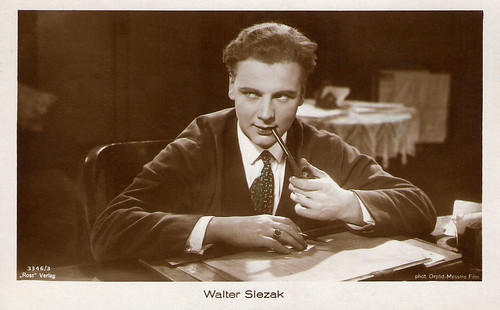
German postcard by Ross Verlag, Berlin, no. 3346/3, 1928-1929. Photo: Orplid - Messtro Film. Walter Slezak in Ledige Mütter/Unwed mothers (Fred Sauer, 1928).
Fifth-columnist
Walter Slezak made his Broadway debut in 'Meet My Sister' (1930). Though publicly modest about his vocal abilities, Slezak gained further plaudits for his role in the Oscar Hammerstein production, 'Music in the Air' (1932-33), scored by Jerome Kern.
After 12 years of stage work, he was cast in his first American film, Once Upon a Honeymoon (Leo McCarey, 1942), playing the fifth-columnist husband of social-climbing Ginger Rogers. Next, he appeared in This Land Is Mine (Jean Renoir, 1943) starring Charles Laughton.
He walked away with most of the acting honours for Hitchcock's claustrophobic thriller Lifeboat (Alfred Hitchcock, 1944) starring Tallulah Bankhead. In Lifeboat, he gave a compelling performance as the callous, methodical Nazi captain, who gradually assumes command of the vessel containing the survivors of the passenger ship torpedoed and sunk by his U-boat.
Film critic Bosley Crowther commented in the New York Times: "Nor is he an altogether repulsive or invidious type. As Walter Slezak plays him, he is tricky and sometimes brutal, yes, but he is practical, ingenious, and basically courageous in his lonely resolve. Some of his careful deceptions would be regarded as smart and heroic if they came from an American in the same spot".
Slezak worked steadily and appeared as a supporting player in films like the MGM musical The Pirate (Vincente Minnelli, 1948), as the scheming medicine-show man in Danny Kaye's The Inspector General (Henry Koster, 1949) and Call Me Madam (Walter Lang, 1953). A hulking figure at 2m, Slezak usually portrayed a villain or thug, but also played lighter, kindlier roles, as in The Wonderful World of the Brothers Grimm (Henry Levin, 1962) and as Squire Trelawney in Treasure Island (John Hough, 1972).
Slezak also played the lead in Broadway musicals, including Cesar in 'Fanny' (1955), for which he won the Tony Award for Best Actor in a Musical. In 1959 he followed in his father's footsteps by singing the part of Zsupan in 'The Gypsy Baron' at the Metropolitan Opera. His TV assignments included the role of the Clock King on Batman (1966-1967).
Slezak married Johanna Van Rijn in 1943. The couple had three children: Ingrid, Erika, and Leo. Erika Slezak went on to become an Emmy-winning actress and has starred as Victoria Lord on the long-running soap opera One Life to Live since 1971. In 1974 Walter appeared on the series as her character's godfather, Lazlo Braedecker. In 1983, just before his 81st birthday Walter Slezak shot himself in his Beverly Hills home, because of his advanced physical illness.
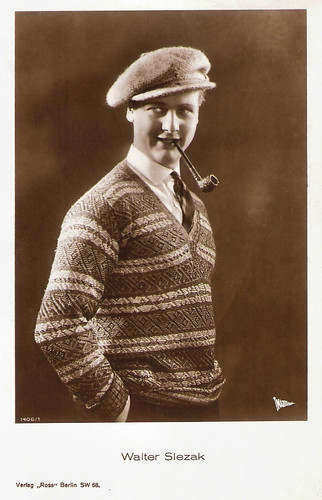
German postcard by Ross Verlag, Berlin, no. 1406/1, 1926-1927. Photo: National.

German postcard by Ross Verlag, Berlin, no. 1406/2, 1926-1927.
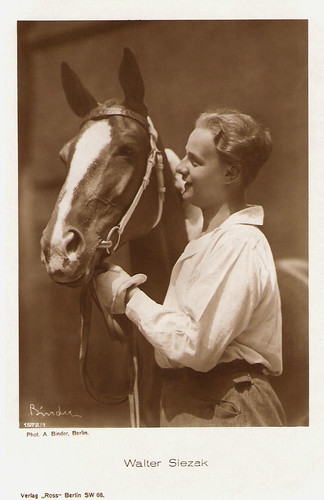
German postcard by Ross Verlag, Berlin, no. 1572/1, 1927-1928. Photo: Alex Binder.
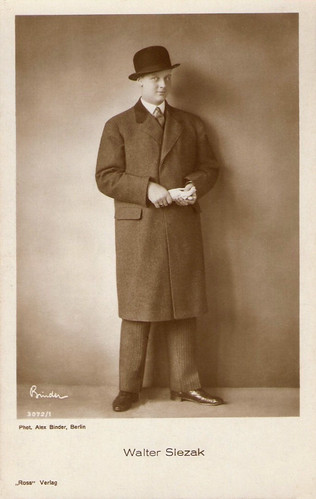
German postcard by Ross Verlag, Berlin, no. 3072/1, 1928-1929. Photo: Alex Binder.
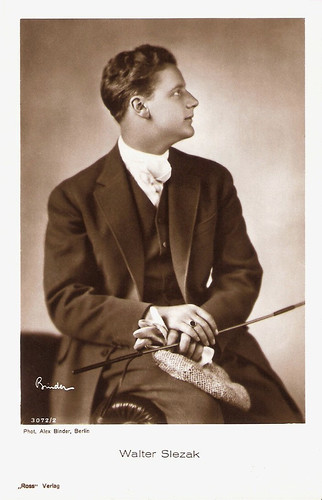
German postcard by Ross Verlag, Berlin, no. 3072/2, 1928-1929. Photo: Alex Binder.
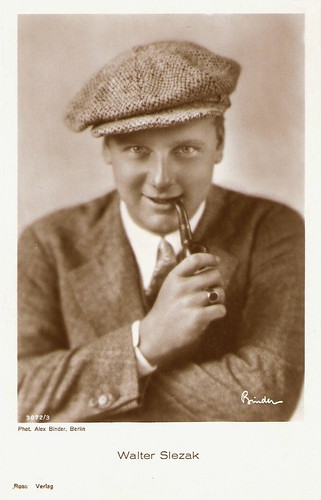
German postcard by Ross Verlag, Berlin, no. 3072/3, 1928-1929. Photo: Alex Binder, Berlin.
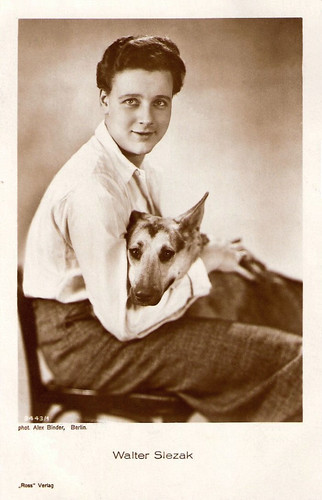
German postcard by Ross Verlag, Berlin, no. 3443/1, 1928-1929. Photo: Alex Binder, Berlin.
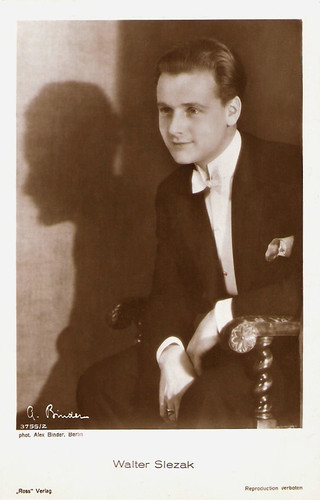
German postcard by Ross Verlag, Berlin, no. 3755/2, 1928-1929. Photo: Alex Binder, Berlin.
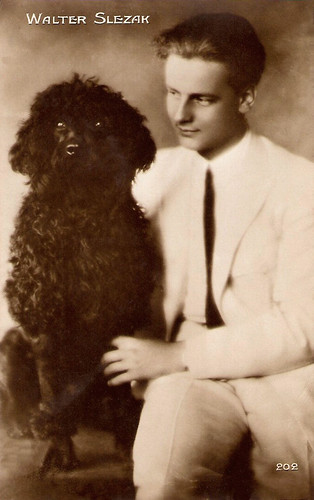
French postcard by Cinémagazine-Editions, Paris, no. 202.
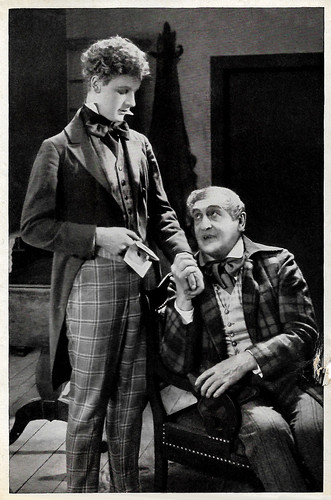
German collectors card in the series 'Vom Werden deutscher Filmkunst - Der Tonfilm', album no. 11, picture no. 130. Photo: Ufa / Ross Verlag. Walter Slezak and Hans Mierendorff in Mein Leopold/My Leopold (Hans Steinhoff, 1931).
Sources: Hal Erickson (AllMovie), Thomas Staedeli (Cyranos), I.S. Mowis (IMDb), IMDb, and Wikipedia.
This post was last updated on 22 September 2021.


