Showing posts with label Norma Shearer. Show all posts

18 June 2022

La Collectionneuse: Marie Antoinette

A daughter of Austrian Empress Maria Theresa, Marie-Antoinette (1755-1793) married Louis, heir to the throne of France, in 1770. After King Louis XV’s death in 1774, Louis XVI and Marie-Antoinette became King and Queen of France. Over the years, Marie-Antoinette‘s popularity among French people declined steadily. Rumoured to be a big spender of the national finances, she ended up being nicknamed “Madame déficit”. She was also accused of infidelity and immoral conduct. In 1789, the French Revolution took place and, in 1792, the monarchy was officially abolished. In January 1793, Louis was condemned to death by guillotine and was executed on the 21st. The former Queen of France suffered the same fate in October.

Marie-Antoinette has since become an icon and many actresses have portrayed her on the screen. Here is a selection of five of them.


Diana Karenne
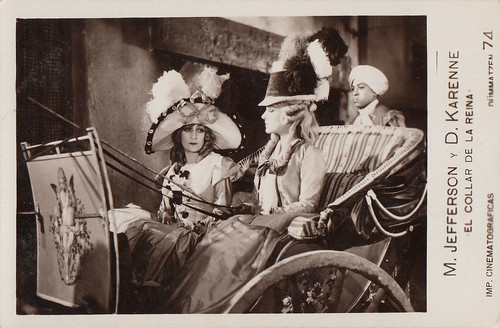

Diana Karenne and Marcelle Jefferson-Cohn (a.k.a. Marcelle Chantal) in Le collier de la reine (1929)
Spanish postcard by Dümmatzen, no. 74. Diana Karenne and Marcelle Jefferson-Cohn (a.k.a. Marcelle Chantal) in Le collier de la reine/The Queen's Necklace (Tony Lekain, Gaston Ravel, 1929).

Diana Karenne (1888-1940) was one of Italian silent movie history’s most famous divas. She played Marie-Antoinette twice: in the German-made Marie-Antoinette - Das Leben einer Königin (1922) and, at the end of her starring career, in the French production Le collier de la reine (1929).

Suzanne Bianchetti
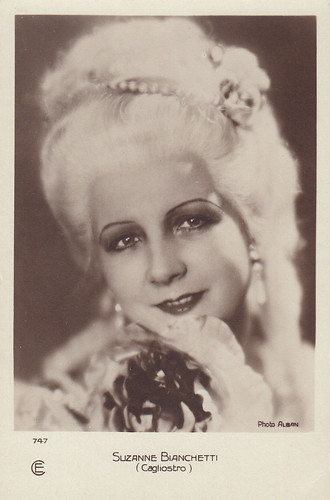

Suzanne Bianchetti in Cagliostro (1929)
French postcard by Cinémagazine-Sélection, Paris, no. 747. Suzanne Bianchetti in Cagliostro/Cagliostro - Liebe und Leben eines großen Abenteurers (Richard Oswald, 1929). Photo: Alban.

French star Suzanne Bianchetti (1889-1936) was given several times aristocratic roles of empresses, queens, marchionesses or duchesses during her career. She played Marie-Antoinette twice: in Napoléon (1927) and Cagliostro (1929).

Norma Shearer
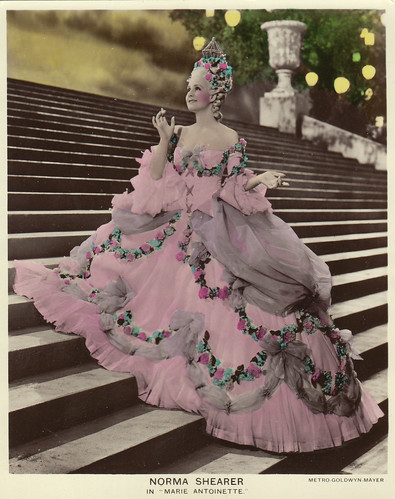

Norma Shearer in Marie Antoinette (1938)
British large card by Picturegoer, in the Colored Art Series, no. CA 8. Photo: Metro-Goldwyn-Mayer. Norma Shearer in Marie-Antoinette (W.S. Van Dyke, 1938).

Tyrone Power and Norma Shearer in  Marie Antoinette (1938)
British postcard by Art Photo. Tyrone Power and Norma Shearer in Marie-Antoinette (W.S. Van Dyke, 1938). Photo: Metro-Goldwyn-Mayer.

Norma Shearer in Marie-Antoinette (1938)
British postcard in the Colourgraph Series, London, no. C302. Photo: Metro-Goldwyn-Mayer. Norma Shearer in Marie-Antoinette (W.S. Van Dyke, 1938).

In 1933, producer Irving Thalberg acquired film rights to Stefan Zweig’s best-selling book 'Marie-Antoinette: The Portrait of an Average Woman' and planned to film it as a lavish star vehicle for his wife, Norma Shearer. But it took several years of preproduction to see his project come to life.

After Thalberg’s death in 1936, Norma Shearer signed a new contract for six movies with M.G.M. in 1937 and it was announced that Marie Antoinette was scheduled to be the first of them. The budget was astronomical and no expenses were spared for the costumes, the wigs and the sets. Clothes designer Adrian, hair stylist Sydney Guilaroff and art director Cedric Gibbons surpassed themselves.

Norma Shearer was surrounded by a top-notch cast. Handsome Tyrone Power was borrowed from 20th Century Fox for the role of Count Axel de Fersen. John Barrymore was King Louis XV, Robert Morley was King Louis XVI, Anita Louise was Princesse de Lamballe, Gladys George was Madame du Barry and Joseph Schildkraut was the scheming Duke of Orleans.

It was an acting challenge for Norma Shearer, who was asked to run the gamut of emotions, from a naive young princess to a prematurely aged and broken lady. She was nominated for an Oscar for her performance and was awarded the Best Actress Volpi Cup at the Venice Film Festival.

At its release in 1938, Marie Antoinette was a massive hit. However, because of its enormous production costs, it lost money. But M.G.M. didn’t really care as they considered it was worth its deficit and that the company’s reputation was enhanced by such prestigious movies.
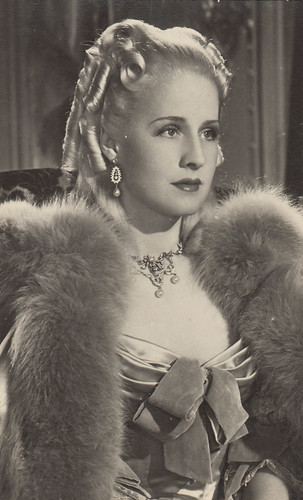
Norma Shearer in Marie-Antoinette (1938)
Spanish postcard by Archivo Bermejo, no. 4036. Photo: Metro-Goldwyn-Mayer. Norma Shearer in Marie-Antoinette (W.S. Van Dyke, 1938).

Norma Shearer in Marie-Antoinette (1938)
German postcard by Ross Verlag, no. A 1860/1, 1937-1938. Photo: Metro-Goldwyn-Mayer. Norma Shearer in Marie-Antoinette (W.S. Van Dyke, 1938).

Norma Shearer in Marie-Antoinette (1938)
German postcard by Ross Verlag, no. A 1944/1, 1937-1938. Photo: Metro-Goldwyn-Mayer. Norma Shearer in Marie-Antoinette (W.S. Van Dyke, 1938).
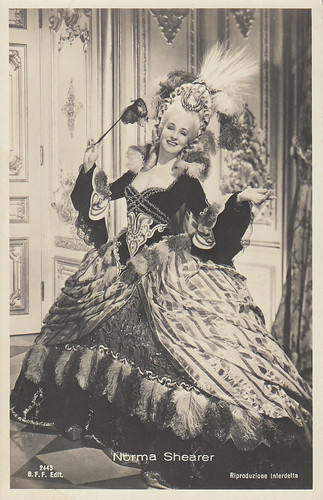
Norma Shearer in Marie-Antoinette (1938)
Italian postcard by Ballerini & Fratini, Firenze (B.F.F. Edit.), no. 2443. Photo: Metro-Goldwyn-Mayer. Norma Shearer in Marie-Antoinette (W.S. Van Dyke, 1938).

Lana Marconi


Lana Marconi in Si Versailles m’était conté (1954)
West-German postcard by Universum-Film A.G. (Ufa), Berlin Tempelhof, no. FK 955. Photo: C.L.M. Film, Paris / Pallas Film Verleih. Lana Marconi in Si Versailles m’était conté/Royal Affairs in Versailles (Sacha Guitry, 1954).

Romanian-born Lana Marconi (1917-1990) was the French author and director Sacha Guitry’s fifth and last wife. During her movie career, she appeared exclusively in films directed by her husband. She played Marie-Antoinette twice: in Si Versailles m’était conté (1954) and Si Paris nous était conté (1956).

Michèle Morgan
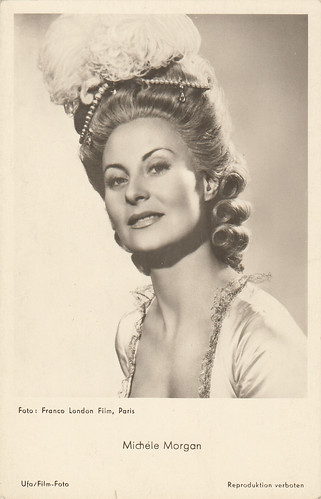

Michèle Morgan in Marie-Antoinette reine de France (1956)
German postcard by Universum-Film Aktiengesellschaft (Ufa), Berlin Tempelhof, no. FK 3050. Photo: Franco London Film, Paris. Michèle Morgan in Marie-Antoinette reine de France/Marie Antoinette Queen of France (Jean Delannoy, 1956).

Marie-Antoinette reine de France (1956) was the sixth movie French star Michèle Morgan made under the direction of Jean Delannoy. Philippe Erlanger, who had been in 1939 one of the initiators of the Cannes film festival and who was working in 1956 at the Ministry of Foreign Affairs, co-wrote the script. He was quite an authority on historical subjects, as he published many biographies about the History of France. Several scenes were filmed at the Palace of Versailles, notably at the State’s Apartments, the Royal Chapel and the Petit Trianon. The movie was part of the official selection of the Cannes Film Festival in 1956.

Text and postcards: Marlene Pilaete.

29 April 2022

Norma Shearer

American actress Norma Shearer (1902-1983) was the 'First Lady of MGM'. She often played spunky, sexually liberated ingenues, and was the first person to be nominated five times for an Academy Award for acting. Shearer won the Best Actress Oscar for The Divorcee (1930).

Norma Shearer
British postcard by W & G Ltd., no. S 6. Photo: George Hurrell, 1932 / MGM.

Norma Shearer
French postcard by Ets. La Deley, Paris for Gaumont-Metro-Goldwyn. Photo: Metro Goldwyn. Caption: a new screen star.

Norma Shearer
French postcard by Europe, no. 618. Photo: Metro-Goldwyn-Mayer.

Norma Shearer by George Hurrell
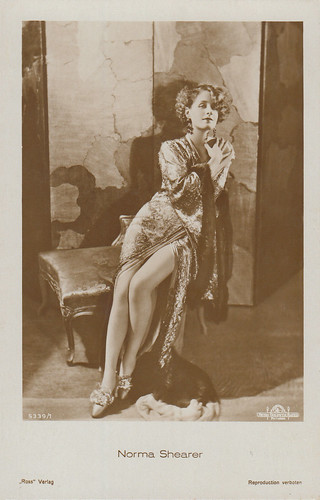
German postcard by Ross Verlag, no. 5339/1, 1930-1931. Photo: George Hurrell / Metro-Goldwyn-Mayer. Norma Shearer in Let Us Be Gay (Robert Z. Leonard, 1930). Collection: Marlene Pilaete.

Norma Shearer
Dutch postcard, no. 21. Photo: Metro-Goldwyn-Mayer.

Norma Shearer
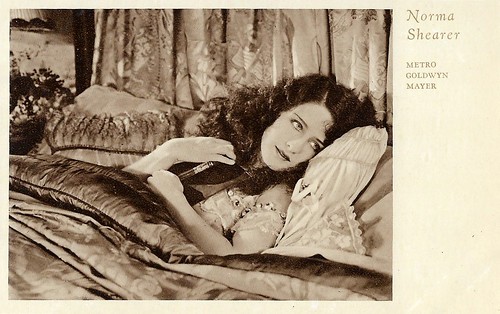
German postcard by Ross Verlag, no. 4514/1, 1929-1930. Photo: Metro-Goldwyn-Mayer.

Norma Shearer
French postcard by Collection Chantal, Paris. Photo: M.G.M.

He Who Gets Slapped


Norma Shearer was born in 1902 in Montréal in Canada. In 1931, she would become a naturalised United States citizen. Her childhood was spent in Montreal, where her father had a construction business. Norma was educated at Montreal High School for Girls and Westmount High School.

At age fourteen, she won a beauty contest. In 1918, her father's company collapsed, and her older sister, Athole Shearer (later Mrs. Howard Hawks) suffered her first serious mental breakdown. Forced to move into a small, dreary house in a 'modest' Montreal suburb, the sudden plunge into poverty only strengthened Shearer's determined attitude.

In 1920 her mother, Edith Shearer, took Norma and her sister to New York. Florenz Ziegfeld rejected her for his Follies, but she got work as an extra at Universal. Other extra parts followed, including one in Way Down East (D. W. Griffith, 1920). She spent much money on eye doctor's services trying to correct her cross-eyed stare caused by muscle weakness.

A year after her arrival in New York, she received a break in the film business: fourth billing in the B-movie The Stealers (Christy Cabanne, 1921). Irving Thalberg had seen her early acting efforts and, when he joined Louis B. Mayer in 1923, gave her a five-year contract. Shearer was cast with Lon Chaney and John Gilbert in the MGM's first official production, He Who Gets Slapped (Victor Sjöström, 1924).

The film was a conspicuous success and contributed to the meteoric rise of the new company, and to Shearer's visibility. By late 1925, Norma Shearer was carrying her own films and was one of MGM's biggest attractions, a bona fide star. She signed a new contract; it paid $1,000 a week and would rise to $5,000 over the next five years. By 1927, Shearer had made a total of 13 silent films for MGM. Each had been produced for under $200,000, and had, without fail, been a substantial box-office hit, often making a $200,000+ profit for the studio.

She was rewarded for this consistent success by being cast in Ernst Lubitsch's The Student Prince in Old Heidelberg (1927), her first prestige production, with a budget over $1,000,000. Privately, Thalberg was very impressed by Shearer. On 29 September 1927, they were married in the Hollywood wedding of the year. Thalberg thought she should retire after their marriage, but she wanted bigger parts. One week after the marriage, The Jazz Singer (Alan Crosland, 1927) was released. Norma's brother, Douglas Shearer, was instrumental in the development of sound at MGM, and every care was taken to prepare her for the microphone.

Norma Shearer in Broadway after Dark (1924)
Italian postcard by Cinema-Illustrazione, series 1, no. 20. Photo: Metro-Goldwyn-Mayer. Norma Shearer in Broadway after Dark (Monta Bell, 1924).

John Gilbert and Norma Shearer in He Who Gets Slapped (1924)
German postcard by Ross Verlag, Berlin, no. 1587/1. Photo: Ufa. John Gilbert and Norma Shearer in He Who Gets Slapped (Victor Sjöström, 1924).

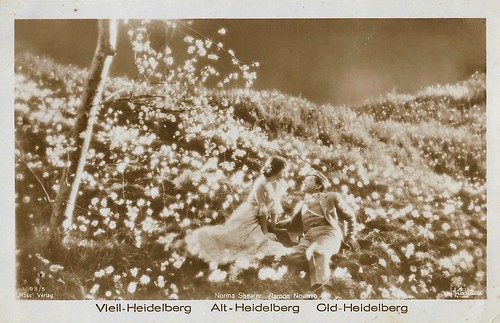
Ramon Novarro and Norma Shearer in The Student Prince (1927)
German postcard by Ross Verlag, Berlin, no. 98/5. Photo: Metro-Goldwyn-Mayer. Ramon Novarro and Norma Shearer in The Student Prince/ The Student Prince in Old Heidelberg (Ernst Lubitsch, 1927).

Norma Shearer in The Actress (1928)
German postcard by Ross Verlag, no. 3880/1, 1928-1929. Photo: Metro-Goldwyn-Mayer. Norma Shearer in The Actress (Sidney Franklin, 1928).

Norma Shearer
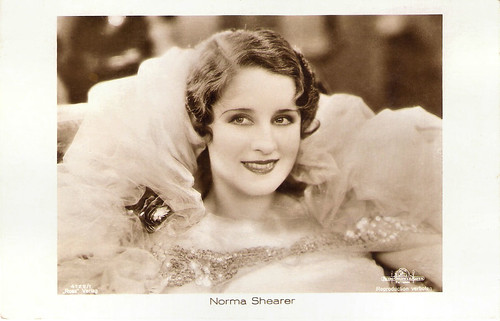
German postcard by Ross Verlag, no. 4129/1, 1929-1930. Photo: Metro-Goldwyn-Mayer.

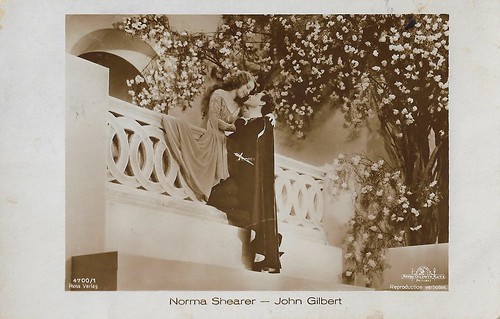
Norma Shearer and John Gilbert in The Hollywood Revue of 1929
German postcard by Ross Verlag, no. 4700/1. Photo: Metro-Goldwyn-Mayer. Norma Shearer as Juliet and John Gilbert as Romeo in the early sound film The Hollywood Revue of 1929 (Charles Reisner, 1929), shot as a series of variety acts. In the film, this sequence was shot in two-color Technicolor.

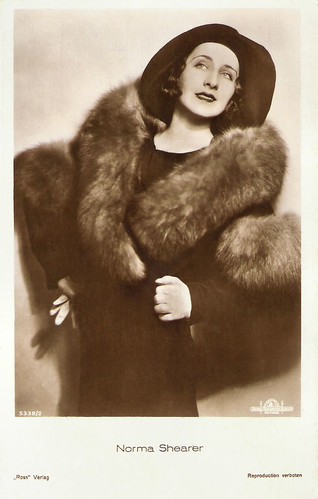
Norma Shearer in Let Us Be Gay (1930)
German postcard by Ross Verlag, no. 5339/2, 1930-1931. Photo: Metro-Goldwyn-Mayer. Norma Shearer in Let Us Be Gay (Robert Z. Leonard, 1930).

Norma Shearer in The Divorcee (1930)
German postcard by Ross Verlag, no. 5080/2, 1930-1931. Photo: Metro-Goldwyn-Mayer. Norma Shearer in The Divorcee (Robert Z. Leonard, 1930).

The Women


Norma Shearer's first talkie was The Trial of Mary Dugan (Bayard Veiller, 1929) with Lewis Stone. Four films later, she won an Oscar in The Divorcee (Robert Z. Leonard, 1930). She intentionally cut down film exposure during the 1930s, relying on major roles in Thalberg's prestige projects: The Barretts of Wimpole Street (1934) and Romeo and Juliet (1936) (her fifth Oscar nomination).

Thalberg died of a second heart attack in September 1936, at age 37. Norma wanted to retire, but MGM more-or-less forced her into a six-picture contract. David O. Selznick offered her the part of Scarlett O'Hara in Gone with the Wind (1939), but the public objection to her cross-eyed stare killed the deal.

She starred in The Women (1939), turned down the starring role in Mrs. Miniver (1942), and retired in 1942. Later that year she married Sun Valley ski instructor Martin Arrouge, eleven years younger than she (he waived community property rights).

From then on, she shunned the limelight. Norma Shearer passed away in 1983 in Woodland Hills, California. She was 80 and had been in very poor health in the last decade of her life. Shearer is interred at Forest Lawn, Glendale, California, USA, in the Great Mausoleum, Sanctuary of Benediction, alongside her first husband Irving Thalberg.

Shearer had two children with Thalberg. Her son Irving Thalberg Jr (1930) died in 1988 of cancer. He was a philosophy professor at the University of Illinois at Chicago. Her daughter Katherine Thalberg (1935) died in 2006 of cancer. A vegan, she headed the Society for Animal Rights in Aspen, Colorado, from 1989.

Norma Shearer
German cigarette card by Ross Verlag in the 'Moderne Schönheitsgalerie' series for Kurmark, no. 289. Photo: Metro-Goldwyn-Mayer (MGM).

Norma Shearer
German postcard by Ross Verlag, Foreign, no. 3927/2, 1928-1929. Photo: Metro-Goldwyn-Mayer.

Norma Shearer
German postcard by Ross Verlag, no. 4710/1, 1929-1930. Photo: Metro-Goldwyn-Mayer. Collection: Geoffrey Donaldson Institute.

Norma Shearer
British postcard by De Reszke Cigarettes, no. 10. Photo: M.G.M. Caption: Norma Shearer started acting in school plays at 14, and went to New York in 1920. After several small parts, obtained feminine leads which brought her a Hollywood contract with M.G.M. In Hollywood she met her husband, Irving G. Thalberg, now head of production of M.G.M. Her performance in Divorcee won her the award of the year's best performance by an actress.

Fredric March and Norma Shearer in The Barretts of Wimpole Street (1934)
British postcard by Abdulla Cigarettes, no. 27. Photo: M.G.M. Fredric March and Norma Shearer in The Barretts of Wimpole Street (Sidney Franklin, 1934).

Leslie Howard and Norma Shearer in Romeo and Juliet (1936)
British postcard by Real Photograph, no. 103. Photo: Metro-Goldwyn-Mayer Pictures. Leslie Howard and Norma Shearer in Romeo and Juliet (George Cukor, 1936).

Norma Shearer
French postcard by Ed. Erpé, no. 654. Photo: Metro-Goldwyn-Mayer. Norma Shearer in Marie-Antoinette (W.S. Van Dyke, Julien Duvivier, 1938).

Tyrone Power and Norma Shearer in Marie Antoinette (1938)
British Real Photograph postcard in the Film Partners series, London, no. P 254. Photo: Metro-Goldwyn-Mayer. Tyrone Power and Norma Shearer in Marie Antoinette (W.S. Van Dyke, 1938).

Norma Shearer in Marie Antoinette (1938)
Yugoslavian (Croatian) postcard by St. Kugli, Zagreb. Photo: Metro-Goldwyn-Mayer. Norma Shearer in Marie Antoinette (W.S. Van Dyke, 1938).

Norma Shearer
British postcard by Art Photo, no. 26. Photo: Metro-Goldwyn-Mayer.

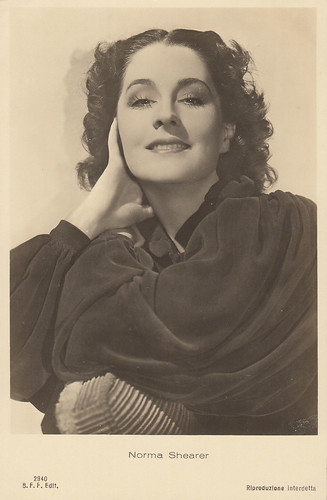
Norma Shearer
Italian postcard by B.F.F. Edit. no 2940. Collection: Marlene Pilaete. Marlene: I saw recently on TV a documentary about Anne Frank. They showed briefly the wall where Anne displayed movie star photos In fact, the photo used on this Ballerini e Fratini postcard is the same that Anne Frank choose to adorn her wall.

Melvyn Douglas and Norma Shearer, in We Were Dancing (1942)
Spanish postcard, no. CM. -318. Photo: Metro-Goldwyn-Mayer. Melvyn Douglas and Norma Shearer in We Were Dancing (Robert Z. Leonard, 1942).

Sources: Ed Stephan (IMDb), Wikipedia, and IMDb.

20 October 2019

Norma Shearer

American actress Norma Shearer (1902-1983) was the 'First Lady of MGM'. She often played spunky, sexually liberated ingenues, and was the first person to be nominated five times for an Academy Award for acting. Shearer won the Best Actress Oscar for The Divorcee (1930).

Norma Shearer
German cigarette card by Ross Verlag in the 'Moderne Schönheitsgalerie' series for Kurmark, no. 289. Photo: Metro-Goldwyn-Mayer (MGM).

Norma Shearer
Italian postcard by Rizzoli, 1936. Photo: Metro-Goldwyn-Mayer.

Norma Shearer
British postcard by Art Photo, no. 26. Photo: Metro-Goldwyn-Mayer.

Leslie Howard and Norma Shearer in Romeo and Juliet (1936)
British postcard by Real Photograph, no. 103. Photo: Metro-Goldwyn-Mayer Pictures. Leslie Howard and Norma Shearer in Romeo and Juliet (George Cukor, 1936).

Norma Shearer in Marie Antoinette (1938)
Yugoslavian (Croatian) postcard by St. Kugli, Zagreb. Photo: Metro-Goldwyn-Mayer. Norma Shearer in Marie Antoinette (W.S. Van Dyke, 1938).

Tyrone Power and Norma Shearer in Marie Antoinette (1938)
British Real Photograph postcard in the Film Partners series, London, no. P 254. Photo: Metro-Goldwyn-Mayer. Tyrone Power and Norma Shearer in Marie Antoinette (W.S. Van Dyke, 1938).

A determined attitude


Norma Shearer was born in 1902 in Montréal in Canada. In 1931, she would become a naturalised United States citizen.

Her childhood was spent in Montreal, where her father had a construction business. Norma was educated at Montreal High School for Girls and Westmount High School. At age fourteen, she won a beauty contest.

In 1918, her father's company collapsed, and her older sister, Athole Shearer (later Mrs. Howard Hawks) suffered her first serious mental breakdown. Forced to move into a small, dreary house in a 'modest' Montreal suburb, the sudden plunge into poverty only strengthened Shearer's determined attitude.

In 1920 her mother, Edith Shearer, took Norma and her sister to New York. Florenz Ziegfeld rejected her for his Follies, but she got work as an extra at Universal. Other extra parts followed, including one in Way Down East (D. W. Griffith, 1920).

She spent much money on eye doctor's services trying to correct her cross-eyed stare caused by muscle weakness. A year after her arrival in New York, she received a break in film: fourth billing in the B-movie The Stealers (Christy Cabanne, 1921).

Irving Thalberg had seen her early acting efforts and, when he joined Louis B. Mayer in 1923, gave her a five-year contract. Shearer was cast with Lon Chaney and John Gilbert in the MGM's first official production, He Who Gets Slapped (Victor Sjöström, 1924). The film was a conspicuous success and contributed to the meteoric rise of the new company, and to Shearer's visibility.

By late 1925, Norma Shearer was carrying her own films, and was one of MGM's biggest attractions, a bona fide star. She signed a new contract; it paid $1,000 a week and would rise to $5,000 over the next five years.

By 1927, Shearer had made a total of 13 silent films for MGM. Each had been produced for under $200,000, and had, without fail, been a substantial box-office hit, often making a $200,000+ profit for the studio. She was rewarded for this consistent success by being cast in Ernst Lubitsch's The Student Prince in Old Heidelberg (1927), her first prestige production, with a budget over $1,000,000.

Privately, Thalberg was very impressed by Shearer. On 29 September 1927, they were married in the Hollywood wedding of the year. Thalberg thought she should retire after their marriage, but she wanted bigger parts.

One week after the marriage, The Jazz Singer was released. Norma's brother, Douglas Shearer, was instrumental in the development of sound at MGM, and every care was taken to prepare her for the microphone.

John Gilbert and Norma Shearer in He Who Gets Slapped (1924)
German postcard by Ross Verlag, Berlin, no. 1587/1. Photo: Ufa. John Gilbert and Norma Shearer in He Who Gets Slapped (Victor Sjöström, 1924).

Ramon Novarro and Norma Shearer in The Student Prince
German postcard by Ross Verlag, Berlin, no. 98/4. Photo: Metro-Goldwyn-Mayer. Ramon Novarro and Norma Shearer in The Student Prince in Old Heidelberg (Ernst Lubitsch, 1927).

Ramon Novarro and Norma Shearer in The Student Prince
German postcard by Ross Verlag, Berlin, no. 98/8. Photo: Metro-Goldwyn-Mayer. Ramon Novarro and Norma Shearer in The Student Prince in Old Heidelberg (Ernst Lubitsch, 1927).

Norma Shearer in The Actress (1928)
German postcard by Ross Verlag, no. 3880/1, 1928-1929. Photo: Metro-Goldwyn-Mayer. Norma Shearer in The Actress (Sidney Franklin, 1928).

Norma Shearer and John Gilbert in The Hollywood Revue of 1929
German postcard by Ross Verlag, no. 4700/1. Photo: Metro-Goldwyn-Mayer. Norma Shearer as Juliet and John Gilbert as Romeo in the early sound film The Hollywood Revue of 1929 (Charles Reisner, 1929), shot as a series of variety acts. In the film, this sequence was shot in two-color Technicolor.

Norma Shearer in Let Us Be Gay (1930)
German postcard by Ross Verlag, no. 5339/2, 1930-1931. Photo: Metro-Goldwyn-Mayer. Norma Shearer in Let Us Be Gay (Robert Z. Leonard, 1930).

Relying on major roles in prestige projects


Norma Shearer's first talkie was The Trial of Mary Dugan (Bayard Veiller, 1929) with Lewis Stone. Four films later, she won an Oscar in The Divorcee (Robert Z. Leonard, 1930).

Shearer intentionally cut down film exposure during the 1930s, relying on major roles in Thalberg's prestige projects: The Barretts of Wimpole Street (Sidney Franklin, 1934) with Fredric March and Charles Laughton, and Romeo and Juliet (George Cukor, 1936) for which she received her fifth Oscar nomination.

Thalberg died of a second heart attack in September 1936, at age 37. Norma wanted to retire, but MGM more-or-less forced her into a six-picture contract.

David O. Selznick offered her the part of Scarlett O'Hara in Gone with the Wind (Victor Fleming, 1939), but the public objection to her cross-eyed stare killed the deal.

She starred in The Women (George Cukor, 1939), turned down the starring role in Mrs. Miniver (William Wyler, 1942), and retired in 1942.

Later that year she married Sun Valley ski instructor Martin Arrouge, eleven years younger than she. He waived community property rights. From then on, she shunned the limelight.

Even after retirement, Norma maintained her interest in the film industry. While staying at a ski lodge, she noticed a photo of the receptionist's daughter and recommended her to MGM - that girl, became the star known as Janet Leigh. She also discovered a handsome young businessman beside a swimming pool - now actor/producer Robert Evans.

Norma Shearer passed away in 1983 in Woodland Hills, California. She was 80 and had been in very poor health in the last decade of her life. Shearer is interred at Forest Lawn, Glendale, California, USA, in the Great Mausoleum, Sanctuary of Benediction, alongside her first husband Irving Thalberg.

Shearer had two children with Thalberg. Her son Irving Thalberg Jr (1930) died in 1988 of cancer. He was a philosophy professor at the University of Illinois at Chicago. Her daughter Katherine Thalberg (1935) died in 2006 of cancer. A vegan, she headed the Society for Animal Rights in Aspen, Colorado, from 1989.

Norma Shearer
German postcard by Ross Verlag, Foreign, no. 3927/2, 1928-1929. Photo: Metro-Goldwyn-Mayer.

Norma Shearer
German postcard by Ross Verlag, no. 4129/1, 1929-1930. Photo: Metro-Goldwyn-Mayer.

Norma Shearer
German postcard by Ross Verlag, no. 4514/1, 1929-1930. Photo: Metro-Goldwyn-Mayer.

Norma Shearer
German postcard by Ross Verlag, no. 4710/1, 1929-1930. Photo: Metro-Goldwyn-Mayer. Collection: Geoffrey Donaldson Institute.
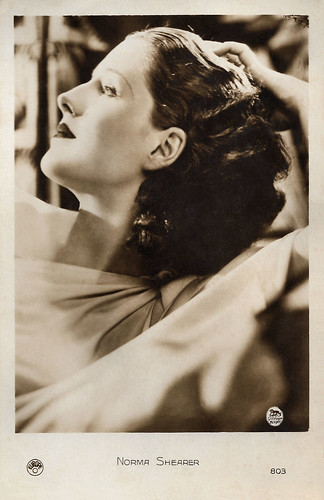
Norma Shearer
German postcard by Ross Verlag, no. 5080/2, 1930-1931. Photo: Metro-Goldwyn-Mayer.

Norma Shearer
German postcard by Ross Verlag, no. 5338/2, 1930-1931. Photo: Metro-Goldwyn-Mayer.

Norma Shearer
German postcard by Ross Verlag, no. 5803/1, 1930-1931. Photo: Metro-Goldwyn-Mayer.

Norma Shearer
Dutch postcard, no. 21. Photo: Metro-Goldwyn-Mayer.

Norma Shearer
French postcard by EC (Editions Chantal, Paris), no. 23. Photo: Metro-Goldwyn-Mayer (MGM).

Norma Shearer
French postcard by Europe, no. 754. Photo: Metro-Goldwyn-Mayer.

Norma Shearer
French postcard by Europe, no. 803. Photo: Metro-Goldwyn-Mayer.

Norma Shearer
French postcard by Ed. Erpé, no. 654. Photo: Metro-Goldwyn-Mayer. Norma Shearer in Marie-Antoinette (W.S. Van Dyke, Julien Duvivier, 1938).

Sources: Ed Stephan (IMDb), Wikipedia and IMDb.