Showing posts with label Paul Richter. Show all posts

05 July 2023

Die Nibelungen (1924), revisited

Die Nibelungen (Fritz Lang, 1924) is one of the masterpieces of the Weimar cinema. It is a diptych of silent fantasy films: Die Nibelungen: Siegfried and Die Nibelungen: Kriemhilds Rache/Kriemhild's Revenge. Years ago, we already did a post of Die Nibelungen with sepia postcards by Ross Verlag. Today, EFSP presents a German postcard series with watercolours by Uvachrom and an Italian series with stills in black and white by G. Vettori. This post is the first in a series of posts about three classic silent films by Fritz Lang.

Die Nibelungen (1924)
German postcard by Uvachrom, series 405, no. 5433. Photo: Ufa. Die Nibelungen I (Fritz Lang, 1924). Caption: Siegfried's sword.

How Siegfried Slayed the Dragon


Die Nibelungen was produced by the Ufa and Decla studios, and it starred Austrian actor Paul Richter as the (nearly) invulnerable hero Siegfried. The screenplays were written by Fritz Lang and his wife at the time, Thea von Harbou. They were based upon the epic Nordic poem 'Nibelungenlied', written around AD 1200 and told through seven cantos.

Die Nibelungen (1924)
German postcard by Uvachrom, series 405, no. 5434. Photo: Ufa. Paul Richter as Siegfried in Die Nibelungen I (Fritz Lang, 1924). Caption: The lime leaf.

It is the tale of the legendary German hero Siegfried (Paul Richter), son of King Siegmund. He masters the art of forging a sword at the shop of Mime (Georg John). On his journey home, he hears tales from the locals about Princess Kriemhild (Margarete Schön), the beautiful sister of King Gunter of Burgundy (Theodor Loos).

Die Nibelungen (1924)
Italian postcard by G. Vettori, Bologna. Paul Richter and Georg John in Die Nibelungen (Fritz Lang, 1924). Caption: Die Nibelungen - Mime tries to betray Siegfried by putting him on the wrong track -.

Siegfried decides to go to Worms, the capital of Burgundy, to win Kriemhild. On his journey to Worms, he is attacked by a dragon. Siegfried slays the dragon and bathes in his blood. This bath makes him invulnerable - except for one spot on his shoulder blade which is missed after being covered by a falling lime leaf.

How Volker, the Bard, sang of Siegfried in front of Kriemhild, and How Siegfried Came in Worms


Paul Richter in Die Nibelungen: Siegfried
Italian postcard by G. Vettori, Bologna. Paul Richter in Die Nibelungen (Fritz Lang, 1924).

Siegfried trespasses on the land of the Nibelungen and is attacked by Alberich, King of the Dwarves (again Georg John). He fights and defeats Alberich who was wearing his wonder cloak of invisibility and transformation. Alberich asks Siegfried to spare his life and in return, he gives the Treasure of the Nibelungen and the Balmung sword. While Siegfried is mesmerised by the treasure, Alberich tries to defeat him but dies in the attempt. Dying, Alberich curses all inheritors of the treasure and he and his dwarves turn to stone. Siegfried makes twelve kings as his vassals and arrives in Worms as a hero.

How Siegfried Won Brunhild for Gunther


Die Nibelungen (1924)
Italian postcard by G. Vettori, Bologna. Hanna Ralph, as Brunhild in Die Nibelungen (Fritz Lang, 1924). Caption: Die Nibelungen - Siegfried - Brunhild.

News reaches the court that Brunhild, a queen of outstanding strength and beauty may be won only by a man capable of matching her athletic prowess. Gunther decides to woo Brunhild (Hanna Ralph) with the aid of Siegfried, to whom he promises the hand of Kriemhild if successful. The men travel to Iceland, to the kingdom of Brunhild, where Siegfried feigns vassalage to Gunther so that he can avoid Brunhild's challenge. He uses instead the cloak's power of invisibility to help Gunther beat the powerful Queen in a three-fold Amazonian battle of strength: throwing stones, throwing a spear and jumping.

How Brunhild Enters Worms and How the King Celebrate Their Wedding


Die Nibelungen (1924)
German postcard by Uvachrom, series 405, no. 5435. Photo: Ufa. Die Nibelungen I (Fritz Lang, 1924). Caption: Brünhilde's entry.

Paul Richter and Margarete Schön in Die Nibelungen (1924)
Italian postcard by G. Vettori, Bologna. Margarete Schön in Die Nibelungen (Fritz Lang, 1924). Caption: Die Nibelungen - Siegfried ...you don't have to carry it - A terrible secret is locked in its short circle.

The men return to Burgundy where Gunther marries Brunhild and Siegfried weds Kriemhild. Brunhild is not, however, completely defeated. She suspects deceit and says to Gunther that she is his captive but not his bride. Hagen von Tronje (Hans Adalbert Schlettow) convinces Siegfried to help. Siegfried transforms himself with the cloak into Gunther and battles Brunhild and removes her arm ring during battle after which she submits to his will. Siegfried leaves the real Gunther to consummate the marriage. Siegfried accidentally brings Brunhild's armlet with him.

How After Half a Year, Siegfried's Gift to His Bride, The Nibelungen Treasure, Arrives in Worms and How the Two Queens Quarrel With Each Other
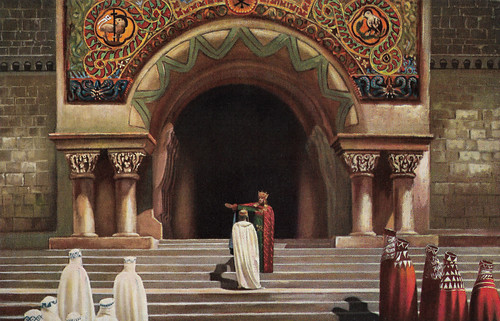

Die Nibelungen (1924)
German postcard by Uvachrom, series 405, no. 5436. Photo: Ufa. Die Nibelungen I (Fritz Lang, 1924). Caption: The quarrel of the queens.

When Kriemhild finds Brunhild's armlet, Siegfried tells her how her brother won the queen. When the Nibelungen treasure that Siegfried acquired from Alberich arrives at the court of Burgundy as Kriemhild's morning gift, the jealous Brunhild becomes more suspicious about Siegfried's feigned vassalage to Gunther. Brunhild dons the Queen Mother's jewellery and proceeds to the cathedral to enter as the first person, as is her right as Queen of Burgundy. Kriemhild and Brunhild quarrel. Brunhild ridicules Kriemhild for marrying a vassal, and Kriemhild reveals Siegfried’s and Gunther’s deception.

How Gunther Betrayed Siegfried


Siegfried's Death
German postcard by Uvachrome, Serie 405, no. 5437. Image: Watercolour after a famous still from Die Nibelungen I (Fritz Lang, 1924).
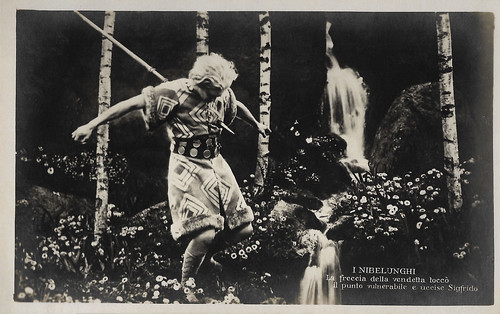
Die Nibelungen (1924)
Italian postcard by G. Vettori, Bologna. Paul Richter as Siegfried in Die Nibelungen (Fritz Lang, 1924). Caption: Die Nibelungen - The arrow of vengeance touched the vulnerable spot and killed Siegfried.

Brunhild demands Siegfried be killed. She lies to Gunther and tells him that Siegfried stole her maidenhood when he battled her on her wedding night. King Gunther and his uncle and loyal warrior, Hagen von Tronje (Hans Adalbert Schlettow), conspire to murder Siegfried during a hunt in the Odenwald Forest. Hagen deceives Kriemhild into telling him the vulnerable part of Siegfried's body where the leaf has fallen. She sews a cross on the spot in Siegfried's tunic. After the hunt, Hagen challenges Siegfried to a race to a nearby spring. When Siegfried is on his knees drinking, Hagen pierces him from behind with a spear.

How Kriemhild Swears Revenge to Hagen Tronje


Die Nibelungen (1924)
German postcard by Uvachrom, series 405, no. 5438. Photo: Ufa. Die Nibelungen I (Fritz Lang, 1924). Caption: Kriemhilde's Lament.
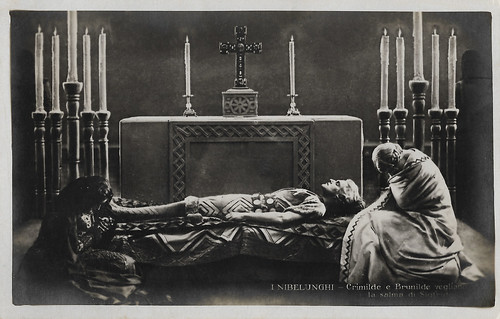
Die Nibelungen (1924)
Italian postcard by G. Vettori, Bologna. Hanna Ralph, Paul Richter and Margarete Schön in Die Nibelungen (Fritz Lang, 1924). Caption: Die Nibelungen - Kriemhild and Brunhild watch over Siegfried's body.

In an evil twist of bitter revenge, Brunhild confesses that she lied about Siegfried stealing her maidenhood to avenge Gunther's deceit of her. Gunther killed his only loyal friend. Kriemhild demands her family avenge her husband's death at the hands of Siegfried, but her family is complicit in the murder, and so they protect Hagen. Kriemhild swears revenge against Hagen while a guilt-ridden Brunhild commits suicide at the foot of Siegfried's corpse laid in state in the cathedral. Kriemhild swears revenge to Hagen.

Die Nibelungen (1924)
Italian postcard by G. Vettori, Bologna. Hans Adalbert Schlettow as Hagen, Theodor Loos as Gunter, Paul Richter as Siegfried and Margarete Schön as Kriemhild in Die Nibelungen (Fritz Lang, 1924). Caption: Die Nibelungen - You must avenge me King Gunter - Hagen of Tronje killed my groom.

Kriemhild's Revenge


Die Nibelungen (1924)
German postcard by Uvachrom, series 405, no. 5653. Photo: Ufa. Die Nibelungen II (Fritz Lang, 1924). Caption: Rüdiger, King Etzel's Bride wooer.

Die Nibelungen (1924)
German postcard by Uvachrom, series 405, no. 5654. Photo: Ufa. Die Nibelungen II (Fritz Lang, 1924). Caption: Kriemhild's Entry into Hun Country.

In the second film, Kriemhild's Rache/Kriemhild's Revenge, is shown how Kriemhild gets her revenge. After Siegfried's dead, Kriemhild marries Etzel, the King of the Huns. She gives birth to a child and invites her brothers to a party. She tries to persuade Etzel and the other Huns, that they kill Hagen, the murderer of Siegfried, but he is protected by her brothers. A fierce battle begins to force her brothers to give Hagen to her.

Probably no literary work has given more to Germanic arts than the 'Nibelungenlied'. Many variations and adaptations appeared through the centuries. The most significant modern adaptation is Richard Wagner’s famous opera cycle 'Der Ring des Nibelungen' (1853–1874). The 1924 film Die Nibelungen is still astounding to look at. Fritz Lang gives the film a real sense of wonder by way of fantasy elements such as dwarfs, dragons and magic powers. Amazingly, such a masterpiece of cinema could have been made in the early 1920s. The standout is the dragon-slaying scene with its wonderful special effects.

Die Nibelungen (1924)
German postcard by Uvachrom, series 405, no. 5656. Photo: Ufa. Die Nibelungen II (Fritz Lang, 1924). Caption: The grim Hagen.

Sources: Claudio Carvalho (IMDb), Thomas Staedeli (Cyranos), Encyclopedia Britannica, IMDb and Wikipedia.

17 September 2022

The white horse

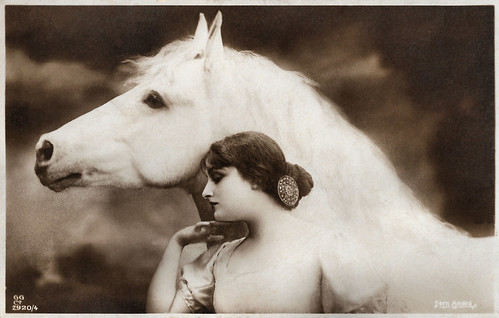
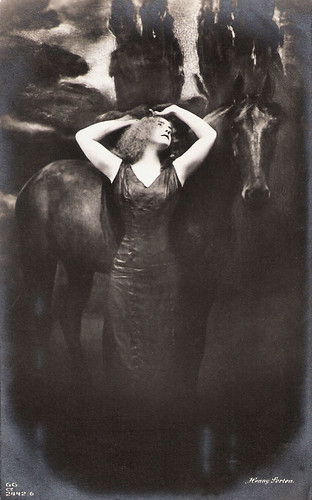
The white horse is an archetype that holds cultural and symbolic significance. It can mean heroism, spiritual enlightenment, and the triumph of good over evil. I found several postcards of female stars of the early German silent cinema, such as Henny Porten and Fern Andra, who were portrayed with a beautiful white horse. These dreamy portraits were made just before the First World War and they symbolise purity and innocence, which were soon lost at the front. And after the lost war, the cinema remembered the Germans of their heroic past when Siegfried rode his iconic white horse in the grand epic of the German silent cinema, Fritz Lang's Die Nibelungen (1924).

Fern Andra


Fern Andra
German postcard by Verlag Photochemie, Berlin / GGCo, no. 1885/4. Photo: Fern Andra Atelier.

Fern Andra
German postcard by Verlag Photochemie, Berlin / GGCo, no. 2909/3. Photo: Fern Andra Atelier.

'Modern' American Fern Andra (1893-1974) became one of the most popular film stars of German cinema in the 1910s and early 1920s. In her films she mastered tightropes, riding horses without a saddle, driving cars and motorcycles, bobsleighing, and even boxing.

Fern Andra
German postcard by Verlag Photochemie, Berlin / GGCo, no. 2920/3. Photo: Fern Andra Atelier.

Fern Andra
German postcard by Verlag Photochemie, Berlin / GGCo, no. 2920/4. Photo: Fern Andra Atelier.

Henny Porten


Henny Porten.
German postcard by GG co., no. 2428/11.

Sturdy and blond Henny Porten (1890-1960) was one of Germany's most important and popular film actresses of the silent cinema. She became the quintessence of German womanhood, ladylike yet kindhearted and a not a little petit bourgeois. She was also the producer of many of her own films.

Henny Porten
German postcard by GG co., no. 2442/6. With a black horse!

Die Nibelungen (1924)


Paul Richter in Die Nibelungen: Siegfried (1924)
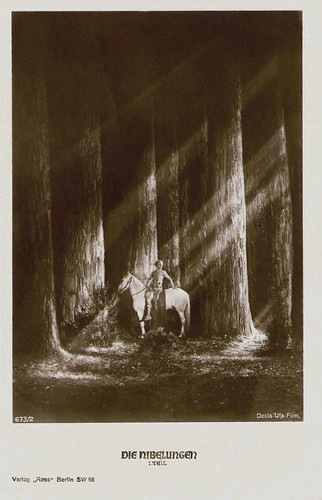
German postcard by Ross Verlag, Berlin, no. 673/2, 1919-1924. Photo: Decla-Ufa-Film. Publicity still for Die Nibelungen: Siegfried (Fritz Lang, 1924). Siegfried (Paul Richter) in the forest.

Austrian actor Paul Richter (1895-1961) is best known as Siegfried, the hero who rides a shining white horse in the classic fantasy film Die Nibelungen (1924), situated in pre-Christian Germany. Die Nibelungen, directed by Fritz Lang, is one of the masterpieces of German silent cinema.

Die Nibelungen in Die Nibelungen: Siegfried (1924)
German postcard by Ross Verlag, Berlin, no. 675/1, 1924. Photo: Decla-Ufa-Film. Paul Richter in Die Nibelungen: Siegfried (Fritz Lang, 1924).

Paul Richter in Die Nibelungen: Siegfried (1924)
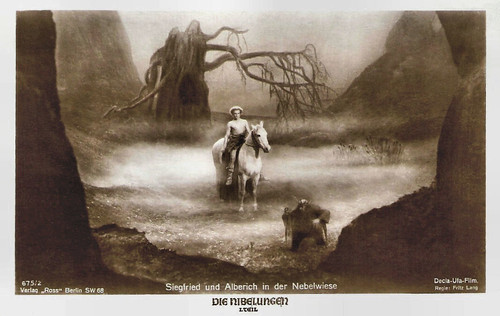
German postcard by Ross Verlag, Berlin, no. 675/2, ca. 1924. Photo: Decla-Ufa-Film. Paul Richter in Die Nibelungen: Siegfried (Fritz Lang, 1924). Siegfried and Alberich in the fog meadow. The meadow Siegfried has to cross is clouded in mist and framed by the dark branches of a leafless tree. Then slowly, very slowly, the white horse emerges through the mist, ridden by Siegfried dressed in white.

Sources: Richard Blank (Film & Light: The History of Filmlighting is the History of Film), Kristen M. Stanton (UniGuide), and IMDb.

26 February 2021

Pietro der Kosar (1925)

Pietro, der Korsar/Peter the Pirate (Arthur Robison, 1925), also known in English as The Sea Wolves or The Love Pirate, is a German silent historical adventure film starring Paul Richter, Aud Egede-Nissen, and Rudolf Klein-Rogge. The film was based on a novel by German author Wilhelm Hegeler, 'Pietro der Korsar und die Jüdin Cheirinca' (Pietro the Corsair and the Jewess Cheirinca).

Paul Richter in Pietro der Kosar (1925)
German postcard by Ross Verlag, Berlin, no. 1024/1, 1927-1928. Photo: Ufa. Paul Richter in Pietro der Korsar/Peter the Pirate (Arthur Robison, 1925).

Aud Egede Nissen and Paul Richter in Pietro der Korsar (1925)
French postcard. Photo: Mon. Cawa-Film. Aud Egede Nissen and Paul Richter in Pietro der Korsar/Peter the Pirate (Arthur Robison, 1925).

Paul Richter in Pietro der Kosar (1925)
German postcard by Ross Verlag, Berlin, no. 992/1, 1925-1926. Photo: Ufa. Paul Richter in Pietro der Korsar/Peter the Pirate (Arthur Robison, 1925).

The strict rules of the Corsairs


In Pietro, der Korsar/Peter the Pirate (Arthur Robison, 1925), Paul Richter plays Pietro, the son of an oil trader (Fritz Richard) on the Italian coast. Pietro would like to be a corsair, and he constantly observes their fort on an offshore island.

When the corsair Salvatore (Rudolf Klein-Rogge) raids his father's house, Pietro overwhelms him. The corsair can flee. From then on, Pietro and his family fear the corsairs' revenge.

However, Salvatore, who owes his life to Pietro, takes him in with the corsairs. With these pirates, he must submit to their strict rules. Meanwhile, Salvatore rises to their leader.

Salvatore is seriously injured while capturing a merchant ship. He is taken to a doctor's house. There he falls in love with the daughter Juana (Aud Egede Nissen). He takes her to his fort.

After a short time, Juana discovers that Salvatore is a weakling. Her only interest is Pietro, and hatred and distrust arise between Salvatore and Pietro. A knife fight should decide. However, Salvatore is shot dead by an invading mercenary and Juana stands between the gun and Pietro to atone for her guilt.

Aud Egede Nissen and Rudolf Klein-Rogge in Pietro der Korsar (1925)
German postcard by Ross Verlag, Berlin, no. 26/1. Photo: Ufa. Aud Egede Nissen and Rudolf Klein-Rogge in Pietro der Korsar/Peter the Pirate (Arthur Robison, 1925).

Paul Richter in Pietro der Korsar (1925)
German postcard by Ross Verlag, Berlin, no. 26/4. Photo: Ufa. Paul Richter in Pietro der Korsar/Peter the Pirate (Arthur Robison, 1925).

Paul Richter and Aud Egede Nissen in Pietro der Kosar (1925)
German postcard by Ross Verlag, Berlin, no. 26/5, 1927-1928. Photo: Ufa. Aud Egede Nissen and Paul Richter in Pietro der Korsar/Peter the Pirate (Arthur Robison, 1925).

Paul Richter in Pietro der Korsar (1925)
German postcard by Ross Verlag, Berlin, no. 26/10, 1927-1928. Photo: Ufa. Paul Richter in Pietro der Korsar/Peter the Pirate (Arthur Robison, 1925).

A school of acting dating back to the Spanish Armada


Pietro der Korsar/Peter the Pirate (Arthur Robison, 1925) was produced by Erich Pommer for the Ufa (Universum-Film AG) in Berlin. Director p of photography was Fritz Arno Wagner, and Albin Grau was responsible for the buildings and the costumes.

The shooting took place from August to October 1924 on the coast near Rome and in the open-air site of the Ufa studios in Neubabelsberg. Decla-Bioscop-Verleih GmbH in Berlin distributed the film. The world premiere took place on 19 February 1925 at U.T. Alexanderplatz Berlin. The post-censorship issued a youth ban.

The international critics found only a few kind words for the film. In the New York Times, Mordaunt Hall wrote on 7 January 1927: “Sandwiched in between Chaplin's famous comedy, Easy Street, and three other ancient American films, there is at the Fifth Avenue Playhouse a tedious Ufa picture, known as Peter the Pirate.

It is a story of sea robbers of the dim past, and the aggregation of players appears to be emulating a school of acting dating back to the Spanish Armada. Even Paul Richter, who gave such a distinguished performance in the film version of Siegfried, seems to have found his colleagues' art contagious. Mr. Richter is a pale-faced fighter with gymnastic shoes and a shirt always open at the collar.

As Peter he longs for adventure and, of course, it comes his way. So he becomes associated with a band of ruddy villains, who try and make you think that they would just as soon cut a throat as gulp down a glass of wine. Actually, these followers of the skull and crossbones look as if they had been shanghaied from a modern costume dance. This weak link in the chain of Ufa productions was directed by Arthur Robison, producer of the film version of Manon Lescaut."

Paul Richter in Pietro der Korsar (1925)
German postcard by Ross Verlag, Berlin, no. 1024/2, 1927-1928. Photo: Ufa. Paul Richter in Pietro der Korsar/Peter the Pirate (Arthur Robison, 1925).

Paul Richter and Aud Egede Nissen in Pietro der Korsar (1925)
German postcard by Ross Verlag, Berlin, no. 1024/3, 1927-1928. Photo: Ufa. Paul Richter and Aud Egede Nissen in Pietro der Korsar/Peter the Pirate (Arthur Robison, 1925).

Paul Richter and Aud Egede Nissen in Pietro der Kosar (1925)
German postcard by Ross Verlag, Berlin, no. 1024/4, 1927-1928. Photo: Ufa. Paul Richter and Aud Egede Nissen in Pietro der Korsar/Peter the Pirate (Arthur Robison, 1925).

Paul Richter and Aud Egede Nissen in Pietro der Kosar (1925)
German postcard by Ross Verlag, Berlin, no. 1024/5, 1927-1928. Photo: Ufa. Paul Richter and Aud Egede Nissen in Pietro der Korsar/Peter the Pirate (Arthur Robison, 1925).

Sources: Wikipedia (German and English), and IMDb.

08 April 2015

Paul Richter

Austrian actor Paul Richter (1895-1961) starred in several silent films directed by Joe May and Fritz Lang. He became an idol of the 1920s with the lushly produced Ufa production Die Nibelungen (Fritz Lang, 1924).

Die Nibelungen, Siegfried
German postcard by Ross Verlag, Berlin, no. 672/1, 1924. Photo: Decla-Ufa-Film. Paul Richter in Die Nibelungen: Siegfried (Fritz Lang, 1924).

Paul Richter in Pietro der Korsar (1925)
German postcard by Ross Verlag, Berlin, no. 26/4. Photo: Ufa. Paul Richter in Pietro der Korsar/Peter the Pirate (Arthur Robison, 1925).

Paul Richter
German postcard by Ross Verlag, Berlin, no. 475/2, 1919-1924. Photo: A. Eberth, Berlin.

Paul Richter
German postcard by Ross Verlag, Berlin, no. 800/1, 1925-1926.

Paul Richter
German postcard by Ross Verlag, Berlin, no. 1657/1, 1927-1928. Photo: Phoebus Film.

A Sex Symbol of the 1920s


Paul Martin Edward Richter was born in Vienna, Austria in 1895. In 1914, he made his film debut with the short silent film Sterbewalzer/Death Waltz (1914), followed by Die Gouvernante/The Governess (1914).

The outbreak of the First World War halted temporarily his film activities. He became an 'emperor hunter' in the Carpathians, and later he was detached to a mountain guide course. Nature and the mountains with which he became familiar on the occasion, found a fixed place in his life and later also in his films.

After WWI, he became famous with the fancy adventure film Das indische Grabmal/The Indian Tomb (Joe May, 1921) starring Olaf Fönss and Mia May.

Another success was the thriller Dr. Mabuse, der Spieler/Dr. Mabuse, the Gambler (Fritz Lang, 1922) with Rudolf Klein-Rogge and Norwegian actress Aud Egede-Nissen, with whom he soon married.

His next film for director Fritz Lang made him a German idol of the 1920s. In Die Nibelungen (Fritz Lang, 1924) he starred as the hero Siegfried.

Thomas Staedeli writes at Cyranos that Richter became a sex symbol of the 1920s: "At last Germany was able to present a pendant to the American stars Ramon Novarro and Rudolph Valentino."

Die Nibelungen in Die Nibelungen: Siegfried (1924)
German postcard by Ross Verlag, Berlin, no. 675/1, 1924. Photo: Decla-Ufa-Film. Paul Richter in Die Nibelungen: Siegfried (Fritz Lang, 1924).

Die Nibelungen I: Siegfried und Alberich in der Nebelwiese
German postcard by Ross Verlag, Berlin, no. 675/2. Photo: Decla-Ufa-Film. Publicity still for Die Nibelungen: Siegfried (Fritz Lang, 1924). Siegfried and Alberich (Georg John) in the fog meadow.

Die Nibelungen 1: Siegfried
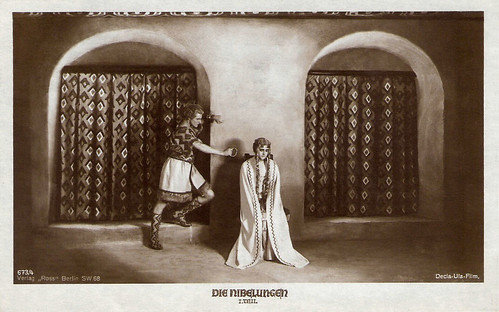
German postcard by Ross Verlag, Berlin, no. 673/2. Photo: Decla-Ufa-Film. Publicity still for Die Nibelungen: Siegfried (Fritz Lang, 1924). Siegfried in the woods.

Die Nibelungen I
German postcard by Ross Verlag, Berlin, no. 673/4. Photo: Decla-Ufa-Film. Publicity still for Die Nibelungen: Siegfried (Fritz Lang, 1924). Siegfried presents Kriemhild (Margarete Schön) the circlet.

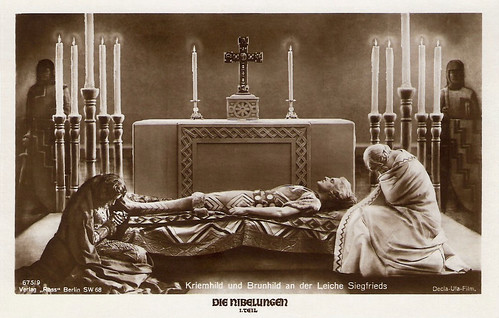
Die Nibelungen I: Kriemhild und Brunhild an der Leiche Siegfrieds
German postcard by Ross Verlag, Berlin, no. 675/9. Photo: Decla-Ufa-Film. Publicity still for Die Nibelungen: Siegfried (Fritz Lang, 1924). Kriemhild (Margarete Schön) and Brunhilde (Hanna Ralph) with the corpse of Siegfried.

Wonderful Special Effects


Die Nibelungen is a duology of silent fantasy films: the first part is Die Nibelungen: Siegfried and the second part is Die Nibelungen: Kriemhilds Rache/Kriemhild's Revenge. They were based upon the epic Nordic poem 'Nibelungenlied', written around AD 1200. The screenplay was written by Fritz Lang and his wife at the time, Thea von Harbou.

During the shooting of the film, there were often arguments between director Lang and his star actor. This found its peak when Richter had to present himself nude in front of the camera for the bath scene in the blood of the dragon.

Because Richter refused to play this part without swimming trunks, Lang finished the scene with Rudolf Klein-Rogge.

More than 80 years later, Die Nibelungen is still astounding to look at. Lang gave the film a real sense of wonder by way of fantasy elements such as dwarfs, dragons, and magic powers.

The standout scene is the dragon-slaying scene with its wonderful special effects. In retrospect, it's amazing that such a masterpiece of cinema could have been made in the early 1920s.

Paul Richter in Pietro der Kosar (1925)
German postcard by Ross Verlag, Berlin, no. 992/1, 1925-1926. Photo: Ufa. Paul Richter in Pietro der Korsar/Peter the Pirate (Arthur Robison, 1925).

Paul Richter in Pietro der Kosar (1925)
German postcard by Ross Verlag, Berlin, no. 1024/1, 1927-1928. Photo: Ufa. Paul Richter in Pietro der Korsar/Peter the Pirate (Arthur Robison, 1925).

Paul Richter in Pietro der Korsar (1925)
German postcard by Ross Verlag, no. 1024/2. Photo: Ufa. Paul Richter in Pietro der Korsar/Peter the Pirate (Arthur Robison, 1925).

Paul Richter and Aud Egede Nissen in Pietro der Kosar (1925)
German postcard by Ross Verlag, Berlin, no. 1024/4, 1927-1928. Photo: Ufa. Paul Richter and Aud Egede Nissen in Pietro der Korsar/Peter the Pirate (Arthur Robison, 1925).

Paul Richter
Russian postcard.

Half-nude Hero


After the enormous success of Die Nibelungen, Paul Richter was soon cast again as a half-nude hero in Pietro, der Korsar/Peter the Pirate (Arthur Robison, 1925) opposite his wife, Aud Egede-Nissen.

They also appeared together in Die rote Maus/The Red Mouse (Rudolf Meinert, 1926), the comedy Kampf der Geschlechter/Clash of the gender (Heinrich Brandt, 1926) and Schwester Veronica/Sister Veronica (Gerhard Lamprecht, 1927).

Other silent films were Dagfin (Joe May, 1926) and the British-German coproduction The Queen Was in the Parlour (Graham Cutts, 1927) featuring Lily Damita.

Paul Richter
German postcard by Ross Verlag, Berlin, no. 862/2, 1925-1926. Photo: Becker & Maas, Berlin.

Paul Richter
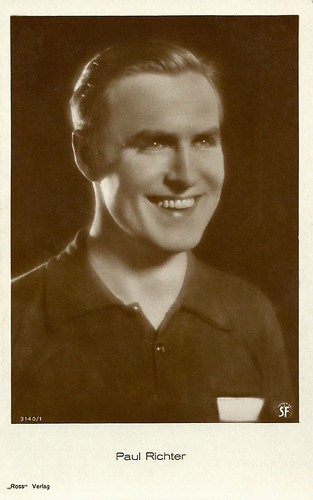
German postcard by Ross Verlag, no. 3140/1, 1928-1929. Photo: SF.

Paul Richter
German postcard by Ross Verlag, no. 3140/2, 1928-1929. Photo: SF.

Paul Richter
German postcard by Ross Verlag, no. 3348/3, 1928-1929. Photo: Orpid Messtro Film.

Paul Richter
German postcard by Ross Verlag, no. 5576/1, 1930-1931. Photo: Transocean-Film. Paul Richter as Kaiser Josef in Die Försterchristl/The Forester's Daughter (Friedrich Zelnik, 1931).

King of the Edelweiss


In the early 1930s Paul Richter was often cast in Heimatfilms, films with a regional background like Die Försterchristel (Friedrich Zelnik, 1931) and Schloss Hubertus/Hubertus Castle (Hans Deppe, 1934) opposite Hansi Knoteck.

From then on he usually played huntsmen, foresters or landowners in such films as Der Jäger von Fall/The Hunter of Fall (Hans Deppe, 1936), Das Schweigen im Walde/Silence of the Forest (Hans Deppe, 1937) and Der Edelweißkönig/King of the Edelweiss (Paul May, 1939), again opposite Hansi Knoteck.

Thomas Staedeli notes that Richter was able to bring real life into these performances "because of his private preference for nature and the mountains" in contrast to successors like Rudolf Prack in the 1950s.

A difficult eye operation ended Richter's career at the end of the 195's. His final film was Wetterleuchten um Maria/Lightning around Maria (Luis Trenker, 1959) starring Marianne Hold. Paul Richter died in 1961 in his home in Vienna. He was the stepfather of actor Georg Richter.

Flyer Das Testament des Dr. Mabuse (1933), 1
German flyer by Illustrierte Film-Kurier, no. 1168, 1952, part 1. Das Testament des Dr. Mabuse/The Testament of Dr. Mabuse (Fritz Lang, 1933).

Paul Richter
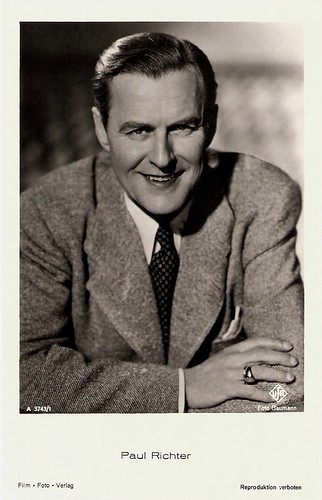
German postcard by Film-Foto-Verlag, no. A 3743/1, 1941-1944. Photo: Baumann / Ufa.

Paul Richter
German postcard by Das Programm von Heute, Berlin. Photo: Tobis. Collection: Miss Mertens.

Paul Richter
German postcard by Das Programm von Heute, Berlin. Photo: Ufa / Baumann. Collection: Miss Mertens.


Siegfried slays the dragon in Die Nibelungen (1924). Source: OperaPeru (YouTube).

Sources: Thomas Staedeli (Cyranos), Wikipedia, and IMDb.