
French postcard by A.N., Paris, no. 98. Photo: Paul Nadar. Victorien Sardou.

French postcard by A & S (Saint-Just), Paris, no. 903/8. Tosca has just killed Baron Scarpia. From a series of staging moments in the play by Sardou and the opera by Puccini.

Italian postcard by Ed. Vettori, Bologna. Francesca Bertini as Tosca and Alfredo De Antoni as Baron Scarpia in Tosca (Alfredo De Antoni, 1918).
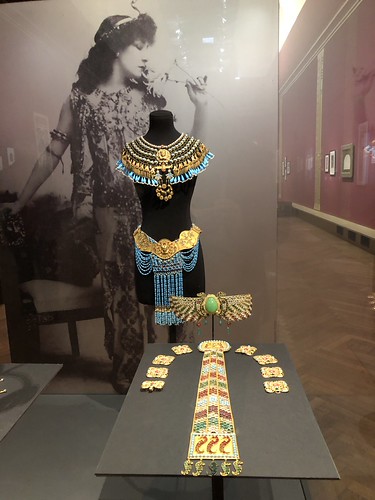
Costume and jewellery worn by Sarah Bernhardt in her performance of the play 'Cléopâtre' by Sardou and Moreau, staged at the Théâtre de la Porte St Martin in Paris in 1890. Photo taken at the exhibition 'Sarah Bernhardt' at the Petit Palais in Paris in 2023.
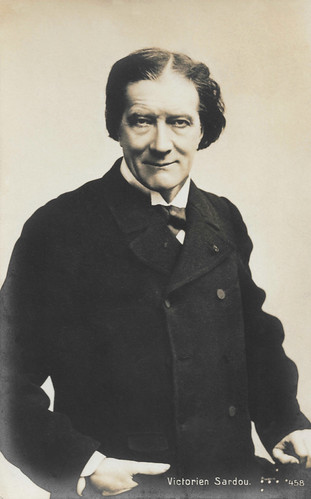
French postcard, no. 458. Victorien Sardou.

French postcard by Ed. Le Deley, Paris. French stage and later also screen actress (Gabrielle) Réjane in the stage play 'Madame Sans-Gêne' by Victorien Sardou and Émile Moreau, performed at the Paris-based Théâtre Moncey. Réjane played the outspoken laundress Catherine Hübscher, who later became the Duchess of Danzig. Sardou and Moreau wrote the play for Réjane, and it was first performed on 27th October 1893 at the Théâtre du Vaudeville in Paris, owned by her husband, Paul Porel. So our cards are for a later version, again with Réjane - even if Gallica does not indicate any staging of the play at this theatre with Réjane in the lead. Perhaps the play was supposed to take place at the Moncey and was then moved to another theatre. After the first performances in 1893, Réjane would repeat the play several times at her own Théâtre Réjane (opened in 1906).

French postcard by Raphael Tuck & Fils, Editeurs, Paris, Série 200. Photo: Gabrielle Réjane, Victorien Sardou and Paul Porel sign the contract for the stage play 'Madame Sans-Gêne'. Paul Porel was the managing director of the Théâtre de Vaudeville in Paris and then the husband of Réjane. It was here that the first performance of 'Madame Sans-Gêne' took place in 1893.
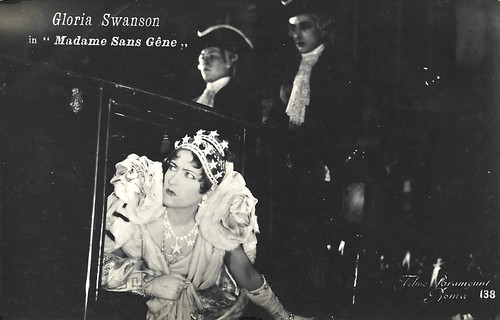
Italian postcard, no. 138. Photo: Films Paramount, Roma. Gloria Swanson in the lost film Madame Sans-Gêne (Léonce Perret, 1925), entirely produced and filmed in France, and based on the play by Sardou and Moreau.

German postcard by AL, no. B 145. Victorien Sardou. Sent by mail in 1913.
The master of dialogue
Victorien Léandre Sardou was born in Paris in 1831. He came from a Provençal family that owned an olive grove in Le Cannet, near Nice. After a winter with severe night frosts, all the olive trees died, and the family was ruined. Antoine Léandre Sardou, his father, moved to Paris, where he worked successively as a bookkeeper, bookkeeping teacher, school principal, and private tutor. He also wrote grammar manuals, dictionaries, and various treatises. Despite all these activities, the Sardous barely managed to make ends meet. After Father Sardou had moved back to the south, Victorien remained behind in Paris and began studying medicine. However, due to a lack of funds, he had to interrupt his studies. Sardou became a French teacher for foreign students, taught Latin, history, and mathematics, and wrote articles for popular encyclopedias. While teaching, Sardou attempted to work his way up in the literary world. He was encouraged in this by Madame de Bawr, a woman who had published several novels during the Restoration period.
Sardou wrote the drama 'La Reine Ulfra', based on an old Swedish chronicle, for Mademoiselle Rachel, one of the most famous actresses of the period, and sent it to her. However, Sardou received a negative reply from the actress. His theatrical debut took place under difficult circumstances. The play 'La Taverne des étudiants', which premiered in 1854 at the Théâtre de l'Odéon, received a stormy reception because rumours circulated that Sardou had been hired by the authorities to provoke the students. After five performances, the play was withdrawn. A subsequent play, 'Bernard Palissy', had been accepted by the Odéon, but due to a change in management, the agreement was called off at the last minute. A play with a Canadian subject, 'Fleur de Liane', was to be performed at the Théâtre de l'Ambigue-Comique, but was also cancelled due to the death of the theatre director. His subsequent plays, 'Le Bossu' and 'Paris à l'envers', were also not performed. The latter play was rejected on the advice of author Eugène Scribe, who was disgusted by the love scene that Sardou would later reuse with great success in the play 'Nos Intimes' (1861).
Sardou found himself plunged into abject poverty and suffered a nearly fatal attack of typhoid fever in 1857. He faded away, surrounded by his rejected manuscripts, in a small apartment in Paris. His neighbour Laurentine de Brécourt took pity on him. She nursed him, cured him, and, when he was well again, introduced him to her friend, the famous actress Virginie Déjazet. The old actress saw potential in Sardou and in 1859 bought a small theatre on Boulevard du Temple for him, which was renamed Théâtre Déjazet. To cover the operating costs, the actress went back on tour through Europe. 'Candide', his first play written for Virginie Déjazet, was banned by the censors, but the next three plays — 'Les premières armes de Figaro' (1859, in collaboration with the prolific Louis-Émile Vanderburch, nearing the end of his career), 'Monsieur Garat' (1860), and 'Les Prés Saint-Servais' (1862) — became a great success. The latter two plays were also translated into English and performed at the Criterion Theatre in London. His play, 'Les Pattes de mouche' (A Scrap of Paper, 1860), also became a success at the Gymnase. Sardou relied heavily on theatrical devices to create an illusion of life, and this largely accounts for his rapid decline in popularity. He quickly rose to the same level as the two most important playwrights of the time, Émile Augier and Alexandre Dumas fils.
Sardou was the master of dialogue, featuring a succession of witty retorts. He applied the structure of the well-made play developed by Eugène Scribe and combined the three classic comic genres (character comedy, comedy of manners, and intrigue) with bourgeois drama. His plays were strongly focused on social satire. In 'Nos Intimes' (1961), Sardou mocked the selfish and vulgar bourgeoisie; in 'Les Vieux Garçons' (1865), old bachelors; and in 'Nos Bons Villageois' (1866), peasants. In 'Les Ganaches' (1862), he mocked old political habits and principles; in 'Séraphine' (1868), modern Tartuffes. In 'Le roi Carotte' (1872), he mocked the revolutionary spirit and those who profit from it, and in 'Divorçons!' (1880) and 'Daniel Rochat' (1880), divorce. In 1882, Sardou wrote 'Fédora' for Sarah Bernhardt. The play was adapted and reworked by Umberto Giordano into the opera 'Fédora'. The piece dealt with the nihilism from the novel 'Fathers and Sons' by Ivan Turgenev. Later, Sardou wrote several more plays for Bernhardt.
Victorien Sardou reinvented himself by introducing a historical element into his plays. He derived 'Théodora' (adapted into an opera by Xavier Leroux in 1907) from Byzantine chronicles and 'La Haine' (1874) from Italian chronicles, while 'La Duchesse d'Athènes' was set in medieval Greece. The play 'Patrie' (adapted into an opera by Émile Paladilhe in 1886) highlighted the revolt of the Dutch 'Geuzen' at the end of the 16th century, while 'La sorcière' (1903) was set in 16th-century Spain. The French Revolution served as the backdrop for several plays: 'Les Merveilleuses' (1873), 'Paméla, marchande de fiscalités' (1898), 'Thermidor' (1891), and 'Robespierre' (1899), which was written for Henry Irving, who performed it in London. The French Empire era was revived in 'La Tosca' (1887, reworked into the opera 'Tosca' by Giacomo Puccini) and 'Madame Sans Gêne' (1893), written for Gabrielle Réjane. The latter play was also performed in London by Henry Irving and Ellen Terry. He also wrote 'Dante' (1903), the Vaudeville 'La Piste' (1906), and 'L'Affaire des Poisons' (The Affair of the Poisons, 1908), which was still being performed at the Théâtre de la Porte Saint-Martin and was very successful at the time of his death in 1898. The play is set during the reign of Louis XIV and the downfall of his mistress, Madame de Montespan.
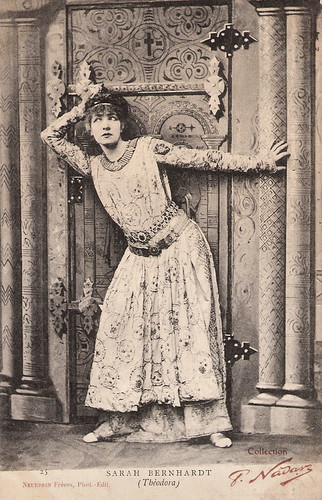
French postcard by Neurdein Frères, Photo-Edit., no. 25. Photo: Nadar. Sarah Bernhardt as Empress Theodora in Victorien Sardou’s play 'Theodora' (1884).

French postcard. Photo: Paul Boyer. Sarah Bernhardt and Pierre Magnier in Théodora (Victorien Sardou, 1884), performed in 1902 at the Théâtre Sarah-Bernhardt.

French postcard by PMM. Photo: Boyer, Paris. Pierre Laugier de la Comédie-Française in 'Thermidor' (1891) by Victorien Sardou.

French postcard. Sarah Bernhardt in the play 'Cléopâtre' by Victorien Sardou and Émile Moreau, first performed in 1890 by Sarah Bernhardt at the Théâtre de la Porte Saint-Martin.

French postcard by Raphael Tuck & Fils, Editeurs, Paris, Série 200. Photo: Gabrielle Réjane in the stage play 'Madame Sans-Gêne' (1893) by Victorien Sardou, which she also filmed twice.

French promotional postcard for Vin Désiles by G.P., Paris. Photo: probably by Paul Nadar. Abel Deval, Directeur de l'Athénée, as Zaccaria in 'Gismonda' by Victorien Sardou, performed at the Théâtre de la Renaissance in 1894, and starring Sarah Bernhardt.

British postcard by J.B. & Co, no. 190C. Photo: Window & Grove. Ellen Terry as Madame Sans Gêne in a British 1897 production of the stage play 'Madame Sans-Gêne'.
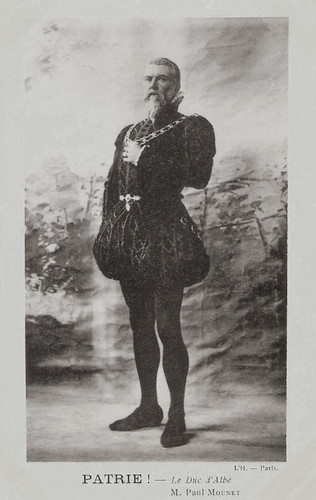
French postcard. Photo: L'H, Paris. Paul Mounet as Le Duc d'Albe in Patrie! (1901) by Victorien Sardou and presented by the Comédie-Française.

French postcard. Photo: Paul Boyer. Pierre Magnier as Andréas in 'Théodora' (1884) by Victorien Sardou, performed in 1902 at the Théâtre Sarah-Bernhardt.

French postcard, no. 1/11. Photo: Paul Boyer, Paris. Marguerite Moreno in the play 'La Sorcière' at the Theatre Sarah Bernhardt in Paris. Moreno performed in this play by Victorien Sardou in 1903.

British postcard in the Rotary Photographic Series, no. 4458 I. Photo: Foulsham & Banfield. Denise Orme the musical play 'The Lady Dandies' or 'The Merveilleuses', based on Victorien Sardou's original play 'Les Merveilleuses'. It was adapted by Basil Hood, lyrics by Adrian Ross, and music by Hugo Felix. The main plot is a love story, concerning Dorlis, an emigré aristocrat who has just returned from enforced military service in Italy, and Illyrine, his ex-wife. It opened at Daly's Theatre, London, under the management of George Edwardes, on 27 October 1906, with a cast that included Evie Greene, Denise Orme and Robert Evett in the leading roles, and ran for 196 performances. The Play Pictorial noted that the name of the show had created some difficulty: "'The Women Dandies' scarcely expresses it, and so it was decided eventually to let the French name stand."

Spanish postcard (but with Italian text on the front). Italia Vitaliani in the play 'Tosca' by Victorien Sardou. 'Tosca' was one of Vitaliani's stage successes, which she performed, e.g. on 30 June 1896 at the Victoria Theatre in Buenos Aires, on 8 May 1904 in Budapest, and on 20 October 1906 at the Politeama Ariosto in Reggio Emilia.

French postcard. Ed. Le Deley, Paris. Georges Dorival in 'L'Affaire des poisons' by Victorien Sardou, performed in 1907.
Conflict as the key to drama
Victorien Sardou is remembered for his development, along with Eugène Scribe, of the well-made play. One of his first goals when writing was to devise a central conflict followed by a powerful climax. From there, he would work backwards to establish the action leading up to it. He believed conflict was the key to drama. He wrote several plays that were made into popular 19th-century operas such as 'La Tosca' (1887) on which Giacomo Puccini's opera 'Tosca' (1900) is based, and 'Fédora' (1882) and 'Madame Sans-Gêne' (1893) that provided the subjects for the lyrical dramas 'Fedora' (1898) and 'Madame Sans-Gêne' (1915) by Umberto Giordano. His play 'Gismonda', from 1894, was also adapted into an opera of the same name by Henry Février, as was 'Patrie!' by Émile Paladilhe. Camille Erlanger based his four-act opera 'La Sorcière'(1912) on Sardou's play of the same name.
In the 1880s, Victorien Sardou became the chief playwright for Sarah Bernhardt. With 'La Divine' in mind, he wrote 'Fédora' (1882). The premiere was headline news in Paris. Le Figaro devoted its whole front page to it. The Paris correspondent of The Era called Bernhardt's performance as Princess Fédora Romazoff "magnificent throughout … the most brilliant of her remarkable career". The play opened at the Théâtre du Vaudeville in Paris on 11 December 1882, and ran for 135 performances. Bernhardt wore a soft felt hat on stage, which was soon a popular fashion for women, known as a fedora. In one scene, Fédora weeps over the body of her murdered lover. The deceased needed only to lie still, and Parisian men of fashion took to spending one evening each as the distinguished corpse. Albert Edward, Prince of Wales, took a turn, delighting the city. In July 1883, Bernhardt led her company in 'Fédora' as the final production in a series of French plays given at the Gaiety Theatre, London. The play was filmed many times. First in the US as Princess Romanoff (Frank Powell, 1915), starring Nance O'Neil. Immediately followed by adaptations in Italy, Fedora (Gustavo Serena, 1916), starring Francesca Bertini, and Austria, White Nights (Alexander Korda, 1916), starring Lili Berky. Other stars who stepped in Bernhardt's footsteps were Pauline Frederick (1918), Lee Parry (1926), Pola Negri (1928), Marie Bell (1934) and Luisa Ferida (1942).
Sardou wrote more plays for Bernhardt: 'Théodora' (1884), 'La Tosca' (1887), and 'Cléopâtre' (1890). Sardou himself directed these productions in which Bernhardt starred. Sardou taught her a broad, flamboyant style of acting, relying for effect on lavish decor, exotic costumes, and pantomimic action. Their third play together, 'La Tosca', was first performed on 24 November 1887. Bernhardt was in her mid-40s by then and France's leading actress. In 1883, she had also taken over the lease on the Théâtre de la Porte Saint-Martin, where 'La Tosca' was to premiere. Its melodramatic plot centres on Floria Tosca, a celebrated opera singer; her lover, Mario Cavaradossi, an artist and Napoleon sympathiser; and Baron Scarpia, Rome's ruthless Regent of Police. By the end of the play, all three are dead. Despite negative reviews from the Paris critics on the opening night, it became one of Sardou's most successful plays. 'La Tosca' had an opening run of 200 performances and was toured by Bernhardt throughout the world in the years following its premiere. Its operatic adaptation, Giacomo Puccini's Tosca, has achieved enduring popularity. There were at least four silent film adaptations. A hand-coloured version starring Sarah Bernhardt was made in 1906 by Le Film d'Art, a French film company run by André Calmettes and Charles le Bargy. There was also a 1918 version by Paramount Pictures with Pauline Frederick as Tosca. Only fragments remain of the Italian film made the same year, starring Francesca Bertini. It was one Bertini's most popular films, which it makes it even more sad that so little remains of this picture. Later films tended to be adaptations of Puccini's opera rather than Sardou's play, with the notable exception of the Italian film Tosca / The Story of Tosca (Carl Koch, 1941) starring Imperio Argentina as Tosca and Rossano Brazzi as Cavaradossi. Jean Renoir originally worked with Koch on the adaptation, but had to leave Italy at the outbreak of World War II.
'Madame Sans-Gêne' (1893) was written specifically for Gabrielle Réjane. 'Madame Sans-Gêne' is a historical comedy-drama concerning incidents in the life of Catherine Hübscher, an outspoken 18th-century laundress who became the Duchess of Danzig. The play premiered at the Théâtre du Vaudeville, Paris, on 27 October 1893. The original cast included Réjane as Catherine, a role she continued to play throughout her career. Réjane led a company to London in 1894, giving the play in the original French at the Gaiety Theatre from 24 June 1894. It was translated into English and starred Henry Irving and Ellen Terry at the Lyceum Theatre in 1897. The first Broadway production was given on 14 January 1895. The play was revived many times in France, and later performers of the title role included Marguerite Pierry, Mistinguett, Lise Delamare and Madeleine Renaud. It was also adapted as an opera in 1915. The first silent film adaptation was the short Madame Sans-Gêne (Clément Maurice, 1900) starring Réjane. She also starred in a remake, Madame Sans-Gêne (André Calmettes, 1911). The last silent film version was Madame Sans-Gêne (Léonce Perret, 1925), starring Gloria Swanson. Sound versions were made in 1941 by Roger Richebé, starring Arletty, and in 1945 in Argentina by Luis César Amadori, featuring José Maurer. A Franco-Italian film version directed by Christian-Jaque and starring Sophia Loren was released in 1961.
Victorien Sardou's final play, 'L'affaire des poisons' (1907), portrays the events of the real-life Affair of the Poisons during the reign of Louis XIV and the downfall of his mistress Madame de Montespan. In 1955, it was made into a French-Italian film of the same title directed by Henri Decoin and starring Danielle Darrieux, Viviane Romance and Paul Meurisse.
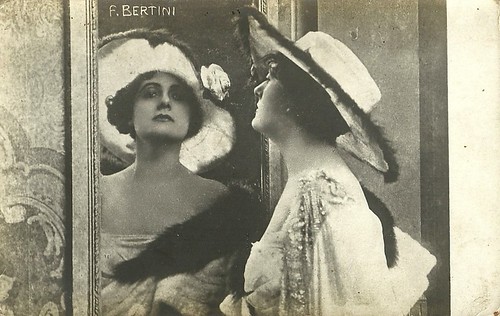
American postcard, monogram K Ltd. Francesca Bertini in Odette (Giuseppe De Liguoro, 1916), based on Victorien Sardou's play 'Odette'.

Italian postcard by IPA CT Duplex, no. 3275. Photo: Films Cines, Lyda Borelli as Terese de Fontenay / Madame Tallien, and Amleto Novelli as Tallien in the Italian silent film Madame Tallien (Enrico Guazzoni, 1916), based on the homonymous play by Victorien Sardou. Caption: Thérèse Cabarus obtains from the enamoured Tallien a passport for Guery.

Spanish collector card by Chocolate Salas-Sabadell, no. 6 of 6 cards. Leda Gys in the silent Italian film Fernanda (Gustavo Serena, 1917), based on Victorien Sardou's play.

Spanish cromo (collector card) by Chocolate Salas-Sabadell, Barcelona, no. 5 of 6 cards. Photo: Caesar Film. Francesca Bertini, Camillo De Riso and Alfredo De Antoni in Andreina (Gustavo Serena, 1917), based on the play 'Andréa' (1873) by Victorien Sardou, adapted by Giuseppe Paolo Pacchierotti.

Spanish collector card by Amattler Marca Luna, series 5, no. 11. Photo: Caesar Film. Francesca Bertini as Floria Tosca in the Italian silent film Tosca (Alfredo De Antoni, 1918). Caption: A vengeful Tosca at Scarpia's.

Italian postcard by Unione Cinematografica Italiana, series Teodora no. 9. Photo: Ambrosio Film. Rita Jolivet and René Maupré in Teodora (Leopoldo Carlucci, 1921). The back of the card reads: "When Teodora (Rita Jolivet) meets the Greek Andrea (René Maupré), she becomes his lover, pretending she is a widow with the name of Mirta." NB most sources, including the original intertitles in the existing print, state that René Maupré played Andrea/Andres, and looking at photos of Maupré, this seems right. Yet, Vittorio Martinelli claims Maupré played the emperor Justinian and Ferruccio Biancini played Andrea.

Italian postcard by G.B. Falci, Milano. Photo: Medusa Film / UCI. Elena (Helena) Makowska in the silent Italian film Rabagas (Gaston Ravel, 1922). The man on the right is probably actor Guido Trento (1892-1957). Rabagas was based on a play by Victorien Sardou about an American billionaire (Makowska), who befriends the Prince of Monaco (Trento) and who succeeds in preventing the overthrow of the regime by the adventurous lawyer Rabagas (Totò Majorana). In the end, she marries the Prince.

Italian postcard, no. 139. Photo: Films Paramount Roma. Gloria Swanson and Émile Drain in Madame Sans-Gêne (Léonce Perret, 1924). Collection: Didier Hanson.

Italian postcard by Italian distributor S.A. Stefano Pittaluga, no. 338. Francesa Bertini and Angelo Ferrari in Mein Leben für das Deine (Luitz-Morat, 1928), based on Victorien Sardou's play 'Odette', and released in Italy under the same title. In 1916, Bertini had already played in an Italian version of Odette and would do it again in the sound era in a French version, Odette (1935).
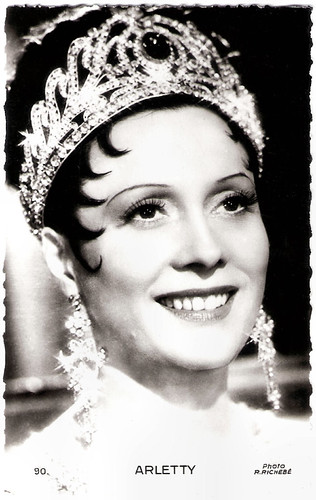
French postcard by Edit. Chantal, Rueil, no. 90. Photo: Roger Richebé. Arletty in Madame Sans-Gêne (Roger Richebé, 1941).

French postcard in the Collection artistique du Vin Désiles. Photo: Boyer.
Sources: Encyclopaedia Britannica, Wikipedia (Dutch, French and English) and IMDb.

No comments:
Post a Comment