
Spanish postcard by Suevia Films / Cesáreo González. Photo: Gómez Sanz.

Spanish postcard, no. 2472.

Spanish postcard. Photo: Juan Gyenes.
The largest contract for a performing artist in Spanish history
Lola Flores was born María Dolores Flores Ruiz in 1923 in the ‘Gypsy quarter’ of San Miguel in Jerez de la Frontera in the province of Cádiz. As a girl, she danced and sang in the tavern run by her father, Pedro Flores, 'El Comino'. Her mother, María del Rosario Ruiz Rodríguez, was a dressmaker. Lola was one quarter gypsy through her maternal grandfather. She learned to dance with María Pantoja and to understand flamenco with Sebastián Nuñez.
By the age of twelve, she was already known as a dancer in local artistic circles. Later, she sang songs by her great idols, Concha Piquer and Estrellita Castro. In 1939, at the age of 16, Flores made her official debut after the end of the Civil War at the Teatro Villamarta de Jerez in the production ‘Luces de España’. Alongside the dance duo Rafael Ortega and Custodia Marchena, and the guitarist Melchor de Marchena, she sang ‘Bautizá con manzanilla’.
The graceful dancer enjoyed her greatest successes with the flamenco singer Manolo Caracol, who possessed a rough Gitano voice and with whom she worked as an artistic duo until their separation in 1951. Together, in 1943, they staged the show 'Zambra', which was so successful that further productions under the same title followed until 1949. In 1958, she married the gypsy singer, guitarist and composer Antonio González Batista, who became a leading figure in Catalan rumba under his stage name El Pescaílla. The couple had three children, all of whom became singers: Dolores Lolita, Antonio (1961–1995) and Rosario.
In 1939, Lola Flores was discovered by film director Fernando Mignoni, and she moved to Madrid to pursue a professional career in music and film. Her film debut was the lead role in Martingala (Fernando Mignoni, 1940). One of her most remarkable films is Embrujo / Spell (Carlos Serrano de Osma, 1947), a musical drama starring Manolo Caracol, who was her boyfriend at the time.
In 1951, she signed a contract with Suevia Films for 6 million pesetas. It was the largest contract for a performing artist in Spanish history. The contract included cinema, TV, theatre and also a tour throughout America. For Suevia Films, she starred in major productions like La Niña de la Venta / The Girl at the Inn (Ramón Torrado, 1951), ¡Ay, Pena, Penita, Pena! / Oh Pain, Little Pain, Pain (Miguel Morayta, 1953) and La Danza de los Deseos / The Dance of Desires (Florián Rey, 1954).

Spanish card by Omega.

Spanish collector card in the series D Snevia, no. 42.
A Spanish pop culture icon
Lola Flores also starred in another classic, Morena Clara (Luis Lucia, 1954) with Fernando Fernán Gómez. It is a remake of the popular 1934 film. She appeared with Gustavo Rojo in María de la O (Ramón Torrado, 1958). In Mexico, she appeared in the dramas La Faraona (René Cardona, 1956) and Sueños de oro (Miguel Zacarías, 1958). Her film El Balcón de la Luna / The Balcony of the Moon (Luis Saslavsky, 1962) with Carmen Sevilla and Paquita Rico spawned the signature songs 'A tu Vera' and '¡Ay, Pena, Penita, Pena!'.
Its critical and commercial failure illustrated the declining popularity of the Andalusian musical, which had been one of the most popular Spanish genres of the 1950s. However, till 1987, Flores demonstrated her fiery temperament and stage presence in various films, in which she usually played a ‘gypsy’. An exception was the comedy Juana la Loca... de vez en cuando (José Ramón Larraz, 1983) in which she played Joanna of Castile, Queen of Spain.
From the 1950s onwards, Lola Flores became acquainted with many prominent figures. In her public appearances, she spoke freely about topics considered taboo, such as violence against women, extramarital affairs and prostitution. She was a supporter and personal acquaintance of the dictator Francisco Franco, who liked to present himself as having a taste for folk music. She still held this view as late as December 1970, when she remarked on Spanish radio that ‘[Franco has] a very noble and kind heart’.
In 1990, she was honoured at a tribute concert in Miami, attended by her friends Celia Cruz and Rocío Jurado, and the singer Julio Iglesias. Flores died of breast cancer in 1995 in La Moraleja, a district of Alcobendas in the Autonomous Community of Madrid, at the age of 72. Following a ceremonial lying-in-state at the Centro Cultural de la Villa in Madrid, she was buried at the Cementerio de la Almudena in Madrid. Around 300,000 people attended her funeral, including numerous prominent figures from all walks of life. Fourteen days after her death, her son Antonio passed away at the age of 33. He was laid to rest alongside his mother.
In 2007, the biopic Lola, la película (Miguel Hermoso, 2007) was made, which describes her early life from 1931 until 1958. In 2023, the Centro cultural Lola Flores was opened in her hometown of Jerez de la Frontera to mark her 100th birthday. The museum displays her awards, dresses (including her wedding dress) and jewellery. Her daughters, grandchildren and her sister Carmen Flores were present at the opening. Wikipedia: "Her strong personality, recognisable image, remarkable professional trajectory and sometimes controversial personal life have turned Flores into a Spanish pop culture icon."
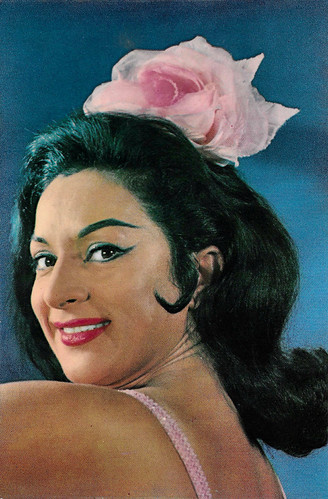
Spanish postcard.

Spanish postcard.
Sources: Wikipedia (German, Spanish and English) and IMDb.

No comments:
Post a Comment