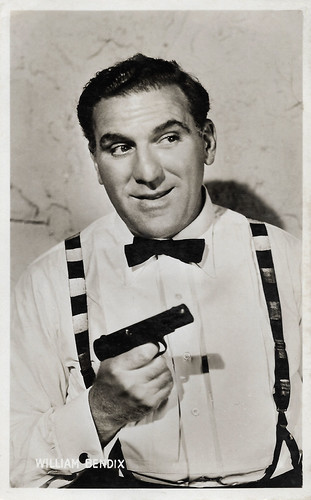
Dutch postcard, no. 19. Photo: Universal / J. Arthur Rank Organisation. William Bendix in White Tie and Tails (Charles Barton, 1946).
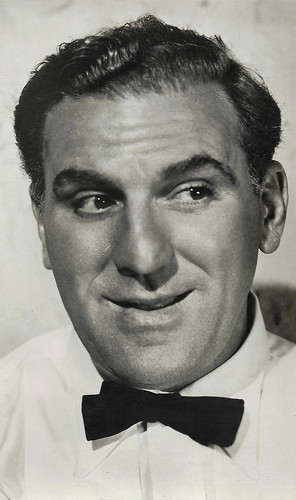
Spanish postcard by JOCABA, no. 3572. Photo: Universal.
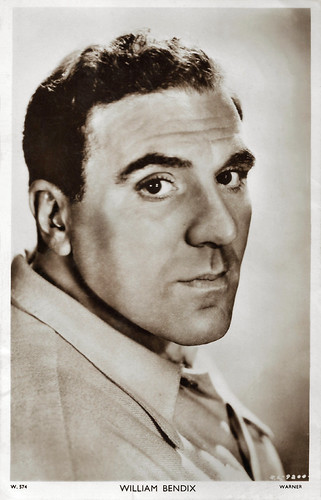
British postcard in the Picturegoer Series, London, no. W 574. Photo: Warner.
Film debut at Vitagraph at age 5
William Bendix was not a son of Brooklyn, New York, although because of his stereotypical 'Brooklyn accent', many people thought that he was. Bendix was actually born in 1906 in Midtown Manhattan, New York City. He was the son of musician Oscar Bendix and his wife, Hilda Carnell. His uncle was composer, conductor, and violinist Max Bendix.
At the age of five, William made his film debut when his father got him a small role in a Lillian Walker film being made in 1911 at Vitagraph Studios, where the elder Bendix was working as a handyman. Bendix did not appear again before the cameras for 31 years.
After dropping out of high school, he worked as a bat boy for the New York Giants and Yankees. He became interested in the theatre and joined the Henry Street Players, a settlement house company. He also worked as a singing waiter.
In 1927, he married, and his father-in-law got him a job managing a grocery in New Jersey. After the ravages of the Great Depression killed his grocery business, he performed in nightclubs and portrayed taxicab drivers in a series of Broadway flops.
His work for the Federal Theatre Project led to work with the Theatre Guild. He attracted the attention of producer Cheryl Walker and appeared in six of her productions at the Theatre Guild. In 1939, he had his first notable performance on Broadway as the cop Krupp in Walker's production of William Saroyan's 'The Time of Your Life'. He was spotted in the play by Hal Roach, who signed him to a film contract.

French poster postcard in the Collection Télérama by Editions Zreik, Paris. Veronica Lake, Alan Ladd and William Bendix in The Blue Dahlia (George Marshall, 1946).

Dutch postcard by J.S.A. Photo: Universal M.P.E.. Deanna Durbin, William Bendix, Tom Drake and Adolphe Menjou in I'll Be Yours (William A. Seiter, 1947).
A star with a burly physique and Brooklyn accent
William Bendix's Hollywood debut was a starring role in Hal Roach's Brooklyn Orchid (Kurt Neumann, 1942). Within a year, he had been nominated for an Academy Award for Wake Island (John Farrow, 1942) starring Brian Donlevy. More often than not, Bendix received less than top billing in films. Because of his looks, he was often called upon to supply comedic support.
In A Connecticut Yankee in King Arthur's Court (Tay Garnett, 1949), he played Sir Sagramore of King Arthur's Round Table in a full suit of armour and pageboy wig. That same craggy appearance brought him roles such as the thug Jeff in the Film Noir The Glass Key (Stuart Heisler, 1942). Jeff repeatedly and gleefully uses his fists to beat star Alan Ladd's face to a pulp and then sadistically challenges Ladd, once he is healed, to come back and receive further 'treatment'.
Bendix's finest and most memorable dramatic performance came in Lifeboat (Alfred Hitchcock, 1944). He touchingly interprets the role of Gus, the shipwreck survivor whose gangrenous limb has to be removed despite the absence of anaesthesia. He was cast in the classic Film Noir The Blue Dahlia (George Marshall, 1946), appearing for the second time alongside Alan Ladd and Veronica Lake. The film was based on Raymond Chandler's first original screenplay.
Bendix also portrayed his childhood hero, baseball legend Babe Ruth, in The Babe Ruth Story (Roy Del Ruth, 1948). He played Nick the bartender in the film version of William Saroyan's The Time of Your Life (H.C. Potter, 1948) starring James Cagney. Bendix had appeared in the stage version, but in the role of Officer Krupp, played in the film by Broderick Crawford.
Bendix's burly physique and Brooklyn accent were fondly remembered for his light-comedy portrayals of factory worker Chester A. Riley in the radio show 'The Life of Riley' (1944), which ran for nine years and then became a television show, The Life of Riley (1953), which also became a huge success and ran another five seasons. Bendix also starred in the big-screen version The Life of Riley (Irving Brecher, 1949).
Bendix worked in films, television and radio up until the end of his life, but always claimed the stage was his first love. Following a stomach ailment, Bendix died at 58 from malnutrition and subsequent pneumonia. His wife of 37 years, Theresa Stefanotti, and their two daughters survived him. He was interred at San Fernando Mission Cemetery, Mission Hills, California.

British postcard in the Picturegoer Series, London, no. W 134. Photo: Paramount.

French postcard, offered by Les Carbones Korès 'Carboplane'.

Vintage postcard. Advertisement by the American Meat Institute. Illustration of William Bendix in the radio show 'The Life of Riley'. Caption: Meet "Hollywood's magnificent Mug". He makes you laugh. William Bendix in 'The Life of Riley' on the air for MEAT Blue Network every Sunday night.
Sources: Jim Beaver (IMDb), Bill Takacs (IMDb), Wikipedia and IMDb.

No comments:
Post a Comment