
French postcard, no. 232. Photo: Nadar. The photo dates from the 1880s, but the card may be a bit newer. Albert Lambert in the title role of Victor Hugo's play 'Ruy Blas'.
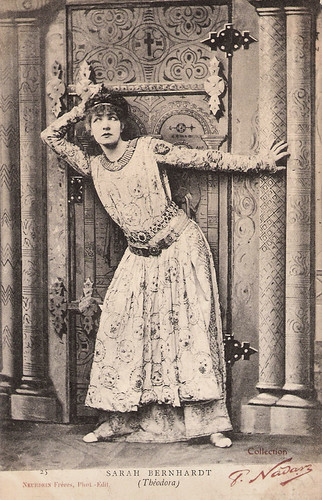
French postcard by Neurdein Frères, Photo-Edit., no. 25. Photo: Paul Nadar. Sarah Bernhardt as Empress Theodora in Victorien Sardou’s play 'Theodora' (1884).

French postcard by Editions Gendre, Paris, no. 119. Photo: Paul Nadar, 1905. Caption: Sacha Guitry, French actor and author, 1885-1957. Sacha Guitry seems to do an imitation here of the popular Belle Epoque actor Little Tich (Harry Relph).

French postcard in the Les Vedettes de Cinéma series by A.N., Paris, no. 102. Photo: Paul Nadar. Vanni Marcoux in Le Miracle des Loups / Miracle of the Wolves (Raymond Bernard, 1924).
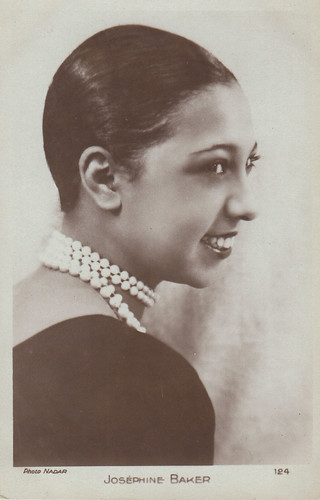
French postcard, no. 124. Photo: Nadar. Collection: Marlene Pilaete. Josephine Baker (1906-1975) was well-known as a singer and dancer. In 1925, she became an instant success in Paris because of her erotic dance. She also performed in a handful of silent and early sound films, La Sirene des Tropiques (1927), Zouzou (1934) and La princesse TamTam (1935).
A rift between father and son
Paul Nadar was born Paul Tournachon in 1856 in Paris. He was the only son of the celebrated nineteenth-century French photographer Félix Nadar, or Nadar (1820-1910), and his wife, Ernestine. He was the grandson of Victor Tournachon, who was a printer and bookseller.
In 1854, Félix Nadar began a portrait photography business. Busy with caricature, he yielded operations to his younger brother, Adrien Tournachon, who took over the business completely but soon ran into debt. Nadar, who had started taking portraits at his own photographic studio at 113 rue St. Lazare, helped his brother revitalise the business, but tensions between them created division and led to legal disputes over the right to use the name 'Nadar'.
In 1860, Nadar moved to 35 Boulevard des Capucines, where he photographed a wide range of personalities: politicians (Guizot, Proudhon), stage actors (Sarah Bernhardt, Paulus), writers (Baudelaire, Sand, Nerval, Gautier, Dumas), painters (Corot, Delacroix, Millet), and musicians (Liszt, Rossini, Offenbach, Verdi, Berlioz). He photographed Victor Hugo on his deathbed in 1885.
In the studio, Félix Nadar eschewed traditional sumptuous decors and unnecessary accessories, and preferred natural daylight. His photographs of women are notable for their natural poses and individual character. Nadar was recognised for breaking the conventions of photographic portraiture, choosing to capture the subjects as active participants.
Paul Nadar was appointed by his father to be artistic director of the latter's studio in Paris in 1874. From 1880 to 1885 and again from 1895 onward, he managed his father's studio. Under Paul, the Nadar studio catered to a more affluent clientele and prospered. He cultivated a more conventional style, which led to a rift between father and son in 1885. In 1886, Félix and Paul Nadar did what may be the first photo-report: an interview with the great chemist and colour theorist Michel-Eugène Chevreul, who was 101 years old. Félix conducted the interview while Paul took photographs. It was published in Le Journal Illustré.
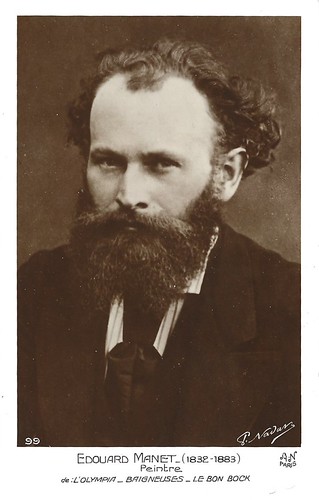
French postcard by A.N. (Armand Noyer), Paris, no. 99. Photo: Paul Nadar. Édouard Manet (1832-1883), painter of 'Olympia', 'The Bathers', 'Le Bon Bock', etc.

French postcard. Photo: Paul Nadar, Paris, 1895. Sent by mail in 1901. Cléo de Mérode (1875-1966) was a French dancer of the Belle Époque. She has been referred to as the 'first real celebrity icon' and the 'first modern celebrity '. De Mérode was also the first woman whose photographic image, thanks in particular to photographers Nadar and Léopold-Émile Reutlinger, was distributed worldwide.

French postcard by Neurdein Frères Photo-Edit, Paris, no 37. Photo: Paul Nadar. Caption: Coquelin Aîné (Cyrano de Bergerac). Benoît-Constant Coquelin (1841-1909), known as Coquelin aîné (Coquelin the Elder), was a French actor who was known as one of the greatest theatrical figures of the age.

French postcard by Neurdein Frères Photo-Edit, Paris, no. 38. Photo: Paul Nadar. Caption: Coquelin Aîné (Cyrano de Bergerac).

French postcard by Neurdein Frères Phot. Edit., Paris, no. 42. Photo: Paul Nadar. Constant Coquelin as Cyrano de Bergerac. Sent by mail in 1903.
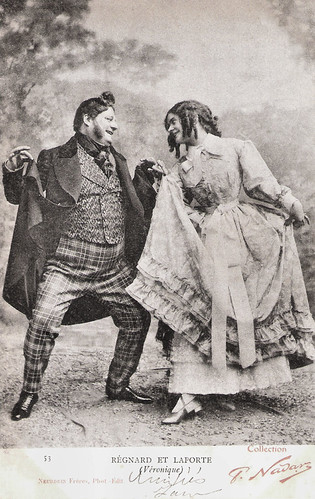
French postcard by Neurdein Frères Phot. Edit., Paris, no. 53. Photo: Paul Nadar. Léonie Laporte and Paul Regnard in 'Véronique' (1898). 'Véronique' is an 1898 operetta in three acts by André Messager with a libretto by Georges Duval and Albert Vanloo. It is Messager's most popular work and was performed many times in France in the fifty years following its premiere at the Théâtre des Bouffes-Parisiens in Paris on 10 December 1898.
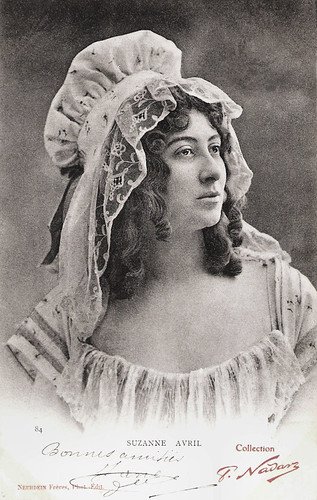
French postcard by Neurdein Frères Phot. Edit., Paris, no. 84. Photo: Paul Nadar. Suzanne Avril (1868-1948) was a stage and silent film actress of the Belle Époque.

French postcard by Neurdein Frères Phot.-Edit., Paris, no. 1. Photo: Paul Nadar. Caption: Théâtre des Bouffes-Parisiens. Polaire in 'Claudine à Paris' by Willy (Colette). I've been proposed to.

French postcard by Neurdein Frères Phot.-Edit., Paris, no. 4. Photo: Paul Nadar. Caption: Théâtre des Bouffes-Parisiens. 'Claudine à Paris'. Oh, I'm so bored at school!
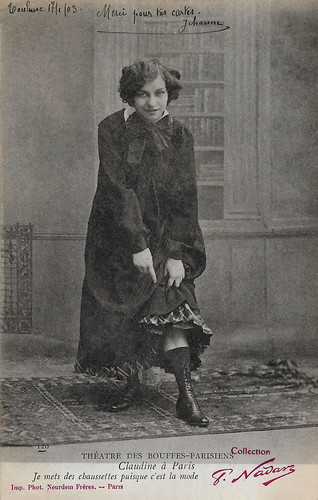
French postcard by Neurdein Frères Phot.-Edit., Paris, no. 120. Photo: Paul Nadar. Caption: Théâtre des Bouffes-Parisiens. Polaire in 'Claudine à Paris'. I wear socks because that's what's fashionable.
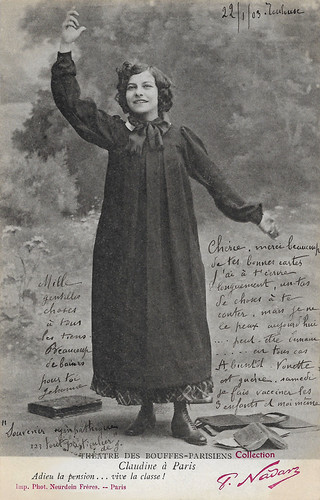
French postcard by Imp. Phot. Neurdein Frères, Paris, no. 123. Photo: Paul Nadar. Caption: Théâtre des Bouffes-Parisiens. Polaire in 'Claudine à Paris' by Willy (Colette). Goodbye boarding school... long live the classroom! Sent by mail in 1903.
The bourgeois and aristocratic clientele of the Belle Époque
Paul Nadar focused on the bourgeois and aristocratic clientele of the Belle Époque and sought to cater to their fashionable tastes. Nadar's audience came from the same social circles as Marcel Proust before he withdrew to write 'À la recherche du temps perdu' (In Search of Lost Time). Many of the characters in Proust's work were clearly recognisable to his contemporaries, while others bore the characteristics of several people. It is known that Proust collected photographs of his friends and acquaintances and used them while writing to help him recall details.
In 1886, Paul Nadar began to experiment with photographing from a hot-air balloon as his father had earlier. He presented his results at the Société Française de la Photographie (French Society of Photography). The press caricatured him as 'The Fearless Paul Nadar' for his courage and his experimentation with photography. An innovative experimenter throughout his career, Paul Nadar investigated artificial lighting and patented a projection system for animating still pictures.
In 1890, he undertook a long trip which brought him along the ancient Silk Route to a World Exhibition in Tashkent. He left Paris for Istanbul on a train and crossed the Black Sea. Having reached Batumi, he crossed the Caucasus through Tbilisi and Baku and arrived in Turkistan - present-day Turkmenistan and Uzbekistan. He travelled the region in two months and took around 1,200 photos of crowds of people in the bazaars and markets of Asia, the great sandy spaces of deserts, mosques, mausoleums and all the majestic vestiges of the exotic Eastern influences. His 'From Turkey to Turkistan' is one of the first 'photo reportages' in the history of photography. Paul Nadar worked during the trip with new equipment from Eastman Kodak.
After opening a photography business in 1893 as George Eastman's agent in France, he married Marie Degrandi, an actress at the Paris Opéra-Comique, in 1894. On 1 April 1895, Félix Nadar turned over the Paris Nadar Studio to Paul. Paul Nadar received permission from his father to continue using the name Atelier Nadar. Félix Nadar moved to Marseille, where he established another photography studio in 1897. He returned to Paris in 1909. Félix Nadar died in 1910, aged 89.
The studio continued under the direction of Paul Nadar, who died in 1939 in Paris. He was 83. Paul Nadar's grave is located in the Père-Lachaise Cemetery in Paris. The studio survived only a few years after his death. His estate, along with his father's, was sold to the French state in 1950. Approximately 60,000 negatives went to the Caisse Nationale des Monuments Historiques et des Sites (now the Centre des monuments nationaux), while prints and other documents are held in the Bibliothèque nationale de France.
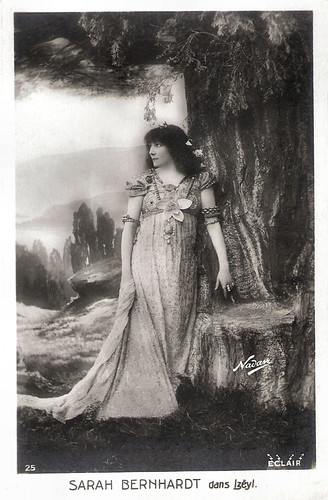
French postcard by Eclair, no. 25. Photo: Paul Nadar. Sarah Bernhardt in the 1894 stage play 'Izéil' by Eugène Morand and Armand Silvestre.
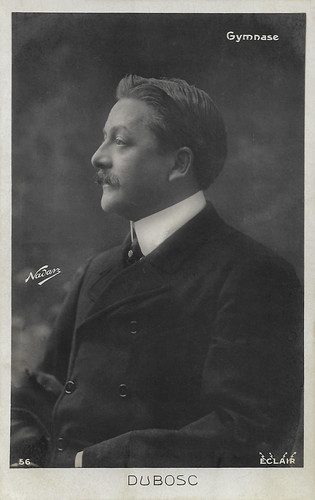
French postcard by Eclair, no. 56. Photo: Paul Nadar. Caption: [Théâtre du] Gymnase. Gaston Dubosc (1861–1941) was a French actor, active in French cinema between 1911 and 1940. He was known for e.g. Le voleur (1915), Un amour de Beethoven (1936) and Mon père avait raison (1936).

French postcard by Eclair, no. 57. Photo: Nadar. Albert Lambert in the Comédie Française stage production of 'Hernani' (1920?) by Victor Hugo.
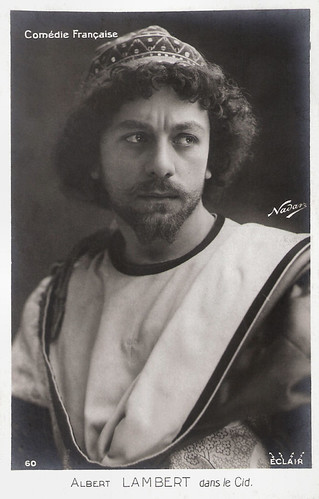
French postcard by Eclair, no. 60. Photo: Paul Nadar. Albert Lambert in the Comédie Française stage production of Le Cid (1906) by Pierre Corneille.
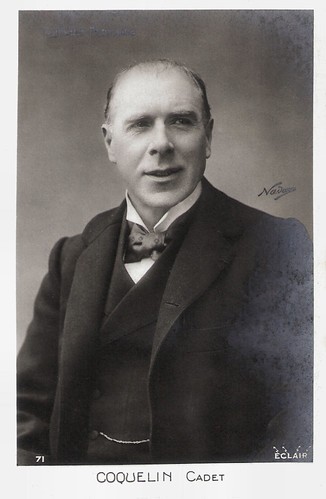
French postcard by Eclair, no. 71. Photo: Paul Nadar. Ernest Alexandre Honoré Coquelin (1848–1909) was a French actor. He was also called Coquelin Cadet, to distinguish him from his brother Benoit.

French postcard by Eclair, no. 72. Photo: Paul Nadar. Caption: Porte St. Martin. Jean Coquelin in the play 'La Dame de Monsoreau' (1908).
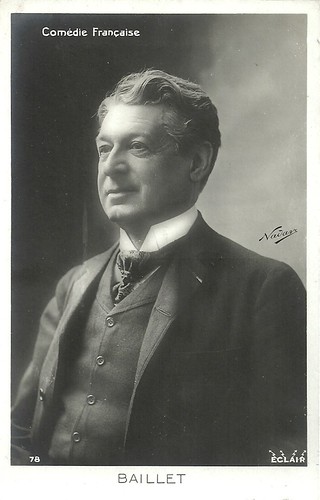
French postcard by Eclair, no. 78. Photo: Paul Nadar. Caption: Comédie-Française. Georges Baillet (1848-1935) was a French stage actor. After fighting in the Franco-Prussian War of 1870 and graduating from the Conservatoire drama school, he started acting at the Paris Odéon. In 1875, he joined the Comédie Française, where he became sociétaire in 1887 and regularly played until 1903. His best-known role, often reprised, was that of Don César de Bazan in 'Ruy Blas' by Victor Hugo. In 1908, Baillet left the Comédie Française over a row about being forced to leave his dressing-room.

French postcard by Eclair, no. 84. Photo: Paul Nadar. Caption: [Théâtre du] Gymnase. Gaston Dubosc in 'Mlle. Josette, ma femme' (Mademoiselle Josette, My Woman). 'Mademoiselle Josette, ma femme' is a French comic play written by Paul Gavault and Robert Charvay which premiered in 1906. Numerous film adaptations have been made. The play was staged at the théâtre du Gymnase and presented as "a 'situation comedy' in the manner of Scribe". It was a considerable commercial and critical success.

French postcard by Edition Pathé Frères. Photo: Paul Nadar. The Ch. must be a mistake, as this is clearly Léon Bernard. Léon Bernard (1877-1935) was a French stage and screen actor and also a theatre director.

French postcard in the series Les Vedettes de Cinéma by A.N., Paris, no 103. Photo: Paul Nadar. Romuald Joubé (1876-1949) was a French actor of silent cinema who became famous for his part in Abel Gance’s J’accuse (1918).
Sources: Getty Museum, British photographic history, Monoskop, Wikipedia (English and German).

No comments:
Post a Comment