
German postcard by Ross Verlag, Berlin, no. 902/1, 1925-1926. Photo: Transocean Film Co., Berlin.

German postcard by Ross Verlag, Berlin, no. 3233/1, 1928-1929. Photo: Atelier Balázs, Berlin.
A poverty-stricken mother who is rejected by almost all of her siblings
Mary Carr was born in 1874 in Germantown, a Philadelphia suburb, as Mary Kennevan. She became a schoolteacher, but soon gave it up for work as an actress in touring companies.
She married actor William Carr and toured extensively with his company. After the turn of the century, he became involved in film production as both an actor and director.
He brought Mary and their six children into the film business with him. Mary made her film debut in the silent drama short The Shadow of Tragedy (1914), directed by and starring Arthur V. Johnson.
Her roles as self-sacrificing, maternal characters in Mrs. Wiggs of the Cabbage Patch (Hugh Ford, 1919) and Over the Hill to the Poorhouse (Harry F. Millarde, 1920) made her a star.
Over the Hill was a tremendous success due in large part to her touching portrayal of a poverty-stricken mother who is rejected by almost all of her siblings. Only the black sheep of the family will help her in the end.

French postcard. Photo: Fox. Mary Carr in Over the Hill to the Poorhouse (Harry F. Millarde, 1920). The film was a huge success in the Netherlands in 1923-1924, where it ran for three weeks at the Amsterdam cinema Theater Tuschinski and four weeks at the Rotterdam-based Grand Theatre (also owned by Abraham Tuschinski). Normally, every week, Dutch cinemas had a new film. For years, Dutch papers would refer to this film with every new film with Carr. The Dutch title was 'Moeder' (Mother), like the French title 'Maman'.

French postcard. Photo: Fox. Mary Carr in Over the Hill to the Poorhouse (Harry F. Millarde, 1920). The film was a huge success in the Netherlands in 1923-1924, where it ran for three weeks at the Amsterdam cinema Theater Tuschinski and four weeks at the Rotterdam-based Grand Theatre (also owned by Abraham Tuschinski). Normally, every week, Dutch cinemas had a new film. For years, Dutch papers would refer to this film with every new film with Carr. The Dutch title was 'Moeder' (Mother), like the French title 'Maman'.
The mother of the movies
Mary Carr followed the success of a poverty-stricken mother, who is rejected by almost all of her siblings, with similar roles in scores of films throughout the silent period. Her Hollywood nickname was 'The Mother of the Movies.'
As older actresses such as Mary Maurice and Anna Townsend passed on, Carr, still in her forties, seemed to inherit all the matriarchal roles in silent films. She separated from William Carr in 1926.
Her notable film appearances include Jesse James (Lloyd Ingraham, 1927) and Second Wife (Russell Mack, 1930). She acted with Laurel and Hardy in the short film One Good Turn (James W. Horne, 1931), in which she demonstrated considerable comedic talent as James Finlayson's antagonist.
In Pack Up Your Troubles (George Marshall, a.o., 1932), she played her signature role as a matronly old woman. Then her film appearances became smaller and fewer, and Carr found herself nearly destitute.
Publicity about her status rallied help to her cause, and she found help and occasional work. She spent her later years appearing infrequently, often in films directed by her son, Thomas Carr. She died at the age of 99 in 1973. She was interred in Calvary Cemetery. Almost all of her children were involved in the film business and appeared with her in Over the Hill to the Poorhouse (1920).

French postcard by Le Deley. Photo: Fox. Mary Carr in Over the Hill to the Poorhouse (Harry F. Millarde, 1920). The French title was 'Maman'.
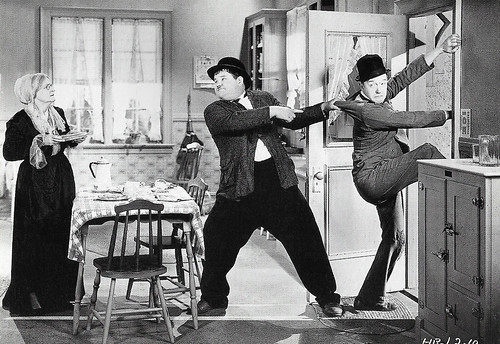
French postcard by Editions La Malibran, Paris, no. CA 78. Mary Carr, Stan Laurel and Oliver Hardy in One Good Turn (James W. Horne, 1931).
Sources: Jim Beaver (IMDb), Wikipedia (English and German) and IMDb.

No comments:
Post a Comment