
French postcard. Photo: Cinédis. Véra Clouzot is coiffed as her character in Le Salaire de la Peur / The Wages of Fear (Henri-Georges Clouzot, 1953).

French postcard by Editions Hazan, Paris, in the Collection Magie Noire, no. 6196, 1989. Photo: Sam Lévin. Michel Auclair and Cécile Aubry in Manon (Henri-Georges Clouzot, 1949).

Chinese postcard. Charles Vanel and Yves Montand in Le Salaire de la Peur / Wages of Fear (Henri-Georges Clouzot, 1953).

Dutch postcard, sent by mail in 1961. Brigitte Bardot in La vérité / The Truth (Henri-Georges Clouzot, 1960).

Dutch-Belgian postcard by ABC Distribution (Belgium), Cinemien (The Netherlands) and Lobster Films. Romy Schneider in L’Enfer / Inferno (Henri-Georges Clouzot, 1964). The film was never finished, but scenes were used in the documentary L'Enfer d'Henri-Georges Clouzot / Henri-Georges Clouzot's Inferno (Serge Bromberg, Ruxandra Medrea, 2009).
Inspired by the expressionistic style of Lang and Murnau
Henri Georges Léon Clouzot was born in Niort, France, in 1907. He was the son of Suzanne Clouzot and Georges Clouzot. He was the eldest of the couple's three children. His father owned a bookshop. From an early age, Clouzot was interested in cinema and showed a talent for writing plays. In 1922, Clouzot's father's bookshop went bankrupt, and the family moved to Brest, where his father became an auctioneer. Here, Clouzot attended naval school, but due to his short-sightedness, he was not admitted to the navy.
At the age of 18, Clouzot went to Paris to study political science. There, he became good friends with several magazine publishers, who noticed his writing talent. Clouzot was soon offered work as a screenwriter for theatre and cinema. Clouzot's career really took off when producer Adolphe Osso hired him to go to Studio Babelsberg in Germany and translate the scripts of the German-language films being shot there into French. During the 1930s, this was Clouzot's main job. He translated the scripts and dialogues of more than 20 films. In Germany, Clouzot saw the films of F.W. Murnau and Fritz Lang, and later in his career, he was often inspired by their expressionist style. In Germany, Clouzot witnessed the rise of Adolf Hitler and the Nazis. In 1934, the Ufa dismissed him as a screenwriter because of his friendship with Jewish film producers such as Adolphe Osso and Pierre Lazareffe. In 1935, Clouzot was diagnosed with tuberculosis and was sent first to Haute-Savoie and then to Switzerland, where he was bedridden for nearly five years in all. While bedridden, Clouzot read constantly and learned the mechanics of storytelling to help improve his scripts.
In 1939, Clouzot met actor Pierre Fresnay, who was already an established film star in France. Clouzot wrote the script for Fresnay's only directorial feature, Le Duel / The Duel (Pierre Fresnay, 1941), and two plays for him. In World War II, after France was invaded by Germany and subsequently during the German occupation, the German-operated film production company Continental Films was established in October 1940. Alfred Greven, the director of Continental, knew Clouzot from Berlin and offered him work to adapt stories of Belgian writer Stanislas-André Steeman. Clouzot was in desperate need of money and accepted Greven's offer. Clouzot's first film for Continental was the adaptation of Steeman's mystery novel 'Six hommes morts' (Six Dead Men). Clouzot retitled the film Le Dernier des Six / The Last of the Six (George Lacombe, 1941), having been influenced by his girlfriend, actress Suzy Delair. While writing the script, he allowed her to choose the name of the character she would play. After the success of Le Dernier des Six, Clouzot was hired as head of the writing team at Continental Films. Due to health problems, partly as a result of his tuberculosis infection, Clouzot was not called up for military service in the Second World War. He therefore continued to work in the film industry, even when France was occupied.
Clouzot had already gained some experience as a director in the 1930s, but his first major film as a director was the comedy-thriller L'assassin habite au 21 / The Murderer Lives at Number 21 (1942). It starred Pierre Fresnay and Suzy Delair playing the same roles they had performed in Le Dernier de six. The film was adapted by Stanislas-André Steeman and Clouzot from Steeman's 1939 book of the same title. The film was a great success. His next film was the suspense thriller Le Corbeau / The Raven (1943), based on a true story about a woman who sent poison pen letters in 1922. Le Corbeau was a great success in France, with nearly 250,000 people having seen it in the first months of its initial release. The film was banned by both the German forces occupying France and the Free French forces fighting them, but for different reasons. Le Corbeau drew controversy over its harsh look at provincial France, and he was fired from Continental before its release. After the liberation of France, Clouzot was suspected of collaborating with the Germans because of his association with Continental. He was found guilty. As punishment, he was banned from ever making another film, but after expressions of support from Jean Cocteau, René Clair, Marcel Carné and Jean-Paul Sartre, among others, this punishment was lifted after two years.
After his sentence was over, Clouzot started to work on his third film, the police drama Quai des Orfèvres / Goldsmiths' Quay (1947). Clouzot asked Stanislas-André Steeman for a copy of his novel, 'Légitime défense', to adapt into a film. Clouzot started writing the script before the novel arrived for him to read. Quai des Orfèvres (1947), starring Suzy Delair, Bernard Blier and Louis Jouvet, was the fourth most popular film in France, drawing 5.5 million spectators in that year. For his next film, Manon (1949), he chose 17-year-old Cécile Aubry after viewing over 700 girls. The film was watched by 3.4 million filmgoers in France and earned Clouzot a Golden Lion at the Venice Film Festival. Clouzot's next film was the comedy Miquette et Sa Mère / Miquette (1950), which was a financial failure. During the film's production, Clouzot met Véra Gibson-Amado, whom he married in 1950. Clouzot and Véra took a film crew with them to Véra's homeland in Brazil for their honeymoon. Clouzot wanted to film a documentary in Brazil, but he ran into trouble with the government when it became apparent that he wanted to show the poverty that prevailed in the country in his film. The film was never completed due to high costs. Clouzot did write a book about his experiences in Brazil, 'Le cheval des dieux'.

French collector card by Pathé. Photo: Production C.I.C.C. (Compagnie industrielle et commerciale cinématographique). Raimu in Le Duel / The Duel (Pierre Fresnay, 1941), scripted by Henri-Georges Clouzot and Jean Villard.

French collector card by Pathé. Photo: Production C.I.C.C. (Compagnie industrielle et commerciale cinématographique). Yvonne Printemps and Raimu in Le Duel / The Duel (Pierre Fresnay, 1941), scripted by Henri-Georges Clouzot and Jean Villard.
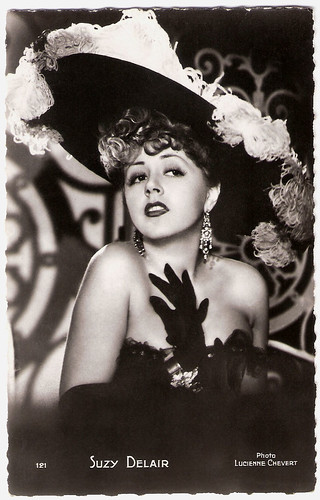
French postcard by Editions P.I., offered by Les Carbones Korès, no. 121. Photo: Lucienne Chevert. Suzy Delair in Quai des Orfèvres (Henri-Georges Clouzot, 1947).

German postcard by Ufa (Universum-Film Aktiengesellschaft), Berlin-Tempelhof, no. FK 658. Retail price: 25 Pfg. Photo: Sam Lévin, Paris. Yves Montand in Le salaire de la peur / The Wages of Fear (Henri-Georges Clouzot, 1953).

French postcard by Photomania, Paris, no. GRA 348. Photo: Collection Reporters Associés - Gamma. Charles Vanel and Yves Montand during the shooting of La salaire de la peur / Wages of Fear (Henri Georges Clouzot, 1953).

Dutch postcard by Uitg. Takken, Utrecht, no. AX 4522. Brigitte Bardot and Sami Frey in La vérité / The Truth (Henri-Georges Clouzot, 1960).

Dutch-Belgian postcard by ABC Distribution (Belgium), Cinemien (The Netherlands) and Lobster Films. Romy Schneider in L’Enfer / Inferno (Henri-Georges Clouzot, 1964). The film was never finished, but scenes were used in the documentary L'Enfer d'Henri-Georges Clouzot / Henri-Georges Clouzot's Inferno (Serge Bromberg, Ruxana Medrea, 2009).

Private photo. Lobby cards for La Prisonnière / Woman in Chains (1968) at the Exposition Clouzot, Cinémathèque Française, 2017.
Beating Hitchcock by just a few hours
Back in France, Henri-Georges Clouzot started his own production company called Véra Films, named after his wife. He was offered a script written by Georges Arnaud, an expatriate living in South America who had written about his own experiences there. Clouzot started writing the film, Le salaire de la peur, with his brother, Jean Clouzot, who would collaborate with him on all his subsequent films under the name of Jérôme Geronimi. In a South American town, four desperate men are offered money to drive trucks carrying nitroglycerin through rough terrain to put out an oil well fire. Le salaire de la peur / The Wages of Fear (1955) stars Yves Montand and Charles Vanel. The sole female role in the film is played by Véra Clouzot. Clouzot wrote the role specifically for his wife, as the character does not exist in the original novel. Le salaire de la peur was the second most successful film in France in 1953 and won the award for best film at the Cannes Film Festival. For his next film, Les Diaboliques / Devilish (1955), Clouzot bought a film script by Pierre Boileau and Thomas Narcejac that Alfred Hitchcock was also interested in, reportedly beating him with a margin of just a few hours. Les Diaboliques involves the story of a cruel headmaster (Paul Meurisse) who brutalises his wife (Véra Clouzot) and his mistress (Simone Signoret). The two women plot to murder him and dump his body in a swimming pool, but when the pool is drained, no corpse is found. This film won the Louis Delluc Prize and the New York Film Critics Circle Award for best foreign film.
Both films brought Clouzot international fame. Clouzot specialised in thrillers. Hitchcock considered Clouzot a very serious rival for the title of Master of Suspense. Nearly all his films contain elements of betrayal, deception and violent death. Clouzot based many of his films on existing works, but was known for regularly making drastic changes to the original story. In the screenplays he wrote himself, Clouzot regularly included characters with corrupt or cowardly personalities, who were capable of both good and bad deeds. He was also successful with a completely different film. His documentary Le mystère Picasso / The Mystery of Picasso (1956) won the Special Jury Prize at the 1956 Cannes Film Festival. The film follows Picasso drawing or painting 15 different works, all of which were intentionally destroyed following the film's production. In 1984, it was declared a national treasure by the government of France. Clouzot's next feature film was the mystery Les Espions / The Spies (1957), featuring actors from around the world, including Curd Jürgens, Sam Jaffe, Peter Ustinov and the young Patrick Dewaere. Les Espions would be the last acting role for Clouzot's wife Véra, who had been suffering from severe heart problems since filming Les Diaboliques. Clouzot's next film, La Vérité / The Truth (1960), featured Brigitte Bardot as Dominique Marceau, who is on trial for the murder of her former boyfriend Gilbert Tellier (Sami Frey). As her trial progresses, the relationship between Dominique and Gilbert becomes more finely shaped. Bardot later described La Vérité as her favourite of all her films. With 5.7 million spectators in France, it was Bardot's highest-grossing film, and it was nominated for the Academy Award for Best Foreign Language Film.
Although Clouzot gained international recognition with his films, his popularity in France began to decline with the emergence of the new film style known as the Nouvelle Vague. Directors and producers who adhered to this new style refused to take Clouzot's thrillers seriously any longer. In the 1960s, Clouzot's health began to decline. He fell ill during the production of L'Enfer / Inferno (1964). The film depicts the extreme jealousy of a hotelier, Marcel (Serge Reggiani, then 42 years old), towards his wife, Odette (Romy Schneider, then 26 years old). It was shot partly in black-and-white, partly in colour. The film was never completed. Between 1965 and 1967, Clouzot filmed five documentaries about Herbert von Karajan for French television. In September 1967, Clouzot began work on his last film, La Prisonnière / Woman in Chains (1968) , about a woman (Elisabeth Wiener) who is introduced to a photographer (Laurent Terzieff) who takes masochistic, submissive pictures of young women. The woman volunteers herself as a model for these pictures and is surprised at her own pleasure in the activity. Production was delayed when Clouzot had to be hospitalised until April 1968. In the 1970s, Clouzot wrote several more film scripts, but these were never made into films.
In the 1930s, Henri-Georges Clouzot met Suzy Delair during a cabaret performance. They had a relationship for 12 years. Clouzot cast Delair in two of his films: L'assassin habite au 21 (1942) and Quai des Orfèvres (1947). Clouzot was very demanding of his actors and often had heated exchanges with them to get them in the right mood for the role. Delair admitted that Clouzot sometimes even hit her, but she did not make a big deal of it because he did the same to other actors. Through actor Léo Lapara, Clouzot met his first wife, Véra Gibson-Amado. The two married in 1950. Véra Clouzot died of a heart attack after filming La Vérité. Her death plunged Clouzot into depression. Clouzot's second wife was Inès de Gonzalez, whom he married in 1963. Clouzot's health deteriorated rapidly in the last years of his life. In 1976, he underwent open-heart surgery. Clouzot died in 1977 in his flat in Paris and was buried next to Véra in the Cimetière de Montmartre. He was 69.
Some 30 years later, Inès de Gonzalez was caught for two hours in a stalled elevator with a man who turned out to be filmmaker Serge Bromberg. Upon learning of the existence of 185 reels (15 hours) of the legendary lost film L'Enfer, Bromberg convinced Gonzalez to release the footage to make a documentary about it. L'Enfer d'Henri-Georges Clouzot / Henri-Georges Clouzot's Inferno (Serge Bromberg, Ruxandra Medrea, 2009) includes interviews with nine cast and crew members, notably Catherine Allégret, the production assistant from 1964, Costa Gavras, and the assistant cinematographer William Lubtchansky. The film received the César Award in 2010 for Best Documentary.

French poster postcard by Editions F. Nugeron, no. E 45. Affiche: Continental Films / J.L. Goossens, Paris. Pierre Fresnay and Suzy Delair in L'assassin habite au 21 / The Murderer Lives at Number 21 (Henri-Georges Clouzot, 1942).

French poster postcard by Editions ZREIK, Paris in the Collection Télérama, la mémoire du cinéma, no. 114. Pierre Fresnay and Ginette Leclerc in Le Corbeau / The Raven (Henri-Georges Clouzot, 1943). Caption: A police film inspired by a news item, produced and distributed during the Occupation (by the German company “Continentale” (sic)), was banned after the Liberation.

French poster postcard, no. E 263. Pierre Fresnay and Ginette Leclerc in Le Corbeau / The Raven (Henri-Georges Clouzot, 1943).

French poster postcard by Editions F. Nugeron, no. E40. Affiche: Pigeot / Majestic. Louis Jouvet and Suzy Delair in Quai des Orfèvres / Goldsmiths' Quay (Henri-Georges Clouzot, 1947).

Private photo. Dutch film poster by Ad Werner for Manon (Henri-Georges Clouzot, 1949). Pictured is Cecile Aubry.

French poster postcard by Editions F. Nugeron, no. E38. Charles Vanel, Yves Montand and Véra Clouzot in Le salaire de la peur / The Wages of Fear (Henri-Georges Clouzot, 1953).

Private photo. Dutch film poster by Ad Werner voor Les diaboliques (Henri-Georges Clouzot, 1955). Caption: Save the secret of Les diaboliques.

British poster postcard by Pyramid, Leicester, no. PC 8512, 1999. Image: Cinedis / FilmSonor. French affiche for Les Diaboliques / Devilish (Henri-Georges Clouzot, 1955).

French poster postcard by Editions ZREIK, Paris, in the Collection Télérama, la mémoire du cinéma, no. 180. French affiche for Les Diaboliques / Devilish (Henri-Georges Clouzot, 1955). Caption: Crime film. A specialist in French Film Noir, Clouzot punctuates this adaptation of Thomas Narcejac and Pierre Boileau's novel with thrilling scenes, rich in suspense and twists and turns.

French poster postcard in the Encyclopédie du Cinéma series by Carterie Artistique et Cinématographique, Pont du Casse, no. EDC 270 VI 3. Image: Filmsonor. French affiche for Les Diaboliques / Devilish (Henri-Georges Clouzot, 1955).

French poster postcard in the Encyclopédie du Cinéma series by Carterie Artistique et Cinématographique, Pont du Casse, no. EDC 2764 VIS01 IT R.01. Image: Cineriz. Italian poster for Les Diaboliques / Devilish (Henri-Georges Clouzot, 1955).

French poster postcard in the Encyclopédie du Cinéma series by Carterie Artistique et Cinématographique, Pont du Casse, no. EDC 2595 VIS 01 FR R.01. Image: Maurice Sinet (Siné). French affiche for Les Espions / The Spies (Henri-Georges Clouzot, 1957).

French poster postcard in the Encyclopédie du Cinéma series by Carterie Artistique et Cinématographique, Pont du Casse, no. EDC 2594 VIS 02 FR R.01 3. Image: Maurice Sinet (Siné). French affiche for Les Espions / The Spies (Henri-Georges Clouzot, 1957).
Sources: Michael Brooke (IMDb), Wikipedia (Dutch and English) and IMDb.
No comments:
Post a Comment