
German postcard by Ross Verlag, no. 363/1, 1919-1924. Photo: Frieda Riess.
Grit Hegesa (1891–1972) was a German dancer and silent film actress. She appeared in seventeen films, including Ewald André Dupont's crime film Whitechapel (1920).

German postcard by Ross Verlag, no. 2991/1, 1928-1929. Photo: Paramount Pictures.
Ruth Taylor (1905-1984) was an American silent film and early talkie actress of the late 1920s. The vivacious blond Mack Sennett comedienne nabbed the most sought-after role in 1928, Lorelei Lee, in the silent film version of Anita Loos' Gentlemen Prefer Blondes. Her son was the writer, comic, and actor Buck Henry.

German postcard by Ross Verlag, no. 4944/2, 1929-1930. Photo: Defina / First National.
American actress Colleen Moore (1899-1988) was a star of the silent screen who appeared in about 100 films beginning in 1917. During the 1920s, she put her stamp on American social history, creating in dozens of films the image of the wide-eyed, insouciant flapper with her bobbed hair and short skirts.

German postcard by Ross Verlag, no. 4978/3, 1929-1930. Photo: Paramount.
Red-haired, cupid-bow-mouthed Nancy Carroll (1903-1965) became a very popular Hollywood star upon the advent of sound film, thanks to her singing and dancing. She was reported to have received more fan mail than any of her Hollywood peers of the same era. As she expanded her acting range from a flaming flapper to a ditzy comedienne to a sensitive heroine, she was nominated for an Oscar for The Devil's Holiday (1930).
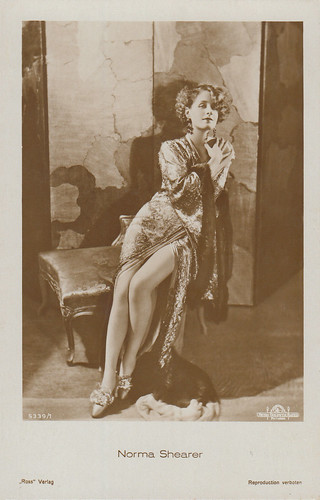
German postcard by Ross Verlag, no. 5339/1, 1930-1931. Photo: George Hurrell / Metro-Goldwyn-Mayer. Norma Shearer in Let Us Be Gay (Robert Z. Leonard, 1930). Collection: Marlene Pilaete.
American actress Norma Shearer (1902-1983) was the 'First Lady of MGM'. She often played spunky, sexually liberated ingenues and was the first person to be nominated five times for an Academy Award for acting. Shearer won the Best Actress Oscar for The Divorcee (1930).
A modern design movement for a mass audience
In 1925, Art Deco (an abbreviation of arts décoratifs) made its debut on the world stage at the L’exposition internationale des arts décoratifs et industiels modernes (International Exhibition of Modern Decorative and Industrial Arts)s, which was held in Paris from April to October. This exposition highlighted the new style of art, architecture, and design that was emerging throughout the world. The event only exhibited new, modern design. No historical revival styles were permitted. 15,000 exhibitors from 20 countries were present. More than 16 million visitors flocked to see new styles of architecture, sculpture, fashion, and decoration that consciously eschewed 19th-century influences.
There were two philosophical camps at the 1925 Paris Exposition. Decorative artists such as Lalique, Cartier and Ruhlmann whose work required wealthy patrons. Their work used expensive, exotic and rare materials employing traditional craftsmanship, but expressed in entirely new ways and forms. Their work represented luxury, glamour, and exuberance. The other camp was the modernists, who instead preferred machine-made objects without ornaments. These included the architects LeCorbusier, Melnikov, and others of the Bauhaus School. They believed that buildings should be 'machines for living' and that the objects in them should be available to everyone. Relations between the two camps were not cordial. Walter Gropius later blasted the ‘imitators who prostituted our fundamental precepts into modish trivialities’. Nikolaus Pevsner lamented the influence of the 1925 Paris Exposition’s ‘inexhaustible source of sham splendour’, with its ‘freakish angular details’, ‘sickening decoration’ and ‘infections of pseudo-cubism’.
The Art Deco style had first appeared in France just before the First World War, but saw its full expression after 1925. Like any design style, Art Deco fits in the continuum of art history, with antecedents and successors that it helped inform. The Arts and Crafts Movement, Cubism, and the Vienna Secession all influenced its beginnings. From the outset, Art Deco was influenced by the bright colours of Fauvism and the Ballets Russes, and the exoticised styles of art from China, Japan, India, Persia, ancient Egypt, and the Maya. In its time, Art Deco was tagged with other names such as style moderne, Moderne, modernistic, or style contemporain, and it was not recognised as a distinct and homogeneous style. Art Deco was a way to translate the ideas of the modern movement for a mass audience and came to epitomise the spirit of the Jazz Age. Since ordinary people were not generally to be found on transatlantic cruise ships or hanging out in the lobbies of grand hotels, their principal exposure to the aesthetic was the cinema.
During the exposition, a silent film was lauded for its modern design: the French Sci-Fi drama L’inhumaine (Marcel L’Herbier, 1924). Director Marcel L'Herbier drew the various applied and fine arts together and created a visual feast of modern art. Paul Poiret designed the costumes, Fernand Léger created the laboratory set, René Lalique supplied artwork for the interiors and architect Robert Mallet-Stevens designed the sets. All of L’Herbier’s collaborators figured prominently at the 1925 Paris Exposition as they were important artistic contributors of their era. L’Herbier also cast other artistic luminaries of the period in a 2,000-person mob scene. Reportedly, Pablo Picasso, James Joyce, Erik Satie, Man Ray and Ezra Pound are in the crowd. The film premiered at the Madeleine Theatre in Paris in November 1924, six months before the Exposition.
After 1925, Art Deco flourished as a style of visual arts, architecture, and product design internationally. Compared to the Bauhaus style, Art Deco was more commercial rather than conceptual. Form followed fashion as much as function. During its heyday till the early 1930s, Art Deco represented luxury, glamour, exuberance, and faith in social and technological progress. The movement featured rare and expensive materials such as ebony and ivory, and exquisite craftsmanship. It also introduced new materials such as chrome plating, stainless steel, and plastic. In New York, the Empire State Building, Chrysler Building, and other buildings from the 1920s and 1930s are monuments to the style. The largest concentration of Art Deco architecture in the world is in Miami Beach, Florida. Art Deco has influenced skyscrapers, bridges, ocean liners, trains, cars, trucks, buses, but also furniture, fashion and everyday objects, including radios and vacuum cleaners. On the silver screen, it influenced the geometric glamour of set designs for musicals and screwball comedies, but crucially, it surrounded the screen as well, in the form and decoration of the movie palaces.

German postcard by Verlag Ross, Berlin, no. 363/2, 1919-1924. Photo: Frieda Riess. Collection: Geoffrey Donaldson Institute.
Grit Hegesa (1891-1972) was a German dancer and silent film actress. She appeared in seventeen films, including Ewald André Dupont's crime film Whitechapel (1920).

German postcard by Ross Verlag, no. 3807/1, 1928-1929. Photo: Paramount. Louise Brooks holding two stuffed toys from the period – Dismal Desmond and Bonzo. Collection: Jean Ritsema / Ross Verlag Movie Star Postcards.
Legendary American dancer and actress Louise Brooks (1906-1985) set the trend of the bobbed haircut and personified the flapper, the rebellious young woman of the 1920s. She played the lead in three European silent film classics: Die Büchse der Pandora / Pandora's Box (1929), Tagebuch einer Verlorenen / Diary of a Lost Girl (1929), and Prix de Beauté / Miss Europe (1930).

German postcard by Ross Verlag, Berlin, no. 3813/1, 1928-1929. Photo: Paramount.
Projected as wholesome but fun-loving, Maine-born leading lady Esther Ralston (1902-1994) enjoyed a prime silent age career. She appeared in close to 100 films over a nearly 30-year period. At her peak, she was packaged and publicised as 'The American Venus' by Florenz Ziegfeld Jr. after appearing as a dazzling beauty queen in the film The American Venus (1926). A decade later, the blonde beauty's career, however, had tapered off.

German postcard by Ross Verlag, no. 3859/1, 1928-1929. Photo: Metro-Goldwyn-Mayer. Collection: Didier Hanson.
At 17, Austrian actress Eva von Berne (1910-2010) was spotted in Vienna by MGM's second in command, Irving Thalberg and introduced in Hollywood as 'the next Garbo'. However, she was not. After playing the ingénue in the apparently lost silent drama The Masks of the Devil (1928), directed by Victor Sjöström, she returned to Europe. Here she made a few more films. At 20, Eva von Berne was dead for Hollywood, but she lived happily for 80 more years.

German postcard by Ross Verlag, Berlin, no. 3780/2, 1928-1929. Photo: Metro-Goldwyn-Mayer.
American actress Norma Shearer (1902-1983) was the 'First Lady of MGM'. She often played spunky, sexually liberated ingenues and was the first person to be nominated five times for an Academy Award for acting. Shearer won the Best Actress Oscar for The Divorcee (1930).

German postcard by Ross Verlag, no. 3802/1, 1928-1929. Photo: Paramount Pictures.
Ruth Taylor (1905-1984) was an American silent film and early talkie actress of the late 1920s. The vivacious blond Mack Sennett comedienne nabbed the most sought-after role in 1928, Lorelei Lee, in the silent film version of Anita Loos' Gentlemen Prefer Blondes. Her son was the writer, comic, and actor Buck Henry.

German postcard by Ross Verlag, no. 4002/1, 1929-1930. Photo: Paramount.
American actor Richard Arlen (1899-1976) was a handsome Hollywood star of the late 1920s and early 1930s.

German postcard by Ross Verlag, no. 4128/1, 1929-1930. Photo: Paramount.
Russian actress Olga Baclanova (1896-1974) achieved prominence during the silent film era and was billed as the ‘Russian Tigress’. The statuesque blonde is best known now as the trapeze artist Cleopatra in the horror classic Freaks (Tod Browning, 1932), which also features a cast of actual carnival sideshow performers.

German postcard by Ross Verlag, no. 4327/1, 1929-1930. Photo: Paramount.
Lupe Velez (1908-1944) was one of the first Mexican actresses to succeed in Hollywood. Her nicknames were 'The Mexican Spitfire' and 'Hot Pepper'. She was the leading lady in such silent films as The Gaucho (1927), Lady of the Pavements (1928), and Wolf Song (1929). During the 1930s, her well-known explosive screen persona was exploited in a series of successful films like Hot Pepper (1933), Strictly Dynamite (1934), and Hollywood Party (1934). In the 1940s, Vélez's popularity peaked after appearing in the Mexican Spitfire films, a series created to capitalise on Vélez's well-documented fiery personality. She had several highly publicised romances and a stormy marriage. In 1944, Vélez died of an intentional overdose of the barbiturate drug Seconal. Her death and the circumstances surrounding it have been the subject of speculation and controversy.
Our dancing daughters
In 1925, hundreds of American architects, designers, department store buyers, artists and patrons of the arts came to the Paris Exposition. One of the many visitors enraptured by the striking line work, stark colours, and complex geometric designs of Art Deco was Cedric Gibbons. In 1928, the up-and-coming film designer brought Art Deco to American cinemas with his work on the film Our Dancing Daughters (Harry Beaumont, 1928), starring Joan Crawford, Dorothy Sebastian and Anita Page. The look of the film would proliferate through both cinema and society from there. Today, everybody still knows his work. Gibbons was, for example, the designer of the Oscar statuette. Our Dancing Daughters was only one of more than 15 films he’s credited on as art director in 1928 alone. Gibbons would amass more than 1,500 credits over his nearly four-decade career. His work illustrates the dizzying pace of industrial film production during Hollywood’s golden age.
Beyond being Art Deco’s American film debut, Our Dancing Daughters (1928) was also the breakout role for Joan Crawford as the most notable dancing daughter. The film does not feature spoken dialogue but does have a synchronised soundtrack, making it an early novelty of the burgeoning sound era. The music makes the characters’ partying lifestyle much more vivid and immediate. The film was formative in the image of the flapper. Our Dancing Daughters was a hit, and other studios scrambled to capture the new look of Art Deco. Soon, reality would race to reflect art. Gibbons’s rich clients asked for exact duplications of the settings he had created for the screen. He received requests from newlyweds and engaged couples for blueprints of the dream houses seen at their local movie palace. Movie stars used set designers as interior decorators for their own mansions. Ramon Novarro had Gibbons furnish his Lloyd Wright-designed house in black fur and silver.
From 1920 to 1940, 1 million people moved to Los Angeles. These people needed a place to live, work, shop, and go to the cinema. Architects could hardly keep up. Art Deco buildings began to appear in LA in the late 1920s during a period of considerable business expansion caused by population growth. The earliest buildings were mostly 'zigzag' in style, but soon the stock market crash and the lingering depression caused this exuberant version of the style to give way to the more restrained 'Streamline' and 'WPA Moderne'. After the war, the architectural profession was looking in a completely new direction, and the period of Art Deco was over. Art Deco became more subdued during the Great Depression. A sleeker form of the style appeared in the 1930s called 'Streamline Moderne', featuring curving forms and smooth, polished surfaces.
Art Deco fizzled out after the outbreak of the Second World War. In the 1950s, it lost its dominance to the functional and unadorned styles of modern architecture and the International Style. For years, it was definitely out of vogue. The swinging sixties saw a revival of Art Deco and gave the style its name. Since it encompasses architecture, fashion, interior design, transportation, advertising and more, and since it infiltrated even the most mundane of home appliances such as the toaster and the coffeemaker, it's hard to nail Art Deco down. But it is unmistakable when you see it and easy to recognise once you have seen a few examples. Art Deco left a powerful mark on cinema. The style transformed the way audiences experienced film. It emphasised modernity, glamour, and spectacle, which aligned perfectly with the cultural spirit of the 1920s and the booming movie palaces.
Art Deco cinemas are probably the most enduring type of the old Art Deco buildings. Characterised by bold geometric patterns, lavish ornamentation, dramatic lighting, and the use of luxurious materials such as marble, brass, and glass, Art Deco theatres created an atmosphere of sophistication and escapism. Those movie palaces could be built because film was the most popular form of entertainment during these decades. In New York, the Roxy theatre was built in 1927 to accommodate 6,200 film-goers. It was the greatest cinema in the world until the Radio City Music Hall opened in 1932. In Amsterdam, the Royal Theatre Tuschinski opened in 1921. The cinema, designed by H.L. De Jong in an elaborate Art Deco style, is now a listed building. Inside, the lobby has been beautifully preserved. The decoration was designed by J. Gidding and features colourful ceiling and wall paintings, carpeting with a peacock motif, and wood carvings and decorative ironwork. All over the world, there are still these old cinemas to remind us of the age of the silent film and the first sound films. These cinemas were not just places to watch films. They were immersive environments that elevated entertainment into an event. They symbolised the optimism, luxury, and modernity of the Art Deco age.

German postcard by Ross Verlag, no. 4673/1, 1929-1930. Photo: Paramount.
Mary Brian (1906-2002) was an American actress and film star with dark brown curls and blue/grey eyes who made the transition from silent films to sound films. She was dubbed 'The Sweetest Girl in Pictures.'

German postcard by Ross Verlag, no. 4708/1, 1929-1930. Photo: Metro-Goldwyn-Mayer.
Beautiful Anita Page (1910–2008) was one of the most popular leading ladies of Hollywood during the last years of the silent screen and the first years of the sound era. According to MGM, she received the most fan mail at the time, and her nickname was "the girl with the most beautiful face in Hollywood".
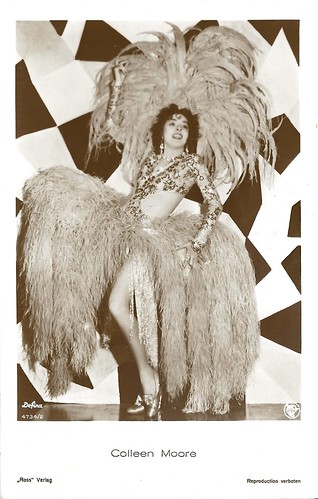
German postcard by Ross Verlag, no. 4734/2, 1929-1930. Photo: Defina / First National.
American actress Colleen Moore (1899-1988) was a star of the silent screen who appeared in about 100 films beginning in 1917. During the 1920s, she put her stamp on American social history, creating in dozens of films the image of the wide-eyed, insouciant flapper with her bobbed hair and short skirts.

German postcard by Ross Verlag, no. 4904/1, 1929-1930. Photo: Ruth Harriet Louise / Metro-Goldwyn-Mayer.
Josephine Dunn (1906-1983) was an American film actress of the 1920s and 1930s.
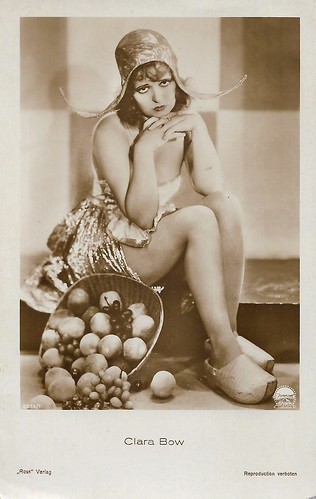
German postcard by Ross Verlag Berlin, no. 5393/1, 1930-1931. Photo: Paramount.
American actress Clara Bow (1905-1965) rose to stardom as an uninhibited flapper in silent films during the 1920s. Her appearance as a plucky shopgirl in the film It (1927) brought her global fame and the nickname 'The It Girl'. Bow came to personify the Roaring Twenties and is described as its leading sex symbol.

German postcard by Ross Verlag, no. 5395/2, 1930-1931, distributed in Italy by Casa Editrice Ballerini & Fratini, Firenze (125). Photo: Paramount.
Red-haired, cupid-bow-mouthed Nancy Carroll (1903-1965) became a very popular Hollywood star upon the advent of sound film, thanks to her singing and dancing. She was reported to have received more fan mail than any of her Hollywood peers of the same era. As she expanded her acting range from a flaming flapper to a ditzy comedienne to a sensitive heroine, she was nominated for an Oscar for The Devil's Holiday (1930).

German postcard by Ross Verlag, no. 5621/2, 1930-1931. Photo: Metro-Goldwyn-Mayer.
Dorothy Jordan (1906-1988) was an American film actress who emerged as an actress at the start of the talkies.
Sources: Dan Schindel (Hyperallergic), Stephen Patience (Apollo), Art Deco Society of Los Angeles, Decolish.com, Decorative Cities, Wikipedia and IMDb.
No comments:
Post a Comment