
American postcard by Fotofolio, NY, NY, no. 2214. Photo: Philippe Halsman, 1959. Marilyn Monroe.

French postcard. Photo: Philippe Halsman / Magnum. Caption: The American jazzman Louis Armstrong, photographed in 1966.
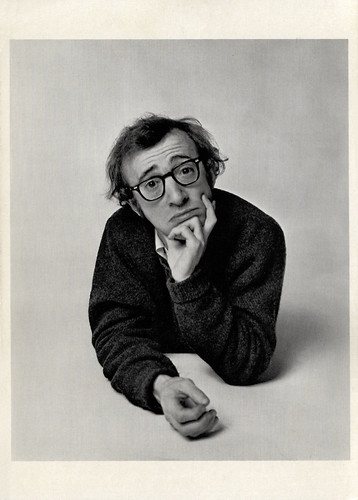
American postcard by Fotofolio, New York, N.Y. Photo: Philippe Halsman, 1969. Woody Allen.
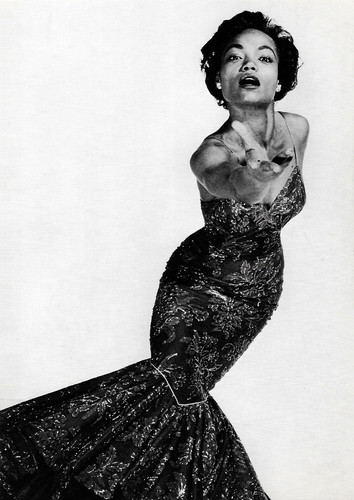
American postcard by Fotofolio, New York, no. PH50. Photo: Philippe Halsman. Caption: Eartha Kitt, 1954.

Australian freecard by AvantCard postcard, no. 16219. Photo: Philippe Halsman. This card promoted the exhibition 'Grace Kelly - Style Icon' in the Bendigo Art Gallery in 2012.
Accused of murdering his father
Philippe Halsman was born Filips Halsmans in Riga, in the part of the Russian Empire which later became Latvia, in 1906 to Jewish parents. His father, Morduch (Maks) Halsman, was a dentist, and his mother, Ita Grintuch, was a secondary school headmistress. Halsmans became familiar with art during visits to major European museums in his youth. He was already particularly interested in portraits. At the age of fifteen, his passion for photography began thanks to a family camera. From 1924, he studied electrical engineering in Dresden, Germany and worked part-time as a freelance photographer for Ullstein Verlag.
On 10 September 1928, whilst staying in Tyrol, the 22-year-old Halsmans went on a mountain hike with his father to the Schwarzenstein in the Zillertal Alps. During this hike, his father lost his life under circumstances that remain unclear to this day. There were no witnesses, and the evidence pointed to a violent death. Philippe was arrested immediately, although there were no apparent motives on his part. The murder trial in Innsbruck caused a sensation throughout Europe. Various anti-Semitic remarks were made in the context of the trial. Despite his protests of innocence, Halsmans was sentenced by a jury court in Innsbruck to ten years’ imprisonment, despite a complete lack of evidence. In an appeal, he was eventually sentenced to four years’ imprisonment. The trial reflected the prevailing anti-Semitism in rural Austria between the two world wars
His sister Liouba, friends and lawyers campaigned for his release, receiving support from Thomas Mann and various European Jewish intellectuals, including Sigmund Freud, Albert Einstein, and Jakob Wassermann, who confirmed his innocence. Reporters Heinrich Eduard Jacob (Berliner Tageblatt, Vienna), Emil Kläger (Neue Freie Presse, Vienna) and Rudolf Olden championed Halsman’s cause by publishing several brilliantly researched articles critical of the judiciary. At that time, a fierce battle raged between psychiatry and the relatively young discipline of psychology. Freud’s theory of the Oedipus complex was debated and expressly ruled out by Freud in newspaper articles, specifically in relation to this case.
Halsmans spent two years in prison, where he contracted tuberculosis. His letters from prison were published as a book in 1930: 'Briefe aus der Haft an eine Freundin'. He was pardoned by the President of Austria, Wilhelm Miklas, and released in October 1930, on the condition that he would leave Austria for good. He moved to France. In 1931, Halsmans left Austria and moved to France to live with his sister. In Paris, he finally turned his childhood hobby, photography, into his profession and opened a photography studio in 1931. He started to call himself Philippe Halsman. Alongside this, he studied at the Sorbonne. He began taking photographs for fashion magazines such as Vogue and quickly gained a reputation as one of France’s finest portrait photographers.
In 1934, the photographer took his first celebrity portrait of André Gide and went on to specialise in this field, photographing Paul Valéry, Jean Giraudoux, Jean Cocteau, André Malraux, Marc Chagall and Le Corbusier. Philippe Halsman became known for his sharp images, in contrast to the soft-focus style often used at the time, and for his close-cropped shots. In 1936, after two years of working together, he married the photographer Yvonne Moser. He commented on the marriage: “I often advise young photographers to marry their rivals. It’s the best way to neutralise them." They would collaborate throughout their lives. They had two children: Irene (born in 1939 in Paris) and Jane (born in 1941 in New York). When Nazi Germany invaded France, Halsman's family fled to Marseille. Eventually, they managed to obtain American visas, with the help of family friend Albert Einstein, whom Halsman famously photographed later in 1947, and the Emergency Rescue Committee.
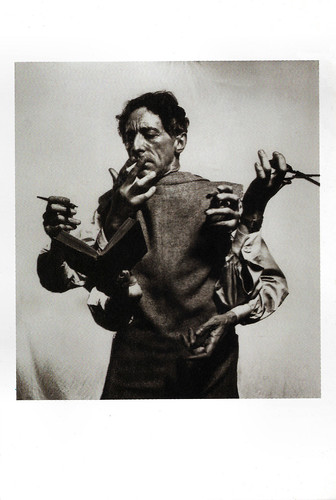
French postcard. Photo montage: Philippe Halsman / Magnum Photos. Caption: The French writer Jean Cocteau in a photographic montage by Philippe Halsman.

American postcard by Fotofolio, NY, NY, no. PH6. Photo: Philippe Halsman. Caption: Salvador Dali, In Voluptate Mors, 1944.
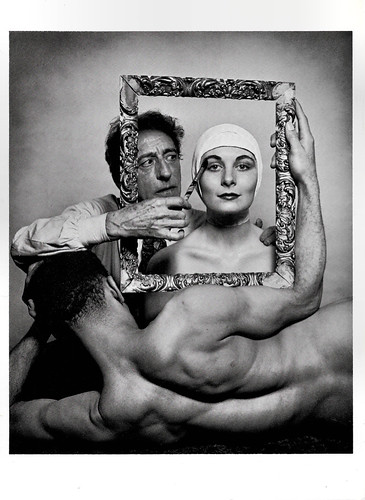
French postcard by Fotofolio, N.Y., N.Y, no. PH8. Photo: Philippe Halsman, 1949. Caption: The Act of Creation. Jean Cocteau, actress Ricki Soma (wife of John Huston and mother of Anjelica) and dancer Leo Coleman.

American postcard by Fotofolio, NY, NY, no. PH2. Photo: Philippe Halsman. Caption: Choreographers George Balanchine, Jerome Robbins, Ruthanna Boris, Anthony Tudor and Todd Bolender, 1951.

American postcard by Fotofolio, New York, N.Y., no. PH 18, 1981. Photo: Philippe Halsman, 1962 / Hastings Galleries Collection. Alfred Hitchcock on the set of The Birds (1963).
Dali's moustache
Philippe Halsman achieved his first success in America when the cosmetics company Elizabeth Arden used his image of model Constance Ford against the American flag in an advertising campaign for the ‘Victory Red’ lipstick. Just one year later, he secured a permanent position at Life magazine, the pinnacle of photojournalism at the time. He first photographed hat designs. A portrait of a model wearing a Lilly Daché hat was the first of his 103 covers for Life, more than by any other photographer. In 1945, Halsman was appointed president of the American Society of Magazine Photographers.
In 1941, Philippe Halsman met the Surrealist artist Salvador Dalí at the Julien Levy Gallery in New York, where the painter was exhibiting. In the late 1940s, they began working together. In his 1948 work 'Dalí Atomicus', he explored the idea of suspension. It depicts three flying cats, a bucket of water and Dalí in mid-air. Halsman and Dalí eventually published an overview of their collaboration in 1954 in the book 'Dali’s Moustache', which contains 36 different depictions of the artist’s characteristic moustache.
Another well-known collaboration between the two was the work 'In Voluptas Mors', a surrealist portrait of Dalí alongside a tableau vivant of seven naked women posing in the shape of a large skull. It took Halsman three hours to arrange the models according to a sketch by Dalí. Over the years, various reinterpretations of and allusions to 'In Voluptas Mors' have appeared; the best known is the version subtly used on the poster for the film The Silence of the Lambs (Jonathan Demme, 1991), whilst an overt reinterpretation appeared on a promotional poster for the British Horror film The Descent (Neil Marshall, 2005).
The photographer remained friends with Salvador Dalí throughout his life and worked with the artist for over 30 years, with the surrealist influence in Philippe Halsman’s photographs being unmistakable.
In 1947, Halsman photographed a grief-stricken Albert Einstein, who, during the session, expressed regret over his role in the American race for nuclear weapons. This became one of Halsman’s most famous photographs. The photograph was used on a US postage stamp in 1966 and on the cover of Time Magazine in 1999, in which Einstein was named ‘Person of the Century’.

American postcard by Fotofolio, NY, NY, no. PH17. Photo: Philippe Halsman. Caption: Humphrey Bogart, 1944.

American postcard by Fotofolio, NY, NY, no. PH38. Photo: Philippe Halsman. Caption: Marlon Brando, 1950.

American postcard by Fotofolio, NY, NY, no. PH7. Photo: Philippe Halsman. Caption: Marilyn Monroe, 1952.

American postcard by Fotofolio, NY, NY, no. PH29. Photo: Philippe Halsman. Caption: William Holden, 1954.

American postcard by Fotofolio, NY, NY, no. PH26, 1983. Photo: Philippe Halsman. Caption: Anthony Perkins, 1956.
Jumpology
In 1951, the founders of Magnum Photos invited Philippe Halsman to join the agency as a ‘contributing member’. That year, NBC commissioned him to photograph several popular comedians of the time, including Milton Berle, Sid Caesar, Groucho Marx and Bob Hope. He photographed the comedians whilst they were performing their acts, and many were photographed whilst jumping into the air. This later inspired many jump shots of celebrities, including the Ford family, the Duke and Duchess of Windsor, Marilyn Monroe, María Félix and Richard Nixon.
Philippe Halsman asked his subjects to jump off the ground for the portrait, and captured them at the moment of the jump. In the pictures, they appear to be floating. Halsman: “When you ask someone to jump, their attention focuses primarily on the act of jumping and the masks fall away, so that the real person appears.” The photographer developed a philosophy around jump photography, which he called 'jumpology'. In 1959, he published 'Philippe Halsman’s Jump Book', which contained a humorous discussion of jumpology and 178 photographs of famous jumpers.
In his 1961 book 'Halsman on the Creation of Photographic Ideas', he discussed ways in which photographers could produce unusual works by following six rules:
1. The rule of the direct approach: you get a strong photograph if you are straightforward and simple.
2. The rule of the unusual technique: to make an everyday and uninteresting subject interesting and unusual, there are several photographic techniques, including unusual lighting, unusual angles, and unusual compositions.
3. The rule of the added unusual feature: capture the audience’s attention through something unexpected. This can be achieved by introducing an unusual feature or prop into the photograph. For instance, Diane Arbus’s photograph of a young boy holding a hand grenade.
4. The rule of the missing function: stimulate the viewer by defying their expectations.
5. The rule of composite characteristics: combine the other rules to add originality to your photograph.
6. The rule of the literal or ideographic method: convey a message through a photograph by depicting the subject as clearly as possible.
In 1960, during the Cold War, he photographed portraits of the Soviet elite for Life magazine during an extended stay in Russia. Celebrities photographed by Halsman include Alfred Hitchcock and François Truffaut during their 1962 interview, Judy Garland, Winston Churchill, John F. Kennedy, Dorothy Dandridge, Pablo Picasso and Jean Cocteau. Many of these photographs appeared on the cover of Life.
In 1963, Halsman was appointed a member of the Famous Photographers School. His works were exhibited at documenta 6 in Kassel. In 1967, Halsman received the Golden Plate Award from the American Academy of Achievement. In 1975, he received the Life Achievement in Photography Award from the American Society of Magazine Photographers. In 1945, he was elected the first president of this organisation. He also organised many major exhibitions around the world. Philippe Halsman died in 1979 in New York at the age of 73.

American postcard by Fotofolio, NY, NY, no. PH24. Photo: Philippe Halsman. Caption: Mary Martin, 1950.

American postcard by Fotofolio, NY, NY, no. PH22. Photo: Philippe Halsman. Caption: Jimmy Durante, 1951.

American postcard by Fotofolio, NY, NY, no. PH5. Photo: Philippe Halsman. Caption: Richard Nixon jumping, 1956.

American postcard by Fotofolio, NY, NY, no. PH56. Photo: Philippe Halsman. Caption: Maurice Chevalier, 1958.

German postcard by Ufa, Berlin-Tempelhof, no. FK 2270. Photo: Halsman / Imperial-Translux / Herzog-Film. Dawn Addams.
Sources: Wikipedia (Dutch, French and German).
No comments:
Post a Comment