
G.W. Pabst. German cigarette card for Hänsom cigarettes by Jasmatzi Cigarettenfabrik G.M.b.H, Dresden/Ross Verlag, Film Series 4 'Aus tönenden Filmen' (From sound films), no. 510. Photo: Nero Film.

German postcard by Ross Verlag G.m.b.H., Berlin. Photo: Sofar-Film-Produktion. Werner Krauss in Die freudlose Gasse / The Joyless Street (Georg Wilhelm Pabst, 1925).
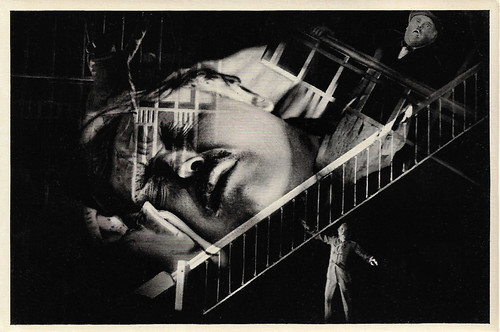
German collectors card by Ross Verlag for the album Vom Werden deutscher Filmkunst. Teil I. Der stumme Film (Cigaretten-Bilderdienst Altona-Bahrenfeld 1935), no. 165. Photo: Ufa. Werner Krauss in Geheimnisse einer Seele / Secrets of a Soul (G.W. Pabst, 1926).

French postcard by Schirmer / Mosel in the series Les Douze de Schirmer, no. 2, Photos de films 1/12, 1990. From the book 'Louise Brooks: Lulu in Berlin'. Louise Brooks and Franz Lederer in Die Büchse der Pandora / Pandora's Box (Georg Wilhelm Pabst, 1929).

German postcard by Ross Verlag, no. 187/2. Photo: Vandor-Nelson Film. Feodor Chaliapin as Don Quichotte and Dorville as Sancho Panza in Don Quichotte / Don Quixote (Georg Wilhelm Pabst, 1933).
An extremely productive period
Georg Wilhelm Pabst or G.W. Pabst was born in the Bohemian town of Raudnitz, Austria-Hungary, today's Roudnice nad Labem, Czech Republic, in 1885. He was the son of a railway clerk. While growing up in Vienna, he studied drama at the Academy of Decorative Arts and initially began his career as a stage actor in Switzerland, Austria and Germany.
In 1910, Pabst travelled to the United States, where he worked as an actor and director at the German Theatre in New York City. In 1914, he decided to become a director, and he returned to recruit actors in Europe. Pabst was in France when World War I began. He was arrested and held as an enemy alien and interned in a prisoner-of-war camp near Brest. While imprisoned, Pabst organised a theatre group at the camp and directed French-language plays.
Upon his release in 1919, he returned to Vienna, where he became director of the Neue Wiener Bühne, an avant-garde theatre. Pabst began his career as a film director at the behest of Carl Froelich, who hired Pabst as an assistant director. He directed his first film, the silent melodrama Der Schatz / The Treasure, in 1923. He directed Henny Porten in the drama Gräfin Donelli / Countess Donelli (1924).
His first major success was the silent drama Die freudlose Gasse / Joyless Street (1925) with Greta Garbo and Asta Nielsen. This socially critical, often censored film marked the beginning of an extremely productive period with numerous artistically valuable and commercially successful films, including such silent films as Geheimnisse einer Seele / Secrets of a Soul (1926) with Werner Krauss and Ruth Weyher, and Die Liebe der Jeanne Ney / The Loves of Jeanne Ney (1927) with Edith Jéhanne and Brigitte Helm.
In Die Büchse der Pandora / Pandora's Box (1928), based on Frank Wedekind's 'Pandora's Box' and 'Earth Spirit', and Tagebuch einer Verlorenen / Diary of a Lost Woman (1929), the lead role was played by American actress Louise Brooks. Together with Arnold Fanck, Pabst also directed the mountain film Die weiße Hölle vom Piz Palü / The White Hell of Pitz Palu (1929) starring Leni Riefenstahl and Gustav Diessl.

German postcard by Ross Verlag, Berlin, no. 695/3. Photo: Maxim Film. Henny Porten and Eberhard Leithoff in Gräfin Donelli / Countess Donelli (G.W. Pabst, 1924).

German postcard by Ross Verlag, no. 1020/1. Photo: Curt Oertel, Berlin. Asta Nielsen in Die freudlose Gasse / Joyless Street (G.W. Pabst, 1925). In 1929, Dutch painter Pyke Koch painted Nielsen's portrait, using one of Oertel's photos. The painting is now at the Centraal Museum, Utrecht. See www.bookspot.nl/images/active/InkijkPDF/cb/9789462582385.pdf. NB Curt Oertel was one of the cinematographers of the film as well.

German postcard by Ross Verlag, no. 1940/1, 1927-1928. Photo: Ufa. Uno Henning in Die Liebe der Jeanne Ney / The Love of Jeanne Ney (G.W. Pabst, 1927).

French postcard by Cinémagazine-Edition, no. 534. Brigitte Helm in Abwege / The Devious Path (Georg Wilhelm Pabst, 1928), presented in France as Crise.

British postcard by Pyramid, no. PC 8238. Louise Brooks in Die Büchse der Pandora / Pandora's Box (Georg Wilhelm Pabst, 1929).
The red Pabst
With the entry of the sound film, Georg Wilhelm Pabst made a trilogy of films that secured his reputation. He achieved international success with the war film Westfront 1918 (1930). Like Lewis Milestone's film All Quiet on the Western Front (1930), the uncompromising anti-war tone of the film led to heated discussions in Germany. His next successes were Die 3-Groschenoper / The Threepenny Opera (1931), based on the Bertolt Brecht and Kurt Weill musical, and the drama Kameradschaft / Comradeship (1931), a French-German co-production concerning a mine disaster where German miners rescue French miners from an underground fire and explosion.
With these films, Pabst placed his work firmly on the left-wing political spectrum and earned the nickname ‘the red Pabst’. Pabst also filmed three versions of Pierre Benoit's novel 'L'Atlantide' in 1932, in German, English, and French, titled Die Herrin von Atlantis, The Mistress of Atlantis, and L'Atlantide, respectively.
In 1933, Pabst directed Don Quixote, once again in German, English, and French versions. At the time the National Socialists seized power, Pabst was filming in France. He decided to stay in France, where he made another film. In the same year, his next stop was Hollywood, where he had little success with A Modern Hero (1934) starring Richard Barthelmess. Then he returned to France to make the Spy film Mademoiselle Docteur / Street of Shadows (1937) starring Pierre Blanchar and Dita Parlo.
When he was visiting his family in Austria in 1939, he was surprised by the start of the Second World War. As he was no longer able to leave the German Reich, he now made films for Bavaria Film under the auspices of the Propaganda Minister, Josef Goebbels. The film biographies Komödianten / The Comedians (1941) and Paracelsus (1943) romanticised historical figures from German history and are typical of the era with their subtle propaganda tendencies.
Leni Riefenstahl asked Pabst to help direct the film Tiefland, as she felt she was Pabst's pupil. However, the collaboration soon ended in a dispute because Riefenstahl had completely different ideas about directing actors. Unfinished remained the drama Der Fall Molander / The Molander Case (1945), based on the novel 'Die Sternegeige' by Alfred Karrasch. On August 28, 1944, Pabst started shooting the film for Terra Film. As shooting was just completed at the Barrandov Studios in Prague and editing had already begun, Prague was liberated by the Red Army, and Pabst was forced to abandon the work. The remaining film is kept at the Národní Filmový Archiv in Prague.

German postcard by Ross Verlag, no. 4485/2, 1929-1930. Photo: Hans Casparius, Berlin. Gustav Diessl in Die weiße Hölle vom Piz Palü / The White Hell of Pitz Palu (Arnold Fanck, G.W. Pabst, 1929).

German postcard by Taschen, from the book 'Leni Riefenstahl five lives' (2000). Photo: Ufa. Leni Riefenstahl as Maria Majoni and Ernst Petersen as Hans Brandt in Die weiße Hölle vom Piz Palü / The White Hell of Piz Palü (Arnold Fanck, G. W. Pabst, 1929).
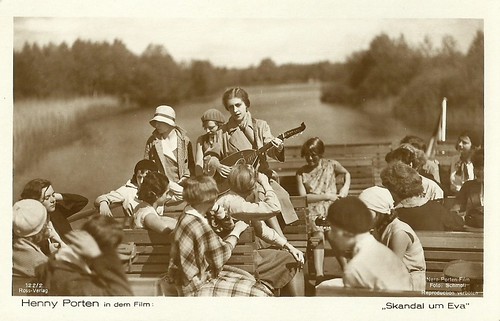
German postcard by Ross Verlag, no. 122/2. Photo: Schmoll / Nero-Porten-Film. Henny Porten in Skandal um Eva / Scandalous Eva (Georg Wilhelm Pabst, 1930).

German cigarette card for Hänsom cigarettes by Jasmatzi Cigarettenfabrik G.M.b.H, Dresden/Ross Verlag, Film Series 4 'Aus tönenden Filmen' (From sound films), no. 663. Photo: Nero-Film. H.J. Möbis and Gustav Diessl in Westfront 1918 (G.W. Pabst, 1930).

German cigarette card for Hänsom cigarettes by Jasmatzi Cigarettenfabrik G.M.b.H, Dresden/Ross Verlag, Film Series 4 'Aus tönenden Filmen' (From sound films), no. 533. Photo: National. Rudolf Forster in Die Dreigroschenoper/The Threepenny Opera (G.W. Pabst, 1931).
An increasingly damaged reputation
After the war, Georg Wilhelm Pabst was unable to continue the success of the films of the Weimar Republic. He made films in Austria, Italy and Germany. For his film Der Prozeß / The Trial (1948) starring Ewald Balser and Ernst Deutsch, he was awarded the director's prize at the Venice Film Festival. The film deals with the Tiszaeszlár affair.
In 1949, the City of Vienna promised to fund four films by Pabst. The first film, Geheimnisvolle Tiefe / Mysterious Depths (1949), with a screenplay written by his wife Gertrude, was such a failure that it ended the whole project. Pabst directed four opera productions in Italy in 1953: 'La forza del destino' for the Maggio Musicale Fiorentino in Florence, and a few weeks later, for the Arena di Verona Festival, a spectacular 'Aïda', with Maria Callas in the title role, 'Il trovatore' and again 'La forza del destino'.
His films Der letzte Akt / The Last Ten Days (1955) and Es geschah am 20. Juli / It Happened on 20 July (1955) dealt with anti-Semitism and the ‘Third Reich’. Der letzte Akt was the first film in post-World War II Germany to feature the character of Adolf Hitler, played by Albin Skoda. Both films were considered quite remarkable attempts to deal with the shadows of the past. Pabst's career and reputation were increasingly damaged by commissioned work such as his last two films, Rosen für Bettina / Ballerina (1956) with Elisabeth Müller and Durch die Wälder, durch die Auen / Through the Woods, Through the Meadows (1956) with Eva Bartok.
Pabst's illness with Parkinson's disease in 1957 finally made it impossible for him to continue his film work. Georg Wilhelm Pabst died in Vienna in 1967 at 81. He is buried in a grave of honour in Vienna's Zentralfriedhof (Central Cemetery). In 1968, Georg-Wilhelm-Pabst-Gasse in Vienna-Favoriten was named after him. In 2024, the forecourt of the old cinema in Leibnitz was also named after Pabst, as he lived in the private Fünfturm castle in Tillmitsch near Leibnitz for several years.
Georg Wilhelm Pabst was married to Gertrude (Trude) Hennings (born 1899) from 1924. Their son Peter (born 1924) was his father's assistant after the Second World War and later an editor at Bavarian television. In 1964/1965, their second son, Michael (born 1941), conducted interviews to prepare a biography, which remained unfinished. G. W. Pabst is the fictional protagonist of Daniel Kehlmann's acclaimed novel 'Lichtspiel', published in autumn 2023.
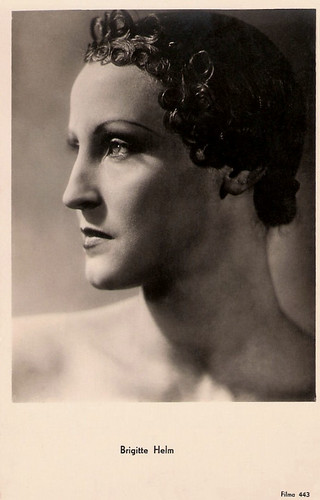
Dutch postcard by Filma, no. 443. Photo: Brigitte Helm in L'Atlantide (G.W. Pabst, 1932).

German postcard by Ross Verlag, no. 8055/1, 1933-1934. Photo: Vandor-Nelson Film. Arlette Marchal in Don Quichotte (G.W. Pabst, 1933).
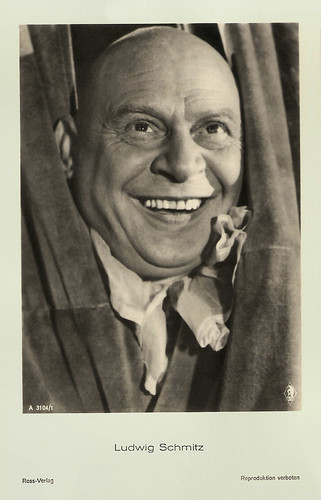
German postcard by Ross Verlag, no. A 3104/1, 1941-1944. Photo: Bavaria-Filmkunst. Ludwig Schmitz in Komödianten / The Comedians (G.W. Pabst, 1941).

German postcard by Ufa, Berlin-Tempelhof, no. FK 3021. Photo: Michaelis / Carlton Film / NF. Ivan Desny in Rosen für Bettina / Ballerina (Georg Wilhelm Pabst, 1956).

West German poster postcard by deutsches filmmuseum Frankfurt am Main. German poster by Josef Bottlik for Nero-Film / Süd-Film. Louise Brooks in Die Büchse der Pandora / Pandora's Box (G.W. Pabst, 1929).
Sources: Wikipedia (Dutch, German and English) and IMDb.
No comments:
Post a Comment