
French postcard by Imprimerie A. Breger Frères, Paris, issued for the cinema Max-Linder Pathé, 24, Boulevard Poissonière, Paris, where the film was presented on 14-20 September 1934. Jean-Pierre Aumont and Rosine Dérean in Lac au dames / Ladies Lake (Marc Allégret, 1934). The film is situated at Lake Konstanz. In Germany, the film was presented as Hell in Frauensee ('Frauensee' was the title of the novel by Vicki Baum, on which the film was based).

French postcard in the Raimu series by MPC (Marcel Pagnol Com), no. 27. Raimu and Fernand Charpin in Fanny (Marc Allégret, 1932).

French postcard by Editions et Publications cinématographiques, no. 74. Photo: Films Roussillon. Josephine Baker in Zouzou (Marc Allégret, 1934).

French postcard by Ed. Chantal, Rueil, no. 91. Photo: Gray Film. An early postcard of Louis Jourdan, still in his twenties in L'Arlésienne (Marc Allégret, 1942).

East German postcard by VEB Progress Film-Vertrieb, no. 2105, 1964. Brigitte Bardot in En effeuillant la marguerite / Plucking the Daisy (Marc Allégret, 1956).
To Africa as the 'secretary' of André Gide
Marc Allégret was born in Basel, Switzerland, in 1900. He was the fourth of five sons of Élie Allégret, a Protestant missionary pastor. Marc's younger brother, Yves Allégret, later also became a director and assisted Allégret on several of his early films, including Mam’zelle Nitouche and Lac aux Dames. His father had been the tutor of the young André Gide. When Marc was 14, his father left to serve in Africa, and he asked Gide to oversee his sons' education. During World War I, the young Allégret became the lover and companion of the 30 years older author. Their relationship marked both their personal maturation. Thanks to Gide, Allégret met the artists and writers of France, such as Paul Valéry, Pablo Picasso, Man Ray, Jean Cocteau, Erik Satie, and later Saint-Exupéry.
Allégret studied law and, in 1925, graduated from Sciences Po. He then accompanied André Gide as his 'secretary' on a ten-month expedition in French Equatorial Africa. French Equatorial Africa covered the modern nations of Gabon, the Republic of Congo, the Central African Republic and Chad. Allegret recorded the journey in film and photographs. He had no formal training in either job, though he had received some lessons from Man Ray in photography. The result, his first effort as a director, was the documentary Voyage au Congo / Travels in the Congo (Marc Allégret, 1927). Allégret and Gide carried out most of their journey on foot. Porters carried the film's negatives for months, through extreme heat and humidity. But the nitrate footage survived.
André Gide wrote two books about their time in Africa, 'Travels in the Congo' and 'Return from Chad', and went on to win the Nobel Prize in Literature. Allégret, despite having no prior training in cinema, proved to be a pioneer by creating a strictly ethnographically driven type of documentary. Wikipedia: "The film depicts the daily lives of eight ethnic groups, focusing on their agriculture, hunting, and fishing practices. The architectural styles of their areas and several group rituals, athletic competitions, and dances are also covered. Allégret's primary interest in the project was ethnographic, and he was genuinely attempting to promote understanding of the cultures he depicted. His depictions managed to avoid the "sensationalism" and stereotyping of the newsreels of the time." The documentary was not commercially successful, but was well-received by critics. Today, Allegret's debut is considered a pioneering ethnographic film. Its methodology influenced the genre.
Allégret decided to pursue a career as a filmmaker. The African trip ended his decade-long relationship with Gide, although they remained friends. His first cinematic experiment was reportedly the famous Dada short film Anémic Cinéma / Anaemic Cinema (Marcel Duchamp, 1926), on which Man Ray and Allégret collaborated. The seven-minute film is composed of alternating static camera shots of spinning animated drawing disks — which Marcel Duchamp called 'Rotoreliefs' — inscribed with puns and alliterations in French. The text, which spirals in a counterclockwise motion, suggests erotic scenarios, and the words, if read aloud, produce repetitive patterns of sounds that lead to scatological or obscene associations in reference to pulsating human sexual activity. The film premiered in a private screening in Paris in August 1926 and was acquired by MoMA in 1938, the first Duchamp work to enter a museum. Pierre Braunberger, who produced Voyage au Congo, hired him to work for his production company. He made several short films, comedies starring Fernandel, such as La Meilleure Bobonne / The Best Wife (Marc Allégret, 1930) and J'ai quelque chose à vous dire / I have something to say to you (Marc Allégret, 1931).
Allegret also became assistant to directors Robert Florey and Augusto Genina. He even replaced Florey in 1930 on the set of the comedy Le Blanc et le Noir / Black and White (Robert Florey, Marc Allégret, 1931), starring Raimu and Fernandel. The film was an adaptation of the 1922 play of the same title by Sacha Guitry, who wrote the screenplay. Allégret was also the art director, designing the film's sets. He co-directed with Genina the French-German crime drama Les amours de minuit / The Lovers of Midnight (Augusto Genina, Marc Allégret, 1931) starring Danièle Parola, Pierre Batcheff and Josseline Gaël. It is a Multiple-language version with a separate German-language version, Mitternachtsliebe, also produced. Les amours de minuit was the first sound film to be made at the Billancourt Studios in Paris. In his feature film debut as a director, Allégret directed Raimu in the Operetta Mam'zelle Nitouche (Marc Allégret, 1931). He also directed Raimu in La Petite Chocolatière / The Chocolate Girl (Marc Allégret, 1932) and Fanny (Marc Allégret, 1932), also starring Orane Demazis and Pierre Fresnay. Fanny, based on the 1931 play of the same name by Marcel Pagnol, was the second part of Pagnol's Marseille Trilogy, which began with Marius (Alexander Korda, 1931) and concluded with César (Marcel Pagnol, 1936). Allegret and Pagnol did not get along very well during filming. However, Fanny was a box office success in France and is still considered a classic of French cinema. Marc Allégret went on to a long career.

French poster card by Editions F. Nugeron, no. E48. French affiche for Fanny (Marc Allégret, 1932), starring Orane Demazis and Pierre Fresnay.
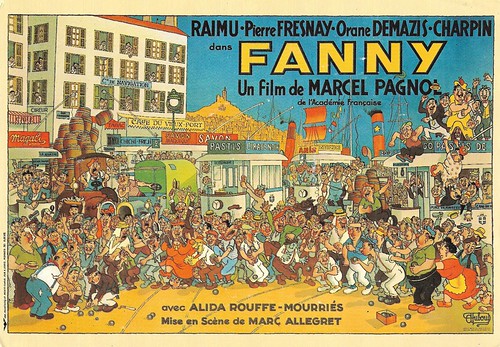
French poster postcard by CPM / Jean Dubout, 1982. French re-issue affiche for Fanny (Marc Allégret, 1932), based on the play by Marcel Pagnol with Raimu, Pierre Fresnay, Orane Demazis, and Charpin. Design: Albert Dubout, 1950.

French postcard in the Raimu series by MPC (Marcel Pagnol Com), no. 2. Photo: Roger Foster. Robert Vattier, Marcel Maupi, Raimu, Paul Dullac, Alida Rouffe and Fernand Charpin in Fanny (Marc Allégret, 1932). Caption: A scene in front of the bar La Marine.

French poster postcard by Société des Amis de la Bibliothèque Forney, Paris. French affiche for Lac aux dames (Marc Allégret, 1934), starring Jean-Pierre Aumont. Design: Jean A. Mercier.

French postcard by Editions La Malibran, Paris, no. CF 40. Josephine Baker and Jean Gabin in Zouzou (Marc Allégret, 1934).
The most beautiful film of the year
In the 1930s, what is considered his best period, Marc Allégret directed such classics as Lac aux dames / Ladies Lake (Marc Allégret, 1934), Gribouille / Heart of Paris (Marc Allégret, 1937) and Entrée des artistes / The Curtain Rises (Marc Allégret, 1938). Between 1931 and 1933, Allégret had an affair with actress Simone Simon, who played the female lead in Lac aux dames. The film was a unique effort by mega-rich Playboy, wine grower, and race-car driver Philippe de Rothschild, then dabbling as a film producer. Based on Vicki Baum’s 1927 Tyrolean-set novel 'Hell in Frauensee', Lac aux Dames was written by Allégret and La Revue du Cinéma editor Jean-Georges Auriol.
The responsibility for the film’s dialogue fell to novelist Colette. At the time, she was in her early 60s and had basically no film experience. Colette was known for her knack for creating audience-pleasing youthful characters in novels like 'Chéri' and 'Le blé en herbe'. At Alt Film Guide, André Soares suggests that the author possibly received some input from André Gide, who hung around during the location shoot. Despite Marc Allégret’s previous credits and Lac aux Dames’ good-looking, sensual performers – 23-year-old Jean-Pierre Aumont’s impressive physique is displayed to advantage throughout the film, while second lead Illa Meery’s breasts are bared in one scene – Philippe de Rothschild had trouble finding a distributor for his production.
Undaunted, he rented the (now defunct) Théâtre du Colisée on Paris’ Champs-Élysées to showcase Lac aux Dames, using a gigantic billboard to lure spectators. French critics were enthusiastic. As reported by the New York Times’ Herbert L. Matthews, a “majority” of them referred to Lac aux Dames as “the most beautiful film of the year.” Matthews agreed, stating that Marc Allégret’s effort “deserves a high place in any international compilation of ‘best’ pictures.” In addition to praise for Jean-Pierre Aumont’s performance, he wrote: “In Mlle. Simon, Mme. Colette … has found the perfect medium to express her profound knowledge of the adolescent mind. It is an exquisitely ingenious part, played with unerring taste. … Simone Simon is a moving, delicious Puck, so naturally played that the part seems made for her.”
During the 1930s, Marc Allégret also directed Zouzou (Marc Allégret, 1934) with Jean Gabin and Josephine Baker, the drama Sous les yeux d'Occident / Under Western Eye (Marc Allégret, 1936) with Pierre Fresnay and Michel Simon, an adaptation of Joseph Conrad's 1911 novel 'Under Western Eyes', the comedy Gribouille / Heart of Paris (Marc Allégret, 1937), in which Michèle Morgan played her first leading role opposite Raimu, and Entrée des artistes / The Curtain Rises (Marc Allégret, 1938), in which Louis Jouvet played a role similar to his own as a teacher at the Conservatoire. Claude Dauphin, Odette Joyeux and Bernard Blier played his students.
On 18 October 1938, Allégret married actress Nadine Vogel, from whom he divorced in 1957. In 1939, Charles Boyer returned from Hollywood to appear in his film Le Corsaire / The Pirate. The film would also mark the screen debut of Louis Jourdan. The screenplay was based on a play by Marcel Achard, and filming took place at Victorine Studios in Nice, in August and September 1939. However, production ceased on the declaration of World War II on 1 September 1939, and Boyer returned to America. The film was never completed, although some footage was later released, and a documentary about the making of the film was released in 1995.

French poster card in the series Encyclopédie du cinéma by Carterie artistique et cinématographique, Pont du Casse. Poster for Gribouille (Marc Allégret, 1937), starring Raimu and Michèle Morgan. Design: Pierre Segogne.

French mini-poster (collector card) by Pathé-Cinema. Raimu and Andrex in Parade en 7 nuits / Parade in 7 Nights (Marc Allégret, 1941).

French mini-poster (collector card) by Pathé-Cinema. Elvire Popesco and Victor Boucher in Parade en 7 nuits / Parade in 7 Nights (Marc Allégret, 1941).

French poster postcard in the series Encyclopédie du cinéma by Carterie artistique et cinématographique, Pont du Casse. French affiche for Maria Chapdelaine / The Naked Heart (Marc Allégret, 1950), starring Michèle Morgan. Design: Duccio Marvasi.

British postcard in the Star Souvenir Series by Jarrold and Sons, Ltd, Norwich, no. 61. Photo: London Films. Michèle Morgan in Maria Chapdelaine (Marc Allégret, 1950).

Cover page of a special issue of the German Progress Film Programm, no. 101/60. Mai Zetterling and Michael Gough in Blackmailed (Marc Allégret, 1951). In the early 1950s, Allégret directed a handful of films in the UK.
A landmark film of great daring
During the Occupation, Marc Allégret directed several comedies. His Parade en 7 nuits / Parade in 7 Nights (Marc Allégret, 1941) starring Raimu, is situated in a dog pound. One of the dogs tells stories about his former life, including adventures in a circus. Production commenced in 1940 at Francoeur Studios in Paris, but was interrupted by the war. It resumed almost a year later in the city of Nice at the Victorine Studios. The drama L'Arlésienne (Marc Allégret, 1942) starring Raimu and a young Louis Jourdan, was based on Alphonse Daudet's play 'L'Arlésienne'. Then followed Félicie Nanteuil (Marc Allégret, 1943), starring Micheline Presle, and Les Petites du quai aux fleurs (Marc Allégret, 1944), in which Odette Joyeux, Louis Jourdan and Bernard Blier appeared alongside Gérard Philipe, who was just starting out.
After the war, he reunited with two of his earliest actors, Fernandel and Simone Simon, in the crime comedy Pétrus (Marc Allégret, 1946). Then he directed three films in Great Britain. Blanche Fury (Marc Allégret, 1948) is a Technicolour drama starring Valerie Hobson, Stewart Granger and Michael Gough. Variety wrote: "It is a morose, moody tale of sex and unabashed villainy. The picture has been well produced, although cool calculation is visible in every move of the picture. French director Marc Allegret makes his English debut, and his technique is evident throughout. He has used color fo great advantage, while his settings and outdoor scenes have immense beauty. This should help put it over, although principal B.O. pull will be Stewart Granger." His next film, the Film Noir Blackmailed (Marc Allégret, 1951), starred Mai Zetterling and Dirk Bogarde. His third British production was the British-French historical drama Maria Chapdelaine / The Naked Heart (Marc Allégret, 1950) starring Michèle Morgan, Kieron Moore and Françoise Rosay. It tells the story of a convent girl in a remote Northern Canadian village at the beginning of the 20th century. The script was written by Allégret, C.K. Jaeger, J. McLaren-Ross, Hugh Mills and Roger Vadim based on the novel 'Maria Chapdelaine' by Louis Hémon. The film was released in separate English and French versions.
Back in France, he made the documentary Avec André Gide / With André Gide (Marc Allégret, 1952), which was narrated by Gérard Philipe and competed for the Venice Film Festival’s Golden Lion. Then he directed Dany Robin, Jean Marais and Jeanne Moreau in the romantic comedy Julietta (Marc Allégret, 1953). The film was important in the career of Allégret's assistant, Roger Vadim. A week before filming, star Jean Marais refused to do the film as he was unhappy with the script. Vadim rewrote the script to the star's satisfaction. Vadim and Allégret tried to have Vadim's wife, Brigitte Bardot, cast as the female lead, but the producer went with the better-known Dany Robin. The film was a big success, and this led to Vadim being given the job of rewriting Cette sacrée gamine / Naughty Girl (Michel Boisrond, 1956), which turned Brigitte Bardot into a star.
Marc Allégret travelled to Italy to direct Hedy Lamarr in the anthology film L'amante di Paride / Loves of Three Queens (Marc Allégret, Edgar G. Ulmer, 1954). Lamarr played a woman WHO IS going to a costume party and tries to work out which Queen she will dress up as. The film follows scenes from the lives of each of the queens. Genevieve, Josephine, and Helen. Then Allégret directed Brigitte Bardot and Jean Marais together in the drama Futures vedettes / School for Love (Marc Allégret, 1955). The screenplay, written by Marc Allégret, was based on a novel by Vicki Baum. The film performed poorly at the French box office. More successful was the comedy En effeuillant la marguerite / Plucking the Daisy (Marc Allégret, 1956) starring Daniel Gélin and Brigitte Bardot. The Los Angeles Times called it "a most delightful, naughty and very funny comedy... Bardot strikes pure gold... It's strictly a fun show that doesn't try to prove a thing.
Danielle Darrieux and hunky Italian film actor Erno Crisa starred in the drama L'Amant de Lady Chatterley / Lady Chatterley's Lover (Marc Allégret, 1955). Allégret co-wrote the screenplay with Philippe de Rothschild and Gaston Bonheur, based on D.H. Lawrence's classic risqué novel about an aristocratic wife who has a passionate affair with her gamekeeper, Oliver. Darrieux plays Lady Chatterley, and her first glimpse of Oliver naked from the waist upwards sets the sexual tone. Leo Genn as Lord Chatterley urges his wife to have sex with another man to produce a noble, honourable heir. He does not, of course, have his gamekeeper in mind. In 1955, the film was banned in New York because it "promoted adultery", but it was released in 1959 after the U.S. Supreme Court reversed a lower court's decision. The American public flocked to see the film. J. Roman Baker at IMDb: "It is the best version of D.H. Lawrence's book, and no other version since this one has been able to be as sexually explicit as the book. So for me, this is a landmark film of great daring in its ability to bring to the screen a banned book in the best way that it could."

Italian postcard by Bromofoto, Milano, no. 1034. Erno Crisa in L'amant de Lady Chatterley / Lady Chatterley's Lover (Marc Allégret, 1955).

Vintage postcard. Isabelle Pia and Brigitte Bardot in Futures Vedettes / School for Love (Marc Allégret, 1955).

West German postcard by Kunst und Bild, Berlin, no. T 614. Photo: Pallas-Film. Isabelle Pia in Futures vedettes / School for Love (Marc Allégret, 1955).

French poster postcard in the series Encyclopédie du cinéma by Carterie artistique et cinématographique, Pont du Casse. French affiche for En effeuillant la marguerite / Plucking the Daisy (Marc Allégret, 1956), starring Brigitte Bardot. Design: Clément Hurel.

French poster postcard by Éditions Zreik, Paris, in the Collection Télérama, la mémoire du cinéma, no. 149. German poster for En effeuillant la marguerite / Plucking the Daisy (Marc Allégret, 1956), starring Brigitte Bardot.
A sharp eye for new talent
In 1962, Marc Allégret directed a young Catherine Deneuve and the hot Yé-yé star Johnny Hallyday in Sophie, one of the four sketches of the anthology film Les Parisiennes / Tales of Paris (Marc Allégret, a.o., 1962).
Allégret was noted for his sharp eye for new talent. Fernandel, Raimu, Jean-Louis Barrault and Josephine Baker all made their film debuts in a Marc Allégret film. He was the first to give important roles to Simone Simon and Michèle Morgan, whom he brought to prominence. Roger Vadim was his assistant. He cast up-and-coming actors in his films, such as Bernard Blier, Louis Jourdan, Danièle Delorme, Gérard Philipe, Daniel Gélin, Brigitte Bardot, Jean-Paul Belmondo, Alain Delon, and Patrick Dewaere.
Shunned, like other French directors of his generation, by New Wave filmmakers and critics, Allégret went on to make documentaries. He directed and produced one last feature film, Le Bal du comte d'Orgel / The Ball of Count Orgel (Marc Allégret, 1970). Based on Raymond Radiguet's book of the same name, posthumously published in 1924, the film concerns a ball hosted by the Comte d'Orgel (Jean-Claude Brialy). The film premiered at the opening of the 1970 Cannes Film Festival. The 1970 audience was not able to relate to this story of the Belle Epoque people who live in luxury and do not seem to be aware that there's a world outside.
Three years later, in 1973, Marc Allégret died of natural causes at his home at 11bis rue Lord-Byron in the 8th arrondissement of Paris. He was 72 years old. Allégret was interred in the Cimetière des Gonards in Versailles, France. He was the uncle of actress Catherine Allégret, the daughter of his brother Yves Allégret and Simone Signoret, who were married from 1944 till 1949.
In 2018, Voyage au Congo / Travels in the Congo (Marc Allégret, 1927) was restored and digitised by Les Films du Panthéon in collaboration with Les Films du Jeudi, with the support of CNC and the Cinémathèque française, and with the help of the British Film Institute. This restored version also includes a newly commissioned instrumental score. IMDb: "Unusual for its time Voyage au Congo / Travels in the Congo (Marc Allégret, 1927) is a largely observational documentary (with one dramatized sequence) showing aspects of the lives, culture, and built environments of diverse groups in the region, amongst them the Baya, Sara and Fula peoples, and without trying to shoehorn them into a dramatic narrative. Travels in the Congo does, of course, retain a certain colonial gaze; in writing about the film, Allégret referred to its subjects as 'a humanity without history'. But overall it remains steadfast in its approach, presenting its subjects on their own terms."
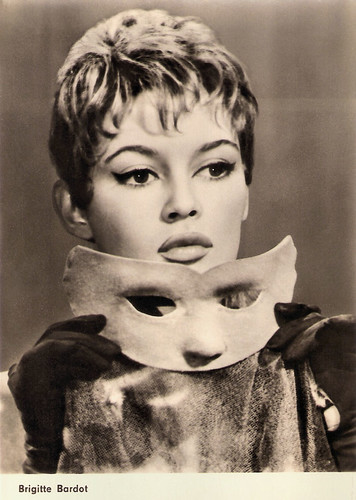
East German postcard by VEB Progress Filmvertrieb, Berlin, no. 1975, 1963. Brigitte Bardot in En effeuillant la marguerite / Mademoiselle Striptease (Marc Allégret, 1956).

Cover page of a special issue of the German Illustrierte Film-Bühne, no. 4684. Henri Vidal and Mylène Demongeot in Sois belle et tais-toi / Be Beautiful But Shut Up (Marc Allégret, 1958).

The retro of the cover page of a special issue of the German Illustrierte Film-Bühne, no. 4684. Henri Vidal, Alain Delon, Mylène Demongeot and Darry Cowl in Sois belle et tais-toi / Be Beautiful But Shut Up (Marc Allégret, 1958).

French poster card in the series Encyclopédie du cinéma by Carterie artistique et cinématographique, Pont du Casse. Spanish poster for the episode film Les Parisiennes / Tales of Paris (Marc Allégret a.o., 1961). Design: Mexique. Allégret directed the episode Sophie, with Catherine Deneuve and Johnny Hallyday.
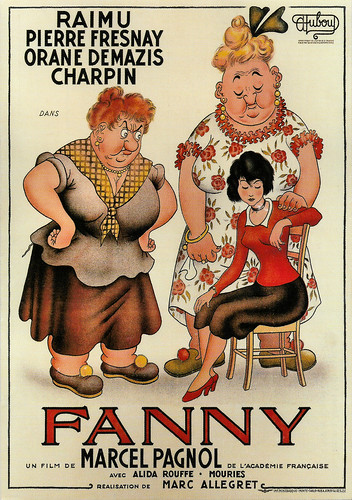
French postcard by Jean Dubout, Paris, 2009, D 49. Poster design by Albert Dubout (1950) for a re-issue of Fanny (Marc Allegret, 1932).
Sources: James Travers (French Films), Andre Soares (Alt Film Guide), J Roman Baker (IMDb), Wikipedia (Dutch, French and English), Encyclopaedia Britannica and IMDb.
No comments:
Post a Comment