
Russian postcard by Goznak, Moscow, series, no. 2, no. A-1725, 1927. The card was issued in an edition of 15,000 copies.
Danish silent film actress Asta Nielsen (1881-1972) was one of the most popular leading ladies of the 1910s and one of the first international film stars. Of her 74 films between 1910 and 1932, seventy were made in Germany, where she was known simply as 'Die Asta'. Noted for her large dark eyes, mask-like face, and boyish figure, Nielsen most often portrayed strong-willed, passionate women trapped by tragic consequences.

Russian postcard by Goznak, Moscow, series, no. 2, no. 98826, 1927. The card was issued in an edition of 20,000 copies.
Swedish Greta Garbo (1905-1990) was one of the greatest and most glamorous film stars ever produced by the Hollywood studio system. She was part of the Golden Age of the silent cinema of the 1920s and was one of the few actors who made a glorious transition to the talkies. She started her career in European cinema and would always stay more popular in Europe than in the USA.
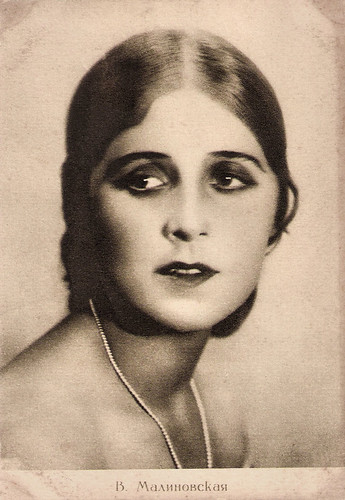
Russian postcard by Goznak, Moscow, series no. 4, no. A-2400, 1927. Published in an edition of 25,000 cards.
Vera Malinovskaya (1900-1988), also written as Malinovskaja or Malinovskaia, played in several Russian films of the 1920s and also in a few films in Germany and Austria. From 1925 on, she had leading roles in films by the Mezhrabpom film company, often playing innocent girls. In 1925, she played Dunia opposite Ivan Moskvin in Kollezhskiy registrator / The Station Master (Ivan Moskvin, Yuri Zhelyabuzhsky, 1925), scripted by Fyodor Otsep (Fedor Ozep), after a novel by Alexander Pushkin.

Russian postcard by Goznak, Moscow. Paul Richter in Pietro der Korsar / Peter the Pirate (Arthur Robison, 1925).
Austrian actor Paul Richter (1895-1961) starred in several silent films directed by Joe May and Fritz Lang. He became an idol of the 1920s with the lushly produced Ufa production Die Nibelungen (Fritz Lang, 1924).

Russian postcard by Goznak, Moscow, no. 2, 1927.
Yuliya Solntseva (1901–1989) was a Soviet film director and actress who starred as the Queen of Mars in the silent Sci-Fi classic Aelita (Yakov Protazanov, 1924) and as a cigarette girl in the romantic comedy Papirosnitsa ot Mosselproma / The Cigarette Girl of Mosselprom (Yuri Zhelyabuzhsky, 1924). Solntseva directed 14 films between 1939 and 1979. She was married to director Aleksandr Dovzhenko and collaborated with him on his later films, including Michurin (1949), for which she was awarded a Stalin Prize. For Povest plamennykh let / The Chronicle of Flaming Years (1961), she won the Best Director award at the 1961 Cannes Film Festival. She was named a People's Artist of the USSR when she turned 80.
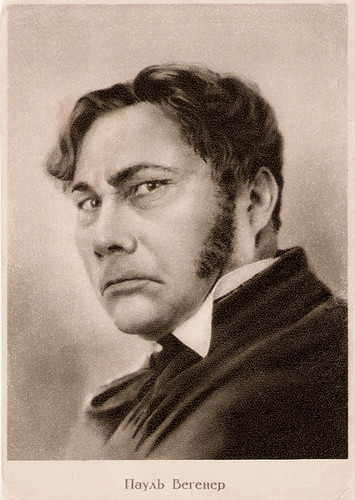
Russian postcard, no. 4, 1927.
German actor, writer, and film director Paul Wegener (1874-1948) is one of the true fathers of the horror and fantasy genre, particularly remembered for his three silent films centred around the Jewish legend of the Golem. Wegener was one of the pioneers of German cinema who realised the potential of the new medium and used the possibilities of cinematic trick photography as a method for presenting fantastic tales seriously.
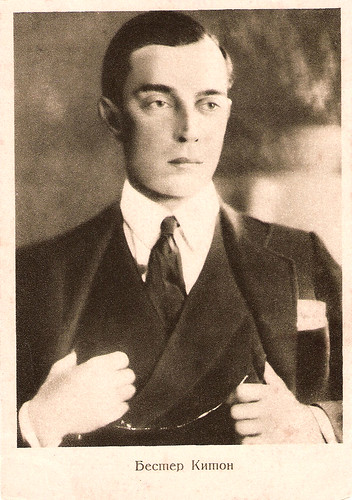
Russian postcard by Goznak, Moscow, no. 1725, 1927.
Stone-faced Buster Keaton (1895-1966) was one of the three greatest comedians of Silent Hollywood. His most enduring features include Our Hospitality (1923), The Navigator (1924), Sherlock Jr. (1924), College (1927), and The General (1927).
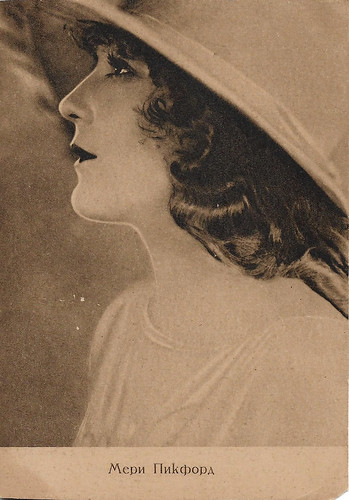
Russian postcard by Goznak, Moscow, no. A-11967, 1928. The card was issued in an edition of 25,000 copies.
Mary Pickford (1892-1979) was a legendary silent film actress and was known as 'America’s sweetheart'. She married Douglas Fairbanks, Sr. in 1920, becoming one of Hollywood’s earliest super couples. Fans adored the pairing, and the couple was mobbed at every port on their whirlwind European honeymoon. She scored box-office hits with Pollyanna (1920), Little Lord Fauntleroy (1921), and Tess of the Storm Country (1922). She was a founder of United Artists and helped to establish the Academy.

Soviet postcard by Goznak, Moscow, series 2, no. A-1725, 1927. Douglas Fairbanks in The Black Pirate (Albert Parker, 1926).
American actor Douglas Fairbanks (1883-1939) was best known for his swashbuckling roles in silent films such as The Mark of Zorro (1920), Robin Hood (1922), and The Thief of Bagdad (1924), but spent the early part of his career making comedies. Fairbanks was a founding member of United Artists and of the Motion Picture Academy. He hosted the first Oscars ceremony in 1929. With his marriage to Mary Pickford in 1920, the couple became Hollywood royalty, and Fairbanks was referred to as 'The King of Hollywood', but his career rapidly declined with the advent of the talkies. His final film was made in Great Britain, The Private Life of Don Juan (1934).
The ideological and artistic needs of the proletariat
In 1924, filmmakers Sergei Eisenstein and Lev Kuleshov created the first association of Soviet filmmakers, the Association of Revolutionary Cinematography (ARK), to “meet the ideological and artistic needs of the proletariat”. Although state-controlled, the organisation was characterised by a pluralism of political and artistic views until the late 1920s.
One of the most iconic developments in film during this period that is still used in films today was editing and montage to create meaning. This style of filmmaking came to be known as 'the Kuleshov effect' and was employed to conserve film stock due to shortages during that period.
Innovation in Russian filmmaking was expressed particularly in the work of Eisenstein, such as his films Bronenosets Potyomkin / Battleship Potemkin (1925) and Oktyabr': Desyat' dney kotorye potryasli mir / October: Ten Days That Shook the World (1928).
Also noteworthy was Vsevolod Pudovkin's adaptation of Maxim Gorky's Mat / Mother to the screen in 1926. Pudovkin developed themes of revolutionary history in the film Konets Sankt-Peterburga / The End of St. Petersburg (1927).
Other noteworthy silent films were films about contemporary life, such as Boris Barnet's Dom na Trubnoy / The House on Trubnaya (1928). The films of Yakov Protazanov were devoted to the revolutionary struggle and the shaping of a new way of life, such as Don Diego i Pelageya / Don Diego and Pelagia (1928). And finally, the Ukrainian director Aleksandr Dovzhenko was noteworthy for the historical-revolutionary epic Arsenal (1929) and the poetic film Zemlya / Earth (1930).
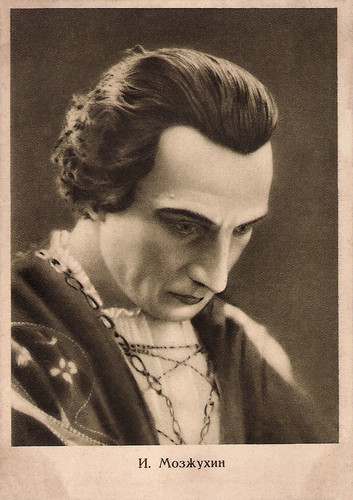
Russian postcard by Goznak, Moscow, series no. 5, no. A 4711, 1928. The card was issued in an edition of 25,000 copies. The price was 10 Kop. Photo: Ivan Mozzhukhin in Kean / Edmund Kean: Prince Among Lovers (Alexandre Volkoff, 1924).
Russian actor Ivan Mozzhukhin (1889-1939) was a legendary star of the European silent film. He escaped execution by the Soviet Red Army and made a stellar career in Europe, but he suffered in Hollywood. He first starred in about thirty silent Russian films made by Pyotr Chardynin, Aleksandr Khanzhonkov, and Yevgeni Bauer. From 1915 to 1919, he worked on about 40 films by directors Yakov Protazanov and Viktor Tourjansky under the legendary Russian producer Joseph N. Ermolieff. After the Revolution, in 1920, he left Russia together with his wife, Nathalie Lissenko and his partners from Ermolieff. They emigrated together to France and started a Russian-French film company. He starred in hits like the innovative murder mystery La maison du mystère / The Mysterious House (1923), Kean / Edmund Kean: Prince Among Lovers (1924), and the lavish adventure spectacle Michel Strogoff / Michael Strogoff (1926) based on the Jules Verne novel. Best remembered is the humorous and visually splendid epic Casanova / The Loves of Casanova (1927).
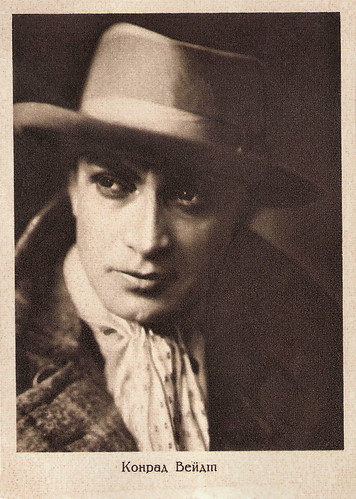
Russian postcard, no. 6, 1928.
Conrad Veidt (1893–1943) was the most highly strung and romantically handsome of the German expressionist actors. From 1916 until his death, he appeared in well over 100 films, including such classics as Das Kabinett des Dr. Caligari / Das Cabinet des Dr. Caligari (Robert Wiene, 1920) and Casablanca (Michael Curtiz, 1942).

Russian postcard by Goznak, Moscow, series no. 9, no. A-15639, 1928. The card was issued in an edition of 10,000 copies. The price was 10 Kop.
Anatoli Ktorov (1898-1980) was a brilliant Soviet and Russian film and stage actor who stuttered in real life but was perfectly eloquent in acting roles. He had a career spanning from silent films by Yakov Protazanov to the Oscar-winning epic Voyna i mir / War and Peace (1965-1967). He became a People's Artist of the USSR in 1963.

Anatoli Ktorov. Soviet-Russian postcard by Goznak, Moscow, 1927, series 2, no. A-98826.

Russian postcard by Goznak, Moscow, series no. 8, no. A-16279, 1928. The card was issued in an edition of 30,000 copies. The price was 10 Kop.
Russian actor Sergei Minin (1901-1937) was a star of the Soviet cinema of the 1920s. He worked with such famous directors as Abram Room and Ilya Trauberg.

Russian postcard by Goznak, Moscow, series no. 5, no. A-47112, 1928. The card was issued in an edition of 25,000 copies. The price was 10 Kop.
Ukrainian actor Vladimir Gajdarov (1893-1976) (aka Wladimir Gaidarow and Vladimir Gaidaroff) was a popular star in the European silent cinema. He began his film career in Russia before the October Revolution. Later, he became a popular star in the German and French silent cinema. The sound film made him return to his home country, but in the Soviet Union, he had a hard time getting work.
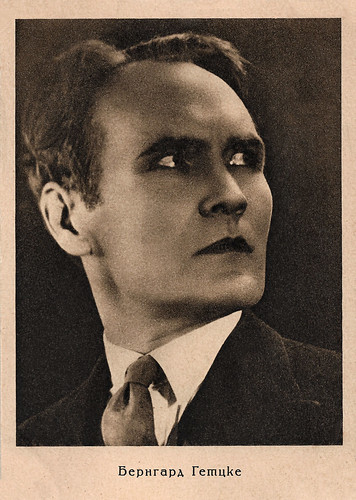
Russian postcard by Goznak, Moscow, series no. 14, no. A 29871, 1929. The card was issued in an edition of 15,000 copies. The price was 10 Kop.
German film actor Bernhard Goetzke (1884-1964) was one of the impressive stars of the silent films by Fritz Lang. He appeared in 130 films between 1917 and 1961.

Russian postcard by Goznak, Moscow.
Vera Malinovskaya (1900-1988), also written as Malinovskaja/Malinovskaia, played in several Russian films of the 1920s and a few in Germany and Austria.

Russian postcard by Goznak, Moscow, 1928, series 5, no. A-4711. For this card, the same photo by Photo Stezer in Vienna was used as on the Ross Verlag card, no. 1023/3.
Austrian actor Walter Slezak (1902-1983) began his film career as a thin leading man in silent films. Unable to keep his weight under control, Slezak decided around 1930 to become a character actor. When the Nazis came into power, he moved to Broadway and Hollywood, where he usually portrayed a villain or thug, but also played lighter, kindlier roles.

Soviet postcard by Goznak, Moscow, series 5, no. A-4711, 1928.
Vivacious Ossi Oswalda (1895-1947) was one of the most popular comediennes of German silent cinema. Ernst Lubitsch was her Pygmalion.

Soviet postcard by Goznak, Moscow, series 5, no. A-16279, 1928.
During the 1920s and 1930s, Galina Kravchenko (1905-1996) was a staff actress with Mezhrabpom Film Studio. She enjoyed a stellar career in Soviet silent films. Kravchenko was married to popular actor Andrei Fajt, and the couple was part of Moscow's cultural milieu during the 1920s and early 1930s. She was censored under the dictatorship of Joseph Stalin and was practically unemployed for more than 20 years. Kravchenko made a comeback as Maria Lvovna Kuragina, the omnipresent socialite in War and Peace (1967) by director Sergei Bondarchuk. Kravchenko was designated Honourable Actress of Russia in 1980.

Soviet postcard by Goznak, Moscow, series 4, no. A-2400, 1927. An edition of 50.000 cards
Natalia 'Nato' Vachnadze (1904-1953) was a Georgian and Soviet film actress. She started her career in the silent film era, usually playing the screen character of an Ingénue, an innocent and passionate young woman. She continued to work as an actress during the sound era until she died in a plane crash in 1953. One of the first film stars of the Soviet Union, she received numerous honours, including the title of People's Artist of the Georgian Soviet Socialist Republic and the Stalin Prize.

Soviet postcard by Goznak, Moscow, series 15, no. A-28014, 1929. An edition of 20.000 cards.
Soviet actress Anel Sudakevich (1906-2002) acted in such silent films as the Spy film Miss Mend / The Adventures of the Three Reporters (Boris Barnet, Fyodor Otsep, 1926), the comedy Potseluy Meri Pikford / A Kiss From Mary Pickford (Sergei Komarov, 1927) and Potomok Chingiskhana / Storm over Asia (Vsevolod Pudovkin, 1928). She was married to Soviet ballet dancer Asaf Messerer, and when their son Boris was born, Anna gave up her film career and became a costume designer in the theatre. She appeared in small parts in Ivan the Terrible II (Sergei Eisenstein, 1945) and other films.

Soviet postcard by Goznak, Moscow, series 1, no. 94282, 1927. An edition of 15.000 cards.
Polish film actress Pola Negri (1897-1987) achieved fame and notoriety as a femme fatale in German and American silent films between the 1910s and 1930s. Negri was an overnight sensation in Ernst Lubitsch's Madame du Barry / Passion (1919). She moved to Hollywood, where she lived in a palace modelled after the White House.

Soviet postcard by Goznak, Moscow, series 4, A-2400, 1927. For this card, the same photo by Alex Binder was used as on the Ross Verlag card, no. 545/2.
Prima ballerina, dancer, singer and actress Liane Haid (1895-2000) was the first film star of Austria. She was the epitome of the Süßes Wiener Mädel (Sweet Viennese Girl). From the mid 1910s on, she made close to a hundred films.

Soviet postcard by Goznak, Moscow, series 12, no. A-29961, 1929. For this card, the same photo by Atelier Schneider was used as on the Ross Verlag card, no. 3170/1.. The photo of Marcella Albani was a publicity still for the film Geheimnisse des Orients / Secrets of the Orient (Alexandre Volkoff, 1928).
Petite Italian actress and author Marcella Albani (1899-1959) appeared in 50 films from 1919 on. She was especially successful as an elegant Latin lady in the German silent cinema.

Soviet postcard by Goznak, Moscow, series 6, no. A-11833, 1928. The picture for this card is the same photo by Frieda Riess that was used on the Ross Verlag card, no. 478/2.
Bartolomeo Pagano (1878-1947) was an Italian actor in Italian and German silent film. His name is forever attached to the character of the strong man Maciste.

Soviet postcard by Goznak, Moscow, series 5, no. A-4711, 1928. The picture on this card is based on a photo by Alex Binder on the Ross Verlag postcard, no. 868/1.
Hungarian-born film star Lya de Putti (1899-1931) portrayed vamps in German and American silent films.

Soviet postcard by Goznak, Moscow, series 6, A-11833, 1928.
Gloria Swanson (1899-1983) was one of the biggest Hollywood stars of the silent era. She transformed from a typical Mack Sennett comedienne into a lively, provocative, even predatory, star in films by Cecil B. De Mille. She received Oscar nominations for Sadie Thompson (1928), The Trespasser (1929) and Sunset Blvd. (1950).

Soviet postcard by School FZU, 1, Sample, typography State Publishing House, no. 73162. Edition: 10.000 cards, 10 kopeks. The name Goznak is not mentioned on this card, but it is very similar to the Goznak cards. In the 1920s, School FZU stands for Shkola fabrichno-zavodskogo uchenichestva, schools of factory and plant apprenticeship. They were the precursors of modern professional technical schools, called PTU since 1959.
Barbara La Marr (1896–1926) was an American film actress, noted for her beauty and her tempestuous marital history. After gaining experience in vaudeville, she became a screenplay writer and then a performer, appearing with Douglas Fairbanks and others in over thirty movies, as well as dancing on Broadway. Her hedonistic lifestyle in Hollywood, with heavy alcohol dependence, led to her early death.

Soviet postcard by [Goznak], Moscow, series 1, no. A9980.
Antonio 'Tony' Moreno (1887-1967) was a Spanish-born American actor and film director of the silent film era and through the 1950s. In his early films, Moreno was often typecast as the 'Latin Lover'. He is best known for films such as The Spanish Dancer (1923) with Pola Negri, Mare Nostrum (1926) with Alice Terry, The Temptress (1926) with Greta Garbo, and It (1927) with Clara Bow.
Sources: Wikipedia and IMDb.
No comments:
Post a Comment