Lotte Neumann (1896-1977) was one of the most successful actresses in the early days of the German silent cinema, and she also worked as a screenwriter and a producer. Neumann was the lovely star in the Ernst Lubitsch comedy Romeo und Julia im Schnee / Romeo and Juliet in the Snow (1920).
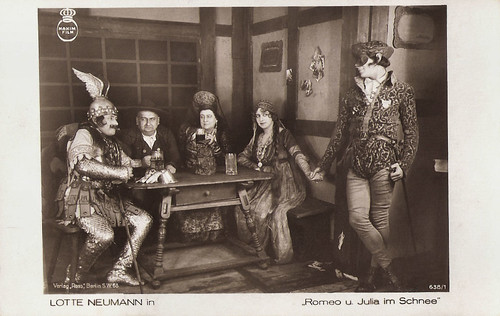
German postcard by Ross Verlag, no. 636/1. Photo: Maxim Film. Publicity still for the Ernst Lubitsch comedy Romeo und Julia im Schnee / Romeo and Juliet in the Snow (1920). The man on the left, dressed as an antique hero, is Julius Falkenstein as Paris. The others are Jakob Tiedtke (Herr Capulethofer), Marga Köhler (his wife), Lotte Neumann (Julia) and Gustav von Wangenheim (Romeo Montekugerl).
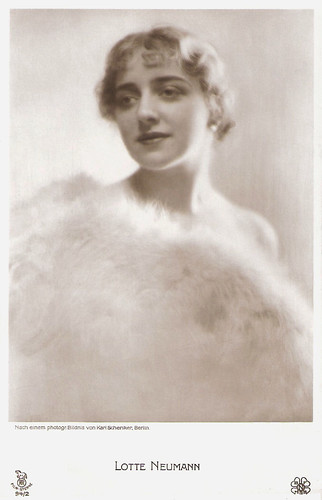
German postcard by Rotophot in the Film-sterne series, no. 94/2. Photo: NBFMB / Karl Schenker.
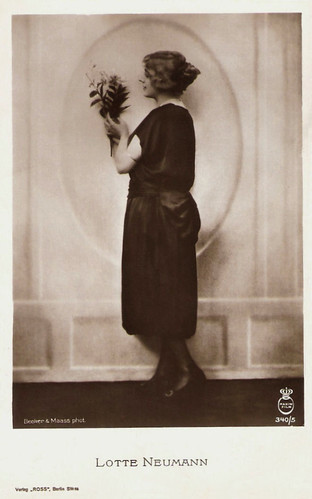
German postcard by Ross Verlag, Berlin, no. 340/5, 1919-1924. Photo: Becker & Maass / Maxim Film.
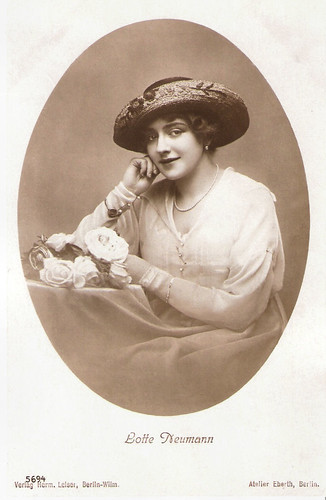
German postcard by Verlag Hermann Leiser, Berlin-Wilm., no. 5694. Photo: Atelier Eberth, Berlin.

German postcard by Verlag Hermann Leiser, Berlin-Wilm., no. 9894. Photo: J. Braae Photokunst, 1917.
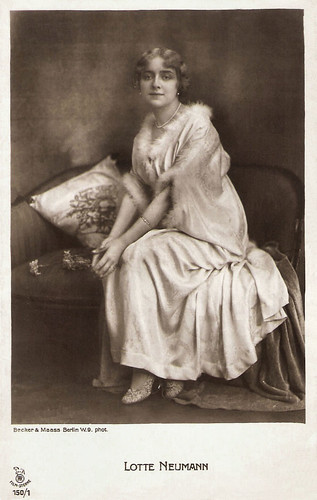
German postcard by Rotophot, Berlin, in the Film-Sterne Series, no. 150/1, 1925-1935. Photo: Becker & Maass.

German postcard by Photochemie, Berlin, no. K. 2095. Photo: Lotte Neumann-Film. Lotte Neumann in Die Richterin / The Judge (Paul von Woringen, 1917).
Lotte Neumann was born as Charlotte Pötler in Berlin, Germany, in 1896.
She attended the Königliche Luisenschule (Royal Louise School) in Berlin, after which the Wagnersche-Klinkhardsche Höhere Mädchenschule (Wagnerian-Klinkhardsche Higher School for Girls).
She began her theatrical career as a 13-year-old choir singer at the Komische Oper (Comic Opera) and at the Komödienhaus (Comedy House) in Berlin.
In 1912, director Max Mack gave her her first film role in Die Launen des Schicksals / Whims of Fate (Max Mack, 1912) with Hanni Weisse.
In the following years, she acted in productions of the German Mutoscope and Biograph GmbH like Ketten der Vergangenheit / Chains of the Past (N.N., 1914), the Sherlock Holmes-film Ein seltsamer Fall / An Unusual Case (Max Mack, 1914), Der eiserne Ring / The Iron Ring (Paul von Woringen, 1915) and In letzter Sekunde / In the Last Second (Walter Schmidthässler, 1916).
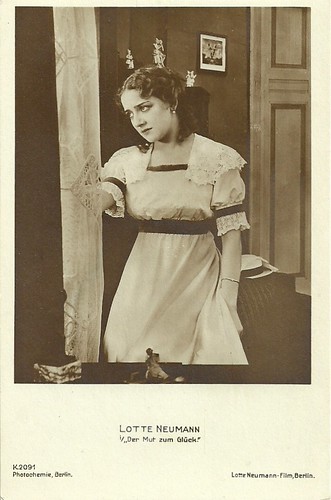
German postcard by Photochemie, Berlin, no. K. 2091. Photo: Lotte Neumann-Film, Berlin. Lotte Neumann in Der Mut zum Glück / The Courage to Happiness (Paul von Woringen, 1917). This was the first film Neumann produced herself with her company, Lotte Neumann-Film.
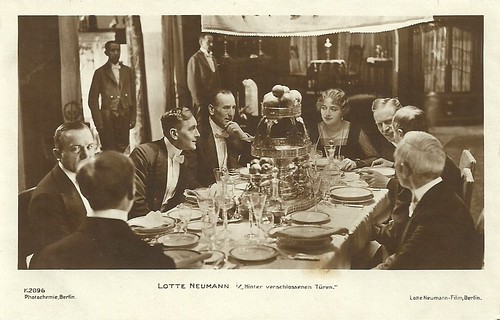
German postcard by Photochemie, Berlin, K. 2096. Photo: Lotte Neumann-Film, Berlin. Lotte Neumann and Ernst Rückert in Hinter verschlossenen Türen / Behind Closed Doors (Paul von Woringen, 1917).

German postcard by Photochemie, Berlin, no. K. 2103. Photo: Lotte Neumann-Film, Berlin. Lotte Neumann in Der Geigenspieler / The Violin Player (Paul von Woringen, 1917).
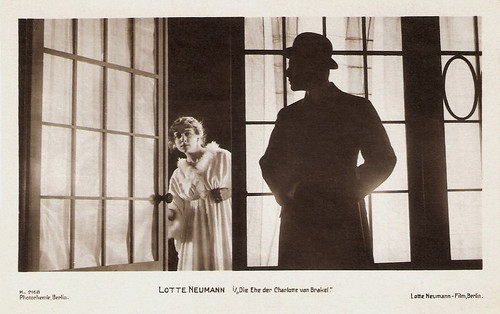
German postcard by Photochemie, Berlin, no. K. 2168. Photo: Lotte Neumann-Film, Berlin. Lotte Neumann in Die Ehe der Charlotte von Brakel / The Marriage of Charlotte von Brakel (Paul von Woringen, 1918).
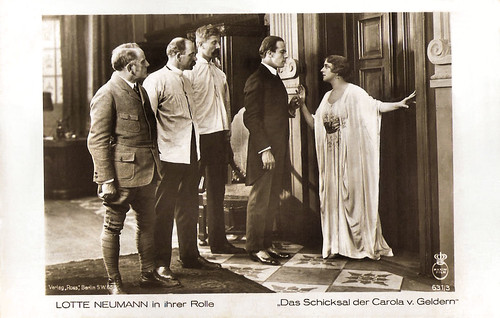
German postcard by Ross Verlag, Berlin, no. 631/3, 1919-1924. Photo: Maxim Film. Lotte Neumann in Das Schicksal der Carola von Geldern / The Fate of Carola von Geldern (Carl Froelich, 1919).
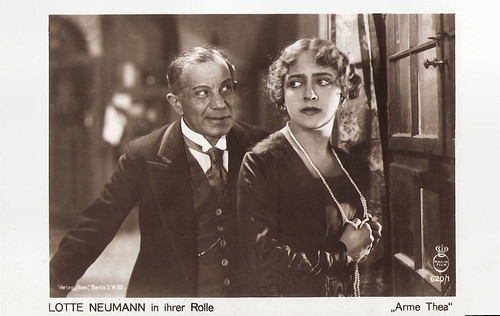
German postcard by Ross Verlag, Berlin, no. 620/1, 1919-1924. Photo: Maxim Film. Publicity still for Arme Thea / Poor Thea (Carl Froelich, 1919).
Lotte Neumann also appeared as a singer and actress on Berlin stages. Soon, she was so well-known that the studio shot a series of Lotte Neumann films.
In 1916, she founded the Lotte Neumann Film GmbH, which existed until 1919.
To these productions belong Hinter verschlossenen Türen / Behind Closed Doors (Paul von Woringen, 1917), Die Richterin / The Judge (Paul von Woringen, 1917), Das Schweigen im Walde / The Silence in the Forest (Paul von Woringen, 1918), Das Spiel mit dem Feuer / The Play With Fire (Paul von Woringen, 1918) and Schatten der Vergangenheit / Shadows of the Past (Paul von Woringen, 1919) - for which she was also the producer.
In 1918, she wrote her first screenplay, for Die Töchter des Herrn Dornberg / The Daughters of Mr. Dornberg (Paul von Woringen, 1918).
From 1919 on, she was committed to the Ufa.

German postcard by Photochemie, no. 5881. Photo: Willingen. Alice Hechy (here as Alice Scheel-Hechy), Lotte Neumann (here as Lotti Neumann), and Georg Baselt in the stage comedy 'Hochherrschaftliche Wohnungen' (Stately Homes) (1913), performed at the Komödienhaus, and written by Toni Impekoven. Caption: Are there at the Kadewe [department store] only such pretty ladies? Under the pseudonym Peter Panter, Kurt Tucholsky wrote a review of the play in Die Schaubühne (16, 17.04.1913).
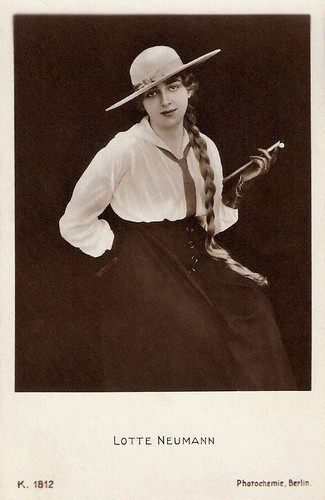
German postcard by Photochemie, Berlin, no. K. 1812.
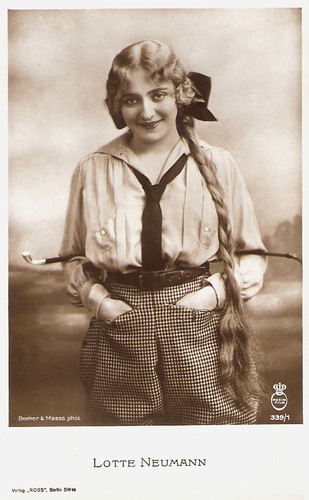
German postcard by Ross Verlag, Berlin, no. 339/1, 1919-1924. Photo: Becker & Maass / Maxim Film.
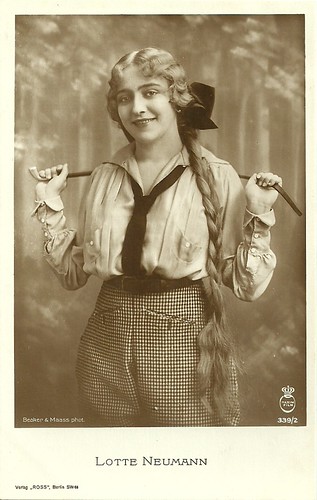
German postcard by Ross Verlag, Berlin, no. 339/2, 1919-1924. Photo: Becker & Maass / Maxim Film.
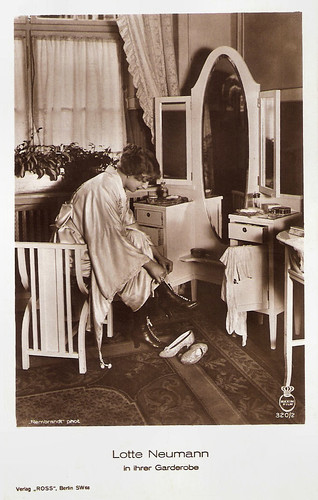
German postcard by Ross Verlag, no. 320/2, 1919-1924. Photo: Rembrandt / Maxim Film. Caption: Lotte Neumann in ihrer garderobe (Lotte Neumann in her wardrobe).
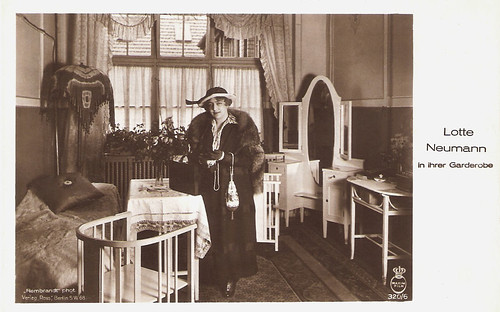
German postcard by Ross Verlag, Berlin, no. 320/6, 1919-1924. Photo: Rembrandt / Maxim Film. Caption: Lotte Neumann in ihrer garderobe (Lotte Neumann in her wardrobe).
During the 1920s, Lotte Neumann remained a popular film actress who embodied aristocratic young women.
In 1920, she acted under the direction of Ernst Lubitsch in the comedy Romeo und Julia im Schnee / Romeo and Juliet in the Snow (1920), set in a 19th-century Alpine village.
Her biggest successes include the film operetta Die Brigantin von New York / The Brigantine, New York (Hans Werckmeister, 1924), Die Frau für 24 Stunden / The Woman for 24 hours (Reinhold Schünzel, 1925) with Harry Liedtke, and Der gute Ruf / The Good Reputation (Pierre Marodon, 1926).
She had film contracts in Austria, Italy and the Balkan States, for example, with Gaumont-Aubert in Paris and with Maldaria in Prague.
Because of her protracted divorce case, which ran from 1929 to 1932, she had to end her career as an actress. Her last film was Die Liebesfiliale (Carl Heinz Wolff, 1931) before she retired from the screen.

German postcard in the Film Sterne series by Rotophot, no. 150/4. Photo: Becker & Maass.

German postcard in the Film Sterne series by Rotophot, no. 150/5. Photo: Becker & Maass.
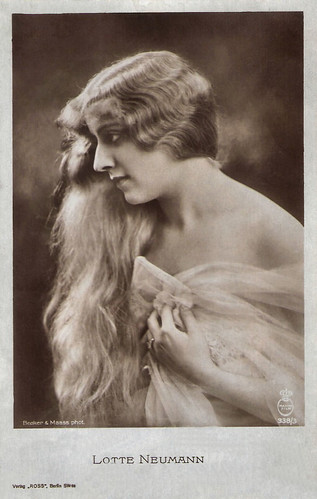
German postcard by Ross Verlag, Berlin, no. 338/3, 1919-1924. Photo: Maxim Film / Becker & Maass.
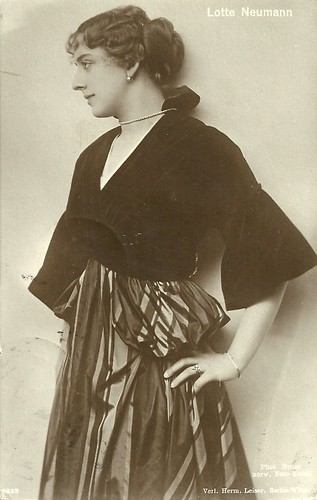
German postcard by Verlag Hermann Leiser, Berlin.
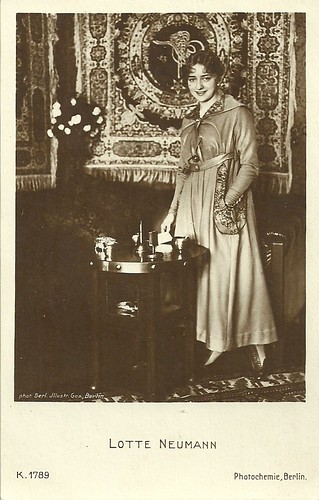
German postcard by Photochemie, Berlin, no. K. 1789. Photo: Berliner Illustrierte Ges. [Gesellschaft], Berlin.

German postcard by Photochemie, Berlin, no. K. 1799. Photo: Berlin Illustrierte Ges., Berlin.
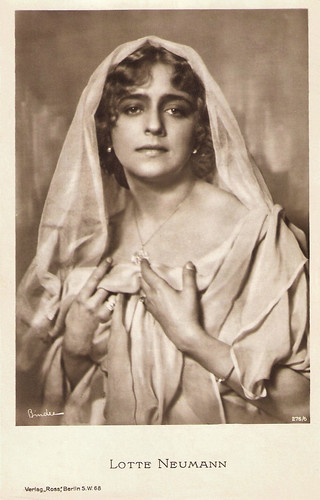
German postcard by Ross Verlag, no. 276/6, 1919-1924. Photo: Alex Binder.
From 1933, Lotte Neumann worked as a film writer under the pseudonym C.H. Diller. Diller was the maiden name of her mother.
In 1935, she married screenwriter Walter Wassermann and also started a professional partnership with him, which lasted until 1944.
She wrote a total of 25 screenplays, including Kora Terry (Georg Jacobi, 1940) for Ufa; Friedrich Schiller (Herbert Maisch, 1939) for Tobis; together with Walter Wassermann, Die Nacht in Venedig / The Night in Venice (Paul Verhoeven, 1941), and Altes Herz wird wieder jung / Old Heart Young Again (Erich Engel, 1942), both for Tobis.
After the war, she continued her work with two more screenplays for small productions until 1958.
She went to live at the residence of her mother in Gmund am Tegernsee, and later lived in Gaißach. Lotte Neumann died in 1977 in Gaißach, Germany.

German postcard by Ross Verlag, no. 276/1, 1919-1924. Photo: Alex Binder.

German postcard by Ross Verlag, no. 276/2, 1919-1924. Photo: Alex Binder.
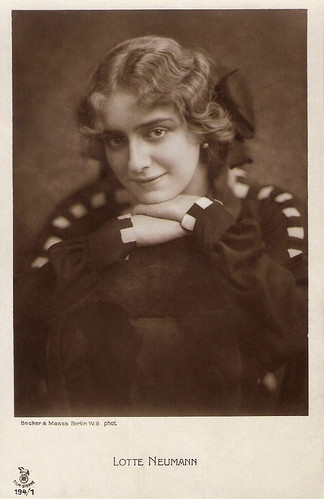
German postcard by Rotophot in the Film-Sterne series, no. 194/1. Photo: Becker & Maass, Berlin.
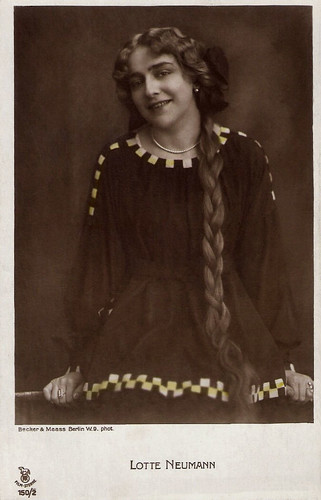
German postcard by Rotophot in the Film-Sterne series, no. 150/2. Photo: Becker & Maass, Berlin.
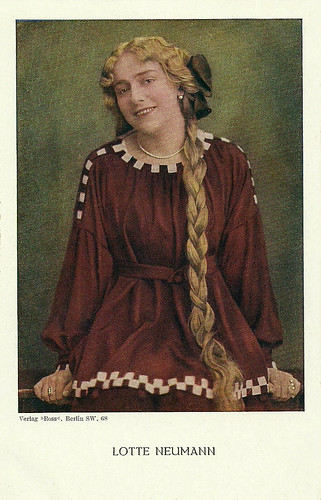
German postcard by Ross Verlag, Berlin.

German postcard by Verlag Ross, Berlin, no. 2001/7. Photo: Becker & Maass. Also on Film Sterne, no. 194/3.
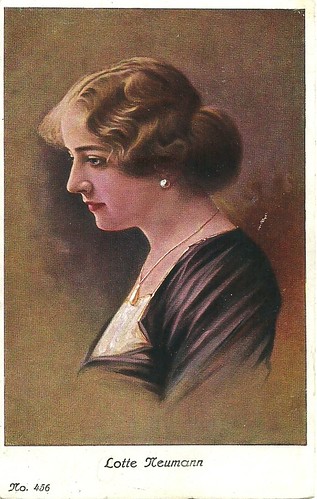
German postcard by MMB, no. 456. Part of the German colour postcards in the Moderne Künstler series by MMB, published in the late 1910s. Photo: F.J. Wesselsky.
Sources: Gabriele Hansch / Gerlinde Waz (Filmpionierinnen in Deutschland - German), Thomas Staedeli (Cyranos), Philippe Pelletier (Cineartistes - Now defunct), Wikipedia (German) and IMDb.
German postcard by Ross Verlag, no. 636/1. Photo: Maxim Film. Publicity still for the Ernst Lubitsch comedy Romeo und Julia im Schnee / Romeo and Juliet in the Snow (1920). The man on the left, dressed as an antique hero, is Julius Falkenstein as Paris. The others are Jakob Tiedtke (Herr Capulethofer), Marga Köhler (his wife), Lotte Neumann (Julia) and Gustav von Wangenheim (Romeo Montekugerl).
German postcard by Rotophot in the Film-sterne series, no. 94/2. Photo: NBFMB / Karl Schenker.
German postcard by Ross Verlag, Berlin, no. 340/5, 1919-1924. Photo: Becker & Maass / Maxim Film.
German postcard by Verlag Hermann Leiser, Berlin-Wilm., no. 5694. Photo: Atelier Eberth, Berlin.
German postcard by Verlag Hermann Leiser, Berlin-Wilm., no. 9894. Photo: J. Braae Photokunst, 1917.
German postcard by Rotophot, Berlin, in the Film-Sterne Series, no. 150/1, 1925-1935. Photo: Becker & Maass.
German postcard by Photochemie, Berlin, no. K. 2095. Photo: Lotte Neumann-Film. Lotte Neumann in Die Richterin / The Judge (Paul von Woringen, 1917).
Sherlock Holmes
Lotte Neumann was born as Charlotte Pötler in Berlin, Germany, in 1896.
She attended the Königliche Luisenschule (Royal Louise School) in Berlin, after which the Wagnersche-Klinkhardsche Höhere Mädchenschule (Wagnerian-Klinkhardsche Higher School for Girls).
She began her theatrical career as a 13-year-old choir singer at the Komische Oper (Comic Opera) and at the Komödienhaus (Comedy House) in Berlin.
In 1912, director Max Mack gave her her first film role in Die Launen des Schicksals / Whims of Fate (Max Mack, 1912) with Hanni Weisse.
In the following years, she acted in productions of the German Mutoscope and Biograph GmbH like Ketten der Vergangenheit / Chains of the Past (N.N., 1914), the Sherlock Holmes-film Ein seltsamer Fall / An Unusual Case (Max Mack, 1914), Der eiserne Ring / The Iron Ring (Paul von Woringen, 1915) and In letzter Sekunde / In the Last Second (Walter Schmidthässler, 1916).
German postcard by Photochemie, Berlin, no. K. 2091. Photo: Lotte Neumann-Film, Berlin. Lotte Neumann in Der Mut zum Glück / The Courage to Happiness (Paul von Woringen, 1917). This was the first film Neumann produced herself with her company, Lotte Neumann-Film.
German postcard by Photochemie, Berlin, K. 2096. Photo: Lotte Neumann-Film, Berlin. Lotte Neumann and Ernst Rückert in Hinter verschlossenen Türen / Behind Closed Doors (Paul von Woringen, 1917).
German postcard by Photochemie, Berlin, no. K. 2103. Photo: Lotte Neumann-Film, Berlin. Lotte Neumann in Der Geigenspieler / The Violin Player (Paul von Woringen, 1917).
German postcard by Photochemie, Berlin, no. K. 2168. Photo: Lotte Neumann-Film, Berlin. Lotte Neumann in Die Ehe der Charlotte von Brakel / The Marriage of Charlotte von Brakel (Paul von Woringen, 1918).
German postcard by Ross Verlag, Berlin, no. 631/3, 1919-1924. Photo: Maxim Film. Lotte Neumann in Das Schicksal der Carola von Geldern / The Fate of Carola von Geldern (Carl Froelich, 1919).
German postcard by Ross Verlag, Berlin, no. 620/1, 1919-1924. Photo: Maxim Film. Publicity still for Arme Thea / Poor Thea (Carl Froelich, 1919).
Shadows of the past
Lotte Neumann also appeared as a singer and actress on Berlin stages. Soon, she was so well-known that the studio shot a series of Lotte Neumann films.
In 1916, she founded the Lotte Neumann Film GmbH, which existed until 1919.
To these productions belong Hinter verschlossenen Türen / Behind Closed Doors (Paul von Woringen, 1917), Die Richterin / The Judge (Paul von Woringen, 1917), Das Schweigen im Walde / The Silence in the Forest (Paul von Woringen, 1918), Das Spiel mit dem Feuer / The Play With Fire (Paul von Woringen, 1918) and Schatten der Vergangenheit / Shadows of the Past (Paul von Woringen, 1919) - for which she was also the producer.
In 1918, she wrote her first screenplay, for Die Töchter des Herrn Dornberg / The Daughters of Mr. Dornberg (Paul von Woringen, 1918).
From 1919 on, she was committed to the Ufa.
German postcard by Photochemie, no. 5881. Photo: Willingen. Alice Hechy (here as Alice Scheel-Hechy), Lotte Neumann (here as Lotti Neumann), and Georg Baselt in the stage comedy 'Hochherrschaftliche Wohnungen' (Stately Homes) (1913), performed at the Komödienhaus, and written by Toni Impekoven. Caption: Are there at the Kadewe [department store] only such pretty ladies? Under the pseudonym Peter Panter, Kurt Tucholsky wrote a review of the play in Die Schaubühne (16, 17.04.1913).
German postcard by Photochemie, Berlin, no. K. 1812.
German postcard by Ross Verlag, Berlin, no. 339/1, 1919-1924. Photo: Becker & Maass / Maxim Film.
German postcard by Ross Verlag, Berlin, no. 339/2, 1919-1924. Photo: Becker & Maass / Maxim Film.
German postcard by Ross Verlag, no. 320/2, 1919-1924. Photo: Rembrandt / Maxim Film. Caption: Lotte Neumann in ihrer garderobe (Lotte Neumann in her wardrobe).
German postcard by Ross Verlag, Berlin, no. 320/6, 1919-1924. Photo: Rembrandt / Maxim Film. Caption: Lotte Neumann in ihrer garderobe (Lotte Neumann in her wardrobe).
Protracted divorce case
During the 1920s, Lotte Neumann remained a popular film actress who embodied aristocratic young women.
In 1920, she acted under the direction of Ernst Lubitsch in the comedy Romeo und Julia im Schnee / Romeo and Juliet in the Snow (1920), set in a 19th-century Alpine village.
Her biggest successes include the film operetta Die Brigantin von New York / The Brigantine, New York (Hans Werckmeister, 1924), Die Frau für 24 Stunden / The Woman for 24 hours (Reinhold Schünzel, 1925) with Harry Liedtke, and Der gute Ruf / The Good Reputation (Pierre Marodon, 1926).
She had film contracts in Austria, Italy and the Balkan States, for example, with Gaumont-Aubert in Paris and with Maldaria in Prague.
Because of her protracted divorce case, which ran from 1929 to 1932, she had to end her career as an actress. Her last film was Die Liebesfiliale (Carl Heinz Wolff, 1931) before she retired from the screen.
German postcard in the Film Sterne series by Rotophot, no. 150/4. Photo: Becker & Maass.
German postcard in the Film Sterne series by Rotophot, no. 150/5. Photo: Becker & Maass.
German postcard by Ross Verlag, Berlin, no. 338/3, 1919-1924. Photo: Maxim Film / Becker & Maass.
German postcard by Verlag Hermann Leiser, Berlin.
German postcard by Photochemie, Berlin, no. K. 1789. Photo: Berliner Illustrierte Ges. [Gesellschaft], Berlin.
German postcard by Photochemie, Berlin, no. K. 1799. Photo: Berlin Illustrierte Ges., Berlin.
German postcard by Ross Verlag, no. 276/6, 1919-1924. Photo: Alex Binder.
Screenplays
From 1933, Lotte Neumann worked as a film writer under the pseudonym C.H. Diller. Diller was the maiden name of her mother.
In 1935, she married screenwriter Walter Wassermann and also started a professional partnership with him, which lasted until 1944.
She wrote a total of 25 screenplays, including Kora Terry (Georg Jacobi, 1940) for Ufa; Friedrich Schiller (Herbert Maisch, 1939) for Tobis; together with Walter Wassermann, Die Nacht in Venedig / The Night in Venice (Paul Verhoeven, 1941), and Altes Herz wird wieder jung / Old Heart Young Again (Erich Engel, 1942), both for Tobis.
After the war, she continued her work with two more screenplays for small productions until 1958.
She went to live at the residence of her mother in Gmund am Tegernsee, and later lived in Gaißach. Lotte Neumann died in 1977 in Gaißach, Germany.
German postcard by Ross Verlag, no. 276/1, 1919-1924. Photo: Alex Binder.
German postcard by Ross Verlag, no. 276/2, 1919-1924. Photo: Alex Binder.
German postcard by Rotophot in the Film-Sterne series, no. 194/1. Photo: Becker & Maass, Berlin.
German postcard by Rotophot in the Film-Sterne series, no. 150/2. Photo: Becker & Maass, Berlin.
German postcard by Ross Verlag, Berlin.
German postcard by Verlag Ross, Berlin, no. 2001/7. Photo: Becker & Maass. Also on Film Sterne, no. 194/3.
German postcard by MMB, no. 456. Part of the German colour postcards in the Moderne Künstler series by MMB, published in the late 1910s. Photo: F.J. Wesselsky.
Sources: Gabriele Hansch / Gerlinde Waz (Filmpionierinnen in Deutschland - German), Thomas Staedeli (Cyranos), Philippe Pelletier (Cineartistes - Now defunct), Wikipedia (German) and IMDb.

No comments:
Post a Comment