Romanian-born actress Elizza La Porta (1904-1997) had a short-lived career in the late silent cinema of Germany. Her main claim to fame was her starring role in Der Student von Prag / The Man Who Cheated Life (1926). Between 1926 and 1930, she starred in 18 German productions. Most of the films were melodramas.

German postcard by Ross Verlag, no. 1694/1, 1927-1928. Photo: Sokal Film. Elizza La Porta plays the flower girl Liduschka in Der Student von Prag / The Man Who Cheated Life (1926), costarring Werner Krauss as Scapinelli and Conrad Veidt as the student Balduin.

German postcard by Ross Verlag, no. 1692/2, 1927-1928. Photo: Sokal-Film. Conrad Veidt plays the student Balduin and his double in Der Student von Prag / The Student of Pragu (Henrik Galeen 1926).
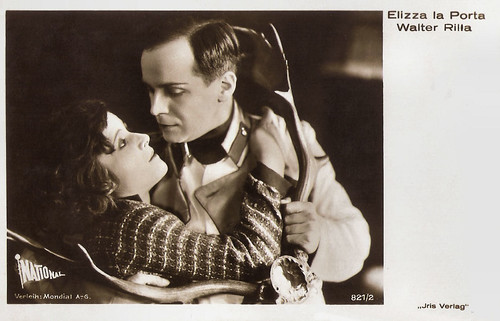
Austrian postcard by Iris Verlag, no. 821/2. Photo: National / Verleih Mondial A.G. Eliza La Porta and Walter Rilla in Die Sporck'schen Jäger / The Sporck Battalion (Holger-Madsen, 1927).
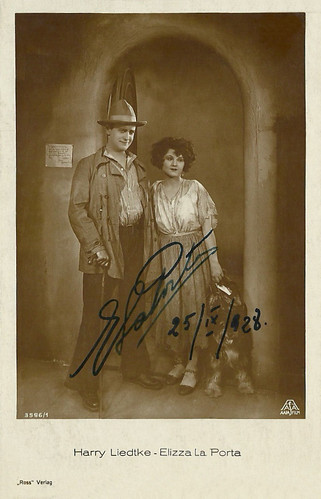
German postcard by Ross Verlag, no. 3596/1, 1928-1929 (Autograph of La Porta signed in 1928). Photo: Aafa-Film. Publicity still for the comedy Robert und Bertram / Robert and Bertram (Rudolf Walther-Fein, 1928) with Harry Liedtke. Collection: Didier Hanson
Elizza La Porta was born Eliza Streinu into a Jewish family in Craiova, Kingdom of Romania, in 1902. (Some sources say 1904). From a young age, she was drawn to the world of theatre, as her father was the manager of the theatre in Craiova. She dreamed of becoming an actress and, at age 14, enrolled in the Drama Department at the Conservatory. She made her debut at age 16 on the stage in Craiova in a supporting role. Her career took a different turn after she got married. She made her first films there under the direction of her husband.
She followed her husband to Germany. She enjoyed only one year of a happy marriage. Her husband died, and she was left a widow with a child. She was subsequently signed up by a Dutch film production company in Amsterdam. A year later, she settled again in Berlin and made her German film debut in Martin Berger’s Die Schmiede (1924). She slightly altered her name to Elizza whilst retaining her married surname. Apart from a few bit-part roles, Elizza La Porta remained largely unemployed at first.
Her German career took off in 1926 with such films as Schenk mir das Leben / Give me the Life (Klaus Fery, 1926), Der Herr der Nacht / Man of the Night (Carl Heinz Wolff, 1926) starring Rudolf Klein-Rogge, and the comedy Die Spork'schen Jäger / The Secret of the Night (Holger-Madsen, 1926) with Otto Gebühr and Walter Rilla.
La Porta flamed in the Horror film Der Student von Prag / The Man Who Cheated Life (Henrik Galeen, 1926) as the flower girl Lyduschka, who is in love with the student Balduin (Conrad Veidt). The penniless Balduin sells his mirror image to a mysterious merchant (Werner Krauss), and his reflection becomes a devilish Doppelgänger.
This first remake of the classic film from 1913 with Paul Wegener is largely based on the original screenplay by Hanns Heinz Ewers. Der Student von Prag made La Porta a well-known actress.

German postcard by Ross Verlag, no. 3041/1, 1928-1929. Photo: Ufa.
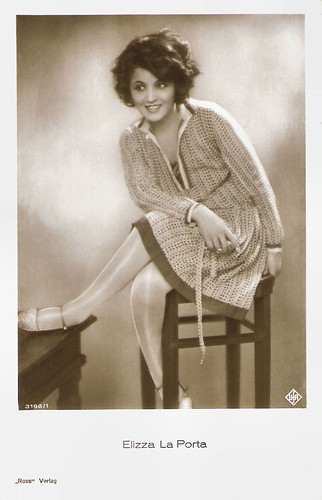
German postcard by Ross Verlag, no. 3198/1 1928-1929. Photo: Ufa.
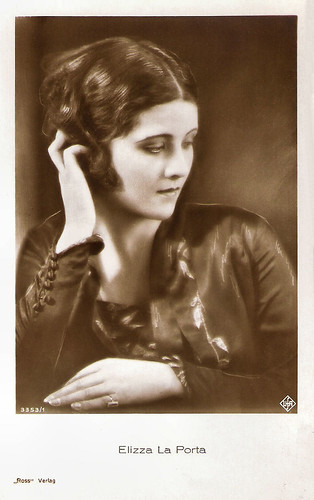
German postcard by Ross Verlag, no. 3353/1, 1928-1929. Photo: Ufa.
Subsequently, Elizza La Porta acted in films like Leichte Kavallerie / Light Cavalry (Rolf Randolf, 1927) with Alphons Fryland, and Laster der Menschheit / Vice of Mankind (Rudolf Meinert, 1927) with Asta Nielsen.
The next year, she played in Die Frauengasse von Algier / The Street of Women of Algiers (Wolfgang Hoffmann-Harnisch, 1928) with Maria Jacobini, and Robert und Bertram / Robert and Bertram (Rudolf Walther-Fein, 1928) with Harry Liedtke and Fritz Kampers.
In the late 1920s, La Porta played female leads in a few German sound films, including Engel im Separée / Angels in the Private Room (Ernö Mayer, 1929) and Grossstadtpiraten / Big City Pirates (Hans Schönlank, 1930). Her last film appearance was a supporting part in Fundvogel / Finding Bird (Wolfgang Hoffmann-Harnisch, 1930), starring Paul Wegener and Camilla Horn.
After the advent of sound films and the decline of silent films, the career of the actress began to wane. On 1 March 1933, she married the Jewish merchant Siegfried Pinkus and was excluded from the film industry by the Nazis. Her chance to land a role in 1937 alongside her friend Heinz Rühmann in the comedy Der Mustergatte / The Model Husband (Wolfgang Liebeneiner, 1937) came to nothing.
Consequently, the Pinkus couple decided to emigrate to the USA. In October 1940, they both arrived in New York City, where they initially settled. Eliza and Siegfried Pinkus, who had become US citizens in 1946, subsequently moved to Los Angeles. Despite the proximity to Hollywood, Elizza La Porta never returned to acting. She was widowed again at the age of 59. Elizza La Porta died in 1997 in West Hollywood, Los Angeles, California, USA. She was 95. She was buried at Hollywood Forever Cemetery.
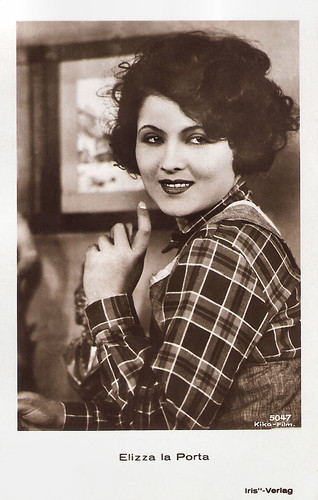
Austrian postcard by Iris-Verlag, no. 5047. Photo: Kiko-Film.

Austrian postcard by Iris Verlag, no. 821/1 Photo: National / Verleih Mondial A.G. Walter Rilla and Eliza La Porta in Die Sporck'schen Jäger /The Sporck Battalion (Holger-Madsen, 1927).

German postcard by Ross Verlag, no. 3609/1, 1928-1929. Photo: Atelier Manassé, Wien (Vienna). Collection: Didier Hanson.
German postcard by Ross Verlag, no. 1694/1, 1927-1928. Photo: Sokal Film. Elizza La Porta plays the flower girl Liduschka in Der Student von Prag / The Man Who Cheated Life (1926), costarring Werner Krauss as Scapinelli and Conrad Veidt as the student Balduin.
German postcard by Ross Verlag, no. 1692/2, 1927-1928. Photo: Sokal-Film. Conrad Veidt plays the student Balduin and his double in Der Student von Prag / The Student of Pragu (Henrik Galeen 1926).
Austrian postcard by Iris Verlag, no. 821/2. Photo: National / Verleih Mondial A.G. Eliza La Porta and Walter Rilla in Die Sporck'schen Jäger / The Sporck Battalion (Holger-Madsen, 1927).
German postcard by Ross Verlag, no. 3596/1, 1928-1929 (Autograph of La Porta signed in 1928). Photo: Aafa-Film. Publicity still for the comedy Robert und Bertram / Robert and Bertram (Rudolf Walther-Fein, 1928) with Harry Liedtke. Collection: Didier Hanson
A devilish doppelgänger
Elizza La Porta was born Eliza Streinu into a Jewish family in Craiova, Kingdom of Romania, in 1902. (Some sources say 1904). From a young age, she was drawn to the world of theatre, as her father was the manager of the theatre in Craiova. She dreamed of becoming an actress and, at age 14, enrolled in the Drama Department at the Conservatory. She made her debut at age 16 on the stage in Craiova in a supporting role. Her career took a different turn after she got married. She made her first films there under the direction of her husband.
She followed her husband to Germany. She enjoyed only one year of a happy marriage. Her husband died, and she was left a widow with a child. She was subsequently signed up by a Dutch film production company in Amsterdam. A year later, she settled again in Berlin and made her German film debut in Martin Berger’s Die Schmiede (1924). She slightly altered her name to Elizza whilst retaining her married surname. Apart from a few bit-part roles, Elizza La Porta remained largely unemployed at first.
Her German career took off in 1926 with such films as Schenk mir das Leben / Give me the Life (Klaus Fery, 1926), Der Herr der Nacht / Man of the Night (Carl Heinz Wolff, 1926) starring Rudolf Klein-Rogge, and the comedy Die Spork'schen Jäger / The Secret of the Night (Holger-Madsen, 1926) with Otto Gebühr and Walter Rilla.
La Porta flamed in the Horror film Der Student von Prag / The Man Who Cheated Life (Henrik Galeen, 1926) as the flower girl Lyduschka, who is in love with the student Balduin (Conrad Veidt). The penniless Balduin sells his mirror image to a mysterious merchant (Werner Krauss), and his reflection becomes a devilish Doppelgänger.
This first remake of the classic film from 1913 with Paul Wegener is largely based on the original screenplay by Hanns Heinz Ewers. Der Student von Prag made La Porta a well-known actress.
German postcard by Ross Verlag, no. 3041/1, 1928-1929. Photo: Ufa.
German postcard by Ross Verlag, no. 3198/1 1928-1929. Photo: Ufa.
German postcard by Ross Verlag, no. 3353/1, 1928-1929. Photo: Ufa.
Sound
Subsequently, Elizza La Porta acted in films like Leichte Kavallerie / Light Cavalry (Rolf Randolf, 1927) with Alphons Fryland, and Laster der Menschheit / Vice of Mankind (Rudolf Meinert, 1927) with Asta Nielsen.
The next year, she played in Die Frauengasse von Algier / The Street of Women of Algiers (Wolfgang Hoffmann-Harnisch, 1928) with Maria Jacobini, and Robert und Bertram / Robert and Bertram (Rudolf Walther-Fein, 1928) with Harry Liedtke and Fritz Kampers.
In the late 1920s, La Porta played female leads in a few German sound films, including Engel im Separée / Angels in the Private Room (Ernö Mayer, 1929) and Grossstadtpiraten / Big City Pirates (Hans Schönlank, 1930). Her last film appearance was a supporting part in Fundvogel / Finding Bird (Wolfgang Hoffmann-Harnisch, 1930), starring Paul Wegener and Camilla Horn.
After the advent of sound films and the decline of silent films, the career of the actress began to wane. On 1 March 1933, she married the Jewish merchant Siegfried Pinkus and was excluded from the film industry by the Nazis. Her chance to land a role in 1937 alongside her friend Heinz Rühmann in the comedy Der Mustergatte / The Model Husband (Wolfgang Liebeneiner, 1937) came to nothing.
Consequently, the Pinkus couple decided to emigrate to the USA. In October 1940, they both arrived in New York City, where they initially settled. Eliza and Siegfried Pinkus, who had become US citizens in 1946, subsequently moved to Los Angeles. Despite the proximity to Hollywood, Elizza La Porta never returned to acting. She was widowed again at the age of 59. Elizza La Porta died in 1997 in West Hollywood, Los Angeles, California, USA. She was 95. She was buried at Hollywood Forever Cemetery.
Austrian postcard by Iris-Verlag, no. 5047. Photo: Kiko-Film.
Austrian postcard by Iris Verlag, no. 821/1 Photo: National / Verleih Mondial A.G. Walter Rilla and Eliza La Porta in Die Sporck'schen Jäger /The Sporck Battalion (Holger-Madsen, 1927).
German postcard by Ross Verlag, no. 3609/1, 1928-1929. Photo: Atelier Manassé, Wien (Vienna). Collection: Didier Hanson.
First scenes of Der Student von Prag / The Man Who Cheated Life (1926). Source: Silent Film Democracy (YouTube).
Sources: Elisabeth Bouleanu (Advarul - Romanian), Thomas Staedeli (Cyranos), Filmportal, Wikipedia (English, Italian and German) and IMDb.
This post was last updated on 30 April 2026.

No comments:
Post a Comment