
French photo card by Cinéma Pathé. Scene from Le bateau de Léontine (N.N., 1911). It is unclear who played the lead in the typical nasty lady series of Léontine ('Titine'), a girl always into terrible mischief.
Titine has received for her party a superb three-master. She has promised her parents to be very good in their absence, but she cannot resist the temptation to sail her boat. She turns the kitchen faucets wide-open, so the room serves as a pool to her exploits. Soon, the ship is sailing in the 'open sea', but Titine is still dissatisfied. However, the water, crossing the floor, flows in large streams onto the lower floors, drowning the tenants and transforming the stairs into impassable torrents. Titine, unsuspecting of the dramas that take place below her, quietly floats in a barrel amidst the disaster.

French photo card by Cinéma Pathé. Photo: SCAG / Pathé Frères. Andrée Marly in Deux vieux garçons (Michel Carré, 1911). Carré also scripted the film. Marly is playing the piano. Her lover (not visible) is played by Charles Maudru. The two old men, courting young Katje in vain and finally giving in, are Louis Baron fils and Georges Coquet. The old woman playing the maid is Marie Ernestine Desclauzas, who was a renowned stage actress in the late 19th century. In real life, Marly was married to Coquet. The setting and costumes in this film refer to the popular Dutch village of Volendam.
Van Peterbon and Van Hoosplott, who had grown old as bachelors, took in their orphaned niece, the pretty Katje. The presence of little Katje, charming beneath her bonnet with golden antennae, troubled the hearts and sleep of the two old bachelors. Meanwhile, Katje, unaware of their feelings, dreams of the young Kobe, who is courting her. The two young people, with the help of the maid, write a marriage proposal to each of the two uncles. Upon receiving this letter, Van Peterbon and Van Hoosplott explode with rage. Then indignation gives way to concern. Could Katje have found out something? When questioned, the maid reassures them, and the two uncles agree to bury the marriage proposals deep in their pockets. However, this move prompts them to each apply for her hand in marriage. But Katje's laughter puts an end to their declarations, and the young girl takes advantage of their confusion to introduce them to Kobe, whom she loves. Faced with the youthfulness of their rival, the two old bachelors become conscious of their wrinkles and white hair. So, gruff but benevolent, they give in to the pleas of the two lovers.

French photo card by Cinéma Pathé. Young Maurice Mathieu or Renée Pré (sources differ) as the son André in Le dévouement d'un gosse (Alfred Machin, 1911).
In a fairground hut where a curious crowd gathers in front of the menagerie, a drama suddenly unfolds between the brave tamer and one of his wild animals. Seriously injured by the furious beast, the man soon dies, leaving his wife and two children in need. Without its tamer, the menagerie is soon abandoned by the public, and poverty descends on the poor caravan. However, little André makes a big decision. Accustomed since early childhood to entering the cage with his father, he will replace the deceased tamer. The public then returned in droves to applaud the world's youngest tamer, while prosperity, thanks to the child's courage, returned to the humble caravan.

French photo card by Cinéma Pathé. Young Maurice Mathieu or Renée Pré (sources differ) as the son André in Le dévouement d'un gosse (Alfred Machin, 1911).

French photo card by Cinéma Pathé. Young Maurice Mathieu or Renée Pré (sources differ) as the son André in Le dévouement d'un gosse (Alfred Machin, 1911).

French photo card by Cinéma Pathé. Scene from the French silent film L'Homme de peine (Michel Carré, 1911). Carré also scripted the film.
A group of Parisians goes on a trip to Corsica, where they enjoy a carefree life. One of them, André Cartier (Dominique-Bernard Deschamps), discovers a pretty girl named Lina (Mme California), the daughter of a woodcutter, in the maquis. He falls in love with her and decides to take her back to Paris with him. Sciavola, the woodcutter (Jean Kemm), discovers his daughter's departure and lets his anger and despair explode. Months pass, bringing weariness on the part of the seducer and soon the end of his whim. Lina, abandoned, gives herself over to a dance from her country in the night restaurant where the break-up has just taken place. This dance wins her the affection of Prince Daniloff (Georges Tréville), who agrees to take her back to Ajaccio to see her country again. However, old Sciavola, aged, worn out and bent over with grief, has had to give up his job. He has become a labourer, working in the very hotel where Lina and her companion are staying. Finding himself in the presence of his guilty daughter, the old man is seized with terrible anger. He brandishes the log he was about to throw into the fire at the unfortunate girl. But just as he is about to strike her, Daniloff intervenes, and Sciavola, overcome with emotion, faints. The great lord, moved by his grief and genuinely enamoured with the young woman, will rehabilitate her by giving her his name.
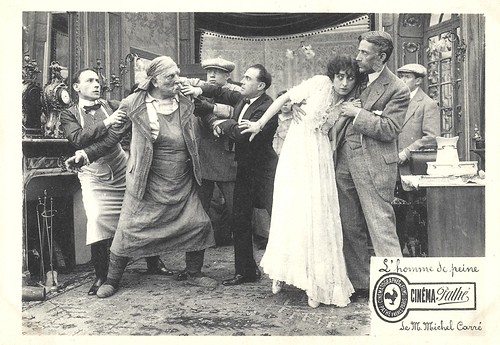
French photo card by Cinéma Pathé. Scene from the French silent film L'Homme de peine (Michel Carré, 1911).

French photo card by Cinéma Pathé. Photo: SCAGL / Pathé Frères. Lucie Pacitti as the daughter and Théodore Thalès as the clown in La fille du clown (Georges Denola, 1911), scripted by Maurice Kéroul.

French photo card by Cinéma Pathé. Photo: SCAGL / Pathé Frères. Lucie Pacitti as the daughter in La fille du clown (Georges Denola, 1911), scripted by Maurice Kéroul.

French photo card by Cinéma Pathé. Photo: Pathé Frères. Still for the film Le foyer perdu (N.N., 1911), scripted by Gustave Grillet (director unknown).
Robert Desroches (Jean Kemm) lives apart from his wife (Eva Raynal) and son Lucien (Maria Fromet). On the occasion of Lucien's birthday, he begs the boy's mother to send him the child. Lucien, having received a beautiful pony from his father as a gift, gives him a present, and Robert Desroches is deeply moved when he sees that it is a portrait of his wife. A visit from a friend distracts him, and while Lucien rides his little horse, the two friends practise shooting with pistols. Suddenly, little Lucien, tired of his mount, grabs one of the guns and, before anyone has time to intervene, fires, seriously wounding his father. Mrs Desroches, seeing her husband's suffering, forgets all her grievances and comes to care for him. And when her rival (Gabrielle Robinne) has left, perhaps she will return.

French photo card by Cinéma Pathé. Photo: Pathé Frères. Still for the film Le foyer perdu (N.N., 1911), scripted by Gustave Grillet.

French photo card by Cinéma Pathé. Photo: Pathé Frères. Still for the film Le foyer perdu (N.N., 1911), scripted by Gustave Grillet.

French photo card by Cinéma Pathé. Photo: Pathé Frères / Pathé Comica. Sarah Duhamel as Rosalie in Rosalie a trouvé du travail (N.N., 1911).
Rosalie is hired as a worker at a fashion shop, but has to promise to be at work always at 7 sharp. The next morning, she awakens at 10 to 7, shoots out of bed, dresses in haste, jumps down the stairs, and crosses the obstacles like a tornado. After a dishevelled run full of wild episodes, Rosalie arrives, red-headed and muddy, scarred with snags, at the fashion shop, only to read the sign on the closed front door, 'closed on Sundays and holidays'.
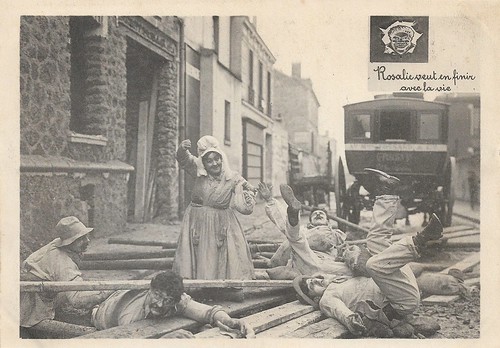
French photo card by Cinéma Pathé. Photo: Pathé Frères / Pathé Comica. Sarah Duhamel as Rosalie in Rosalie veut en finir avec la vie (N.N., 1911).
Rosalie is fired, so she wants to commit suicide. She shoots herself with a revolver, but only destroys the mirror. She throws herself on the tramway rails, but, alas, this one takes another track. She throws herself from a parapet but in vain. Desperate, she goes into a gun shop, throws a bomb and mounts to heaven, but it only causes her to descend again, this time in the arms of a well-moustached police officer, so she gets lust for life again.

French photo card by Cinéma Pathé. Photo: Pathé Frères. Max Linder and Olga Demidoff as the mother-in-law in Max et sa belle-mère / Max and His Mother-In-Law (Max Linder, Pathé 1911). The man in the back is Jacques Vandenne. The young woman to the right of Linder may be Paulette Lorsy, playing his wife.
French comedian Max Linder (1883-1925), with his trademark silk hat, stick and moustache, was an influential pioneer of silent film. He was largely responsible for the creation of the classic style of silent slapstick comedy, and he was the highest-paid entertainer of his day.

French photo card by Cinéma Pathé. Photo: Pathé Frères / S.C.A.G.L. Charles Prince in Rigadin veut se faire arrêter (Georges Monca, 1911). Scripted by Gabriel Timmory.
Charles Prince (1872-1933), aka ‘Prince’, was a French film actor, director and writer. He was famous for his countless comical shorts with his alter ego Rigadin. Rigadin veut se faire arrêter (1911) was strongly based on an earlier film with a similar plot: La purée veut se faire arrêter (1908). A bum eats without paying, thus hoping to get food and lodging at the police station. Yet, he manages to get away with it. When he suddenly gets money and orders a huge meal, the restaurant owner warns the police and our poor bum is arrested after all.

French photo card by Cinéma Pathé. Photo: Pathé Frères / S.C.A.G.L. Georges Dorival (the father), Darmody (the mother), Marie Fromet (Pierrot) and little Carina (the little sweep) in the sentimental drama Oiseau de printemps, hirondelle d'hiver (Georges Denola, 1911). Scripted by E. M. Laumann.
Both boy roles were played by girls. The poor little sweep, maltreated by his boss, saves the life of little Jean and is afterwards adopted by the family of Jean. Georges Édouard Lemarchand, known as Dorival or Georges Dorival (1871-1939), was a French stage and screen actor of Norman origin, a painter and an important art collector.

French photo card by Pathé Frères. Georges Vinter as the detective Nick Winter in Le Pickpocket mystifié (N.N., 1911).
Nick Winter, the astonishing detective, is in Le Pickpocket mystifié (N.N., 1911) hot on the trail of a clever crook. Winter catches him in a bank where he is robbing a bank clerk's wallet with unparalleled skill and audacity, using a cleverly rigged cane. In an instinctive move, the detective reaches into the thief's pocket, but this gesture makes him look like a thief himself in the eyes of the bank clerk, who calls the police. Nick, handcuffed, is taken to the police station, followed by his thief, who has now become the complainant. But there, the roles are reversed, and the clever policeman has no trouble exposing his adversary.

French photo card by Pathé Frères. The title of the film is crossed, but it might have been the comedy Le chapeau de Jobard /Jobard's hat (Emile Cohl, 1911). Lucien Cazalis, aka Jobard, made 13 short comedies in 1911, directed by Emile Cohl.
Paris is so unsafe and the pickpockets so bold that Jobard, ever cautious, puts a large sum of money he has just received in banknotes into his top hat. Unfortunately, his bad luck means that during a visit to a client, a distracted maid exchanges Jobard's top hat for her boss's. When he realises what has happened, Jobard, in a panic, rushes to every hat he sees, but unfortunately fails to find the one hiding his treasure, and ends up being rebuffed time and time again. Mistaken for a madman, poor Jobard is taken to the hospital and showered without mercy. Fortunately, the doctor on duty happens to be Jobard's customer, and Jobard finally regains his hat, his treasure and his freedom.

French photo card by Pathé Frères. Photo: Pathé Frères. Scene from the comedy Le cache-poussière / The Dust-cover (N.B., 1911). The film was shot in the South of France.
Robert, allowed to go to lunch with his fiancée at the Réserve de Beaulieu, borrows his uncle's car, dust cover and... money. While the two lovers stroll along the enchanting shores of the Côte d'Azur, Robert's aunt encounters them, recognises her husband's car and dust cover, and, believing herself betrayed, hails a taxi and sets off in pursuit. After a turbulent chase, she catches up with them at the hotel, where the imbroglio is resolved to everyone's satisfaction.

French photo card by Pathé Frères. Photo: Pathé Frères/ Modern Pictures, Scene from La ruse du petit ramoneur / The Little Sweep's Stratagem (Camille de Morlhon, 1911).
Jean, the little Savoyard boy (and a little sweep), having come into some money, enters a bakery to treat himself to the unusual luxury of a croissant. The baker, a kind woman, gives him a free cake, which Jean enjoys with delight. A few steps away, the little chimney sweep, struck by the suspicious behaviour of two individuals, follows them, spies on them and discovers their plot: to rob the bakery. As soon as they climb through the window, little Jean quickly secures the shutters with strong ropes, enters the shop and locks the door to the room where the two thieves are operating. The burglars, trapped, take refuge, one in the chimney, the other in the kneading trough. And it is black as coal and white as a baker's boy that they are caught by the police and taken to the station, thanks to the little chimney sweep, who has paid his debt of gratitude with interest.
Sources: Fondation-Jerome Seydoux - Pathe and IMDb.

No comments:
Post a Comment