Austrian actor Rudolf Prack (1905-1981) was once 'the most often kissed man of the German cinema’. Nowadays he is mainly connected with his Heimatfilms of the 1950s, but his career already started in the middle of the 1930s.

German Postcard by Film-Foto-Verlag, no. G 121. Photo Baumann / Ufa.

German postcard by Film-Foto-Verlag, no. A 3849/1, 1941-1944. Photo: Baumann.

German postcard by Film-Foto-Verlag, no. A 3741/2, 1941-1944. Photo: Baumann / Ufa.

German postcard by Ufa (Universal-Film Aktiengesellschaft, Berlin-Tempelhof), no. CK-119. Retail price: 30 Pfg. Photo: Arthur Grimm.
Rudolf Anton Prack was born in Vienna, Austria-Hungary (now Austria), in 1905. He was the son of Rudolf Prack, a postman, and his wife, Melanie Elisabeth.
He visited a commercial academy and finished an apprenticeship as a bank clerk. Rudolf Jr. then worked for a bank to be able to finance his acting classes at the Max-Reinhardt-Seminar in Schönbrunn. Prack started his stage career in Vienna under Hans Thimig at Theater in der Josefstadt, and he made his film debut in the musical comedy Florentine (Carl Lamac, 1938).
In 1939, Gustav Ucicky contracted Prack for Wien-Film. The handsome actor celebrated his first major success in Mutterliebe / Mother Love (Gustav Ucicky, 1939) with Käthe Dorsch. His part as the poacher Thomas Werndl in Krambambuli (Karl Köstlin, 1940) finally turned him into a public idol.
He cemented his fame with films like Die goldene Stadt / The Golden City (Veit Harlan, 1942), Reise in die Vergangenheit / Journey Into the Past (Hans H. Zerlett, 1943) and the Crime film Orient-express / Orient Express (Viktor Tourjansky, 1944).
From July 1938, Rudolf Prack was a member of the SA with the rank of Sturmmann; in this capacity, he was also present at the 1938 Reich Party Congress in Nuremberg. However, according to his SA service record issued in February 1939, Prack was not a member of the NSDAP. In 1944, he was included in the ‘God-blessed’ list of the Reich Ministry of Public Enlightenment and Propaganda.

German postcard by Film-Foto-Verlag, no. 3741/1, 1941-1944. Photo: Baumann / Ufa.

German postcard by Film-Foto-Verlag, no. A 3471/1, 1941-1944. Photo: Baumann / Ufa.

German postcard by Film-Foto-Verlag, no. A 3563/1, 1941-1944. Photo: Baumann / Ufa.

German postcard by Kunst und Bild, Berlin, no. A 493. Photo: Berolina Herzog Film. Still from Johannes und die 13 Schönheitsköniginnen / Johannes and the 13 Beauty Queens (Alfred Stöger, 1951).
After the war, the needs of the German public had changed completely. They had to fight against doubt, unemployment and a restricted view of the future. At the end of the 1940s and the beginning of the 1950s, Rudolf Prack became the 'nice, young gentleman', the ideal protagonist of the post-war generation.
During the Wirtschaftswunder era, the Heimatfilm arose. These regional films abducted the audience into the alleged world of nature. Prack always was the noble, helpful and benign protagonist in these films. His film roles earned him the reputation of being the ‘most kissed man in German cinema’. Although Rudolf Prack was already in his fifties at the time and many of his co-stars were over 20 years his junior, the age difference was never an issue in the films.
Together with actress Sonja Ziemann, Rudolf Prack formed the dream couple of six Heimatfilms, such as Schwarzwaldmädel / The Black Forest Girl (Hans Deppe, 1950) and Grün ist die Heide / The Heath Is Green (Hans Deppe, 1951). In the latter, he played the noble-minded, yet dashing ranger, which turned out to be his showcase role. In 1949 and 1950, Prack was awarded a Bambi.
In Die Privatsekretärin / The Private Secretary (Paul Martin, 1953), a typist falls in love with his character, a general director who travels incognito. The film conveys the feeling of unlimited advancement in the Wirtschaftswunder era.
Other popular films were Die Diebin von Bagdad / The Thief of Bagdad (Carl Lamac, 1952), Roman eines Frauenarztes / Novel of a Gynaecologist (Falk Harnack, 1954), Dany, bitte schreiben Sie / Dany, Please Write Me (Eduard von Borsody, 1956), and Du bist wunderbar / You Are Wonderful (Paul Martin, 1959), with singer Caterina Valente.

Austrian postcard by HDH Verlag (Verlag Hubmann), Wien (Vienna), no. 170. Photo: International Film. Publicity still for Lockende Sterne / Alluring star (Hans Müller, 1952).

German postcard by Rüdel-Verlag, Hamburg-Bergedorf, no. 607. Photo: Von Neusser / Gloria / Gundlach. Rudolph Prack and Winnie Markus in Kaiserwalzer / The Emperor Waltz (Franz Antel, 1953).

German postcard by Kolibri-Verlag G.m.b.H., Minden/Westf., no. 2952. Photo: CCC / Gloria. Caterina Valente and Rudolf Prack in Das einfache Mädchen / The Simple Girl (Werner Jacobs, 1957).

Dutch postcard by Gebr. Spanjersberg N.V., Rotterdam, no. 5423. Photo: Hafbo-film. Caterina Valente and Rudolf Prack in Du bist wunderbar / You Are Wonderful (1959).
Rudolf Prack's film activities diminished in the 1960s.
He took part in Die junge Sünderin / The Young Sinner (Rudolf Jugert, 1960), featuring Karin Baal, Mariandl (Werner Jacobs, 1961), Schwejks Flegeljahre / Schweik's Years of Indiscretion (Wolfgang Liebeneiner, 1963) opposite Peter Alexander, and Heidi (Werner Jacobs, 1965).
When his popularity slumped, Prack started to write radio plays and short stories. He also appeared in TV productions during the 1960s and 1970s. During the mid-1960s, Prack became a TV star as a country doctor in the TV series Landarzt Dr. Brock.
To his last films belong Karl May (Hans Jürgen Syberberg, 1974), starring Helmut Käutner as the writer Karl May, and the WW I-film Die Standarte / The Standard (Ottokar Runze, 1977) with Peter Cushing. With his unsympathetic role in the acclaimed film Jesus von Ottakring (Wilhelm Pellert, 1975), he surprised many Austrian audiences.
Rudolf Prack retired from acting in 1976 and died of pneumonia in 1981 in Vienna, Austria. He was buried at Hietzing Cemetery. Prack and his wife Maria Heinisch had three children, Adelheid, Adalberta and Michael. Although he was called ‘the quintessential lover of post-war German and Austrian cinema’, Prack reportedly described himself as a ‘womaniser against his will’.

German postcard by Kolibri-Verlag. Photo: Wesel.
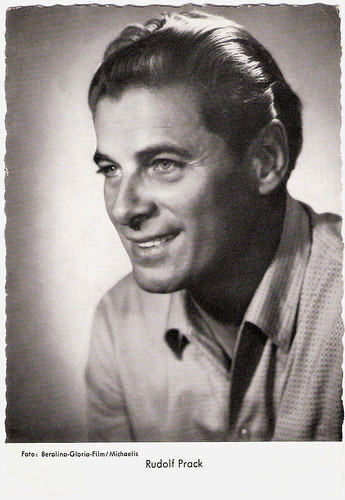
German postcard by WS-Druck, Wanne-Eickel. Photo: Berolina - Gloria-Film / Michaelis.

Dutch postcard by N.V. v.h. Weenenk & Snel, Baarn. Photo: Conny Froboess in Mariandl (Werner Jacobs, 1961). The man on the postcard is not the mentioned Günther Philipp but Rudolf Prack.

German postcard by Ufa (Universal-Film Aktiengesellschaft, Berlin-Tempelhof), no. CK-50. Retail price: 30 Pfg. Photo: Ringpress / Vogelmann.
Sources: Thomas Staedeli (Cyranos), Filmportal, Wikipedia (German), and IMDb.
This post was last updated on 11 May 2026.
German Postcard by Film-Foto-Verlag, no. G 121. Photo Baumann / Ufa.
German postcard by Film-Foto-Verlag, no. A 3849/1, 1941-1944. Photo: Baumann.
German postcard by Film-Foto-Verlag, no. A 3741/2, 1941-1944. Photo: Baumann / Ufa.
German postcard by Ufa (Universal-Film Aktiengesellschaft, Berlin-Tempelhof), no. CK-119. Retail price: 30 Pfg. Photo: Arthur Grimm.
Krambambuli
Rudolf Anton Prack was born in Vienna, Austria-Hungary (now Austria), in 1905. He was the son of Rudolf Prack, a postman, and his wife, Melanie Elisabeth.
He visited a commercial academy and finished an apprenticeship as a bank clerk. Rudolf Jr. then worked for a bank to be able to finance his acting classes at the Max-Reinhardt-Seminar in Schönbrunn. Prack started his stage career in Vienna under Hans Thimig at Theater in der Josefstadt, and he made his film debut in the musical comedy Florentine (Carl Lamac, 1938).
In 1939, Gustav Ucicky contracted Prack for Wien-Film. The handsome actor celebrated his first major success in Mutterliebe / Mother Love (Gustav Ucicky, 1939) with Käthe Dorsch. His part as the poacher Thomas Werndl in Krambambuli (Karl Köstlin, 1940) finally turned him into a public idol.
He cemented his fame with films like Die goldene Stadt / The Golden City (Veit Harlan, 1942), Reise in die Vergangenheit / Journey Into the Past (Hans H. Zerlett, 1943) and the Crime film Orient-express / Orient Express (Viktor Tourjansky, 1944).
From July 1938, Rudolf Prack was a member of the SA with the rank of Sturmmann; in this capacity, he was also present at the 1938 Reich Party Congress in Nuremberg. However, according to his SA service record issued in February 1939, Prack was not a member of the NSDAP. In 1944, he was included in the ‘God-blessed’ list of the Reich Ministry of Public Enlightenment and Propaganda.
German postcard by Film-Foto-Verlag, no. 3741/1, 1941-1944. Photo: Baumann / Ufa.
German postcard by Film-Foto-Verlag, no. A 3471/1, 1941-1944. Photo: Baumann / Ufa.
German postcard by Film-Foto-Verlag, no. A 3563/1, 1941-1944. Photo: Baumann / Ufa.
German postcard by Kunst und Bild, Berlin, no. A 493. Photo: Berolina Herzog Film. Still from Johannes und die 13 Schönheitsköniginnen / Johannes and the 13 Beauty Queens (Alfred Stöger, 1951).
Dream couple of the Heimatfilm
After the war, the needs of the German public had changed completely. They had to fight against doubt, unemployment and a restricted view of the future. At the end of the 1940s and the beginning of the 1950s, Rudolf Prack became the 'nice, young gentleman', the ideal protagonist of the post-war generation.
During the Wirtschaftswunder era, the Heimatfilm arose. These regional films abducted the audience into the alleged world of nature. Prack always was the noble, helpful and benign protagonist in these films. His film roles earned him the reputation of being the ‘most kissed man in German cinema’. Although Rudolf Prack was already in his fifties at the time and many of his co-stars were over 20 years his junior, the age difference was never an issue in the films.
Together with actress Sonja Ziemann, Rudolf Prack formed the dream couple of six Heimatfilms, such as Schwarzwaldmädel / The Black Forest Girl (Hans Deppe, 1950) and Grün ist die Heide / The Heath Is Green (Hans Deppe, 1951). In the latter, he played the noble-minded, yet dashing ranger, which turned out to be his showcase role. In 1949 and 1950, Prack was awarded a Bambi.
In Die Privatsekretärin / The Private Secretary (Paul Martin, 1953), a typist falls in love with his character, a general director who travels incognito. The film conveys the feeling of unlimited advancement in the Wirtschaftswunder era.
Other popular films were Die Diebin von Bagdad / The Thief of Bagdad (Carl Lamac, 1952), Roman eines Frauenarztes / Novel of a Gynaecologist (Falk Harnack, 1954), Dany, bitte schreiben Sie / Dany, Please Write Me (Eduard von Borsody, 1956), and Du bist wunderbar / You Are Wonderful (Paul Martin, 1959), with singer Caterina Valente.
Austrian postcard by HDH Verlag (Verlag Hubmann), Wien (Vienna), no. 170. Photo: International Film. Publicity still for Lockende Sterne / Alluring star (Hans Müller, 1952).
German postcard by Rüdel-Verlag, Hamburg-Bergedorf, no. 607. Photo: Von Neusser / Gloria / Gundlach. Rudolph Prack and Winnie Markus in Kaiserwalzer / The Emperor Waltz (Franz Antel, 1953).
German postcard by Kolibri-Verlag G.m.b.H., Minden/Westf., no. 2952. Photo: CCC / Gloria. Caterina Valente and Rudolf Prack in Das einfache Mädchen / The Simple Girl (Werner Jacobs, 1957).
Dutch postcard by Gebr. Spanjersberg N.V., Rotterdam, no. 5423. Photo: Hafbo-film. Caterina Valente and Rudolf Prack in Du bist wunderbar / You Are Wonderful (1959).
Heidi and Karl May
Rudolf Prack's film activities diminished in the 1960s.
He took part in Die junge Sünderin / The Young Sinner (Rudolf Jugert, 1960), featuring Karin Baal, Mariandl (Werner Jacobs, 1961), Schwejks Flegeljahre / Schweik's Years of Indiscretion (Wolfgang Liebeneiner, 1963) opposite Peter Alexander, and Heidi (Werner Jacobs, 1965).
When his popularity slumped, Prack started to write radio plays and short stories. He also appeared in TV productions during the 1960s and 1970s. During the mid-1960s, Prack became a TV star as a country doctor in the TV series Landarzt Dr. Brock.
To his last films belong Karl May (Hans Jürgen Syberberg, 1974), starring Helmut Käutner as the writer Karl May, and the WW I-film Die Standarte / The Standard (Ottokar Runze, 1977) with Peter Cushing. With his unsympathetic role in the acclaimed film Jesus von Ottakring (Wilhelm Pellert, 1975), he surprised many Austrian audiences.
Rudolf Prack retired from acting in 1976 and died of pneumonia in 1981 in Vienna, Austria. He was buried at Hietzing Cemetery. Prack and his wife Maria Heinisch had three children, Adelheid, Adalberta and Michael. Although he was called ‘the quintessential lover of post-war German and Austrian cinema’, Prack reportedly described himself as a ‘womaniser against his will’.
German postcard by Kolibri-Verlag. Photo: Wesel.
German postcard by WS-Druck, Wanne-Eickel. Photo: Berolina - Gloria-Film / Michaelis.
Dutch postcard by N.V. v.h. Weenenk & Snel, Baarn. Photo: Conny Froboess in Mariandl (Werner Jacobs, 1961). The man on the postcard is not the mentioned Günther Philipp but Rudolf Prack.
German postcard by Ufa (Universal-Film Aktiengesellschaft, Berlin-Tempelhof), no. CK-50. Retail price: 30 Pfg. Photo: Ringpress / Vogelmann.
Sources: Thomas Staedeli (Cyranos), Filmportal, Wikipedia (German), and IMDb.
This post was last updated on 11 May 2026.

2 comments:
Very Nice Blog.
Er war einer der ganz Großen nach dem Krieg und der meist geküsste Mann im deutschen Film. Er wird unvergessen bleiben. Seine Lebensgefährtin sagte einmal zu ihm, Du wirst in ihren Träumen immer die Hauptrolle spielen. Sie beschrieb ihn mit einem Wort " liebenswert "
Post a Comment