Dancer and film actress Violetta Napierska (1900-1985) appeared mainly in the German silent cinema. She co-starred with Béla Lugosi and Lee Parry in the Horror film Hypnose / Hypnosis (1920) and in several other films produced and directed by Richard Eichberg.

German postcard by Verlag Hermann Leiser, Berlin-Wilmersdorf, no. 7223. Photo: H.W. Mager, Berlin.
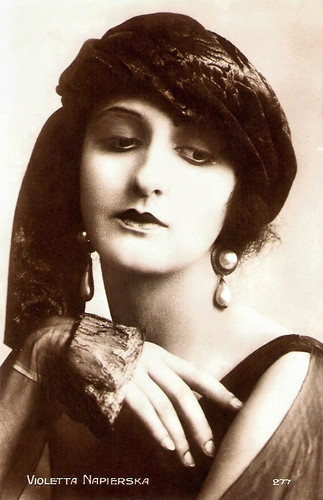
French postcard by Cinémagazine-Edition, Paris, no. 277.
According to the cigarette card below, Violetta (sometimes Violette) Napierska was a French variété dancer. According to Thomas Staedeli at Cyranos, she was born Violette Bertha Theodora Amélie Louise Ella Bella Heermann in 1900 in Geneva in Switzerland. She grew up in an artistic household and spent her childhood in Switzerland and France. After his military career, Victor Heermann, her German father, was a cellist at the Paris Opera. She received dance lessons from Isadora Duncan at a young age and performed as a dancer at the Opera Comique in Paris. As a German citizen, she was initially interned at the outbreak of the First World War in 1914 before she was able to leave for Switzerland. During the war years, she danced in benefit performances for the Red Cross. In 1919, she toured Switzerland and gave guest performances – now as Violetta Napierska – in Karlsruhe, Baden-Baden and at the National Theatre in Mannheim.
During a stay in Berlin, she came into contact with the film business. From 1919 on, she appeared in German silent films like Sünden der Eltern / Sins of the Elders (Richard Eichberg, 1919) and Nonne und Tänzerin / Nun and Dancer (Richard Eichberg, 1919), both starring German star Lee Parry. She then appeared in Die Abenteuer der Marquise von Königsmarck / The Adventures of the Marquise of Königsmarck (Emmerich Hanus, 1920) with Heinrich Schroth. For Richard Eichberg-Film, she next appeared in the two-part Der Fluch der Menschheit / The Curse of Man (Richard Eichberg, 1920), starring Lee Parry and Béla Lugosi.
According to Wikipedia, Napierska was Lugosi’s mistress at the time. According to a now-defunct MySpace blog on Lugosi, he had only fallen in love with her, and he even wrote her a poem: “One (poem) I wrote while living in Germany, working in the Budapest Theatre. I had fallen in love with a very young girl by the name of Violetta Napierska. Regretfully, nothing ever developed from our acquaintance.” Lugosi and Napierska worked together again on the Horror film Hypnose / Hypnosis (Richard Eichberg, 1920) and the two-parter Der Tanz auf dem Vulkan / Dance on the Volcano (Richard Eichberg, 1920), both co-starring Lee Parry. The U.S. version of the latter film was known as Daughter of the Night. For a long time, it was considered a lost film until an archive print was discovered in its American release version in the 1990s.
The success of these films led to another cooperation of the director and his stars: Ihre Hoheit die Tänzerin / Her Highness the Dancer (Richard Eichberg, 1922). The film was banned by the German Film Review Office, and it could not be shown in the Weimar Republic. The makers appealed, but the Office considered the film ‘corruptive’, and the appeal was rejected. A shortened version was again not approved. Finally, in early 1923, a version of the film, now renamed Der Leidensweg der Eva Grunwald / The Ordeal of Eva Grunwald, was approved, but considered suitable for adults only.
Violetta Napierska also filmed several times for Emelka under the direction of Franz Osten. Examples are Die Kette der Schuld / The Chain of Guilt (Franz Osten, 1921) and Der Verfluchte / The Cursed (Franz Osten, 1921). Opposite Ludwig Trautmann, she appeared in Die graue Macht / The Gray Power (Fred Stranz, 1923). Her last German film was Der Mitternachtszug/The Midnight Train (James Bauer, 1923).

German collector card by Eckstein-Halpaus, Dresden, in the series Die Tanzbühnen der Welt, Group 4 'Die Revue und Variétébühne', no. 218. Photo: Schneider. Caption: La Napierska, a French revue dancer who combines beauty with well-honed dancing skills.
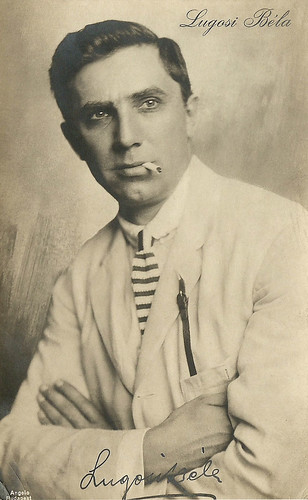
Béla Lugosi. Hungarian postcard. Photo: Angelo, Budapest. Collection: Didier Hanson.
After her marriage to Italian film producer Giovanni Seyta, Violetta Napierska returned to France, where she appeared in Le p'tit Parigot / The Small Parisian One (René Le Somptier, 1926), a serial in six parts, which starred Georges Biscot, and was based on a story by Paul Cartoux and Henri Decoin. She was unable to gain a foothold as a film actress in France and retired from the film business. Violetta and her husband lived in Paris, and she returned to dancing.
In 1932, after the introduction of sound film, Violetta founded the film company Exim-Films with Achille Nani, in which her husband was involved as managing director. She returned to the screen in supporting parts in La coqueluche de ces dames / The Darling of These Ladies (Gabriel Rosca, 1935) with Lisette Lanvin, and Coeur de gueux / Rogue’s Heart (Jean Epstein, 1936) starring Madeleine Renaud. She also appeared in the Italian version Cuor di vagabondo / Rogue’s Heart (Jean Epstein, 1936) with Renaud and Fosco Giachetti.
Towards the end of the 1930s, Violetta Napierska settled with her husband in his Italian homeland. In the 1940s and 1950s, she worked, credited as Viola Heermann, as a choreographer for such Italian films as Ridi pagliaccio / Laugh, Clown (Camillo Mastrocinque, 1941) and Messalina (Carmine Gallone, 1951) starring Maria Félix. She only appeared sporadically on screen herself. In 1955, she appeared in her final film La Vena d'Oro / The Gold Vein (Mauro Bolognini, 1955) about an Oedipal relationship between a mother (Märta Torén) and her only son. As the son appeared, the then 16-year-old Mario Girotti, who would become Spaghetti Western hero Terence Hill in 1967.
After the Second World War, the Italian resident also headed the Accademia Coreografica Italiana in the building of the Associazione Artistica Internazionale in Rome. Violetta Napierska retired and died in 1985 in Rocca di Papa, Italy, at the age of 85. In the music scene, her name is not forgotten. In 1997, the American band Darling Violetta took their name from the salutation used by Béla Lugosi in a poem for Violetta Napierska around 1920:
My Darling Violetta,
Slumber envelops your beautiful face
And a dream grips your soul in embrace;
I will guard you.
You are my dream every night, every day,
And regardless of where you might stay,
I will seek you.
Then, when you want to forget all the world,
And fly to my arms like a bird,
I will love you.
Signed,
Bela
Videoclip of 'Spoiled and Rotten' by Darling Violetta. Source: GMiddleman (YouTube).
Sources: Béla Lugosi (MySpace - Now defunct), Thomas Staedeli (Cyranos), Wikipedia (English and German), and IMDb.
This post was last updated on 5 December 2025.
German postcard by Verlag Hermann Leiser, Berlin-Wilmersdorf, no. 7223. Photo: H.W. Mager, Berlin.
French postcard by Cinémagazine-Edition, Paris, no. 277.
'Béla Lugosi’s Mistress'
According to the cigarette card below, Violetta (sometimes Violette) Napierska was a French variété dancer. According to Thomas Staedeli at Cyranos, she was born Violette Bertha Theodora Amélie Louise Ella Bella Heermann in 1900 in Geneva in Switzerland. She grew up in an artistic household and spent her childhood in Switzerland and France. After his military career, Victor Heermann, her German father, was a cellist at the Paris Opera. She received dance lessons from Isadora Duncan at a young age and performed as a dancer at the Opera Comique in Paris. As a German citizen, she was initially interned at the outbreak of the First World War in 1914 before she was able to leave for Switzerland. During the war years, she danced in benefit performances for the Red Cross. In 1919, she toured Switzerland and gave guest performances – now as Violetta Napierska – in Karlsruhe, Baden-Baden and at the National Theatre in Mannheim.
During a stay in Berlin, she came into contact with the film business. From 1919 on, she appeared in German silent films like Sünden der Eltern / Sins of the Elders (Richard Eichberg, 1919) and Nonne und Tänzerin / Nun and Dancer (Richard Eichberg, 1919), both starring German star Lee Parry. She then appeared in Die Abenteuer der Marquise von Königsmarck / The Adventures of the Marquise of Königsmarck (Emmerich Hanus, 1920) with Heinrich Schroth. For Richard Eichberg-Film, she next appeared in the two-part Der Fluch der Menschheit / The Curse of Man (Richard Eichberg, 1920), starring Lee Parry and Béla Lugosi.
According to Wikipedia, Napierska was Lugosi’s mistress at the time. According to a now-defunct MySpace blog on Lugosi, he had only fallen in love with her, and he even wrote her a poem: “One (poem) I wrote while living in Germany, working in the Budapest Theatre. I had fallen in love with a very young girl by the name of Violetta Napierska. Regretfully, nothing ever developed from our acquaintance.” Lugosi and Napierska worked together again on the Horror film Hypnose / Hypnosis (Richard Eichberg, 1920) and the two-parter Der Tanz auf dem Vulkan / Dance on the Volcano (Richard Eichberg, 1920), both co-starring Lee Parry. The U.S. version of the latter film was known as Daughter of the Night. For a long time, it was considered a lost film until an archive print was discovered in its American release version in the 1990s.
The success of these films led to another cooperation of the director and his stars: Ihre Hoheit die Tänzerin / Her Highness the Dancer (Richard Eichberg, 1922). The film was banned by the German Film Review Office, and it could not be shown in the Weimar Republic. The makers appealed, but the Office considered the film ‘corruptive’, and the appeal was rejected. A shortened version was again not approved. Finally, in early 1923, a version of the film, now renamed Der Leidensweg der Eva Grunwald / The Ordeal of Eva Grunwald, was approved, but considered suitable for adults only.
Violetta Napierska also filmed several times for Emelka under the direction of Franz Osten. Examples are Die Kette der Schuld / The Chain of Guilt (Franz Osten, 1921) and Der Verfluchte / The Cursed (Franz Osten, 1921). Opposite Ludwig Trautmann, she appeared in Die graue Macht / The Gray Power (Fred Stranz, 1923). Her last German film was Der Mitternachtszug/The Midnight Train (James Bauer, 1923).
German collector card by Eckstein-Halpaus, Dresden, in the series Die Tanzbühnen der Welt, Group 4 'Die Revue und Variétébühne', no. 218. Photo: Schneider. Caption: La Napierska, a French revue dancer who combines beauty with well-honed dancing skills.
Béla Lugosi. Hungarian postcard. Photo: Angelo, Budapest. Collection: Didier Hanson.
Oedipal relationship
After her marriage to Italian film producer Giovanni Seyta, Violetta Napierska returned to France, where she appeared in Le p'tit Parigot / The Small Parisian One (René Le Somptier, 1926), a serial in six parts, which starred Georges Biscot, and was based on a story by Paul Cartoux and Henri Decoin. She was unable to gain a foothold as a film actress in France and retired from the film business. Violetta and her husband lived in Paris, and she returned to dancing.
In 1932, after the introduction of sound film, Violetta founded the film company Exim-Films with Achille Nani, in which her husband was involved as managing director. She returned to the screen in supporting parts in La coqueluche de ces dames / The Darling of These Ladies (Gabriel Rosca, 1935) with Lisette Lanvin, and Coeur de gueux / Rogue’s Heart (Jean Epstein, 1936) starring Madeleine Renaud. She also appeared in the Italian version Cuor di vagabondo / Rogue’s Heart (Jean Epstein, 1936) with Renaud and Fosco Giachetti.
Towards the end of the 1930s, Violetta Napierska settled with her husband in his Italian homeland. In the 1940s and 1950s, she worked, credited as Viola Heermann, as a choreographer for such Italian films as Ridi pagliaccio / Laugh, Clown (Camillo Mastrocinque, 1941) and Messalina (Carmine Gallone, 1951) starring Maria Félix. She only appeared sporadically on screen herself. In 1955, she appeared in her final film La Vena d'Oro / The Gold Vein (Mauro Bolognini, 1955) about an Oedipal relationship between a mother (Märta Torén) and her only son. As the son appeared, the then 16-year-old Mario Girotti, who would become Spaghetti Western hero Terence Hill in 1967.
After the Second World War, the Italian resident also headed the Accademia Coreografica Italiana in the building of the Associazione Artistica Internazionale in Rome. Violetta Napierska retired and died in 1985 in Rocca di Papa, Italy, at the age of 85. In the music scene, her name is not forgotten. In 1997, the American band Darling Violetta took their name from the salutation used by Béla Lugosi in a poem for Violetta Napierska around 1920:
My Darling Violetta,
Slumber envelops your beautiful face
And a dream grips your soul in embrace;
I will guard you.
You are my dream every night, every day,
And regardless of where you might stay,
I will seek you.
Then, when you want to forget all the world,
And fly to my arms like a bird,
I will love you.
Signed,
Bela
Videoclip of 'Spoiled and Rotten' by Darling Violetta. Source: GMiddleman (YouTube).
Sources: Béla Lugosi (MySpace - Now defunct), Thomas Staedeli (Cyranos), Wikipedia (English and German), and IMDb.
This post was last updated on 5 December 2025.

2 comments:
Hey did you just copy/paste that postcards website or did they copy you and did you make this up out of thin air?
This info is only shared by you & p.w.
Nothing at any Bela Lugosi websites or bios.
What gives, bro?? Please provide sources!
Also, you're CONTRADICTING YOURSELF BY quoting Bela (out of where?) REGRETFULLY saying NOTHING EVER developed.
NOTHING. Nothing as in no kiss, no sex. So not his mistress.
Post a Comment