Showing posts with label Mercedes Brignone. Show all posts

29 July 2023

Mercedes Brignone

Mercedes Brignone (1885-1967) was an Italian theatre, film and television actress. The peak of her career was during the silent era. Brignone was directed several times on screen by her brother, Guido Brignone.

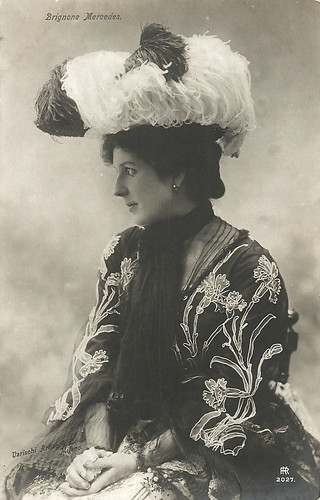
Mercedes Brignone
Italian postcard by Varischi Artico & Co. Milano, no. 2027.
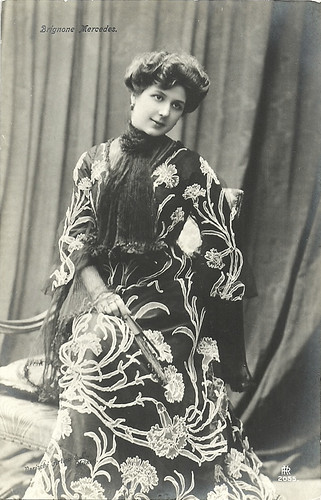
Mercedes Brignone
Italian postcard by Varischi Artico & Co. Milano, no. 2055.
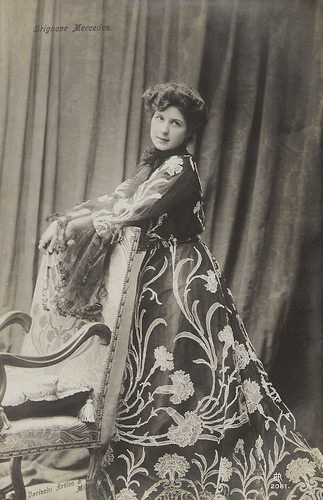
Mercedes Brignone
Italian postcard by Varischi Artico & Co. Milano, no. 2061. Sent by mail in Belgium in 1917.

Neglected


Mercedes Brignone was born in Madrid, Spain in 1885. She was the daughter of Italian stage actor Giuseppe Brignone. Already as a child, she started to perform with her father and became a lively comical actress. In 1903 she married actor Uberto Palmarini with whom she worked in the same theatre company.

Probably her first film role was in the short Il marito in campagna/The Husband in the Country (?, 1912), which co-starred Umberto Mozzato. It was an adaptation of the French boulevard comedy Le mari à la campagne by Jean-François Bayard and Jules de Wailly.

From 1914 she had a steady career in the Italian cinema, first in shorts but soon in feature-length films. Brignone starred in these films, which in 1914 were all Milano productions, often directed by Baldassarre Negroni and co-starring Livio Pavanelli and her husband, Uberto Palmarini. Examples of these films are La corsa all’abisso/The Pace That Kills (Attilio Fabbri, 1914), La dote del burattinaio/The Puppet’s Dowry (Baldassarre Negroni, 1914), and Il re dell’Atlantico/The King of the Atlantic (Baldassarre Negroni, 1914).

Brignone left Milano and worked for several other companies. In 1915 she played in Mezzanotte/Midnight (Augusto Genina, 1915) and in the adaptation of Salvatore Di Giacomo’s play A San Francisco/In San Francisco (1915), directed by her co-star Gustavo Serena. San Francisco refers here to the former prison in Naples. In 1916, Brignone again acted with husband Palmarini in Medusa velata/Veiled Medusa (Ugo De Simone, 1916), and played with her brother Guido and his wife Lola Visconti-Brignone in Espiazione/Penitence (Mario Corte, 1916).

She acted opposite Helena Makowska and Umberto Mozzato, the actor in her first film, La Gioconda (Eleuterio Rodolfi, 1916). This film, based on Gabriele D’Annunzio’s play, narrates the bizarre story of a sculptor (Mozzato) who neglects his wife (Brignone) for his femme fatale-like model (Makowska). When the wife tries to save her marriage, the model wants to crush the sculpture for which she modelled. The wife tries to save the statue but loses her hands in doing so. The film is now considered lost, although it was widespread at the time. Happily, the postcards of the film still exist.


Il rubino del destino (1914)
Spanish collectors card by Chocolate Amatller, Barcelona, no. 3 of 6. Photo: Milano Films. Mercedes Brignone, Franz Sala and Livio Pavanelli in Il rubino del destino/The Ruby of Destiny (Henri Étiévant, 1914), scripted by Augusto Genina. The film was released in Spain as El rubí del destino in January 1914.

Il rubino del destino (1914)
Spanish collectors card by Chocolate Amatller, Barcelona, no. 6 of 6. Photo: Milano Films. Mercedes Brignone and Livio Pavanelli in Il rubino del destino/The Ruby of Destiny (Henri Étiévant, 1914).

Mercedes Brignone in La corsa all'abisso (1914)
Spanish collectors card by Reclam Films, Mallorca, card 1 of 6. Photo: Milano Films. Mercedes Brignone in La corsa all'abisso/The Pace That Kills (Attilio Fabbri, Milano Films 1914). The cinematography was by Carlo Montuori. Attilio De Virgiliis played Brignone's rich lover, while the poor painter may have been played by Camillo Apolloni.
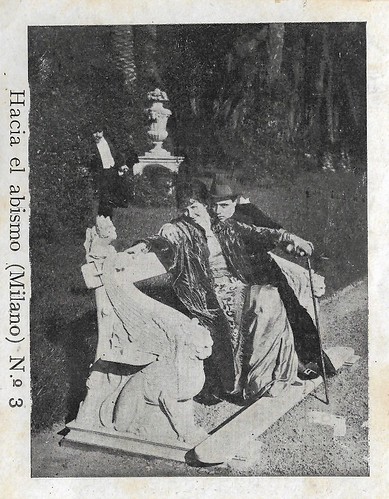
Mercedes Brignone in La corsa all'abisso (1914)
Spanish collector's card by Reclam Films, Mallorca, card 3 of 6. Photo: Milano Films. Mercedes Brignone and Attilio De Virgiliis in La corsa all'abisso/The Pace That Kills (Attilio Fabbri, 1914).
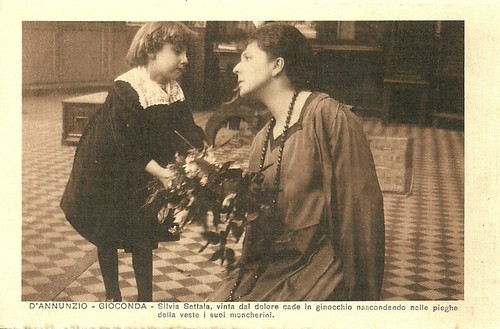
Gioconda 18. Mercedes Brignone, La Gioconda
Mercedes Brignone in La Gioconda (1916). Italian postcard by IPA CT, no. 3660, 1917. Photo: Ambrosio.

Monstre Sacré


In 1917, Mercedes Brignone played in La flotta degli emigranti/The Fleet of the Emigrants (Leopoldo Carlucci, 1917) co-starring Ileana Leonidoff, Il delitto dell’opera/The crime of the work (Eleuterio Rodolfi, 1917), and Amleto/Hamlet (Eleuterio Rodolfi, 1917). Amleto starred the monstre sacré of the Italian stage Ruggero Ruggeri as Hamlet opposite Brignone as Gertrud and Helena Makowska as Ophelia. Some years ago, the film was found and restored.

Rodolfi had started his own company for which Brignone starred in various films: after Amleto followed Un dramma di Vittoriano Sardou/A Play by Victorien Sardou (Eleuterio Rodolfi, 1918), La signora Rebus/Mrs. Rebus (Eleuterio Rodolfi, 1918), Il buon Samaritano/The Good Samaritan (Eleuterio Rodolfi, 1919), a remake of Il marito in campagna/The Husband in the Countryside (Mario Almirante, 1920), and Il privilegio dell’amore/The Privilege of Love (Eleuterio Rodolfi, 1920).

In the film Il perfetto amore/The Perfect Love (1918), Mercedes Brignone was directed for the first time by her brother, Guido Brignone. From 1916 on, he had been active as a film director for the Cines company. Their next film together was Il quadro di Osvaldo Mars/The Portrait by Osvaldo Mars (Guido Brignone, 1921). In this film, Mercedes Brignone plays a countess in this film who discovers a daring painting will be exposed of her in a Salome outfit and nothing much more. She cuts the painting to pieces but is also accused of the murder of the painter. The film was recently found in South America by the Bologna film archive and restored.

Il quadro di Osvaldo Mars intriguingly shows the double nature of the countess: restrained and violent, but Brignone also plays a double role as the lookalike of the countess, a farmer’s wife who leaves her husband and child to climb the social ladder. After Il quadro di Osvaldo Mars, Guido Brignone directed his sister again in Le campane di San Lucio/The Bells of San Lucio (1921).

After that, Mercedes Brignone became the co-star of Il segreto del morto/The Secret of the Dead (Luigi Romano Borgnetto, 1922) with Carlo Aldini, I due sergenti/The Two Sergeants (Guido Brignone, 1922) with Giovanni Cimara – the film was based on a popular French novel that was often filmed in Italy - and Maciste e il nipote d’America/Maciste and the American Cousin (Eleuterio Rodolfi, 1924), with Bartolomeo Pagano as the legendary strongman, of course.
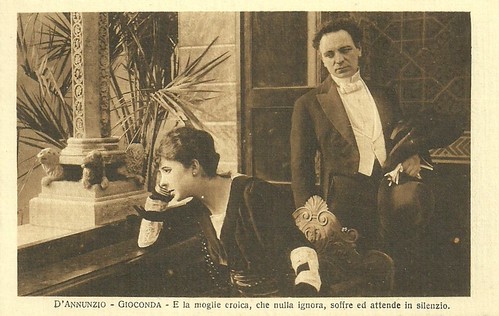
Gioconda 10. Mercedes Brignone and Umberto Mozzato in La Gioconda
Mercedes Brignone and Umberto Mozzato in La Gioconda (1916). Italian postcard by ICA CT, no. 3670, 1916. Photo: Ambrosio.
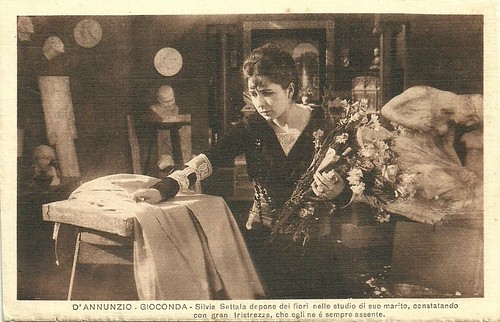
Gioconda 16
Italian postcard by IPA CT, no. 3871. Photo: Film della Società Ambrosio, Torino. V. Uff. Rev. St. Terni. Publicity still for La Gioconda (Eleuterio Rodolfi, 1916). Caption: Sivia Settala deposes flowers in the studio of her husband, noting with great sadness, that he is ever more absent.
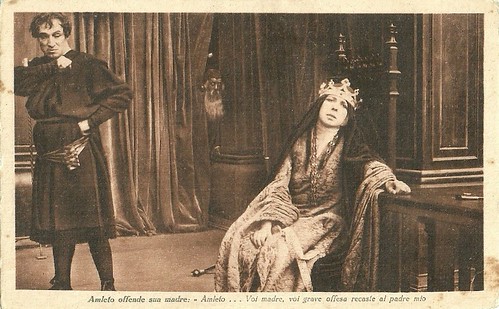
Amleto (1917)
Italian postcard for the film Amleto (Eleuterio Rodolfi, 1917), adapted from Shakespeare's play Hamlet, and starring Ruggero Ruggeri in the title role, with Mercedes Brigone as Hamlet's mother, Queen Gertrude, while Polonius spies between the curtains. Caption: Hamlet: You mother, you committed a grave offence to my father.
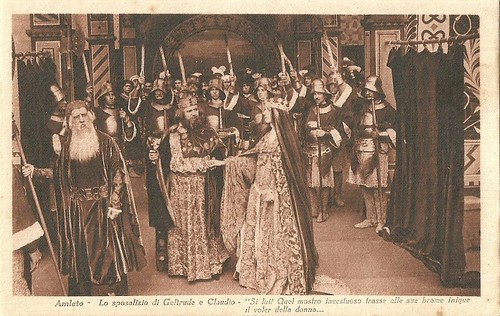
Amleto (1917)
Italian postcard for the film Amleto (Eleuterio Rodolfi, 1917) with Mercedes Brignone as Queen Gertrude and Armand Pouget as King Claudius. Caption: The wedding of Gertrud and Claudius: "Yes, him! That incestuous beast won to his shameful lust the will of my [most seeming-virtuous] queen." (spoken by The Ghost in Shakespeare's Hamlet).
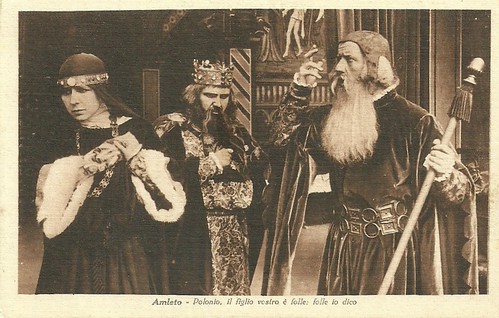
Mercedes Brignone in Amleto
Italian postcard for the film Amleto (Eleuterio Rodolfi, 1917) with Mercedes Brignone as Queen Gertrude and Armand Pouget as King Claudius. Caption: "Polonius: Your noble son is mad. Mad call I it". Who played Polonius unknown.

Napoleon


After an interval of six years, Mercedes Brignone returned to the cinema as a governess in the first Italian sound film, La canzone dell'amore/The Song of Love (1930), starring Dria Paola.

By now Brignone had to be satisfied with smaller parts, as in Nerone/Nero (Alessandro Balsetti, 1930), La stella del cinema/The Film Star (Mario Almirante, 1931) featuring Leda Gloria, Corte d’Assise/Before the Jury (Guido Brignone) with Marcella Albani, Vivere/To Live (Guido Brignone, 1938) with opera singer Tito Schipa, and the comedy Il marchese di Ruvolito/The Marquis of Ruvolito (Raffaello Matarazzo, 1939) with the Napolitan brothers Eduardo and Peppino De Filippo.

In Sant’Elena, piccola isola/Saint Helen, Little Island (Umberto Scarpelli, Renato Simoni, 1943) Brignone played Madama Letizia vs. Ruggero Ruggeri as Bonaparte. Other films she appeared in during the war period were La primadonna (Ivo Perilli, 1943) starring German actress Anneliese Uhlig, and Il fiore sotto gli occhi/The Flower under the Eyes (Guido Brignone, 1944) with Claudio Gora.

In the postwar era, Mercedes Brignone worked for several theatre companies. She often played in comedies with Ruggero Ruggeri and Tino Carraro. Only incidentally, she appeared in films. Her last (bit) parts were in Lorenzaccio (Raffaello Pacini, 1951) and Vacanze d’inverno/Winter Holidays (Camillo Mastrocinque, Giualiano Carnimeo, 1959) starring Michèle Morgan.

For RAI radio, she acted in Aurelia (Enzo Ferrieri, 1949), while on television she could be seen in two stage plays, Romanticismo/Romanticism (1954), and Pane altrui/The Other's Bread (1957) and had a guest role in the series Le inchieste del commissario Maigret/The Investigations of Commissioner Maigret (1965), starring Gino Cervi. Mercedes Brignone died in 1967 in Milan. She was the aunt of actress Lilla Brignone, the daughter of her brother Guido.
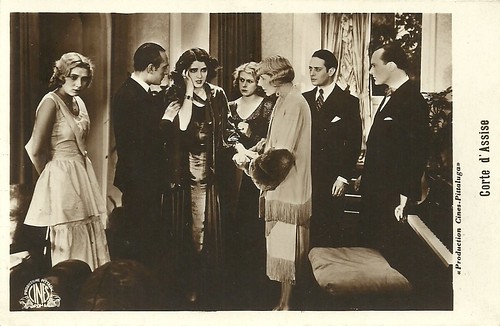
Marcella Albani in Corte d'Assise (1930)
Italian postcard. Photo: Produzione Cines-Pittaluga. Publicity still for the court case melodrama Corte d'Assise (Guido Brignone, 1930), released in 1931. From left to right: Lya Franca, Renzo Ricci, Marcella AlbaniMercedes Brignone, and far-right Elio Steiner.
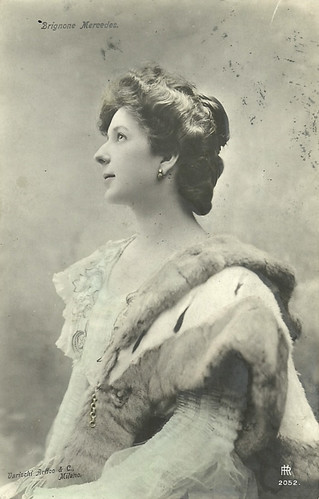
Mercedes Brignone
Italian postcard by Varischi Artico & Co, Milano, no. 2052.
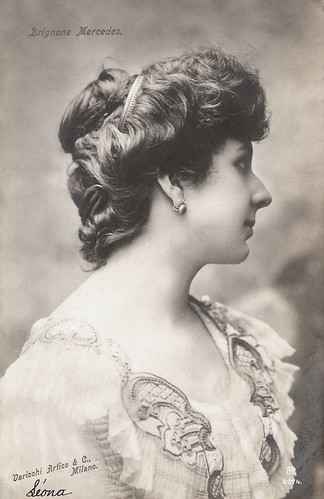
Mercedes Brignone
Italian postcard by Varischi Artico & Co. Milano, no. 2074. Sent by mail in Belgium in 1906.
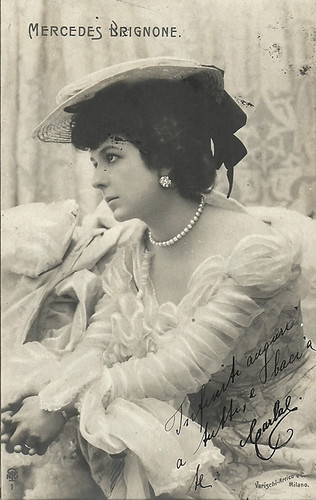
Mercedes Brignone
Italian postcard by NPG / Varischi Artico e C., Milano, no. 1.

Mercedes Brignone
Italian postcard, no. 58. Photo: Sciutto.

Sources: Vittorio Martinelli (Il cinema muto Italiano - Italian), Wikipedia (Italian) and IMDb.

This post was last updated on 11 August 2023.

07 June 2023

Varischi & Artico

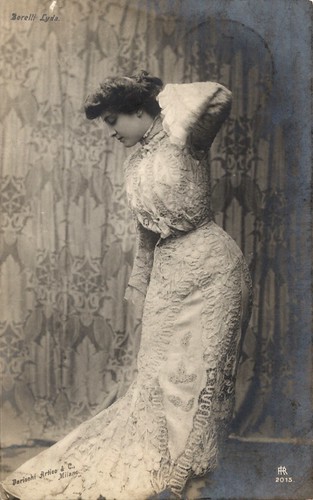
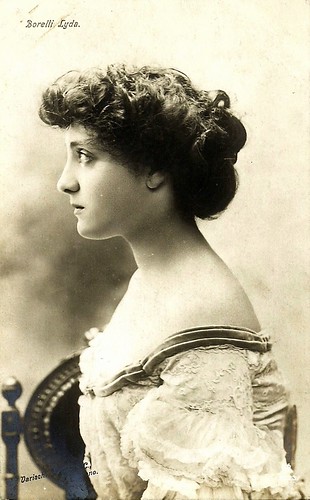
In 1900, Italian photographers Arturo Varischi and Giovanni Artico assumed ownership of the L. Ricci portrait studio where they had both trained as employees. Varischi & Artico gained a reputation for infant portraits and for their ability to attract famous actors like Lyda Borelli, Irma Gramatica and Tina di Lorenzo, but also musicians, singers, and writers to their studio. For this post, we selected 25 film and stage star postcards with portraits by Varischi & Artico.

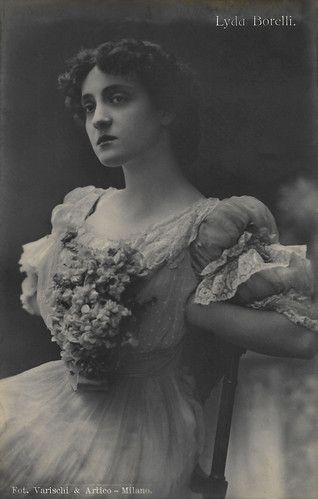
Lyda Borelli
Italian postcard. Photo: Varischi & Artico. Lyda Borelli.

Lyda Borelli (1887-1959) was already an acclaimed stage actress before she became the first diva of Italian silent cinema. The fascinating film star caused a craze among female fans called 'Borellismo'.

Lyda Borelli
Italian postcard by RA, no. 2015. Photo: Varischi Artico & Co., Milano. Lyda Borelli.

Lyda Borelli
Italian postcard by RA, no. 2023. Photo: Varischi Artico & Co, Milano. Lyda Borelli.
Lyda Borelli
Italian postcard by RA, no. 2125. Photo: Varischi Artico & Co., Milano. Lyda Borelli.

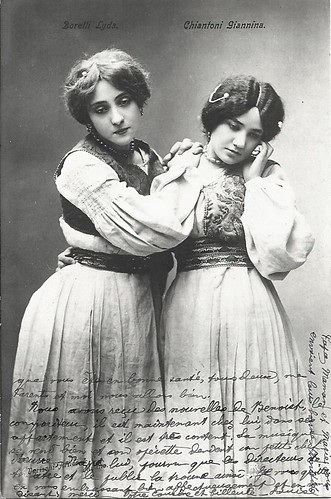
Lyda Borelli and Giannina Chiantoni in La figlia di Jorio
Italian postcard by RA, no. 2120. Photo: Varischi Artico & Co, Milano. Lyda Borelli and Giannina Chiantoni in Gabriele D'Annunzio's stage play 'La figlia di Jorio' (1904)

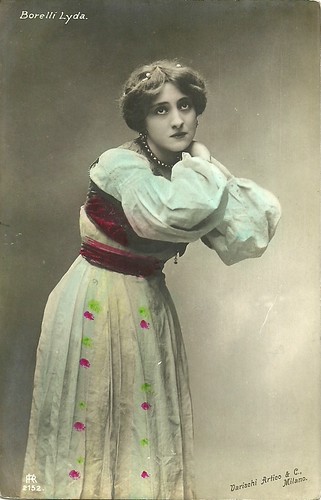
Lyda Borelli in La figlia di Jorio
Italian postcard by RA, no. 2152. Photo: Varischi Artico Co., Milano. Lyda Borelli as Favetta in the stage play 'La figlia di Jorio' by Gabriele D'Annunzio (1904).

In 1903, Gabriele D'Annunzio wrote the drama 'La figlia di Jorio' (The Daughter of Jorio), a pastoral tragedy situated in the Abruzzi mountains in the centre of Italy. On 2 March 1904, the stage company Talli-Calabresi-Grammatica performed the premiere of the play at the Teatro Lirico in Milan. The protagonist should have been Eleonora Duse, but she fell ill. D' Annunzio, whose relationship with Duse was fading, didn't wait for her healing and gave the female lead to Irma Grammatica - which hurt Duse dearly. The painter Francesco Paolo Michetti, a good friend of D'Annunzio, designed the sets and costumes. The play was a huge success, also in Chieti in Abruzzi when it was performed there the same year. In 1907, with D'Annunzio's permission, a version in the Abruzzi dialect was written and performed.

Giannina Chiantoni as Ornella in La figlia di Jorio (1904)
Italian postcard by RA, no. 3515. Photo: Varischi Artico & Co., Milano. Giannina Chiantoni as Ornella in 'La figlia di Jorio' (1904).

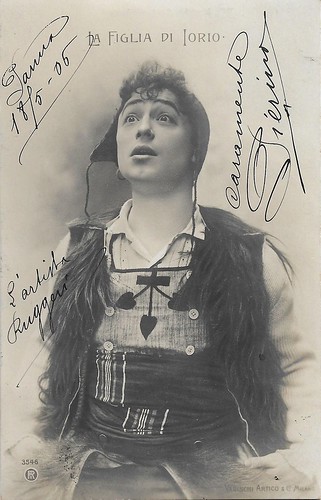
Ruggero Ruggeri in La figlia di Jorio (1906)
Italian postcard by RA, no. 3546. Photo: Varischi Artico.& Co., Milano. Mailed 18 May 1906. Ruggero Ruggeri as Aligi in 'La figlia di Jorio' (1904).

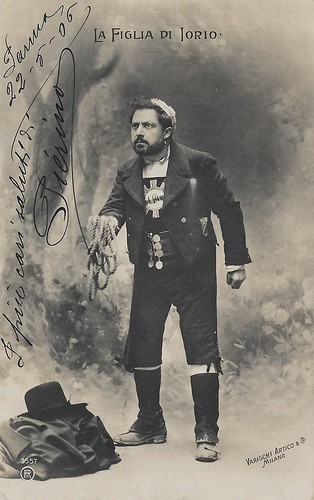
Oreste Calabresi in La figlia di Jorio
Italian postcard by RA, no. 3557. Photo: Varischi Artico & Co., Milano. Oreste Calabresi as Lazaro in 'La figlia di Jorio' ( 1904).

Lyda Borelli
Italian postcard. Photo: Varischi & Artico, Milano. Lyda Borelli.


Lyda Borelli
Italian postcard. Photo: Varischi & Artico, Milano. Lyda Borelli.

Lyda Borelli
Italian postcard. Photo: Varischi & Artico, Milano. Lyda Borelli.

Daguerreotype business


In 1900, Arturo Varischi and Giovanni Artico became the owners of the portrait studio and photo laboratory of Leone Ricci in Milano, Italy, where they had both been trained.

Ricci had started his daguerreotype business already before 1850 and thus was one of the earliest photographers in Milano. His studio had a long history of portraying the Milanese bourgeoisie and aristocracy and Varischi & Artico Company continued this tradition.

Giovanni Artico was born in Vittorio Veneto in 1868. After his studies in chemistry, he established himself in Milan. Like many young contemporaries, he was interested in the upcoming business of photography. He chose to start working in the portrait studio of Leone Ricci.

There he met another employee, Arturo Varischi, and the two decided to take over Ricci's business.
The two photographers conveniently shared their business location (first Corso Vittorio Emanuele 110-111, later Corso Vittorio Emanuele 22) with Angelo Pettazzi, an established merchant and producer of photographic equipment and supplies.

Most of the photos of Varischi & Artico date from 1900-1920, while the company name was first spelt as Varischi, Artico & Co., and later on as Varischi & Artico Co. On postcards, the credit reads Fot. Varischi & Artico - Milano - as on the postcard above.

Irma Gramatica
Italian postcard by TCR, no. 1. Photo: Varischi Artico & Co., Milano. Irma Gramatica.

Irma Gramatica (1867-1962) was an Italian stage and screen actress, known for her talent but also for her temper.

Irma Gramatica
Italian postcard by TCR, no. 2. Photo: Varischi Artico & Co., Milano. Irma Gramatica.

Mercedes Brignone
Italian postcard by RA, no. 2027. Photo: Varischi Artico e C., Milano. Mercedes Brignone.

Mercedes Brignone (1885-1967) was an Italian theatre, film and television actress. She was a major star in Italian silent cinema of the 1910s and early 1920s. In the 1930s and early 1940s, she often played secondary parts in Italian sound films.

Mercedes Brignone
Italian postcard by RA, no. 2052. Photo: Varischi Artico & Co. Milano. Mercedes Brignone.
Mercedes Brignone
Italian postcard by AR, no. 2055. Photo: Varischi Artico e C., Milano. Mercedes Brignone.

Mercedes Brignone
Italian postcard by RA, no. 2061. Photo: Varischi Artico & Co. Milano. Sent by mail in Belgium in 1917. Mercedes Brignone.

Mercedes Brignone
Italian postcard by RA, no. 2074. Photo: Varischi Artico & Co. Milano. Sent by mail in Belgium in 1906. Mercedes Brignone.

Mercedes Brignone
Italian postcard by NPG, no. 1. Photo: Varischi Artico e C., Milano. Mercedes Brignone.

Performers of the Scala


Arturo Varischi and Giovanni Artico soon gained a reputation for their infant portraits. They were also known for their ability in attracting famous artists to their studio. Renowned opera performers from the Scala flocked to Varischi & Artico Co. for their publicity by use of souvenir photographs and picture postcards.

They also attracted famous musicians like Arturo Toscanini, stage actors and writers to their studio. Soon also the first film stars were portrayed by them. One of their most popular subjects was the first diva of the silent Italian cinema, Lyda Borelli. Notable is also their series of colour portraits.

Arturo Varischi died prematurely. In 1923 Artico took over on his own and transformed the 19th-century portrait studio into a modern business.

Giovanni Artico died in 1930, and his widow, Regina Trelancia, continued the activities till 1933. Later their son Carlo Artico also became a photographer and reopened Studio Artico in Milan.

In the archive of Studio Artico, there are about 70 original photos of famous personalities like author Giovanni Verga and actress Tina de Lorenzo, which were signed by the sitters. They show the artistry and craftsmanship of Artico. Many prints of his work can be found in archives all over Italy, especially in Milan.

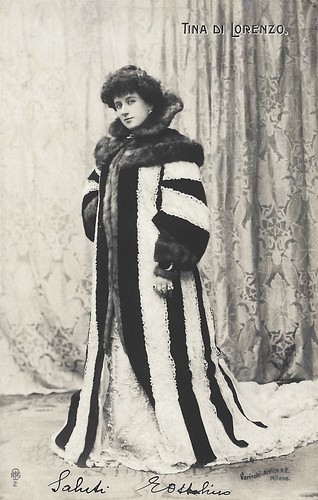
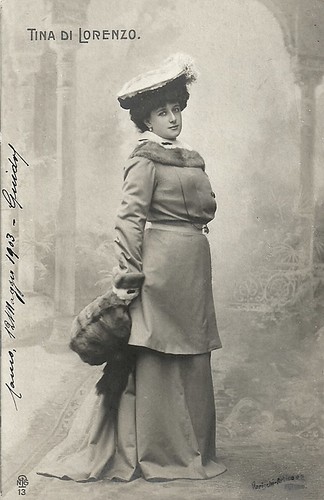
Tina Di Lorenzo
Italian postcard by NPG, no. 2. Photo: Varischi Artico & C., Milano. Tina Di Lorenzo.

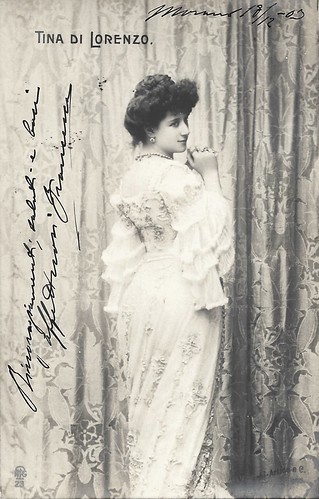
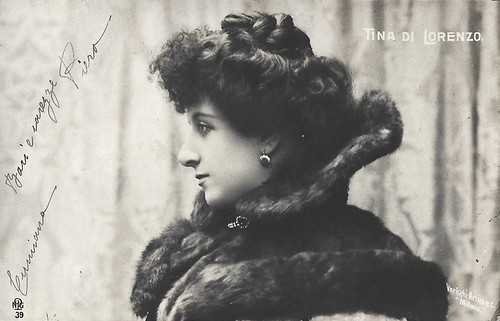
Tina Di Lorenzo (1872-1930) was one of the 'grand dames' of the Italian stage during the early twentieth century, nicknamed "Angelicata" and "La encantadora". In 1915 she also acted in two or three films. In 1901 she married reputed stage actor Armando Falconi, who would have a second career in Italian sound cinema.

Tina Di Lorenzo
Italian postcard by NPG, no. 13. Photo: Varischi Artico & C., Milano. Sent by mail on 12 May 1903. Tina Di Lorenzo.

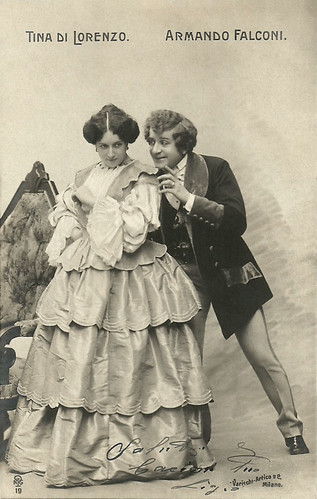
Armando Falconi and Tina Di Lorenzo
Italian postcard by NPG, no. 19. Photo: Varischi Artico & C., Milano. Armando Falconi and Tina Di Lorenzo.

Armando Falconi (1871-1954) was an Italian stage and screen actor. Though he was foremost a theatre actor and comedian, he had a prolific career as a comedian in Italian cinema of the 1930s and early 1940s. He was married to the famous stage actress Tina Di Lorenzo, with whom he also often acted together.

Tina Di Lorenzo
Italian postcard by NPG, no. 23. Photo: Varischi Artico & C., Milano. Sent by mail on 18-12-1903. Tina Di Lorenzo.
Tina Di Lorenzo
Italian postcard by NPG, no. 39. Photo: Varischi Artico & C., Milano. Tina Di Lorenzo.

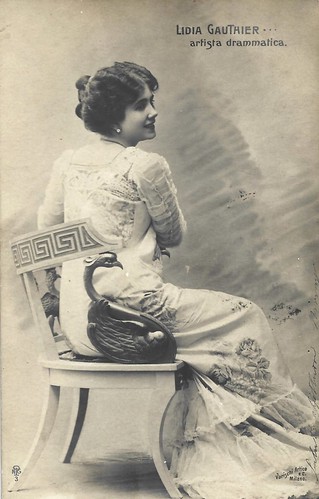
Lidia Gauthier
Italian postcard by NPG, no. 3. Photo: Varischi Artico & C., Milano.

Lidia Gauthier (?-?) is a little-known Italian stage actress who in the 1900s though knew a certain reputation and was portrayed by photo studios such as Varischi Artico. She acted e.g. at the stage company of Teresa Mariani, where Gianna Chiantoni was the leading actress.

Elisa Severi
Italian postcard by NPG, no. 4. Photo: Varischi Artico & C., Milano.

Elisa Severi (1872-1930) started as a stage actress. She joined the Drammatica Compagnia Palladini-Talli in 1894, and headed a company with Oreste Calabresi for the 1905-1906 season, with Mercedes Brignone as one of the company's other actresses. Severi appeared in twenty silent films between 1913 and 1921. She was the grandmother of the famous film director Mario Monicelli.

Giulia Cassini Rizzotto
Italian postcard by NPG, no. 10. Photo: Varischi Artico & C., Milano.

Giulia Cassini Rizzotto (1865-1943) was an Italian actress and film director, kindergarten teacher, novelist, translator and writer. She appeared in many films in Italy including Malombra (1917) and Fabiola (1918) and directed five films herself. She was married to the actor Alfonso Cassini.

Sources: Giovanna Ginex (Varischi e Artico fotografi a Milano: i primi decenni del secolo), Silvia Paoli (Lo studio e laboratorio fotografico Artico, Rivista di storia e fotografia, no. 24, II, december 1996), Max Hochstetler (Luminous Lint), and Claudia Morgan (Commune di Trieste) (Italian).

01 November 2014

La Gioconda (1917)

Polish singer and actress Helena Makowska (1893-1964) or Elena Malowska was a beautiful diva of the Italian silent cinema in the 1910s. She played the title role in the Ambrosio production La Gioconda (Eleuterio Rodolfi, 1917), based on a play by Gabriele D'Annunzio. The IPA produced for this silent drama a series of sepia postcards.

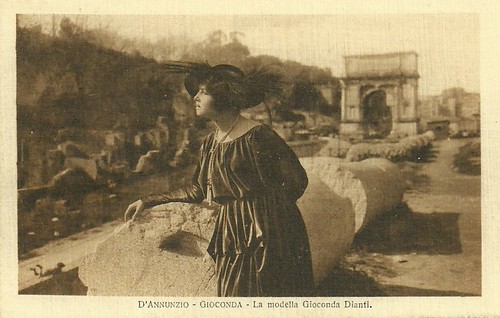
Gioconda 1. Helena Makowska as the model Gioconda Dianti
Italian postcard by IPA CT, no. 3654, Censura S. Prefetti, Terni, 18-4-1917. Photo: Ambrosio. Caption: 'The model Gioconda Dianti.' At the Forum Romanum, Rome. Helena Makowska in La Gioconda (Eleuterio Rodolfi, 1917).

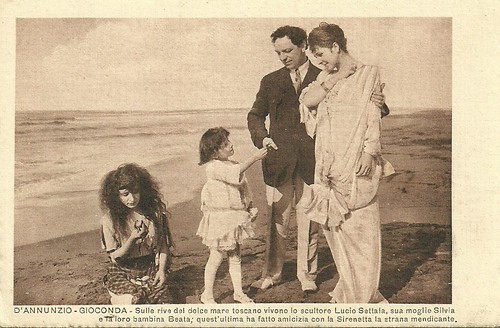
Gioconda 2
Italian postcard by IPA CT, no. 3872, V. Uff. Rev. St., Terni. Photo: Ambrosio. Caption: "On the banks of the sweet Tuscan coast the sculptor Lucio Settala, his wife Silvia and their daughter Beata live. The latter has befriended the Little Siren, a strange beggar girl." Umberto Mozzato as Settala, Mercedes Brignone as his wife, Linda Pini as 'Sirenetta' in La Gioconda (Eleuterio Rodolfi, 1917).

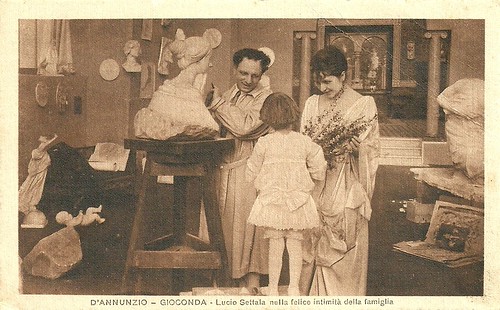
Gioconda 3
Italian postcard by IPA CT, no. 3654, V. Uff. Rev. St., Terni. Photo: Ambrosio. Caption: "Lucio Settala in the happy intimacy of the family." Umberto Mozzato as Settala and Mercedes Brignone as his wife Silvia in La Gioconda (Eleuterio Rodolfi, 1917).

Gioconda 4
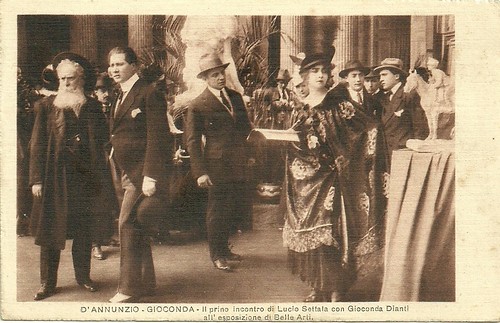
Italian postcard by IPA CT, no. 3880, V. Uff. Rev. St., Terni. Photo: Ambrosio. Caption: "The first encounter of Lucio Settala with Gioconda Dianti at the Fine Arts exhibition." Centre, Umberto Mozzato as Settala, right Helena Makowska as Gioconda Dianti in La Gioconda (Eleuterio Rodolfi, 1917).

Gioconda 5
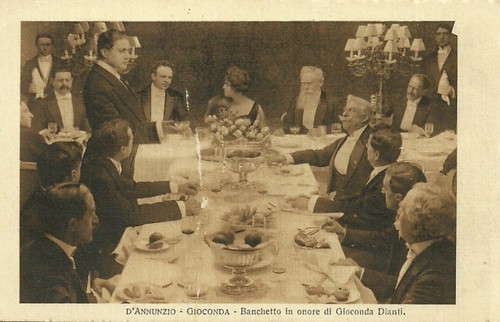
Italian postcard by IPA CT, no. 3661, Censura S. Prefetti, Terni, 18-4-1917. Photo: Ambrosio. Caption: "Banquet in honour of Gioconda Dianti." In the back, centre, Helena Makowska as Gioconda Dianti in La Gioconda (Eleuterio Rodolfi, 1917).

Seductive mistress


Famous sculptor Lucio Settala (Umberto Mozzato) lives on the Tuscan coast with his wife Silvia, daughter Beata and a beggar girl whom Beata befriends, la Sirenetta (Linda Pini).

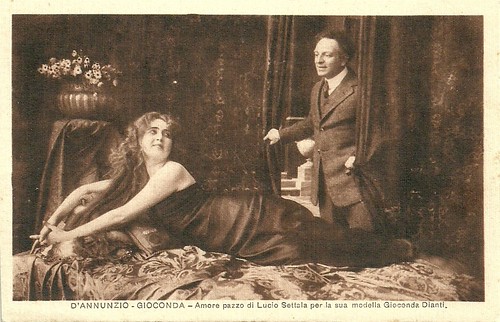
At a Fine Arts exhibition, Lucio encounters the beautiful femme fatale Gioconda Dianti (Helena Makowska). She becomes his model for a statue of a female nude in an ecstatic pose.

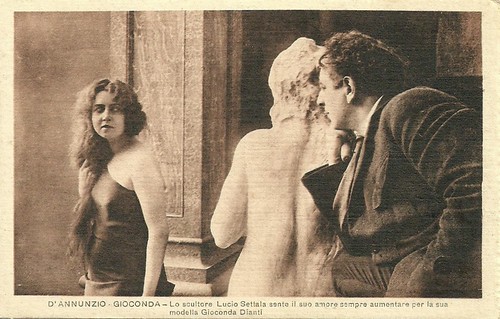
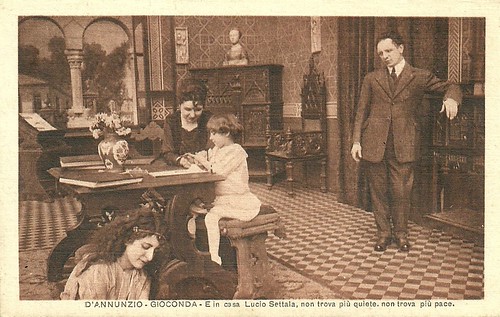
More and more, Lucio falls in love with her and neglects his wife and child. Instead of his angelic wife (Mercedes Brignone), keeper of family values, he prefers his seductive mistress, the inspiration to his art. His wife suffers in silence.

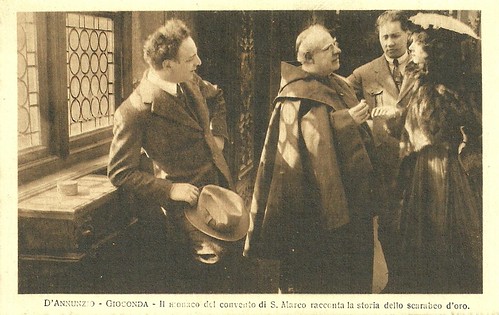
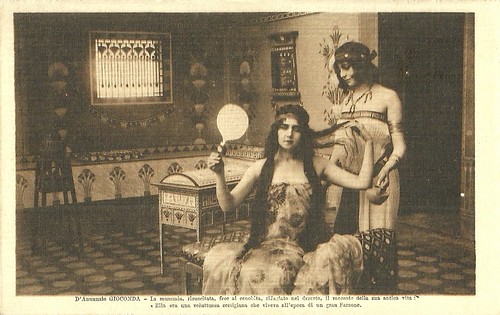
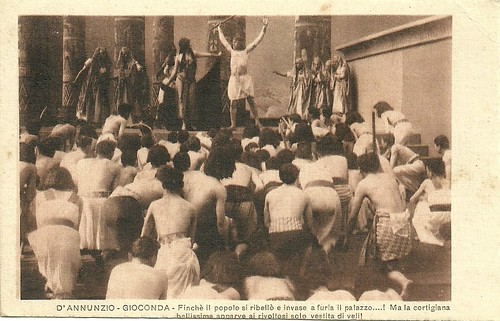
At the convent of St. Mark, a monk tells Lucio and Gioconda the legend of an Egyptian mummy come to life (again played by Makowska) who becomes the voluptuous courtesan of the Pharaoh. When the people rebel against the Pharaoh’s spoiling of her, she shows herself just dressed in transparent veils to the rebels.

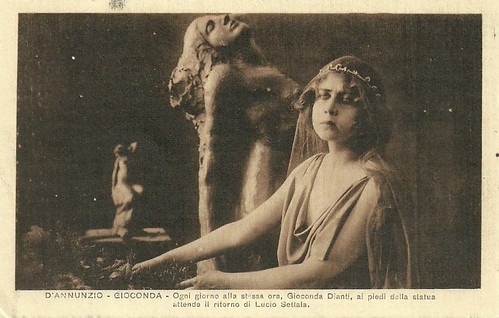
Silvia guards her husband’s abandoned studio, placing fresh flowers there. In the climax of the story, Silvia tries to regain her husband and struggles with the rival. In a moment of anger, Gioconda throws the statue on Silvia for which she has posed.

In order to save the masterpiece of her husband, Silvia sacrifices both her hands, reduced to stumps. His wife’s tragedy awakens the blinded infidel, who returns to the family hearth.

Gioconda 6
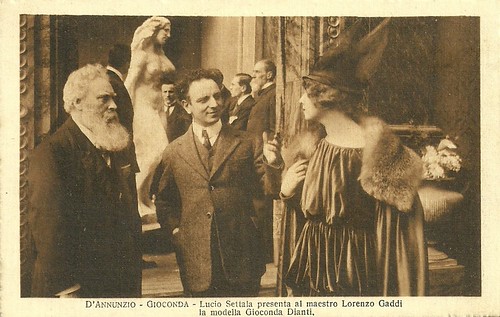
Italian postcard by IPA CT, no. 3663, Censura S. Prefetti, Terni, 18-4-1917. Photo: Ambrosio. Caption: 'Lucio Settala presents maestro Lorenzo Gaddi the model Gioconda Dianti.' Umberto Mozzato as the sculptor Lucio Settala and Helena Makowska as the model in La Gioconda (Eleuterio Rodolfi, 1917).

Gioconda 6a
Italian postcard by IPA CT, no. 3877. Photo: Film della Soc. Ambrosio, Torino. V. Uff. Rev. St., Terni. Caption: "Sculptor Lucio Settala feels his love for his model Gioconda Dianti is ever expanding." Umberto Mozzato as Lucio Settala and Helena Makowska as Gioconda Dianti in La Gioconda (Eleuterio Rodolfi, 1917).

Gioconda 7a
Italian postcard by IPA CT, no. 3876. Photo: Film della Soc. Ambrosio, Torino. V. Uff. Rev. St., Terni. Caption: "Lucio Settala is madly in love with his model Gioconda Dianti." Umberto Mozzato as Lucio Settala and Helena Makowska as Gioconda Dianti in La Gioconda (Eleuterio Rodolfi, 1917).

Gioconda 8
Italian postcard by IPA CT, no. 3881. Photo: Film della Soc. Ambrosio, Torino. V. Uff. Rev. St., Terni. Caption: "And at home Lucio Settala didn't find rest nor peace." Standing right, Settala (Umberto Mozzato), sitting at the table his wife Silvia (Mercedes Brignone), and sitting on the (fore-)ground la Sirenetta (Linda Pini) in La Gioconda (Eleuterio Rodolfi, 1917).

Gioconda 9
Italian postcard by IPA CT, no. 3662. Photo: Film della Soc. Ambrosio, Torino. V. Uff. Rev. St., Terni. Caption: "Every night at the same hour, Gioconda Dianti, at the feet of the statue awaited the return of Lucio Settala." Helena Makowska as the model Gioconda Dianti in La Gioconda (Eleuterio Rodolfi, 1917).

Mixed feelings


In 1916 Eleuterio Rodolfi directed La Gioconda for the Ambrosio film studio. He had written the script himself and had based it on the homonymous play by Gabriele D’Annunzio.

The film premiered in Rome on 24 January 1917.

While the play by D’Annunzio, written in 1898 and first performed in 1899, was received rather coolly at its premiere, the film was received with more mixed feelings.

While the Turin based journal La vita cinematografica thought Helena Makowska had a perfect body but a wooden expression, the Naples based journal La Cine-Fono, already a few months before the first public screening, wrote appraisal for its adaptation of D'Annunzio's play (considered very suitable to be filmed because of its theatricality), but also lauded the actor's performances of Makowska, Mozzato and Brignone.

La Gioconda is now considered a lost film.

Gioconda 10. Mercedes Brignone and Umberto Mozzato in La Gioconda
Italian postcard by IPA CT, no. 3670. Photo: Film della Soc. Ambrosio, Torino. V. Uff. Rev. St., Terni, 5-10-1916. Caption: "And the heroic wife, who knew very well what was going on, suffered and waited in silence." Mercedes Brignone and Umberto Mozzato in La Gioconda (Eleuterio Rodolfi, 1917).

Gioconda 11
Italian postcard by IPA CT, no. 3662. Photo: Film della Società Ambrosio, Torino. ensura Terni, 18-4-1917. Caption: "The monk of the convent of St. Mark told the story of the golden scarabee." Helena Makowska as the model Gioconda Dianti but also as the Egyptian courtesan in the legend told, and left in the image Umberto Mozzato as the artist Lucio Settala in La Gioconda (Eleuterio Rodolfi, 1917).

Gioconda 12
Italian postcard by IPA CT, no. 3873. Photo: Film della Società Ambrosio, Torino. Censura S. Prefett., Terni, 18-4-1917. Caption: "The resurrected mummy told the monk, refugee in the desert, the story of her ancient life: She had been a voluptuous courtesan who lived in the times of the great Pharaon." Helena Makowska as the Egyptian courtesan in La Gioconda (Eleuterio Rodolfi, 1917).

Gioconda 13
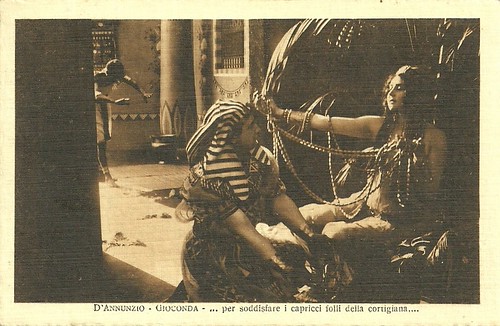
Italian postcard by IPA CT, no. 3879. Photo: Film della Società Ambrosio, Torino. Censura S. Prefett., Terni, 5-10-1916. Caption: "... in order to satisfy the mad caprice of the courtesan..." Helena Makowska as the Egyptian courtesan in La Gioconda (Eleuterio Rodolfi, 1917).

Gioconda 14
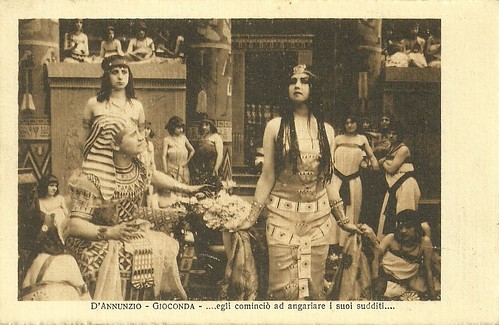
Italian postcard by IPA CT, no. 3662. Photo: Film della Società Ambrosio, Torino. Censura S. Prefett., Terni, 5-10-1916. Caption: "... he started to anger his subjects..." Helena Makowska as the Egyptian courtesan in La Gioconda (Eleuterio Rodolfi, 1917).

Gioconda 15
Italian postcard by IPA CT, no. 3874. Photo: Film della Società Ambrosio, Torino. V. Uff. Rev. St., Terni. Caption: "At last the populace rebelled and invaded the palace furiously...! But the courtesan appeared to the rebels dressed only in veils!" Helena Makowska as the Egyptian courtesan in La Gioconda (Eleuterio Rodolfi, 1917).

Gioconda 16
Italian postcard by IPA CT, no. 3871. Photo: Film della Società Ambrosio, Torino. V. Uff. Rev. St. Terni. Caption: "Sivia Settala deposes flowers in the studio of her husband, constating with great sadness, that he is ever more absent." Mercedes Brignone as Silvia Settala inLa Gioconda (Eleuterio Rodolfi, 1917).

Gioconda 18. Mercedes Brignone, La Gioconda
Italian postcard by IPA CT, no. 3660. Photo: IPA CT. Censura Terni 18-4-1917. Caption: "Struck by grief, Silvia Settala falls on her knees, hiding her stumps in the folds of her clothes." Mercedes Brignone as Silvia Settala inLa Gioconda (Eleuterio Rodolfi, 1917).

Sources: Vittorio Martinelli (Il cinema muto italiano, 1916 - Italian), Matilde Tortora (Italian), Wikipedia (Italian) and IMDb.