Showing posts with label Paul Wegener. Show all posts

25 July 2020

Paul Wegener on stage

German actor, writer, and director Paul Wegener (1874-1948) is a film legend. As one of the pioneers of the German cinema, he realised the potential of the new medium. But before he made such silent classics as Der Student von Prag/The Student of Prague (Stellan Rye, Paul Wegener, 1913) and Der Golem/The Golem (Henrik Galeen, Paul Wegener, 1915), he was already well-known as a stage actor. He worked in the theatre since 1895 and remained true to this profession till his death. Max Reinhardt of the Deutschen Theater took him to his distinguished theatre company in Berlin in 1906 where Wegener starred in such classic plays as 'Macbeth', 'Richard III', and 'Faust I'. Verlag Hermann Leiser published a series of intriguing postcards of Wegener's stage roles.

Paul Wegener and Tilla Durieux in Der Graf von Gleichen (1909)
German postcard by Verlag Hermann Leiser (formerly: Louis Blumenthal), Berlin-Wilm, no. 1209. Photo: Becker & Maass, Berlin. Caption: Paul Wegener and Tilla Durieux in 'Der Graf von Gleichen'. During the season of 1908/09, Wegener played Engelbert, count of Gleichen, in 'Der Graf von Gleichen' by Wilhelm Schmidtbonn, based on the legend of the same name. Felix Hollaender directed.
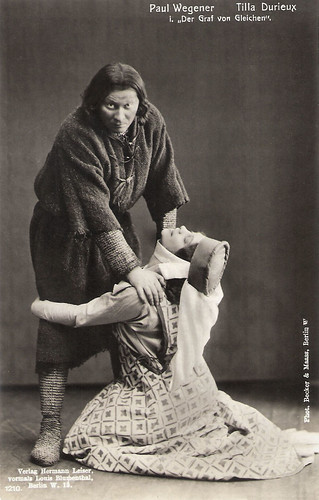
Paul Wegener and Tilla Durieux in Der Graf von Gleichen
German postcard by Verlag Hermann Leiser (formerly: Louis Blumenthal), Berlin-Wilm, no. 1210. Photo: Becker & Maass, Berlin. Caption: Paul Wegener and Tilla Durieux in 'Der Graf von Gleichen'.
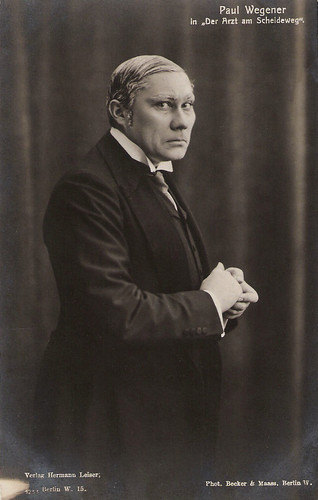
Paul Wegener
German postcard by Verlag Hermann Leiser, Berlin, no. 1233. Photo: Becker & Maass, Berlin. Caption: Paul Wegener in Der Arzt am Scheideweg. In 1908,  Paul Wegener played Ridgeon in the play 'Der Arzt am Scheideweg' (The Doctor's Dilemma) by George Bernhard Shaw.

Paul Wegener as  Mephisto
German postcard by Verlag Hermann Leiser, Berlin, no. 1275. Photo: Becker & Maass, Berlin. Caption: Paul Wegener as Mephisto. During the season of 1908/09, Wegener also played Mephisto in 'Faust I' by Johann Wolfgang von Goethe. Oscar Beregi played Faust and Max Reinhardt was the director.

Paul Wegener as Mephisto
German postcard by Verlag Hermann Leiser, Berlin, no. 1621. Photo: Hans Böhm. Caption: Paul Wegener as Mephisto.

I have long doubted, but now I am sure


At the age of 20, Paul Wegener decided to end his studies at the University of Leipzig and concentrate on acting. Paul wrote to his father, "I am about to end my law studies and get on the stage. I'm very sorry to disappoint you, but I have to... I have long doubted, but now I am sure". The father then refused to give him further financial support.

After just a few short months Paul had managed to build up a repertoire of thirty character roles, and with a college distinction, he set off to make his stage debut at the Stadt Nurnberg. In the following years, he had small engagements in Leipzig, Rostock, Wiesbaden and at the Bernarts-Theater in Aachen.

In 1900 Paul Wegener was drafted into one-year military service with the Gersdorff Fusilier Regiment. Only then did his actual theatre career begin. An important and finally well-paid engagement - at least 9000 marks a year - lead him in 1904 to Hamburg. At the Hamburger Stadt-Theater,  he appeared in the first German-language production of 'Nachtasyl' (Night Asylum) by Maxim Gorki. It was a great success.

In 1905 he appeared in the film production of Die Byzantier by Victor Hahn. The film's premiere was seen by a talent-scout for Max Reinhardt of the Deutschen Theater who had been sent to view the film. The scout telegraphed Reinhardt immediately, praising Wegener's performance.

Wegener debuted at the distinguished the Deutsches Theater in Berlin in October 1906. he became the star of the company and was a huge success as Iago and Othello. He went on extensive theatre tours throughout Europe and performed in Vienna, Budapest, Switzerland, Romania, and the Netherlands. He stayed at the Deutsches Theater till 1920.

Paul Wegener in Faust
German postcard by Verlag Hermann Leiser, Berlin, no. 3387. Photo: Becker & Maass. Caption: Paul Wegener as Mephisto.

Paul Wegener as Franz Moor
German postcard by Verlag Hermann Leiser, no. 4070. Photo: Becker & Maass. Caption: Paul Wegener as Franz Moor. In 1908, Max Reinhardt directed Wegener as Franz Moor in 'Die Räuber' (The Robbers) by Friedrich Schiller.

Paul Wegener in König Oedipus (1910)
German postcard by Verlag Hermann Leiser, Berlin, no. 4552. Photo: Becker & Maass. Caption: Paul Wegener as King Oedipus. During the 1910-1911 season, Wegener interpreted the title role of Oedipus in 'Oedipus Rex' by Sophocles in the translation by Hugo von Hofmannsthal. The production was performed in the arena of the Circus Schumann in Berlin.

Paul Wegener in König Oedipus (1910)
German postcard by Verlag Hermann Leiser, no. 4553a, Berlin. Photo: Zander & Labisch, Berlin. Caption: King Oedipus.

Paul Wegener in König Oedipus (1910)
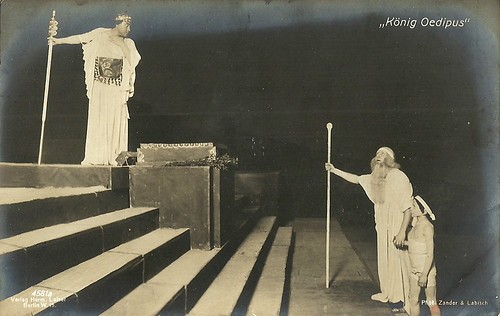
German postcard by Verlag Hermann Leiser, Berlin, no. 4581a. Photo: Zander & Labisch, Berlin. Caption: King Oedipus. Tiresias at the palace of Oedipus.

The first major theater-in-the-round production in modern times


This production of Sophocles's classic tragedy 'Oedipus Rex', directed by Max Reinhardt in a translation by Hugo von Hofmannsthal, had its premiere in 1910. It was first performed in a Summer festival in Munich and in the Fall in a circus arena Berlin.

The stars were Paul Wegener as Oedipus and Tilla Durieux as Jocasta, though some considered the masses of extras performing the Thebans to be the real stars.

Emily Bilski writes in 'Berlin Metropolis: Jews and the New Culture, 1890-1918': "Oedipus was the first major theater-in-the-round production in modern times that featured masses of actors performing for a mass audience."

Paul Wegener as Jago
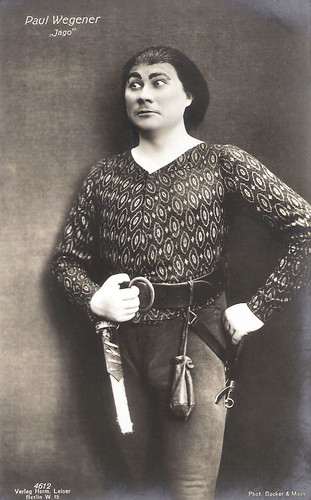
German postcard by Verlag Hermann Leiser, no. 4612. Photo: Becker & Maass. Caption: Paul Wegener as Jago. During the season of 1910-1911, Wegener played Iago in 'Othello' by William Shakespeare. Albert Bassermann appeared in the title role and Max Reinhardt was the director.

Paul Wegener as Macbeth
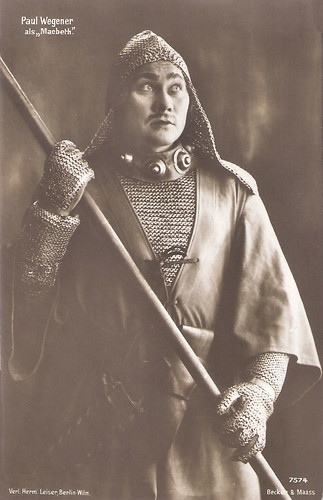
German postcard by Verlag Hermann Leiser, no. 7571. Photo; Becker & Maass. Caption: Paul Wegener as Macbeth. Max Reinhardt directed Paul Wegener in 'Macbeth' in 1916. Reinhardt gave unusual close attention to the psychological motivation of the characters. Reinhardt worked out every tone and gesture for Macbeth and his Lady, played by Hermione Körner. Reinhardt saw Macbeth as a neurotic

Paul Wegener as Macbeth
German postcard by Verlag Hermann Leiser, no. 7574. Photo; Becker & Maass. Caption: Paul Wegener as Macbeth.

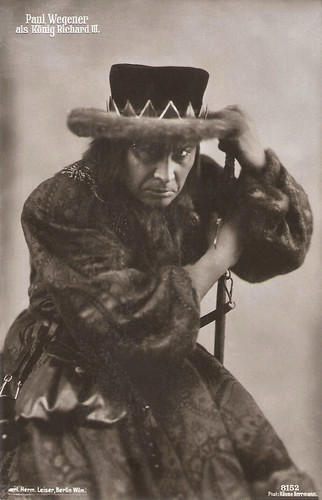
Paul Wegener as König Richard III
German postcard by Verl. Hermann Leiser, Berlin Wilm, no. 8152. Photo: Hänse Hermann. Caption: Paul Wegener as König Richard III.  In 1914, Wegener played the title role in 'Richard III', by William Shakespeare. It was performed at the Theater in der Königgrätzer Straße (Hebbel-Theater).

Paul Wegener as König Richard III
German postcard by Verl. Hermann Leiser, Berlin-Wilm, no. 8501. Photo: Hänse Herrmann. Caption: Paul Wegener as König Richard III. Publicity still for a stage production of 'König Richard III' (Richard III) by William Shakespeare.

Paul Wegener as Othello
German postcard by Verl. Hermann Leiser, Berlin-Wilm, no. 9937. Photo: Fritz Richard. Caption: Paul Wegener as Othello. During the 1917-1918 season, Wegener played the title role in 'Othello' by William Shakespeare under the direction of Max Reinhardt.

Paul Wegener as Othello
German postcard by Verlag Hermann Leiser, no. 9990. Photo: Fritz Richard. Caption: Paul Wegener as Othello.

Sources: Jens Geutebrück (Paul Wegener site), John L. Styan (Max Reinhardt), Stephanie d'Heil (Steffi-Line - German),   The Missing Link, Wikipedia (English and German), and IMDb.

24 August 2018

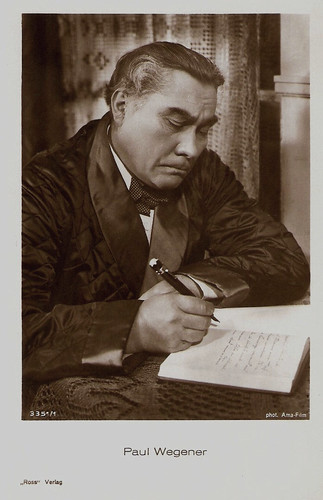
Paul Wegener

German actor, writer and film director Paul Wegener (1874-1948) is one of the true fathers of the horror and fantasy genre. He is particularly remembered for his three silent films centred around the Jewish legend of the Golem. Wegener was one of the pioneers of German cinema who realised the potential of the new medium and used the possibilities of cinematic trick photography as a method for presenting fantastic tales in a serious matter.

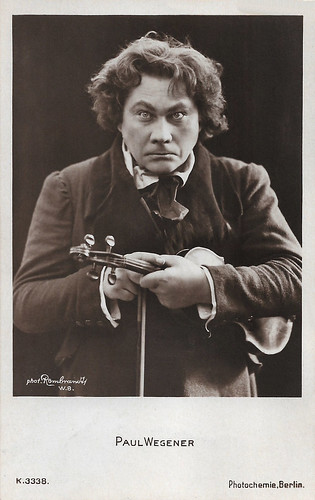
Paul Wegener
German postcard by Photochemie, Berlin, no. K. 3338. Photo: Rembrandt. Probably a publicity still for Der verlorene Schatten/The Lost Shadow (Rochus Gliese, 1921) in which Wegener played Sebaldus, der Stadtmusikant (the city musician).

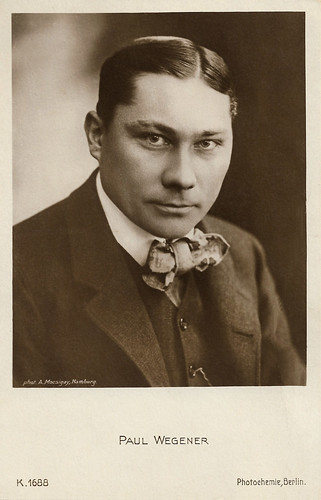
Paul Wegener
German postcard by Photochemie, Berlin, no. K. 1688. Photo: A. Mocsigay, Hamburg.

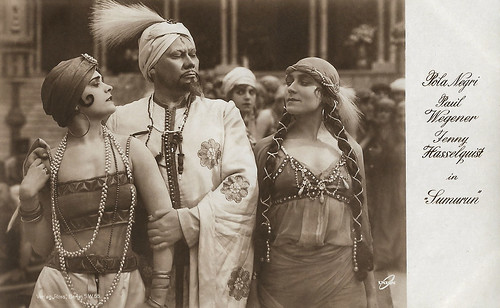
Pola Negri, Paul Wegener and Jenny Hasselquist in Sumurun (1920)
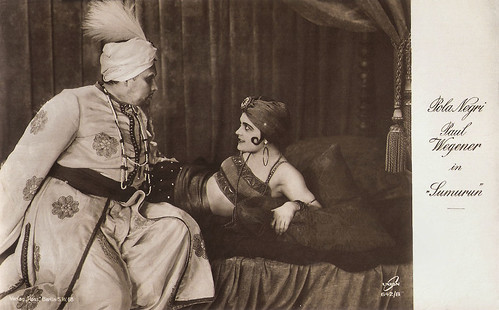
German postcard by Ross Verlag, Berlin. Photo: Union Film. Publicity still for Sumurun (Ernst Lubitsch, 1920) with Pola Negri and Jenny Hasselqvist.

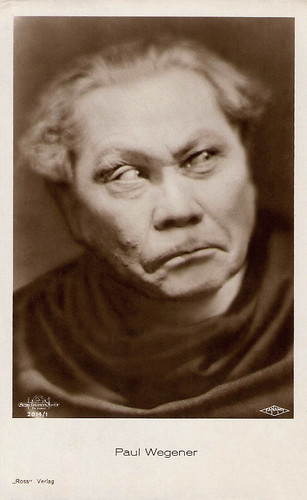
Paul Wegener in The Magician (1926)
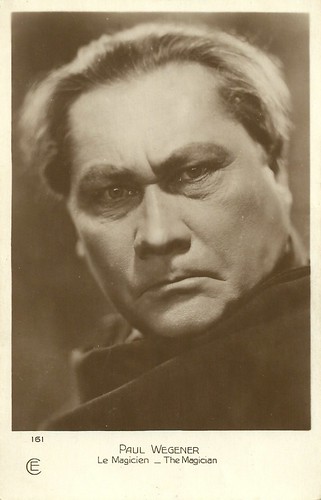
German postcard by Ross Verlag, no. 2014/1, 1927-1928. Photo: Metro-Goldwyn-Mayer (MGM) / FaNaMet. Publicity still for The Magician (Rex Ingram, 1926). The FaNaMet company was one of the cooperations in Europe of the First National Pictures Corporation, Metro-Goldwyn-Mayer company and the Paramount Famous Lasky Cooperation. It was located in Austria and till 1928 in former Yugoslavia. Another cooperation was the ParUfaMet in Germany.

Paul Wegener
German postcard by Ross Verlag, no. 3351/1, 1928-1929. Photo: Ama-Film. Publicity still for Alraune/Mandrake (Henrik Galeen, 1928).

Haunted by the actions of his evil reflection


Paul Wegener was born in 1874 in in the West Prussian village of Arnoldsdorf, Germany (today Jarantowice, Poland) to Anna Wolff and Otto Wegener. He grew up on his father's estate Bischdorf in Ermland before he was sent to Rössel in 1883, and later to Königsberg, to attend secondary school. As a schoolboy Wegener already appeared on stage as an extra at the Königsberger Stadttheater which began his lifelong devotion to the stage.

After finishing school in 1894, he started to study law in Freiburg (Breisgau) and Leipzig but he dropped out of university already one year later to start a career as an actor. He set off for Berlin to make his stage debut at the Stadt Nurnberg. He toured the provinces until he appeared in the film Die Byzantier/The Byzantines (Victor Hahn, 1905). The film's premiere was seen by a talent scout for Max Reinhardt of the Deutschen Theater. Reinhardt himself saw Wegener in a production of Maxim Gorky's The Lower Depths in Hamburg and took him to his distinguished theatre company in Berlin in 1906. There, Wegener became one of the best-known German actors during the following years. He starred in productions of such classic plays as Richard III and Mephisto. But after two years his contract was denied renewal.

Unlike so many other actors of his generation, he openly welcomed the challenge of the new medium of motion pictures. His first film was Der Verführte/The seduced (Max Obal, Stellan Rye, Carl Ludwig Schleich, 1913). He had always enjoyed experimenting with trick photography, particularly the double-exposed ghost effect that visually illustrated the ‘doppelganger’ of German literature. Fascinated that this might be achieved in motion pictures, Paul approached Bioskop Studios where innovative cameraman Guido Seeber claimed it could be done.

Filming began on Der Student von Prag/The Student of Prague (Stellan Rye, Paul Wegener, 1913) in an old section of Prague with interiors shot at Lobkowitz castle. The story had been written by Hanns Heinz Ewers, who was called the successor of Edgar Allan Poe. Der Student von Prag incorporated elements borrowed from both Poe and E.T. Hoffmann to create the tale of the impoverished student Balduin (Paul Wegener) who is offered 100 thousand gold pieces by the mysterious Dr. Scapinelli (John Gottowt) in exchange for his reflection.

Balduin becomes haunted by the actions of his evil reflection, freed from its owner and bent on destroying his life. Double exposure had long been a staple of humorous trick films like those of Georges Méliès, but Wegener used the technology to create a brooding atmosphere in what became one of the first true feature films. The premiere was a roaring success and international critics hailed Der Student von Prag as one of the first artistically important German films.

Paul Wegener
German postcard by Verlag Hermann Leiser, Berlin, no. 1233. Photo: Becker & Maass, Berlin. Publicity still for the play Der Arzt am Scheideweg (The Doctor's Dilemma) by George Bernhard Shaw.

Paul Wegener in König Oedipus (1910)
German postcard by Verlag Hermann Leiser, Berlin, no. 4581a. Photo: Zander & Labisch, Berlin. Paul Wegener in König Oedipus (1910). Tiresias at the palace of Oedipus.

Paul Wegener as Jago
German postcard by Verlag Hermann Leiser, no. 4612. Photo: Becker & Maass. Paul Wegener as Jago in Othello by William Shakespeare.

Paul Wegener as Macbeth
German postcard by Verl. Hermann Leiser, Berlin-Wilm, no. 7574. Photo: Becker & Maass. Publicity still for a stage production of Macbeth by William Shakespeare.

Paul Wegener as König Richard III
German postcard by Verl. Hermann Leiser, Berlin Wilm, no. 8152. Photo: Hänse Hermann. Publicity still for a stage production of König Richard III/Richard III by William Shakespeare.

At the forefront of the world's fantasy film output


Paul Wegener had a sincere interest in folklore and legends. He had first heard the 16th-century Jewish legend of Rabbi Loew and the Golem while making Der Student von Prag on location. Der Golem/The Golem (Henrik Galeen, Paul Wegener, 1915) tells the tale of a clay statue created by Rabbi Loew during the sixteenth century to defend the Jews from the pogrom. In 1915 the statue is magically brought to life again by an antique dealer (Henrik Galeen) but the Golem falls in love with the antique dealer's daughter (Lyda Salmonova).

Paul Wegener played the Golem himself and was well-suited for the part. The over 1.8 m long actor didn't look like a typical German; his face seemed created from stone and his sticking-out cheekbones and narrow eyes let him seem like a Mongolian. His performance and the film itself were a success and firmly established Wegener's reputation. Another of his early films, Der Yoghi (Rochus Gliese, Paul Wegener, 1916), provided him with another ‘doppelganger’ role: the yogi and the young inventor. The film which he also wrote and produced, accommodated three of his interests, trick photography (it was one of the first films to feature invisibility), the supernatural and Eastern mysticism. Sadly, only fragments of this film survive.

In 1917, he made the parody Der Golem und die Tänzerin/The Golem and the Dancer (Rochus Gliese, Paul Wegener, 1917). This film may well be the first horror film sequel ever. A man (Wegener), after seeing Der Golem in a cinema, dresses up as the Golem to frighten a dancing girl (again Lyda Salmanova). All footage of this comedy is believed lost. It was the big-budget epic Der Golem - Wie er in die Welt Kam/The Golem (Carl Boese, Paul Wegener, 1920) which stands now as one of the classics of the German cinema and helped to cement Wegener's place in cinematic history. The cast included formidable actors such as Ernst Deutsch, Albert Steinruck, and Otto Gebühr, and the cameraman was Karl Freund.

The 1920 film is a prequel to the 1914 film, set in 1580 Prague as Rabbi Loew (Albert Steinruck) creates the Clayman to protect the Jewish ghetto from the persecution of Emperor Rudolph II (Otto Gebühr). Brought to life at a time decided by the stars and when the magic word Aemaet is placed in his amulet, the creature saves the community, but the rabbi's assistant (Ernst Deutsch) causes the statue to go on the rampage until it is rendered lifeless by a small child.

Der Golem put Germany at the forefront of the world's fantasy film output. The film ran in New York for ten months. The Golem would later influence the Universal horror cycle of the 1930s. It was an inspiration for director James Whale, whose Frankenstein (1931) was a direct descendant in style and approach. For Universal Karl Freund would photograph Dracula (Tod Browning, 1930) featuring Béla Lugosi, and he also would direct Boris Karloff in The Mummy (1932).

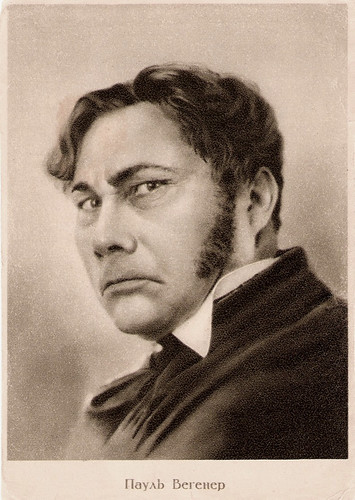
Paul Wegener
Russian postcard, no. 4, 1927.

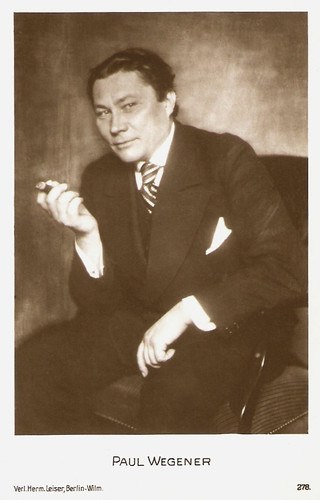
Paul Wegener
German postcard by Verlag Hermann Leiser, Berlin-Wilh., no. 278.

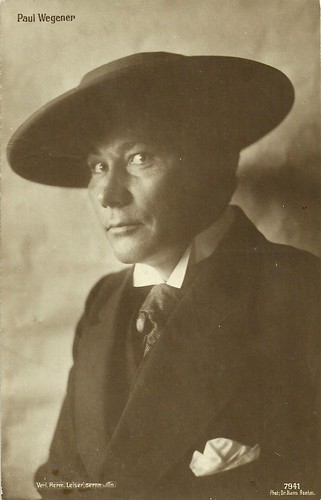
Paul Wegener
German postcard by Verlag Herm. Leiser, Berlin, no. 7941. Photo: Dr. Hans Boehm.

Paul Wegener
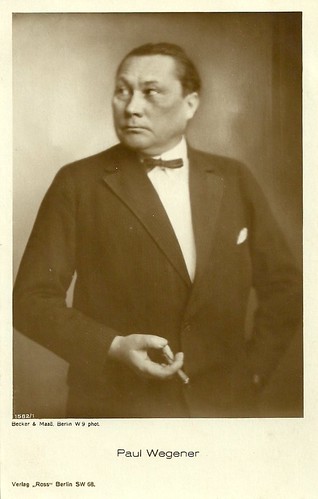
German postcard by Ross Verlag, no. 1582/1, 1927-1928. Photo: Becker & Maass.

Paul Wegener
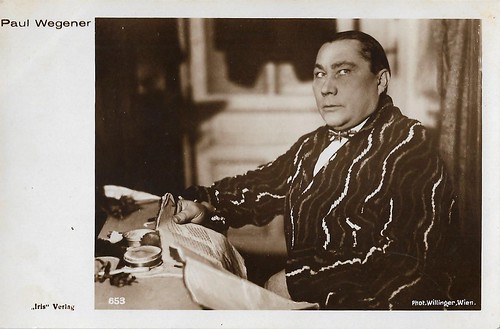
Austrian postcard by Iris Verlag, no. 653. Photo Willinger, Wien/ Vienna. Paul Wegener in his dressing room.

Artificial insemination using the seed of a hanged murderer's corpse


In the following years, Paul Wegener concentrated solely on his acting career. He appeared in the Arabian Nights adventure Sumurun/One Arabian Night (Ernst Lubitsch, 1920) with Pola Negri, and also in Lubitsch's Das Weib des Pharao/Pharoah's Wife (Ernst Lubitsch, 1922) as the King of Ethiopia.

Wegener appeared twice with his favourite film actress Asta Nielsen, first in Steuerman Holk/Helmsman Holk (Rochus Gliese, Ludwig Wolff, 1920) and then in Vanina Vanini/Vanina (Arthur von Gerlach, 1922), in which he portrayed a crippled sadistic governor. In 1922 he also appeared in Lucrezia Borgia/Lucretia Borgia (Richard Oswald, 1922) featuring Liane Haid, and in Monna Vanna (Richard Eichberg, 1922) with Lee Parry, set during the Renaissance.

In 1923 Wegener formed his own company Paul Wegener AG. and invested heavily in a production about one of his primary interests, Buddhism. Although the film was completed it was never released. Wegener's hard work and images never got to be seen and the project left him severely in debt. In 1926 he appeared in his only Hollywood production, The Magician (Rex Ingram, 1926), a gothic melodrama based on the career of ‘black arts’ practitioner Aleister Crowley.

In Germany, he appeared in Svengali (Gennaro Righelli, 1927) as a musician with extra-sensory powers and in Die Weber/The Weavers (Friedrich Zelnik, 1927). The following year he returned to co-writing and acting in Ramper der Tiermensch/Ramper the Beastman (Max Reichmann, 1928) as an Arctic explorer who loses his way in the cold terrain and devolves into a shaggy beast.

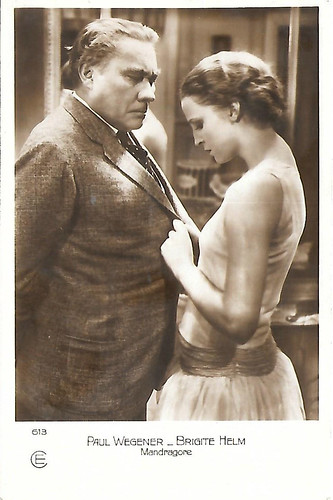
1928 saw another of his key roles: Professor Jakob ten Brinken in the highly erotic and horrific Alraune/Mandrake (Henrik Galeen, 1928). Ten Brinken creates the title character (Brigitte Helm) by artificial insemination using the seed of a hanged murderer's corpse. The result is a woman without a soul who leads all men who fall in love with her to destruction.

Pola Negri in Sumurun
German postcard by Ross Verlag, Berlin. Photo: Union Film. Publicity still for Sumurun (Ernst Lubitsch, 1920) with Paul Wegener and Pola Negri.

Paul Wegener in The Magician (1926)
French postcard by Editions Cinémagazines, no. 161. Paul Wegener in his only Hollywood film, The Magician (Rex Ingram, 1926).

Wilhelm Dieterle and Paul Wegener in Die Weber (1927)
German postcard by Ross Verlag, Berlin, no. 77/4. Photo: Zelnik-Film. Publicity still for Die Weber/The Weavers (Friedrich Zelnik, 1927) with Wilhelm Dieterle.

Paul Wegener and Brigitte Helm in Alraune (1928)
French postcard by CE, no. 613. Photo: publicity still for Alraune/Mandrake (Henrik Galeen, 1928) with Brigitte Helm. Collection: Didier Hanson.

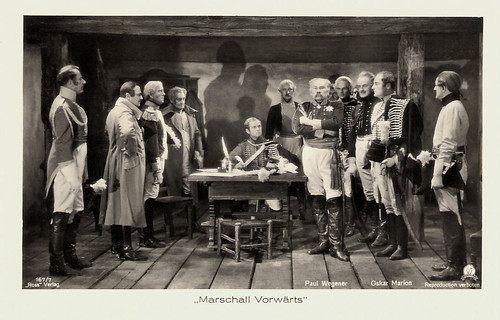
Paul Wegener and Oscar Marion in Marschall Vorwärts (1932)
German postcard by Ross Verlag, no. 167/7. Photo: Biograph-Film. Publicity still for Marschall Vorwärts/Marshall Forward (Heinz Paul, 1932) with Oscar Marion.

Compromised


Paul Wegener made his sound debut in the black comedy/horror film Unheimliche Geschichten/Unholy Tales (Richard Oswald, 1932), in which he took great delight in sending himself up as well as the whole expressionist film genre. He appeared in five tales based on stories by Edgar Allen Poe and Robert Louis Stevenson.

In 1933 the National Socialists took over in Germany and theatre companies were disbanded and many of the actors and directors were arrested, persecuted or exiled. According to Ronald V. Borst on Missing Link, Wegener was a pacifist and was unwanted by the new political power, but Hal Erickson at AllMovie typifies Wegener as ‘a fervent supporter of the Third Reich’. Erickson mentions that Wegener was appointed Actor of the State by German propaganda minister Joseph Goebbels in 1941.

In his 2004 review in Senses of Cinema of the study Paul Wegener - Frühe Moderne im Film by Heide Schönemann, Thomas Elsasser called Wegener's political position during the Nazi era as ‘compromised’.

Between 1933 and 1945, Wegener directed no less than seven feature films, among them Ein Mann will nach Deutschland/A Man Wants to Get to Germany (1934) with Karl Ludwig Diehl, and Der Weg nach Shanghai/Moscow-Shanghai (1936) starring Pola Negri.

He also starred in 20 more films, including such infamous propaganda films as the Horst Wessel glorification, Hans Westmar (Franz Wenzler, 1933, Der Grosse König/The Great King (Veit Harlan, 1942), and the morale booster Kolberg/Burning Hearts (Veit Harlan, 1945) starring Heinrich George. Elsaesser concludes though that describing Wegener as “a convinced Nazi, or even an opportunist fellow-traveller neither captures his philosophy of life”.

Under the Nazis Wegener also continued his work on stage, at the Schillertheater under the direction of Heinrich George and at the Staatliche Bühne in Berlin under Gustaf Gründgens.

After the end of the war, Wegener was permitted by the Soviet occupiers to perform again: he was one of the first to rebuild cultural life in Berlin. Despite ill health, he became president of the Kulturbund zur Erneuerung Deutschlands, an organisation to improve standards for its inhabitants. In September 1945 he reopened the Deutsches Theater with a memorable performance in G.E. Lessing’s Nathan der Weise (Nathan the Wise), according to Elsaesser "German literature's most eloquent plea for multi-ethnic tolerance and religious emancipation".

His last film performances were in Der grosse Mandarin/The Mandarin (Karl-Heinz Stroux, 1949) and Augen der Liebe/Eyes of Love (Alfred Braun, 1951) starring Käthe Gold.

In July 1948 he reprised his role as Nathan at the Deutsches Theater, but in the very first scene he collapsed and the curtain was brought down. Two months later he died in his sleep in Berlin.

Paul Wegener was married six times, twice to actress Lyda Salmonova who was his co-star on several occasions. She became his widow. His other wives were the actresses Änny Hindermann, Ida Ahlers, Elisabeth Rohwer and Greta Schröder.

Paul Wegener, Eugen Klöpfer and Maria Koppenhöfer in Unheimliche Geschichten (1932)
German postcard by Ross Verlag, no. 148/1. Photo: K. Ewald / Oswald-Film /SF. Paul Wegener as the murderer, Eugen Klöpfer as the principal physician and Maria Koppenhöfer as Her Highness in Unheimliche Geschichten/Unholy Tales (Richard Oswald, 1932).

Brigitte Helm and Paul Wegener, Inge und die Millionen (1933)
German collectors card in the series 'Vom Werden deutscher Filmkunst - Der Tonfilm', album no. 11, picture no. 41. Photo: Ufa / Ross Verlag. Brigitte Helm and Paul Wegener in Inge und die Millionen/Inge and the Millions (Erich Engel, 1933).

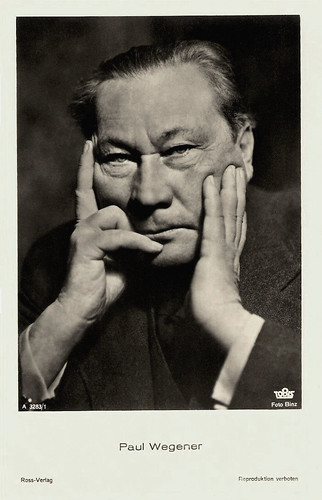
Paul Wegener
German postcard by Ross Verlag, no. A 3283/1, 1941-1944. Photo: Tobis / Binz.

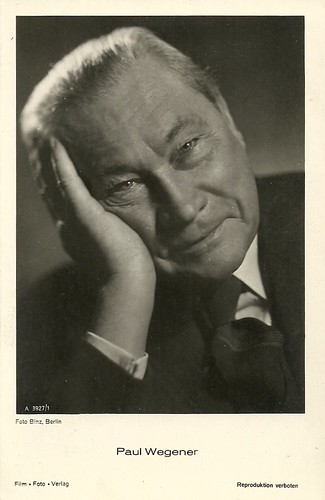
Paul Wegener
German postcard by Film-Foto-Verlag, no. A 3927/1, 1941-1944. Photo: Binz, Berlin.


A scene from Der Golem - Wie er in die Welt Kam (1920). Source: Crvendramini (YouTube).


Rare footage from the lost film Lebende Buddha (1923). Source: Infamous Monsters (YouTube).


Alraune (1928). Source: Olex Melnyk (YouTube).

Sources: Ronald V. Borst (Missing Link), Hal Erickson (AllMovie), Thomas Elsaesser (Senses of Cinema), E.H. (Erick) Larson, Thomas Staedeli (Cyranos), Stephen P. (BBC-h2g2), Filmportal.de, Wikipedia and IMDb..

This post was last updated on 22 October 2022.

04 November 2012

The Choice of Manuel Palomino Arjona

There are many collections of postcards to be found at Flickr. You can spend hours viewing interesting collector's sets. A special collector is Manuel Palomino Arjona from Spain. Under the title Performing Arts / Artes Escénicas, Manuel uploaded some 50,000 pictures of the performing arts: vintage images of dance, music, opera, theatre, magic, circus and also of film. We invited Manuel to select his favourite film star postcards from this huge and incredible treasure. He writes: "I tried to pick cards that were on the borders between the various performing arts and that represent an entire historical era, making it clear that the cinema is just the latest chapter in the history of the performing arts. I've also selected some players who try to escape their historical circumstances, are an exception to the rule, but their 'transcending' underlines their moment in history. After my selection, I noticed that I had no postcards of Alexander Tairov, Orson Welles, Cheryl McCall, Max Carl Adolf von Sydow, nor of Uta Hagen. These words have to fill this gap."
Here's the Choice of Manuel Palomino Arjona:

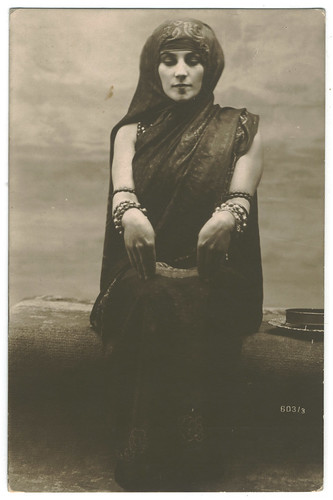
TÓRTOLA VALENCIA, Carmen (danse)_Mass Regis. 603-3
Carmen Tórtola Valencia. Spanish postcard by Mass Regis, no. 603-3.
Manuel: "A tireless traveler, used her exotic dance to hobnob with the intelligentsia of her time. Was Buddhist and vegetarian, was morphine addict, collector of pre-Columbian art, pioneer of women's liberation, republican and Buddhist."

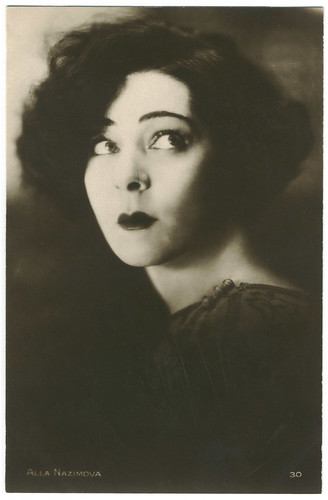
030 Alla Nazimova
Alla Nazimova. Vintage postcard.
"Defeated by a film industry that did not support her innovations. Broke social conventions and scandalized Hollywood. Her projects have a profound intellectual depth."

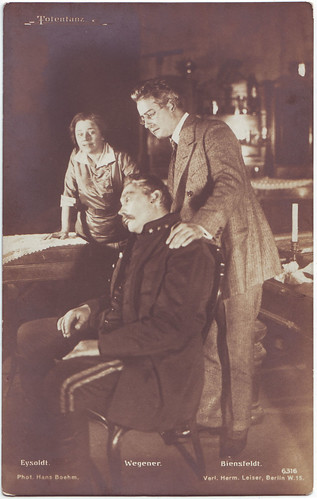
6316 EYSOLDT, Gertrud & WEGENER, Paul & BIENSFELDT, Paul (Totentanz)_Leiser; 6316. Photo Hans Boehm
Totentanz. German postcard by Hermann Leiser. Photo: Deutsches Theatre, Berlin, 27 September 1912. Dir. Max Reinhardt; Edward: Paul Wegener; Alice: Gertrud Eysoldt (or Rosa Bertens on tour to Stockholm); Kurt: Paul Biensfeldt; Design: Gustav Knina.
"Max Reinhardt was an innovator of modern theater, promoter of expressionism. Jewish emigrant because of Nazism, and an acting teacher in Hollywood."

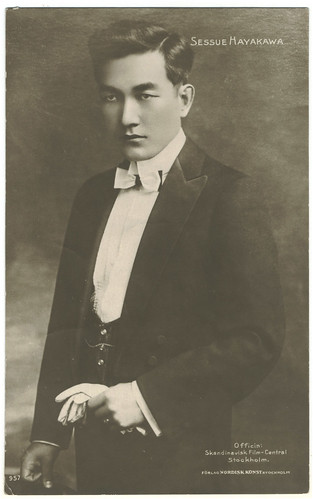
HAYAKAWA, Sessue_Nordsik Konst; 957
Sessue Hayakawa. Swedish postcard by Nordisk Kunst, Sockholm, no. 957.
"A male sex symbol who fell into disgrace and became a supporting actor. Entrepreneur and hedonistic, cultured and refined, rich and extravagant. Committed to his time, at ease among all races and on every continent. A human map we should never forget."

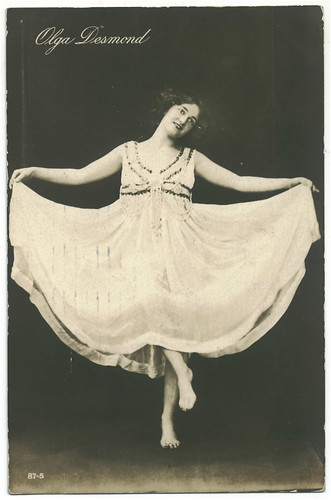
DESMOND, Olga_PG. 87-5
Olga Desmond. Vintage postcard.
"Opened her eyes in Prussia and left us in the GDR. Her nude solo dance provoked the Puritanism of Imperial Russia."

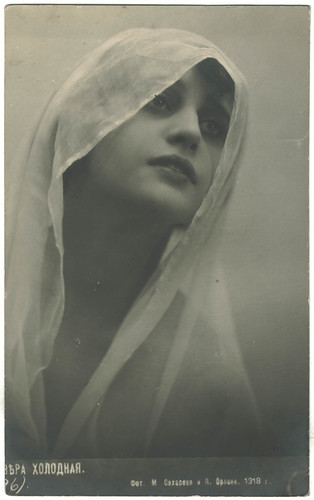
KHOLODNAYA, Vera_Sin datos (1918); 96. Photo M. Sajarova & P. Orlova
Vera Kholodnaya. Vintage postcard, 1918, no. 96. Photo: M. Sajarova & P. Orlova
"She started as a tsarist and ended, reportedly, as a counterrevolutionary. In the 25 years of her life she tasted public success and the artistic directives of the Bolsheviks. Left to us are only a few of her films and her personal greatness."

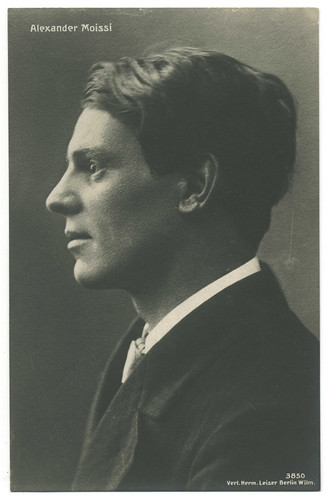
3850 MOISSI, Alexander_Leiser. 3850
Alexander Moissi. German postcard by Hermann Leiser, Berlin-Wilm., no. 3850.
"Stage animal with a melodious speech, did a few silent films. Was not interested in theatre innovations such as Expressionism and epic theater, but his repertoire was exquisite. One of the great."

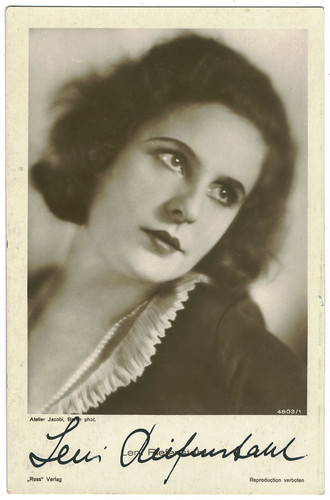
RIEFENSTAHL, Leni_Ross. 4803-1. Photo Jacobi. Signed
Leni Reifenstahl. German postcard by Ross Verlag, no. 4803/1, 1929-1930. Photo: Atelier Jacobi. Signed.
"Her work was reduced to Nazi propaganda, but it changed the documentary genre forever."

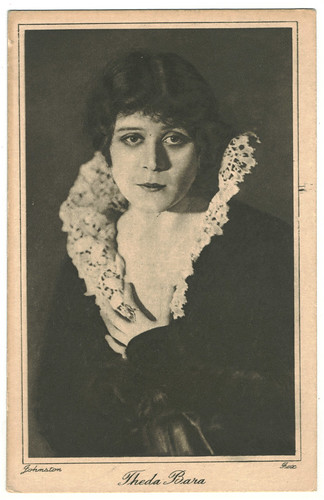
Theda Bara
Theda Bara. British postcard. Photo: Johnston / Fox.
"Turning her into a sex symbol as a vamp gave rise to both film publicity and to Fox."

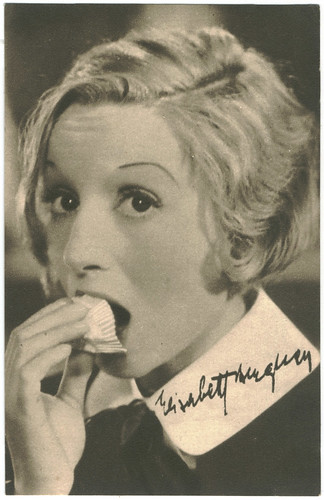
BERGNER, Elisabeth_Real Photogravure (Film Star Bijou Postcards Screen). Editorial Sign
Elisabeth Bergner. British postcard by Real Photogravure (Film Star Bijou Postcards Screen). Editorial Sign.
"Another long living Prussian. She inspired the character of All About Eve."

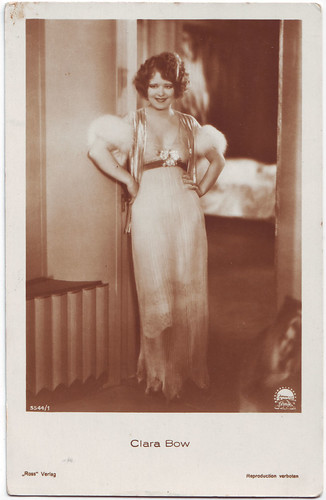
BOW, Clara_Ross; 5544-1. Photo Paramount
Clara Bow. German postcard by Ross Verlag, no. 5544/1, 1930-1931. Photo: Paramount.
"She was born during a heat wave and became the sex symbol of the 1920's. Her strong Brooklyn accent marred her mystical femme fatale aura."

5271 NIELSEN, Asta_Leiser; 5271. In Engeleins Hochzeit
Asta Nielsen. German postcard by Hermann Leiser, no. 5271. Photo: publicity still for Engeleins Hochzeit/Engelein's Wedding (1916, Urban Gad).
"She was the first international film star. She rejected the offer by the Nazis to give her career a boost and decided to help Jews."

Graçias, Manuel!

The Choice of... is an irregularly appearing series. Earlier guests were Egbert Barten, Véronique3, Didier Hanson, Asa, Bunched Undies, and Miss Mertens.