Showing posts with label Enrico Caruso. Show all posts

22 March 2026

Enrico Caruso

Enrico Caruso (1873-1921) was an Italian operatic tenor. He sang to great acclaim at the major opera houses of Europe and the Americas, appearing in a wide variety of roles from the Italian and French repertoires, ranging from the lyric to the dramatic. Between 1908 and 1919, he also appeared in five films.

Enrico Caruso
Italian postcard by Casa Editrice Ballerini & Fratini, Firenze, no. 849.

Enrico Caruso
French postcard by S.I.P. in the Collection Artistique du Vin Désilés. Photo: Alfred Ellis & Walery.

Who sent you to me? God himself?


Enrico Caruso was born in Naples in 1873 into a poor family. He was the third of seven children to a poor alcoholic father. His early life was marked by hardship and a nascent passion for singing that found expression in local churches and on the streets.

Some teachers found his voice untrainable, but he persisted and briefly studied music with conductor Vicenzo Lombardini. His formal training helped shape his natural talent. His professional debut came in 1895 at a back street theatre in Naples. Then followed by years of performing across Italy and beyond, during which he built his repertoire and reputation.

In the summer of 1897, he auditioned for Giacomo Puccini. Puccini was looking for a leading tenor for a performance of 'La Boheme' in Livorno. Puccini was so impressed with the range and tone of the young Caruso's voice that he reportedly mumbled in awe, "Who sent you to me? God himself?" In 1900, he made his debut at La Scala in Milan, a major milestone that sealed his status as one of Italy's most promising talents.

In May 1902, Caruso debuted at the Covent Garden Opera in 'Rigoletto' by Giuseppe Verdi. His first recording contract was also signed in 1902, in London, with the Gramophone and Typewriter Company for ten arias at the rate of 10 pounds per take. It was a decision that would transform both his career and the music industry itself. His 1902 recording of 'Vesti la giubba' from Leoncavallo's 'Pagliacci' became the first record to sell over a million copies, making Caruso a household name and arguably the world’s first recording superstar.

His fame quickly spread across the Atlantic. With the help of the banker Pasquale Simonelli, he went to New York. There, Caruso made his Metropolitan Opera debut in November 1903. Enrico Caruso would reign as the leading tenor of The Met for 18 consecutive seasons, from 1903 until shortly before his death. He made 607 appearances in 37 different operatic productions.

Enrico Caruso
German postcard by Gerlach, no. 5014, distributed in the USA by Breitkopf & Härtel, New York. Photo: Martens.

Enrico Caruso
Italian postcard. Collection: Didier Hanson.

Ventures into the nascent world of cinema


Enrico Caruso’s career at the Metropolitan Opera was the pinnacle of his professional life. He captivated audiences in roles such as Rodolfo in Giacomo Puccini's 'La bohème', Radamès in Giuseppe Verdi's 'Aida', and the Duke in Verdi's 'Rigoletto'.

Steve Shelokhonov at IMDb: "His voice had a combination of the full baritone-like character with the smooth and brilliant tenor qualities. His range was broadened into baritone at the expense of the higher tenor notes. Caruso never sang the high C, and often transposed in order to avoid it." His powerful stage presence was matched only by the commercial success of his recordings, which brought his voice into millions of homes. His unprecedented success made him a wealthy man and a bona fide celebrity, sought after by high society and adored by the public.

Beyond the stage and the recording studio, Caruso ventured into the nascent world of cinema. He appeared in five films during the latter part of his career, leveraging his immense fame to experiment with the new medium. His film career began with a single appearance in a silent documentary, Enrico Caruso (Bruno Zirato, 1918), a short film showcasing the star off-stage.

More significantly, he starred in two fictional silent features for the Famous Players-Lasky Corporation (which would become Paramount Pictures). The first was My Cousin (Edward José, 1918), where he played a dual role: both a celebrated tenor named Tommaso Garnerone and his impoverished, look-alike cousin. This was followed by The Splendid Romance (Edward José, 1919), another dramatic role.

His final two film appearances were in a single release, a short silent film titled Enrico Caruso (Bruno Zirato, 1919), comprising two segments: The Dumb Cavalier (Bruno Zirato, 1919) and The World’s Most Famous Tenor (Bruno Zirato, 1919). These film roles, though few, demonstrated Caruso's willingness to embrace new media and cemented his status as a modern celebrity.

Enrico Caruso
Spanish postcard by Chocolate Amatller, marca Luna, Serie 11, no. 12.

Enrico Caruso, Je crois entendre encore
Vintage 78 rpm record. Enrico Caruso sings 'Je crois entendre' encore from 'Les Pecheurs de perles' (Georges Bizet). His Master's Voice, no. 2-032026 (recorded 7 December 1916 in New York ). The record is only registered on one side, typical for early first records. Hear the song: Je crois entendre encore.

Sending shockwaves around the world


Enrico Caruso’s life was tragically cut short. After falling ill during a performance of 'L'elisir d'amore' in 1920, his health rapidly deteriorated. He had contracted pneumonia and developed a complication in the form of pleural inflammation (pleurisy), followed by abscesses in his lungs. He returned to his native Naples. After a series of unsuccessful surgeries, Enrico Caruso died in 1921 in Naples at the age of 48.

Caruso was the father of Rodolfo Caruso and singer/actor Enrico Caruso Jr., by an earlier relationship with soprano Ada Giachetti, and Gloria Caruso Murray by his marriage to Dorothy Benjamin Caruso.

He was laid to rest in Naples, Italy. His death sent shockwaves around the world, marking the end of an era. Caruso's influence, however, lived on, ensuring his life and voice remained a source of fascination and inspiration, leading to his portrayal in several films long after his death.

The most famous cinematic tribute is the Technicolour MGM musical biography The Great Caruso (Richard Thorpe, 1950). American tenor Mario Lanza starred as Caruso, and the hit film popularised Caruso's story for a new generation. Another film, a dramatic feature closer to home, was the Italian production Caruso, la leggenda di una voce / Caruso, legend of a voice (Giacomo Gentilomo, 1951), starring Ermanno Randi.

A more recent television movie, Caruso (Giacomo Battiato, 1987), also explored his life. He is pictured on a 22¢ US commemorative postage stamp in the Performing Arts series, issued in 1987. Both his pioneering recordings and the biopics that followed ensured that Enrico Caruso's legend never faded.

Mario Lanza in The Great Caruso (1951)
British postcard in the Picturegoer Series, London, no. D 40. Photo: Metro-Goldwyn-Mayer. Mario Lanza in The Great Caruso (Richard Thorpe, 1951).

Mario Lanza in The Great Caruso (1951)
German special issue of Das neue Film-Programm. Photo: MGM. Mario Lanza and Jarmila Novotna in The Great Caruso (Richard Thorpe, 1951).

Sources: Steve Shelokhonov (IMDb), Encyclopaedia Britannica, Wikipedia and IMDb.

02 September 2016

EFSP's Dazzling Dozen: A Night at the Opera

Nowadays, you can enjoy a night at The Metropolitan Opera in New York in your local cinema. In December 2006, The Met started a series of performance transmissions shown live in high definition in cinemas around the world. The series expanded from an initial six transmissions to 10 in the 2014–2015 season and today reaches more than 2,000 venues in 70 countries across six continents. But long before these transmissions started, several opera stars were already very popular in the cinema. Today 12 dazzling postcards of opera performers who also became film stars.

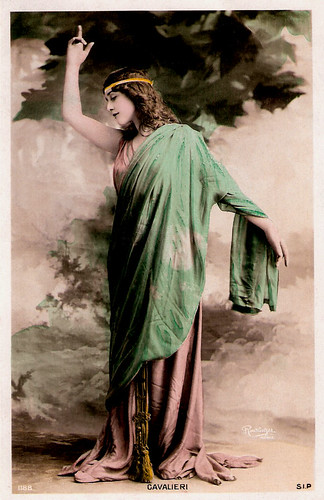
Lina Cavalieri
Lina Cavalieri. French postcard by S.I.P., no. 1188. Sent by mail in 1905. Photo: Reutlinger, Paris.

Around 1900, Italian soprano Lina Cavalieri (1874-1944) was considered the most beautiful woman on earth. In the 1910s, she pursued a career in the silent cinema in Italy and in the United States.

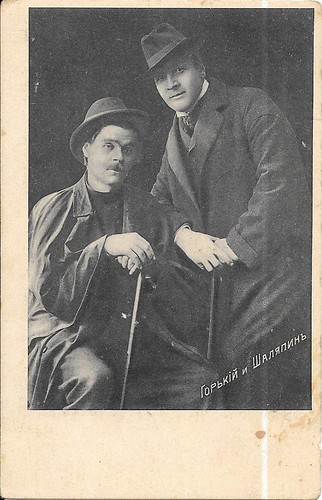
Maxim Gorky and Feodor Chaliapin
Maxim Gorky and Feodor Chaliapin. Russian postcard. Collection: Didier Hanson.

Feodor Ivanovich Chaliapin (Russian: Фёдор Ива́нович Шаля́пин) (1873–1938) was a Russian opera singer. The possessor of a large, deep and expressive bass voice, he enjoyed an important international career at major opera houses and is often credited with establishing the tradition of naturalistic acting in his chosen art form. The only sound film which shows his acting style is Don Quixote (Georg Wilhelm Pabst, 1933). Chaliapin collaborated with novelist Maxim Gorky, who wrote and edited his memoirs, which he published in 1933.

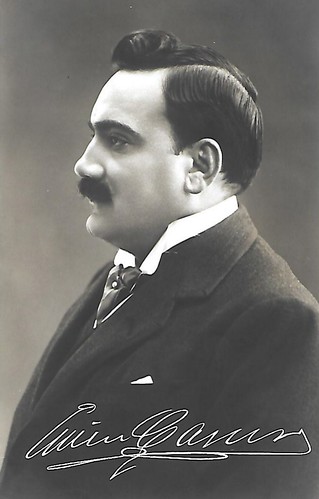
Enrico Caruso
Enrico Caruso. Italian postcard. Collection: Didier Hanson.

Enrico Caruso (1873-1921) was an Italian operatic tenor. He sang to great acclaim at the major opera houses of Europe and the Americas, appearing in a wide variety of roles from the Italian and French repertoires that ranged from the lyric to the dramatic. Between 1908 and 1919 he appeared in five films.

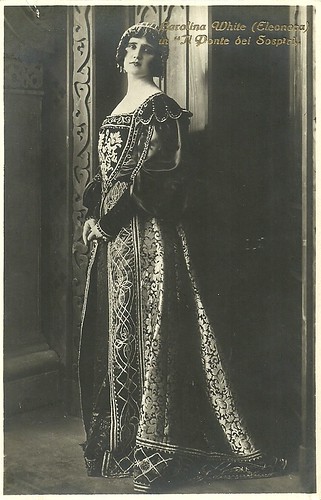
Carolina White in Il ponte dei sospiri
Carolina White. Italian postcard by Ed. G.B. Falci, Milano, no. 56. Photo: La Fotominio. Publicity still for Il ponte dei sospiri (Domenico Gaido, 1921).

American opera singer Carolina White (1885-1961) had a short-lived film career. She played opposite the famous opera singer Enrico Caruso in My Cousin (Edward José, 1918). In 1921 she played the love interest of Luciano Albertini in the 4-part episode film Il ponte dei sospiri, directed by Domenico Gaido, and partly shot on location in Venice. After that White didn't act in film anymore. She died in Rome in 1961.

Geraldine Farrar
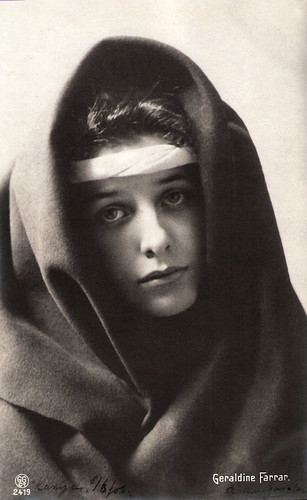
Geraldine Farrar. Dutch postcard by GG Co., no. 2419.

American silent film star Geraldine Farrar (1882-1967) was one of the most famous opera singers of the early twentieth century and one of the great beauties of her day. She had a large following among young women, who were nicknamed 'Gerry-flappers'. From 1915 to 1920, she also starred in more than a dozen films, which were filmed during the then traditional 8 week summer hiatus from the opera house and concert hall. Her films included Cecil B. De Mille's adaptation of Georges Bizet's opera Carmen (1915). One of her most notable screen roles was as Joan of Arc in Joan the Woman (Cecil B. DeMille, 1917).

Richard Tauber
Richard Tauber. Dutch postcard. Photo: Filma Film. Publicity still for Ich glaub nie mehr an eine Frau (Max Reichmann, 1930).

Austrian opera singer Richard Tauber (1891-1948) was one of the world's finest Mozartian tenors of the 20th century. Some critics commented that "his heart felt every word he sang". He also tested the then new talking pictures in such popular musical films as Ich küsse Ihre Hand, Madame (1929) with Marlene Dietrich, Das Land des Lächelns (1930) and Melodie der Liebe (1932).

Willi Domgraf Fassbaender
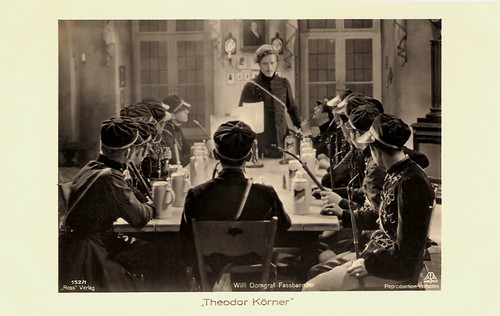
Willi Domgraf Fassbaender. German postcard by Ross Verlag, no. 152/1, 1932. Photo: Aafa Film. Publicity still for Theodor Körner (Carl Boese, 1932).

Celebrated German opera singer Willi Domgraf Fassbaender (1897–1978) was one of the leading lyric baritones of the inter-war period. He was particularly associated with Mozart and Italian roles. ‘The Italian baritone’ starred in the 1930’s in a number of musical films, which helped his shining international reputation.

Gitta Alpar
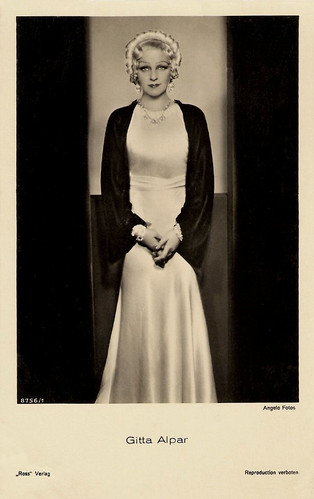
Gitta Alpár. German postcard by Ross Verlag, no. 8756/1, 1933-1934. Photo: Angelo Fotos.

Hungarian-born Gitta Alpár (1903-1991) was a Jewish actress, opera and operetta singer, and dancer, whose career in Germany was broken by the Nazis.

Beniamino Gigli
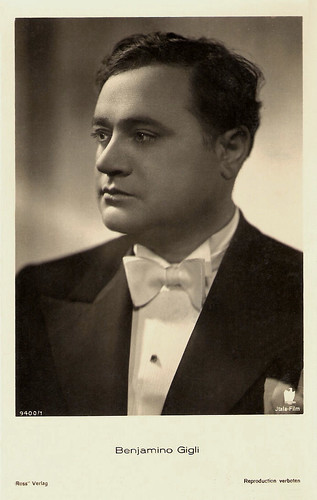
Beniamino Gigli. German postcard by Ross Verlag, no. 9400/1, 1935-1936. Photo: Itala Film.

Actor and opera singer Beniamino Gigli (1890-1957) was one of the most famous Italian tenors, internationally respected for the beauty of his voice and his vocal technique. Between 1935 and 1950, 'Benito Mussolini's favourite singer' also starred in various German and Italian entertainment films.

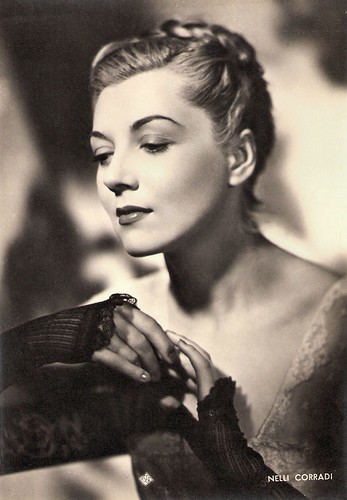
Nelly Corradi
Nelly Corradi. Italian postcard by ASER, no. 173. Photo: De Antonis.

Beautiful Nelly Corradi (1914–1968) was an Italian opera singer and actress. She made her film debut in Max Ophüls’s La signora di tutti (1934) and had her biggest successes after the war with opera films like Lucia di Lammermoor (1946).

Mario Lanza
Mario Lanza. British postcard in the Picturegoer Series, London, no. D 40. Photo: Metro-Goldwyn-Mayer. Publicity still for The Great Caruso (Richard Thorpe, 1951).

Mario Lanza (1921–1959) was an American tenor, actor and Hollywood film star of the late 1940s and the 1950s. His masterpiece was The Great Caruso (Richard Thorpe, 1951), the top-grossing film in the world in 1951. Lanza's voice was so dazzling that an awestruck Arturo Toscanini called it the "voice of the century".

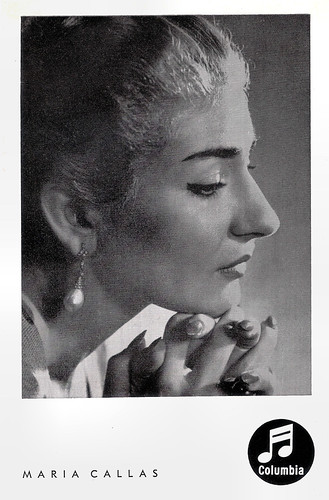
Maria Callas
Maria Callas. German promotion card by Columbia, no. DrW 2946 d. Photo: Angus McBean.

Greek-American soprano Maria Callas (1923–1977) was one of the most renowned and influential opera singers of the 20th century. Many critics praised her bel canto technique, wide-ranging voice and dramatic interpretations. Her repertoire ranged from classical opera seria to the bel canto operas of Donizetti, Bellini and Rossini and further, to the works of Verdi and Puccini; and, in her early career, to the music dramas of Wagner. Her musical and dramatic talents led to her being hailed as La Divina. Her most famous film appearance was the title role in Pier Paolo Pasolini's Medea (1969).

Sources: The Metropolitan Opera, Wikipedia and IMDb.

This is a post for Postcard Friendship Friday, hosted by Beth at the The Best Hearts are Crunchy. You can visit her by clicking on the button below.